Scottish Inventions · Engineering · Card No. 40 of 50
Patrick Bell's Reaping Machine (1828)
The Scottish Invention That Mechanised Harvesting and Led to the Modern Combine Harvester
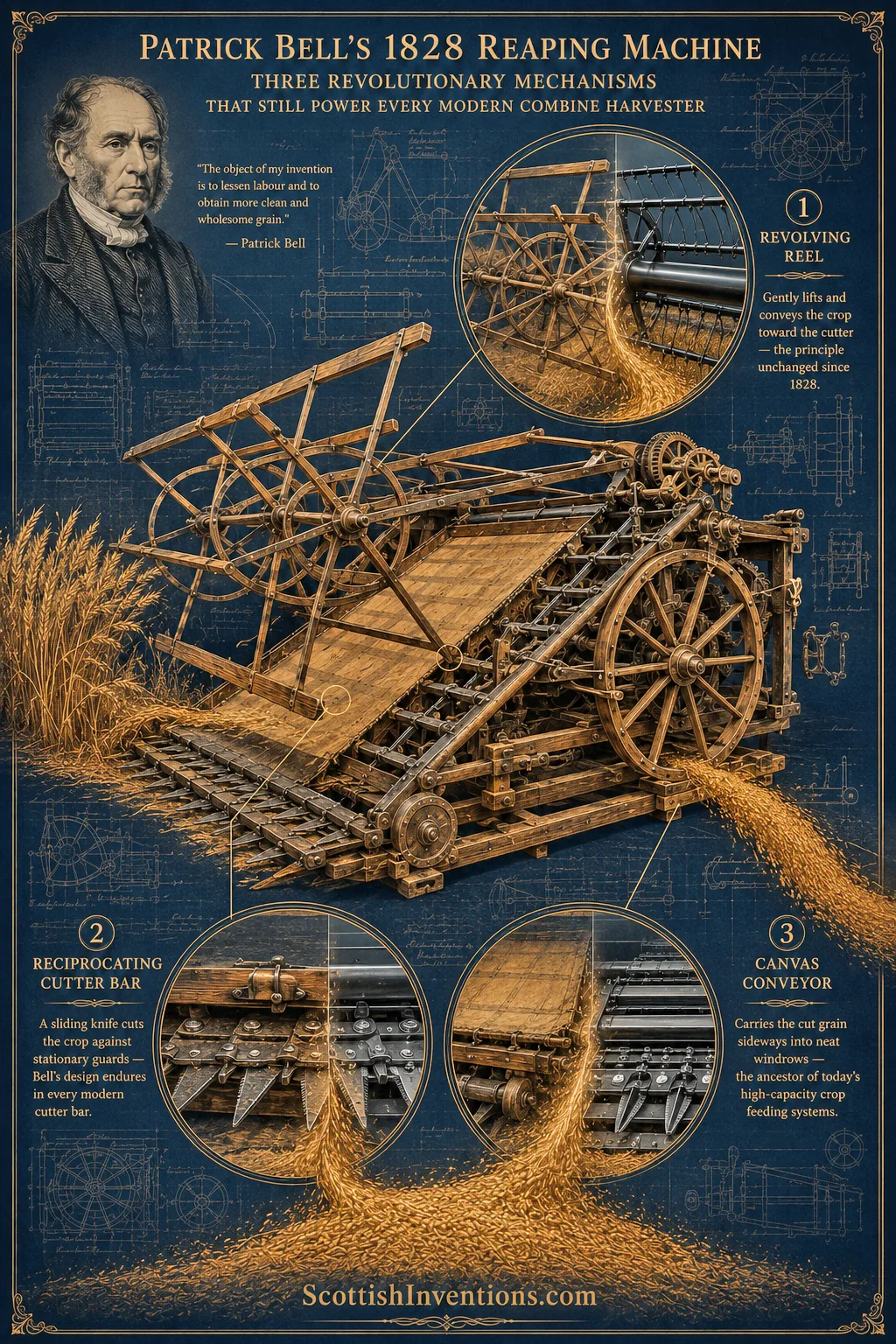
Patrick Bell's revolutionary 1828 mechanical reaper introduced the revolving reel, reciprocating cutter bar and canvas conveyor — three engineering innovations still found in modern combine harvesters.
TL;DR
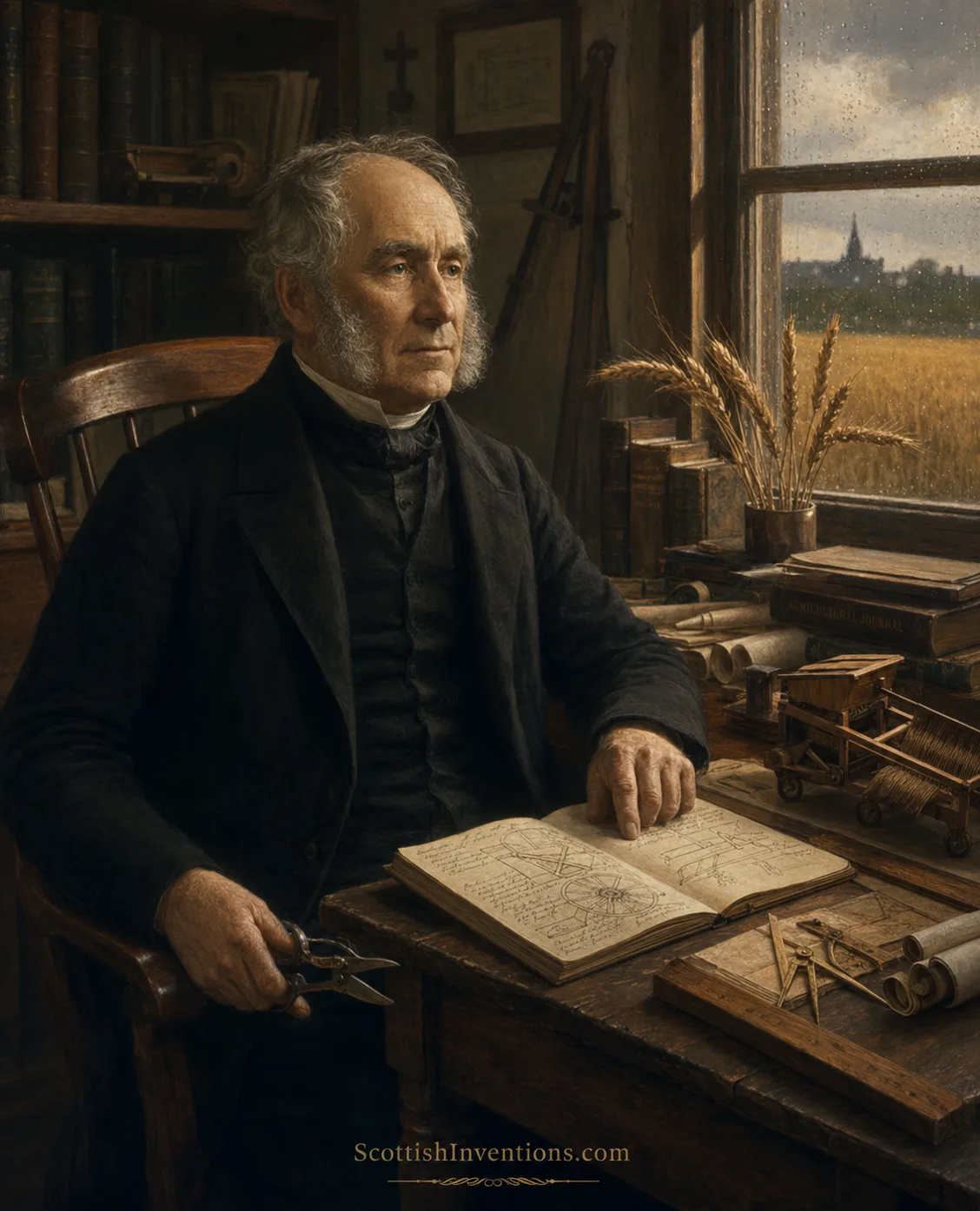
- Reverend Patrick Bell (1799–1869), a farmer's son and divinity student from Angus, built one of the world's first genuinely workable mechanical reapers in 1827–28 — combining the revolving reel, the reciprocating cutter bar and the canvas conveyor, three elements still found in every combine harvester today.
- Bell's machine was cutting Scottish grain several years before Cyrus McCormick's famous American reaper; whether McCormick built on Bell's ideas or arrived at similar features independently remains genuinely disputed, and it was McCormick who commercialised the reaper on a vast scale while Bell — who never patented his invention — made almost nothing.
- Bell's original machine survives in the Science Museum in London; he was belatedly honoured in 1867 with £1,000 and a piece of plate by the Highland and Agricultural Society, and is commemorated by stained-glass windows in Carmyllie Church, the parish he served as minister.
Key Findings
- Bell came first among practical machines, but he was not the first to try. A long line of British inventors attempted mechanical reapers from 1799 onward; nearly all failed in the field. Bell's is widely regarded as the first to work reliably over many successive harvests — one American historian, H. C. Bachman, judged that "in workmanship, this machine was far ahead of any reaper made in America until at least 1847."
- The priority debate is real and should not be overstated. Bell's public trial (1828) preceded McCormick's first test (1831) and patent (1834). Four Bell machines reached America before 1831. But McCormick always insisted his design was essentially different and independently arrived at.
- Bell's machine reaped only. It cut standing grain and laid it in a neat windrow at the side; it did not thresh, and sheaves still had to be bound by hand. Threshing had already been mechanised by fellow Scot Andrew Meikle in the 1780s.
- He never patented it, deliberately. As a man of faith he believed the invention should benefit all mankind — a decision that cost him wealth and allowed inferior copies to damage his machine's reputation.
Patrick Bell at a glance
- Inventor
- Rev. Patrick Bell
- Born
- Auchterhouse, Angus — 12 May 1799
- Died
- Carmyllie, Angus — 22 April 1869
- Invention
- First practical mechanical reaping machine
- Prototype
- Mid Leoch farm, 1827
- First demonstration
- Scotland, 1828
- Award
- £50 premium (1828–29); £1,000 (1867)
- Working rate
- ≈ 1 acre / hour · 12 acres / day
- Original machine
- Science Museum, London (1868-15)
- Legacy
- Reel, cutter bar and conveyor of every modern combine harvester
Early Life in Angus
Patrick Bell was born on 12 May 1799 at Mid Leoch farm, in the parish of Auchterhouse, a few miles north-west of Dundee in Angus (then Forfarshire). (The Dictionary of National Biography gives his birth simply as "April 1799," but 12 May is the date now generally cited.) He was a son of George Bell, the tenant farmer of Mid Leoch, and his wife Margaret Lunan, one of a large farming family.
Bell grew up amid the hard rhythms of the farming year and attended Auchterhouse parish school before working his way to the University of St Andrews, where he studied divinity and took his degree, graduating in 1827. He was, by every account, a man of restless mechanical curiosity: he installed a gas-lighting system at Mid Leoch and experimented with extracting sugar from sugar beet a century before the industry reached Scotland. Between 1833 and 1837 he spent several years in Upper Canada (around Fergus, Ontario), working as a private tutor and bush farmer and keeping detailed journals of the geography and agriculture he observed. Returning to Scotland, he was ordained in the Church of Scotland in 1843 and became minister of the parish of Carmyllie, near Arbroath, a charge he held until his death. He married Jane Lawson.
Inspiration — The Garden-Shears Story
Tradition holds that Bell's inspiration came from a pair of garden shears left stuck in a hedge: he is said to have taken them through a gap and tried them on standing grain, seeing in their scissoring action the principle of a mechanical cutter. This charming story is a staple of popular accounts and should be treated as tradition; the more sober record simply notes that Bell was prompted by seeing the heavy toil of harvest workers on his father's farm. Whatever the true spark, by the summer of 1827 he had a working plan and — in a small outhouse workshop at Mid Leoch — the beginnings of a machine.
Scotland Before Mechanised Harvesting
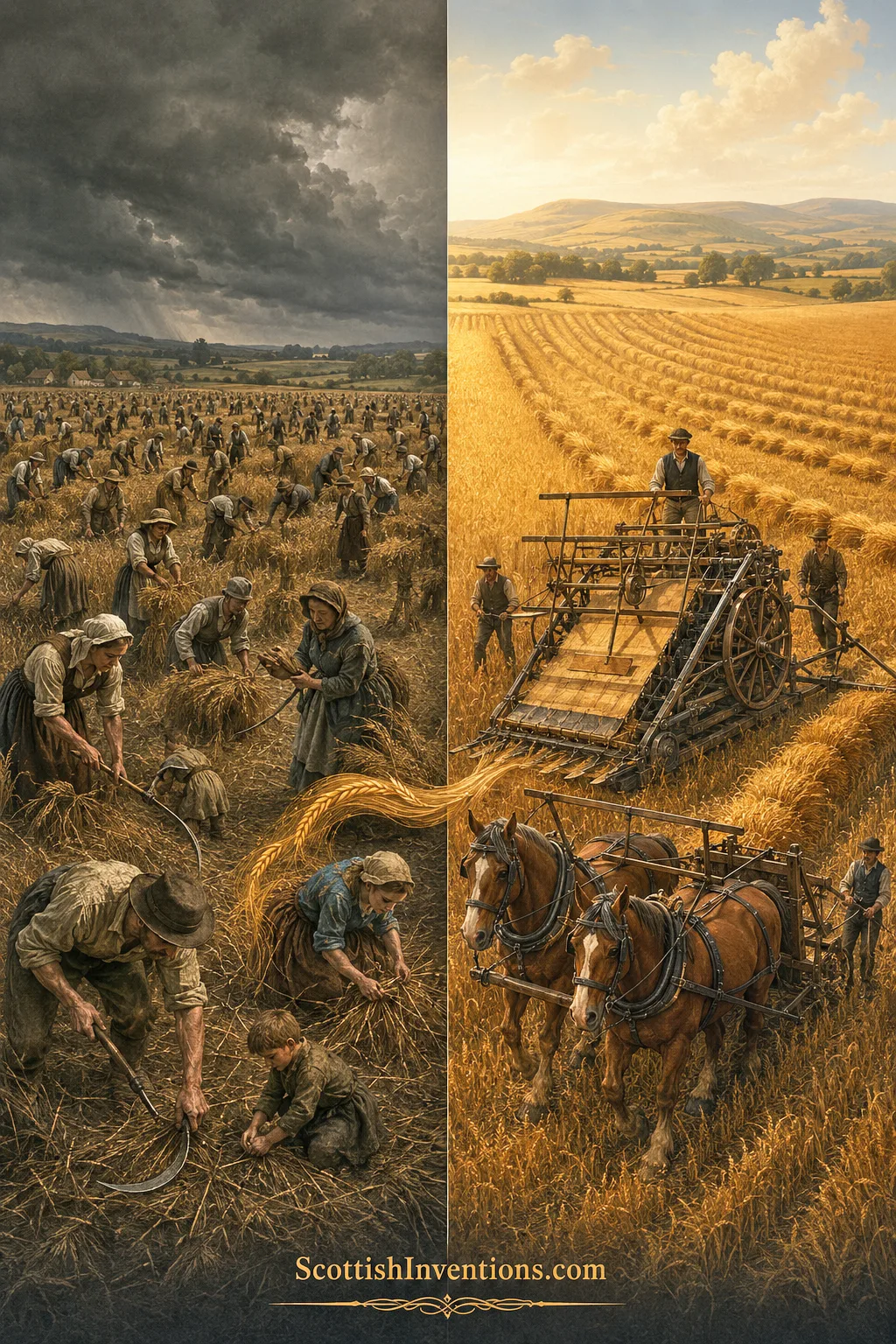
To understand what Bell achieved, picture the early nineteenth-century Scottish harvest. Grain was cut entirely by hand, with the sickle or the scythe, in a punishing race against time. Once a crop ripened, a single autumn storm could flatten and spoil weeks of a farm's work in hours. Harvest therefore demanded huge gangs of labour working flat out in a narrow window — the classic line of men swinging scythes, followed by women and children gathering, binding and stooking. Harvesting had become the last great unmechanised bottleneck of Scotland's agricultural revolution.
Inventors across Britain had been chasing a solution for a generation, spurred by premiums offered by agricultural societies. Joseph Boyce of London took the first reaper patent in 1799–1800; James Plucknett of Deptford tried a revolving circular blade around 1805; Gladstone of Castle Douglas patented a front-draught machine in 1806; there were machines by Salmon of Woburn (1807), James Smith of Deanston (c.1811–14), Alexander Scott of Ormiston (1815), Mann of Cumberland (c.1820), and — crucially — Henry Ogle and the Brown foundry at Alnwick, who around 1822 produced the first reciprocating knife-bar. John Common of Denwick in Northumberland built a genuinely promising machine around 1812. Yet, as the historical record makes plain, it is believed that scarcely one of these early reapers was ever worked through a full harvest; their real capabilities were never properly tested, and most collapsed into disuse.
A word of caution on one Scottish claim: Michael Stirling of Dunblane is sometimes invoked as an earlier inventor, but his device — attributed to the 1750s and known only from a later sworn family statement — was a rotary threshing machine, not a reaper, and remains unverified in any published record of its own time. It does not represent a working mechanical reaper before Bell.
The Bell Reaper
Three Innovations That Changed Farming Forever
The Invention (1827–1828)
Working largely in secret in an outhouse workshop at Mid Leoch — reportedly fearing ridicule — Bell built a model in 1827 and then, with the help of a local carpenter and blacksmith, a full-scale machine. He is said to have spread earth on the floor of his shed and "planted" cut stalks to test the cutter indoors before daring a field. The best-known episode is the secret night trial: Bell and his brother slipped out to a field of wheat around eleven o'clock at night with "the good horse, Jock" yoked to the machine, whispering in case anyone should discover them. This account descends from Bell's own narrative, published in the Journal of Agriculture in 1854.
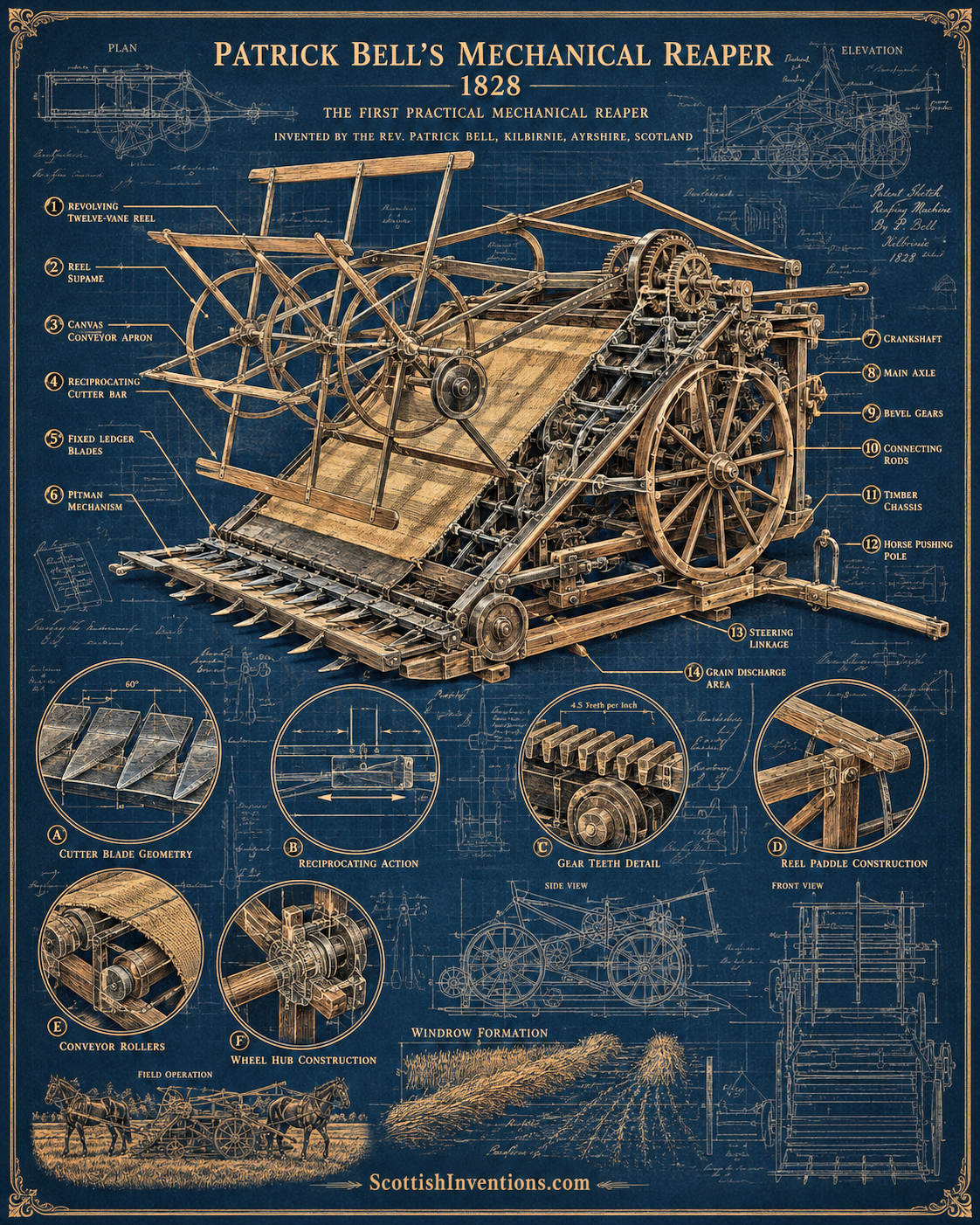
The machine Bell created brought together three ideas into a working whole:
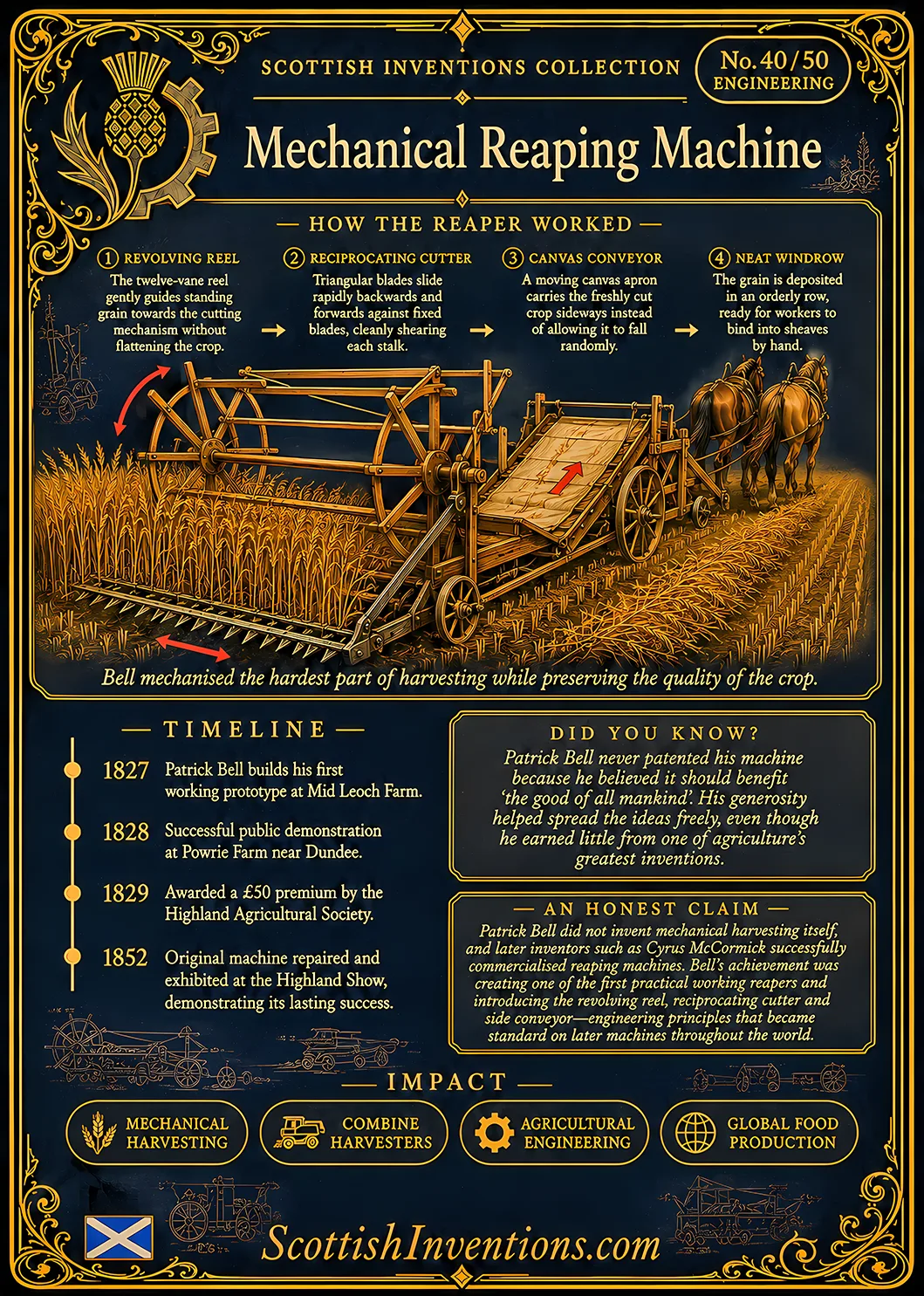
- A revolving reel — a twelve-vane frame at the front that gathered the standing crop and pressed it back against the cutter (contemporary descriptions record "a revolving 12 vane reel to pull the crop over the cutting knife").
- A reciprocating cutter bar — originally a row of scissor- or shear-type blades, "triangular reciprocating blades over fixed triangular blades," that sheared the stalks with a side-to-side motion, exactly like mechanised shears.
- A canvas conveyor (apron) — which caught the cut grain and carried it to one side, laying it in a tidy windrow clear of the machine.
Cleverly, the whole apparatus was pushed by two horses walking behind it, so the animals trod only on already-cut stubble rather than trampling the standing crop. According to the Science Museum Group's record for the original machine, "the reaper was propelled by two horses walking behind it and pushing the machine through collars harnessed to a pole and cut, on average, one acre per hour." Bell's own long-run figures, based on fourteen years' experience, put a full working day at about 12 imperial acres, using the machine plus a supporting crew of around fourteen labourers.
Critically, the machine only reaped. It cut the grain and delivered it into a windrow — but the crop still had to be gathered, bound into sheaves and stooked by hand, and threshing (separating grain from straw) remained an entirely separate operation, one that fellow Scot Andrew Meikle had already mechanised in the 1780s.
The First Public Demonstration (1828)
Bell's machine was demonstrated publicly in 1828 and reported with approval. It is important to be precise here, because the popular record and the scholarly record diverge. Many websites and a widely reprinted 2008 Dundee Courier article state that the first public trial took place at Powrie Farm near Dundee on 10 September 1828. However, this exact date and location appear only in popular sources; the scholarly account — Professor James Hendrick's 1928 centenary paper for the Highland and Agricultural Society, as transcribed by Lawrence Melville — places the secret night trial and early use at Bell's father's farm, Mid Leoch, with later use at his brother George's farm at South Inchmichael. The safest statement is that the machine was working and being publicly shown in 1828; the precise "10 September at Powrie" detail should be treated as tradition rather than established fact.
What is firmly documented is the reception. Bell's own "Description and plate of a new reaping machine" appeared in the Quarterly Journal of Agriculture (Volume 1, 1828–29, pp. 217–219), edited by David Low, followed by a further notice of the machine in the same volume (pp. 331–332). And the Highland and Agricultural Society of Scotland awarded Bell a premium of £50 in the 1828–29 session — an honour, though it barely covered his costs; a working model was afterwards placed in the Society's museum.
In the following years a number of machines were built to Bell's design and used in east-central Scotland, chiefly manufactured in and around Dundee. As the Science Museum Group summarises, "only a small number of these machines were constructed, and the extent of Bell's influence has been controversial. Four were exported to the USA before 1831." Others were reportedly exported to Australia and Poland.
1828
Public demonstrations
One Acre
Per hour
3
Core innovations still used today
Why Bell Did Not Patent
Bell deliberately declined to patent his reaper. As a devout man — and later a minister — he held that his invention should be freely available for the good of all mankind. It was a decision of genuine principle, and it had two lasting consequences. First, Bell earned almost nothing from a machine that helped transform world agriculture. Second, without patent control he could not police the quality of imitations: inferior copies appeared, and, coupled with the machine's real weaknesses (a heavy draught and a delivery web liable to disorder, and shears that clogged in damp or weedy grain), they did little to encourage widespread adoption.
"Like a child prematurely born, it came into the world before the agriculture community were ready to welcome it."
Bell seems to have regarded his mechanical work as secondary to his ministry, and by contemporary accounts remained serenely unaffected by the later clamour over his invention.
Bell versus McCormick — The Priority Question
This is where accuracy matters most, and where myth most often creeps in. The honest picture is as follows.
Bell's machine was designed around 1826, modelled in 1827 and publicly working in 1828. In America, Cyrus McCormick first tested a reaper on a neighbour's Virginia farm in 1831 and received his US patent on 21 June 1834; Obed Hussey, his great rival, had patented his own reaper slightly earlier, on 31 December 1833; and William Manning had received a US reaper patent on 3 May 1831. On the simple question of "who had a working machine first," Bell clearly precedes all of them by several years.
The harder question is influence. Four Bell machines are documented as having reached the United States before 1831, and Scottish and British commentators of the 1850s argued forcefully that American reapers were "based upon the same principle... the CUTTER — in Bell's," and that the imported machines "became the models from which the... American reapers have since sprung." McCormick himself flatly rejected this. In an 1852 letter to Scientific American he insisted his reaper was "essentially and entirely different" from Bell's, pointing to real distinctions: McCormick used a sickle-type cutter (not Bell's scissors), his platform was fixed with a man raking off the cut grain (not Bell's moving canvas apron), and his machine was drawn behind the horses rather than pushed in front. Whether McCormick knew of Bell's design when developing his own is not established; he maintained he did not.
Complicating any tidy "Scotland beat America" story, the Dictionary of National Biography itself concluded that John Common of Denwick — not Bell — was arguably first to embody "the essential principles of the modern reaper," stating that "it has... been ascertained, with tolerable certainty, that John Common, of Denwick, was the first to produce a machine having the essential principles of the modern reaper. This was done in 1812... There is also evidence to show that Common's machine was really the original of that brought out by McCormick."
The 1851 Great Exhibition sharpened the rivalry rather than settling it. There, American reapers by McCormick and Hussey caused a sensation. In field trials McCormick's machine performed impressively while Hussey's faltered, and McCormick was awarded the exhibition's Council Medal — the recognition that made his machine world-famous. Bell's own machine was not the star of 1851; a version was, however, refurbished and shown at the Highland Show at Perth in 1852, where it was thought by some to be a new machine on the market. Around 1850 the Yorkshire manufacturer William Crosskill also put Bell's design into wider production as "Crosskill's Bell" reaper.
Legacy and Recognition
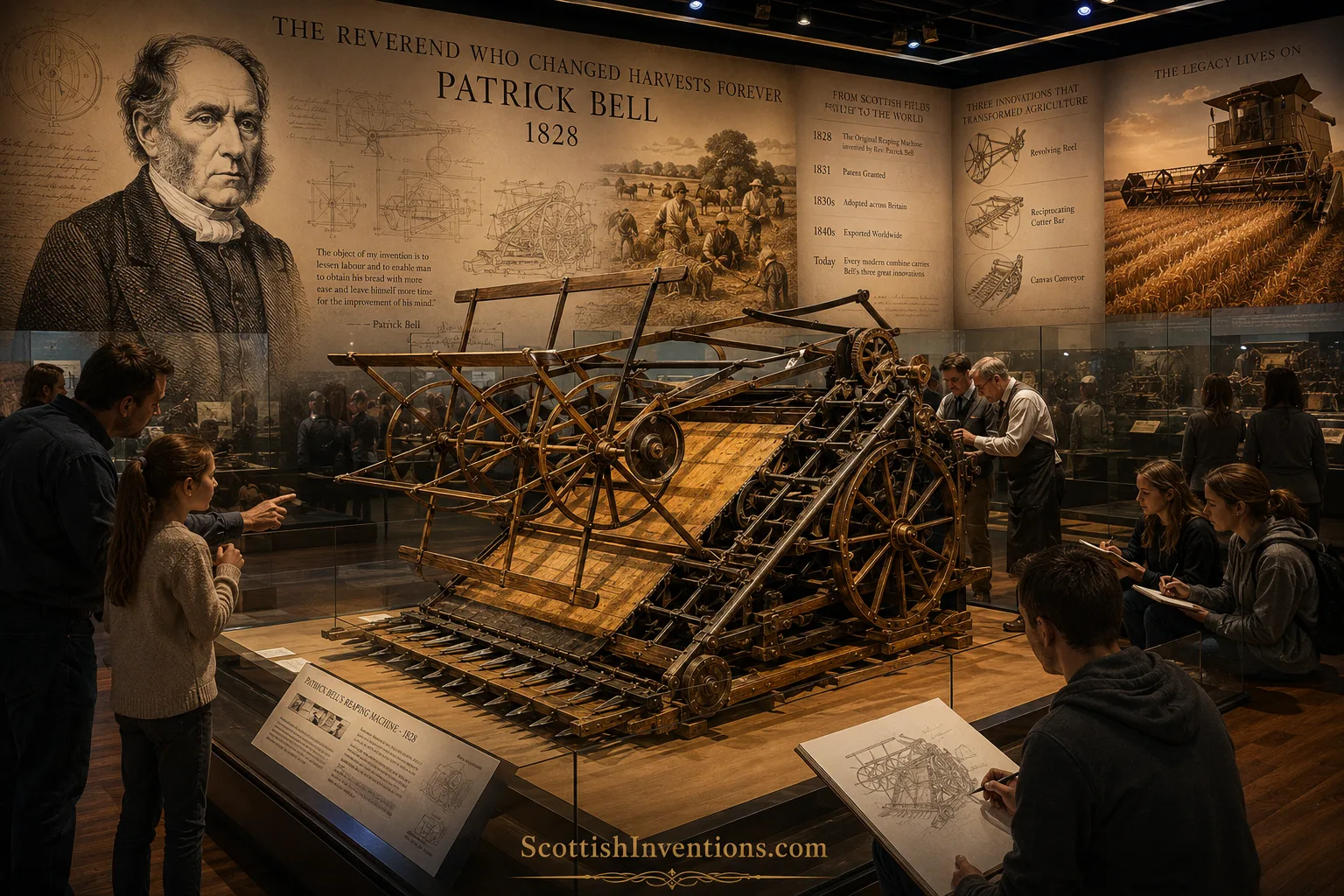
Bell's original reaping machine survives today in the Science Museum in London. Fastidiously kept by his brother, it was, in the words of the Dictionary of National Biography, "worked regularly from the time of its first construction until about 1868, when it was purchased for the museum of the Patent Office," and it carries the Science Museum object number 1868-15. It is the actual machine rather than a replica, though it was modified during its long working life — notably, its original scissor-type cutter was replaced by a reciprocating knife mechanism. A contemporary example or model is held by the National Museum of Rural Life at Wester Kittochside, East Kilbride, and Bell's own 1:48 brass scale model is also in the national collections (catalogued as inv. 1868-14/1).
Recognition came late but genuinely. Bell gave a full account of his invention at the meeting of the British Association at Dundee in 1867, and, per the Science Museum Group, "in 1867, two years before his death, he was awarded a £1000 prize by the Highland and Agricultural Society of Scotland" — presented, Grace's Guide adds, together with "a piece of plate, subscribed for by the farmers of Scotland and others." (Some sources date the presentation to a General Meeting in January 1868.) He also received an honorary doctorate. Bell died at the manse in Carmyllie on 22 April 1869. Two stained-glass windows in Carmyllie Church commemorate the minister-inventor.
From Reaper to Combine Harvester
Bell's real legacy is technological. The three elements he brought together — the revolving reel, the reciprocating cutter bar, and the side-delivery canvas conveyor — became standard fixtures of the machines that followed. From the simple reaper the technology evolved step by step: the self-raking reaper, which mechanically swept the cut grain off; the reaper-binder (from the 1870s, developed by William Deering and others), which added automatic binding of sheaves; and finally the combine harvester, which folded in threshing so that a single machine cuts, threshes and cleans grain in one pass. American and Australian inventors — Hiram Moore and John Hascall in Michigan in the 1830s, and later Hugh Victor McKay in Australia — drove the combine's development, but the cutting front-end of every one of those machines descends conceptually from the reel-and-cutter arrangement Bell demonstrated.
Here the second great Scottish contribution comes in. Threshing had already been mechanised by Andrew Meikle, whose threshing machine of the 1780s is itself a landmark of the agricultural revolution. Bell's reaper and Meikle's thresher are, in effect, the two mechanical halves that the modern combine eventually united — a neat double contribution from Scottish invention, though the combine as a complete machine was developed largely in America and Australia across the following century.
| Patrick Bell (1828) | Modern Combine Harvester |
|---|---|
| Revolving reel | Modern reel (same principle) |
| Reciprocating cutter bar | Hydraulic reciprocating cutter bar |
| Canvas conveyor apron | Crop feed conveyor to threshing drum |
| Two horses pushing behind | Diesel engine, self-propelled |
| Reaped only — hand binding & threshing separately | Reaps + threshes + cleans in one pass |
Timeline
12 May 1799
Born at Mid Leoch farm
Patrick Bell born in the parish of Auchterhouse, Angus, son of the tenant farmer George Bell and Margaret Lunan.
1827
First working model
Working largely in secret in an outhouse workshop at Mid Leoch, Bell builds a full-scale prototype with the help of a local carpenter and blacksmith.
1827
Divinity degree, St Andrews
Graduates from the University of St Andrews, having devised the reaper as a theological student.
1828
First public demonstration
The machine is publicly demonstrated in east-central Scotland and reported with approval in the Quarterly Journal of Agriculture.
1828–29
£50 premium awarded
The Highland and Agricultural Society of Scotland awards Bell a £50 premium; a working model is placed in the Society's museum.
Before 1831
Four machines exported to America
A small number of Bell reapers reach the United States — years before Cyrus McCormick's first test in 1831.
1833–1837
Upper Canada
Bell spends several years around Fergus, Ontario, working as a tutor and bush farmer while keeping detailed journals of North American agriculture.
1843
Ordained in the Church of Scotland
Becomes minister of the parish of Carmyllie, near Arbroath — a charge he holds until his death.
c.1850
'Crosskill's Bell' reapers
Yorkshire manufacturer William Crosskill puts Bell's design into wider production, and a refurbished machine is shown at the Highland Show at Perth in 1852.
1867
£1,000 and a piece of plate
The Highland and Agricultural Society of Scotland formally honours Bell with £1,000, a piece of plate subscribed by Scottish farmers, and an honorary doctorate.
22 April 1869
Died at Carmyllie manse
Bell dies as minister of Carmyllie; two stained-glass windows in Carmyllie Church commemorate the minister-inventor.
Today
Science Museum, London
The original 1828 machine (object 1868-15) survives in the Science Museum, London — arguably the most important surviving agricultural machine of the Industrial Revolution.
Key Takeaways
Bell's Three Enduring Innovations
- The revolving reel — Bell's twelve-vane frame is the direct ancestor of the reel on every modern combine.
- The reciprocating cutter bar — his sliding blade against fixed guards is still the standard cutter geometry on combines and mowers worldwide.
- The canvas conveyor — the moving apron that carried Bell's cut grain sideways lives on as the crop feed conveyor in every combine harvester on Earth.
"The object of my invention is to lessen labour and to obtain more clean and wholesome grain." — Patrick Bell
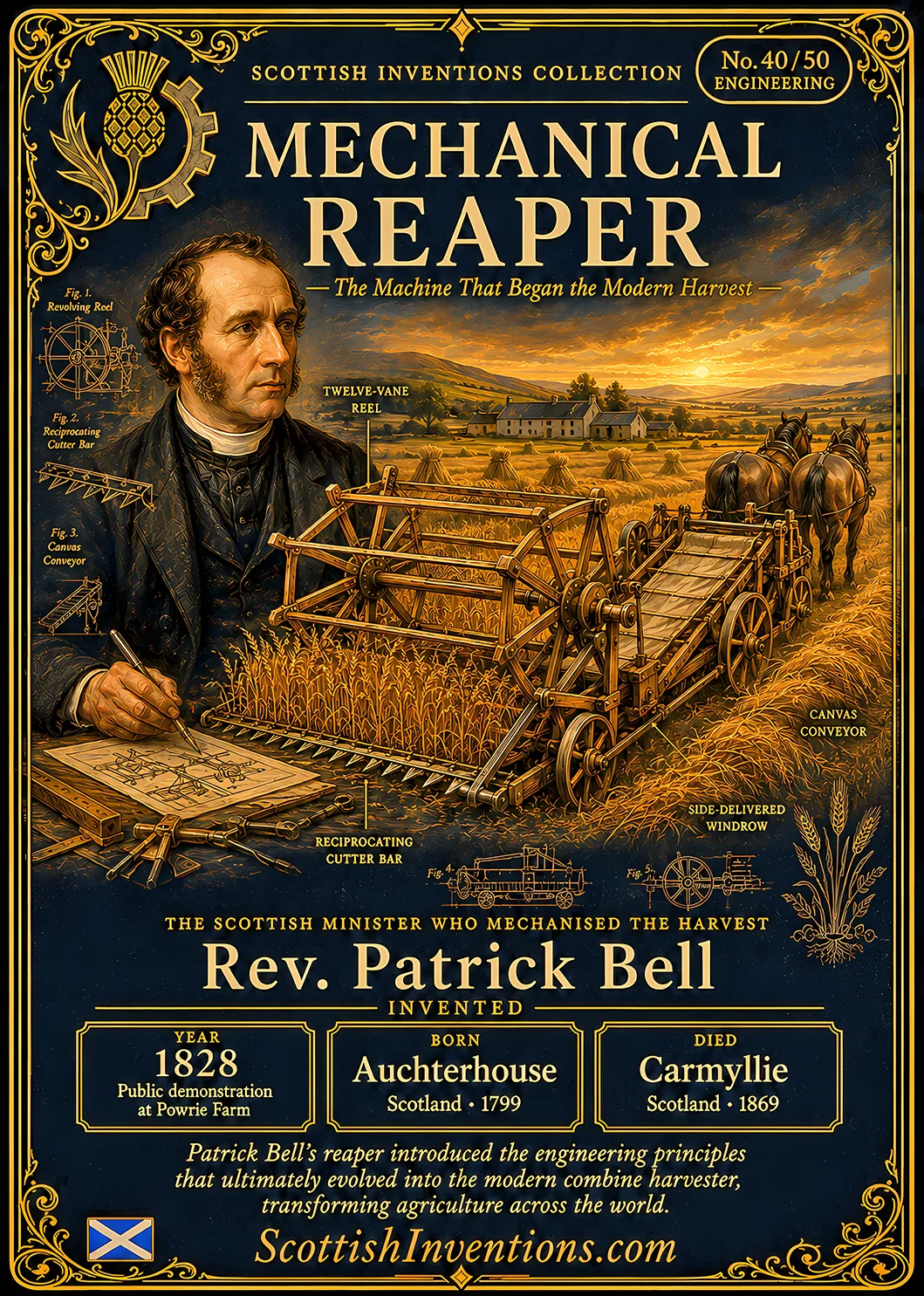
The Mechanical Reaping Machine trading card
Card No. 40 of 50 in the Scottish Inventions Collection.
Frequently Asked Questions
- Who invented the mechanical reaper?
- The Rev. Patrick Bell (1799–1869), a farmer's son and divinity student from Angus, Scotland, invented the first genuinely practical mechanical reaping machine in 1827–1828 at Mid Leoch farm near Auchterhouse. Earlier British inventors — Joseph Boyce (1799), John Common of Denwick (1812), Henry Ogle (c.1822) and others — had attempted mechanical reapers, but Bell's is widely regarded as the first to work reliably over successive harvests.
- Was Patrick Bell before McCormick?
- Yes. Bell's machine was modelled in 1827 and publicly working in 1828. In America, Cyrus McCormick first tested a reaper in 1831 and patented it on 21 June 1834. Four Bell machines are documented as reaching the United States before 1831. However, McCormick always insisted his own design was independently arrived at and 'essentially and entirely different' from Bell's, and the priority-of-influence question is genuinely disputed.
- What did Patrick Bell invent?
- Bell invented the first practical mechanical reaping machine — a horse-pushed field machine that combined three ingenious mechanisms into a working whole: a revolving twelve-vane reel that gathered the standing crop, a reciprocating scissor-type cutter bar that sheared the stalks, and a canvas conveyor apron that carried the cut grain sideways into a neat windrow. These three principles are still found in every combine harvester in the world today.
- Why is Patrick Bell important?
- Bell mechanised the last great unmechanised bottleneck of the agricultural revolution — the harvest itself. His machine cut about one acre per hour and could work up to twelve imperial acres in a full working day with a supporting crew, replacing gangs of workers wielding sickles and scythes. The engineering principles he introduced went on to shape modern farming worldwide, ultimately underpinning the combine harvester that feeds much of humanity.
- How did Patrick Bell's machine work?
- Two horses walked behind the machine, pushing it through collars harnessed to a pole so the animals trod only on the already-cut stubble. As the machine advanced, its revolving twelve-vane reel pressed the standing grain back against a reciprocating triangular-bladed cutter that sheared the stalks like giant shears. The cut crop fell onto a moving canvas conveyor apron that carried it sideways and deposited it in a neat windrow beside the machine, ready for workers to bind by hand.
- What parts of Bell's machine are still used today?
- All three of Bell's core mechanisms survive in every modern combine harvester. The revolving reel still gathers the crop toward the cutter. The reciprocating cutter bar — Bell's sliding knife against fixed guards — is still the standard cutter geometry on combines and mowers. The canvas conveyor lives on as the crop feed conveyor that carries cut grain into the threshing drum. Only the horse power (now a diesel engine) and the separate hand binding have gone.
- Where is Patrick Bell's original machine?
- Bell's original 1828 reaping machine survives in the Science Museum in London (object number 1868-15). It was purchased for the Patent Office Museum in 1868 after working regularly on Scottish farms for four decades. A related contemporary example is held at the National Museum of Rural Life at Wester Kittochside, East Kilbride, and Bell's own 1:48 brass scale model is also in the national collections (inv. 1868-14/1).
- Did Patrick Bell patent his invention?
- No — deliberately. As a devout man, and later a Church of Scotland minister, Bell believed his invention should be freely available for the good of all mankind. The decision cost him fortune: he earned almost nothing from a machine that helped transform world agriculture, and without patent control he could not police inferior copies that damaged his machine's reputation. Recognition finally came in 1867, two years before his death, when the Highland and Agricultural Society of Scotland awarded him £1,000 and a piece of plate subscribed for by Scottish farmers.
- What is the difference between a reaper and a combine harvester?
- A reaper — like Bell's — only cuts the standing grain and lays it in a windrow; the crop still has to be gathered, bound into sheaves and threshed (grain separated from straw) in separate operations. A combine harvester 'combines' cutting, threshing and cleaning into a single machine that walks through the field and delivers clean grain. The combine, largely developed in America and Australia across the following century, unites Bell's reaper with the threshing principle already mechanised by fellow Scot Andrew Meikle in the 1780s.
Continue the Story
Explore the Scottish Inventions Collection
Fifty collectible cards celebrating the Scottish inventors, engineers and pioneers whose ideas shaped the modern world — from Watt's steam engine to Bell's reaper and beyond.
Browse all 50 cardsSources
- Science Museum Group — object record 1868-15, Patrick Bell's reaping machine.
- Patrick Bell, "Description and plate of a new reaping machine," Quarterly Journal of Agriculture Vol. 1 (1828–29), ed. David Low, pp. 217–219 and 331–332.
- James Hendrick, centenary paper to the Highland and Agricultural Society of Scotland, 1928 (transcribed Lawrence Melville).
- Dictionary of National Biography — entries on Patrick Bell and John Common of Denwick.
- H. C. Bachman, comparative assessment of British and American reapers (mid-19th century).
- Cyrus H. McCormick, letter to Scientific American, 1852 — refutation of Bell influence.
- Grace's Guide to British Industrial History — Rev. Patrick Bell and the Highland Society award.