Scottish Inventions · Engineering
James Watt's Governor: The Device That Tamed the Power of Steam
Scottish Impact Index (SI Score)
- Global Impact
- 9/10
- Longevity
- 5/10
- Economic / Material Impact
- 10/10
- Originality / Distinctiveness
- 9/10
- Legacy (Built Upon)
- 10/10
- Recognition
- 8/10
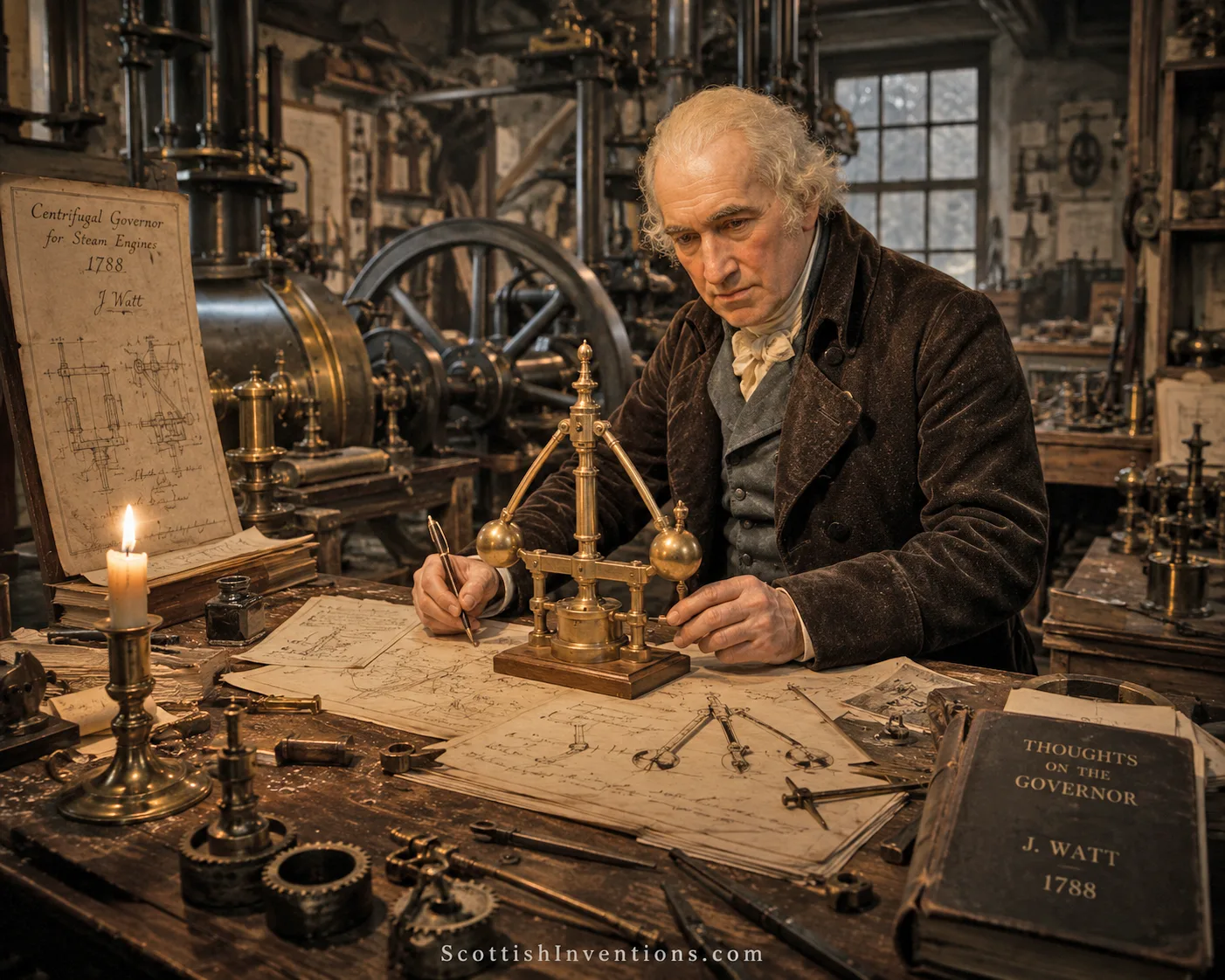
In 1788 a quiet Scottish engineer fitted two spinning iron balls to a steam engine — and gave machines the gift of self-control. It was the first true closed-loop feedback system, and it still runs the modern world.
On this page
- Introduction
- Key Facts
- The Problem of Uncontrolled Power
- The Invention of the Centrifugal Governor
- How Watt's Governor Worked
- Impact on the Industrial Revolution
- Why Watt's Governor Changed Everything
- Maxwell and the Mathematics of Control
- Interactive Timeline
- Modern Legacy
- Related Scottish Inventions
- FAQ
- Sources
By the late eighteenth century James Watt had already transformed the steam engine from a crude pumping machine into a powerful, versatile source of industrial power. His separate condenser, parallel-motion linkage and double-acting design had dramatically improved efficiency and capability. Yet one major problem remained: the steam engine was very difficult to control. Its speed could fluctuate wildly with the load, threatening machinery and producing inconsistent results in factories.
In 1788 Watt solved that problem with one of his most elegant and far-reaching inventions: the centrifugal governor. A relatively simple mechanical device, it automatically regulated the engine's speed, providing the steady, reliable power that factories needed. It was one of the earliest successful examples of automatic feedback control in engineering — and it made the steam engine truly practical for driving the machinery of the Industrial Revolution.
The governor did not merely improve the steam engine. It introduced a fundamental principle of automatic control that would later influence everything from heavy industrial machinery and ironworks to modern robotics and aerospace systems.
Key Facts
Born Greenock, 1736
James Watt trained as an instrument maker and refined the steam engine into the prime mover of the Industrial Revolution.
Patented 1788
The centrifugal governor was first fitted to a Boulton & Watt rotative steam engine and quickly became a standard feature.
First feedback loop
One of the earliest successful industrial closed-loop feedback control systems — sensing, deciding and correcting without human input.
Powered the factories
Reliable speed control made steam engines safe and practical for spinning mills, weaving sheds and rolling plants.
Maxwell, 1868
James Clerk Maxwell's paper 'On Governors' used Watt's device to establish the mathematics of modern control theory.
From brass to AI
The same closed-loop principle now runs autopilots, robotics, spacecraft guidance and intelligent automation.
The Problem of Uncontrolled Power
Early steam engines, including Watt's improved versions, suffered from a basic limitation. When the load on the engine decreased — for example when some machines in a factory were stopped — the engine could speed up dangerously. When the load increased, it slowed down or stalled. This variation made steam unsuitable for many industrial applications, particularly in textile mills where consistent speed was essential for producing uniform yarn and cloth.
Factory owners needed an engine that could maintain a steady rotational speed regardless of changes in demand. Manual adjustment by an operator was impractical, slow and unreliable. What was needed was a device that could sense changes in speed and automatically adjust the steam supply — without human intervention.
Watt understood this challenge clearly. His business partner, Matthew Boulton, is said to have suggested using a centrifugal mechanism to regulate the engine. Watt, with his deep mechanical insight, turned the suggestion into a working solution.
The Invention of the Centrifugal Governor
In 1788 Watt designed and installed his first centrifugal governor on a Boulton & Watt steam engine. The device consisted of two heavy metal balls mounted on arms attached to a vertical spindle that rotated with the engine's flywheel. As the engine sped up, the spinning balls rose outward under centrifugal force. That upward motion was mechanically linked to a throttle valve controlling the flow of steam into the engine.
When the engine ran too fast, the rising balls partially closed the throttle, reducing the steam supply and slowing the engine. When the engine slowed under increased load, the balls dropped, opening the throttle and admitting more steam. The system formed a self-regulating feedback loop that held speed remarkably steady.
Watt's governor was not entirely original in concept. Similar centrifugal mechanisms had been used in windmills and flour mills for centuries. Watt's achievement was to apply the principle successfully and systematically to the steam engine on an industrial scale — refining the design, integrating it elegantly with his engine, and making it a standard feature of Boulton & Watt machines.

How Watt's Governor Worked
The beauty of the governor lay in its simplicity. It required no external power beyond the rotation of the engine itself. The physics was straightforward: centrifugal force increases with the square of rotational speed. As speed rose, the balls swung outward and upward against gravity. That motion was transmitted through a series of linkages to the throttle valve.
Watt also incorporated a clever design feature to improve stability. Early versions could oscillate — "hunting" — by repeatedly speeding up and slowing down. Watt added damping and carefully tuned geometric proportions to reduce this tendency, making the governor stable in operation.
The device gave the steam engine something it had previously lacked: self-regulation. For the first time, a machine could adjust its own power output in response to changing conditions — one of the earliest practical implementations of what engineers today call a closed-loop feedback control system.
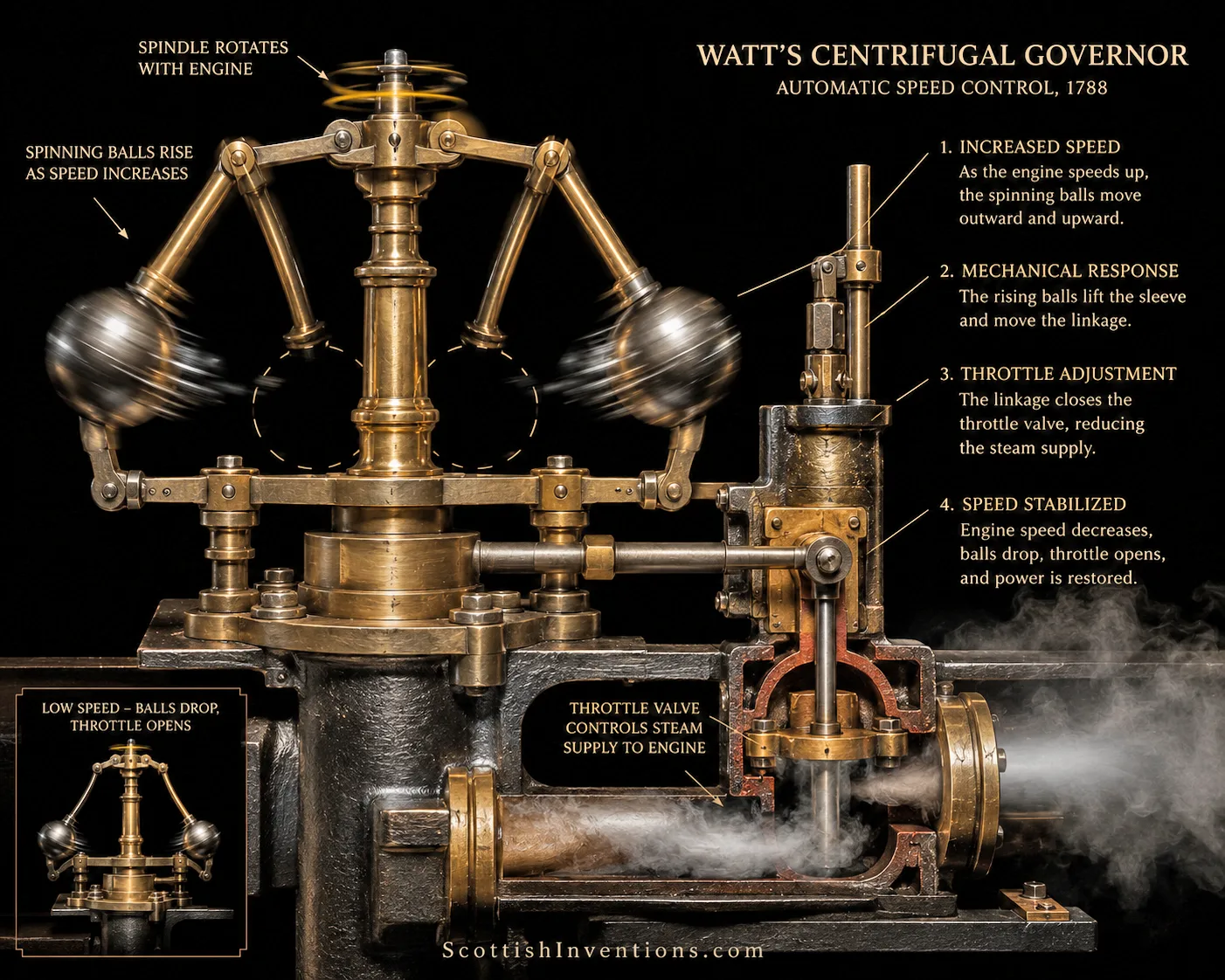
Engineering Explainer — Inside the Governor
1. Rotating spindle
Driven directly by the engine, so spindle speed always tracks engine speed.
2. Flyballs
Two heavy iron balls on hinged arms — the mechanical 'sensor' of rotational speed.
3. Rising arms
Centrifugal force lifts the arms outward; the angle is a direct measure of speed.
4. Sliding sleeve
A collar on the spindle moves up as the arms rise, converting angle into linear motion.
5. Mechanical linkage
A bell-crank linkage transmits the sleeve's motion to the throttle valve.
6. Throttle valve
Regulates the flow of steam from boiler to cylinder — the system's 'actuator'.
7. Steam regulation
More speed → less steam. Less speed → more steam. Power is matched to load automatically.
8. Feedback loop
Sense → decide → correct → re-sense. The classic closed-loop control diagram in brass.
9. Stable engine speed
Damping and careful geometry settle the engine at a steady operating point.
Impact on the Industrial Revolution
The introduction of the governor had immediate and lasting effects on industry. With reliable speed control, steam engines could now drive complex machinery — spinning frames, looms, rolling mills — with consistent power. Factories no longer needed to stop production or risk damage when loads changed. This reliability encouraged the wider adoption of steam power across Britain and eventually the world.
The governor helped make steam power competitive with water power even where water wheels were impractical. It contributed significantly to the shift from rural, water-powered mills to urban steam-powered factories — one of the defining transformations of the Industrial Revolution. Combined with Symington's marine steam engine and Neilson's hot blast process, it placed Scottish engineering at the very heart of industrialised Britain.
By the early nineteenth century, the Boulton & Watt engine — equipped with the governor as standard — had become the universal prime mover of British industry.
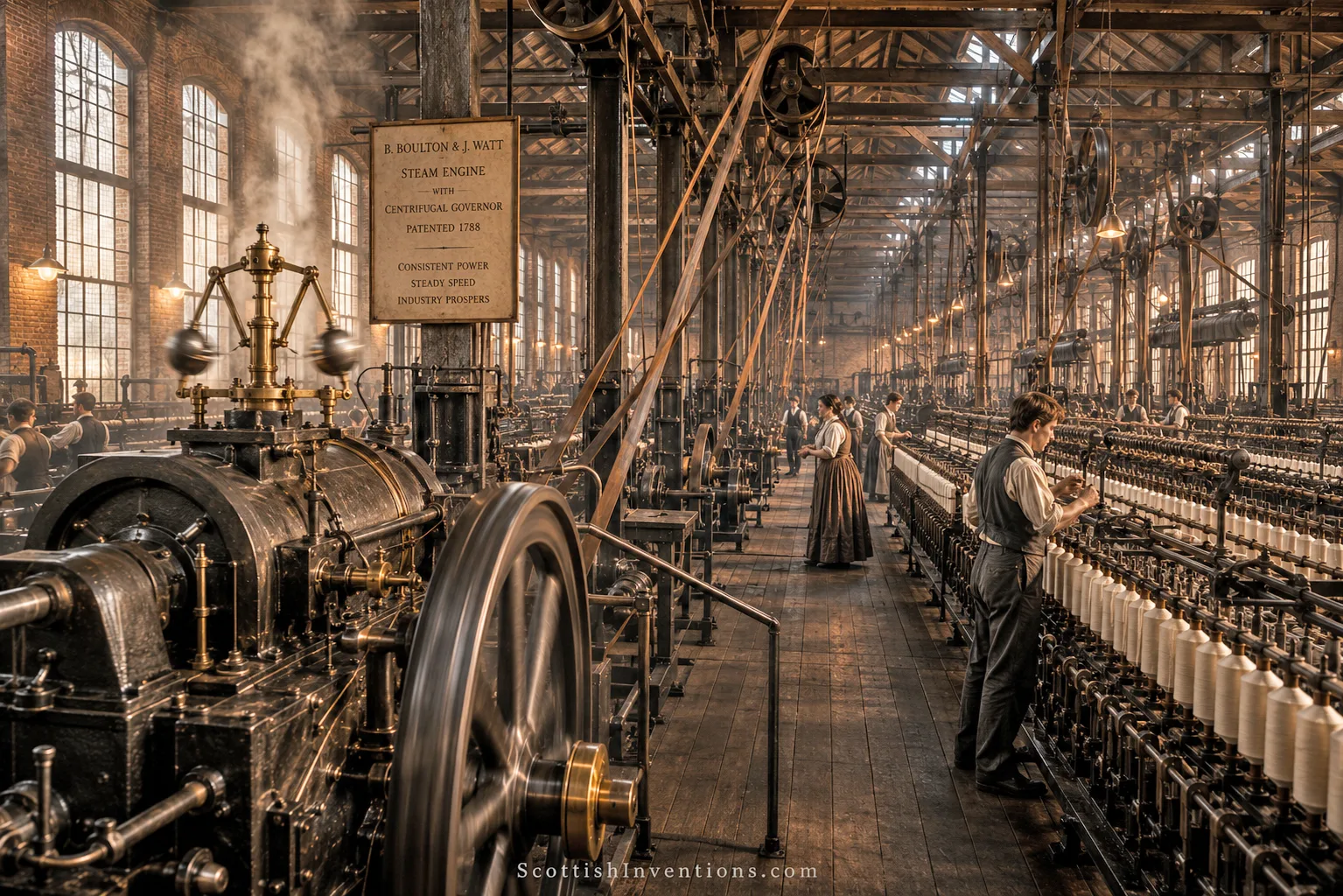
Feature
Why Watt's Governor Changed Everything
Automatic speed control
Engines maintained steady rpm regardless of load — without an operator.
Reliable factory power
Mills, looms and lathes could run continuously and produce uniform output.
Improved safety
No more runaway engines tearing themselves apart when the load dropped.
Increased productivity
Predictable power enabled larger, more complex industrial processes.
Birth of feedback engineering
The first successful industrial closed-loop control system.
Foundation of modern automation
Every robot, autopilot and smart factory descends from this idea.
Maxwell and the Mathematics of Control
Beyond its immediate industrial impact, Watt's governor had profound intellectual consequences. It demonstrated that mechanical systems could be designed to regulate themselves — an idea that fascinated nineteenth-century scientists and engineers.
In 1868 another great Scot, James Clerk Maxwell, published a paper titled On Governors, in which he analysed the stability of Watt's device using differential equations. It is regarded as one of the foundational texts of control theory. The mathematics later developed by Maxwell and his successors underpins everything from PID controllers in chemical plants to flight control laws in modern airliners.
The principles demonstrated by Watt's governor — sensing, feedback and automatic correction — underpin virtually all modern automatic control systems, from cruise control in cars to autopilots in aircraft and industrial process control. While the technology has advanced enormously, the core concept of using feedback to maintain stability remains the same.
Interactive Timeline
- ●
1736
James Watt born in Greenock
Born on the Firth of Clyde to a shipwright and merchant family.
- ●
1769
Separate condenser patented
Watt's first transformational invention — dramatically improving steam engine efficiency.
- ●
1775
Boulton & Watt partnership
Matthew Boulton becomes Watt's business partner; their Soho engines spread across Britain.
- ●
1781
Rotary motion
Watt's sun-and-planet gearing converts reciprocating motion into rotation, enabling factory drives.
- ●
1784
Parallel motion linkage
An elegant mechanism that constrains the engine's piston rod to move in a straight line.
- ●
1788
Centrifugal governor introduced
The first practical application of closed-loop feedback control to an industrial machine.
- ●
Early 1800s
Steam-powered factories
Boulton & Watt engines, regulated by the governor, become the universal prime mover of British industry.
- ●
1819
James Watt dies
Watt dies at Heathfield, near Birmingham. The SI unit of power, the watt, is named in his honour.
- ●
1868
Maxwell publishes 'On Governors'
James Clerk Maxwell's mathematical analysis founds modern control theory.
- ●
1900s
Electrical control systems
Feedback principles migrate from brass linkages to relays, servomotors and electronic regulators.
- ●
Late 1900s
Computerised automation
Digital controllers, PID loops and PLCs run factories, refineries and power stations worldwide.
- ●
Today
AI, robotics, aerospace
Autopilots, drones, self-driving cars and intelligent systems all rest on the closed-loop principle Watt pioneered.
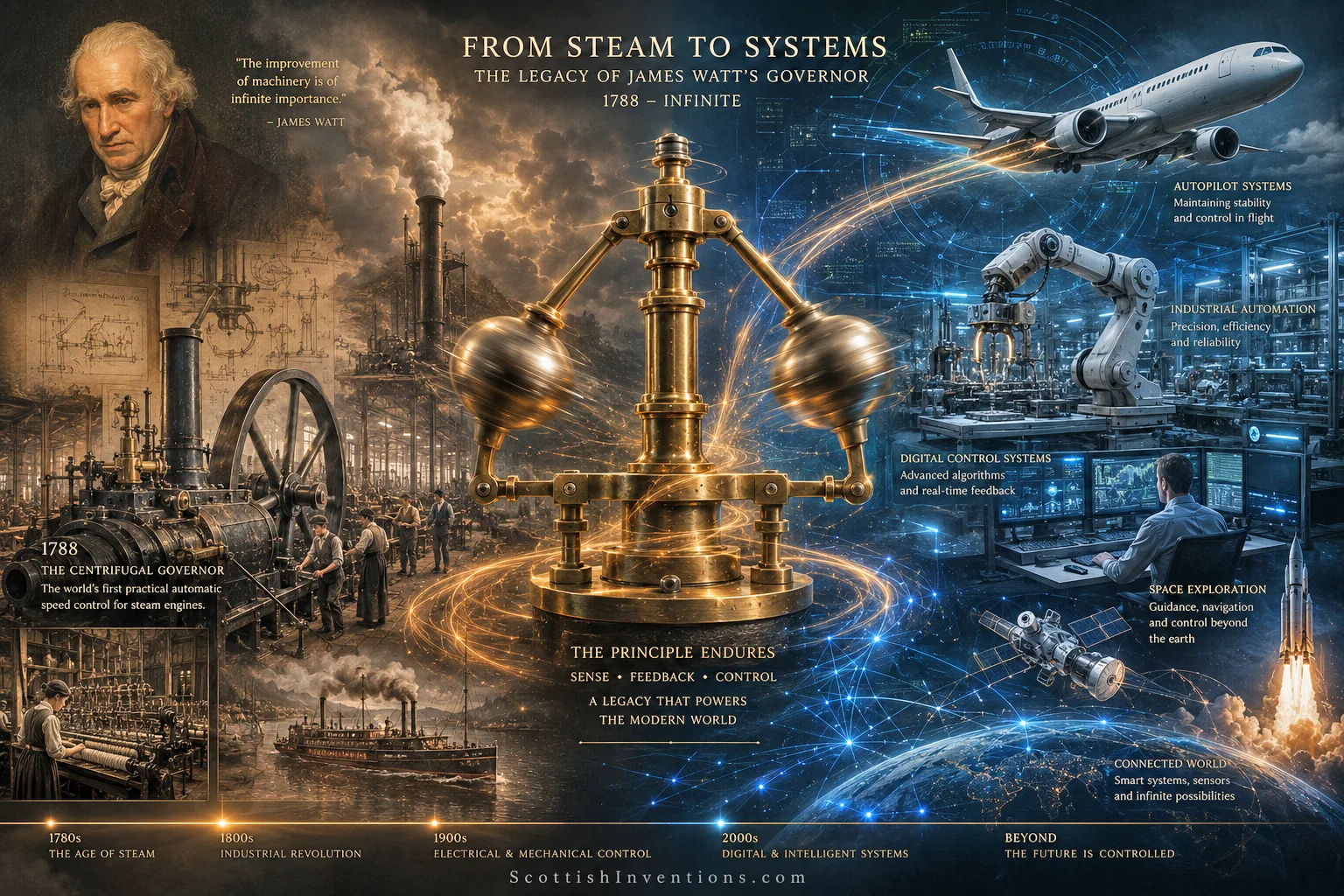
From Brass Linkages to Intelligent Systems
The same closed-loop principle that lifted two spinning balls on a Boulton & Watt engine in 1788 now flies airliners, lands rockets and runs the world's smart factories. Watt's governor inspired the development of:
- Industrial automation
- Manufacturing robots
- Cruise control
- Aircraft autopilot
- Digital control systems
- Process engineering
- Smart factories
- Spacecraft guidance
- Autonomous systems
- AI feedback training loops
The hardware has evolved from brass linkages and iron flyballs to silicon, software and sensors. The underlying principle of automatic feedback control has not changed at all.
James Watt did not seek the spotlight. He was a meticulous, thoughtful engineer who preferred solving practical problems to public acclaim. The governor was one of his later innovations, coming after the more famous improvements to the steam engine itself. Yet in many ways it completed his life's work — making the engine truly usable across the whole landscape of industry. The unit of power, the watt, is named in his honour. Coming soon to ScottishInventions.com: the Scottish Inventions Collection.
Frequently Asked Questions
- What is James Watt's Governor?
- James Watt's Governor is a centrifugal mechanical device introduced in 1788 that automatically regulated the speed of steam engines. Two heavy metal balls spinning on hinged arms rose outward as engine speed increased and, through a linkage, closed a throttle valve to reduce the supply of steam — creating a self-correcting feedback loop. It is widely regarded as the first successful industrial application of closed-loop feedback control.
- What does a centrifugal governor do?
- A centrifugal governor senses the rotational speed of an engine and automatically adjusts the supply of fuel — in Watt's case, steam — to keep that speed steady, regardless of changes in load. As the engine runs faster, the governor reduces power; as the engine slows under load, it allows more power. The result is stable, self-regulating operation without human intervention.
- How does Watt's governor work?
- A spindle, driven by the engine itself, spins two pivoted arms with heavy iron 'flyballs'. Rising centrifugal force lifts the balls outward and upward, sliding a collar up the spindle. That collar is mechanically linked to the engine's throttle valve. When the balls rise the throttle closes and steam supply is reduced; when they fall the throttle opens. Engine speed settles around a stable equilibrium point.
- Why was automatic control important?
- Before the governor, steam engines required constant manual attention. Sudden changes in load could cause engines to race dangerously or stall completely, damaging machinery and producing inconsistent output. Automatic control made steam power reliable, safe and predictable — the prerequisite for organising entire factories around steam-driven shafts and belts.
- Did James Watt invent the governor?
- Watt did not invent the centrifugal principle itself — similar 'lift-tenter' mechanisms had been used in windmills and flour mills for centuries to regulate the gap between grindstones. What Watt did, in 1788, was adapt and integrate the device into the steam engine, refining its geometry and damping so it could regulate steam supply reliably. His was the first successful industrial application of feedback control.
- What is feedback control?
- Feedback control is the engineering principle of using a measurement of a system's output to automatically adjust its input. The system 'senses' what it is doing, compares that to a desired value, and corrects itself. Watt's governor is the classic mechanical example: it senses engine speed and adjusts steam supply to keep speed constant. The same principle underlies thermostats, cruise control, autopilots and modern industrial robots.
- How did the governor change the Industrial Revolution?
- By giving steam engines steady, dependable speed, the governor made factory-scale mechanisation practical. Spinning frames, looms and rolling mills now had a power source they could trust, and the Boulton & Watt engine — fitted with the governor as standard — became the universal prime mover of British industry. It accelerated the shift from rural water-powered mills to urban steam-powered factories.
- Why did James Clerk Maxwell study governors?
- In 1868 the Scottish physicist James Clerk Maxwell published 'On Governors', the first rigorous mathematical analysis of why some governors remained stable while others oscillated or 'hunted'. Maxwell used differential equations to characterise stability, laying the mathematical foundations of modern control theory — built on top of Watt's mechanical invention.
- How is Watt's governor connected to robotics?
- Every industrial robot, drone, autopilot and self-driving car uses closed-loop feedback control: sense, compare, correct. The physical hardware is electronic and digital, but the principle is the one Watt demonstrated in 1788. Modern control engineering is, at its core, a sophisticated descendant of the centrifugal governor.
- Is the same principle still used today?
- Yes. From household thermostats and cruise control to aircraft autopilots, spacecraft guidance, smart factories and AI training loops, the closed-loop feedback principle pioneered by Watt's governor underpins virtually every automatic system in modern life. The technology has changed beyond recognition; the underlying idea has not.
Sources
Tier 1 · Primary
- James Clerk Maxwell, "On Governors", Proceedings of the Royal Society of London, vol. 16 (1868).
- H. W. Dickinson & Rhys Jenkins, James Watt and the Steam Engine (Oxford University Press, 1927).
Tier 2 · Scholarly and institutional
- Richard L. Hills, Power from Steam: A History of the Stationary Steam Engine (Cambridge University Press, 1989).
- Otto Mayr, The Origins of Feedback Control (MIT Press, 1970).
- Science Museum Group — Boulton & Watt engine collection notes.
- Royal Society of Edinburgh — Fellows' biographical archive.
Tier 3 · General reference
- Encyclopædia Britannica — entries on James Watt, the centrifugal governor and control theory.
Newsletter
Discover Scotland's hidden inventors
One short, beautifully illustrated story a fortnight. No spam, ever.
Sign up free