Scottish Inventions · Transport · Card No. 29 of 50
Robert Francis Fairlie: The Scot Whose Two-Headed Engine Conquered the World's Mountains
The Glasgow-born railway engineer whose 1864 patent produced the articulated Double Fairlie locomotive — a symmetrical, two-headed steam engine that transformed mountain railways from Snowdonia to Mexico, Russia and India, and whose principles still power the world's diesel and electric trains today.
TL;DR
- Robert Francis Fairlie (Glasgow, 1830 – London, 1885) was a Scottish railway engineer who patented the double-bogie articulated Fairlie locomotive on 12 May 1864 — a two-headed steam engine that could haul heavy loads up steep gradients and around tight curves that defeated conventional locomotives.
- His 1869 locomotive Little Wonder on the Ffestiniog Railway in Wales, and its internationally observed 1870 trials, proved narrow-gauge railways could be built cheaply in mountainous country worldwide — spreading his engines to Mexico, Russia, New Zealand, India and beyond.
- The Ffestiniog Railway still builds and runs double Fairlies at its Boston Lodge Works — the newest, James Spooner, entered service in 2023 — and Fairlie's articulation principle lives on in the Beyer-Garratt and in virtually every modern diesel and electric locomotive.
Key Findings
- A Glasgow-born innovator, not an Ayrshire one. Robert Francis Fairlie was born in Glasgow, the son of engineer T. Archibald Fairlie and Margaret Fairlie. The 2007 Oxford Dictionary of National Biography entry by Geoffrey Hughes gives his birth date as 5 April 1830; older sources say March 1831 — we flag the discrepancy honestly.
- His patent was real and precise. British Patent No. 1210, "Improvements in Locomotive Engines and Boilers," was granted on 12 May 1864.
- "Little Wonder" (1869) was the breakthrough. Built by George England & Co., it was the first truly successful double Fairlie and made his name.
- The 1870 Ffestiniog trials were a genuine international sensation, attended by railway commissioners and engineers from Russia, India, Sweden, Mexico and Britain.
- His design still runs and is still built today at the world's oldest railway works.
Fairlie at a glance
- Inventor
- Robert Francis Fairlie
- Born
- Glasgow, 5 April 1830
- Died
- London, 31 July 1885
- Patent
- British Patent No. 1210 (12 May 1864)
- First locomotive
- The Progress, 1865
- Breakthrough
- Little Wonder, Ffestiniog Railway, 1869
- Countries used
- Wales, Mexico, Russia, New Zealand, India, USA, Australia, Sweden, Peru, Bolivia, Canada
- Legacy
- The Beyer-Garratt and virtually every modern diesel and electric locomotive
- Still operating
- Yes — Ffestiniog Railway, Snowdonia; latest built 2023
Early Life and Scottish Background
Robert Francis Fairlie was, in the truest sense, a son of the Scottish engineering age. Born in Glasgow in 1830 — the great workshop city then pouring out ships, iron and machinery — he was the son of an engineer, T. Archibald Fairlie, and grew up steeped in the mechanical arts. Like many ambitious young locomotive men of his generation, he learned his craft in the great English railway workshops at Crewe and Swindon, the beating hearts of Victorian steam. There is a wonderful anecdote from the original Dictionary of National Biography: during a strike in 1851, the young Fairlie showed his mettle by acting as an engine-driver for several days.
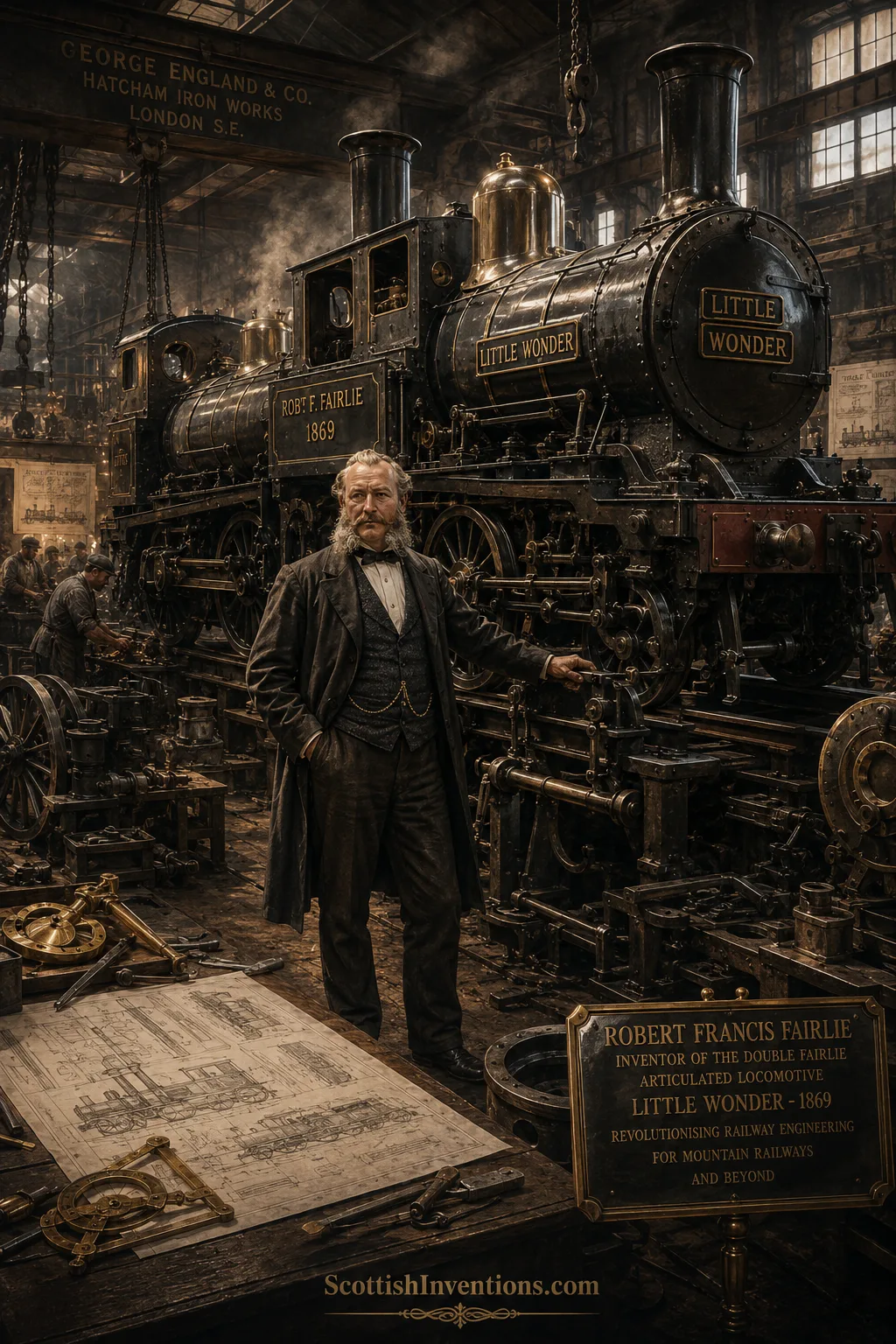
His talent carried him fast. In 1852–1853, still only in his early twenties, he was appointed Engineer and General Manager of the Londonderry & Coleraine Railway in Ireland — a remarkable responsibility for so young a man. He then travelled to India to work for the Bombay, Baroda & Central India Railway, gaining exposure to the brutal realities of operating trains in difficult, mountainous terrain. By 1859 he had returned to London and set himself up as a consulting railway engineer, and it was in this period that the idea for his patent germinated.
Fairlie was more than a mechanic; he was an evangelist. He became one of the most passionate advocates of his age for narrow-gauge railways as a cheap, democratic alternative to expensive standard-gauge lines — an argument he would carry from Wales to Ireland to the Americas.
The Problem Fairlie Solved
To understand why Fairlie's invention mattered so enormously, you must understand the fundamental contradiction that trapped Victorian locomotive engineers. A powerful locomotive needs a large boiler and many driving wheels — and that means a long, rigid wheelbase. But a long, rigid wheelbase cannot get around tight curves. In flat, rich countries like England this scarcely mattered. But in mountainous terrain — the Andes, the Caucasus, the mountains of Mexico, the slate hills of Snowdonia — railways had to twist through tight curves and climb steep gradients, and there the contradiction became a wall. You could have power, or you could have flexibility, but not both.
Worse still, conventional locomotives "wasted" weight. Their maximum pulling power (tractive effort) depends on the weight pressing their driving wheels onto the rails. Yet a conventional engine carried much of its weight on un-powered leading and trailing wheels, and dragged a tender that carried nothing but coal and water and contributed nothing to grip. And because a conventional engine had a definite front and back, every terminus needed an expensive turntable or triangle of track to turn it around.
The existing workarounds were poor. Banking engines (extra locomotives pushing from behind) doubled crew and cost. Rack railways, with a toothed centre rail, were slow and hugely expensive to build. As the great railway-building boom of the 1860s swept across the globe, a fundamentally new approach was needed to open up the mountainous, thinly populated countries that conventional railways could not economically reach.
The Invention — the Fairlie Locomotive (1864 Patent)
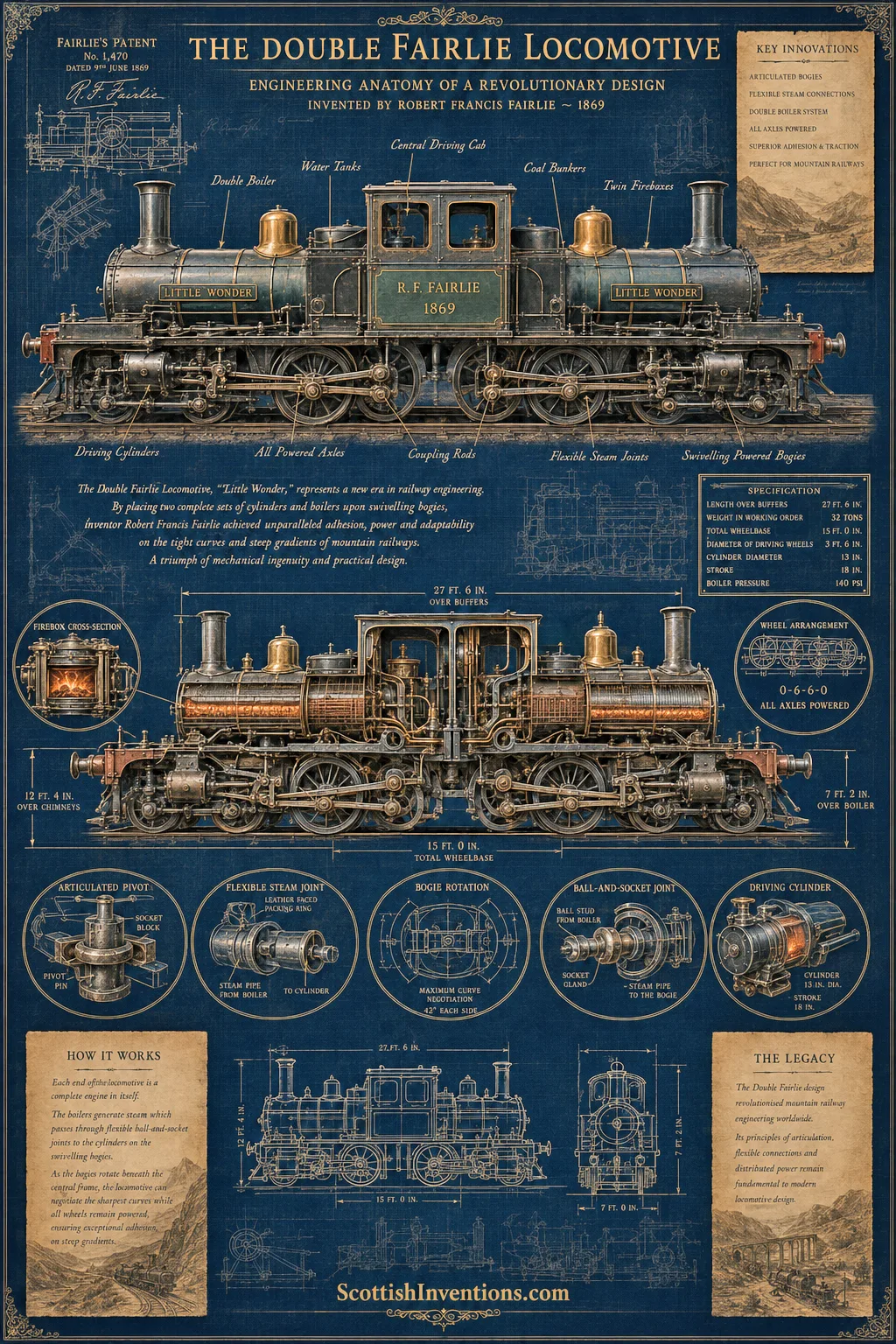
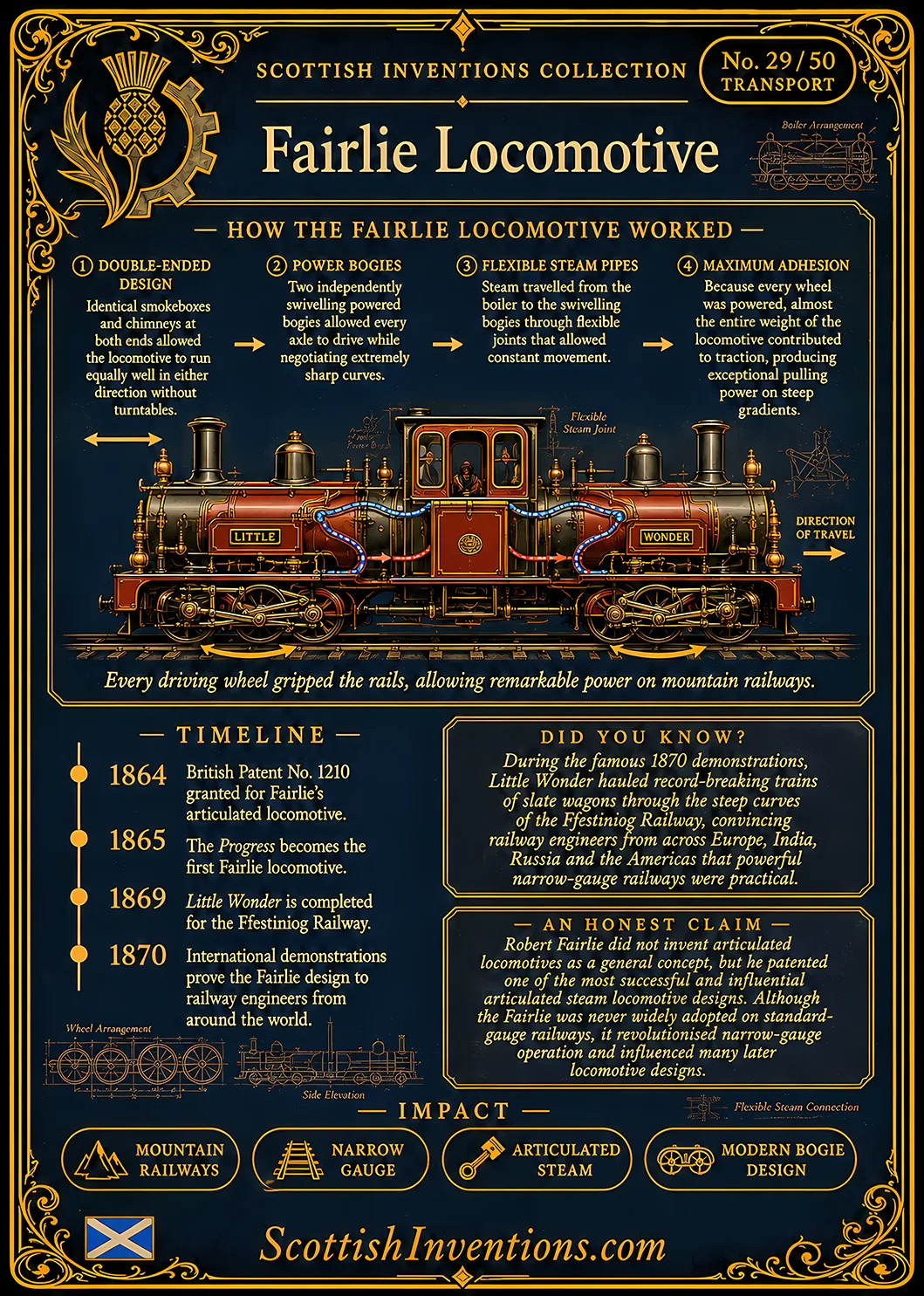
Fairlie's answer, protected by British Patent No. 1210 of 12 May 1864 (with a French patent following that November), was beautifully logical. Instead of one long rigid frame, he mounted the boiler on two independent, swivelling "bogies" (US: trucks), each carrying its own cylinders and driving wheels, each pivoting freely on a central pin. Every axle was driven, so the whole weight of the engine — including all its fuel and water — pressed down as useful grip. Because the bogies swivelled, the engine could snake around curves that would derail a rigid locomotive of the same power.
The signature "double Fairlie" took this to its logical, and visually startling, conclusion: a symmetrical, double-ended engine with a smokebox and chimney at each end, a central cab, and a distinctive double boiler with the firebox (or fireboxes) in the middle. It looked, as generations of Welsh visitors have observed, like a two-headed dragon. It could be driven equally well in either direction — no turntables required, ideal for remote mountain lines. There was also a simpler "single Fairlie," with one powered swivelling bogie at one end and an un-powered carrying bogie at the other, used more like a conventional tank engine for lighter work.
The great engineering challenge was getting steam from the fixed central boiler down to the swivelling bogies without leaking. Fairlie's solution was flexible steam pipes with ball-and-socket (spherical) joints that could accommodate the movement of the bogies — a detail that would later prove historically important. His first engine, "The Progress" (sometimes "Pioneer"), was built in 1865 by James Cross & Co. of St Helens for the Neath & Brecon Railway. It had a single central firebox, and this proved a weakness: the draught tended to favour one half of the boiler, leaving the other half inefficient. The problem would be solved in Wales.
The Ffestiniog Railway and "Little Wonder" (1869)
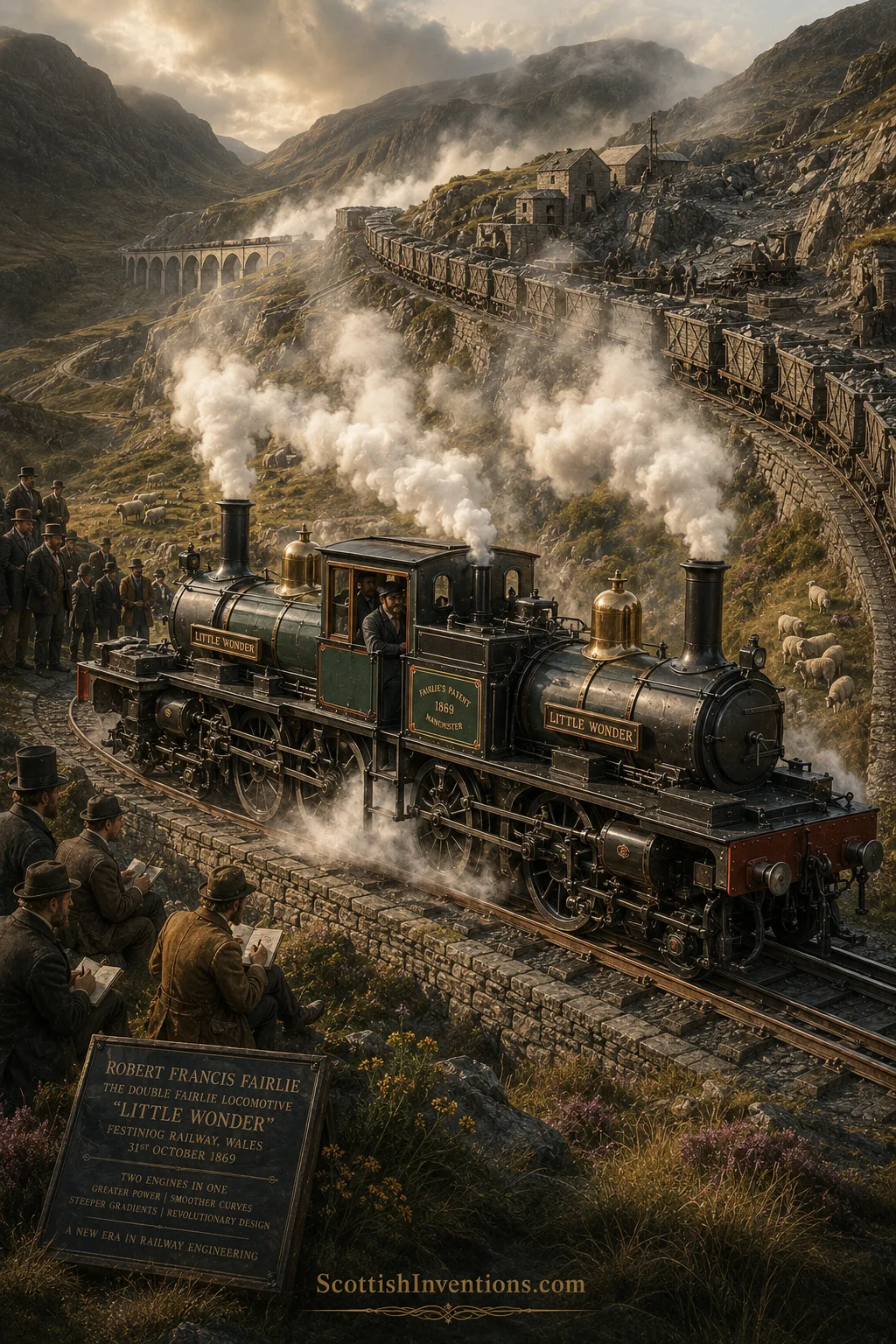
The Ffestiniog Railway was the perfect proving ground. Opened in 1836 to a startlingly narrow gauge of just 1 ft 11½ in (597 mm), it wound 13½ miles through the mountains of Snowdonia, carrying slate from the quarries of Blaenau Ffestiniog down to the port of Porthmadog. By the 1860s its traffic had outgrown horse power and its first little George England tank engines. Doubling the line or widening the gauge would have been ruinously expensive. Its engineers — the Spooner family, James and his son Charles Easton Spooner — needed more power on the same tight, twisting, narrow track. Fairlie's design was the answer.
"Little Wonder," built in 1869 by George England & Co. at the Hatcham Iron Works, was the fourth double Fairlie built but the first genuinely successful one — crucially, because it had two separate fireboxes, curing the drafting problem of the earlier engines. It transformed what the little railway could do, more than doubling the power of the earlier engines.
"The observers came to see something they were told should not work, and left convinced."
Then came the moment that made Fairlie world-famous. On 11 February 1870, he staged a formal demonstration at the Ffestiniog, inviting a glittering international audience. The guest list was extraordinary for a tiny Welsh slate line: the Duke of Sutherland; Captain Tyler, the Government's railway inspector; commissioners and engineers representing Imperial Russia, the Indian Government, Sweden, Mexico and Prussia; and reporters from The Times and the engineering press. In the trials, "Little Wonder" hauled a train of 112 wagons weighing 206 long tons (231 short tons) up the line at an average speed of 12½ mph — whereas the railway's older engine "Welsh Pony" was only just able to haul 26 wagons weighing 73 tons at a maximum of 5 mph.
Fairlie's reward to the railway was generous and consequential: he granted the Ffestiniog Railway Company a perpetual, royalty-free licence to build and use his patent, in return for using its success in his publicity. That single gift is why the Ffestiniog still builds Fairlies to this day.
The Global Spread of the Fairlie Locomotive
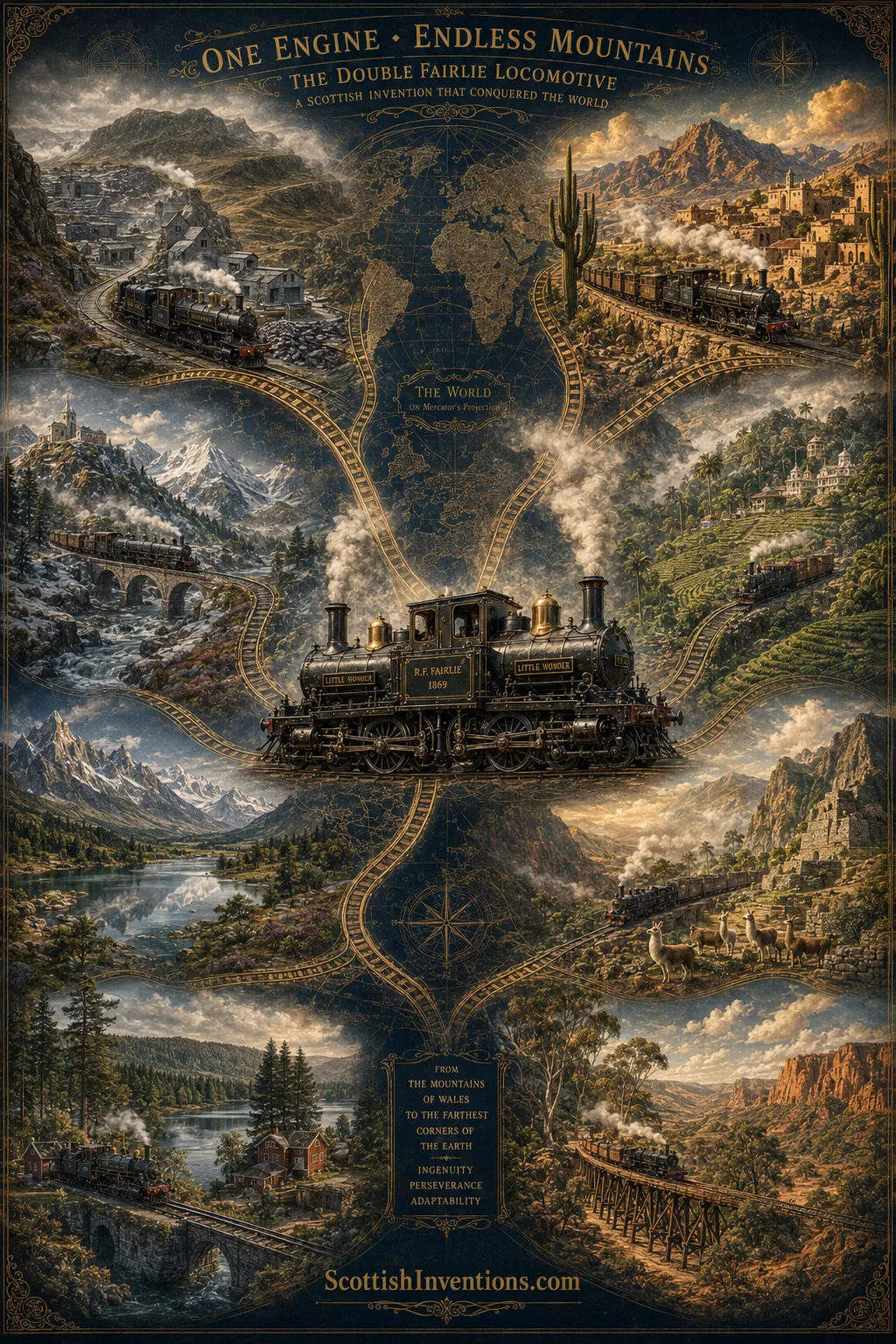
The 1870 trials filled Fairlie's order book, and by 1876 forty-three different railways around the world had operated his patent locomotives. The design was tailor-made for the developing world's mountainous, cash-poor railways.
- Mexico became his most devoted customer. The Ferrocarril Mexicano operated huge 0-6-6-0T Fairlies weighing around 125 tons each on the fearsome climb between Mexico City and Veracruz, used until the line was electrified in the 1920s.
- Russia used Fairlies on the Tambov–Saratov line and, most successfully, on the Surami Pass of the Transcaucasian Railway from 1872; built in England, then Germany, then under licence at Kolomna, they lasted until electrification in 1934.
- New Zealand ordered R and S class single Fairlies and B and E class double Fairlies for its narrow-gauge network under Julius Vogel's 1870 public-works programme. The double Fairlie "Josephine" survives in Dunedin.
- India received Fairlies that worked the Bolān Pass and later the Nilgiri Mountain Railway.
- Fairlies also ran in Queensland (Australia), Western Australia, Canada, Sweden, Peru, Bolivia and the United States, where William Mason built around 146 "Mason Bogie" variants (roughly 88 narrow-gauge) between 1871 and 1890.
It must be said honestly: the Fairlie was not universally successful. Its flexible steam joints leaked, its footplate was cramped, its fuel and water capacity was limited, and it could ride roughly. Historians generally agree the only really long-term successful applications, beyond the Ffestiniog itself, were in Mexico, New Zealand and Russia. But even where individual engines disappointed, the idea Fairlie championed — powerful articulated locomotives on cheap narrow-gauge track — changed railway building forever.
Fairlie's Advocacy and Publications
Fairlie was a formidable pamphleteer. In 1864 he published Locomotive Engines: What They Are and What They Ought to Be (London, John King & Co.), a lively dialogue setting out the failings of conventional locomotives and the virtues of his own. In 1872 came Railways or No Railways: The Battle of the Gauges Renewed (London, Effingham Wilson), a full-throated argument for narrow gauge as the economical future of railways. On 19 September 1870 he presented a paper, "On the Gauge for the Railways of the Future," to the British Association for the Advancement of Science at Liverpool — a text that was reprinted and became one of the sparks for the narrow-gauge boom in the United States. He was, in short, the intellectual leader of the "narrow-gauge controversy" of the 1860s and 1870s.
The Ffestiniog Railway Legacy Today
Here is where Fairlie's story becomes gloriously living history. The Ffestiniog Railway is the only railway in the world to have operated double Fairlie locomotives continuously, and it still does. Its Boston Lodge Works — recognised by Guinness World Records as the oldest railway works in the world — has built steam locomotives in the 19th, 20th and 21st centuries.
The star of the fleet is Merddin Emrys, built at Boston Lodge in 1879 to the design of George Percival Spooner. It was the first locomotive built at the works, has spent its entire working life on the line, and is still hauling passengers today — one of the oldest working locomotives in the world. It is joined by David Lloyd George (built 1992, the most powerful engine ever to run in normal service on the line) and the brand-new James Spooner (built in 2023 at Boston Lodge on the 153rd anniversary of "Little Wonder's" trials). An original double Fairlie, Livingston Thompson (1886), is preserved in the National Railway Museum at York.
The Garratt Connection
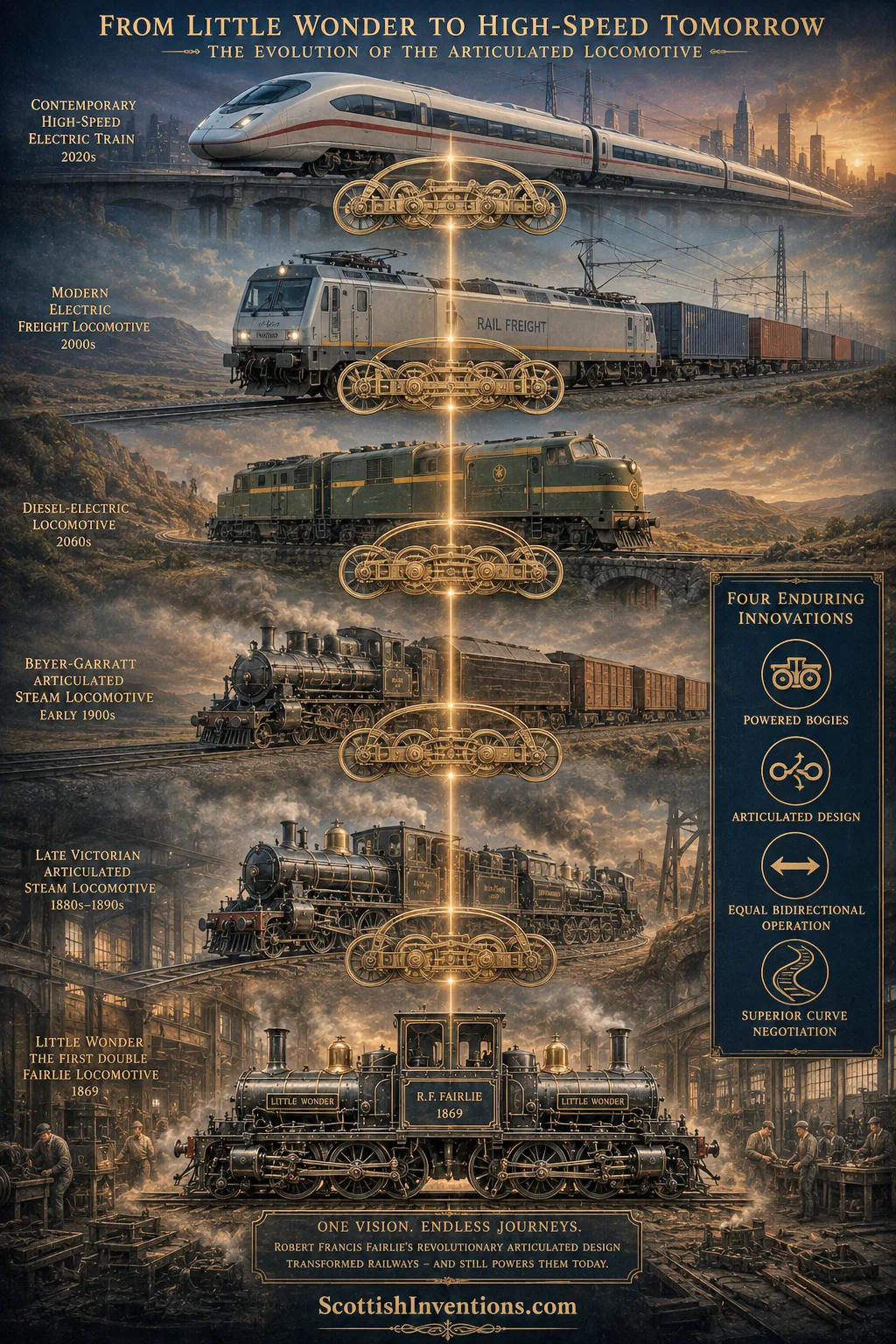
Fairlie's influence did not end with his own engines. The next great articulated locomotive — the Beyer-Garratt — traces a direct engineering lineage back to him. Herbert William Garratt (1864–1913) took out the drawing for his patent in 1907, and production by Beyer, Peacock & Co. of Manchester began in 1909. Like the Fairlie, the Garratt used two powered, pivoting engine units; but Garratt slung a huge boiler on a cradle between them, with the water tanks and coal bunker carried on the engine units, allowing an enormous boiler and colossal power.
The direct link is documented: as the railway historian L. T. C. Rolt recorded, when Beyer, Peacock's engineers struggled in 1909 to make steam-tight flexible connections for the Garratt locomotive, they solved the problem after studying the spherical steam joints on a Fairlie locomotive built for the Ffestiniog Railway. Garratts went on to dominate the railways of Africa: 1,636 Garratts ran on 86 railways in 48 countries, of which Beyer, Peacock built 1,116. In this sense the Garratt is Fairlie's grandchild, and through it a Glasgow engineer's idea powered the development of much of the world.
And there is a final, sweeping legacy. The vast majority of the diesel and electric locomotives running on the world's railways today follow the basic Fairlie form: two powered bogies with all axles driven, capable of running equally well in either direction. Fairlie lost the argument about gauge, but he won the argument about articulation.
Timeline
1830
Born in Glasgow
Robert Francis Fairlie born on 5 April, son of engineer T. Archibald Fairlie and Margaret Fairlie.
c.1849
Trained at Crewe & Swindon
Apprenticed in the great English railway workshops that shaped a generation of Victorian locomotive engineers.
1851
Drove during a strike
In his early twenties, showed his mettle by acting as an engine-driver for several days during a strike.
1852–53
Londonderry & Coleraine Railway
Appointed Engineer and General Manager of the Londonderry & Coleraine Railway in Ireland.
Late 1850s
Bombay, Baroda & Central India
Worked in India, gaining first-hand experience of railways in difficult mountainous terrain.
1859
Consulting engineer in London
Returned to London and set up as a consulting railway engineer — the period in which the Fairlie patent germinated.
12 May 1864
British Patent No. 1210
'Improvements in Locomotive Engines and Boilers' — the founding patent of the articulated Fairlie locomotive.
1865
The Progress
First Fairlie locomotive built by James Cross & Co. of St Helens for the Neath & Brecon Railway.
1869
Little Wonder built
George England & Co. at Hatcham Iron Works completes 'Little Wonder' for the Ffestiniog Railway — the first fully successful double Fairlie.
11 Feb 1870
International trials
Little Wonder hauls 112 wagons (~206 long tons) at an average 12½ mph before commissioners from Russia, India, Sweden, Mexico and Prussia.
1870
The Gauge Paper
Presents 'On the Gauge for the Railways of the Future' to the British Association at Liverpool — a spark for the American narrow-gauge boom.
1872
Battle of the Gauges
Publishes 'Railways or No Railways: The Battle of the Gauges Renewed', his manifesto for narrow-gauge railways.
1876
Global reach
By this date, forty-three different railways worldwide are operating Fairlie patent locomotives.
31 Jul 1885
Death in London
Fairlie dies in London aged 55.
2023
James Spooner enters service
Boston Lodge Works completes a brand-new double Fairlie — Fairlie's design still being built 159 years after his patent.
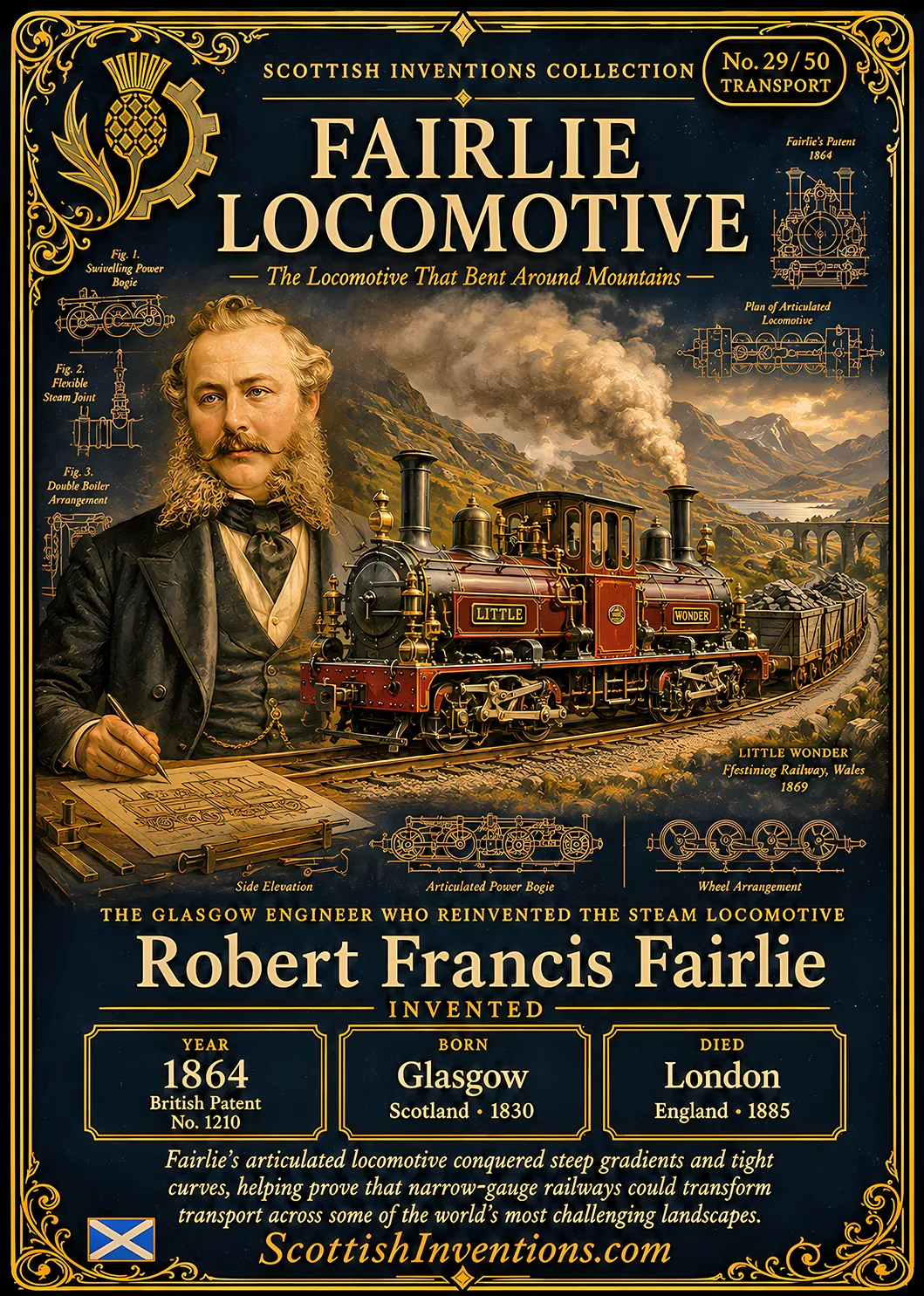
The Fairlie Locomotive trading card
Card No. 29 of 50 in the Scottish Inventions Collection.
Frequently Asked Questions
- Who was Robert Francis Fairlie?
- Robert Francis Fairlie (5 April 1830 – 31 July 1885) was a Glasgow-born Scottish railway engineer. He trained at the great English railway workshops at Crewe and Swindon, ran the Londonderry & Coleraine Railway in his early twenties, worked in India on the Bombay, Baroda & Central India Railway, and set up as a consulting railway engineer in London before patenting the articulated Fairlie locomotive in 1864.
- What is a Double Fairlie locomotive?
- A Double Fairlie is an articulated steam locomotive with a symmetrical, double-ended body, a chimney and smokebox at each end, a central cab, and two independently swivelling powered bogies. Every axle is powered, so the entire weight of the locomotive contributes to grip on the rails. It can run equally well in either direction without needing a turntable.
- Why was the Double Fairlie revolutionary?
- Victorian locomotive engineers were trapped by a contradiction: a powerful locomotive needed a long rigid wheelbase, but that could not negotiate tight curves. Fairlie's articulated design combined enormous pulling power with the flexibility to snake around sharp mountain curves, while making bidirectional operation possible on remote lines without turntables.
- Where was Little Wonder used?
- 'Little Wonder' was built in 1869 by George England & Co. at the Hatcham Iron Works in London for the Ffestiniog Railway in Snowdonia, Wales. Its internationally observed trials on 11 February 1870 hauled 112 wagons of about 206 long tons up the line at an average of 12½ mph — a performance that transformed the world's understanding of narrow-gauge railways.
- Which countries used Fairlie locomotives?
- By 1876, forty-three railways worldwide had operated Fairlies. The design was used most successfully in Wales, Mexico (on the Ferrocarril Mexicano's Veracruz climb), Russia (Transcaucasian Railway) and New Zealand. Fairlies also ran in India, Australia, Canada, Sweden, Peru, Bolivia and the United States, where William Mason built around 146 'Mason Bogie' variants.
- Does any Double Fairlie still operate today?
- Yes — the Ffestiniog Railway is the only railway in the world to have run double Fairlies continuously since Victorian times. Its Boston Lodge Works, the oldest railway works in the world, still builds them. 'Merddin Emrys' (1879) is still in service, alongside 'David Lloyd George' (1992) and the brand-new 'James Spooner', which entered service in 2023.
- What is the difference between a Fairlie and a Garratt locomotive?
- Both are articulated steam locomotives with two powered swivelling bogies. A Fairlie mounts a symmetrical double boiler and central cab directly on the two engine units. A Beyer-Garratt slings a single huge boiler on a cradle between the two engine units, with water tanks and coal bunker on the units themselves. The Garratt design directly borrowed Fairlie's spherical steam joints, and its inventor Herbert Garratt is often described as Fairlie's engineering grandchild.
- Was Robert Fairlie Scottish?
- Yes. Robert Francis Fairlie was born in Glasgow in 1830, the son of engineer T. Archibald Fairlie. Older sources occasionally place his birth in Irvine, Ayrshire, but every authoritative modern source — including the Oxford Dictionary of National Biography — confirms Glasgow. The Ayrshire confusion arises from the village of Fairlie in North Ayrshire, from which the surname derives.
- Why are articulated locomotives important?
- Articulated locomotives combine great power with the flexibility to negotiate sharp curves. This made railways viable in mountainous, sparsely populated countries where rigid-frame locomotives could not operate economically. The vast majority of modern diesel and electric locomotives still follow Fairlie's basic form — two powered bogies with all axles driven and equally good running in either direction.
- Where can you ride a Double Fairlie today?
- On the Ffestiniog Railway in Snowdonia, north Wales, which runs 13½ miles from Porthmadog up to Blaenau Ffestiniog. The line's Boston Lodge Works still builds and maintains double Fairlies, and 'Merddin Emrys' (1879), 'David Lloyd George' (1992) and 'James Spooner' (2023) all haul regular passenger services.
Sources
- Geoffrey Hughes, "Fairlie, Robert Francis (1830–1885)," Oxford Dictionary of National Biography, 2007.
- Ffestiniog Railway Company — official site and Festipedia.
- National Railway Museum, York — Livingston Thompson preserved Double Fairlie.
- Grace's Guide to British Industrial History — R. F. Fairlie and George England & Co.
- L. T. C. Rolt, The Mechanicals: Progress of a Profession — on the Fairlie / Garratt lineage.