Scottish Inventions · Transport
Two Scots, Two Inventions, One Story: The Pneumatic Tyre
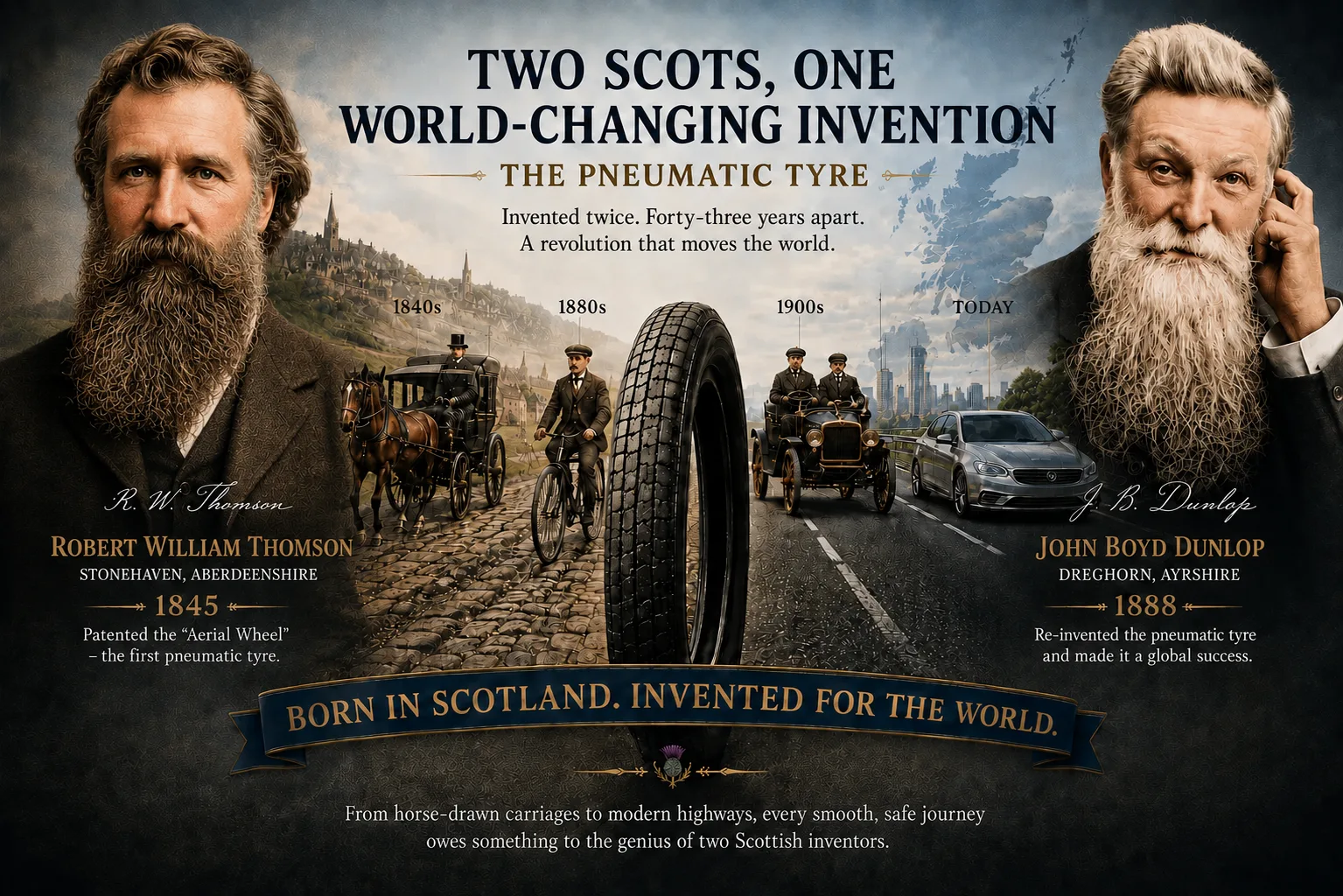
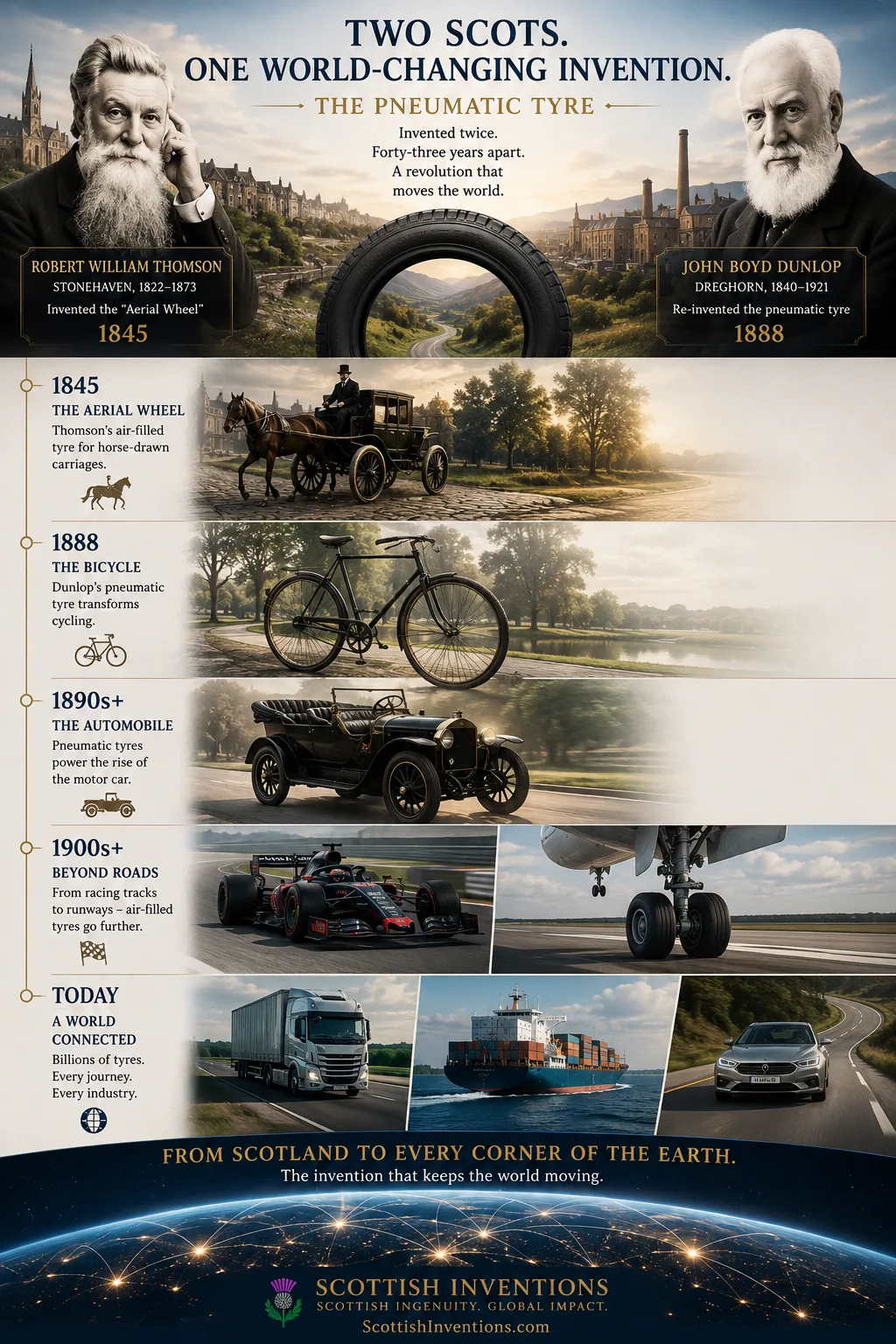
Invented twice. Forty-three years apart. A revolution that still moves the world.
Introduction
Scotland did not just invent the pneumatic tyre - it invented it twice. The first pneumatic tyre was patented in 1845 by Scottish engineer Robert William Thomson of Stonehaven, who called his air-filled creation the "Aerial Wheel." Forty-three years later, in 1888, a Scottish veterinary surgeon named John Boyd Dunlop, working in Belfast, independently arrived at the same idea while trying to make his young son's tricycle ride more smoothly over cobbles.
Both men were Scots. Both invented the pneumatic tyre. Neither knew of the other's work. Together, by accident of timing and circumstance, they gave the modern world its rolling stock - bicycles, motor cars, lorries, aircraft - everything that moves on a cushion of compressed air. This is the story of how two quiet Scottish minds, working a generation apart, changed the way the world travels.
Quick Answer
Who invented the pneumatic tyre?
The pneumatic tyre was first invented by Scottish engineer Robert William Thomson in 1845 and independently reinvented by Scottish veterinary surgeon John Boyd Dunlop in 1888. Thomson created the original "Aerial Wheel," while Dunlop's version became commercially successful and transformed modern transportation.
Robert William Thomson (1822-1873)
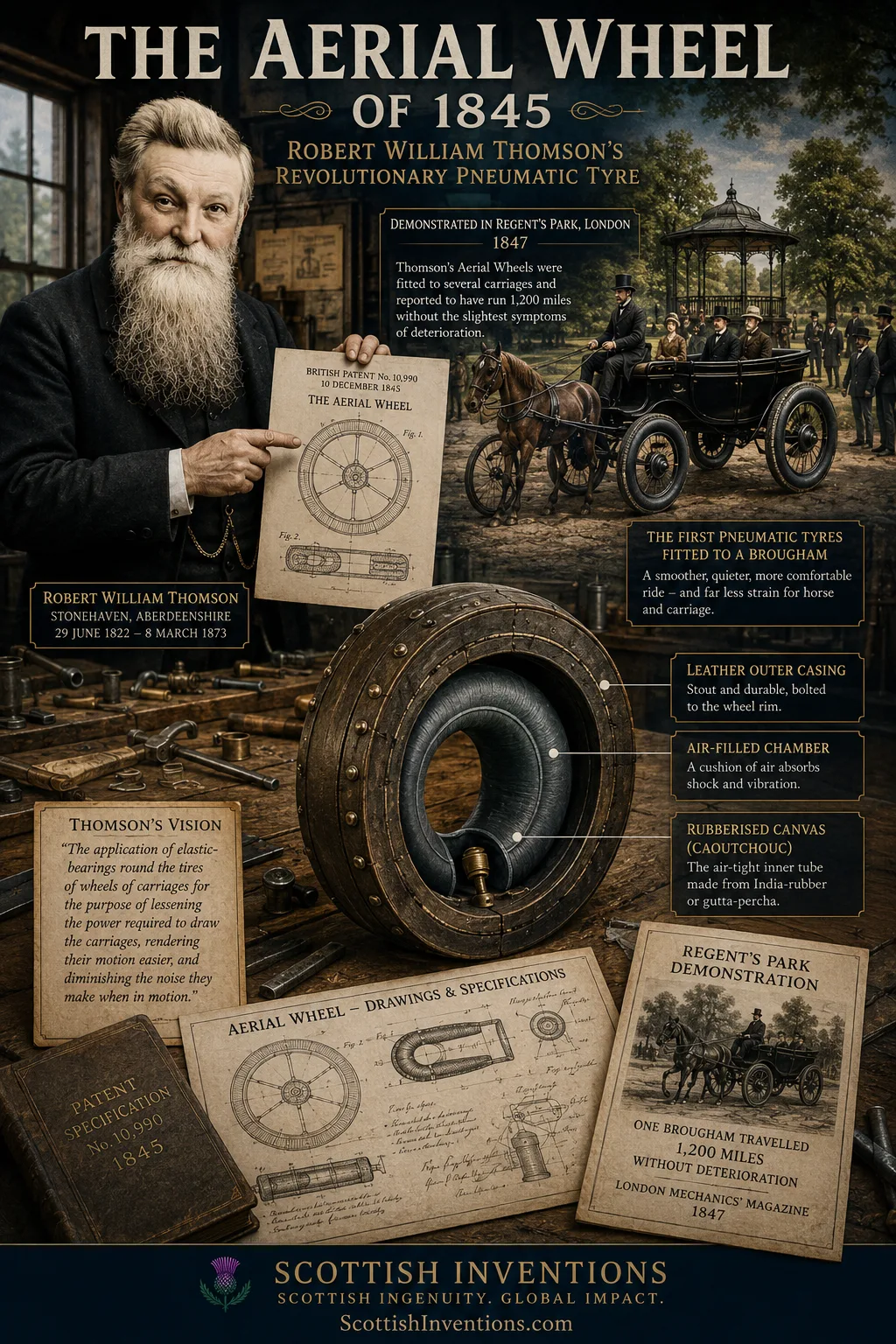
Born in Stonehaven, Aberdeenshire on 29 June 1822, Robert William Thomson was a prodigious self-taught engineer. By his early twenties he had already invented a self-filling fountain pen and a method of detonating mines by electricity. On 10 December 1845, aged just 23, he filed British Patent No. 10,990, "an improvement in carriage wheels," and the pneumatic tyre was born.
Thomson's design was strikingly modern: a hollow rubberised canvas inner tube inflated with compressed air, enclosed in a stout leather outer casing bolted to the wheel rim. In 1847 his "Aerial Wheels" were fitted to a brougham and demonstrated in London's Regent's Park. The London Mechanics' Magazine reported that a single set ran 1,200 miles without the slightest symptoms of deterioration.
But Thomson was a man ahead of his industry. Rubber was scarce and prohibitively expensive in the 1840s, the bicycle was still decades away, and the motor car not yet imagined. The Aerial Wheel was a beautiful answer to a question almost nobody was yet asking. Thomson moved on - patenting the first self-propelled road steamer and a fountain pen - and the world's first pneumatic tyre quietly slipped from public memory.
John Boyd Dunlop (1840-1921)
John Boyd Dunlop was born on 5 February 1840 at Dreghorn in Ayrshire, the son of a farmer. He trained as a veterinary surgeon at Edinburgh's Dick Vet School and, in 1867, moved his thriving practice to Belfast. He had no idea Thomson's 1845 patent existed.
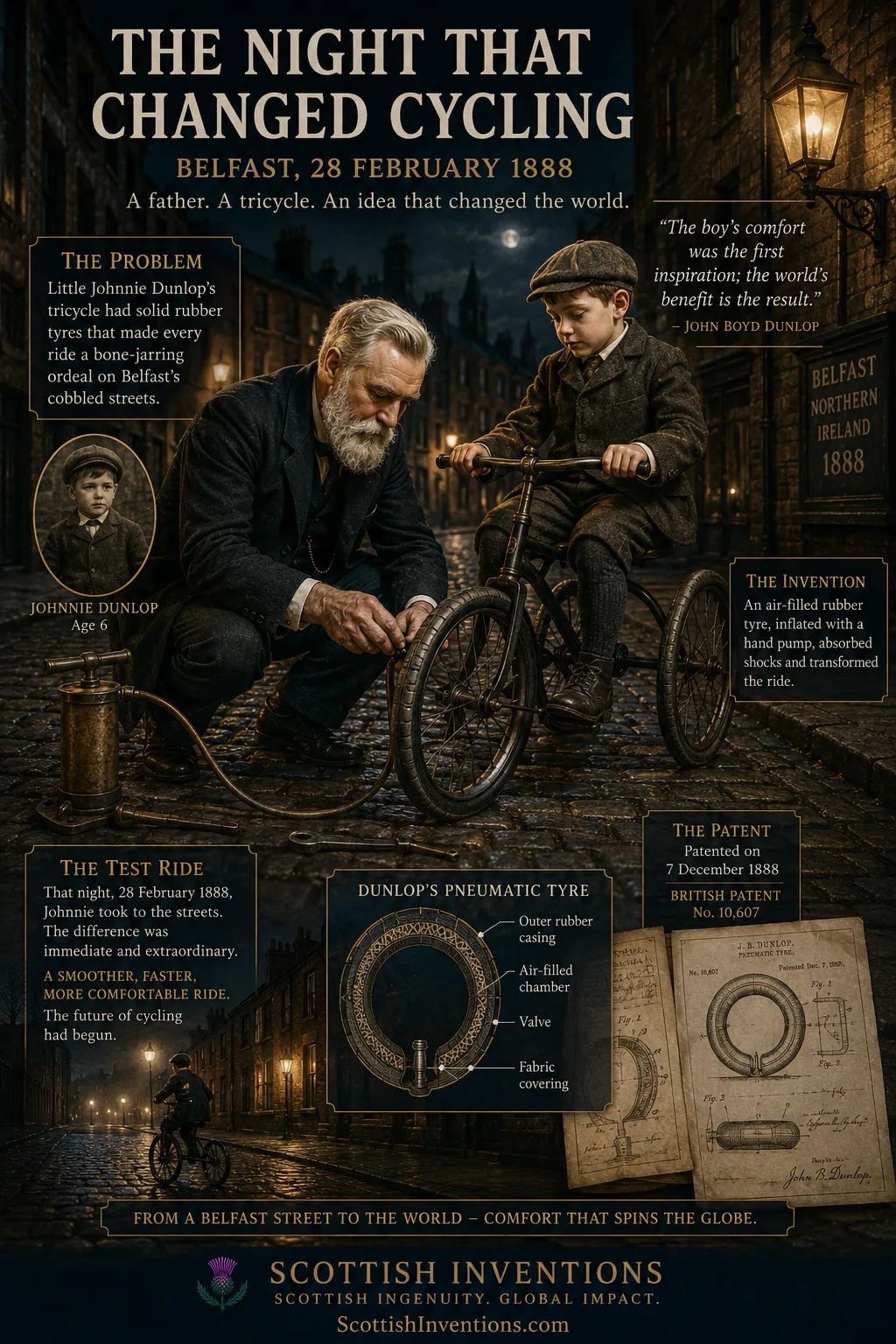
The story is now a fixture of Scottish folklore. In late February 1888 his nine-year-old son Johnnie complained that his solid-rubber tricycle made every ride a bone-jarring ordeal on Belfast's cobbled streets. Dunlop, used to thinking about animal comfort, wrapped a thin rubber sheet around a wooden disc, glued the edges, and inflated it with a football pump. On the night of 28 February 1888, Johnnie took his rebuilt tricycle out into the lamplit streets - and the future of cycling, then motoring, then aviation, rolled silently after him.
"The boy's comfort was the first inspiration; the world's benefit is the result."
On 7 December 1888, Dunlop filed British Patent No. 10,607. In 1889 a young Belfast cyclist named Willie Hume won every race at Queen's College Sports riding on Dunlop tyres - the tyre's first public victory. Within five years the Pneumatic Tyre Company was supplying half the world's bicycles.
Why Thomson Was Forgotten and Dunlop Took Off
When Dunlop's 1888 patent was challenged in court, Thomson's prior art was rediscovered and Dunlop's original patent was formally invalidated in 1892. Yet the Dunlop name lived on - and Thomson stayed in the shadows. Why?
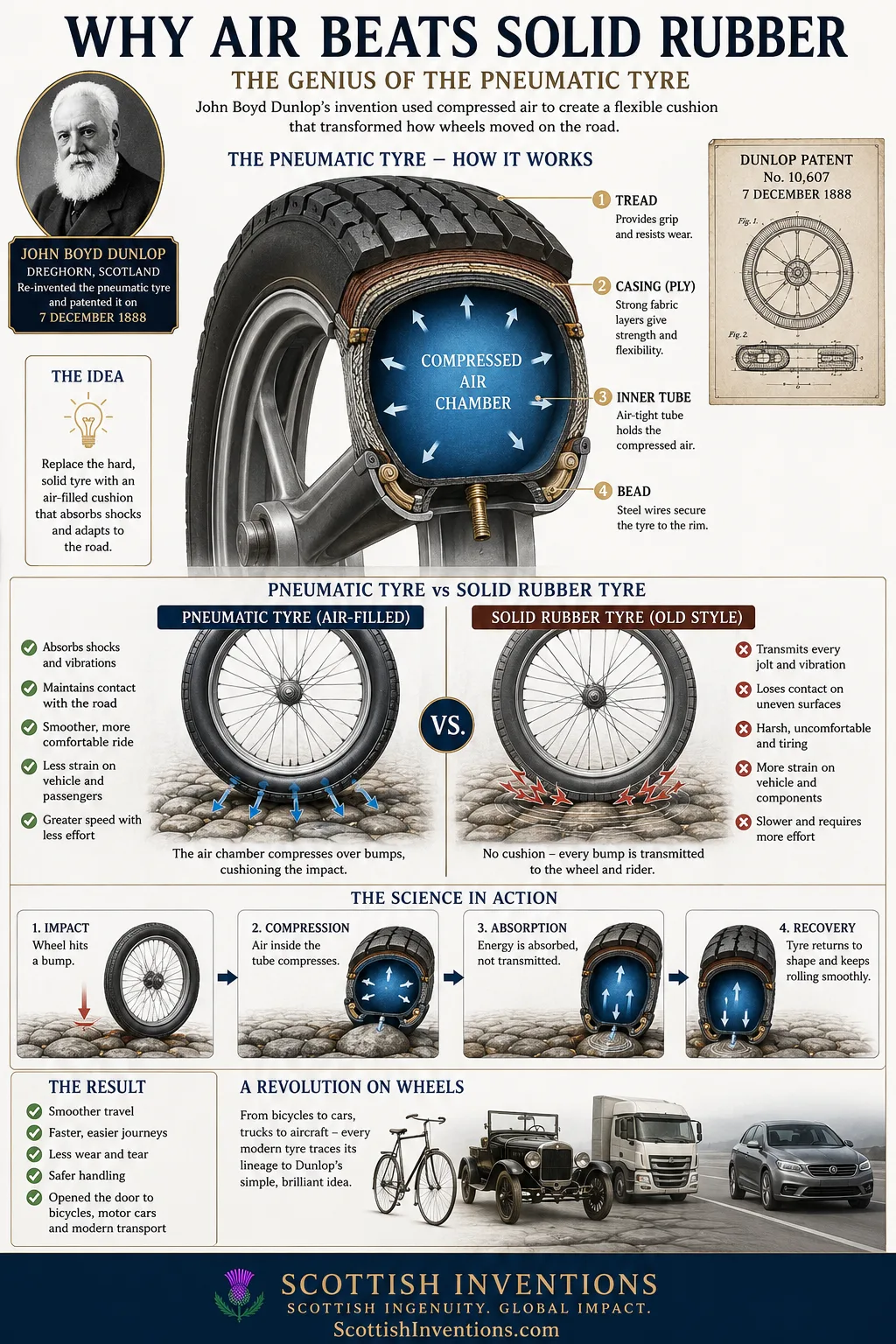
Timing decided everything. By 1888 the safety bicycle had created mass demand for a smoother ride; vulcanised rubber was abundant and cheap; the motor car was just five years away from changing the world. Dunlop's idea landed on fertile ground that simply did not exist in 1845. The pneumatic tyre's genius is the same in both patents - a compressed air chamber that absorbs impact, maintains road contact and recovers instantly - but Dunlop happened to invent it at the precise moment civilisation was ready to roll.
From Bicycle to Motor Car
The bicycle boom of the 1890s was the pneumatic tyre's first global stage. Then, in 1895, the Michelin brothers fitted air-filled tyres to a Peugeot motor car in the Paris-Bordeaux-Paris race. The motor industry never looked back. Without pneumatic tyres, no motorway, no Formula One, no global haulage, no jet aircraft landing gear, no school run.
It is a lineage that runs straight back to two Scottish patents - and to the same elegant principle: trap a column of compressed air between the road and the wheel, and let physics do the rest. The pneumatic tyre joins a long Scottish list that also includes James Watt's improvements to the steam engine, Alexander Graham Bell's telephone, and John Logie Baird's television.
Inventor Comparison
| Robert William Thomson | John Boyd Dunlop | |
|---|---|---|
| Birthplace | Stonehaven, Aberdeenshire | Dreghorn, Ayrshire |
| Invention date | 1845 | 1888 |
| Patent | British Patent No. 10,990 | British Patent No. 10,607 |
| Significance | First pneumatic tyre - the Aerial Wheel | First commercially successful pneumatic tyre |
| Legacy | Visionary forerunner; rediscovered in 1892 court case | Founded global Dunlop tyre industry |
Timeline of the Pneumatic Tyre
1845
Thomson patents the Aerial Wheel
Robert William Thomson registers British Patent No. 10,990 - the world's first pneumatic tyre.
1847
Regent's Park demonstration
Aerial Wheels fitted to broughams in London cover 1,200 miles without deterioration.
1888
Dunlop reinvents the tyre
John Boyd Dunlop fits an air-filled tyre to his son's tricycle in Belfast and files Patent No. 10,607.
1889
First competitive victory
Cyclist Willie Hume wins on Dunlop tyres at Queen's College Sports, sparking commercial demand.
1895
Tyres meet the motor car
Michelin adapts the pneumatic tyre for the automobile, transforming road transport.
Today
A world on air
More than 2.5 billion pneumatic tyres are manufactured worldwide each year.
Legacy
More than 2.5 billion pneumatic tyres are produced worldwide every year. Every car on every motorway, every articulated lorry, every Boeing landing on every runway, every Tour de France stage and Formula One Grand Prix rolls on the principle two Scotsmen patented independently in the nineteenth century. The Dunlop name still graces tyres made by Goodyear and Sumitomo; Thomson's reputation has been quietly restored by engineers and historians who recognise his 1845 patent as the original.
It is one of the most quietly important inventions in human history - and Scotland gave it to the world not once, but twice.
Did You Know?
Invented twice in Scotland
Both the original 1845 patent and the 1888 reinvention came from Scottish minds.
43 years apart
Thomson patented in 1845; Dunlop patented again in 1888 - independently.
1,200 miles without wear
Thomson's Aerial Wheels were tested on a brougham in London with no measurable deterioration.
Born for a child's tricycle
Dunlop's prototype was built so his son Johnnie could ride more smoothly on Belfast's cobbles.
Won its first race in 1889
A cyclist using Dunlop tyres beat the field at Belfast's Queen's College Sports - the tyre's first public victory.
2.5+ billion tyres a year
Every car, truck, bus and aircraft today traces its rubber lineage back to two Scottish patents.
Frequently Asked Questions
▸Who invented the pneumatic tyre?
The pneumatic tyre was first invented by Scottish engineer Robert William Thomson in 1845 and independently reinvented by Scottish veterinary surgeon John Boyd Dunlop in 1888. Thomson patented the original Aerial Wheel, while Dunlop produced the version that achieved commercial success and powered the modern transport revolution.
▸What was Robert William Thomson's Aerial Wheel?
The Aerial Wheel was Thomson's 1845 invention, patented as British Patent No. 10,990. It used a hollow rubberised canvas inner tube inflated with air and enclosed in a stout leather outer casing bolted to the wheel rim. Demonstrated in Regent's Park in 1847, one brougham fitted with Aerial Wheels travelled 1,200 miles with no measurable deterioration.
▸Why is John Boyd Dunlop more famous than Robert William Thomson?
Dunlop's 1888 tyre arrived just as bicycles, then motor cars, were becoming mass-market machines, so demand was enormous. Thomson's 1845 design was technically brilliant but came decades before rubber manufacturing and road networks could support it. Dunlop's patent also seeded a global company, cementing his name in public memory.
▸When was the first pneumatic tyre patented?
The first pneumatic tyre was patented on 10 December 1845 by Robert William Thomson of Stonehaven, Aberdeenshire, as British Patent No. 10,990. John Boyd Dunlop's independent reinvention was patented on 7 December 1888 as British Patent No. 10,607 - 43 years later.
▸How did pneumatic tyres change transportation?
Pneumatic tyres replaced jolting solid rubber and iron with a cushion of compressed air, making vehicles faster, quieter, safer and far more comfortable. They enabled the bicycle boom of the 1890s, made the motor car practical, and today underpin cars, trucks, aircraft landing gear and racing - over 2.5 billion tyres are produced each year worldwide.
▸Is the Dunlop tyre company still operating today?
Yes. The Dunlop brand founded on the back of John Boyd Dunlop's 1888 patent still exists today, manufactured and licensed by major tyre groups including Goodyear and Sumitomo Rubber Industries. The name remains one of the most recognised in motorsport, aviation and road transport more than 135 years after the original patent.
Conclusion
The pneumatic tyre is a tale of two patents, two Scotsmen and one luminous idea. Robert William Thomson dreamed it up in 1845, decades before the world was ready. John Boyd Dunlop reinvented it in 1888, just as the world began to roll. Between them they delivered the silent, cushioned, dependable wheel on which all modern transport now turns - born in Scotland, invented for the world.