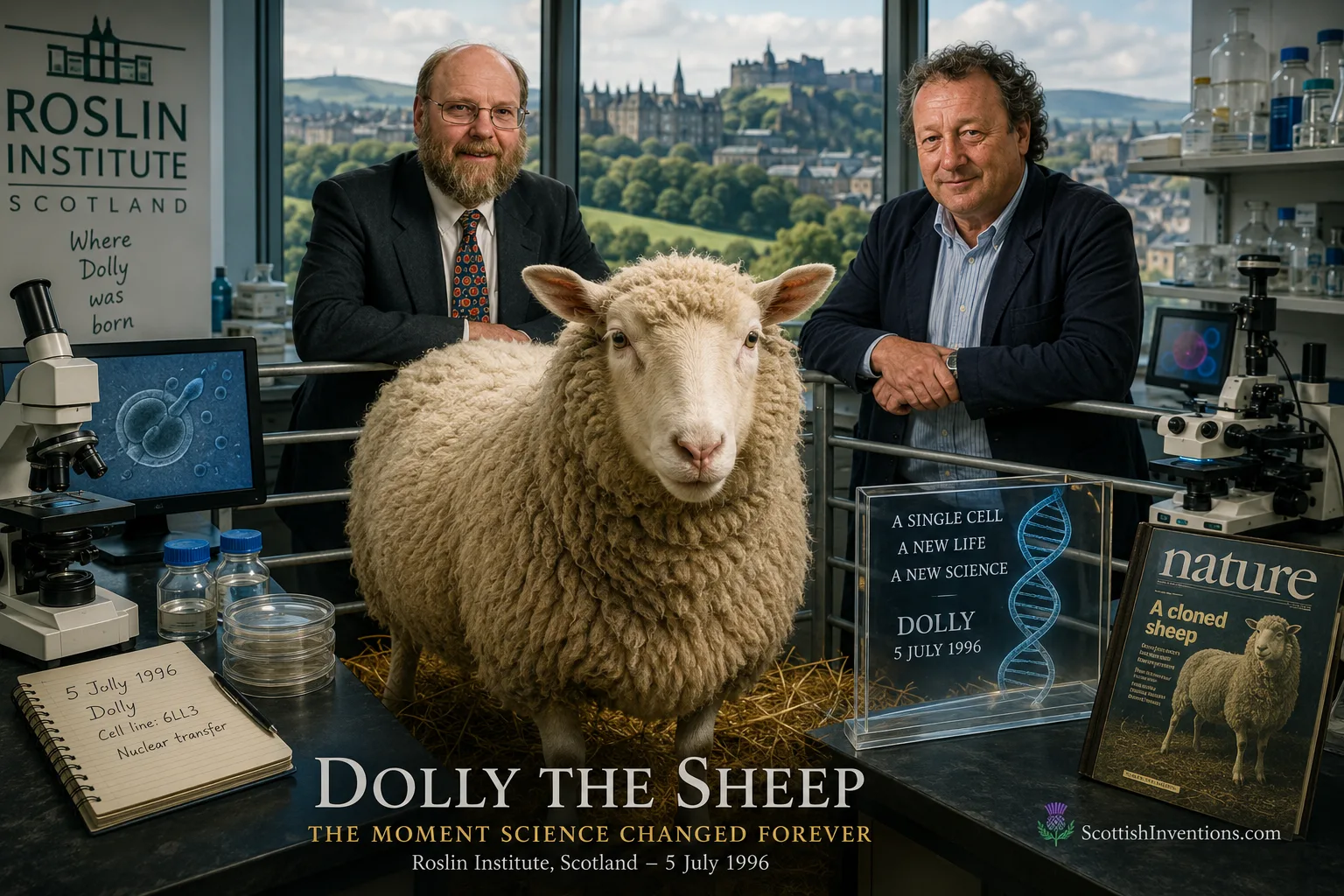
Dolly the Sheep
by Ian Wilmut & Keith Campbell
Introduction — the lamb that rewrote biology
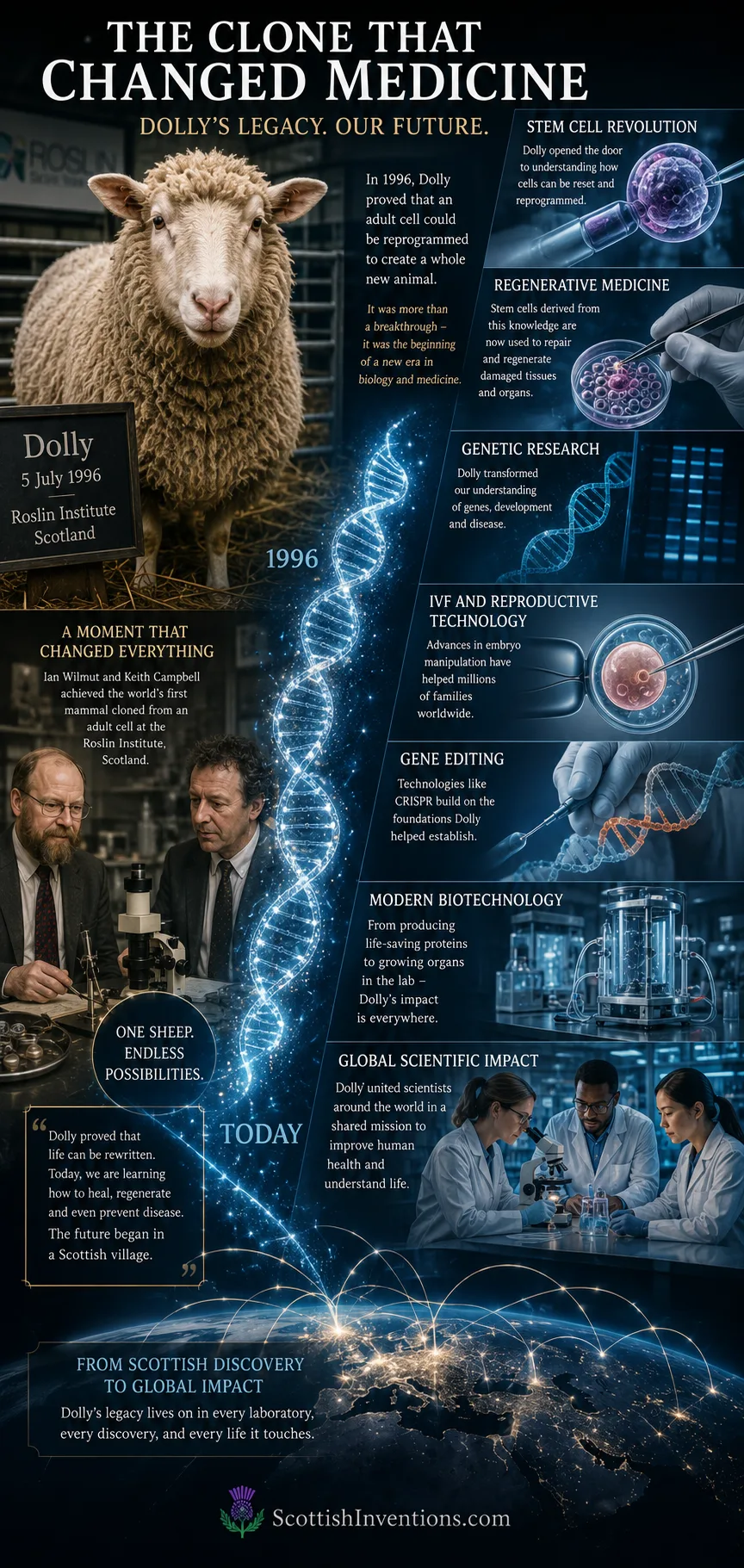
Of all the discoveries ever made on Scottish soil, few have rippled outward as far as the one that began with a single lamb in a quiet field outside Edinburgh. On 5 July 1996, at the Roslin Institute in Midlothian, a Finn Dorset ewe gave birth to a 6.6-kilogram lamb known in the laboratory only as 6LL3. The world would come to know her as Dolly — the first mammal ever cloned from an adult body cell.
Dolly was not just an extraordinary animal; she was a living refutation of a century of biological dogma. Her existence proved that the DNA in a fully grown, specialised cell still held the complete blueprint to build a whole new creature. From that single Scottish lamb came the modern stem-cell revolution, the foundations of regenerative medicine, and a worldwide bioethics debate that continues to this day.
Two Englishmen, one Scottish triumph
Like Joseph Lister — the Englishman whose revolutionary antiseptic surgery was developed in Glasgow and Edinburgh — the men behind Dolly were born south of the border, but their world-changing work was done entirely in Scotland.
Sir Ian Wilmut (1944–2023) was born in Hampton Lucy, Warwickshire, and read agricultural science at Nottingham before completing a PhD on the deep-freezing of embryos at Darwin College, Cambridge. In 1973 he took a post at the Animal Breeding Research Organisation at Roslin, just south of Edinburgh, where he would spend his entire career studying embryo development and, later, genetic engineering of livestock.
Keith Campbell (1954–2012) was born in Birmingham to an English mother and a Scottish father, and began his schooling in Perth, Scotland. After a winding route through microbiology at Queen Elizabeth College, London and a DPhil at the University of Sussex, he joined Roslin in 1991. Wilmut hired him precisely because Campbell's expertise in the cell cycle could solve the problem that had defeated everyone else. The work was funded partly by the Scottish-based PPL Therapeutics and carried out using a Scottish Blackface egg and a Scottish Blackface surrogate. Dolly is, in every sense that matters, a Scottish invention.
The Dogma That Said Cloning Was Impossible
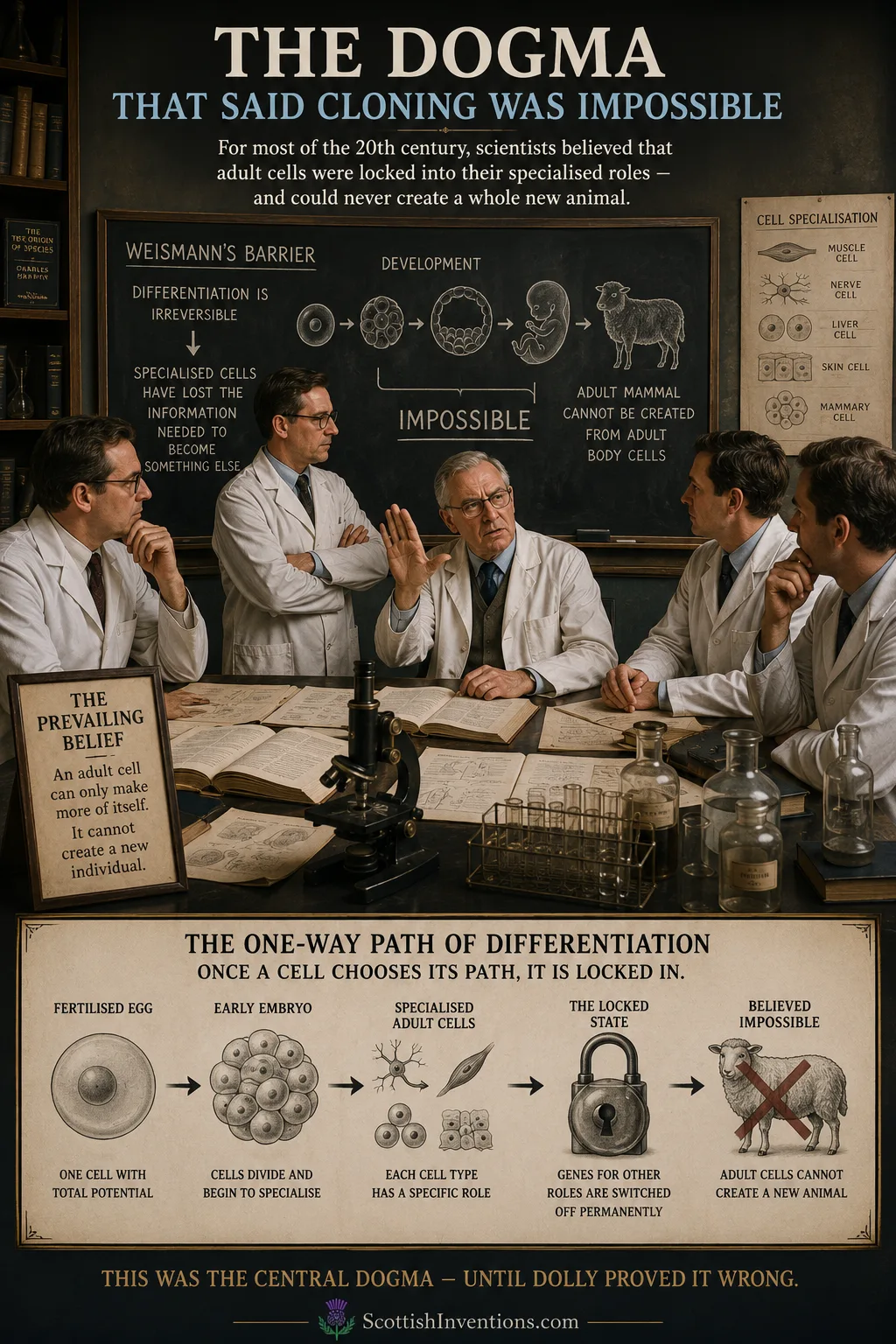
To understand the magnitude of Dolly, you must understand the dogma she destroyed. As an animal develops, a single fertilised egg divides and its descendant cells differentiate into specialised types — skin, muscle, nerve, liver, udder. The prevailing belief through much of the twentieth century, rooted in ideas associated with the nineteenth-century biologist August Weismann, was that this specialisation was essentially irreversible. Once a cell became an udder cell, the genetic information it no longer needed was switched off, lost, or permanently locked away.
Earlier experiments in amphibians had begun to crack this idea. From 1958 onward John Gurdon showed that nuclei taken from specialised cells of the frog Xenopus could produce swimming tadpoles, and in 1966 even fully developed frogs from intestinal cell nuclei — work for which he shared the 2012 Nobel Prize. But frogs are not mammals. Through the 1970s and 1980s, most biologists held firm to the view that the mammalian case was fundamentally different — that the genome of an adult mammalian cell simply could not be persuaded to start over. Somatic cell nuclear transfer from an adult mammal was considered, by serious scientists, to be impossible.
The Breakthrough — And Campbell's Quiet Genius
The Roslin team's path to Dolly ran through earlier successes. In July 1995, Campbell and Bill Ritchie produced Megan and Morag, lambs cloned from cultured embryo-derived cells — proving that cells grown and differentiated in culture could still yield live offspring. The decisive insight, however, was Campbell's. He recognised that the cell cycles of the donor nucleus and the recipient egg had to be coordinated, and that the donor cell should be pushed into a quiescent, non-dividing G0 state before transfer. By starving the cells of nutrients, the team could arrest them in this dormant state, making the nucleus far more amenable to being reprogrammed by the egg.
The process, in plain terms: the team took a mammary gland cell from a year-old Finn Dorset ewe; starved it into the quiescent G0 state; removed the nucleus from an unfertilised egg taken from a Scottish Blackface ewe; fused the donor cell with the enucleated egg using pulses of electricity; cultured the resulting embryo for around six days; and implanted it into a surrogate Scottish Blackface ewe.
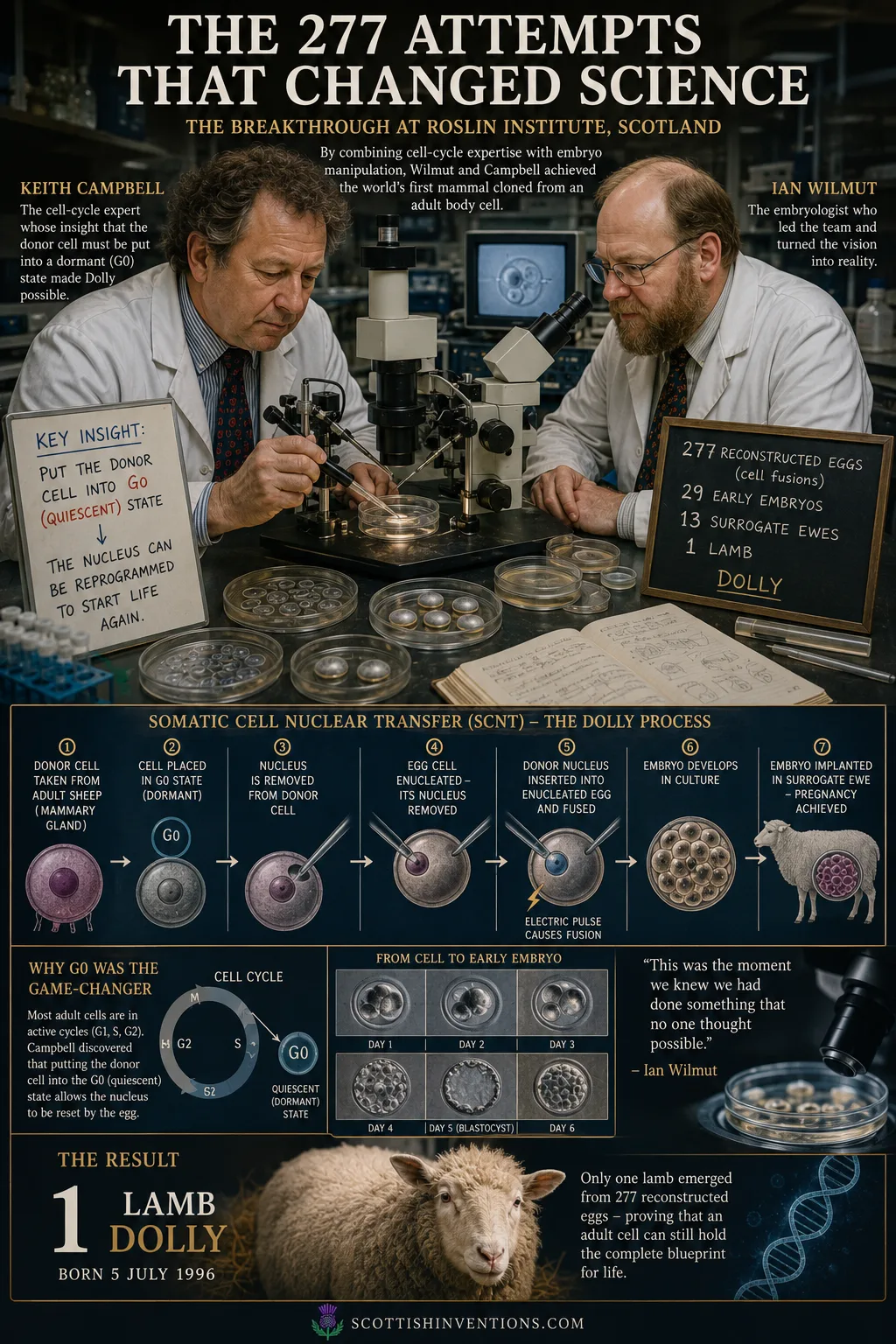
From the adult mammary cell line, the team made 277 reconstructed eggs. Of these, 29 developed into early embryos and were transferred into 13 surrogate ewes. Only one pregnancy went to full term. After 148 days, a 6.6-kg lamb with the laboratory designation 6LL3 was born on 5 July 1996. Because the donor cell came from a mammary gland, the Roslin stockmen christened her after the country singer Dolly Parton.
“This was the moment we knew we had done something that no one thought possible.”
Why Dolly Mattered — The Science
Dolly proved that the DNA in an adult, fully differentiated somatic cell retains the complete genetic blueprint of the whole organism, and that it can be reprogrammed to build an entire new animal. The decades-old dogma of irreversible differentiation was overturned in a single Scottish lamb.
The implications cascaded outward. Dolly gave enormous momentum to therapeutic cloning, to stem-cell research, and to the study of cellular ageing and reprogramming. Critically, she set the stage for the most important development in the field: in 2006 Shinya Yamanaka showed that introducing just four genes could reprogram an adult mouse cell back into a pluripotent stem-cell-like state — induced pluripotent stem (iPS) cells. The conceptual leap that reprogramming an adult mammalian cell was even possible had been demonstrated by Dolly.
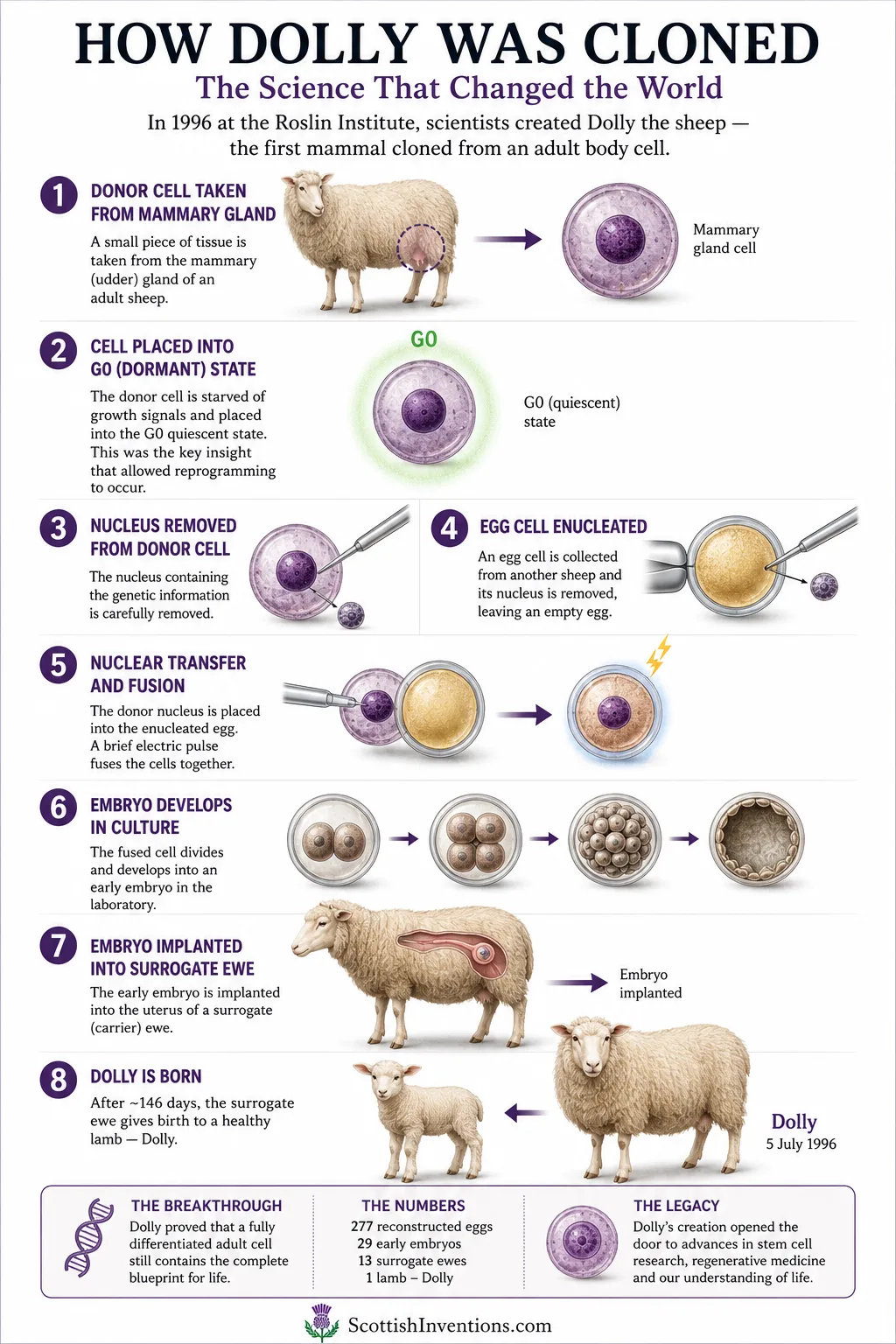
How Dolly Was Cloned — Somatic Cell Nuclear Transfer in Eight Steps
1. Donor cell taken
A tissue sample is taken from the mammary (udder) gland of an adult Finn Dorset ewe — the genetic donor.
2. Cell starved into G0
The donor cell is deprived of nutrients so it drops into a dormant, quiescent (G0) state — Campbell's key insight.
3. Nucleus removed
The nucleus containing the donor's complete DNA is carefully extracted.
4. Egg enucleated
An unfertilised egg from a Scottish Blackface ewe has its own nucleus removed, leaving an empty shell.
5. Nuclear transfer & fusion
The donor nucleus is inserted into the empty egg and a brief electric pulse fuses the two together.
6. Embryo cultured
The reconstructed cell divides in the lab for around six days, becoming an early embryo.
7. Embryo implanted
The embryo is transferred into the uterus of a surrogate Scottish Blackface ewe.
8. Dolly is born
After 148 days, the surrogate gives birth to a healthy lamb — the first mammal ever cloned from an adult cell.
Dolly's life, death and the ageing controversy
Dolly lived her entire life at the Roslin Institute, where she became the most photographed sheep in history — friendly, curious, and thoroughly spoiled by visitors. Crucially, she bred naturally with a Welsh Mountain ram named David, producing six lambs between 1998 and 2000 and demonstrating that a cloned animal could reproduce normally.
In February 2003 a CT scan revealed tumours in her chest — ovine pulmonary adenocarcinoma, a lung disease caused by a retrovirus common among sheep kept indoors. She was euthanised on 14 February 2003, aged six and a half. Her body was preserved by taxidermy and donated to National Museums Scotland; she has been on display at the National Museum of Scotland in Edinburgh ever since.
A 1999 study found Dolly's telomeres were about 20% shorter than expected for a sheep her age, raising fears she had been 'born old'. But a 2016 University of Nottingham study of thirteen cloned sheep — four of them genetic copies of Dolly — found that 'SCNT has no obvious detrimental long-term health effects'. The consensus today is that premature ageing is not an inevitable consequence of cloning.
Legacy
Sir Ian Wilmut spent his later career championing regenerative medicine, becoming founding director of the MRC Centre for Regenerative Medicine at the University of Edinburgh in 2006. He was appointed OBE in 1999 and knighted in 2008 for services to science. In a striking act of scientific honesty, in 2006 he acknowledged that Keith Campbell deserved '66 per cent' of the credit for Dolly. He died in 2023, aged 79.
Keith Campbell — and this point matters — was not knighted, despite frequent claims to the contrary. He shared the 2008 Shaw Prize for Medicine and Life Sciences with Wilmut and Yamanaka, and received the International Embryo Transfer Society's Pioneer Award posthumously in 2015. He died at his home in Derbyshire in 2012, aged 58.
Dolly opened the floodgates. Cats, dogs, cattle, pigs, horses, deer, mice and rats have all been cloned using the same fundamental technique. Cloning has been applied to endangered and even extinct species — a Pyrenean ibex was briefly brought back from extinction in 2009. The Roslin Institute, now part of the University of Edinburgh, continues to build on the Dolly legacy in genetics and regenerative medicine. The broadest legacy, though, is conceptual: Dolly changed our understanding of what a cell can do. She proved that the developmental clock can be turned back — and that the future of medicine began in a Scottish village.
Dolly the Sheep — A Timeline
1991
Keith Campbell joins the Roslin Institute, bringing deep expertise in the cell cycle.
1995
Megan and Morag — lambs cloned from cultured embryo cells — prove the technique can work.
5 July 1996
A 6.6 kg Finn Dorset lamb, laboratory designation 6LL3, is born at Roslin: Dolly.
22 Feb 1997
Roslin Institute confirms Dolly's existence after the story breaks early in The Observer.
27 Feb 1997
The landmark paper appears in Nature 385: 810–813, making Dolly a global sensation.
1998–2000
Dolly breeds naturally with a Welsh Mountain ram, producing six lambs.
14 Feb 2003
Dolly is euthanised after a CT scan reveals lung tumours; her body is preserved for the National Museum of Scotland.
2006
Wilmut publicly states Campbell deserved '66 per cent' of the credit for Dolly.
Related Inventions
Beta-Blockers
Sir James Black · 1964
The drug class that revolutionised cardiology.
Ultrasound
Ian Donald · 1956
Diagnostic ultrasound imaging.
Weekly Scottish Innovation Facts
Delivered to your inbox every Sunday. No spam, just brilliance.