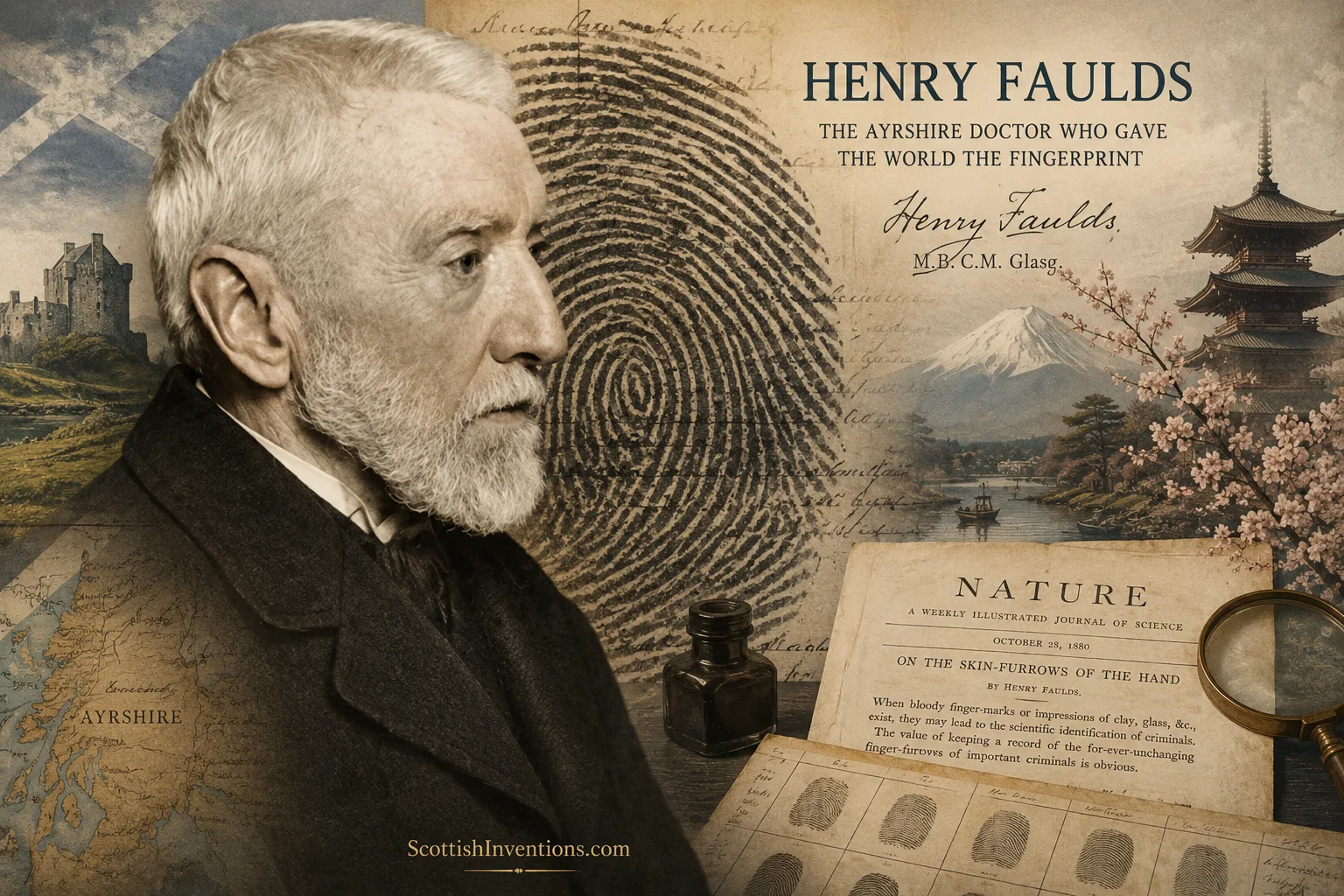
Fingerprint Identification
by Henry Faulds
Introduction
Every time a smartphone unlocks at the press of a thumb, every time a crime-scene print is matched in a police database, the world is using an idea first set down in print by a Scottish doctor working in a Tokyo hospital in 1880. Henry Faulds — born in Beith, Ayrshire — was the first person to publish the proposal that the patterns on our fingertips are unique, permanent, and capable of identifying any human being on Earth. From that single short letter in Nature flowed the entire modern science of fingerprint identification, forensic biometrics and personal authentication.
Early Life and Background
Henry Faulds was born on 1 June 1843 in Beith, a small town in North Ayrshire on Scotland's west coast. The son of a modest family, he left school at thirteen to work as a clerk in Glasgow, but a hunger for learning drew him back to study. He attended classes at the Faculty of Arts at the University of Glasgow before training in medicine at Anderson's College — now part of the University of Strathclyde — and qualifying as a physician and surgeon with the M.B.C.M. from Glasgow.
A devout Presbyterian, Faulds was driven by a sense of service that pulled him beyond Scotland. After a brief medical mission in India with the Church of Scotland, he sailed for Japan in 1873 as a medical missionary, founding the Tsukiji Hospital in Tokyo — one of the first Western-style teaching hospitals in the country. There he taught surgery to Japanese students, fought epidemics of cholera and rabies, and helped establish modern medical practice in Meiji-era Japan.
The Discovery — Fingerprints in Japan (1880)
The breakthrough came almost by accident. In the late 1870s Faulds joined his friend, the American zoologist Edward Sylvester Morse, on an archaeological dig near Tokyo, examining shards of ancient Jōmon-period pottery. As he turned a fragment in his hand, Faulds noticed the unmistakable impression of a fingerprint — left thousands of years earlier by the potter who had shaped the clay.
He was transfixed. If these ridges had survived for millennia on a piece of fired clay, and if no two prints he could find were ever exactly alike, then the patterns on the human fingertip must be both unique and unchanging. He began collecting prints from his hospital colleagues, students, and patients — including monkeys at a nearby zoo — and even shaved his own ridges to prove they grew back identically. The implications, he realised, were enormous: a person could be identified, beyond all doubt, by the lines on their own skin.

The Nature Paper That Changed Forensic Science
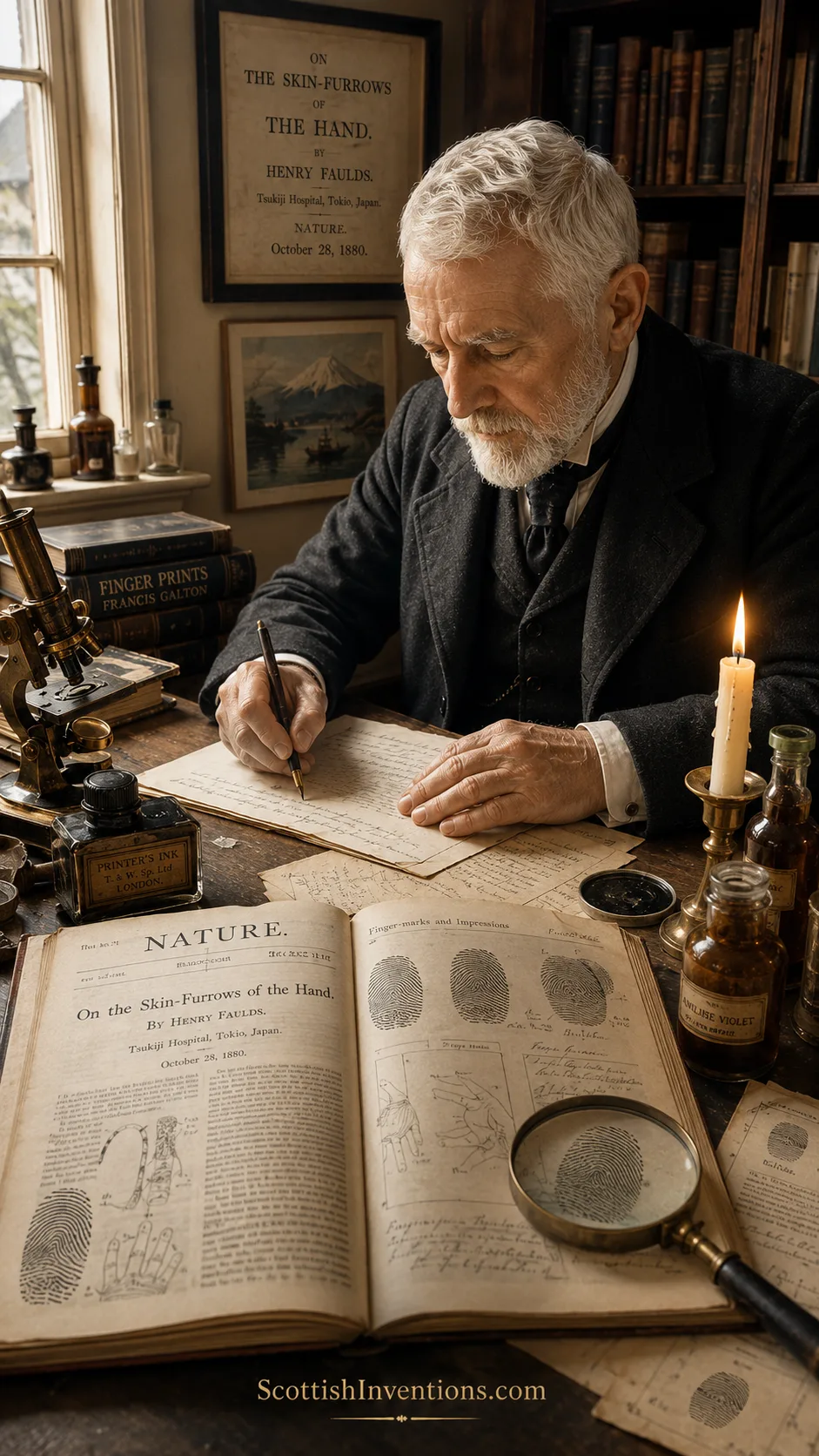
On 28 October 1880, the world's leading scientific journal, Nature, published a short letter under the title 'On the Skin-Furrows of the Hand', signed Henry Faulds, Tsukiji Hospital, Tokio, Japan. In barely a page of dense, careful prose, Faulds set out three ideas that would reshape law and identity:
First, that the patterns of ridges on the fingertips were unique to every individual. Second, that they remained unchanged throughout a person's life. And third — most far-reaching of all — that they could be used to identify criminals from prints left at the scene of a crime. 'When bloody finger-marks or impressions of clay, glass, &c., exist,' he wrote, 'they may lead to the scientific identification of criminals.'
It was the first published proposal of forensic fingerprinting anywhere in the world. Faulds had already tested the idea in practice: in Tokyo he had used a sooty fingerprint left on a whitewashed wall to clear an innocent man wrongly accused of theft, and another print to identify the true culprit — arguably the first forensic fingerprint case in history.
The Priority Dispute
Recognition was slow and bitter. A month after Faulds's paper appeared, the English civil servant William Herschel wrote to Nature describing his own use of handprints on contracts in colonial India. The two men corresponded politely at first, then less politely, then not at all. When Sir Francis Galton — a cousin of Charles Darwin — took up fingerprinting in the 1890s and published the influential book Finger Prints (1892), he leaned heavily on Herschel's work and largely sidelined Faulds.
When Scotland Yard adopted the Henry Classification System in 1901 — devised by Sir Edward Henry, drawing on Galton — the credit went to others. Faulds spent the rest of his life campaigning, often furiously, for recognition of his priority, writing pamphlets, letters and books to set the record straight. He died in 1930 in Wolstanton, Staffordshire, having returned to general practice in England, his contribution still largely unacknowledged by the establishment he had tried to convince.
Modern historians of forensic science have since restored his reputation. The 1880 Nature paper is now universally acknowledged as the first published statement of the principle of forensic fingerprint identification, and Faulds is rightly regarded as the founder of the discipline.
How Fingerprint Identification Works
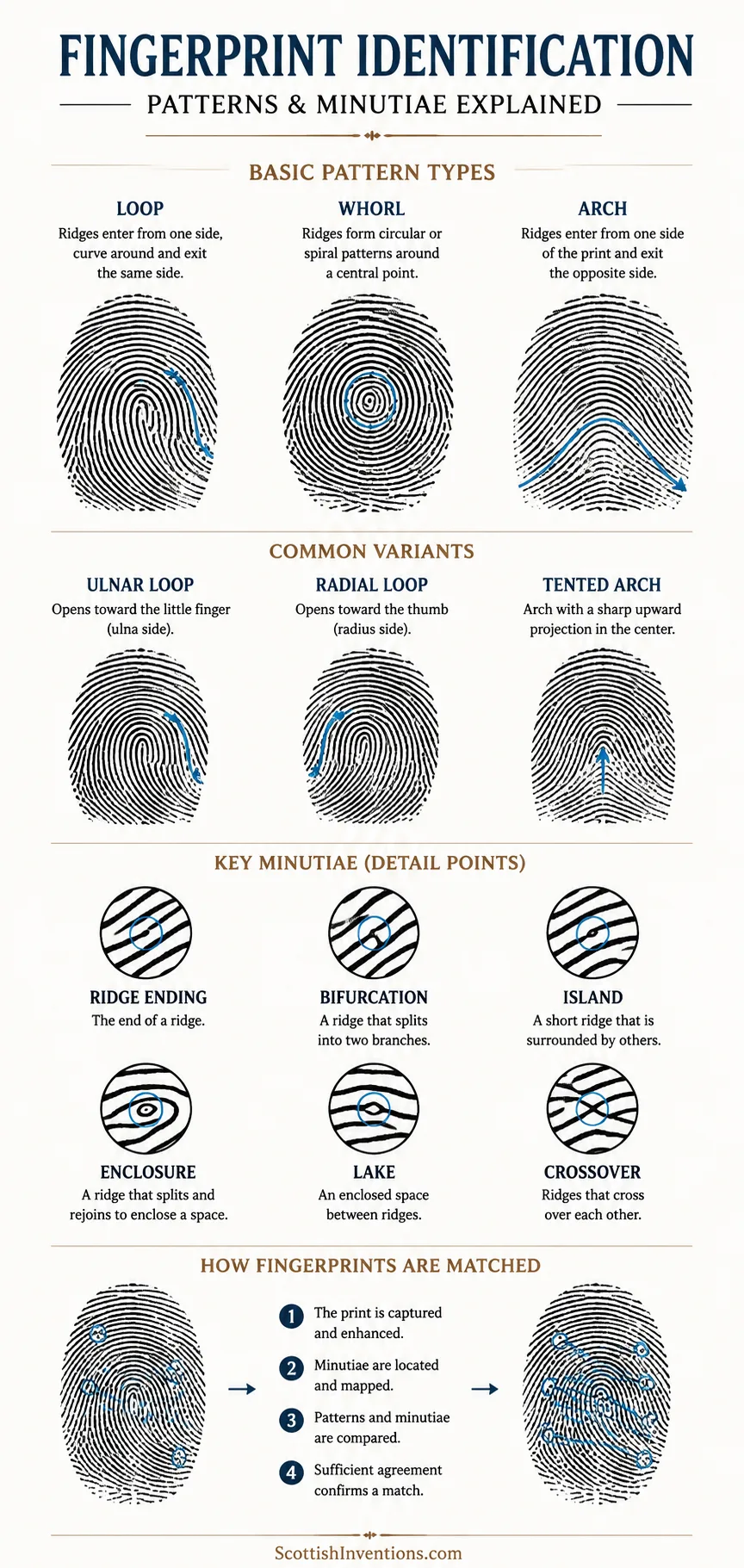
A fingerprint is a record of the friction ridges on the surface of the fingertip — patterns formed in the womb and unchanged for life, even regrowing identically after a burn or cut. Identification rests on two layers of detail: the overall pattern type, and the fine 'minutiae' within it.
The three primary pattern types are the loop (where ridges enter and exit the same side), the whorl (a circular or spiral pattern around a central point) and the arch (ridges that enter one side and exit the other). Within those patterns, examiners look for minutiae: ridge endings, bifurcations where one ridge splits into two, short isolated 'islands', enclosures, lakes and crossovers. A confirmed match typically requires a sufficient number of these minutiae to align in the same relative positions on both prints.
Beyond Forensics — Fingerprints in Modern Life
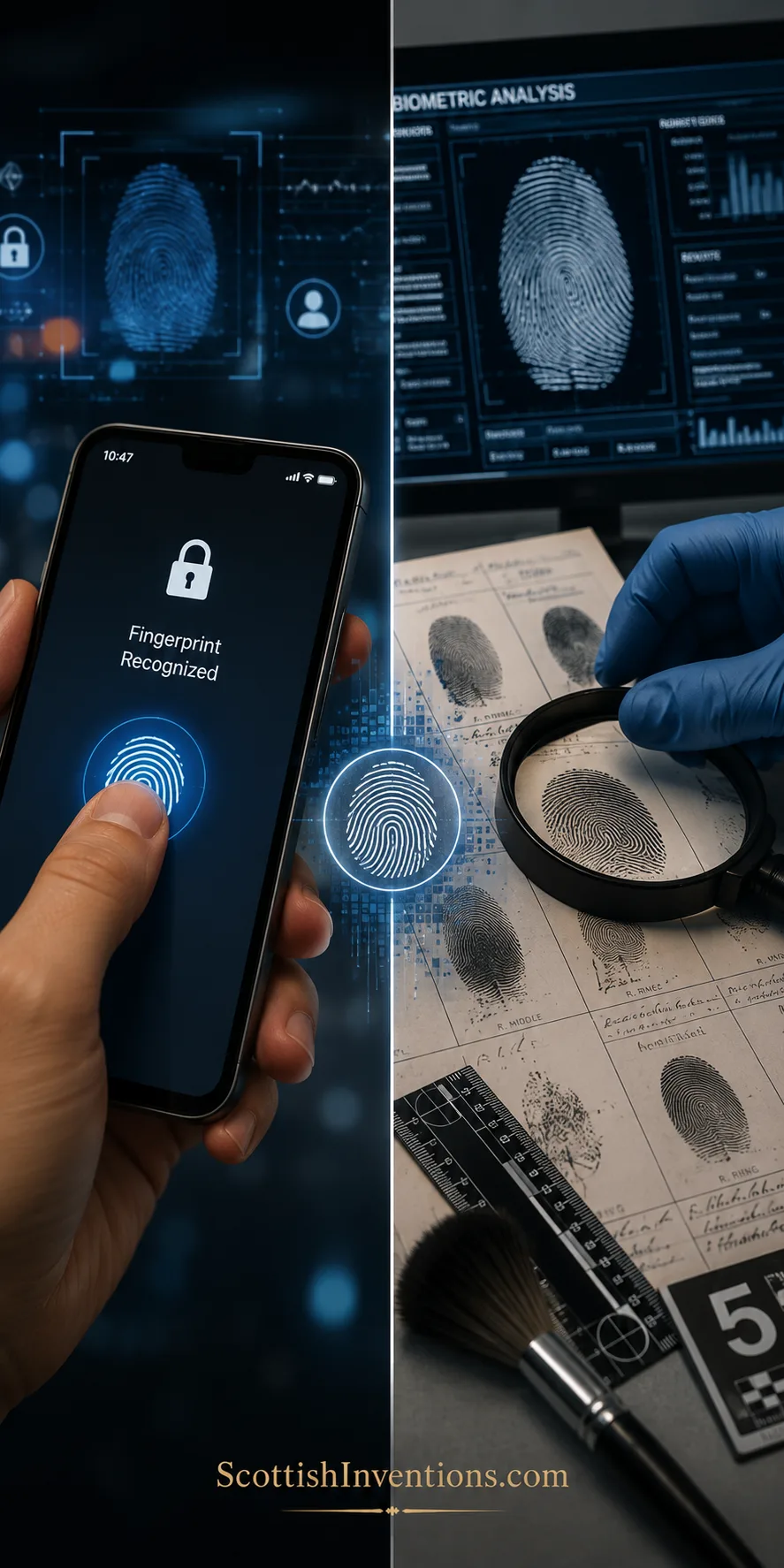
The principle Faulds proposed in his Nature letter has long since escaped the police evidence locker. Every modern smartphone with a fingerprint sensor, every laptop, every airport e-gate, every banking app authenticating a payment, every secure facility unlocked by a thumb on a scanner is using the same insight: that the ridges on the human fingertip are unique, permanent, and machine-readable.
Biometric fingerprint authentication is now one of the most widely deployed identification technologies in human history, used by billions of people every day. India's Aadhaar system alone holds fingerprint records for more than a billion citizens. Forensic AFIS databases — Automated Fingerprint Identification Systems — match crime-scene prints against tens of millions of records in seconds. Behind every one of them stands the same nineteenth-century Scottish doctor, peering at a piece of Japanese pottery and asking a simple question.
Legacy and Recognition
It took the best part of a century for Henry Faulds to receive his due. There is now a memorial to him in his birthplace of Beith, Ayrshire, and the local heritage society maintains an archive of his papers. His Nature letter of 28 October 1880 is preserved as one of the foundational documents of forensic science, reprinted in textbooks and cited in every serious history of fingerprinting.
Modern fingerprint experts, biometric engineers and forensic scientists trace the lineage of their discipline directly to a young Scottish missionary doctor in Meiji-era Tokyo. Henry Faulds did not invent the fingerprint — nature did that long before him — but he was the first person on Earth to understand what it meant, and the first to put that meaning into print.
Frequently Asked Questions
Who invented fingerprint identification? The Scottish doctor Henry Faulds was the first person to publish the principle of using fingerprints to identify individuals, in the journal Nature on 28 October 1880.
Was Henry Faulds Scottish? Yes. He was born in Beith, Ayrshire, in 1843 and trained in medicine in Glasgow before working as a medical missionary in Japan.
What did Henry Faulds discover? He recognised that the ridge patterns on human fingertips are unique to every person and unchanging throughout life, and proposed that they could be used to identify criminals from prints left at a crime scene.
When was fingerprinting first used in forensic science? Faulds reported using fingerprints to clear an innocent suspect and identify the true thief in Tokyo around 1879–80, and his Nature paper of 28 October 1880 is the first published proposal of forensic fingerprinting.
How do fingerprints identify people? Examiners match the overall pattern (loop, whorl or arch) and the precise positions of minutiae — ridge endings, bifurcations, islands and other features — to confirm that two prints came from the same finger.
Are fingerprints unique? Yes. No two people, including identical twins, have ever been found to share the same fingerprint, and the patterns remain stable from before birth until decomposition after death.
Related Inventions


Anaesthesia / Chloroform
James Young Simpson · 1847
Surgical anaesthesia using chloroform.
Weekly Scottish Innovation Facts
Delivered to your inbox every Sunday. No spam, just brilliance.