The BBC
by John Reith
Introduction — the Scotsman who invented the BBC
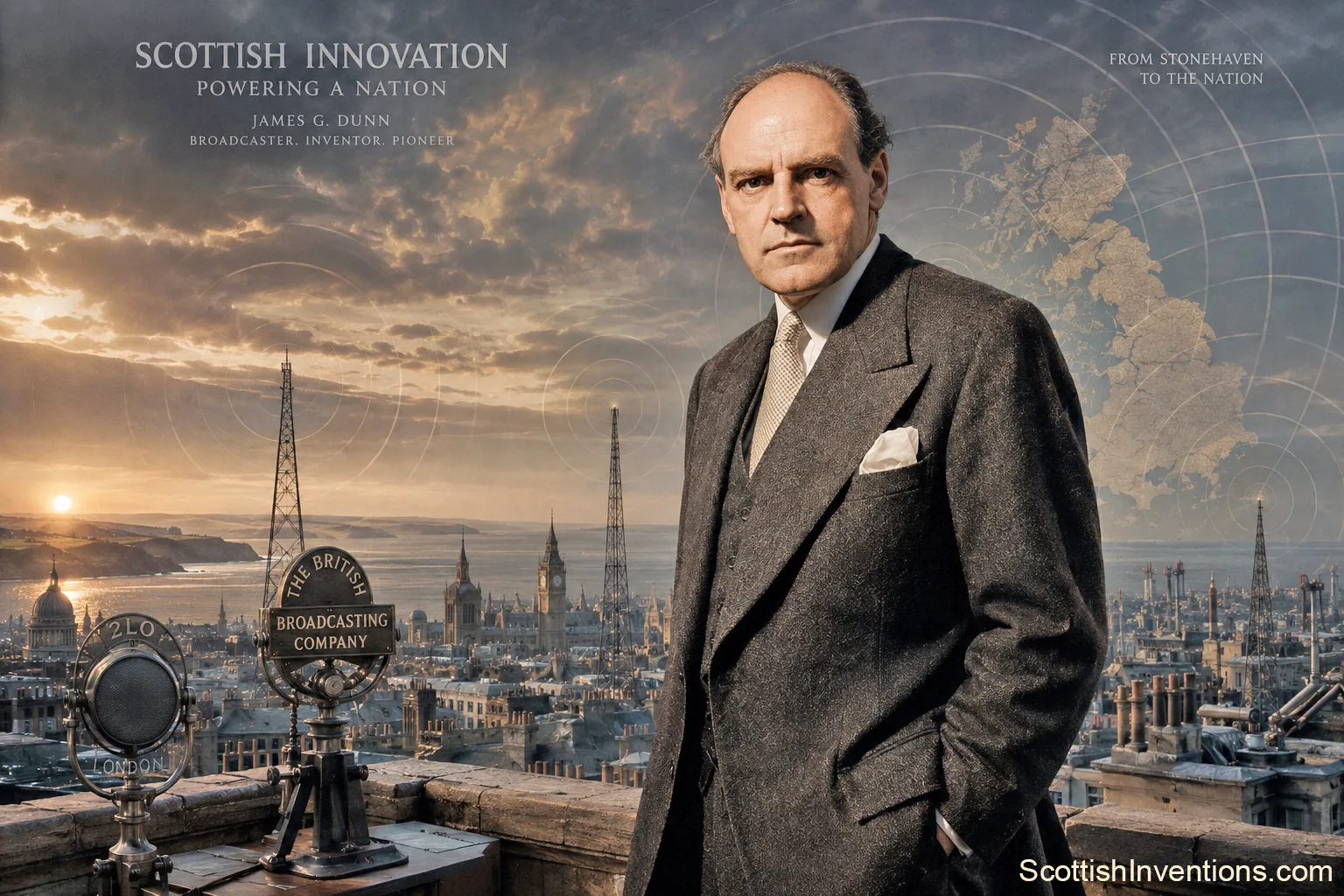
Some inventions are objects. Others are institutions. John Charles Walsham Reith — a Stonehaven-born engineer, Great War veteran and self-styled prophet of the airwaves — did not invent the wireless valve or the cathode-ray tube. What he invented was something arguably more durable: the idea that broadcasting could be a public service rather than a commercial product.
Between 1922 and 1938, the unlikely figure of John Reith took a tiny consortium of radio-set manufacturers and built it into the British Broadcasting Corporation — an independent national institution funded by the public, accountable to the public, and answerable to neither government nor advertiser. The model he created has been imitated everywhere from Canada to Japan to Australia. The phrase 'public service broadcasting' is Reith's gift to the world.
An Engineer from Stonehaven — Reith's Scottish Roots
John Reith was born on 20 July 1889 in the manse at Stonehaven, on the Kincardineshire coast, the youngest of seven children of the Rev. Dr George Reith, minister of the Free Church of Scotland's College Church in Glasgow. The household was austere, Presbyterian and rigorously moral — a world of cold mornings, family prayers, and a father who expected nothing less than excellence. The young Reith never lost the Calvinist conviction that work was a sacred duty and that institutions exist to improve the people they serve.
Educated at Glasgow Academy and at Gresham's School in Norfolk, he was steered away from the ministry his father wanted for him and into engineering. He served a five-year apprenticeship with the North British Locomotive Company in Glasgow — at the time the largest locomotive builder in Europe — learning the rigour of heavy industry from the shop floor up. He was, in his own famous formulation, 'a Scotsman with an instinct for the impossible'.
The Great War made him. Commissioned into the Royal Engineers in 1914, Lieutenant Reith was shot in the face at the Battle of Loos on 7 October 1915, the bullet ploughing a furrow across his left cheek that remained, for the rest of his towering 6 ft 6 in life, his most visible feature. Invalided home, he spent the rest of the war managing a vast munitions contract for the British government in the United States — running great engineering projects on an industrial scale, and learning the discipline of mass organisation that would later remake British broadcasting.
The British Broadcasting Company and the Birth of the BBC
In the autumn of 1922, six radio-set manufacturers — Marconi, Metropolitan-Vickers, GEC, BTH, Western Electric and the Radio Communication Company — banded together at the Post Office's prompting to form a single commercial wireless operator. The British Broadcasting Company Ltd was registered on 15 December 1922. The day before, its directors had taken on a 33-year-old Scottish engineer they had never heard of as General Manager. He had no experience in broadcasting whatsoever. His name was John Reith.
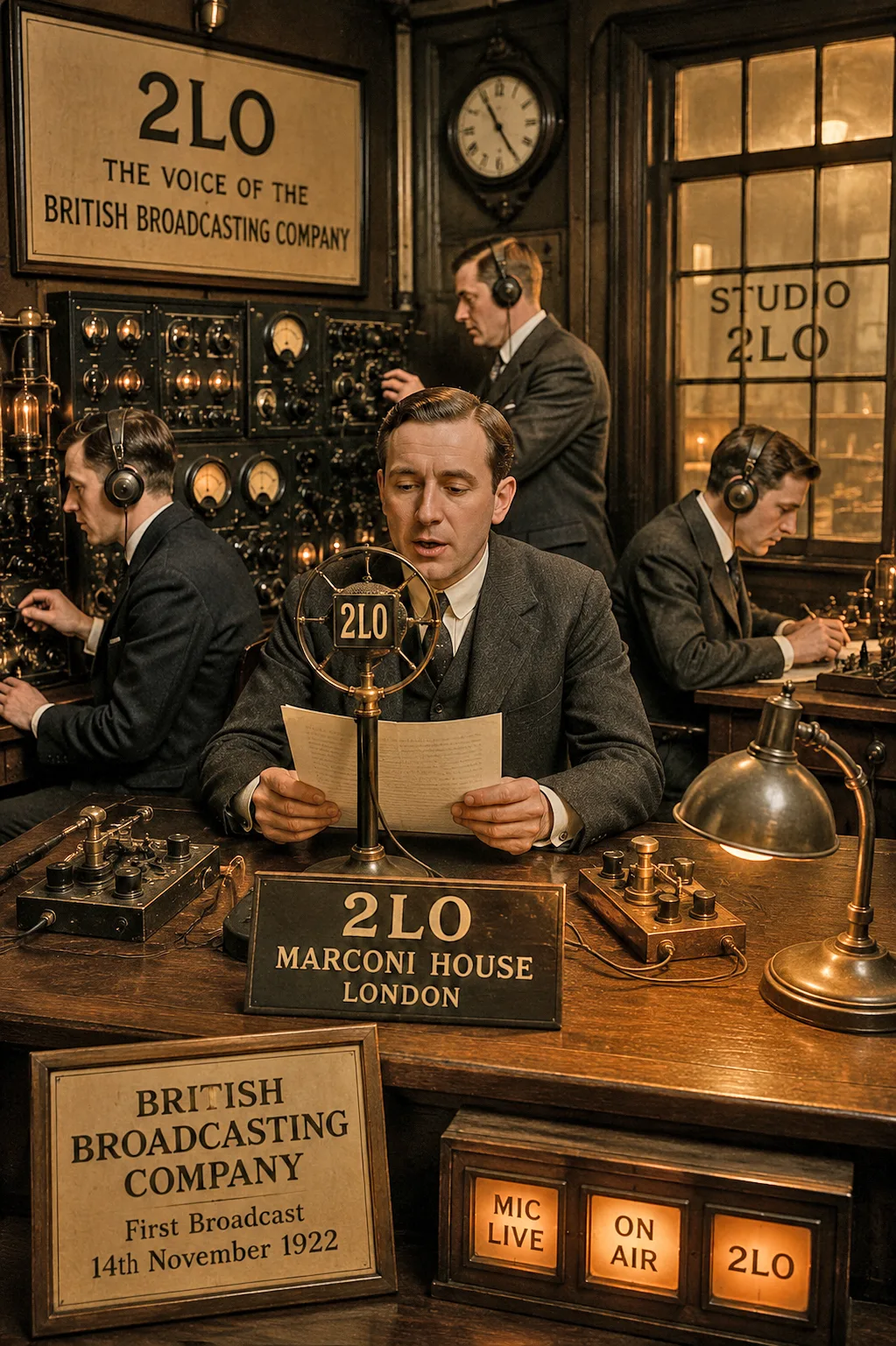
The first broadcast had already gone on air on 14 November 1922 from station 2LO at Marconi House in the Strand — a six o'clock news bulletin read twice, slowly the second time so listeners could take notes. Within months Reith had taken complete command of the fledgling operation, moved it to Savoy Hill, hired an austere corps of producers and presenters in dinner jackets, and imposed what would become known as 'Reithian' standards on every transmission. The radio set boomed: by 1925 there were over a million licensed listeners in Britain.
From the outset, Reith believed his little company was something more than a commercial enterprise — it was a national trust, given temporary stewardship of the public's airwaves. He lobbied relentlessly for it to be reorganised as a non-commercial public corporation. The Crawford Committee in 1925 agreed. On 1 January 1927 the British Broadcasting Company Ltd was dissolved and reborn by Royal Charter as the British Broadcasting Corporation, funded by a public licence fee, independent of advertisers and at arm's length from government. Reith became its first Director-General — the only man, then or since, to take an organisation from its first breath to its founding institutional charter.
Reith's Vision — Public Service Broadcasting
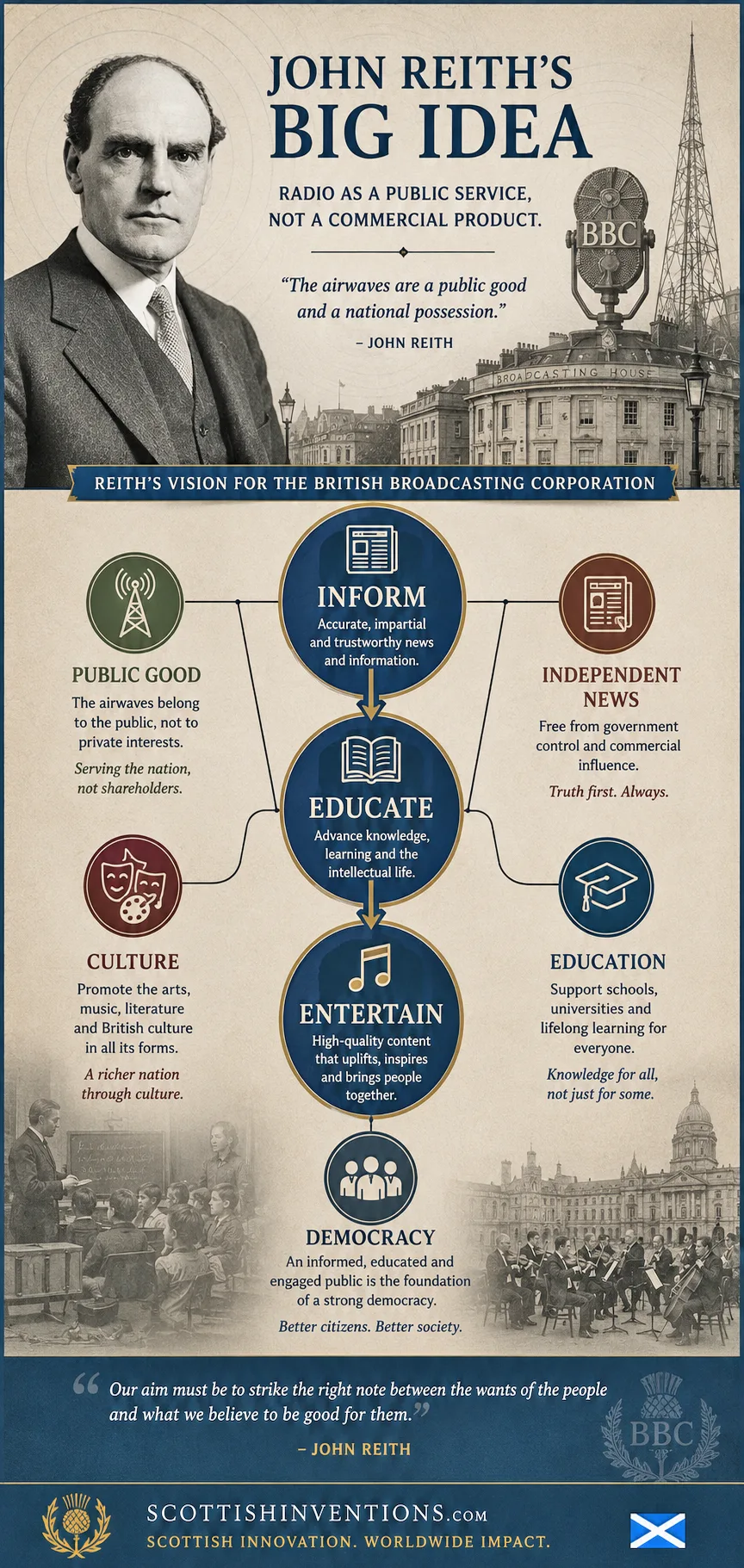
What set the BBC apart, and what set Reith apart, was an idea — radical at the time, almost universally adopted since. Broadcasting, Reith argued, was not a business but a public good. The airwaves were 'a national possession'. A broadcaster funded by the public, free of government control and free of commercial pressure, had a duty not merely to entertain its audience but to enlarge it. As he put it in his 1924 book Broadcast Over Britain: 'Our responsibility is to carry into the greatest possible number of homes everything that is best in every department of human knowledge, endeavour and achievement.'
“The airwaves are a public good and a national possession.”
Out of that conviction came the most famous formulation in the history of broadcasting: the BBC should inform, educate and entertain. The three duties were inseparable. News must be impartial and trustworthy. Music must be drawn from the great tradition. Talks must stretch the listener. The BBC was, in Reith's phrase, 'a great national university of the air'.
The Reithian Principles — Reith's Vision for Broadcasting
Inform
Accurate, impartial and trustworthy news and information — a duty owed to every citizen, not a commodity sold to consumers.
Educate
Advance knowledge, learning and the intellectual life of the nation — broadcasting as a great national university of the air.
Entertain
High-quality drama, music and comedy that uplift and unite — entertainment in service of cultural life, not a race to the bottom.
Independent
Free from government control and commercial influence — the BBC must speak with its own voice, never as a mouthpiece of state or sponsor.
Public Good
The airwaves belong to the public, not to private interests. Broadcasting is a national possession to be held in trust.
Universal
Available to everyone, everywhere, for the same modest licence fee — from city to coast, from mountain to moor.
That meant standards. Reith insisted his announcers wear evening dress at the microphone, on the principle that they were guests in the listener's home. He banned slang from the news bulletins, mandated Received Pronunciation, and refused to allow the BBC to broadcast horse-racing tips or commercial advertising of any kind. To his critics he was a moralising Calvinist autocrat; to his admirers he was protecting a young and impressionable medium from the worst impulses of the market. Either way, the principles he forged — independence, impartiality, universality, quality — are the principles by which every reputable public broadcaster on earth still claims to operate.
The BBC under Reith — What He Built
In sixteen years as the BBC's defining figure, Reith built an institution from almost nothing. By the time he resigned in 1938 the BBC employed more than 4,000 people; transmitted across the entire United Kingdom from a network of high-power transmitters; produced its own concerts under the BBC Symphony Orchestra (founded 1930); ran an enormous Radio Times that was Britain's biggest-selling magazine; and operated from a new purpose-built headquarters, Broadcasting House on Portland Place, opened in 1932 and still the BBC's London home today.
Two innovations stand out. In December 1932 the BBC Empire Service began short-wave broadcasts from a new transmitter station at Daventry, beaming British news and culture to every continent. King George V used it that Christmas to make the very first royal Christmas message — a tradition unbroken to this day. The Empire Service was the forerunner of the BBC World Service, which still reaches more than 400 million people every week in 42 languages.
The second innovation was even more startling. On 2 November 1936, from a refurbished wing of Alexandra Palace in north London, the BBC launched the world's first regular, high-definition, public television service — 405 lines, broadcast twice daily, the first scheduled high-definition television transmissions anywhere on earth. Reith himself was lukewarm about television; he distrusted its theatricality and feared it would crowd out the serious cultural work of radio. But under his leadership the BBC nonetheless became the cradle of the medium.
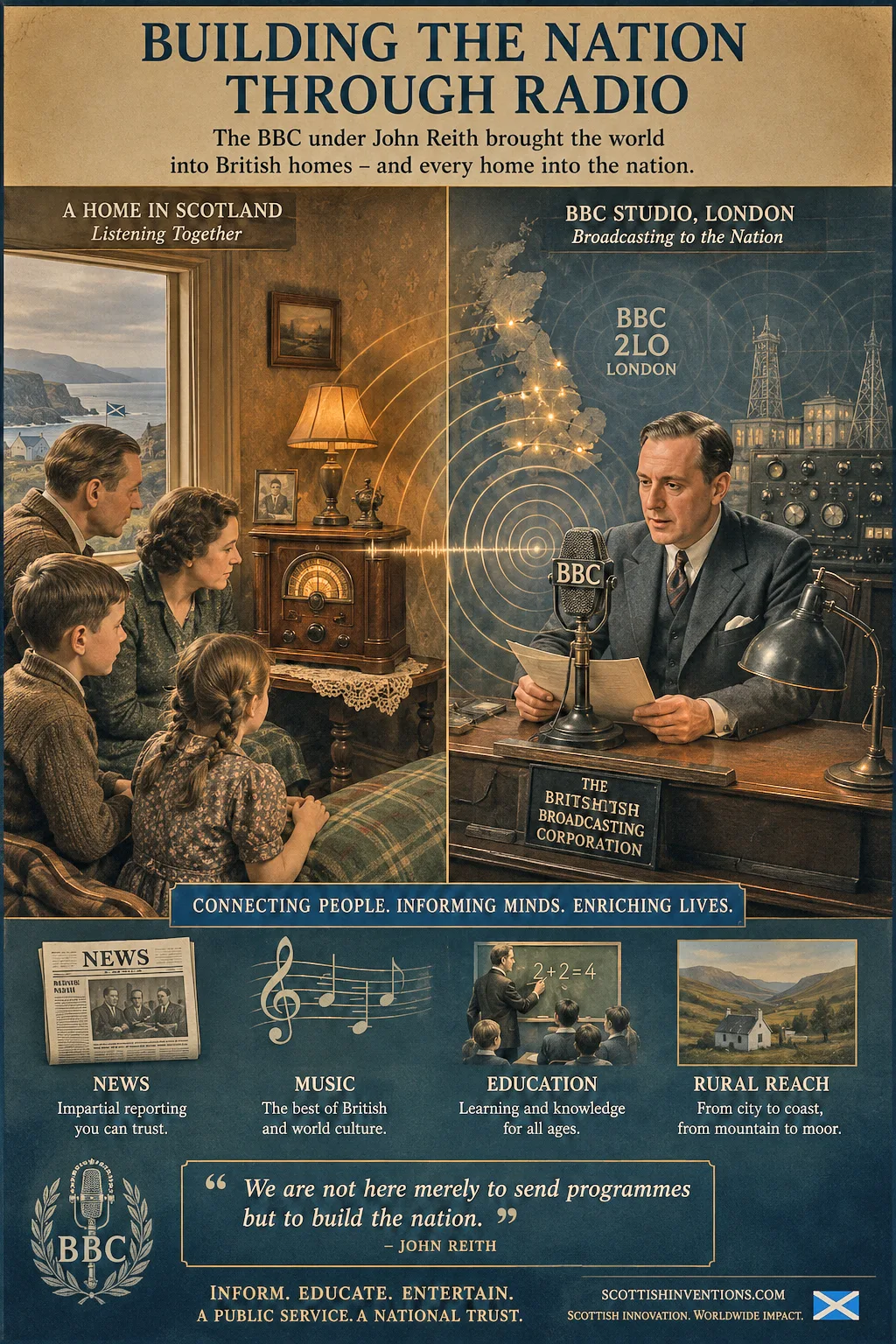
Reith's BBC also wove the four nations together. He made sure that crofters in Sutherland, miners in Rhondda, Belfast linen-workers and Lancashire mill-girls all heard the same news, the same Test Match, the same Christmas King. For tens of millions of Britons in the 1930s, the wireless in the corner was the first cultural institution that addressed them all as citizens of one shared nation.
The Man Behind the Microphone — Reith's Character
Reith was an extraordinarily complicated man — towering, formidable, and never an easy colleague. At 6 ft 6 in, with the bullet scar across his cheek and a deep Aberdeenshire baritone, he intimidated everyone he met. His diaries, published after his death, reveal a man wracked by self-doubt and a permanent sense that his talents were being wasted. He resigned the BBC in 1938 in part out of frustration that the country he had served so heroically had never offered him the truly great office of state he felt he was made for.
He went on to chair Imperial Airways and Cable & Wireless, and during the Second World War briefly served as Minister of Information and Minister of Works and Buildings under Churchill — a man with whom, characteristically, he did not get on. Knighted in 1927, raised to the peerage as Baron Reith of Stonehaven in 1940, he remained to his death the dour and demanding Calvinist his father had raised. Stanley Baldwin once said of him: 'You either liked Reith or you couldn't stand him — there was no middle ground.'
But for all his prickliness, Reith never wavered on the central point. Broadcasting was a sacred trust. The public airwaves belonged to the people. The BBC existed not to make money, not to flatter politicians, not to chase ratings — but to lift the cultural life of the nation. He died in Edinburgh on 16 June 1971, the same year the BBC celebrated 49 years of broadcasting. Tributes poured in from every public broadcaster on earth.
Legacy
The institution John Reith built is now a century old. The BBC reaches more than 460 million people worldwide every week. The World Service broadcasts in 42 languages. The BBC iPlayer, BBC News online, BBC Sounds and BBC Studios carry the Corporation into the streaming age. Through every change of technology — radio to television, analogue to digital, terrestrial to online — the underlying mission has remained Reith's: inform, educate, entertain.
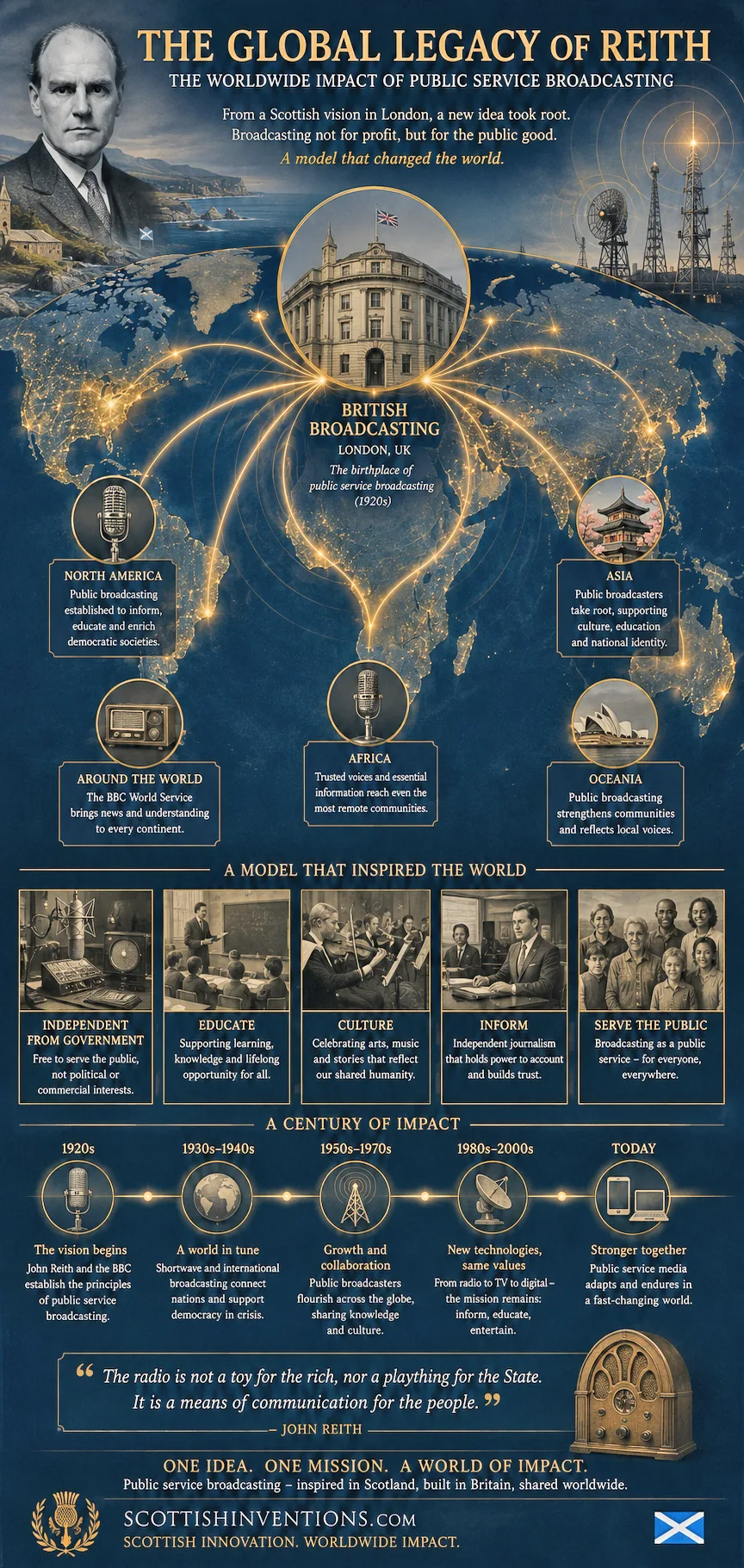
But Reith's most important invention was not the BBC alone. It was the idea of public service broadcasting itself. The Canadian Broadcasting Corporation (1936), the Australian Broadcasting Corporation (1932), Radio New Zealand, NHK in Japan, Doordarshan in India, Germany's ARD, France's Radio France, the Republic of Ireland's RTÉ, South Africa's SABC, even — in a heavily commercial market — America's PBS and NPR: all are descendants, direct or indirect, of the Reithian model.
The BBC Reith Lectures, broadcast annually since 1948 and delivered by figures from Bertrand Russell to Margaret MacMillan, were named in his honour. The annual Reith Award celebrates his memory in Stonehaven. And the phrase 'Reithian' has long since entered the English language as a shorthand for broadcasting that is independent, principled and serious — a public good rather than a private product.
Not bad for a 33-year-old engineer from a Stonehaven manse who, in December 1922, had never broadcast a word in his life.
John Reith — A Life in Seven Dates
1889
Born on 20 July at the manse in Stonehaven, Kincardineshire — the youngest of seven children of a Church of Scotland minister.
1915
Wounded at the Battle of Loos while serving as a lieutenant with the Royal Engineers; the bullet leaves the famous lifelong scar across his cheek.
1922
Appointed General Manager of the newly formed British Broadcasting Company on 14 December — at the age of just 33, and with no broadcasting experience whatsoever.
1927
The British Broadcasting Company is dissolved and reborn by Royal Charter as the British Broadcasting Corporation; Reith becomes its first Director-General.
1932
Launches the BBC Empire Service — the forerunner of the BBC World Service — broadcasting to every continent from Daventry.
1936
The BBC launches the world's first regular high-definition public television service from Alexandra Palace, London, on 2 November.
1971
Dies in Edinburgh on 16 June; his ashes are buried at Rothiemurchus on Speyside.
Frequently Asked Questions
Who founded the BBC? The BBC was founded as the British Broadcasting Company Ltd in October 1922 by a consortium of six radio manufacturers, but its character, mission and shape were almost entirely the work of John Reith, who joined as General Manager in December 1922 and led the organisation as its first Director-General from 1927 to 1938.
Was John Reith Scottish? Yes. John Charles Walsham Reith was born on 20 July 1889 at the manse in Stonehaven, Kincardineshire. He was educated at Glasgow Academy and apprenticed as an engineer at the North British Locomotive Company in Glasgow.
What are Reithian principles? The Reithian principles are the founding values Lord Reith imposed on the BBC: that broadcasting should inform, educate and entertain; that it must be independent of both government and commercial interests; that it should be of the highest possible quality; and that it should be universally available to every citizen.
What does 'inform, educate and entertain' mean? Reith's famous triad means a public broadcaster has three inseparable duties: to deliver accurate and trustworthy news (inform), to advance learning and the intellectual life of the nation (educate), and to provide high-quality drama, music and comedy that uplift and unite (entertain).
Why is John Reith important? Because he invented the institutional model of public service broadcasting that has since been adopted on every inhabited continent. Without Reith there would be no BBC as we know it, and almost certainly no CBC, no ABC, no NHK and no RTÉ.
How did the BBC influence broadcasting worldwide? Reith's BBC became the prototype for public broadcasters in dozens of countries. Canada modelled the CBC directly on it in 1936; Australia did the same with the ABC; Japan's NHK, Ireland's RTÉ, Germany's post-war ARD and many others all consciously took the BBC as their template.
Related Inventions
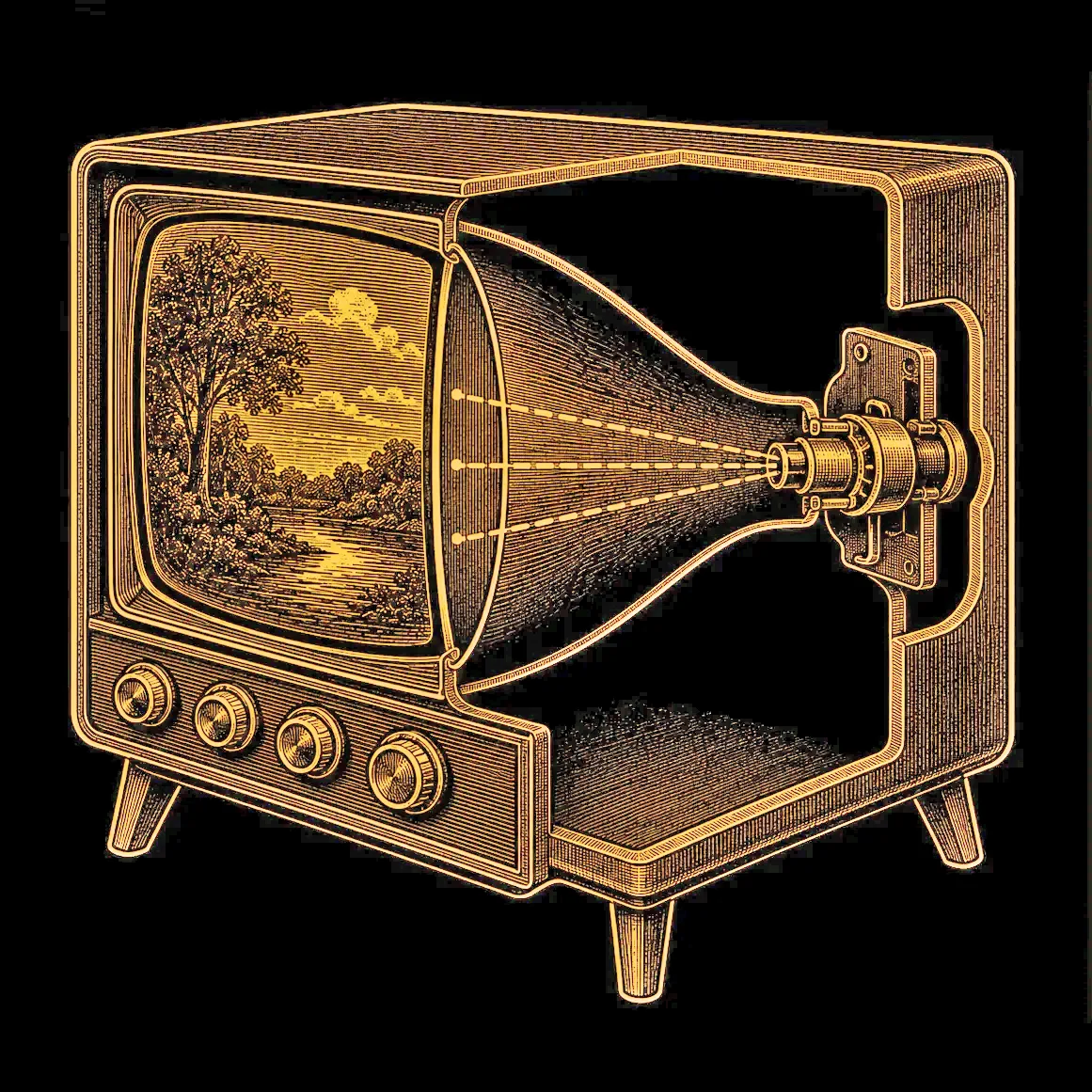
Television
John Logie Baird · 1925
The first working television, built from household objects.
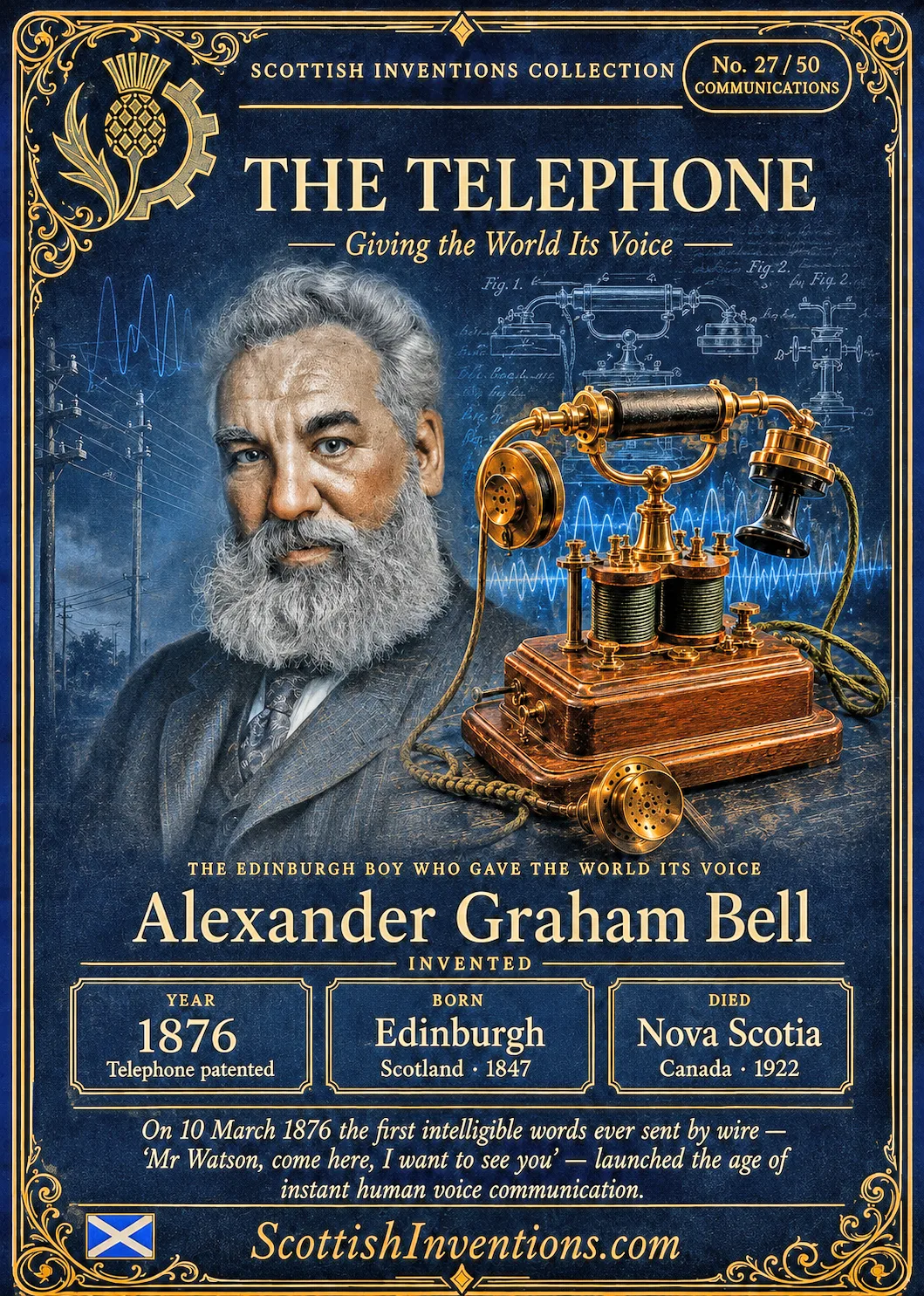
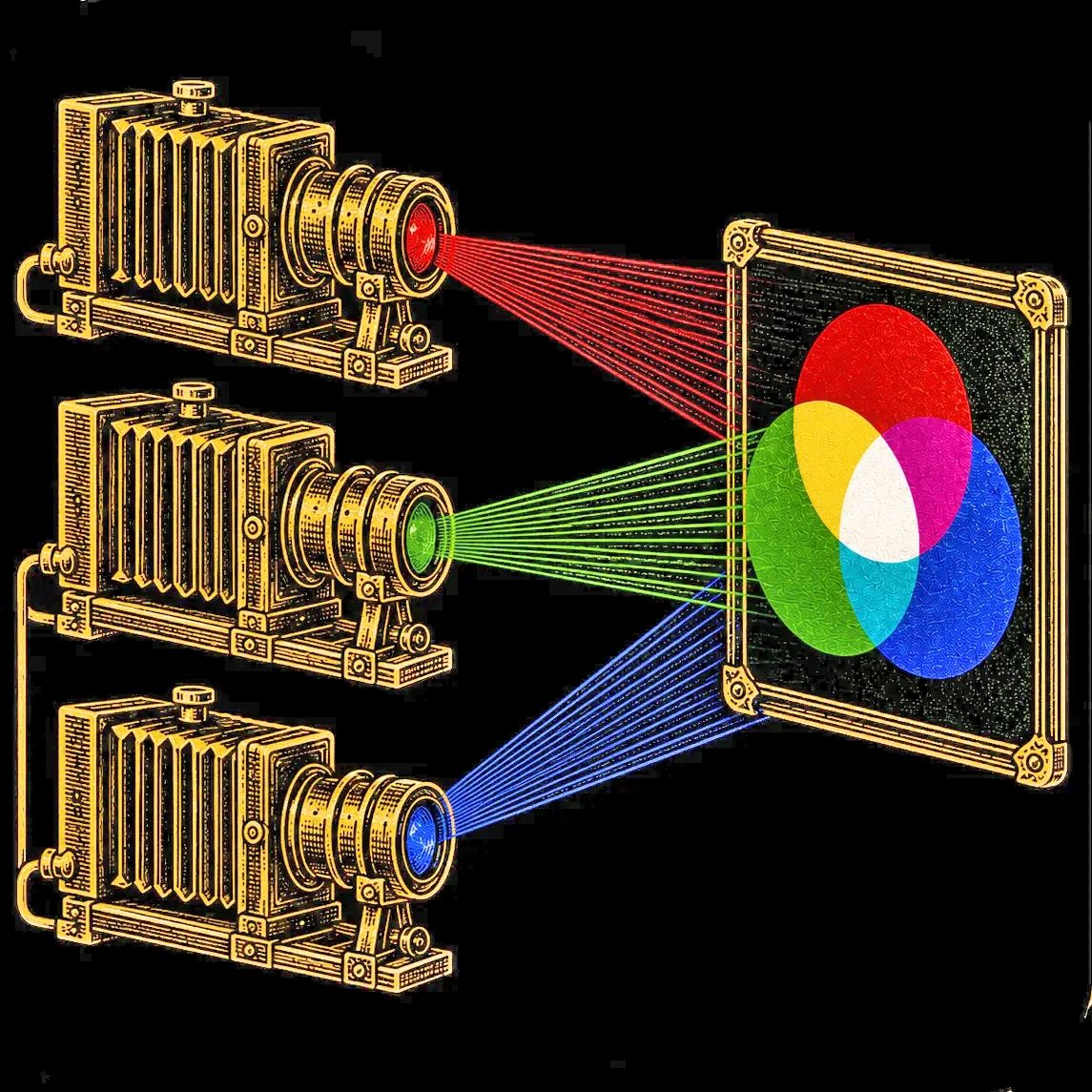
First Permanent Colour Photograph
James Clerk Maxwell · 1861
Three-colour-separation photography.
Weekly Scottish Innovation Facts
Delivered to your inbox every Sunday. No spam, just brilliance.