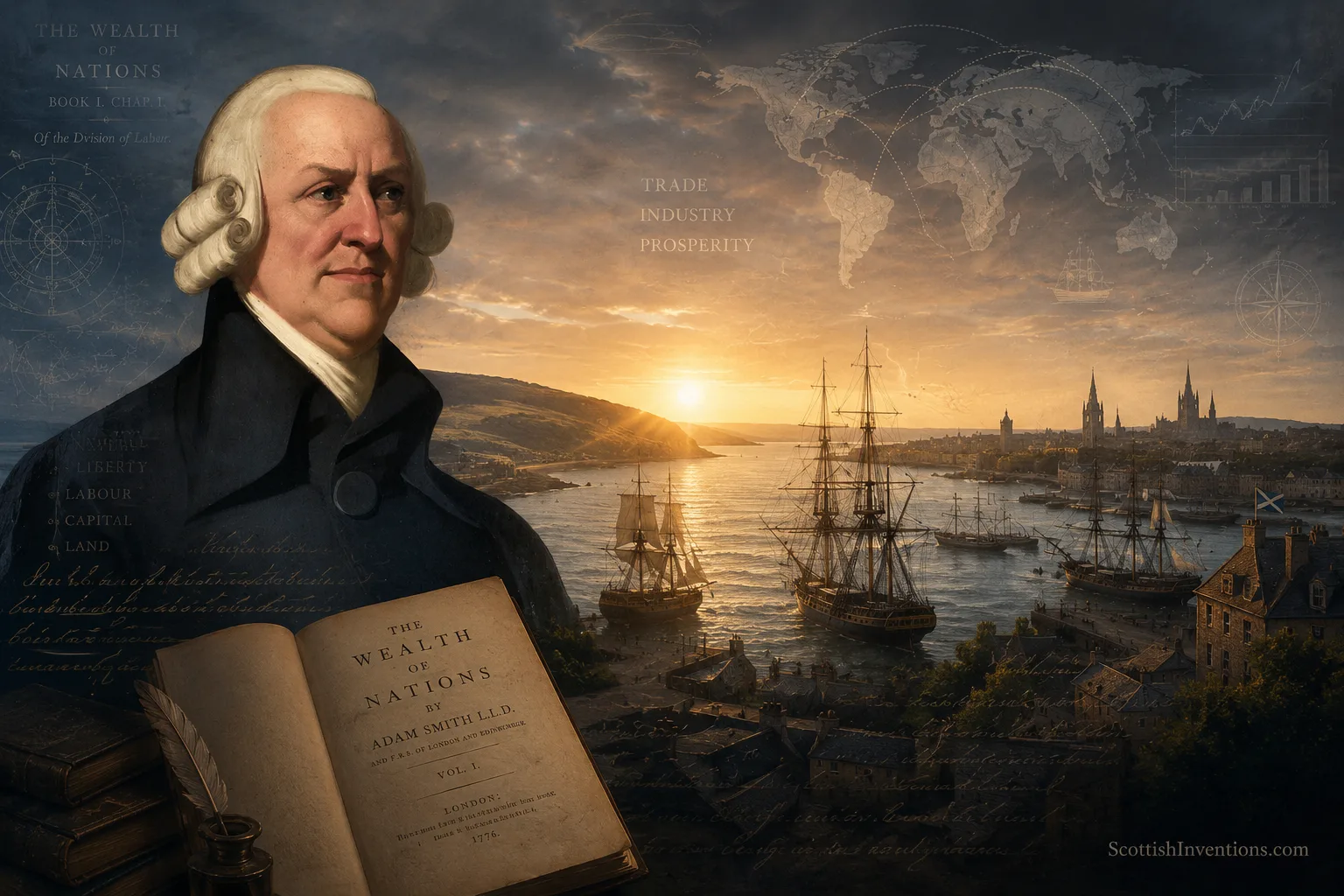
The Wealth of Nations
by Adam Smith
Introduction — the man who invented economics
Scotland has given the world the steam engine, the telephone, television, antiseptic surgery and the chainsaw. But its greatest invention may not be a machine at all. It is an idea — and a way of seeing the world — first set down in print in March 1776 by a quiet, bookish bachelor from Kirkcaldy. Adam Smith did not invent money, or markets, or trade. He invented economics: the systematic understanding of how individuals, work and exchange together create the wealth of nations.
Before Smith, governments measured a country's riches by the gold in its vaults. After Smith, they measured it by what its people could produce. That shift — from hoarding to producing, from privilege to productivity — is the intellectual foundation on which the modern world is built. Every theory of growth, every policy on trade, every debate about markets and government still begins, in some form, with The Wealth of Nations.
The intellectual context — the Scottish Enlightenment
Smith did not work alone. He was the brightest star in a constellation of thinkers we now call the Scottish Enlightenment — the eighteenth-century intellectual movement that turned a small, poor northern kingdom into the engine room of modern thought. In Edinburgh's New Town, in Glasgow's college quad and around the candlelit tables of the Select Society, Scots were rewriting the rules of philosophy, science, medicine, history and human nature.
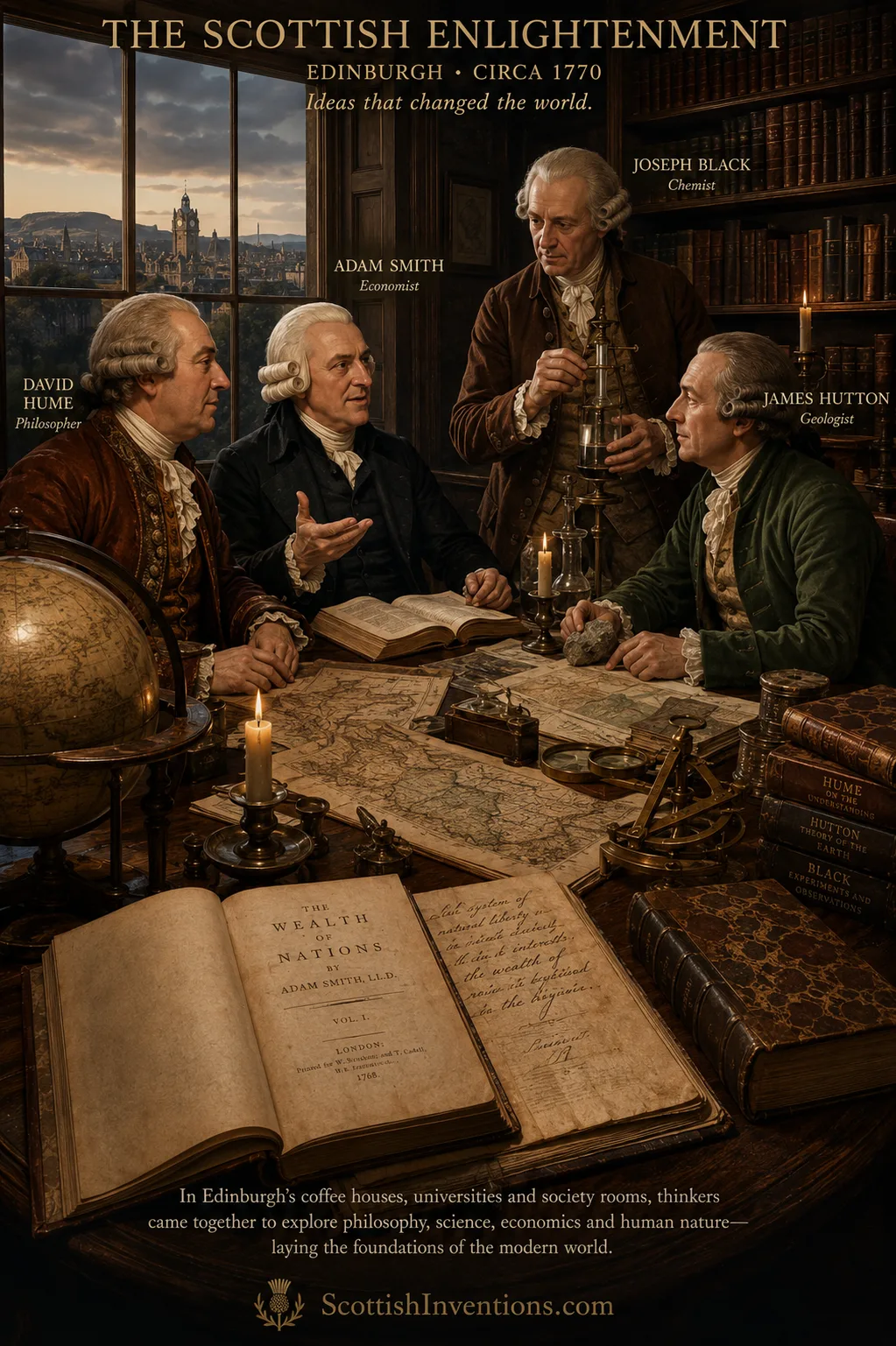
His closest friend was the philosopher David Hume, whose scepticism cleared the ground on which Smith would build. He learned chemistry from Joseph Black, who discovered carbon dioxide and latent heat, and walked the hills with the geologist James Hutton, the father of modern geology. Francis Hutcheson, his Glasgow teacher, taught him that ethics could be studied as rigorously as physics. From this remarkable circle, Smith absorbed the conviction that human society — like the natural world — obeys discoverable laws.
It is impossible to imagine The Wealth of Nations without this milieu. The Scottish Enlightenment supplied Smith with method, ambition and an audience of equals. It is the reason a book about pin factories and trade winds came to redefine the modern world.
Early life — Kirkcaldy, Glasgow and Oxford
Adam Smith was baptised on 5 June 1723 in Kirkcaldy, a busy little port on the Fife coast looking out across the Firth of Forth to Edinburgh. His father — also Adam — was the local Comptroller of Customs and died before his son was born. The boy grew up in his mother Margaret's house, in a town of shipowners, salt-pans, nail-makers and merchants, surrounded from infancy by the daily realities of trade.
In 1737, aged just fourteen, Smith enrolled at the University of Glasgow, where he came under the spell of the moral philosopher Francis Hutcheson. From there he won a scholarship to Balliol College, Oxford, which he found intellectually moribund — 'the greater part of the public professors,' he wrote drily, 'have given up altogether even the pretence of teaching.' He read alone, voraciously, for six years.
Returning to Scotland, he gave a celebrated series of public lectures in Edinburgh, then in 1751 was elected Professor of Logic, and a year later Professor of Moral Philosophy, at Glasgow. The Glasgow years were, he later said, 'by far the most useful, and therefore by far the happiest and most honourable period of my life.'
The Wealth of Nations — the book
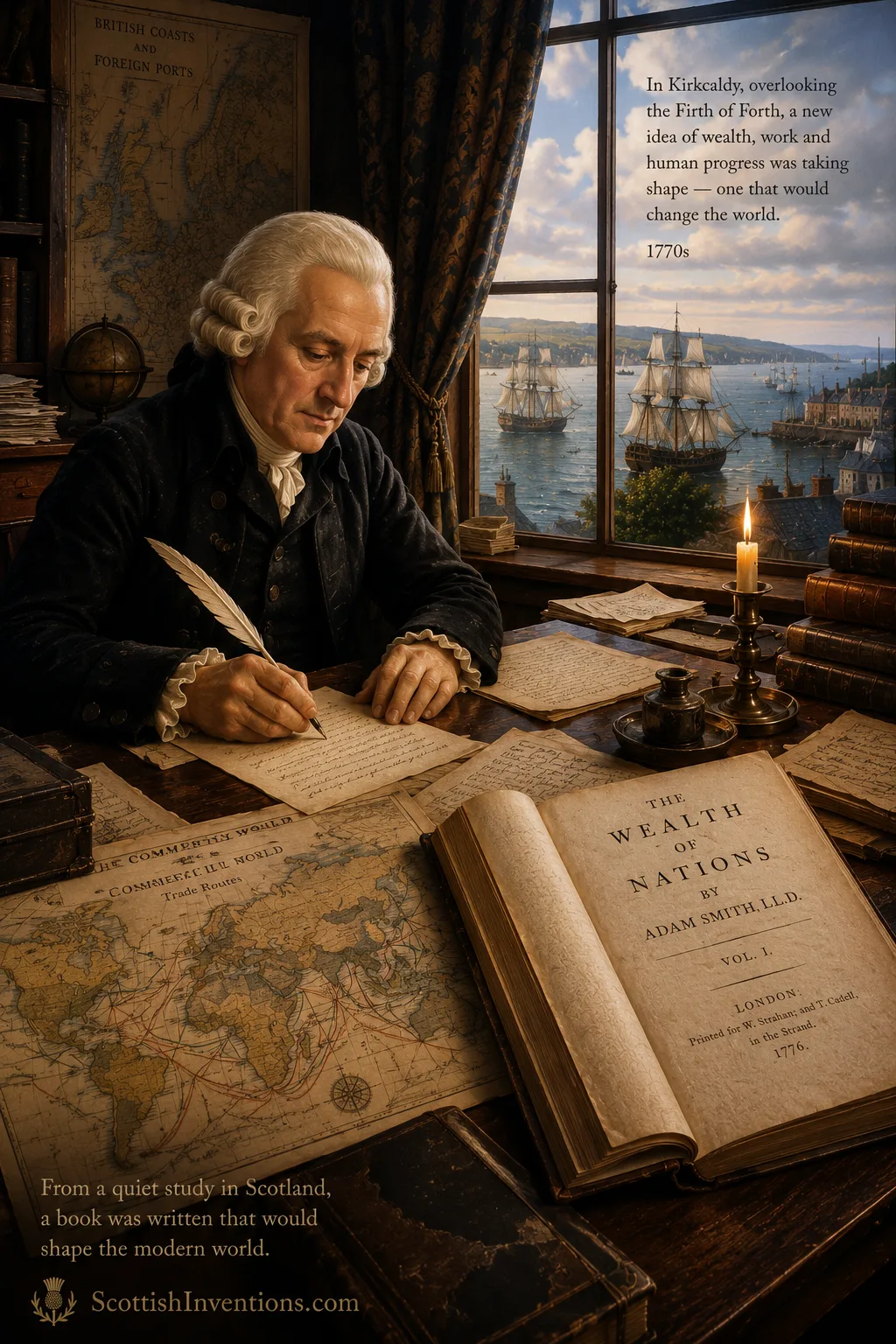
On 9 March 1776, the London publishers W. Strahan and T. Cadell brought out a two-volume work with the magnificently grand title An Inquiry into the Nature and Causes of the Wealth of Nations. It had taken Adam Smith more than a decade to write, much of it in the upstairs study of his mother's house in Kirkcaldy, with the masts of merchant ships passing in the windows behind him.
It is an immense book — nearly a thousand pages, five 'books' in length — but its argument is breathtakingly clear. A nation's wealth, Smith insists, is not its stockpile of gold or silver. It is the annual produce of the labour of its people. The way to make a country richer is therefore not to hoard treasure or strangle imports, but to make labour itself more productive, and to let people freely exchange the fruits of that labour, at home and abroad.
The core ideas — explained accessibly
Strip away the eighteenth-century prose, and The Wealth of Nations is built on a handful of stunningly simple ideas. The first is the division of labour. Smith opens the book with a deliberately humble example — a pin factory. A single worker, working alone, could perhaps make twenty pins a day. But if the work is broken into eighteen distinct operations — drawing the wire, straightening it, cutting it, pointing it, grinding the head — and each is performed by a specialist, the output is transformed.
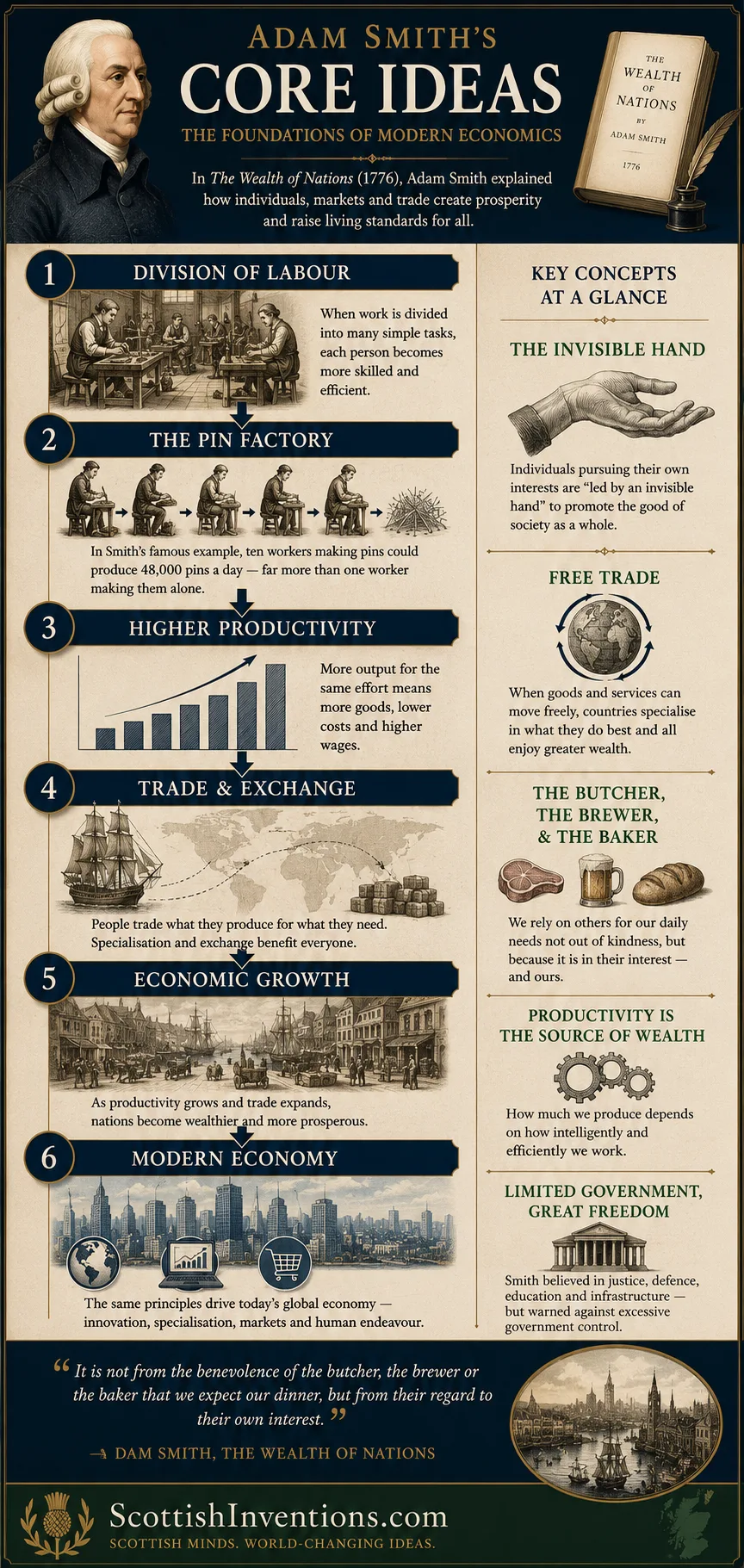
“Ten workers in a pin factory, each performing one small task, could produce 48,000 pins a day — far more than one worker making them alone.”
From the division of labour flows everything else. As workers specialise, productivity rises; as productivity rises, more goods become available; as more goods are produced, they must be exchanged. People go to the market not out of charity but out of self-interest — and yet, almost miraculously, the result is a society richer in food, clothing, books, ships and ideas than any planner could have designed. 'It is not from the benevolence of the butcher, the brewer or the baker,' Smith wrote, 'that we expect our dinner, but from their regard to their own interest.'
This is the famous invisible hand. Individuals pursuing their own gain are 'led by an invisible hand' to promote ends that were no part of their intention — the general prosperity of society. Smith did not mean that markets are infallible. He hated cartels ('people of the same trade seldom meet together, even for merriment and diversion, but the conversation ends in a conspiracy against the public') and he supported public goods — justice, defence, roads, schools. But he saw, with extraordinary clarity, that free exchange between free people, on the largest possible scale, is the most powerful engine of prosperity ever discovered.
Add free trade between nations, and the picture is complete. Let countries specialise in what they produce best, let them swap freely across borders, and the wealth of all is enlarged. It is, in essence, the entire intellectual programme of the modern global economy.
The Core Ideas of Modern Economics
Division of Labour
Splitting work into small specialised tasks makes each worker faster, more skilful and far more productive.
The Invisible Hand
Individuals pursuing their own interest are led 'as by an invisible hand' to promote the good of society as a whole.
Free Trade
When goods and services move freely across borders, countries specialise in what they do best and everyone grows richer.
The Butcher, Brewer & Baker
We rely on others for our daily needs not from their kindness, but because it serves their interest — and ours.
Productivity = Wealth
A nation's true wealth is not its gold but the intelligent, efficient labour of its people and the goods they produce.
Limited Government, Great Freedom
Smith backed justice, defence, education and infrastructure — but warned against governments smothering the market they served.
The Theory of Moral Sentiments — Smith's wider thought
It is a common mistake to read Smith as a prophet of pure self-interest. He was not. Seventeen years before The Wealth of Nations, in 1759, he published The Theory of Moral Sentiments — a book about sympathy, conscience and the 'impartial spectator' inside each of us who judges our own behaviour. He considered it his finest work, and revised it until the year of his death.
The two books are not in tension; they are two halves of a single picture. Moral Sentiments asks how human beings, given their selfish passions, manage to live together at all. The Wealth of Nations asks how, given the same selfish passions, they manage to grow rich together. The answer, in both, is the same: through cooperation, exchange, and the steady operation of institutions — the courts, the markets, the moral expectations of neighbours — that turn private interest into public good.
Legacy and influence
Within decades of publication, The Wealth of Nations had become the founding text of an entirely new discipline. David Ricardo built the theory of comparative advantage on its foundations. John Stuart Mill, Alfred Marshall and the entire Victorian school of political economy worked in Smith's shadow. In the twentieth century, economists as different as John Maynard Keynes, Friedrich Hayek and Milton Friedman all wrestled with — and built upon — the questions Smith had set. There is no modern economic tradition, of left or right, that does not have him somewhere at its root.
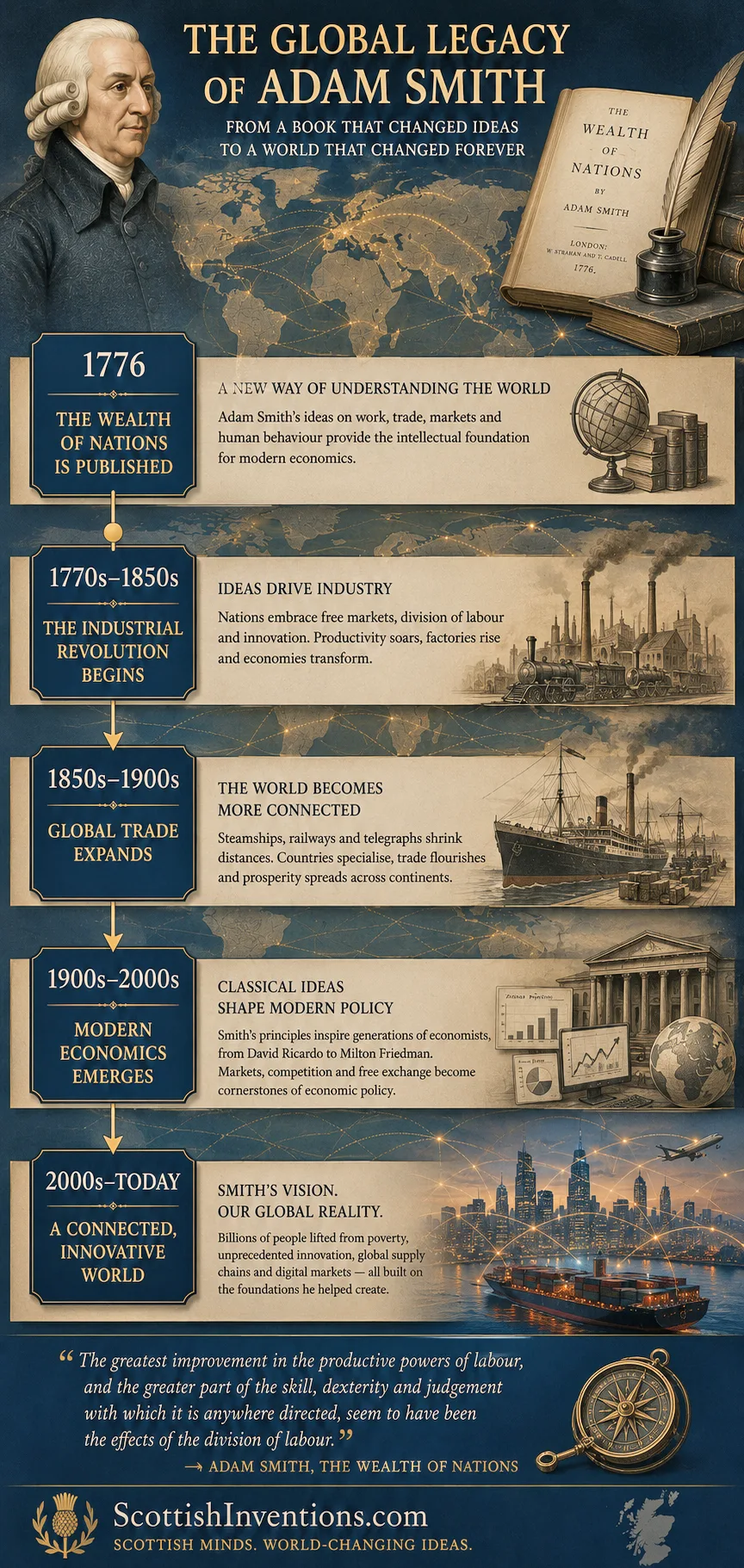
His influence reached far beyond economics. The Industrial Revolution that followed his book embodied his ideas: specialisation, mechanisation, free exchange across an expanding empire of trade. Steamships, railways, telegraphs and oceanic supply chains carried Smithian principles around the world. By the twentieth century, billions of people had been lifted out of subsistence poverty by the cumulative working-out of the framework he had sketched in a Kirkcaldy study.
In recognition of his stature, the Bank of England placed Adam Smith on the £20 note in 2007 — the first Scot ever to appear on a Bank of England banknote, and one of only a handful of intellectuals so honoured. Visit Edinburgh today and you will find his statue on the Royal Mile, gazing across at St Giles' Cathedral, with the Old Town spread below — the city of the Enlightenment looking back at the man who, more than any other, turned its ideas into a working world.
Adam Smith — A Life in Six Dates
1723
Adam Smith baptised in Kirkcaldy, Fife, on 5 June.
1737
Enters the University of Glasgow aged 14 to study under Francis Hutcheson.
1759
Publishes The Theory of Moral Sentiments — his first great book.
1776
Publishes An Inquiry into the Nature and Causes of the Wealth of Nations.
1790
Dies at Panmure House, Edinburgh, on 17 July; buried in Canongate Kirkyard.
2007
Adam Smith becomes the first Scot to appear on a Bank of England note — the £20.
Smith today — why he still matters
Two and a half centuries after publication, The Wealth of Nations is not a museum piece. Open a newspaper and Smith is in every story: in arguments about tariffs and trade wars, in debates about minimum wages and competition policy, in the design of global supply chains and the regulation of digital platforms. Behavioural economists who study how people actually choose — rather than how they 'should' choose — are working in territory Smith mapped out in Moral Sentiments long before them.
The most striking thing about Smith, read today, is how modern he sounds. He understood that markets need rules, that monopolies corrode prosperity, that workers deserve decent wages, that education is in the interest of the whole society. He warned against governments captured by merchants — and against merchants captured by their own self-importance. His Scotland was a small country trying to make sense of an emerging global economy. The questions he asked are the questions we are still trying to answer.
Scottish minds. World-changing ideas. No Scot has changed the world's mind more completely than Adam Smith of Kirkcaldy.
Frequently Asked Questions
Who was Adam Smith? Adam Smith (1723–1790) was a Scottish moral philosopher and political economist, born in Kirkcaldy in Fife. He is widely regarded as the father of modern economics and the author of An Inquiry into the Nature and Causes of the Wealth of Nations, published in 1776.
Did Adam Smith invent economics? Smith did not invent trade, money or markets, but he is universally credited with founding economics as a systematic discipline. The Wealth of Nations (1776) is the first comprehensive analysis of how labour, productivity and exchange create national wealth, and every later school of economics builds on it.
What is The Wealth of Nations about? It is a five-book inquiry into how nations grow rich. Smith argues that prosperity comes not from hoarding gold but from the productive labour of free people exchanging goods in open markets, at home and through international trade.
What is the invisible hand? The 'invisible hand' is Smith's famous metaphor for the way individuals pursuing their own interests are unintentionally led to promote the good of society as a whole. It captures his insight that free exchange between many self-interested people produces broadly beneficial outcomes for everyone.
What is division of labour? The division of labour is the practice of breaking complex work into small, specialised tasks performed by different people. Smith's famous pin-factory example shows that ten workers, each doing one step, could produce around 48,000 pins a day — far more than ten workers each making whole pins alone.
Why is Adam Smith important today? Because the modern world runs on his framework. Free trade, globalisation, productivity-led growth, competition policy and the entire discipline of economics descend directly from his work. He appeared on the Bank of England £20 note from 2007 to 2020 in recognition of his unique influence.
Related Inventions
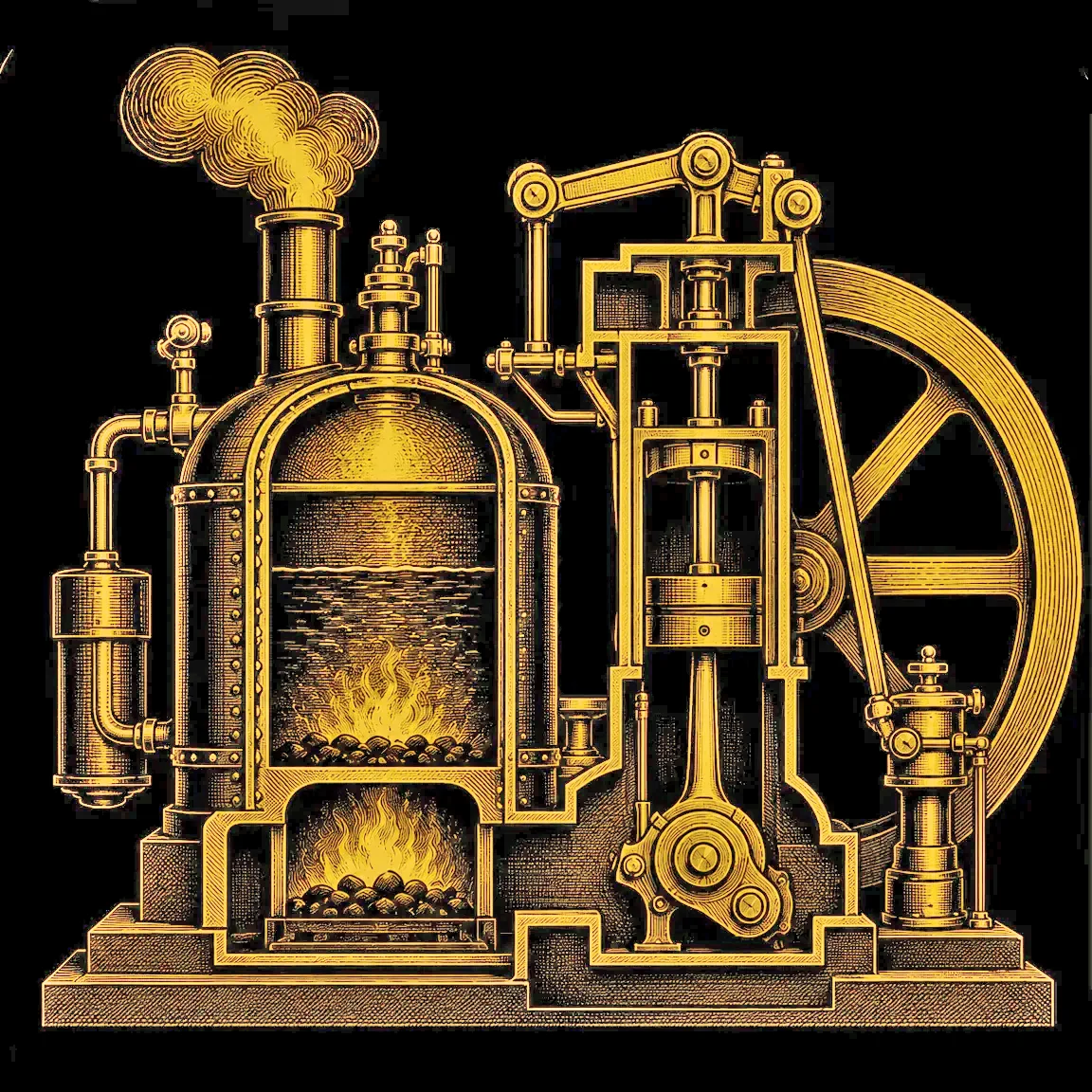
Watt Steam Engine
James Watt · 1769
The separate condenser that powered the Industrial Revolution.
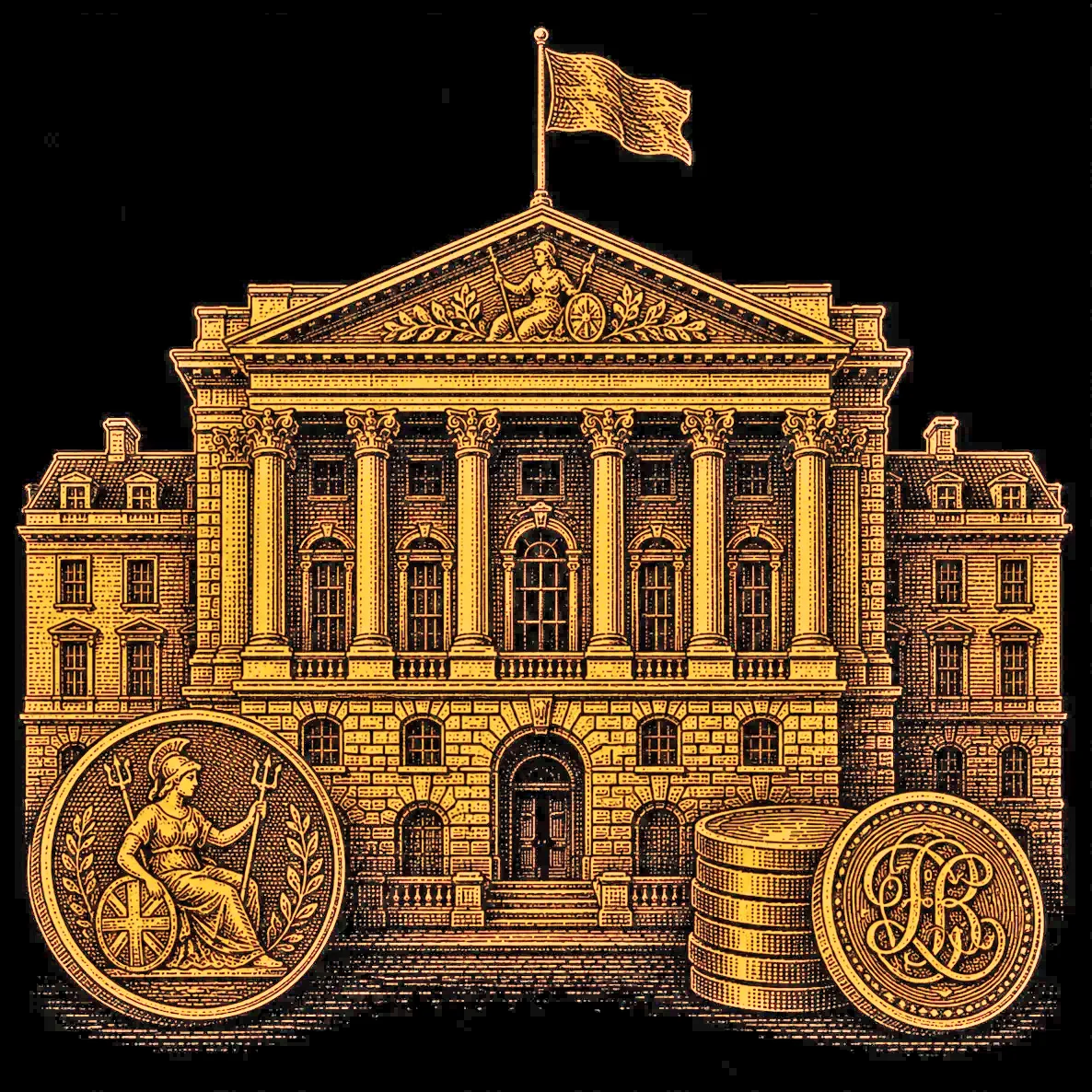
Bank of England
William Paterson · 1694
Founded by a Scot in London.
Weekly Scottish Innovation Facts
Delivered to your inbox every Sunday. No spam, just brilliance.