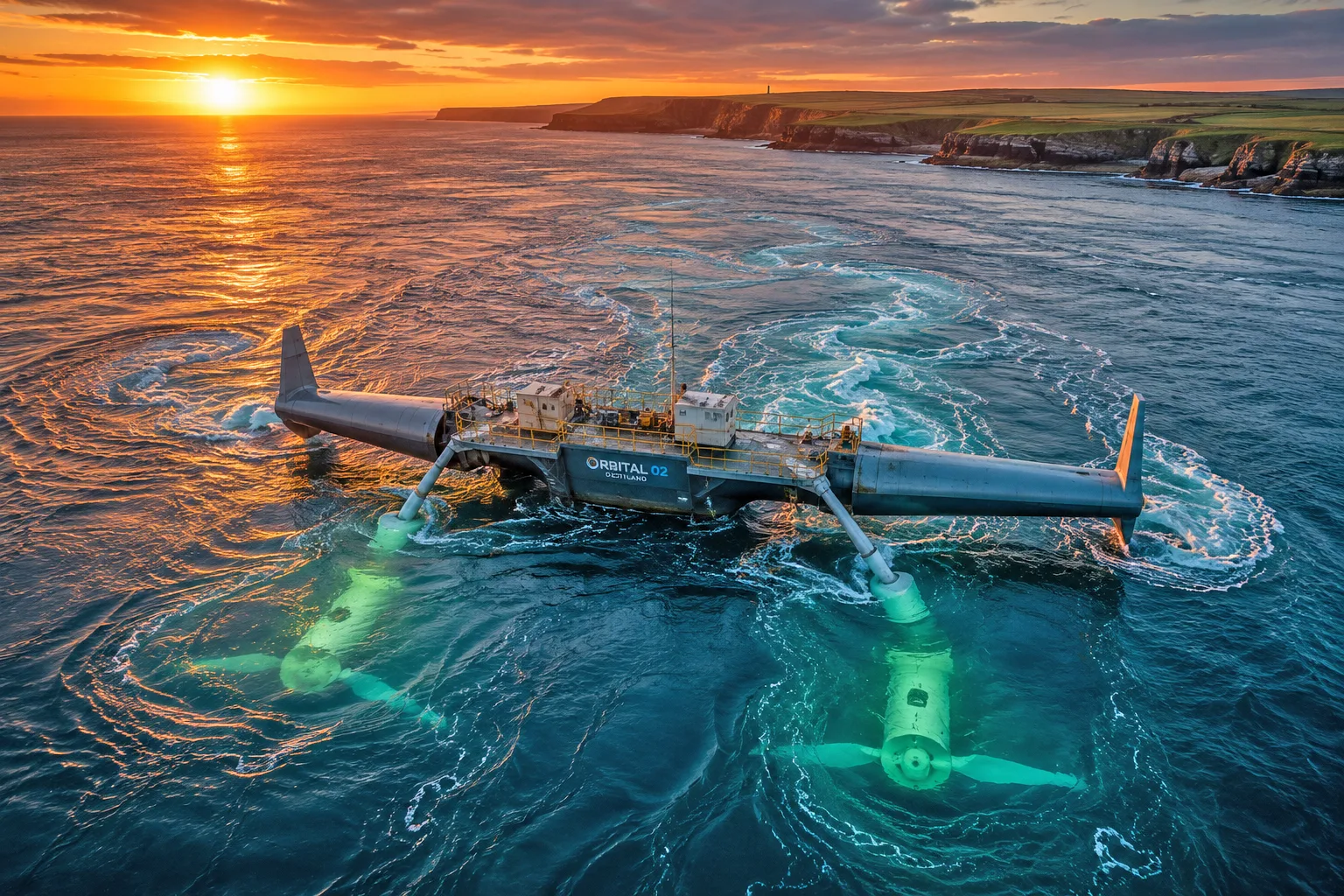
Orbital O2 Tidal Turbine
by Orbital Marine Power
Introduction — Scotland's tidal moonshot
Three miles off the Orkney island of Eday, in a stretch of water called the Fall of Warness, a bright yellow steel hull the length of two Routemaster buses rides the tide. Two enormous rotors hang below it, turning slowly as 250 million tonnes of seawater an hour rush past. This is the Orbital O2 — the most powerful tidal turbine ever built, designed and assembled in Scotland, and quietly feeding clean electricity into the British grid since the spring of 2021.
It is, by some distance, the leading symbol of Scotland's place in the global marine-energy story. The country that gave the world Salter's Duck and the Pelamis wave machine has now built the machine that finally turned tidal stream power from a laboratory promise into a commercial reality. This is the story of how it happened — the company, the technology, the science of tidal energy, and the Pentland Firth waters that made it possible.
Orbital Marine Power — from start-up to world record
Orbital Marine Power started life in 2002 in Orkney as Scotrenewables Tidal Power, the brainchild of mechanical engineer Barry Johnston. From the very beginning the team backed an unfashionable idea: instead of bolting heavy turbines to the seabed — the industry orthodoxy at the time — they would float them on the surface, hang the rotors beneath, and let a slender steel hull do the structural work. Floating turbines could be towed back to port for maintenance, slashing the cost that had crippled every seabed-fixed rival.
The company's first machine, the 250 kW SR250, was launched in 2011 and connected to the grid at the European Marine Energy Centre (EMEC) in Orkney. Five years later, in 2016, it was followed by the 2 MW SR2000, briefly the world's most powerful tidal turbine. In its first year of operation the SR2000 generated more than 3 GWh — more electricity than Scotland's entire wave and tidal sector had managed in the previous twelve years combined. By 2019 the company had rebranded as Orbital Marine Power, ready to take the technology from prototype to production. The O2, deployed in April 2021, is the result.
The O2 turbine — the machine itself
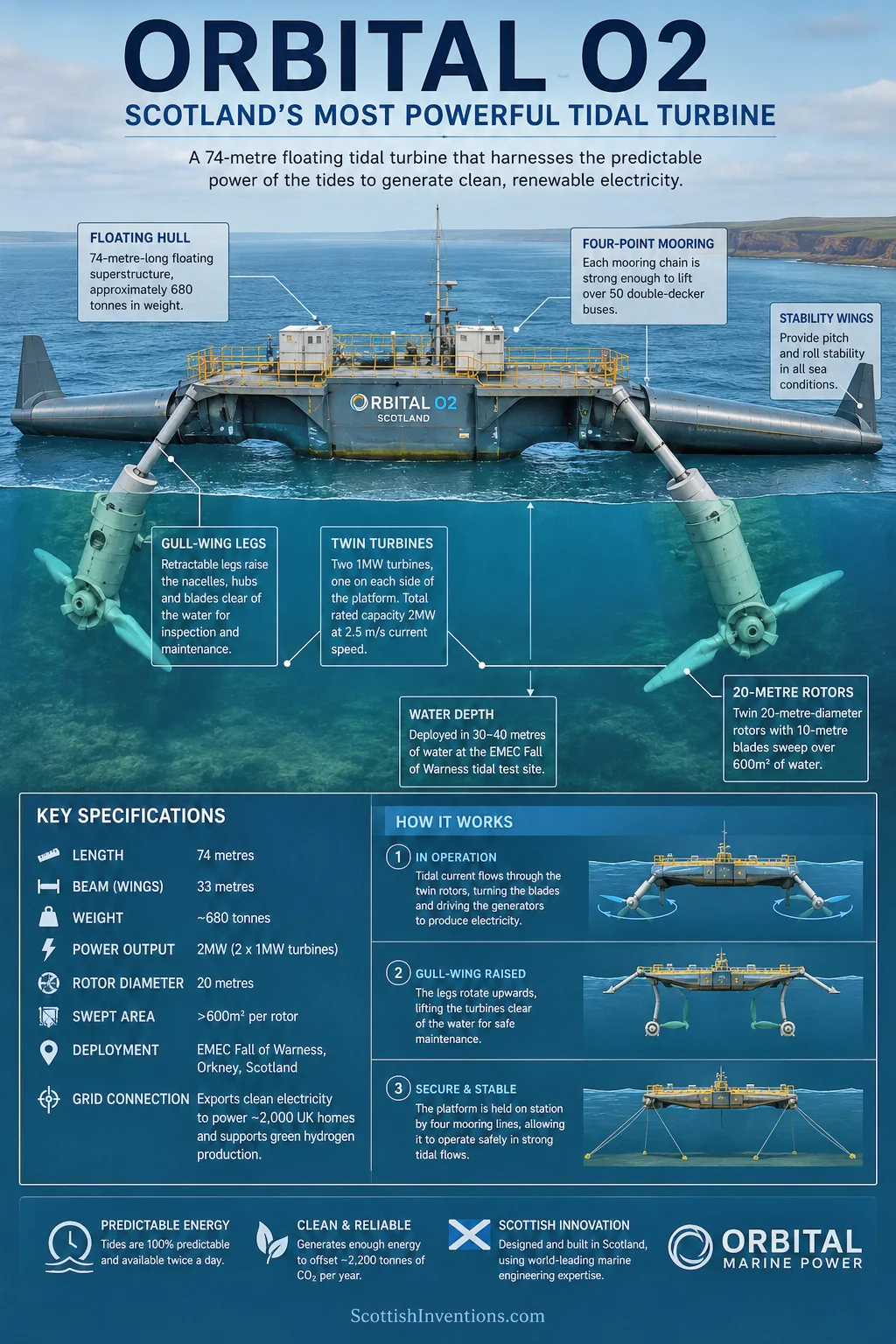
Up close the O2 is enormous. The bright yellow steel hull is 74 metres long — about the same as a six-storey building tipped on its side — and weighs roughly 680 tonnes. Two retractable steel legs hang from the underside, and at the end of each leg sits a turbine nacelle carrying a 20-metre diameter, two-bladed rotor. With the legs lowered into operating position the rotors sweep a combined area of more than 600 square metres of fast-moving water on every tide.
Each rotor drives a 1 MW generator housed inside its nacelle, giving the O2 its headline 2 MW rating. The blades are bi-directional: they pitch through 180° so the machine can harvest power on both the flood and the ebb tide, four times a day, every day, indefinitely. A single 33 kV subsea export cable carries the electricity to EMEC's onshore substation on Eday and from there into Scotland's national grid. The whole platform is held in position by four catenary mooring chains anchored to the seabed, and is designed to operate continuously for fifteen years between major refits.
It was assembled in Dundee — at the Forth Ports facility, with steelwork from Texo Group in Newcastle — towed up the east coast of Scotland and installed at the Fall of Warness in April 2021. Within months it had produced its first MWh, and it has been generating ever since.
The technology — how tidal turbines work
A tidal-stream turbine is, in essence, an underwater wind turbine. Moving water spins the blades, the blades spin a shaft, and the shaft drives a generator. Because seawater is roughly 832 times denser than air, a tidal rotor can be much smaller than a wind turbine for the same power output — and because the tides are driven by gravity, not weather, the energy is utterly predictable. Tide tables can be calculated decades in advance to the minute, which makes tidal generation uniquely valuable to grid operators trying to balance more variable renewables.
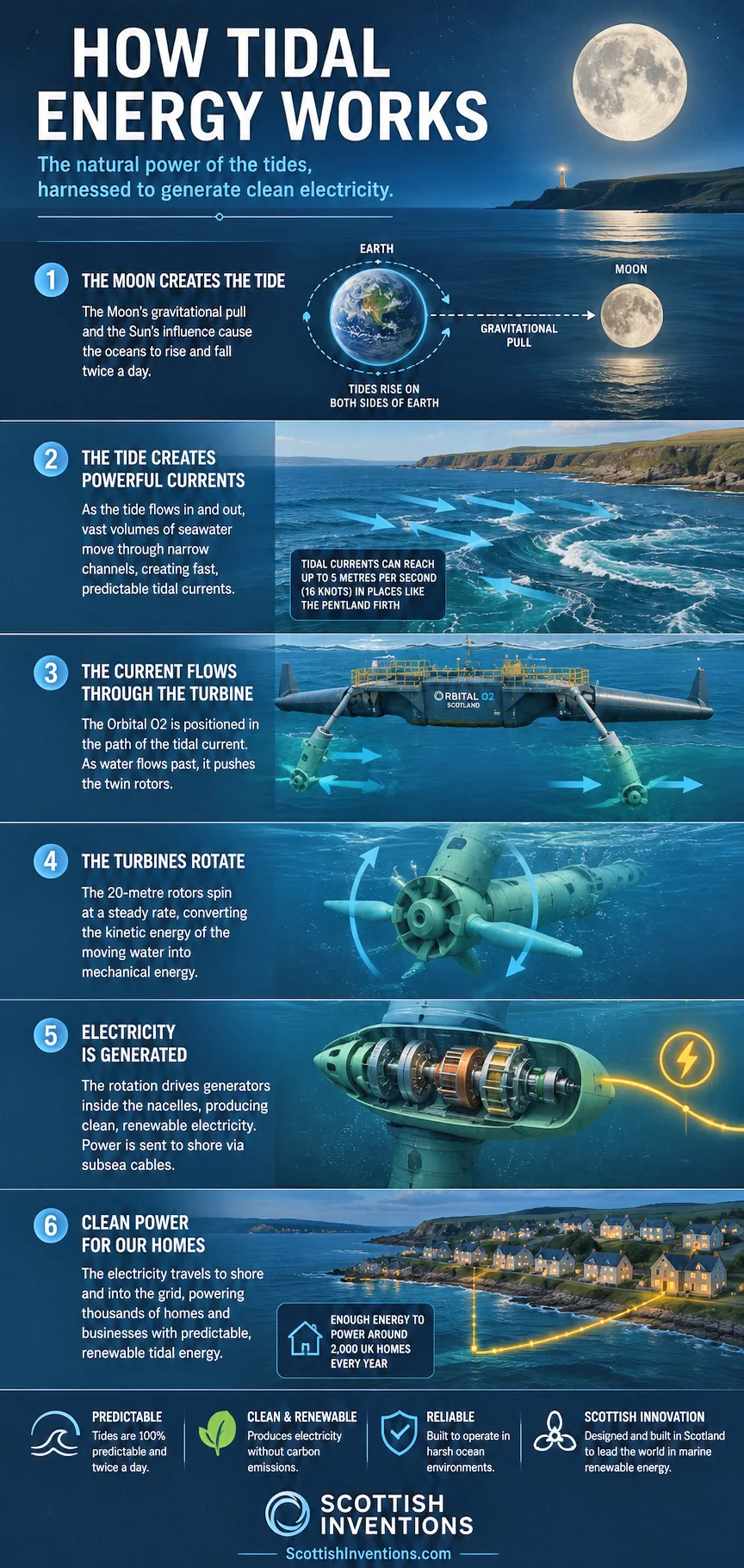
What sets the O2 apart from earlier seabed-fixed designs is the floating-platform architecture. The hull provides both buoyancy and a working deck, the retractable legs let the rotors be raised clear of the water for maintenance, and the whole machine can be unmoored and towed to port — a job that takes a few days rather than the multi-million-pound seabed operations that crippled earlier projects. That single insight, championed by Orbital from 2002 onwards, is what has finally made commercial tidal power realistic.
Once electricity leaves the generator it follows the same path as any other offshore source: subsea cable to shore, onshore substation, transformer, and into the high-voltage transmission network. Since 2022 the O2 has also been wired into EMEC's onshore electrolyser, producing the world's first tidal-powered green hydrogen — a glimpse of how predictable marine energy could decarbonise heavy transport as well as the grid.
Milestones and records
The O2 holds the title of most powerful tidal turbine in the world at the time of writing, with a rated capacity of 2 MW from a single floating platform. In its first year of operation it delivered enough clean electricity to meet the annual demand of around 2,000 UK homes, while simultaneously offsetting an estimated 2,200 tonnes of CO₂. It set further records in 2022 when surplus power from the turbine was used to make green hydrogen at the EMEC electrolyser on Eday — the first time tidal electricity had been converted into a storable, exportable zero-carbon fuel anywhere in the world.
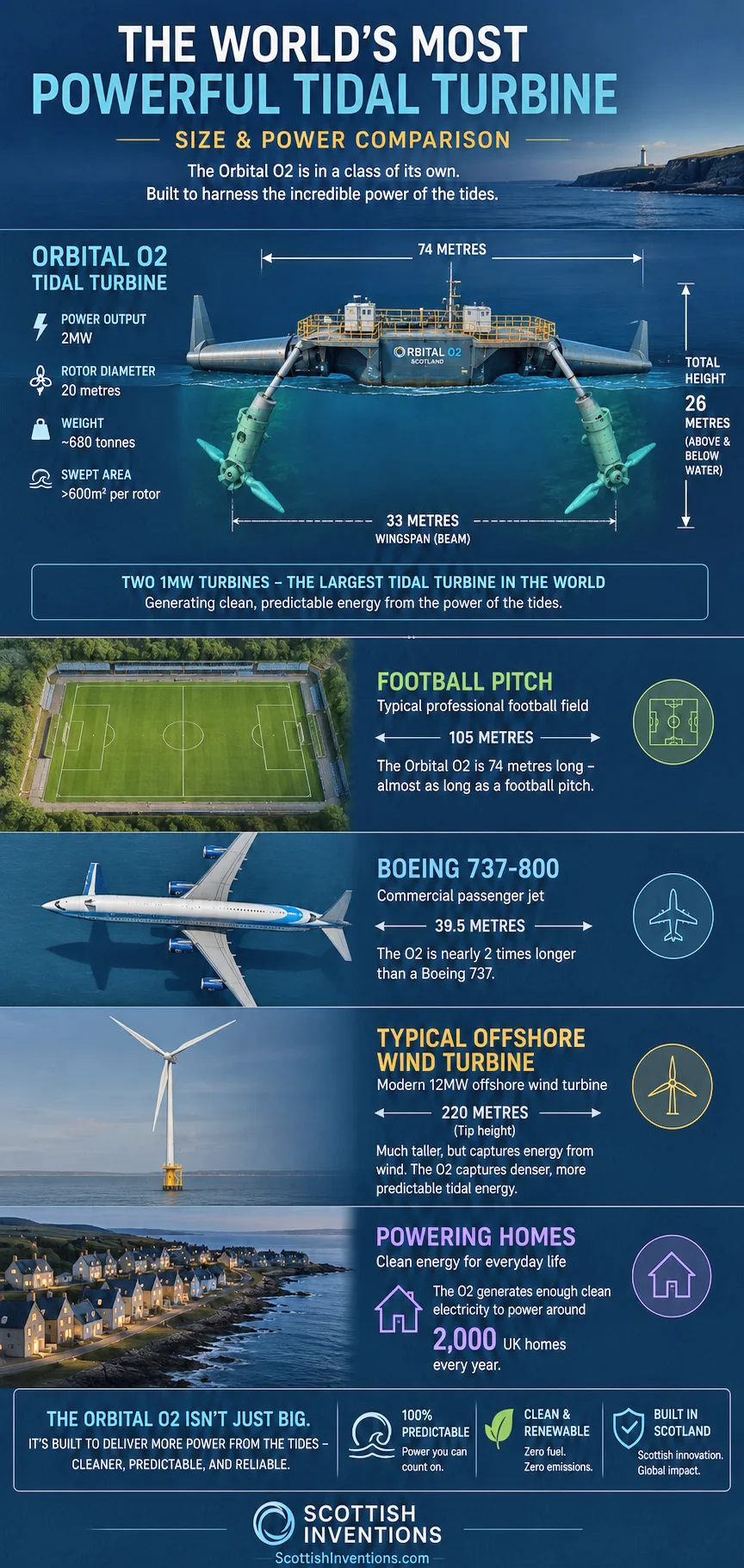
Behind those headline numbers sits a longer pattern. The SR2000 generated more electricity in its first twelve months than the rest of the UK wave and tidal sector combined had managed in over a decade. The O2 has now run continuously through Orcadian winters that routinely throw twelve-metre waves and four-knot currents at it. Each milestone is, in effect, evidence for the same claim: tidal stream power is no longer an experiment.
EMEC and the Pentland Firth — the perfect test bed
The O2 could only have been built in Scotland, because the conditions and infrastructure that make it possible exist nowhere else on Earth at the same scale. The European Marine Energy Centre (EMEC), established in Orkney in 2003, was the first grid-connected wave and tidal test centre in the world. Its Fall of Warness tidal site, between the islands of Eday and Muckle Green Holm, sees peak spring-tide flows of around four metres per second — among the fiercest tidal streams anywhere — and is wired with cables, transformers and data systems that let developers plug straight in.
Surrounding EMEC is the Pentland Firth, the narrow strait between mainland Scotland and Orkney, which UK government studies have estimated could meet up to half of Scotland's electricity demand from tidal stream power alone. The Crown Estate's leasing rounds have already awarded enough seabed in these waters for hundreds of megawatts of tidal capacity, and Orbital's O2-X array — planned to follow the single O2 from the mid-2020s — is one of the leading projects in line to develop it.
Why this matters — Scotland's marine energy legacy
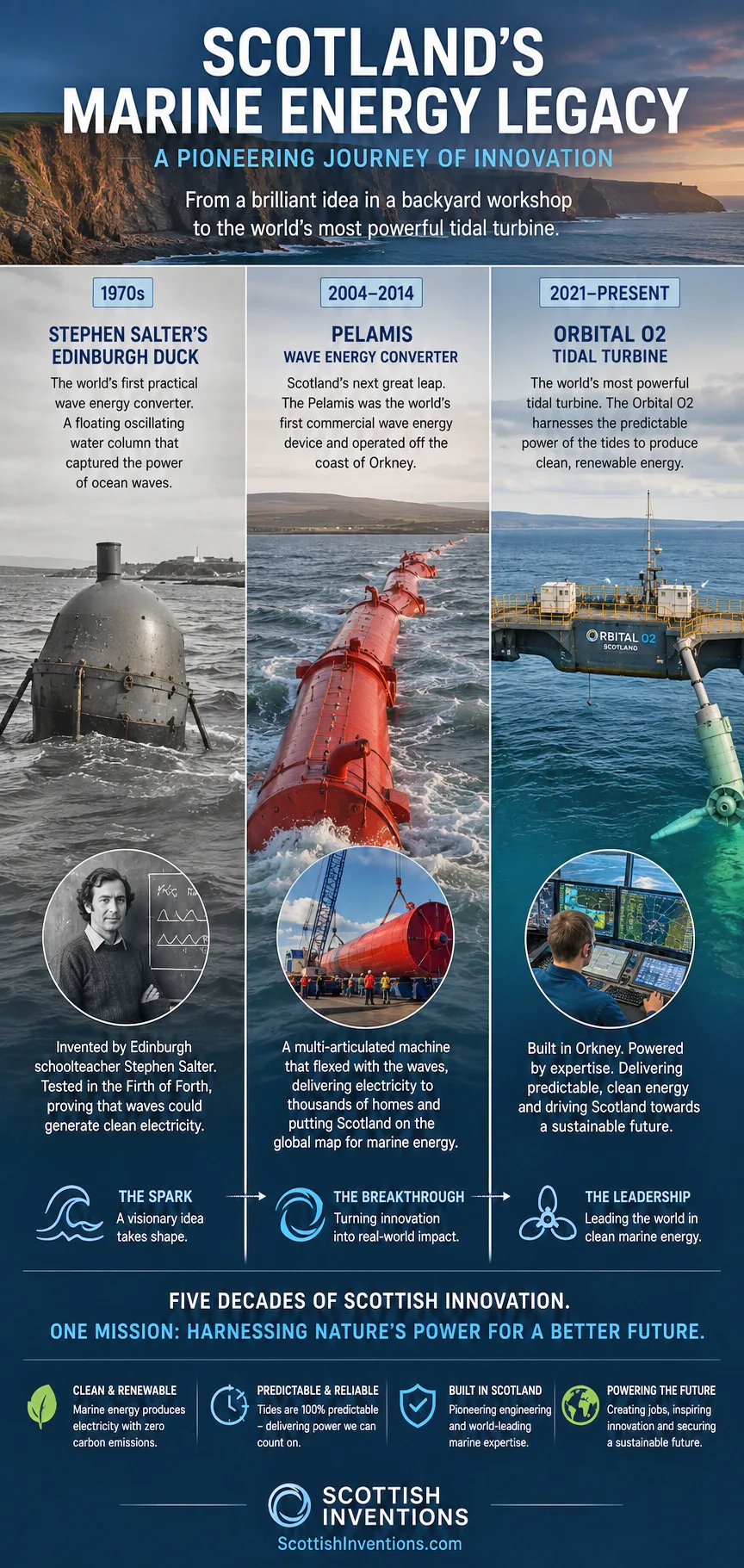
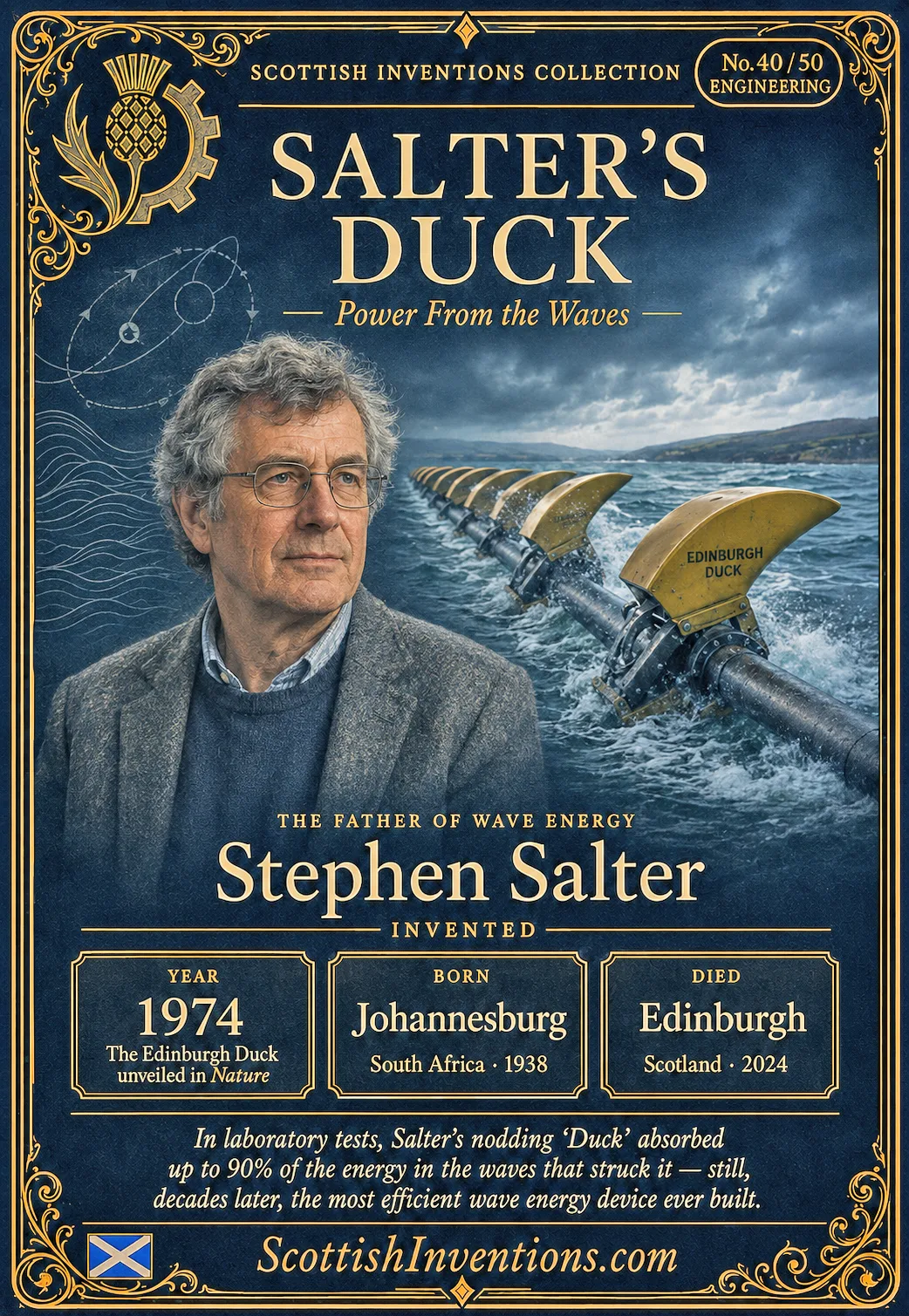
The O2 sits at the end of a long Scottish line. In 1974 Stephen Salter, working at the University of Edinburgh, invented the nodding 'Duck', the most efficient wave-energy device ever tested. In 2004 the Pelamis Wave Machine — designed in Edinburgh, tested at EMEC — became the world's first grid-connected offshore wave converter. And from 2021 onwards the Orbital O2 has carried the same tradition into tidal stream power, with the highest power rating of any tidal turbine ever built.
Marine renewables are now a strategic Scottish industry. Orkney is home to the only purpose-built test centre of its kind in the world, Edinburgh and Glasgow host a cluster of consultancies, fluid-dynamics specialists and certification firms serving global clients, and Scottish-built tidal devices are being exported to Canada, France, the Far East and the United States. The case for it is also climate-critical: as a predictable, base-load complement to wind and solar, tidal stream power can fill the gaps that variable renewables leave in the grid — and the country that learned to harness it first is now the one teaching the rest of the world how to do it.
The future — the O2-X array and beyond
Orbital's next chapter is already taking shape. The O2-X programme will scale the O2 platform up to a 2.4 MW machine and deploy them in arrays, starting with the Eday West site at EMEC and extending into projects already announced in France's Raz Blanchard and in Far Eastern waters where tidal currents are strong and grid demand is high. Orbital has also raised tens of millions of pounds in crowdfunding and grant funding from the Scottish and UK governments, the EU and private investors to support the build.
The longer-term ambition is straightforward: prove that floating tidal arrays can compete on cost with offshore wind, and turn the Pentland Firth and Fall of Warness into the first multi-hundred-megawatt tidal-power region in the world. If they succeed, Scotland's marine-energy story will go from interesting curiosity to genuine global industry — and the bright yellow hull turning quietly off Eday will be remembered as the machine that started it.
Frequently Asked Questions
What is the Orbital O2? The Orbital O2 is a 74-metre floating tidal-stream turbine designed and built in Scotland by Orbital Marine Power and deployed at the European Marine Energy Centre (EMEC) in Orkney in April 2021. It is rated at 2 MW — the highest power rating of any tidal turbine ever built — and generates enough clean electricity to meet the annual demand of around 2,000 UK homes.
Where is the Orbital O2 located? The O2 is moored at the Fall of Warness tidal-stream test site at EMEC, between the islands of Eday and Muckle Green Holm in Orkney, off the north coast of Scotland. The Pentland Firth and Orkney waters around it are among the most energetic tidal streams in the world.
How does a tidal turbine work? A tidal turbine works like an underwater wind turbine: moving water spins a set of blades, the blades turn a shaft, and the shaft drives an electrical generator. Because seawater is around 832 times denser than air, the rotors can be smaller than a wind turbine for the same power, and because tides are driven by the gravitational pull of the Moon and Sun, the power output can be predicted decades in advance.
Why is the Orbital O2 important? Because it is the first tidal-stream turbine to deliver utility-scale power from a floating platform that can be towed to port for maintenance — the breakthrough that finally makes commercial tidal energy realistic. It is also the foundation for Orbital's O2-X array programme, and a flagship for Scotland's marine renewables industry.
Is tidal power better than wind power? It is not better, but it is genuinely complementary. Tidal power offers far higher predictability than wind or solar — the tides can be forecast to the minute decades ahead — which makes it uniquely valuable for grid stability. Tidal resources are also far more concentrated geographically: the UK alone has an estimated 50% of Europe's tidal resource, much of it in Scottish waters.
What is EMEC in Orkney? The European Marine Energy Centre (EMEC), founded in 2003 and based in Stromness on the Orkney mainland, is the world's first and largest grid-connected open-sea test facility for wave and tidal energy converters. It runs the Fall of Warness tidal test site, where the Orbital O2 is deployed, and has hosted more wave and tidal devices than any other site on Earth.

Weekly Scottish Innovation Facts
Delivered to your inbox every Sunday. No spam, just brilliance.