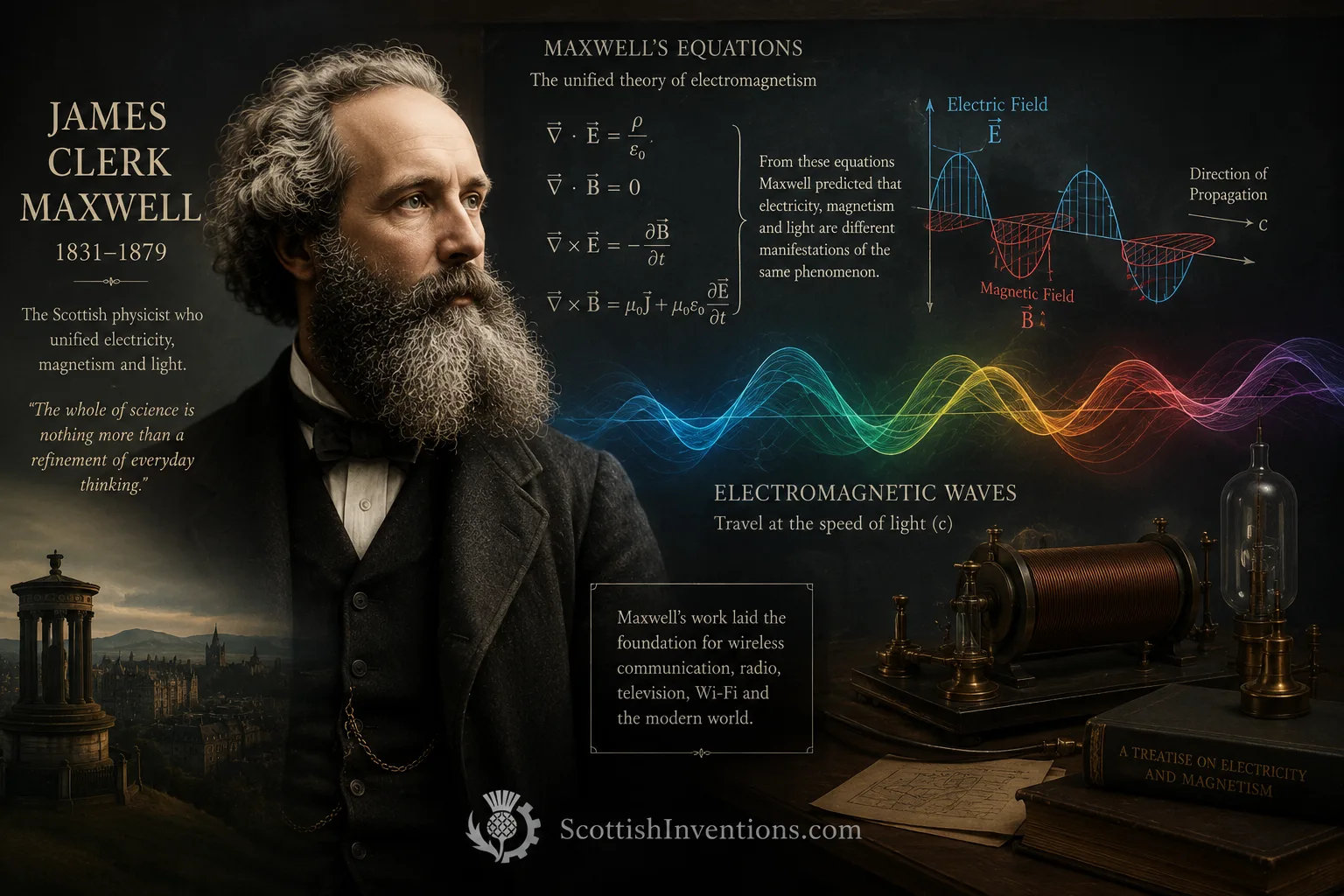
Maxwell's Equations
by James Clerk Maxwell
What's the go o' that?
James Clerk Maxwell was born on 13 June 1831 at 14 India Street in Edinburgh, a New Town house his parents had built in the 1820s and which today is home to the James Clerk Maxwell Foundation. Soon after his birth the family moved to Glenlair, their country home in Kirkcudbrightshire in Galloway, and it was there, roaming fields, ponds and drains, that the boy's restless curiosity first showed itself.
A relative wrote in 1834, when 'the Boy' was not yet three, that 'he has great work with doors, locks, keys etc., and Show me how it doos is never out of his mouth,' adding that he 'investigates the hidden course of streams and bell-wires.' The phrase most associated with him — pestering adults with 'What's the go o' that?', and when fobbed off, 'But what's the particular go o' that?' — captures a mind that simply had to know how everything worked.
When James was eight, his mother Frances Cay died of abdominal cancer — the same disease that would one day claim him. He was sent to Edinburgh Academy in 1841, aged ten. Arriving with a strong Galloway accent and home-made clothes, he was teased and saddled with the nickname 'Dafty' — until he astonished his classmates by sweeping up prizes in mathematics, scholarship and English verse. He was just 14 when he wrote his first scientific paper, on oval curves, read to the Royal Society of Edinburgh on his behalf because the boy was thought too young to present it himself.
A breadth of genius — before electromagnetism
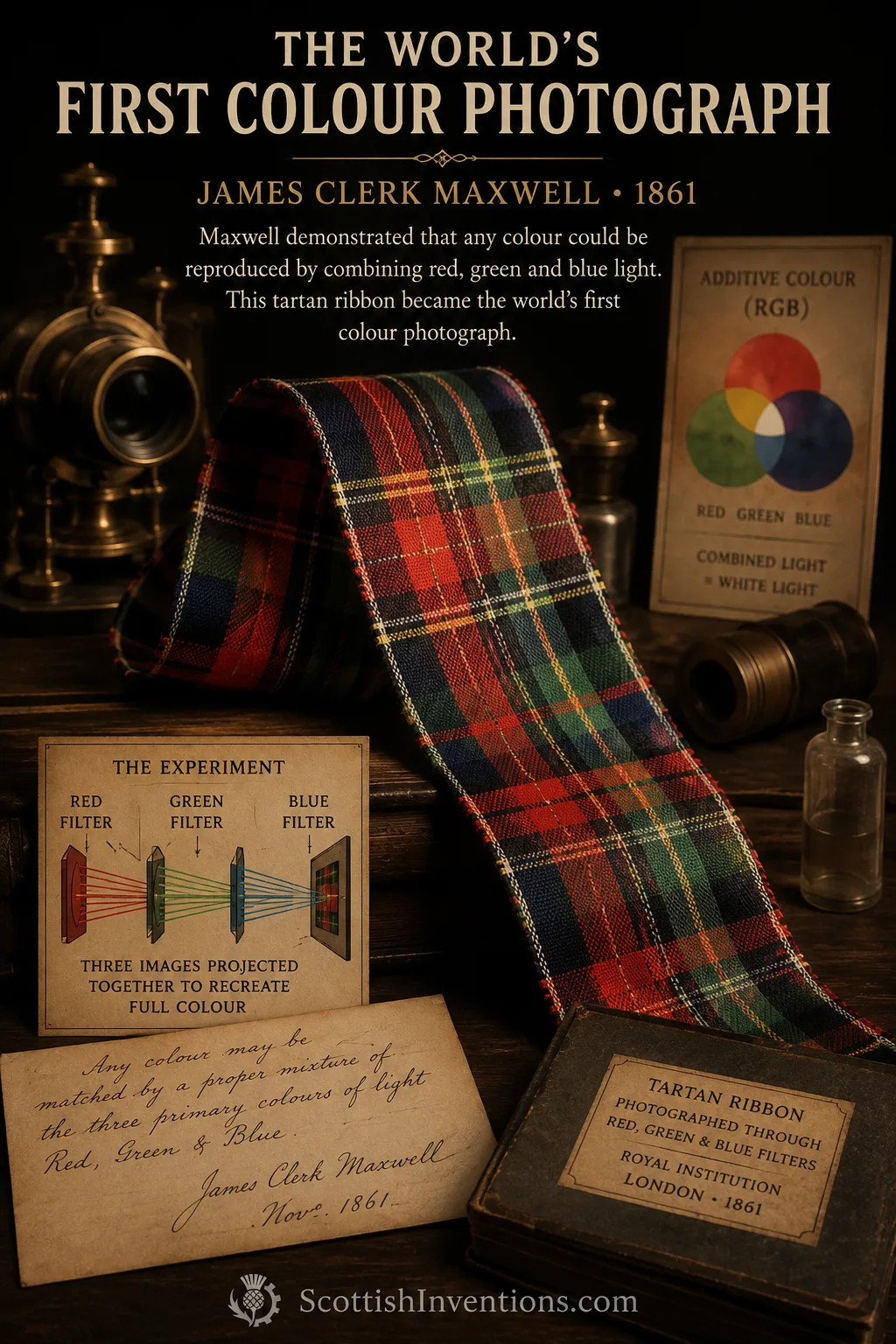
What makes Maxwell extraordinary is that the work for which he is most famous was only one peak in a whole mountain range. He worked out that any colour could be reproduced by mixing red, green and blue light — the principle of additive colour, and the foundation of every screen you own. At a Royal Institution lecture in 1861 he had the photographer Thomas Sutton photograph a tartan ribbon three times, through red, green and blue filters, then projected the three positives through matching filters to recombine them into the world's first colour photograph.
For the 1856 Adams Prize at Cambridge he tackled the centuries-old puzzle of Saturn's rings. By sheer mathematics he proved that a solid ring would be torn apart and a fluid one would break up, so the rings had to consist of countless small particles each in its own orbit. Over a century later the Voyager and Cassini missions confirmed he was right.
In 1860 he treated a gas as a swarm of molecules in random motion and used probability to derive the distribution of their speeds — the first time a physical law was given a statistical foundation. Refined by Boltzmann, it became the Maxwell–Boltzmann distribution, a cornerstone of statistical mechanics. In 1867 he imagined a 'finite being' controlling a tiny door between two boxes of gas, seemingly cheating the second law of thermodynamics — the thought experiment Lord Kelvin christened 'Maxwell's Demon', still driving debate linking thermodynamics and information theory today.
The equations — the heart of it all
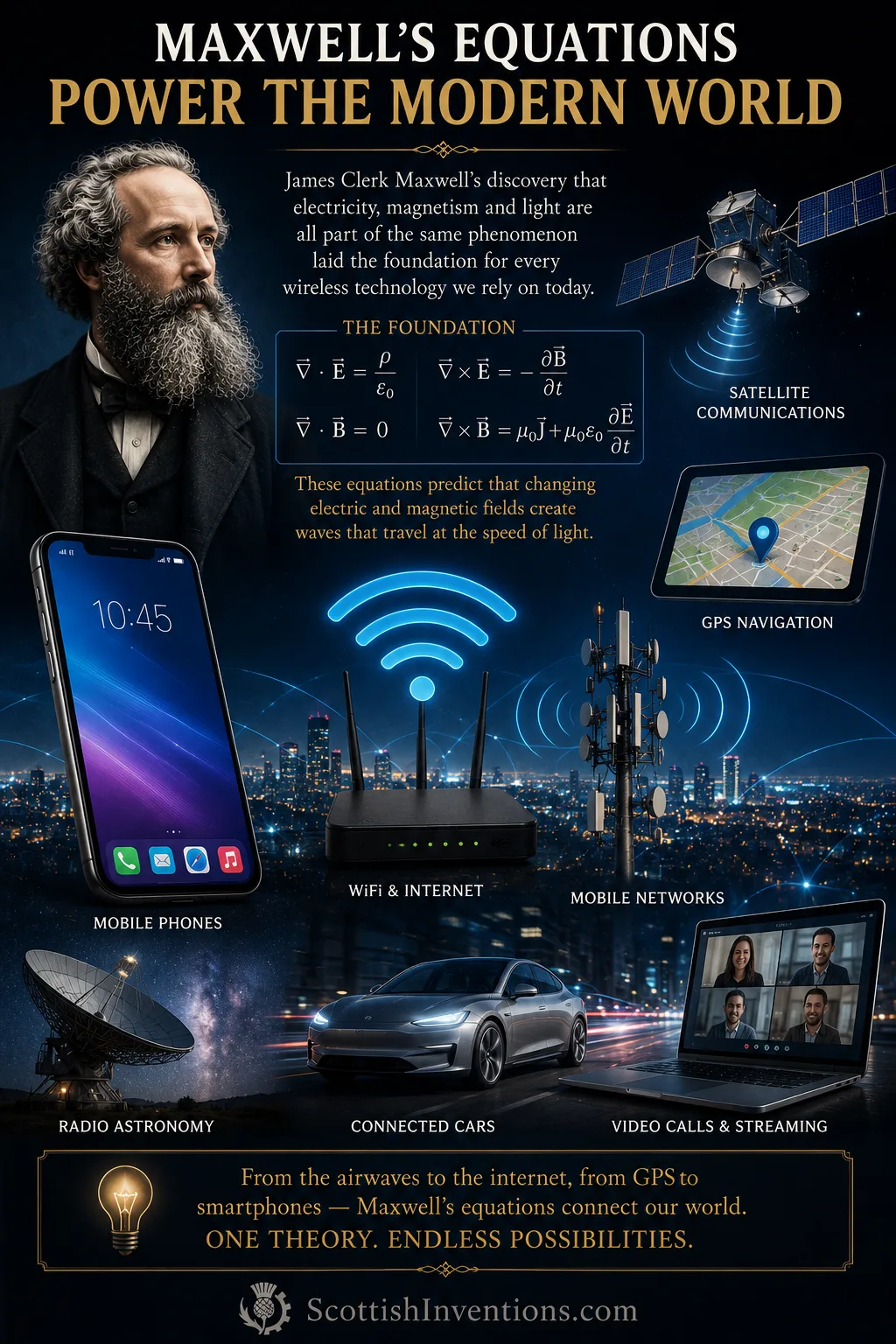
By the mid-19th century, electricity and magnetism were a patchwork of separate laws. Faraday had shown that a changing magnetic field produces electricity, and had the visionary but un-mathematical idea of 'lines of force' filling space. Ampère had quantified the magnetism produced by currents; Gauss had described how charges produce electric fields. What was missing was a single mathematical framework. Maxwell supplied it.
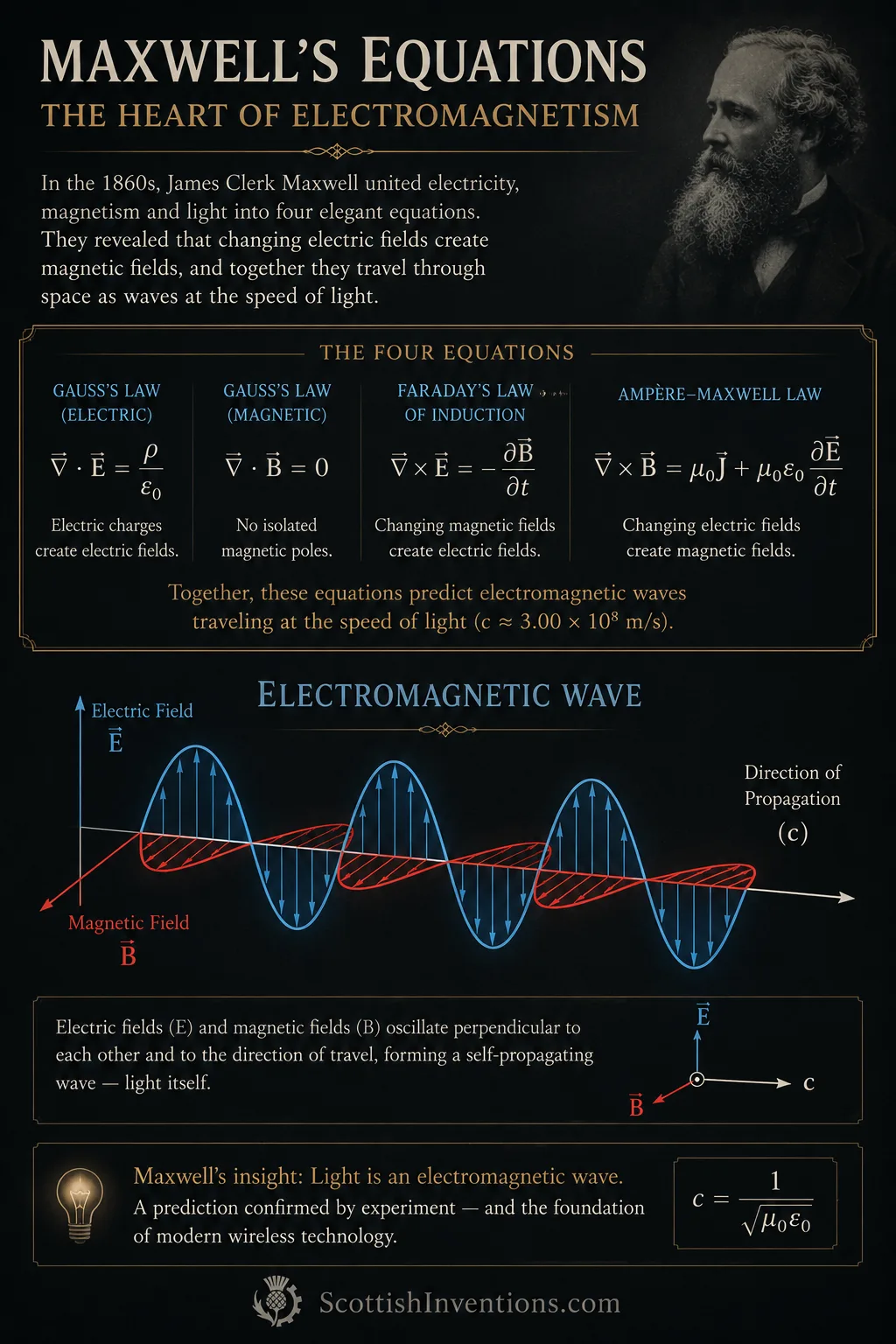
The crucial stroke was the displacement current. Ampère's law, as it stood, was mathematically inconsistent for changing fields. Maxwell added a new term — with no experimental evidence behind it at the time — to make the mathematics whole. The consequence was breathtaking: a changing electric field must itself generate a magnetic field. Combine that with Faraday's induction, and electric and magnetic fields can take turns regenerating one another and propagate through empty space as a wave.
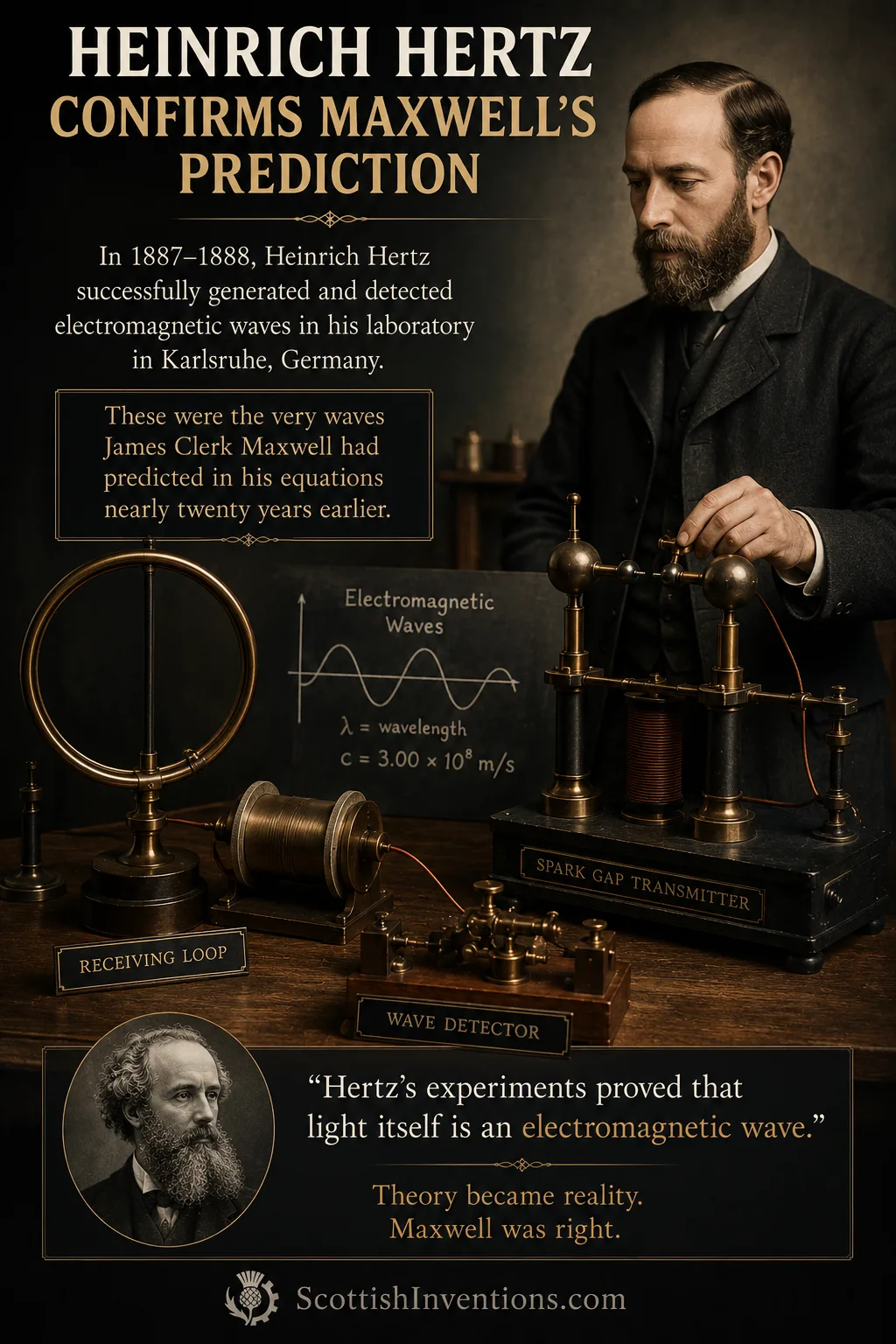
When Maxwell calculated the speed of that wave from purely electrical measurements, he obtained a velocity of about 310,740,000 metres per second — startlingly close to the measured speed of light. He drew the inevitable conclusion: light, electricity and magnetism were one. Maxwell did not live to see it proved. In 1887–1888, eight to nine years after his death, Heinrich Hertz generated and detected electromagnetic waves in his laboratory and confirmed they behaved exactly as Maxwell's mathematics demanded.
In plain English the four equations say: electric charges produce electric fields; there are no magnetic monopoles, so magnetic field lines always form closed loops; a changing magnetic field creates an electric field; and electric currents and changing electric fields create magnetic fields.
What the equations gave the world
Almost every technology that defines modern life is a direct descendant of those four lines. Hertz's spark-gap experiments led, through Oliver Lodge, Nikola Tesla and Guglielmo Marconi, to radio — and then to television and radar. Today the same physics powers mobile phones, WiFi, microwave ovens and GPS. Because Maxwell showed that visible light is just one band of a vast electromagnetic spectrum, his work also underlies X-rays, fibre-optic communications, and the magnetic fields at the heart of MRI scanners.
Richard Feynman summed up the verdict of history: 'From a long view of the history of mankind — seen from, say, ten thousand years from now — there can be little doubt that the most significant event of the 19th century will be judged as Maxwell's discovery of the laws of electrodynamics. The American Civil War will pale into provincial insignificance in comparison with this important scientific event of the same decade.'
Maxwell's equations also lit the fuse of 20th-century physics. They implied that the speed of light is the same for every observer — a fact that clashed with everyday notions of relative motion. Einstein resolved the paradox by making it the foundation of special relativity in 1905. On the walls of his studies in Berlin and later Princeton, Einstein hung the portraits of just three predecessors: Newton, Faraday and Maxwell.
The man behind the mathematics
In 1858 Maxwell married Katherine Mary Dewar, daughter of the Principal of Marischal College in Aberdeen. Katherine was no mere bystander to his science — she assisted in his colour-vision experiments and later made the painstaking temperature measurements for his work on the viscosity of gases. The couple had no children but were devoted; when Maxwell nearly died of smallpox, he credited her nursing with saving his life.
His career carried him across Britain: Professor of Natural Philosophy at Marischal College, Aberdeen (1856–1860); Professor at King's College London (1860–1865); then five productive years back at Glenlair (1865–1871), where he wrote much of the Treatise on Electricity and Magnetism; and finally, from 1871, the first Cavendish Professor of Physics at Cambridge, where he designed and oversaw the building of the Cavendish Laboratory.
For all his seriousness of purpose, Maxwell was a famous wit who delighted in puns and parody. He signed letters to his friend Peter Guthrie Tait as 'dp/dt' — a mathematical in-joke because in Tait's thermodynamics textbook the equation dp/dt = JCM happened to spell out his initials. His faith was deep but unshowy, and threaded quietly through both his life and his letters.
Death and legacy
Maxwell died on 5 November 1879, aged just 48, of abdominal cancer — the same disease that had killed his mother. He is buried at Parton Kirk in Galloway. Hertz's confirmation of his waves came within a decade; special relativity was built on his equations a generation later.
In Physics World's 1999 millennium poll of 100 leading physicists, Maxwell was voted the third-greatest physicist of all time, behind only Einstein and Newton. A statue by the sculptor Alexander Stoddart — seated with his dog Toby at his feet and a colour-top in his hands, flanked by reliefs of Newton and Einstein — was unveiled at the east end of George Street in Edinburgh on 25 November 2008.
Related Inventions
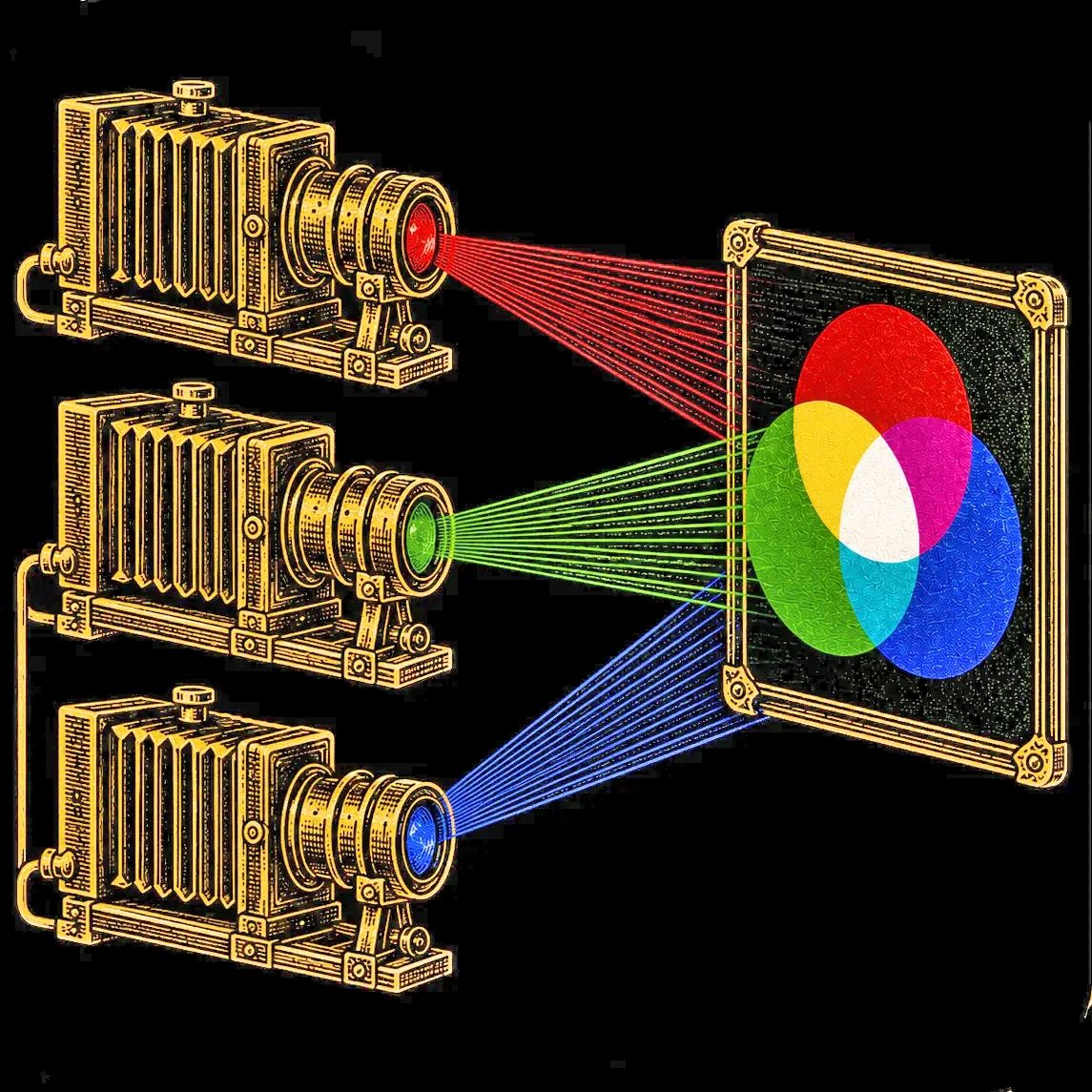
First Permanent Colour Photograph
James Clerk Maxwell · 1861
Three-colour-separation photography.
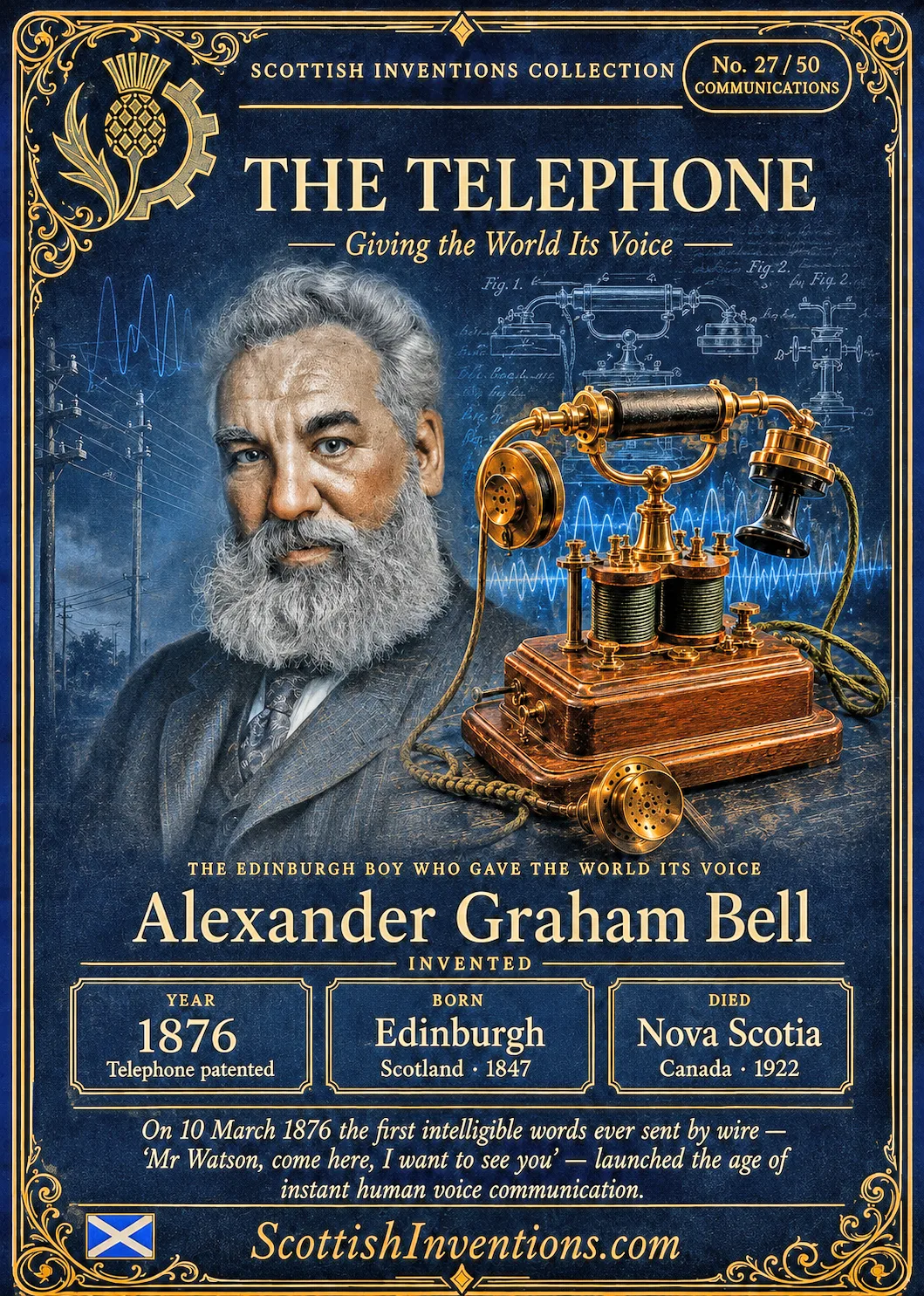
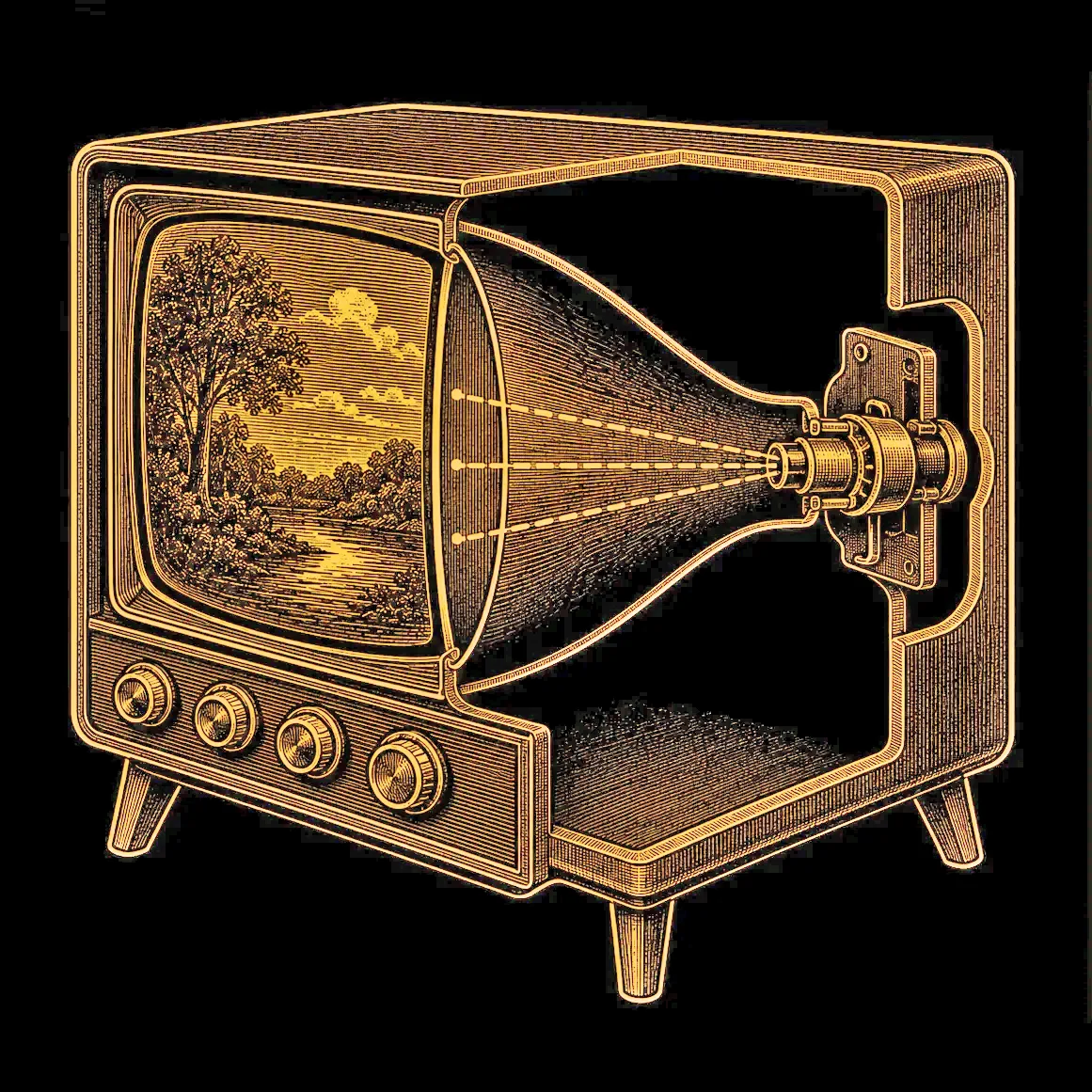
Television
John Logie Baird · 1925
The first working television, built from household objects.
Weekly Scottish Innovation Facts
Delivered to your inbox every Sunday. No spam, just brilliance.