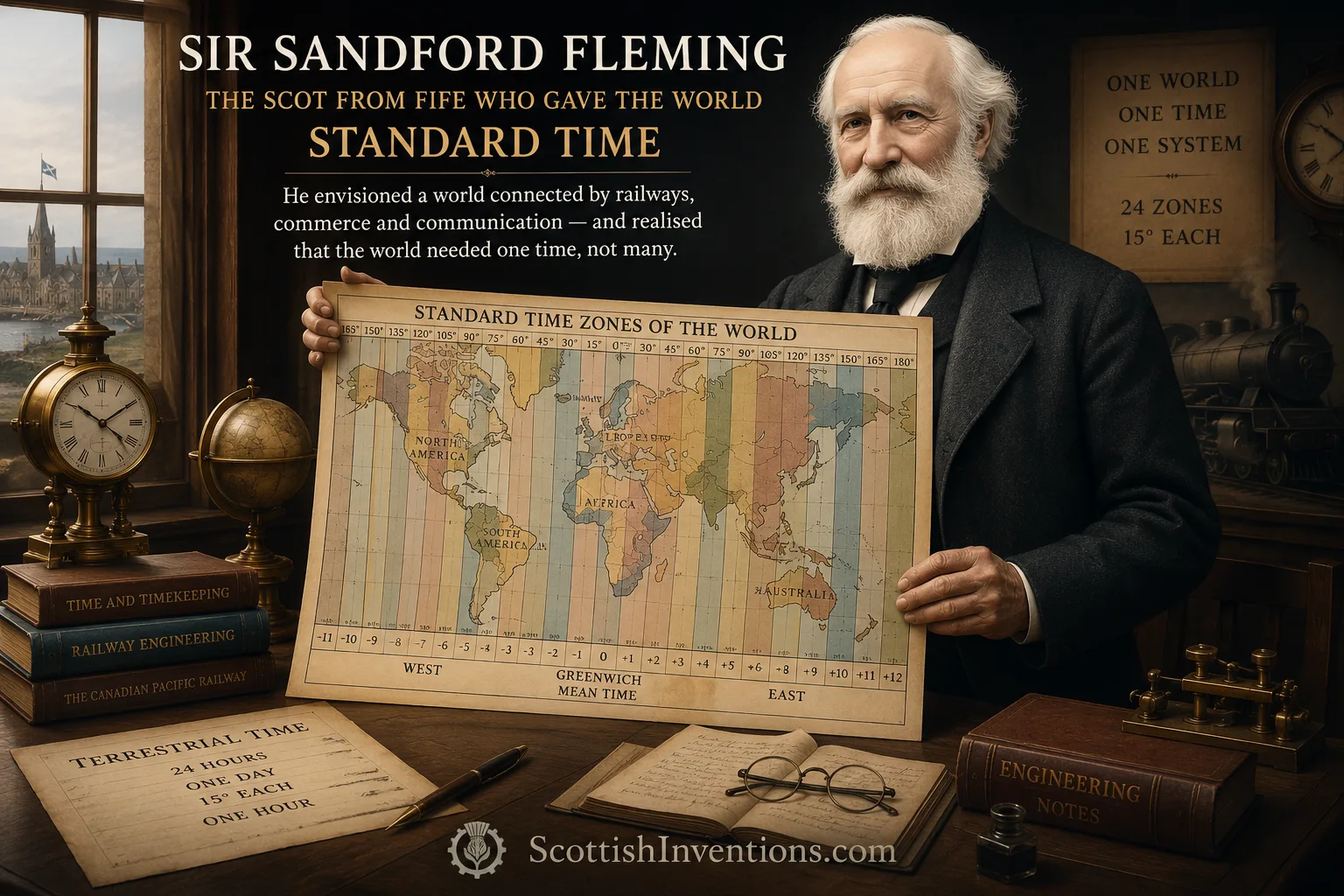
Universal Standard Time
by Sandford Fleming
The Fife boy who organised the planet's clocks
When you glance at your phone and it silently corrects itself across a time zone, you are using the invention of a Scot from Fife. Sir Sandford Fleming did not invent the clock, but he did something arguably grander: he organised the entire planet's relationship with time. Before him, time was a local, chaotic, parochial affair. After him, it became a single coordinated global system — and that system has proved to be one of the most durable international agreements ever made.
Born in the linoleum-and-harbour town of Kirkcaldy in 1827, Fleming emigrated to Canada at 18 and rose to become the chief engineer of his adopted nation's great railways. But it was his 'spare-time' obsession — the reform of timekeeping — that changed the world.
A Kirkcaldy upbringing
Sandford Fleming was born on 7 January 1827 in Kirkcaldy, Fife, the son of Andrew Greig Fleming and Elizabeth Arnot. Educated first in Kennoway and then in Kirkcaldy, the young Fleming showed an early flair for mathematics and drawing. At the age of 14 he was apprenticed to the distinguished Scottish engineer and surveyor John Sang in Kirkcaldy, learning surveying, draughtsmanship and engineering — the foundational skills of his career.
In 1845, aged 18, he emigrated to the Province of Canada with his elder brother David, sailing from the Broomielaw in Glasgow aboard the ship Brilliant. He qualified as a surveyor in 1849 and quickly made his mark, helping to found the Canadian Institute in Toronto and rising to become chief engineer of the Northern Railway, then of the Intercolonial Railway, and from 1871 engineer-in-chief of the surveys for the Canadian Pacific Railway.
The problem: the chaos of local time
To understand Fleming's achievement, you must understand the bewildering muddle that preceded it. For almost all of human history, every town kept its own local 'solar time,' set by the moment the sun reached its highest point — local noon. A clock in Bristol genuinely read a different time from a clock in London, because the sun arrived there later.
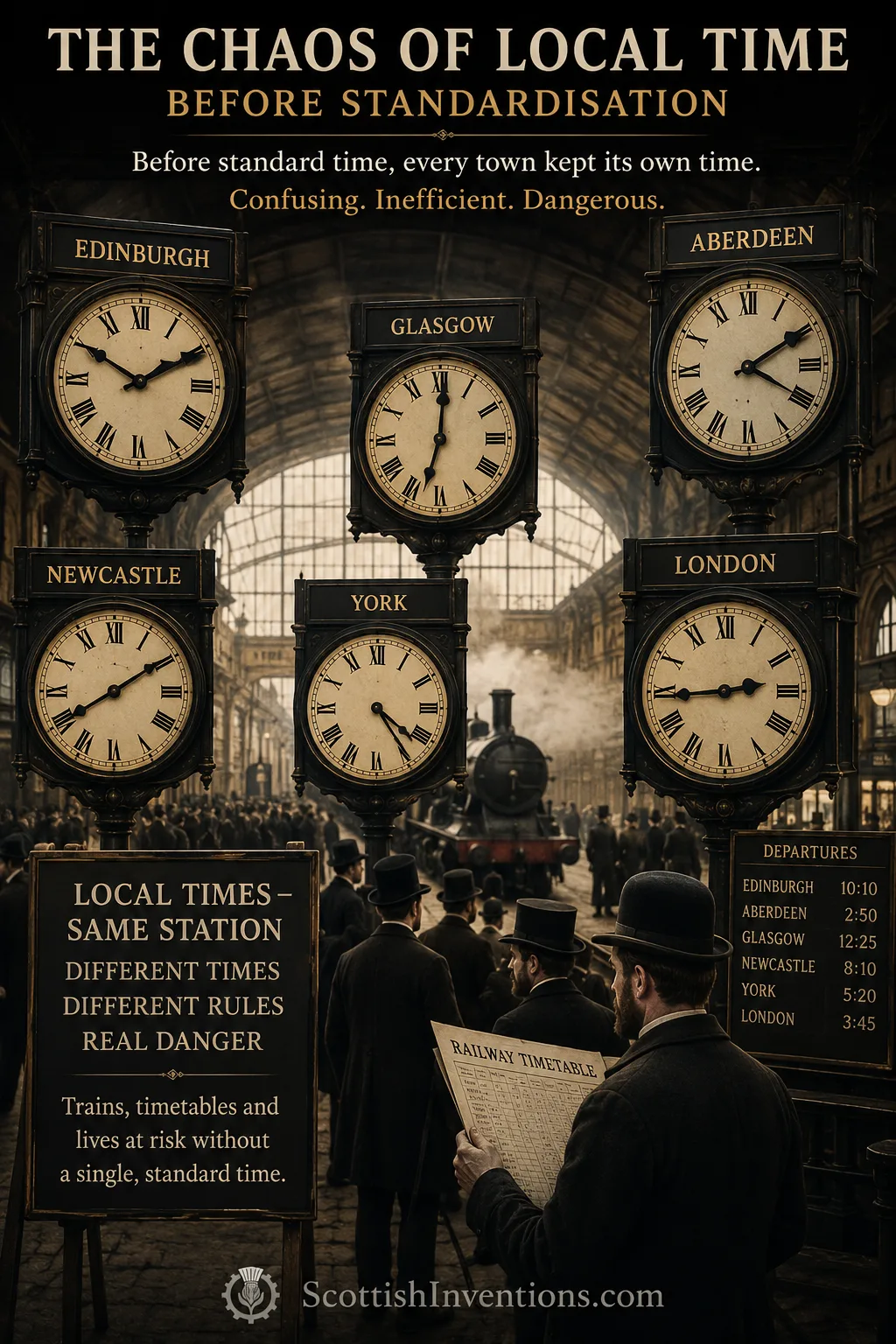
The railway shattered this comfortable arrangement. According to the Library of Congress, 'Every city in the United States used a different time standard, so there were more than 300 local sun-times to choose from. Railroad managers tried to address the problem by establishing 100 railroad time zones.' A traveller changing trains at a major junction like Chicago might encounter six different 'official' times on different railroad clocks in the same station.
This was not merely inconvenient; it was dangerous. On single-track lines, trains running on mismatched times risked catastrophic collisions. The conditions were ripe for a reformer.
The big idea
A much-loved anecdote holds that in 1876 Fleming missed a train at an Irish railway station because the printed timetable read 'p.m.' when it should have read 'a.m.', and that this infuriating night stranded on a platform crystallised his thinking about a 24-hour clock and standard time. The honest verdict is that the story is essentially undocumented and probably apocryphal — but it is beyond dispute that Fleming, a constant traveller and railway engineer, was acutely conscious of the confusion caused by both local time and the ambiguous 12-hour clock.
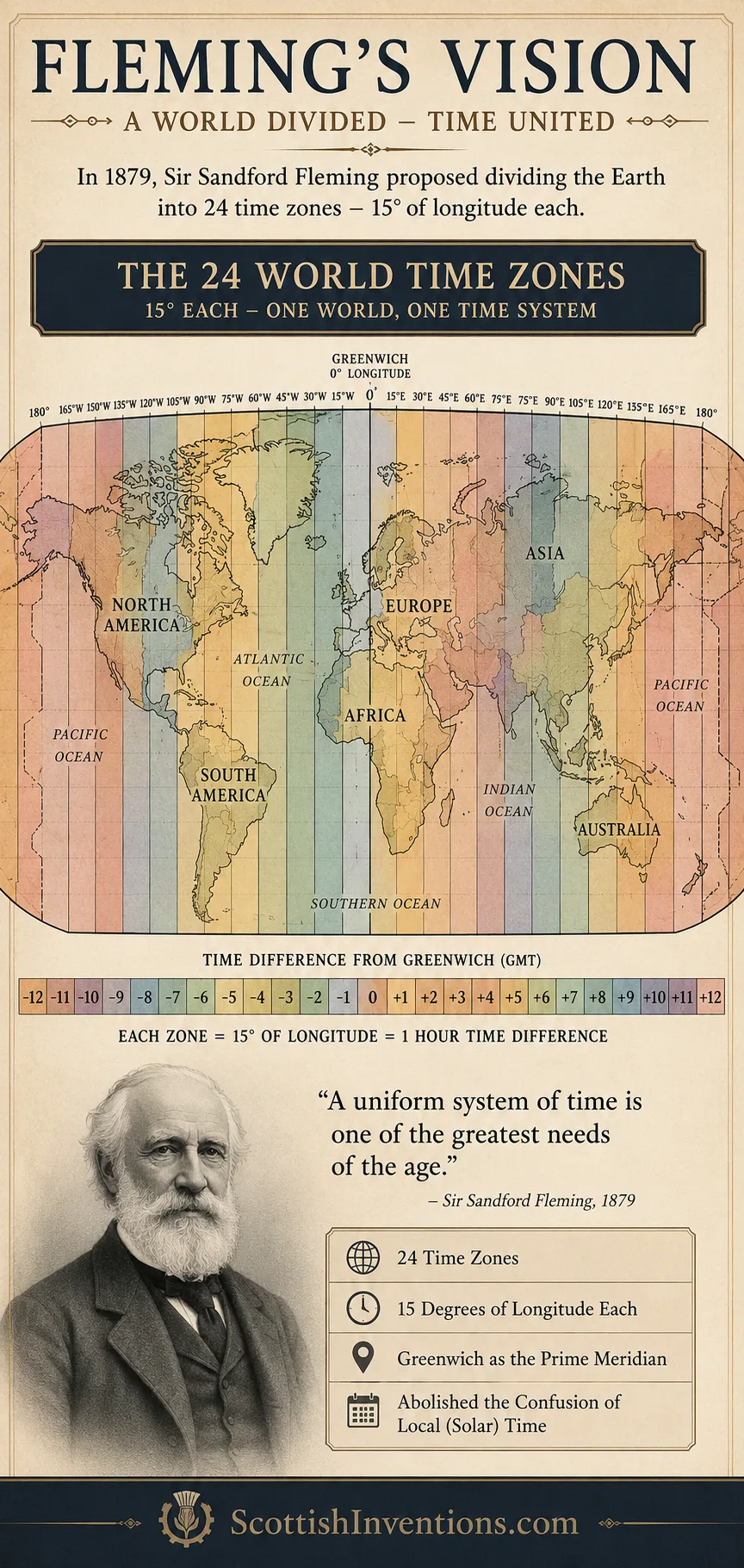
Fleming's actual innovation was twofold and elegant. First, he proposed dividing the world into 24 time zones, each 15 degrees of longitude wide and each exactly one hour apart, with all clocks within a zone sharing a single time. Second, he proposed a single global 24-hour reference, which he called 'Terrestrial Time' and later 'Cosmic Time'.
His first formal proposals came in 1876 with a memoir, 'Terrestrial Time.' He then refined them in two papers presented at a meeting of the Canadian Institute in Toronto on 8 February 1879 — the meeting now commemorated as the 'birthplace of standard time.' So important were these papers that in June 1879 the British government forwarded copies to eighteen foreign countries and to scientific bodies.
The campaign: getting the world to agree
Fleming was not content to publish and wait. He was a born institutional operator who lobbied governments, railway companies, scientific societies and the British Colonial Office relentlessly for years. The American Society of Civil Engineers made him chairman of its committee on standard time in 1881, and he carried out a survey of railway managers and scientists at his own expense.
Rather than wait for governments, the North American railways acted on their own. On Sunday, 18 November 1883 — forever known as 'the Day of Two Noons' — railways across the United States and Canada simultaneously adopted standard time zones. As standard noon arrived in each zone, clocks were reset; in places where local solar noon had already passed, towns experienced a second noon.
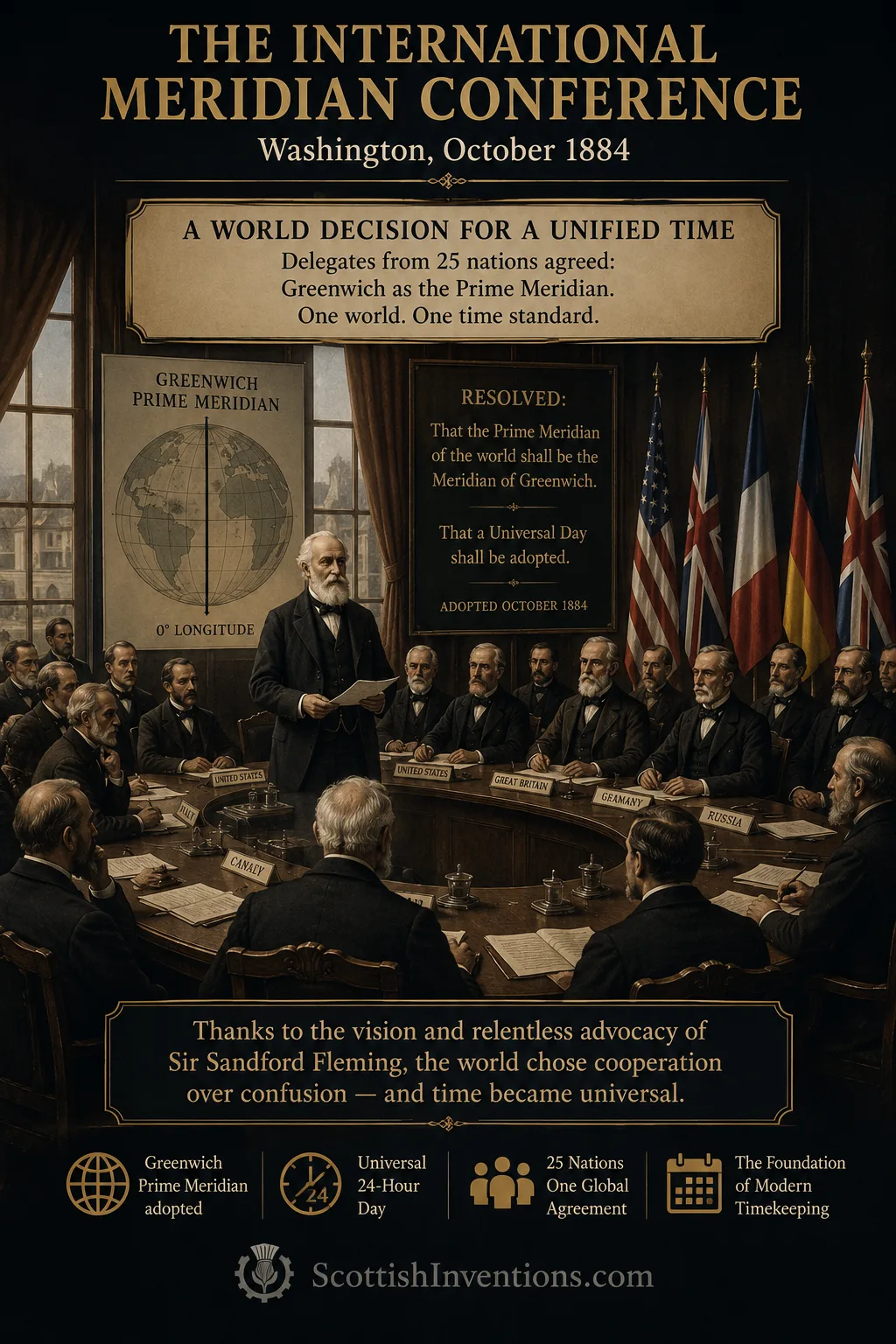
The push for global uniformity culminated in the International Meridian Conference, held in Washington, D.C., in October 1884. Delegates representing 25 nations resolved overwhelmingly to adopt the meridian through the Royal Observatory at Greenwich as the world's prime meridian, by 22 votes to 1. Fleming attended as one of the delegates of Great Britain and was the only delegate to distribute a position paper. The conference fixed the prime meridian from which the zones would be measured; the gradual global adoption of Fleming's zones themselves then unfolded over decades.
The mathematics, made simple
The beauty of the system lies in its arithmetic. A full circle is 360 degrees; the Earth turns once — 360° — in 24 hours. Divide 360 by 24 and you get 15. So the Earth rotates 15 degrees of longitude every hour, and each ideal time zone is 15° wide and one hour apart from its neighbours.
Fleming's legacy lives on directly in Coordinated Universal Time (UTC), the modern global time standard introduced in its present, atomic-clock-based form on 1 January 1972. Every time zone on Earth is now defined as an offset from UTC. Fleming's idealised 24-hour 'Cosmopolitan Time' is, in spirit, the ancestor of the UTC that synchronises every computer, phone, GPS satellite and aircraft today.
Sandford Fleming's other achievements
Fleming's life would be remarkable even if he had never thought about clocks. As engineer-in-chief of the Canadian Pacific Railway surveys from 1871 to 1880, he organised the immense task of surveying a route across a continent. He is the tall, bearded, top-hatted figure standing behind Donald Smith in the famous photograph of the driving of the Last Spike at Craigellachie on 7 November 1885.
In 1851 Fleming designed Canada's first postage stamp, the Three-Pence Beaver — one of the world's first pictorial postage stamps. Boldly, rather than depict the reigning monarch, he put an industrious beaver at the centre, helping to establish the beaver as a national emblem of Canada.
From the 1880s Fleming was the tireless champion of a state-owned submarine telegraph cable across the Pacific — part of the 'All Red Line.' The trans-Pacific cable was completed and inaugurated on 31 October 1902, the moment the globe was first encircled by telegraph.
Legacy and honours
Fleming was showered with recognition. He was knighted (KCMG) in 1897, having been made a CMG in 1877. From 1880 until his death in 1915 he served as Chancellor of Queen's University in Kingston, Ontario. He held honorary doctorates from St Andrews, Columbia, Toronto and Queen's, and was a charter member and president of the Royal Society of Canada.
His greatest monument, though, is invisible and everywhere. The 24-zone framework descended from his vision is used by every country on Earth — quite plausibly the most universally accepted international standard ever devised. From satellites to smartphones, from global finance to international travel, every moment of modern life depends on the time system Fleming championed.

Kirkcaldy remembers its son
For a long time his birthplace was strangely quiet about him, overshadowed by Kirkcaldy's other famous son, Adam Smith. That was finally remedied in the summer of 2022, when Fife Council unveiled an analemmatic sundial — a 'human sundial' on which a person stands as the gnomon — on the Kirkcaldy waterfront, its oval form symbolising Fleming's idea of a time system embracing the whole world. An earlier plaque had been unveiled in the town in 1973.
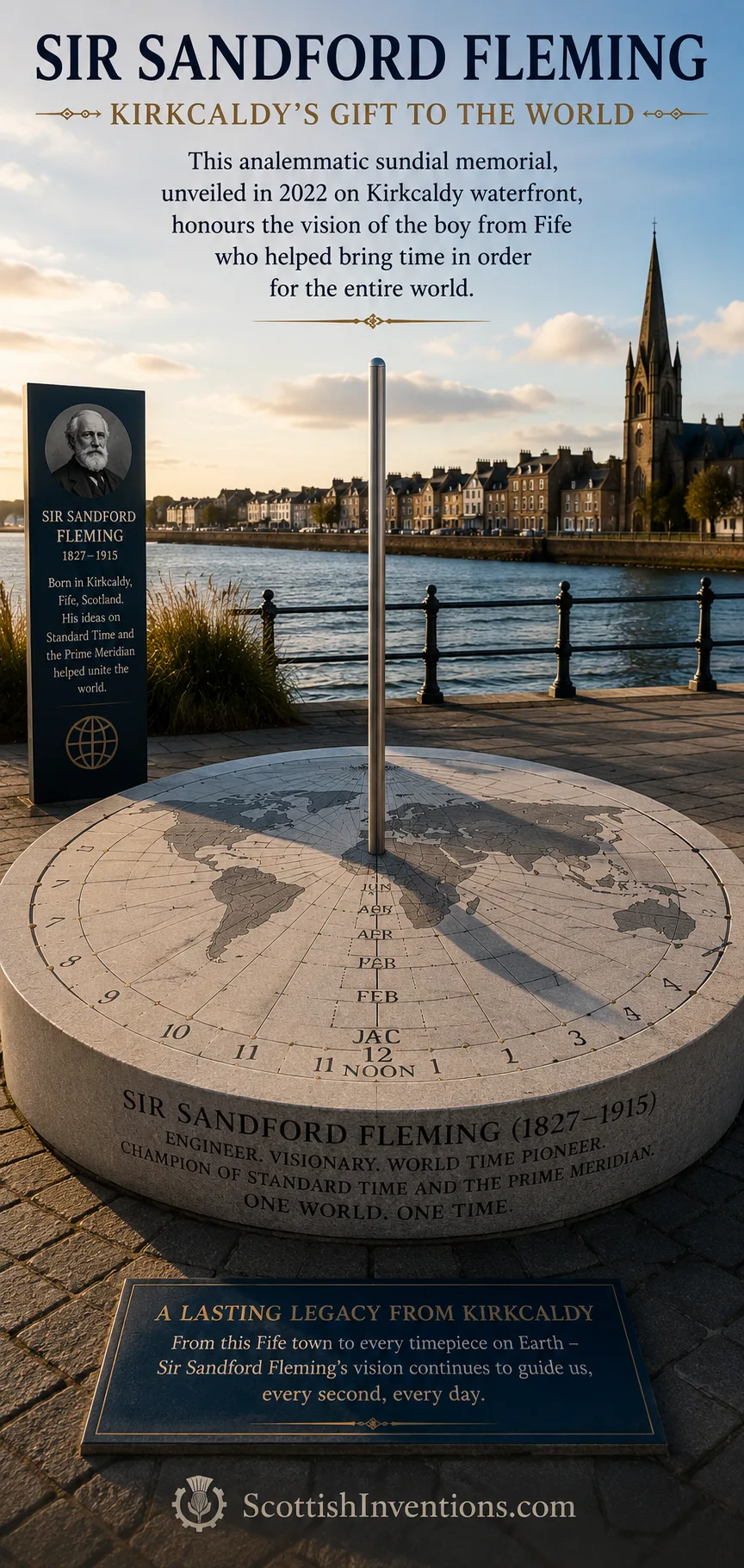
It is a fitting tribute. The Scot from Fife who taught the world to share a clock is now remembered, at last, in the harbour town where it all began.
Related Inventions

Television
John Logie Baird · 1925
The first working television, built from household objects.
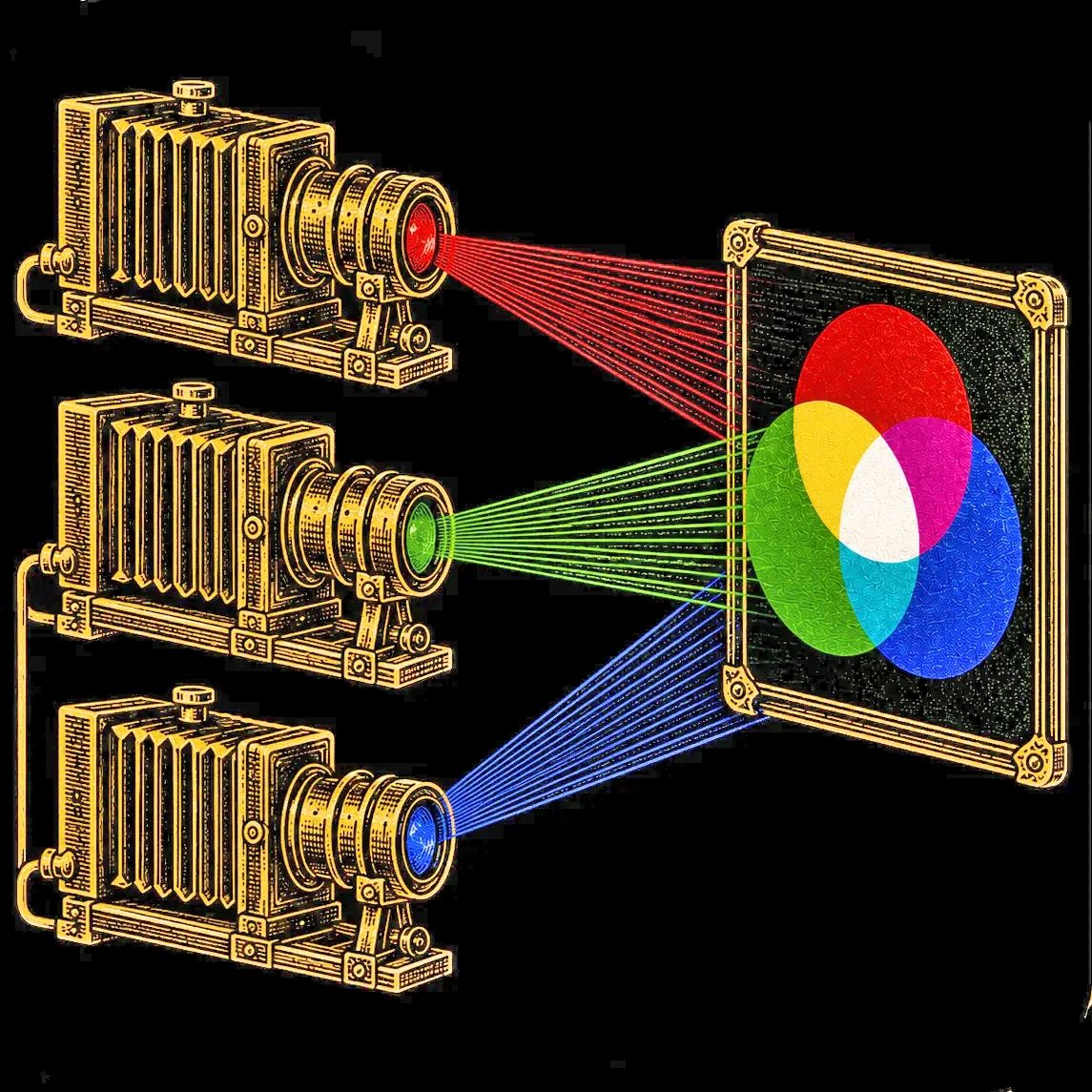
First Permanent Colour Photograph
James Clerk Maxwell · 1861
Three-colour-separation photography.
Weekly Scottish Innovation Facts
Delivered to your inbox every Sunday. No spam, just brilliance.