Scottish Inventions · Transport · Card No. 39 of 50
Robert Davidson & the Galvani
The Aberdeen Chemist Who Built the World's First Electric Locomotive
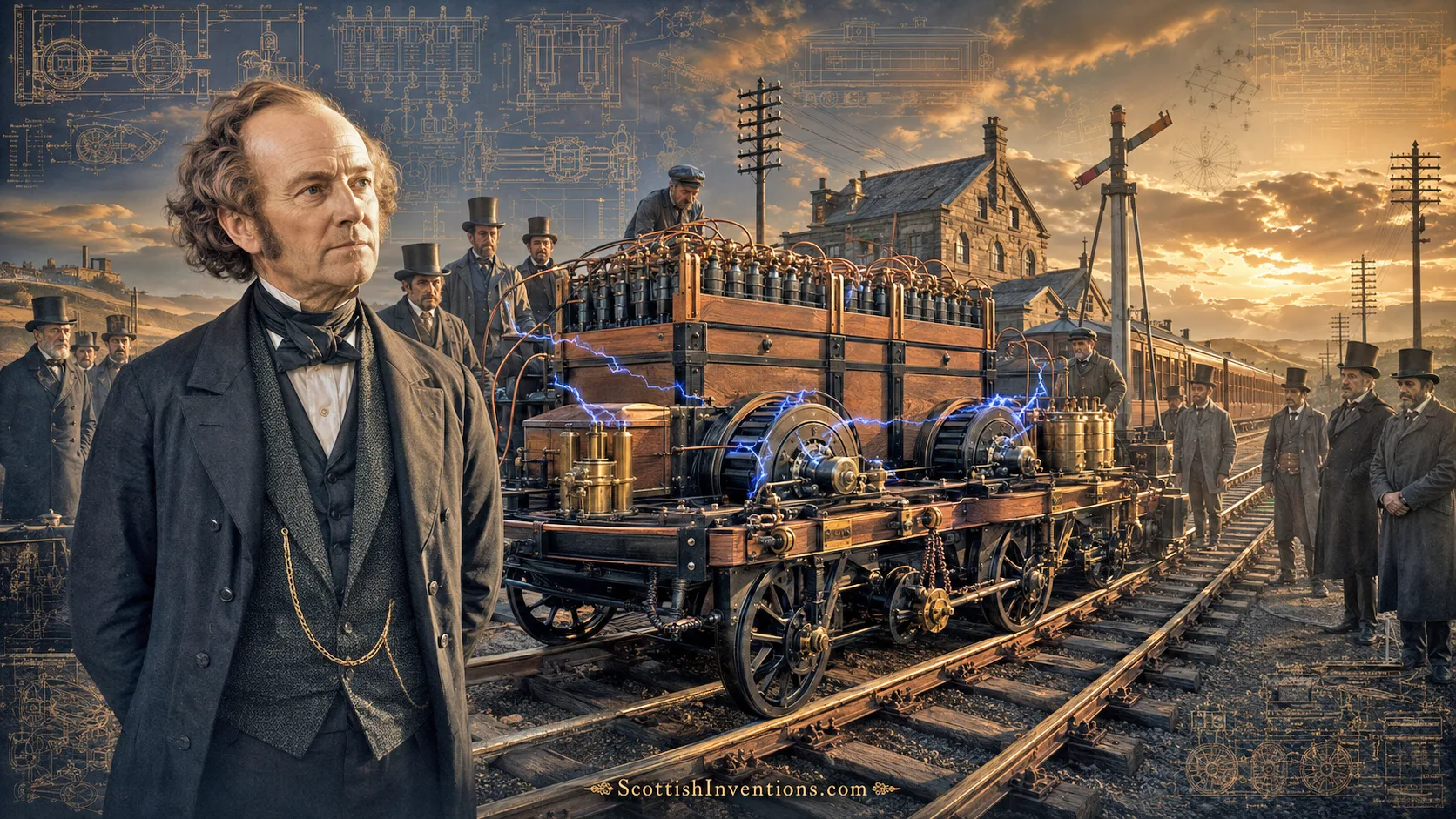
In September 1842, on the newly opened Edinburgh and Glasgow Railway, a several-ton wooden wagon powered by zinc batteries hauled itself along the track at walking pace. It was the world's first electric locomotive — 37 years before the invention is usually said to have happened.
TL;DR
- Robert Davidson (1804-1894), an Aberdeen chemist, built the world's first known electric railway locomotive — the Galvani — which ran under its own power on the Edinburgh and Glasgow Railway in September 1842, some 37 years before Werner von Siemens' celebrated 1879 electric railway.
- The Galvani worked but was commercially doomed: its non-rechargeable zinc batteries were ruinously expensive to feed compared with coal, and the machine was later destroyed by railway workers who, in the words of one modern encyclopaedia, "saw it as a threat to their job security."
- Scotland can claim an extraordinary double: Davidson pioneered the electric railway locomotive, while a shadowy compatriot, Robert Anderson, is widely credited with an early electric road carriage in the 1830s — though Anderson's story is so thinly documented that it must be treated with caution.
Key Findings
- Birth, life and death verified. Davidson was born in Aberdeen on 18 April 1804 and died there on 16 November 1894, aged 90. He was a lifelong Aberdonian, a manufacturing chemist by trade, and is buried in St Peter's Cemetery, Aberdeen.
- Experimental motors from 1837; the full-size Galvani in 1842. Small motors and a model locomotive from 1837, a four-wheeled electric car by 1839, a public exhibition in Aberdeen in 1840, and the full-size locomotive in 1842.
- Endorsed by the Royal Scottish Society of Arts. Per the University of Aberdeen's John S. Reid, cited on Wikipedia: "He obtained the endorsement of the Royal Scottish Society for Arts in his ventures and they made him a £15 grant."
- The Galvani ran on the Edinburgh and Glasgow Railway in September 1842, moving itself at about 4 mph. It was about 16 feet (4.9 m) long; sources differ on its weight, giving figures from five to seven tons.
- The economics killed it. Consuming zinc in a battery was far dearer than burning coal — a "forty times" figure is often quoted, though its precise verbatim origin is uncertain.
Robert Davidson at a glance
- Inventor
- Robert Davidson
- Born
- Aberdeen — 18 April 1804
- Died
- Aberdeen — 16 November 1894
- Profession
- Manufacturing chemist & electrical experimenter
- Invention
- The Galvani electric locomotive
- Demonstrated
- Edinburgh & Glasgow Railway, September 1842
- Power source
- Non-rechargeable galvanic (zinc-acid) batteries
- Motors
- Two electromagnetic motors, one per axle
- Length / weight
- ~16 ft (4.9 m); 5-7 tons
- Top speed
- ~4 mph (6.5 km/h)
- World first
- First electric locomotive on a public railway
Early Life in Aberdeen
Robert Davidson was born in Aberdeen on 18 April 1804. His family was in trade: according to his obituary in the Aberdeen Evening Express of 16 November 1894, his father carried on the business of a wine and spirit merchant "for many years" at 44 Broad Street, and the young Davidson entered that business at an early age. He was educated at Marischal College — one of Aberdeen's two universities at the time — attending the second- and third-year classes from 1819 to 1821, where he heard the lectures of Professor Patrick Copland. According to the University of Aberdeen's account, he received this education in return for working as a laboratory assistant.
In the 1820s Davidson set up in business near the Aberdeen-Inverurie Canal — first supplying yeast, then moving into the manufacture and supply of chemicals, with diverse sidelines such as file-sharpening and, later, perfumes. He was, by the standards of his city, a prosperous and practical man of business. His chemical trade is important to the story: making his own galvanic batteries "was not a difficult task for a chemical supplier and man with workshop skills," as the University of Aberdeen's John S. Reid put it.
Davidson had two consuming passions outside business: astronomy and electricity. In astronomy he built himself a large reflecting telescope some 35 feet long, with a 2-foot-diameter mirror — a genuine landmark of struts and ladders in his corner of Aberdeen. It was electricity, though, that would carry his name into history. Aberdeen in the 1830s was a vigorous centre of Scottish intellectual and scientific life, and Davidson's work found an audience in the learned societies of both Aberdeen and Edinburgh.
The Scientific Context of 1842
Davidson worked at the dawn of the electrical age. Alessandro Volta had unveiled the first battery — the voltaic pile — in 1800, and in the 1820s and 1830s Michael Faraday demonstrated how electricity could be turned into mechanical motion, though in a form useless as a practical motor. Steam, meanwhile, ruled transport: George Stephenson's Rocket of 1829 had proved the steam locomotive, and by the early 1840s Britain was in the grip of railway fever. Scotland's first inter-city line, the Edinburgh and Glasgow Railway, opened for passenger traffic on 21 February 1842.
The great question of the moment was whether electricity might replace steam for traction. Davidson was not alone in asking it. In the United States, the Vermont blacksmith Thomas Davenport received the first US patent for an electric motor in February 1837 and ran a small model car on a short track. In Russia, the German-born physicist Moritz von Jacobi propelled a 28-foot paddle-boat carrying passengers along the Neva at St Petersburg in September 1838. These were the parallel experiments of a genuinely international moment — and, strikingly, Davidson's machines were among the most ambitious of them all.
Davidson's Early Electric Experiments (1837-1841)
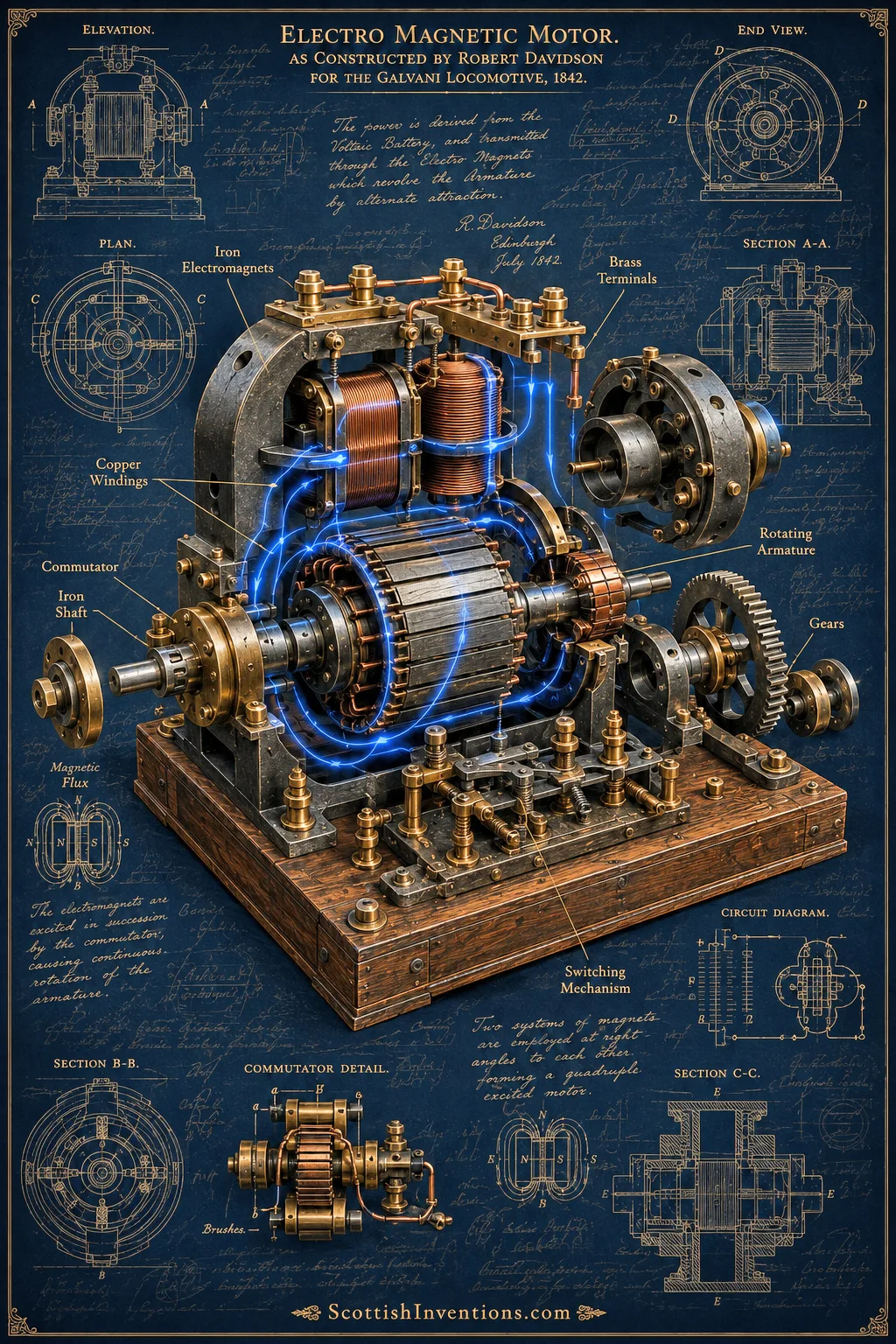
By 1837 Davidson had built his first fair-sized electric motor, working on his own principles. His design used electromagnets acting on iron bars fixed around a rotating wooden cylinder or "log" — one for each axle — with a switch cutting the current when the bars were in opposition. This is, in effect, an early form of what modern engineers call a switched reluctance motor, and a full-size working replica now stands in the Grampian Transport Museum at Alford.
By 1839 Davidson had applied his batteries and motors to a printing press, a turning lathe and a four-wheeled electric car — arguably the first known electric four-wheeled vehicle. In 1840 he staged a public Electromagnetic Exhibition in Aberdeen, where thousands paid a shilling to see a working model electric locomotive capable of carrying two people, an electric lathe, an electric printing press, and an electromagnet that could lift two tons. He took the exhibition to Edinburgh the following year, where — on 12 February 1842 — it was seen by a ten-year-old James Clerk Maxwell, taken along by his father. To bolster his railway scheme, Davidson secured the endorsement of the Royal Scottish Society of Arts, which made him a £15 grant.
The Galvani — The World's First Electric Locomotive (1842)
Between his Aberdeen and London exhibitions, Davidson built his masterpiece: a full-size electric locomotive he named Galvani, after the Italian scientist Luigi Galvani, whose experiments with frogs' legs first hinted at the link between electricity and motion. The machine was a four-wheeled locomotive about 16 feet (4.9 metres) long. It was powered by Davidson's own non-rechargeable galvanic (primary) cells — batteries that generated current by consuming zinc in acid — driving his electromagnetic motors, one on each axle.
Sources differ on its exact weight and capability. The University of Aberdeen gives "about 6 tons"; Guinness World Records describes "a battery locomotive weighing five tons on the Edinburgh & Glasgow Railway, Scotland, where it ran at 6.5 km/h (4 mph)"; and Wikipedia's "Electric locomotive" article describes a "seven-ton vehicle [that] hauled a load of six tons at four miles per hour for a distance of one and a half miles." The consistent core across all accounts is a several-ton machine that moved at roughly walking pace.
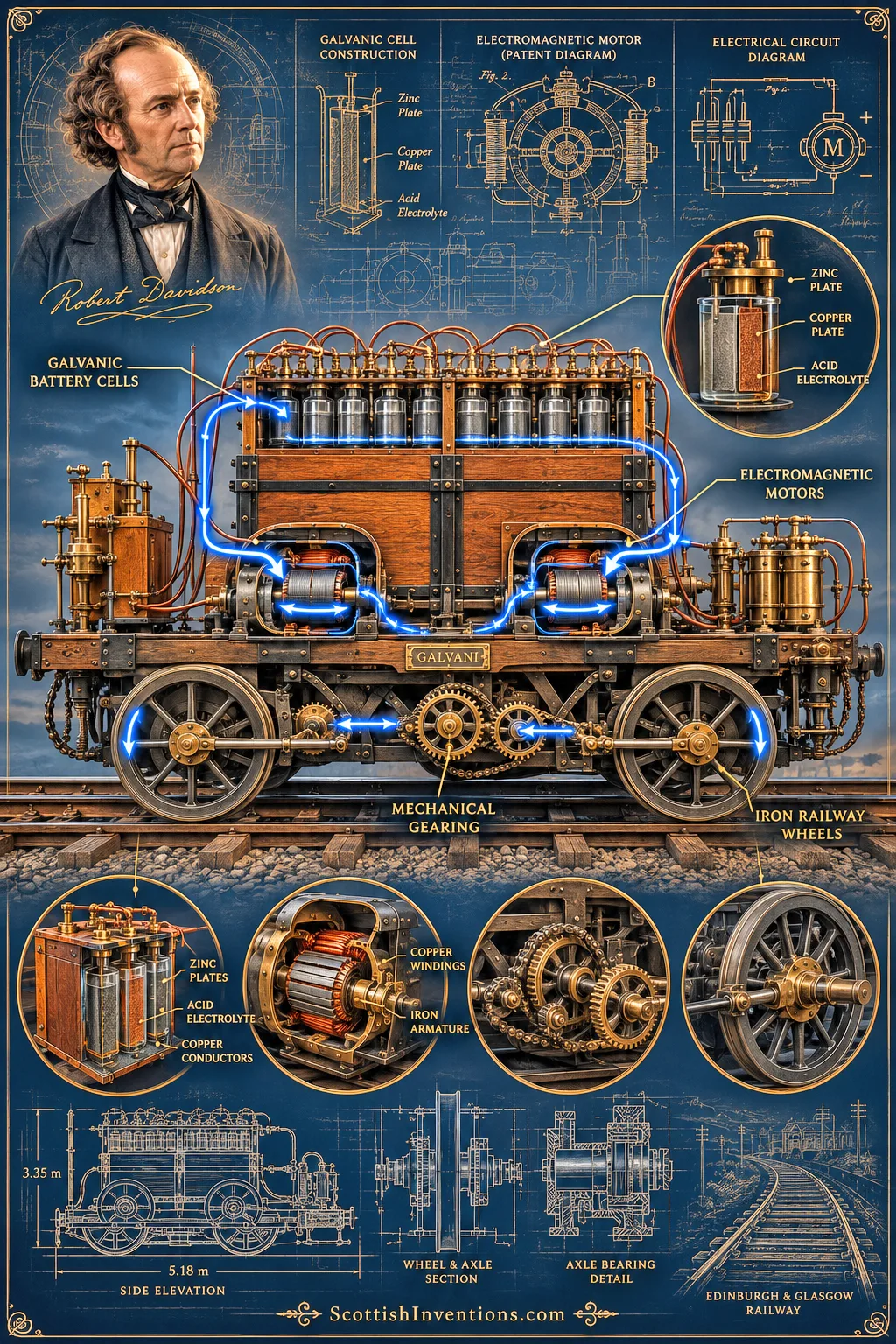
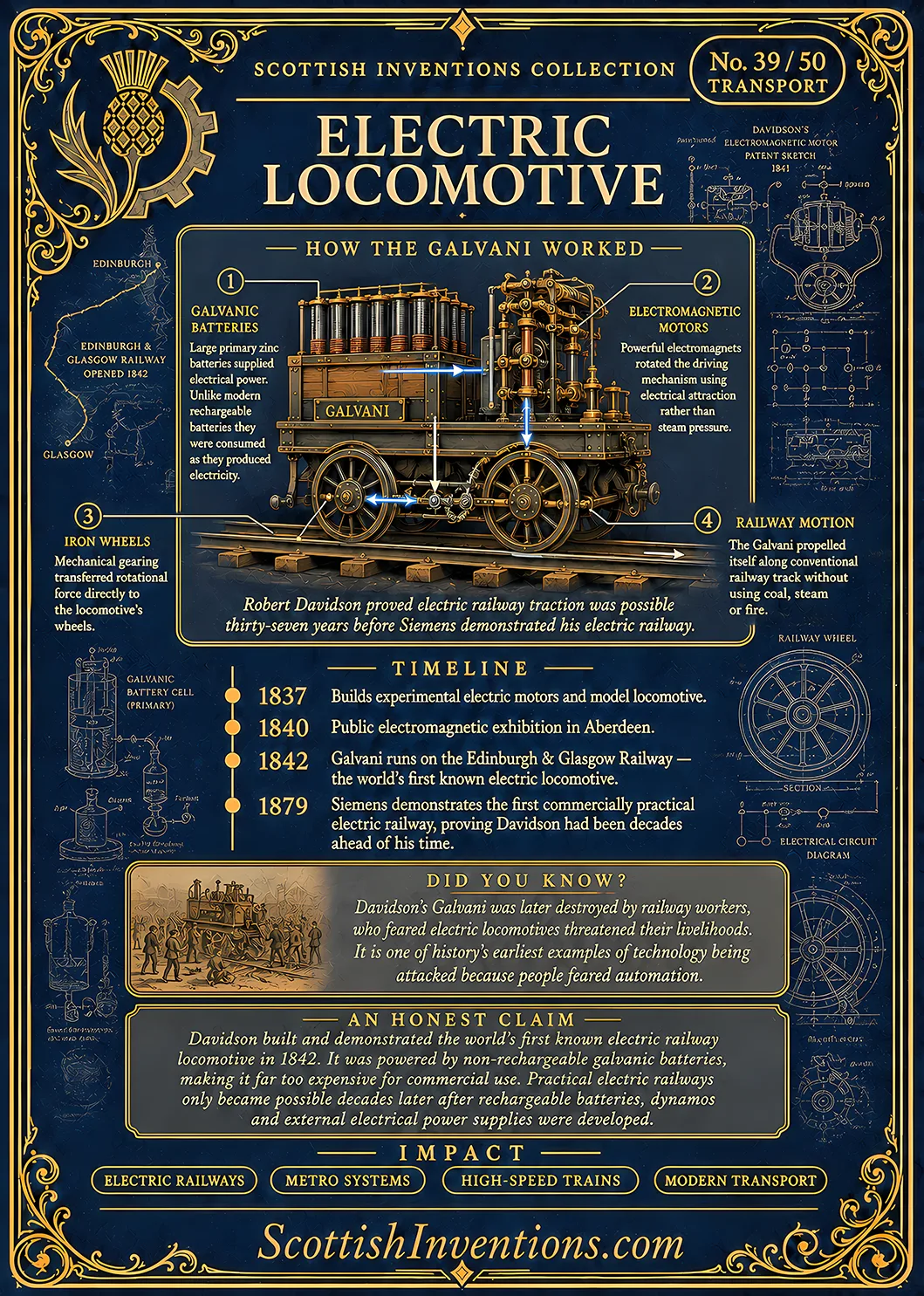
Battery → Motor → Wheels
How the Galvani Worked
01
Galvanic Battery
Zinc plates in acid electrolyte generate a direct current — consumed continuously as the metal dissolves.
02
Electromagnetic Motor
Electromagnets pull iron bars around a rotating cylinder; a commutator switches the current at the right moment.
03
Mechanical Drive
Gearing transfers the rotation directly to the iron railway wheels — no coal, no steam, no fire.
Public Demonstration on the Edinburgh & Glasgow Railway
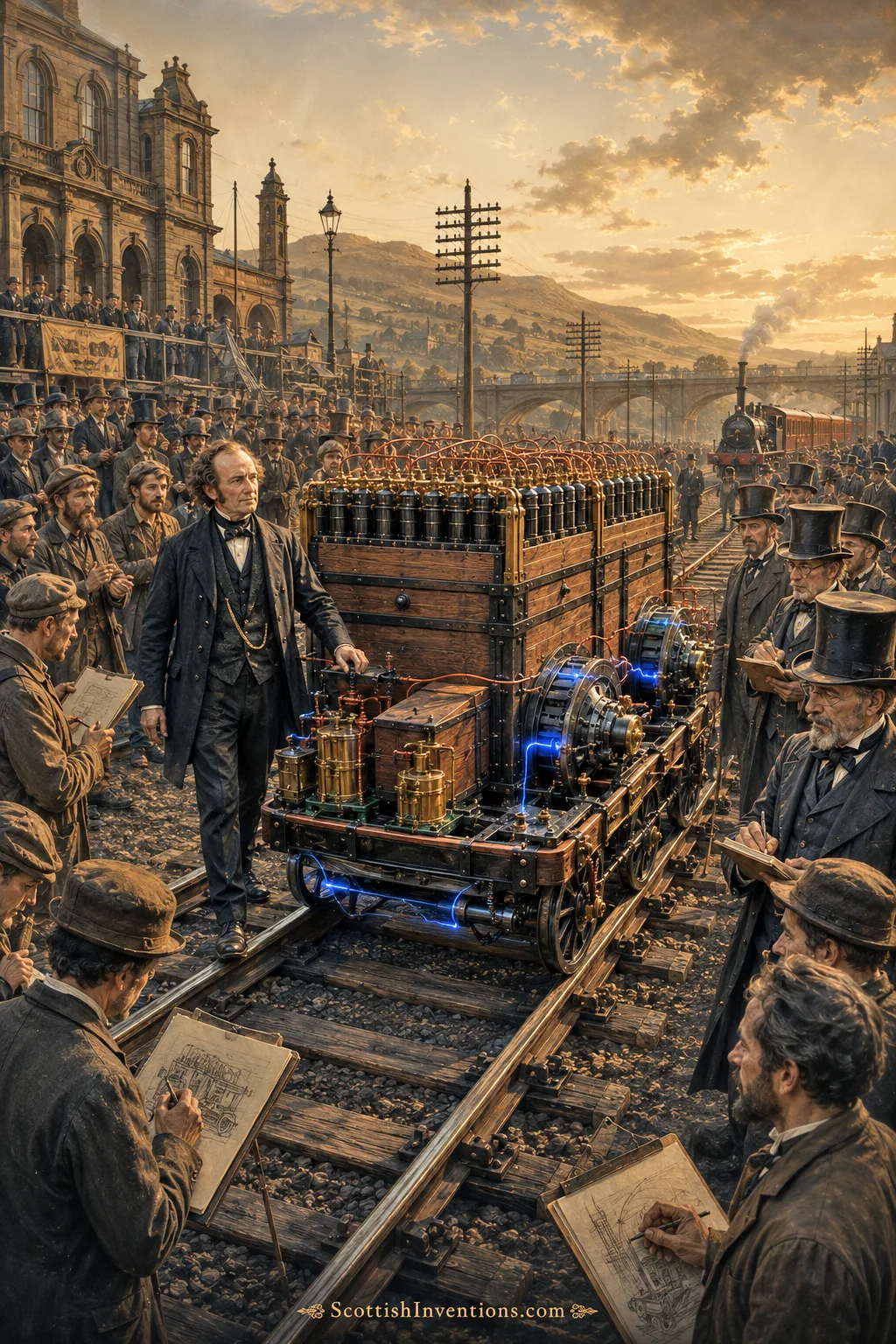
In September 1842 the Galvani ran on the Edinburgh and Glasgow Railway. The railway had not yet reached Aberdeen, so the newly opened Edinburgh-Glasgow line was the natural proving ground. This was, so far as the record shows, the first time an electric motor had hauled a substantial machine along a railway track — the world's first electric railway locomotive.
It was, however, a limited triumph: the University of Aberdeen and Wikipedia both note that the machine was capable of carrying only itself, hauling no meaningful load of passengers or goods, and the directors of the railway were not sufficiently impressed to take the concept further.
4
Miles per hour
1½
Miles hauled
37
Years before Siemens
The Destruction of the Galvani
The Galvani's end is one of the most striking and oft-repeated parts of the story — and one where honesty demands care. Wikipedia's "Electric locomotive" article states plainly that "it was destroyed by railway workers, who saw it as a threat to their job security." The University of Aberdeen's account is more cautious, saying the Galvani "was destroyed before Davidson could get it back, by men unknown but suspected of being promoters of steam engines." Other accounts say bluntly that steam mechanics smashed it in its shed, and one railway history records that it was destroyed while stored in the engine house at Perth.
The core of the story is reasonably well attested: the machine was destroyed, and the fear of the steam trade is the traditional explanation. But the precise where, when and who are not firmly documented, and readers should treat the vivid "Luddite mob" version as likely but not proven. What is certain is that no physical remains of the Galvani survive, and that after 1843 Davidson settled back into family life and business in Aberdeen, unable to find a patron to continue the work.
"Robert Davidson was undoubtedly the first to demonstrate the possibility of electrical traction in a practical way."
Why the Galvani Failed Commercially
The Galvani proved the concept but could never have paid its way, and the reason was chemistry, not engineering. Davidson's batteries were primary cells: they produced electricity by consuming zinc, and once spent they could not be recharged — the chemicals simply had to be replaced. Zinc was expensive; coal was cheap. Feeding a battery locomotive was therefore vastly dearer than stoking a steam engine's firebox.
A widely quoted claim holds that running the Galvani cost about forty times more per mile than a coal-fired steam engine. This figure circulates very widely, but its precise origin is shaky. It traces, through modern encyclopaedias, to a cost comparison associated with an extract from the Railway Times of 10 December 1842, reproduced in the appendix to Sir John Aspinall's 1909 presidential address to the Institution of Mechanical Engineers. The "forty times" wording appears to be a modern paraphrase rather than a verbatim 1842 quotation. The qualitative economics, though, are not in doubt: contemporary and modern sources agree that battery traction was hopelessly uneconomic in 1842. Tellingly, Moritz von Jacobi in Russia reached the same conclusion by measuring the zinc consumed by his motors, judging electric motors uneconomic given the high price of zinc.
The technology to make electric traction viable arrived only later. The French physicist Gaston Planté invented the rechargeable lead-acid battery in 1859, and the perfecting of the dynamo from the 1860s meant electricity could be generated cheaply rather than consumed from a battery. It was Werner von Siemens who reaped the reward, demonstrating the first electric railway powered by a generator at the Berlin Industrial Exhibition in 1879. That machine drew its current from a third rail rather than carrying batteries, and its locomotive pulled three cars around a 300-metre track; during the four months of the exhibition, it carried 90,000 passengers. Davidson's 1842 experiment predated Siemens by 37 years — a gap confirmed by the Grampian Transport Museum.
Sidebar: Scotland's Other Electric Pioneer, Robert Anderson
Alongside Davidson stands a second, far more shadowy Scottish figure: Robert Anderson, widely credited with building the world's first crude electric road carriage sometime between 1832 and 1839. Where Davidson built a railway locomotive, Anderson is said to have fitted batteries and a motor to a horseless road carriage — which is precisely what distinguishes the two men.
Honesty is essential here. Almost nothing is reliably documented about Anderson: there is no known patent, no confirmed contemporary newspaper record, no surviving vehicle, and even the date is given only as a range. His carriage is universally described as "crude" and was powered, like Davidson's machines, by non-rechargeable primary cells. Because both men were Scots working with galvanic cells in the same decade, they are occasionally confused in careless sources.
A specific claim sometimes attributed to the IEEE — that "Scotsman Robert Anderson is the inventor of the first full-scale electricity driven carriage" — should be treated sceptically: that exact wording actually appears in a 2022 article in a Romanian academic journal, not in an IEEE publication. A genuine IEEE history (Massimo Guarnieri, IEEE Industrial Electronics Magazine, 2011) does mention Anderson, but uses more cautious language, calling it a crude prototype. What we can fairly say is this: Anderson may well have built an electric road carriage before Davidson's railway locomotive, and both men belong to Scotland's remarkable early contribution to electric transport.
Timeline
18 April 1804
Born in Aberdeen
Robert Davidson is born in Aberdeen, son of a wine and spirit merchant at 44 Broad Street.
1819-1821
Educated at Marischal College
Attends the second- and third-year classes at Marischal College, in return for working as a laboratory assistant to Professor Patrick Copland.
1820s
Chemical business near the Aberdeen-Inverurie Canal
Sets up in Aberdeen supplying yeast, chemicals, perfumes and offering file-sharpening — the workshop and know-how that made his later electrical experiments possible.
1837
First working electromagnetic motor and model locomotive
Builds a fair-sized electromagnetic motor of his own design and a model electric locomotive — an early form of what modern engineers would call a switched reluctance motor.
1839
Four-wheeled electric car, lathe and printing press
Applies his batteries and motors to a printing press, a turning lathe and a four-wheeled electric car — arguably the first known electric four-wheeled vehicle.
1840
Electromagnetic Exhibition, Aberdeen
Thousands pay a shilling to see a working model electric locomotive, an electric lathe, an electric printing press and an electromagnet lifting two tons.
12 February 1842
Edinburgh exhibition — Maxwell in the audience
Ten-year-old James Clerk Maxwell, taken by his father, sees Davidson's Edinburgh exhibition. The Royal Scottish Society of Arts makes Davidson a £15 grant.
September 1842
The Galvani runs on the Edinburgh & Glasgow Railway
Davidson's full-size electric locomotive hauls itself along the newly opened Edinburgh-Glasgow line at about 4 mph — the world's first electric railway locomotive on a public railway.
1843
The Galvani destroyed
The machine is destroyed shortly after its trials — traditionally by railway workers who feared for their jobs, though the exact circumstances remain disputed.
1859
Planté's rechargeable battery
French physicist Gaston Planté invents the lead-acid rechargeable battery — the missing piece that will eventually make electric traction commercially viable.
1879
Siemens' Berlin electric railway
37 years after Davidson, Werner von Siemens demonstrates the first electric railway powered by a generator at the Berlin Industrial Exhibition — carrying 90,000 passengers.
1890
London's electric Tube opens
The City & South London Railway opens as the world's first deep-level electric underground line. The press rediscovers the elderly Davidson as 'the oldest living electrician.'
16 November 1894
Death in Aberdeen
Davidson dies in Aberdeen aged 90. His gravestone in St Peter's Cemetery simply calls him 'chemist.' His new business cards had read 'Father of the Electric Locomotive.'
Key Takeaways
Davidson's Three Enduring Contributions
- A working electric locomotive. The Galvani hauled itself along a real public railway in 1842 — proof, decades ahead of its time, that electric traction was possible.
- An early practical electromagnetic motor. Davidson's switched-magnet design foreshadowed the switched reluctance motor and helped establish the electromagnetic principles later engineers would build on.
- A demonstration that pointed the way. Every high-speed train, metro and tram in the world today is a distant descendant of that walking-pace machine on the Edinburgh-Glasgow line.
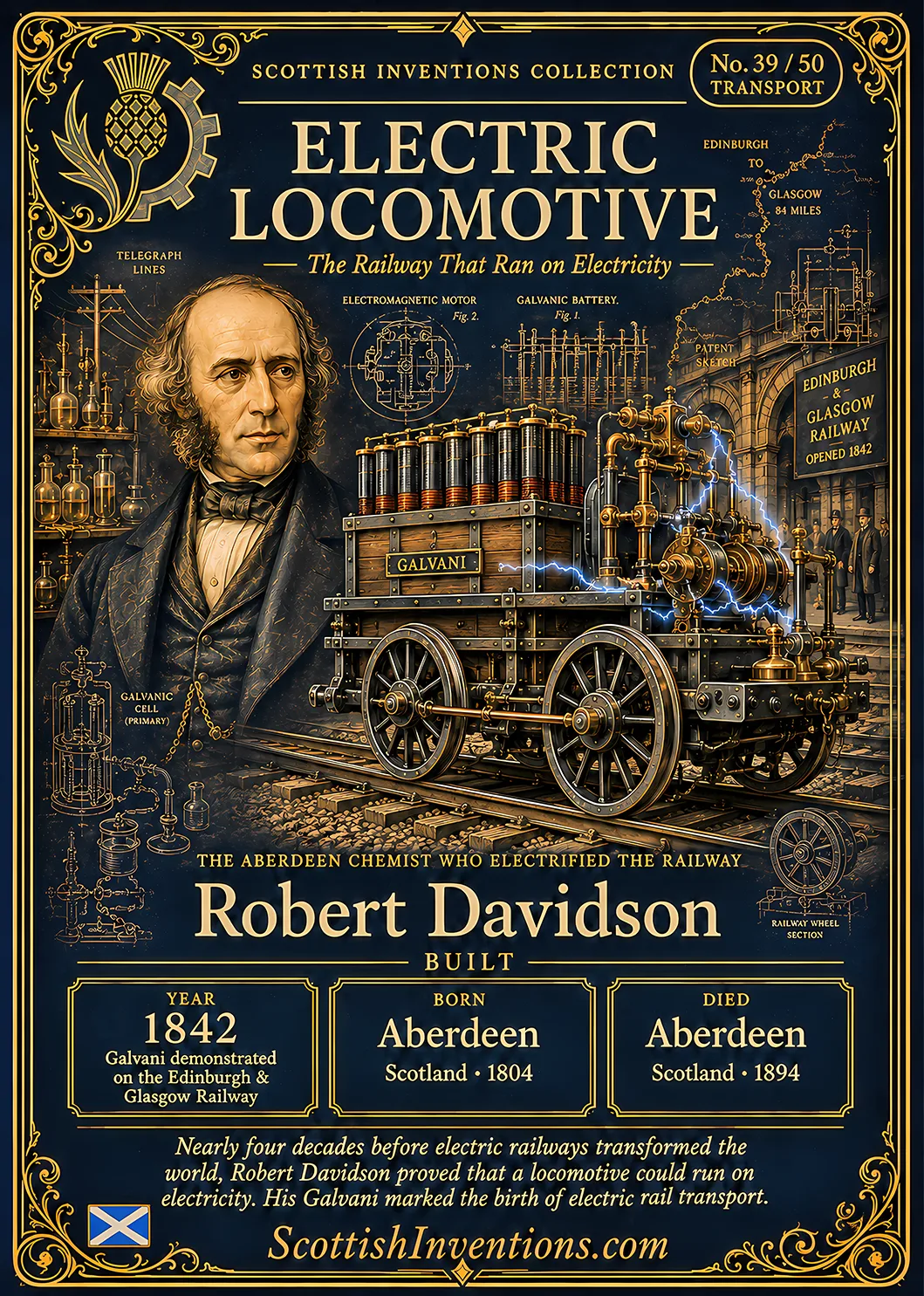
The Electric Locomotive trading card
Card No. 39 of 50 in the Scottish Inventions Collection.
Frequently Asked Questions
- Who was Robert Davidson?
- Robert Davidson (1804-1894) was an Aberdeen manufacturing chemist and self-taught electrical engineer who built the world's first known full-size electric railway locomotive. Educated at Marischal College and running a chemical business near the Aberdeen-Inverurie Canal, he combined workshop skill with a passion for electricity to construct the Galvani, demonstrated on the Edinburgh and Glasgow Railway in September 1842.
- What was the Galvani locomotive?
- The Galvani was a four-wheeled electric railway locomotive about 16 feet (4.9 m) long, weighing between five and seven tons depending on the source. It was powered by Davidson's own non-rechargeable galvanic (primary) cells driving two electromagnetic motors, one on each axle. Davidson named it after Luigi Galvani, whose frog-leg experiments first hinted at the link between electricity and motion.
- Was Robert Davidson really the inventor of the first electric locomotive?
- Yes — the historical record supports the claim. From 1837 Davidson built experimental motors and a model locomotive; by 1839 he had produced a four-wheeled electric car, and in 1840 he staged a public Electromagnetic Exhibition in Aberdeen. His full-size Galvani followed in 1842 and ran on the Edinburgh and Glasgow Railway. It is the first known electric locomotive to have hauled itself along a public railway anywhere in the world.
- How did the Galvani work?
- Large primary zinc-acid batteries mounted on the wagon supplied direct current to two electromagnetic motors. Each motor used electromagnets acting on iron bars fixed around a rotating wooden cylinder — one per axle — with a switch (commutator) cutting the current when the bars were in opposition. Mechanical gearing transferred the rotation to the iron railway wheels, propelling the Galvani along conventional track without coal, steam or fire.
- Why did the Galvani fail commercially?
- The problem was chemistry, not engineering. Davidson's batteries were primary cells that produced current by consuming zinc, which was expensive; coal was cheap. Running a battery locomotive therefore cost vastly more per mile than firing a steam engine — a widely quoted figure suggests about forty times more, though its precise 1842 origin is uncertain. Rechargeable batteries and efficient dynamos, which would eventually make electric traction viable, had not yet been invented.
- Why were galvanic batteries so expensive?
- Galvanic (primary) cells generate current by consuming a metal — in Davidson's case, zinc — in an acid electrolyte. Once the zinc is used up, the battery is spent and cannot be recharged; new zinc must be bought and installed. In 1842 zinc was a costly refined metal, while coal was abundant and cheap. Every foot the Galvani moved literally consumed money in a way a steam engine's coal never did.
- How does Robert Davidson compare with Werner von Siemens?
- Davidson's 1842 demonstration predates Werner von Siemens' famous Berlin electric railway by 37 years. But Siemens had two decisive advantages Davidson lacked: Gaston Planté's rechargeable lead-acid battery (1859) and the perfected dynamo, which meant electricity could be generated cheaply from coal rather than consumed from a primary cell. Davidson proved the concept; Siemens made it pay.
- Did railway workers really destroy the Galvani?
- The Galvani was destroyed shortly after its 1842 trials, and the traditional explanation — repeated by many popular sources — is that railway workers smashed it because they saw it as a threat to their jobs. The University of Aberdeen's more cautious wording blames 'men unknown but suspected of being promoters of steam engines,' and one railway history places its destruction at the engine house in Perth. The machine was certainly destroyed; the precise where, when and who are not firmly documented.
- What happened to Robert Davidson after the experiment?
- Unable to find a patron to fund further development, Davidson returned to Aberdeen and resumed his chemical business. He lived on into his ninetieth year, dying in Aberdeen on 16 November 1894. When London's City & South London deep-level electric Tube opened in 1890, the press rediscovered him as the 'oldest living electrician' and he commissioned new business cards reading 'Robert Davidson: Father of the Electric Locomotive.'
- Where can you see a replica of the Galvani today?
- A full-size working replica of Davidson's electromagnetic motor, together with a replica of his galvanic battery and a scale model of the Galvani, forms the centrepiece of the 'It's Electric!' exhibition at the Grampian Transport Museum in Alford, Aberdeenshire. A companion book, Robert Davidson: Pioneer of Electric Locomotion (Lumphanan Press), tells the full story. No physical remains of the original Galvani survive.
Legacy
The line of descent from Davidson's 1842 experiment to the modern world runs through Siemens' 1879 Berlin railway and into the first deep-level electric underground line, London's City and South London Railway. Officially opened by Edward, Prince of Wales on 4 November 1890, it ran 3.2 miles from King William Street to Stockwell using 14 four-wheeled Mather & Platt locomotives, and was "the first successful deep-level underground 'tube' railway in the world, and the first major railway to use electric traction." Today's high-speed electric trains, underground metros and trams are all conceptually the children of that walking-pace machine on the Edinburgh-Glasgow line.
Davidson lived just long enough to see his vision vindicated. On the opening of the electric Tube in London, the elderly Aberdonian was rediscovered by the press as the "oldest living electrician," and his reaction was to commission a new set of business cards that read "Robert Davidson: Father of the Electric Locomotive."
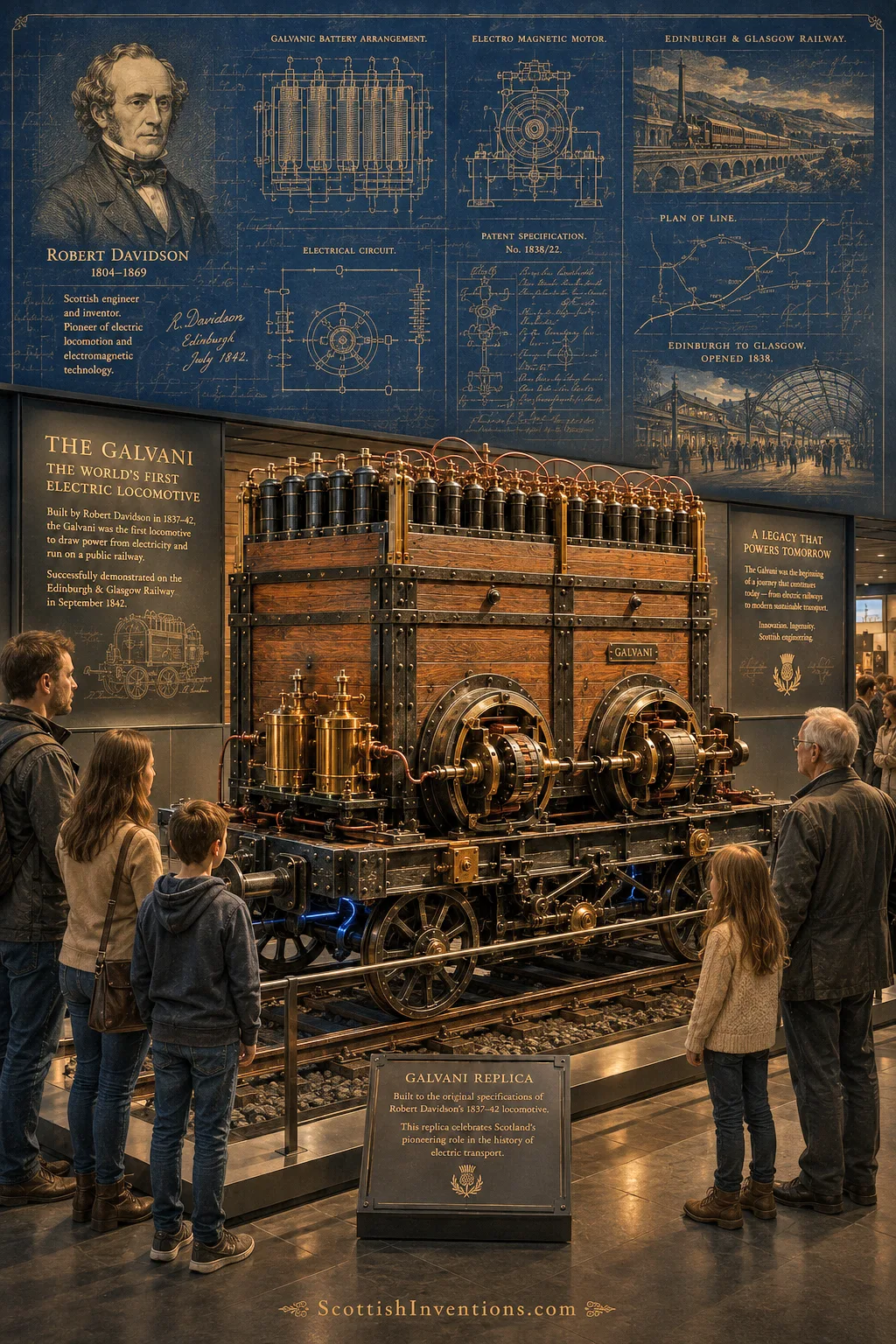
Modern recognition is real but modest. A full-size working replica of Davidson's motor, together with a replica of his battery and a model of the Galvani, forms the centrepiece of the "It's Electric!" exhibition at the Grampian Transport Museum at Alford, Aberdeenshire, produced with a companion book, Robert Davidson: Pioneer of Electric Locomotion, from Lumphanan Press. In Aberdeen, the little Canal Road where he lived and worked survives, but his house and business are gone.
Continue Exploring
Continue Exploring Scottish Engineering Innovation
From the world's first electric locomotive to electric lighting, telecommunications and precision engineering, Scottish inventors laid many of the foundations of modern technology. Explore the remarkable engineering achievements that helped shape today's world.
Explore More Scottish Engineering InventionsSources
- John S. Reid, University of Aberdeen — biographical account of Robert Davidson.
- Obituary of Robert Davidson, Aberdeen Evening Express, 16 November 1894.
- Wikipedia, "Electric locomotive" and "Robert Davidson (inventor)" — accessed 2026.
- Guinness World Records — earliest electric locomotive.
- Grampian Transport Museum, Alford — "It's Electric!" exhibition and companion book Robert Davidson: Pioneer of Electric Locomotion (Lumphanan Press).
- Massimo Guarnieri, "When Cars Went Electric, Part One," IEEE Industrial Electronics Magazine, 2011.
- Sir John Aspinall, Presidential Address to the Institution of Mechanical Engineers, 1909, appendix referencing Railway Times, 10 December 1842.