Card No. 2 · Scottish Inventions Collection
James Bowman Lindsay and the 1835 "Constant Electric Light": Dundee's Underrated Genius and the Truth About His Lamp
By Scottish Inventions Editorial · 12 min read
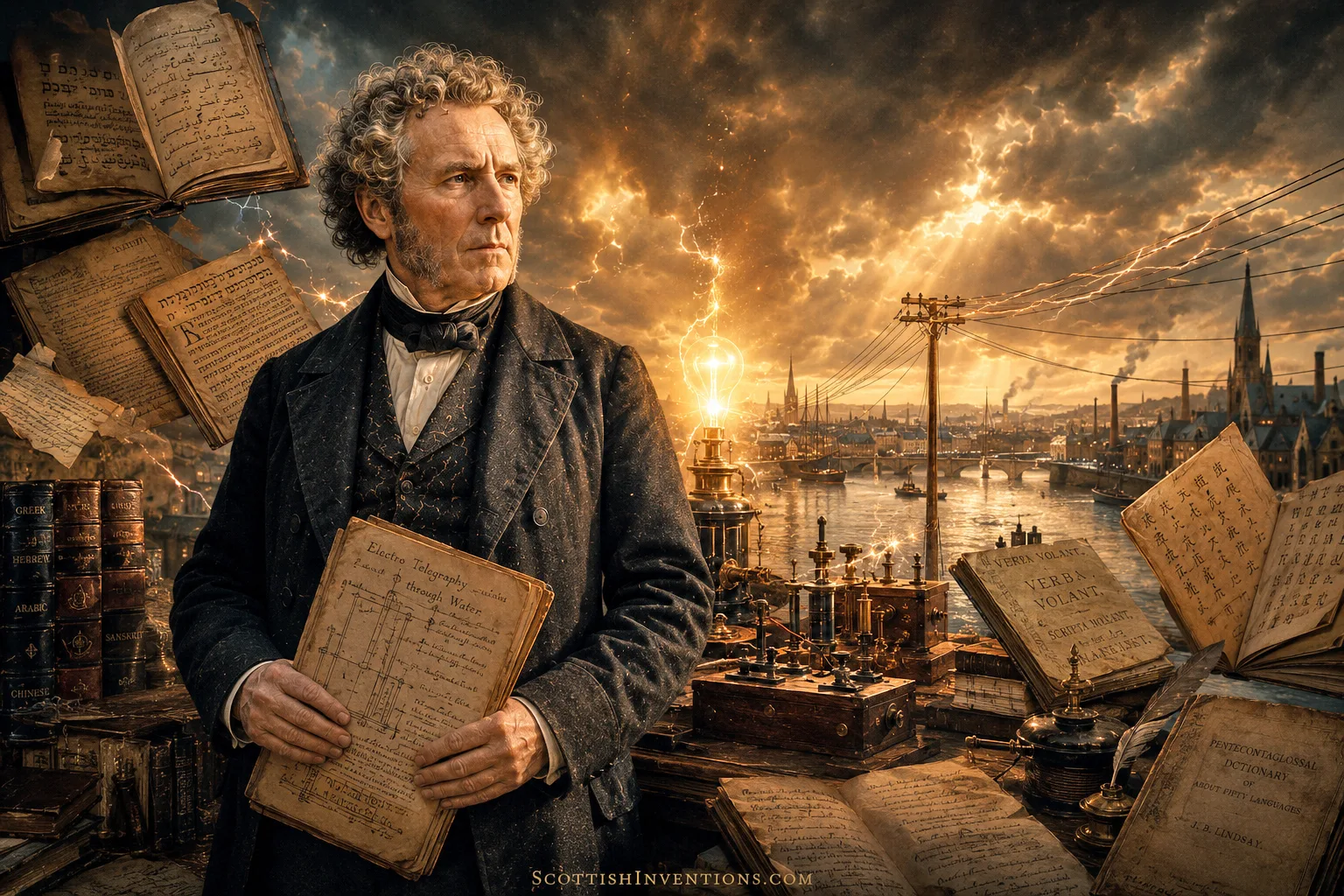
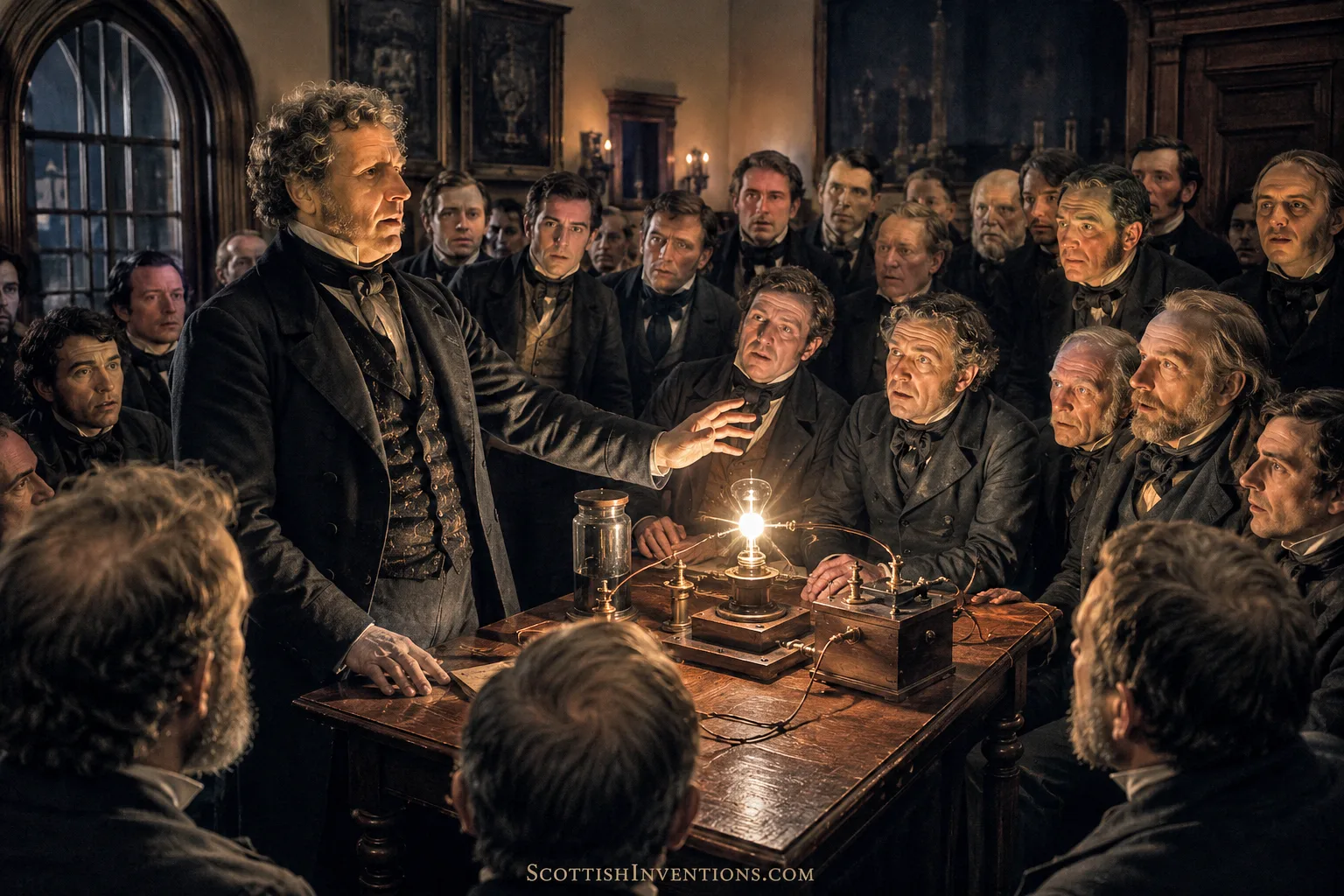
On the evening of Saturday 25 July 1835, in a modest lecture room in Dundee, a self-educated weaver's son obtained what local newspapers called a "constant electric light". The man was James Bowman Lindsay, and the demonstration came more than 40 years before Edison and Swan. Yet history has largely forgotten him — and the truth about what he actually achieved is far more interesting than the popular myth.
Table of Contents
From the Loom to the Lecture Hall
James Bowman Lindsay was born on 8 September 1799 at Cotton of West Hills, Carmyllie, a windswept Angus parish near Arbroath. His father John was a farm worker and handloom weaver; his mother Elizabeth Bowman gave him a name he carried — and a stubborn appetite for self-improvement. Lindsay was apprenticed to the loom himself, but spent every spare hour reading.
In 1821, aged 22, he matriculated at the University of St Andrews, where he studied mathematics, physics and theology. By 1829 he had become a science and mathematics lecturer at the Watt Institution in Dundee — a post he would hold for the rest of his working life. It was an unusual life for the son of a weaver, but Lindsay was an unusual man.

The 1835 Demonstration
By the early 1830s, Lindsay had been experimenting with voltaic batteries — the only practical source of continuous current available at the time — for years. On the evening of 25 July 1835, he obtained a steady, continuous glow. The Dundee, Perth & Cupar Advertiser reported the demonstration in the following days. Lindsay himself wrote, in a letter dated 28 October 1835, that he could write at a distance of six to eight inches and "read a book at the distance of 1½ feet" by the light he had produced.
That is the documentary record. There are no surviving drawings, no surviving apparatus, no detailed technical description. The Oxford Dictionary of National Biography pointedly titles its entry on him "experimenter with electricity and writer on theology" — not "inventor". This page intentionally honours that nuance.
The Technical Question: How Did It Work?
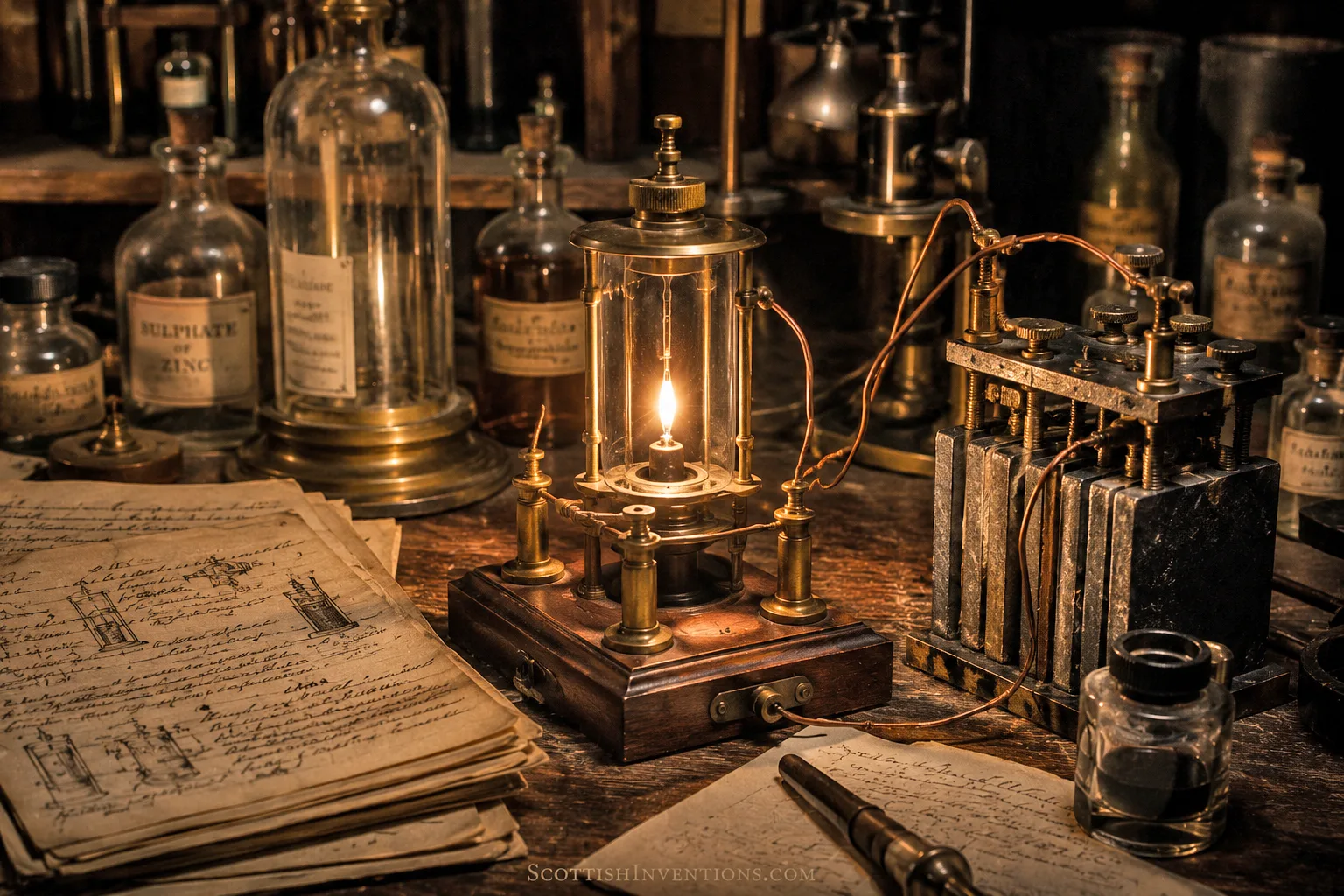
With no surviving apparatus, any answer is necessarily a reconstruction. The most plausible technical reading — based on what Lindsay had access to in 1835 and what he himself wrote later — is that his "constant electric light" was a primitive incandescent source: a thin metal wire heated to glowing by current from a multi-cell voltaic battery, possibly enclosed within a glass tube or jar to slow oxidation.
- Power source: a voltaic pile or trough battery providing steady DC.
- Emitter: a wire (likely platinum or iron) heated to incandescence.
- Envelope: an open or partly-shielded glass enclosure — not a sealed vacuum bulb, which would not be practicable until Sprengel's mercury pump (1865) and later refinements.
- Output: enough light to read by at 18 inches; not enough for any practical lighting role.
Electric Light Before Edison
The familiar story — that Edison "invented" the light bulb in 1879 — collapses the work of many pioneers across most of a century. Humphry Davy had already passed current through a platinum strip and made it glow at the Royal Institution in 1802. By the 1840s, Warren de la Rue in London and others were experimenting with platinum filaments in vacuum tubes. Lindsay sits squarely in that lineage: a real pioneer of incandescent lighting, not the lone inventor of the modern bulb.
Compared with Davy's arc demonstrations, Lindsay's contribution was the steadiness of his light — a continuous, constant glow rather than the dazzling, sputtering arc. Compared with Swan and Edison decades later, his apparatus was experimental: he never developed the high-resistance carbon filament, the sealed vacuum bulb, or — crucially — the entire system of generators, wiring and switches that made electric lighting commercially viable in the late 1870s. That is a real, unbridgeable gap. Lindsay was a pioneer; he was not the founder of the electric-lighting industry.
Telegraphy Through Water
Lindsay's most secure technical claim to fame may actually lie elsewhere. In 1854 he demonstrated telegraphy through water, transmitting signals across the River Tay between Dundee and Woodhaven — a distance of roughly two miles — without a continuous wire connecting the two banks. He used the water itself as the conducting medium, with electrodes plunged into the river on each side.
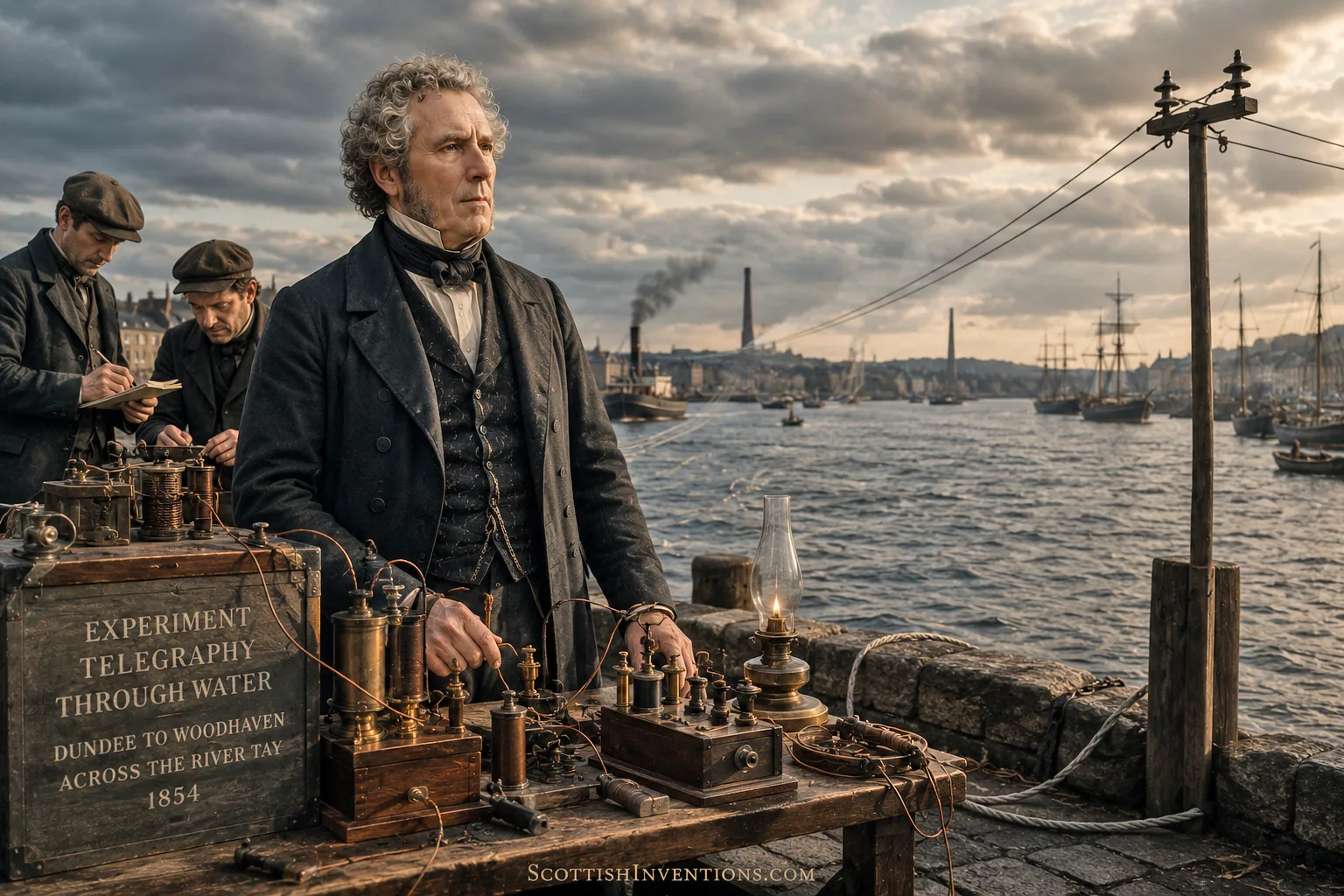
This was conduction telegraphy rather than radio (which awaited Hertz, Marconi and J. C. Bose later in the century), but it was an extraordinary step. He had already, in 1843, proposed a transatlantic telegraph — a vision that took another two decades to realise. Read alongside Alexander Bain's chemical telegraph and the wider Scottish telegraphic tradition, Lindsay belongs in the front rank of early electrical communicators.
The Pentecontaglossal Dictionary
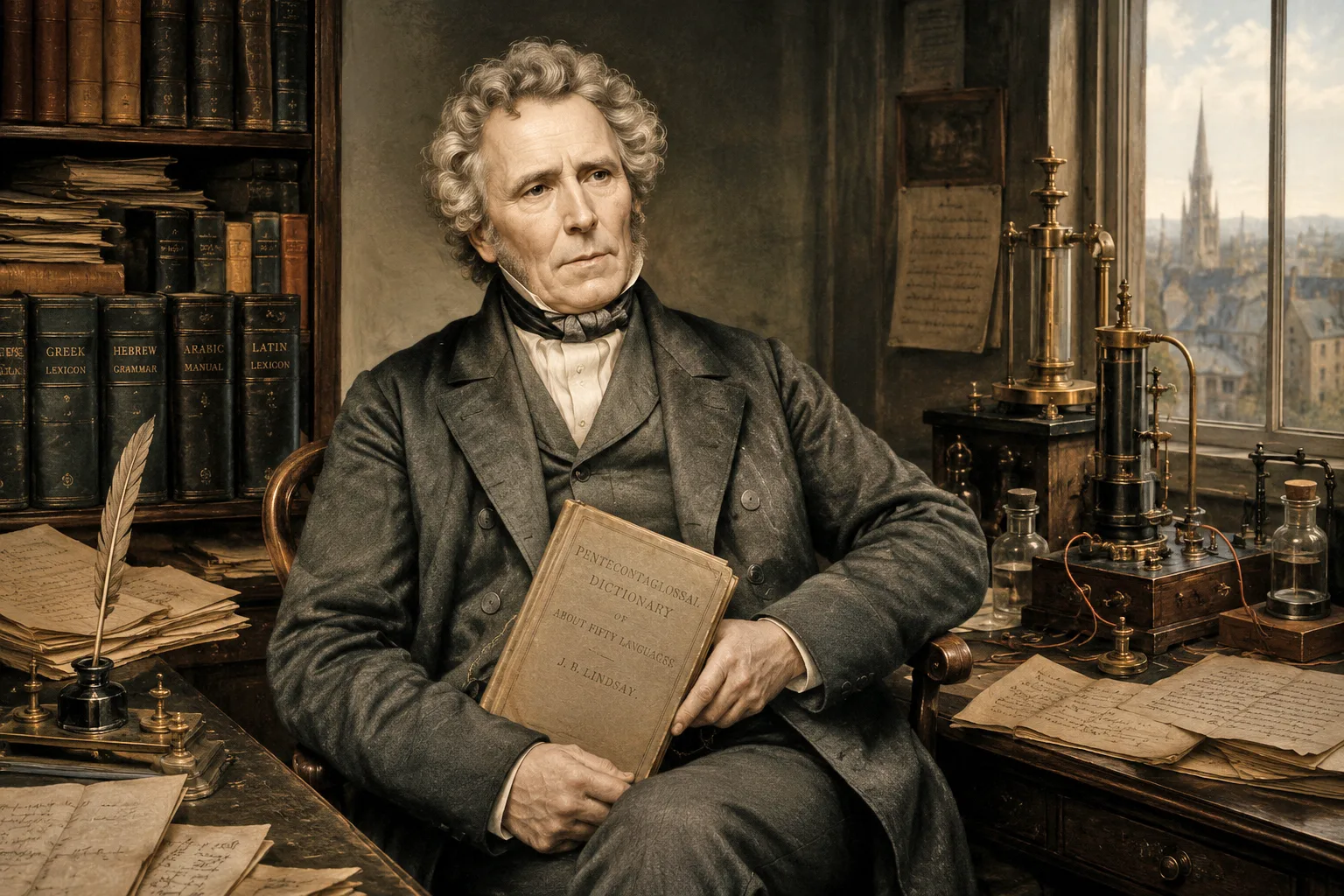
If the electric light shows Lindsay's scientific imagination, his Pentecontaglossal Dictionary shows the staggering scale of his scholarship. Pentecontaglossal — from the Greek for "fifty tongues" — was his attempt at a comparative dictionary covering around fifty languages, including Greek, Hebrew, Syriac, Arabic, Sanskrit, Persian and Chinese.
He worked at it for decades, almost entirely alone, alongside his lecturing duties. A fragment was published posthumously in 1860. It is not a polished modern lexicographical reference, but the ambition — one man, no institutional support, fifty languages — is almost without parallel.
Myth vs Reality
| Myth | Reality |
|---|---|
| Lindsay invented the modern light bulb. | He demonstrated an early constant electric light in 1835, but never developed a practical commercial lamp. |
| Edison invented electric light. | Many pioneers contributed across decades — Davy (1802), Lindsay (1835), Swan and Edison (1878–79), and others. |
| Lindsay's lamp survives in a museum. | No surviving apparatus or technical drawings are known. Everything rests on contemporary newspaper reports and his own letters. |
| Lindsay only worked on electric lighting. | He also pioneered through-water telegraphy and compiled an extraordinary multilingual dictionary. |
Timeline
- 1799 — Born at Carmyllie, near Arbroath.
- 1821 — Matriculates at the University of St Andrews.
- 1829 — Appointed lecturer at the Watt Institution, Dundee.
- 1832 — Early experiments with electric telegraphy.
- 25 Jul 1835 — Demonstrates a 'constant electric light' in Dundee.
- 1836–37 — Public lectures on electrical phenomena.
- 1843 — Proposes a transatlantic telegraph.
- 1854 — Telegraphy across the River Tay through water.
- 1858 — Awarded a Civil List pension of £100 per year.
- 1862 — Dies in Dundee on 29 June.
- Today — Remembered as one of Scotland's great underrated polymaths.
Why James Bowman Lindsay Matters
Lindsay matters because his story shows a 19th-century Scottish scientific imagination at full stretch: a self-taught weaver's son, working far from London or Cambridge, who reached almost simultaneously into electric lighting, electrical communication, through-water telegraphy, theology and comparative linguistics. The fact that he never patented his electric light, never raised capital to commercialise it, and never quite finished his dictionary is part of the story too. Scottish invention is full of figures like him — visionaries who left the industrial cashing-in to others. See also William Murdoch's coal gas lighting, James Watt's centrifugal governor and Maxwell's first colour photograph.
Frequently Asked Questions
Who was James Bowman Lindsay?
A self-educated Scottish weaver's son (1799–1862) who became a lecturer at Dundee's Watt Institution and worked as a pioneer of electric lighting, through-water telegraphy, and comparative linguistics.
Did James Bowman Lindsay invent the light bulb?
No. He demonstrated a 'constant electric light' in 1835, decades before Edison and Swan, but he never developed a practical commercial bulb. The modern incandescent lamp is credited to Swan and Edison in 1878–79.
What happened on 25 July 1835?
On the evening of 25 July 1835, Lindsay obtained what the Dundee, Perth & Cupar Advertiser called a 'constant electric light'. He later claimed he could read a book at a distance of one-and-a-half feet by its glow.
How did Lindsay's electric light work?
No apparatus or drawings survive. Historians believe it was a primitive incandescent source — a wire heated to glowing by current from a voltaic battery — rather than a sealed vacuum bulb.
Was James Bowman Lindsay before Edison?
Yes — his demonstration predates Edison's 1879 incandescent bulb by 44 years, and Humphry Davy's 1802 platinum-strip experiment by 33 years. But Lindsay's device was experimental, not a usable lamp.
Did Lindsay invent wireless telegraphy?
Not in the modern radio sense, but in 1854 he successfully transmitted signals through the water of the River Tay between Dundee and Woodhaven without a continuous wire — an early conduction-based 'wireless' telegraphy.
What was the Pentecontaglossal Dictionary?
Lindsay's astonishing comparative dictionary of around fifty languages, including Greek, Hebrew, Arabic, Sanskrit and Chinese. It was published posthumously in 1860 and remains one of the most ambitious one-man lexicographical projects in history.
Why is James Bowman Lindsay important?
He was a visionary pioneer of electric lighting, an early experimenter in through-water telegraphy, and an extraordinary self-taught polyglot — a striking example of Scottish 19th-century scientific imagination working far from the major research centres.
Where was Lindsay born?
At Cotton of West Hills, Carmyllie, near Arbroath in Angus, Scotland, on 8 September 1799.
What other inventions did Lindsay create?
Beyond his 1835 electric light he proposed a transatlantic telegraph (1843), demonstrated through-water telegraphy across the Tay (1854), and produced the multilingual Pentecontaglossal Dictionary.
Sources
- Dundee, Perth & Cupar Advertiser, late July / early August 1835 — original report of the 25 July 1835 demonstration.
- James Bowman Lindsay, letter dated 28 October 1835 — describing reading at 18 inches by the light.
- Oxford Dictionary of National Biography — entry for James Bowman Lindsay (1799–1862), "experimenter with electricity and writer on theology".
- Autobiographical sketch held by Dundee Public Library (1893).
- A. J. Cochrane, contemporary 19th-century notices on Lindsay's Dundee work; D. W. Hutchison and modern Dundee local-history studies.