Scottish Inventions · Communications
Frederick G. Creed: The Glasgow Teleprinter That Wired the World
How a self-taught Nova Scotian telegrapher, working in a Glasgow shed with a second-hand typewriter, built the first practical teleprinter — the machine that wired the news, won wars at Bletchley Park, and seeded ASCII, telex and the modern internet.
Introduction
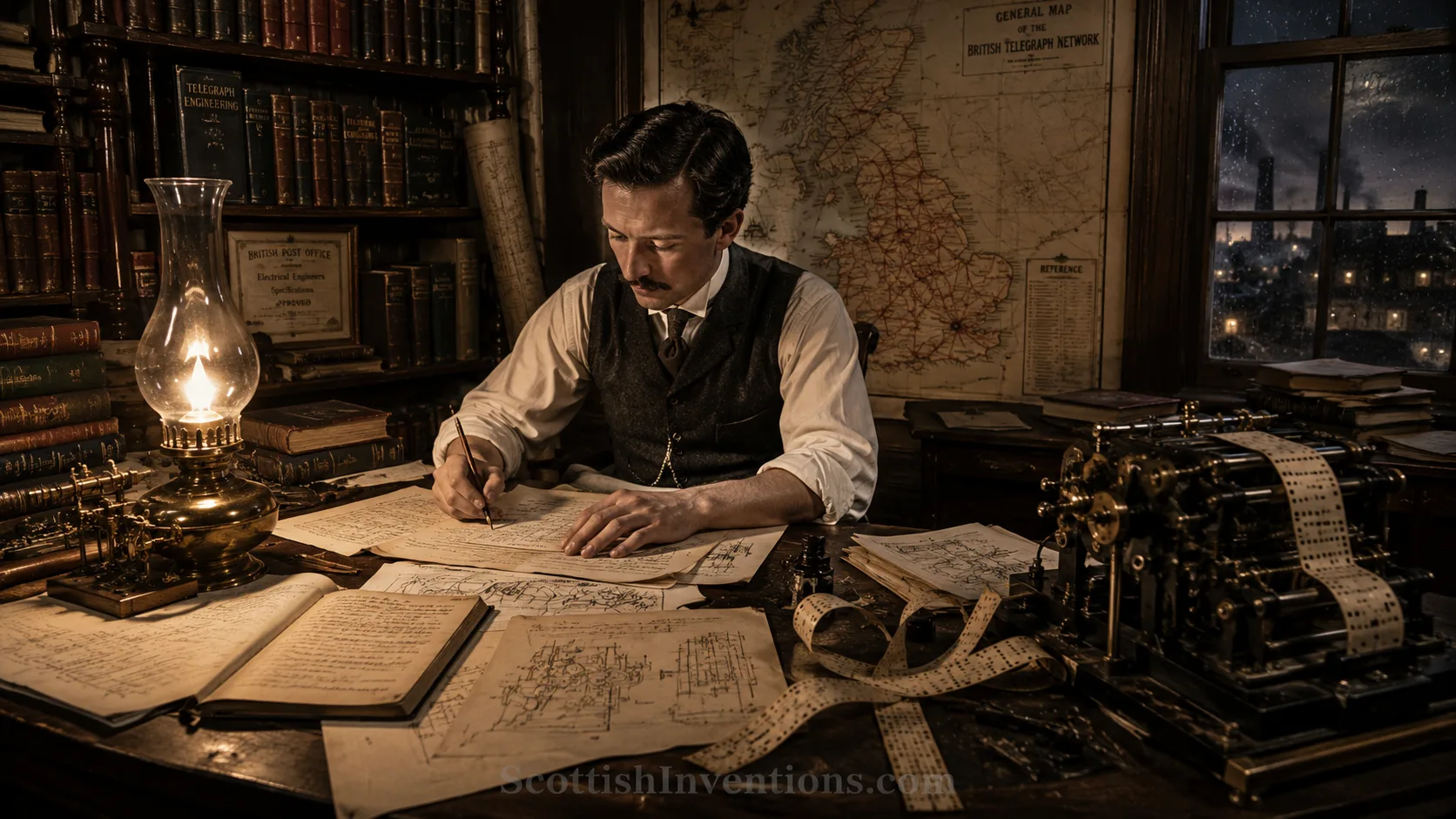
In 1897, a thirty-something Canadian telegraph operator stepped off a ship at the Broomielaw, walked into a Glasgow market on Sauchiehall Street and bought a second-hand typewriter. In a rented shed, with that typewriter, a compressed-air supply and a head full of years spent hammering hand-keys in Peruvian and Chilean cable offices, Frederick George Creed built the machine that would print telegrams automatically.
The teleprinter is one of those rare inventions whose downstream consequences are still everywhere — in every newsroom, every command centre, every Linux terminal, every email and every text message — but whose origin story has been almost completely forgotten. This is its definitive account: not the myth of a lone inventor, but the true and richer story of how an international cast of engineers built up the printing telegraph over 80 years, and how Creed, in Glasgow, made it practical.
On this page
- Key Takeaways
- Quick Facts
- Early Life
- The Evolution of the Teleprinter
- Why Telegraphy Needed Improving
- Creed's Glasgow Breakthrough
- How the Teleprinter Worked
- The Creed Model 7
- Journalism Revolution
- The Birth of Telex
- WWII and Bletchley Park
- From Teleprinter to Computer Terminal
- ASCII and Modern Computing
- Legacy
- Myth vs Fact
- Did You Know?
- Timeline
- Related Scottish Inventions
- Further Reading
- Frequently Asked Questions
Key Takeaways
- The teleprinter has no single inventor; it was built up cumulatively by House, Hughes, Baudot, Murray, the Krums and Creed over roughly 80 years.
- Frederick George Creed (1871–1957) developed the first practical, mass-produced high-speed teleprinter system in Britain — from a Glasgow shed beginning in 1897.
- Despite Lord Kelvin reportedly dismissing the idea, the British Post Office ordered 12 machines in 1902; Creed's Glasgow factory opened in 1904.
- The Creed Model 7 (1931) became the telex workhorse and the standard British military teleprinter of the Second World War, with over 150,000 built.
- Creed teleprinters wired the Press Association's news network and were the primary text-handling machines at Bletchley Park.
- Teleprinter coding (Baudot → Murray → ITA2) is the direct ancestor of ASCII, and the Unix/Linux "tty" device name preserves the word teletypewriter to this day.
- The often-told Murray–Creed "rivalry" is a myth: in 1925 Creed simply bought the rights to Donald Murray's patents.
Quick Facts
Born Nova Scotia 1871
Frederick George Creed born 6 October 1871 in Mill Village, Queens County, Nova Scotia.
Glasgow workshop 1897
Built his first keyboard perforator in a Glasgow shed using a second-hand typewriter from Sauchiehall Street.
Post Office 1902
Secured an order for 12 machines from the British General Post Office despite Lord Kelvin's scepticism.
Glasgow factory 1904
Opened a small Glasgow factory; the Glasgow Herald adopted the system in 1906, claiming it was three times faster than Morse.
Model 7 (1931)
Page-printing telex teleprinter; the standard British military machine of WWII; over 150,000 made.
TTY legacy
Every Unix and Linux terminal window still carries the 'tty' (teletypewriter) abbreviation derived from Creed's machines.
Early Life: From Nova Scotia to the Pacific Cable Offices
Frederick George Creed was born on 6 October 1871 in the small lumbering community of Mill Village, Queens County, Nova Scotia. His family moved east to Canso, on the eastern tip of mainland Nova Scotia and a transatlantic cable landing station of considerable importance to nineteenth-century communications. By his mid-teens Creed was working as a "check boy" for the Western Union Telegraph Company there, teaching himself both cable and landline telegraphy. The cable station was, in effect, his university.
From Canso he went south to work as a telegraph operator for the Central and South American Telegraph and Cable Company in Peru and Chile. It was in the company's office at Iquique, Chile, that the central idea came to him. Hour after hour at the hand-operated Morse key and the Wheatstone tape punch, with the slow business of forming dots and dashes by hand, he found himself wondering whether a machine with a typewriter-style keyboard could not punch coded signals onto paper tape simply by pressing character keys. In 1896 he married Scottish-born Jane "Jennie" Russell, whom he had met in Chile. Around 1897 the couple moved to Glasgow to make the idea real.
The Evolution of the Teleprinter
The teleprinter is a textbook example of cumulative invention. No single mind conjured it from nothing; instead, six or seven engineers across two continents added one essential piece at a time, until what emerged in Creed's Glasgow workshop was something genuinely new. The honest lineage:
1846 — Royal Earl House
American inventor House patented the first printing telegraph (US 4,464), linking two 28-key piano-style keyboards by wire with synchronised typewheels — Roman letters printed at the receiving end, no Morse code required. It managed around 40 words per minute but needed a second person to crank the power mechanism.
1855 — David Edward Hughes
The Welsh-American Hughes improved House's idea with a weight-driven mechanism and a spinning typewheel. His machine became the dominant printing telegraph of the 19th century, adopted by Western Union and across Europe.
1874 — Émile Baudot
The Frenchman Émile Baudot patented a five-unit code in which every character was a fixed-length combination of mark/space signals — a profound economy over Morse's variable lengths. His multiplex system used time-division multiplexing to send several messages over one wire. The unit of signalling speed, the baud, is named after him.
1901 — Donald Murray
New Zealand engineer Donald Murray adapted Baudot's code for a typewriter keyboard and punched-tape workflow, reassigning the combinations so the most frequent letters required the fewest punched holes. He added control codes (Carriage Return, Line Feed). His Murray code evolved into ITA2, the dominant teleprinter code of the 20th century — and the one Creed used.
c.1906 — Charles & Howard Krum
At the American Morkrum Company (later Teletype Corporation), the Krums perfected the start-stop synchronisation method that kept sending and receiving machines in step without precision speed control. Morkrum installed its first commercial teletypewriter system in 1910.
1897–1931 — Frederick G. Creed
In Glasgow, and later Croydon, Creed built the first practical, mass-produced high-speed perforating-and-printing system. He did not invent the underlying code or the start-stop principle — but he was the engineer who turned the printing telegraph from a laboratory curiosity into the everyday backbone of British communications.
Why Telegraphy Needed Improving
By the 1890s the world ran on the telegraph, and the telegraph ran on Morse code. Every message had to be tapped out by hand on a Morse key by a skilled operator, received as a series of clicks at the other end, and transcribed back into English by a second operator. The work was slow, error-prone and absurdly labour-intensive — and the world's appetite for messages was growing faster than telegraph offices could hire trained Morse men.
The Wheatstone automatic system used pre-punched tape to send Morse faster, but the messages still had to be prepared and decoded by skilled hands. What the world needed was a machine that any typist could use, that sent messages on a single wire as a fixed coded burst per character, and that printed them out automatically at the far end — in plain English, on paper, ready to hand to the recipient. That is exactly what the teleprinter became.
The Practical Teleprinter
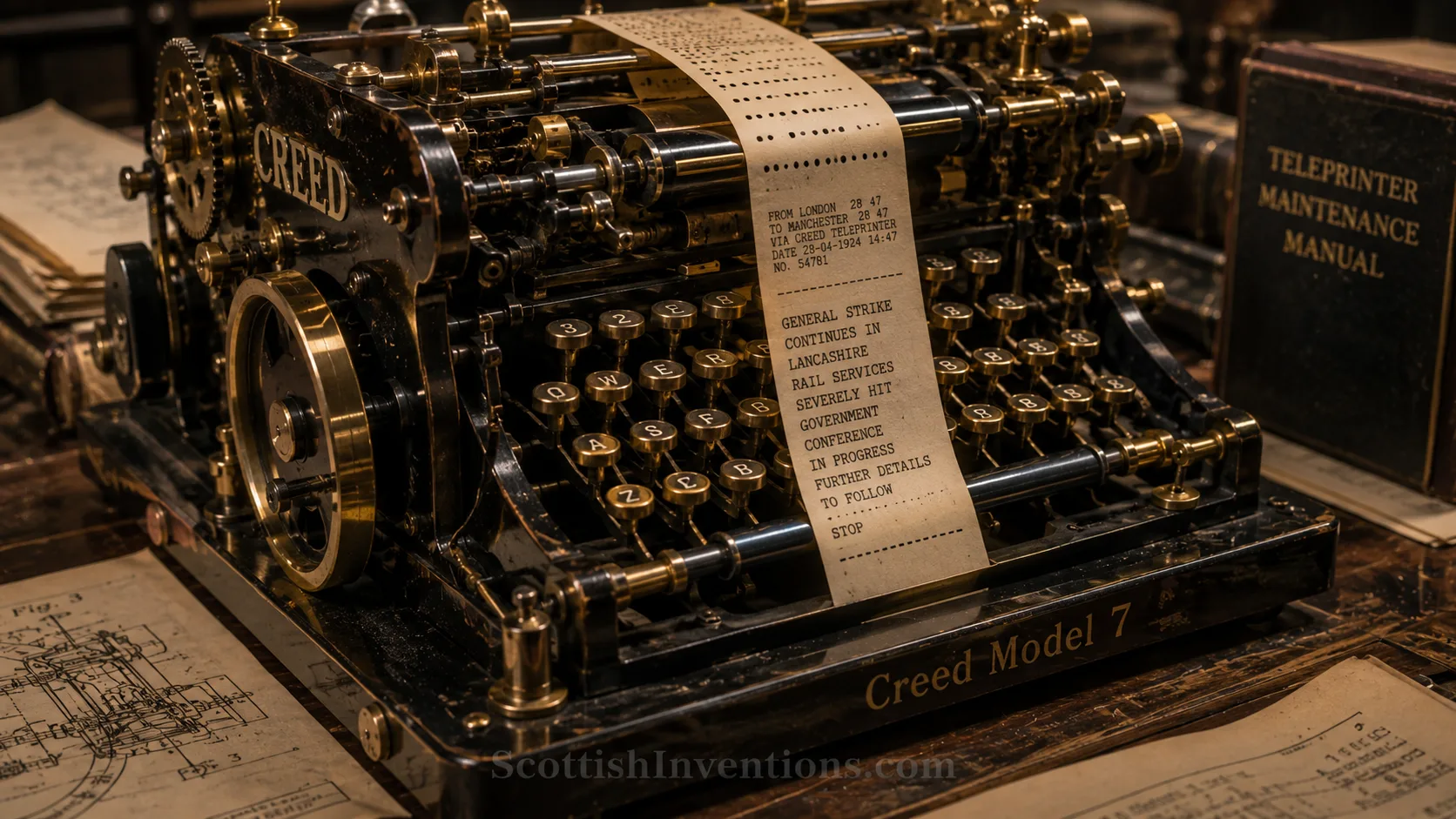
Creed's Glasgow shed contained one of the more unusual workshops in the history of British engineering: a second-hand Sauchiehall Street typewriter, a length of compressed-air pipe and a homemade bench. From these materials he built a three-part system — a keyboard perforator that punched the Murray code onto paper tape; a reperforator that received signals and re-punched tape at the receiving station; and a printer that decoded the tape into printed English. He called it the Creed High Speed Automatic Printing System.
Lord Kelvin — Britain's most famous physicist, then in his late seventies and an undisputed authority on telegraphy — is reported to have told Creed bluntly that "there is no future in that idea." The British General Post Office disagreed. In 1902 it ordered 12 machines; a small Glasgow factory opened in 1904; and in 1906 the Glasgow Herald became one of the first newspapers in the world to wire its pages with the Creed system, reporting that it ran three times faster than the rival Morse apparatus. Within a few years the Daily Mail was using Creed machines to transmit the entire contents of the newspaper from London to Manchester every day.
How a Teleprinter Worked
A teleprinter is, essentially, two linked typewriters that talk over a wire. When you press a key it does not transmit a picture of the letter — it transmits a short coded burst of electrical pulses.
- 1. Five bits per character. Each character is encoded as five "mark" (current on) or "space" (current off) signals — the Baudot/Murray code, later standardised as ITA2.
- 2. Shift codes for the full alphabet. Five bits give only 32 combinations, so two special codes — LTRS (letters) and FIGS (figures) — flip the same combinations between two sets of meanings, much like a typewriter shift key.
- 3. Start and stop bits. Each character is wrapped in a start bit and one or more stop bits — the "start-stop" method invented by the Krums — so the receiving machine can synchronise itself without precision speed control.
- 4. Decoding and printing. At the receiving end, the machine reads the five data bits, selects the matching character on a typewheel or set of type-bars, and strikes it onto paper.
- 5. Optional tape capture. Many teleprinters also punched the incoming message onto paper tape so it could be stored, re-transmitted or fed straight into a relay station.
- 6. Control codes. Carriage Return and Line Feed moved the print mechanism without printing a character — control codes that still survive in modern software.
The result was a system that any office typist could operate. The teleprinter did for the telegraph what the typewriter had done for handwriting — turned a skilled craft into an ordinary clerical task and, in doing so, multiplied its volume a thousandfold.
The Creed Model 7
Creed entered the true start-stop teleprinter field comparatively late, after a series of incremental machines: the Model 1P page printer (1924), the Model 2P (1925), and then the landmark Model 3 (3X) tape teleprinter (1927) for the Post Office telegram service, printing onto gummed paper tape at 65 words per minute. But the machine that put the Creed name into every newsroom and military signals office in Britain was the Creed Model 7, launched in 1931 for the new telex service.
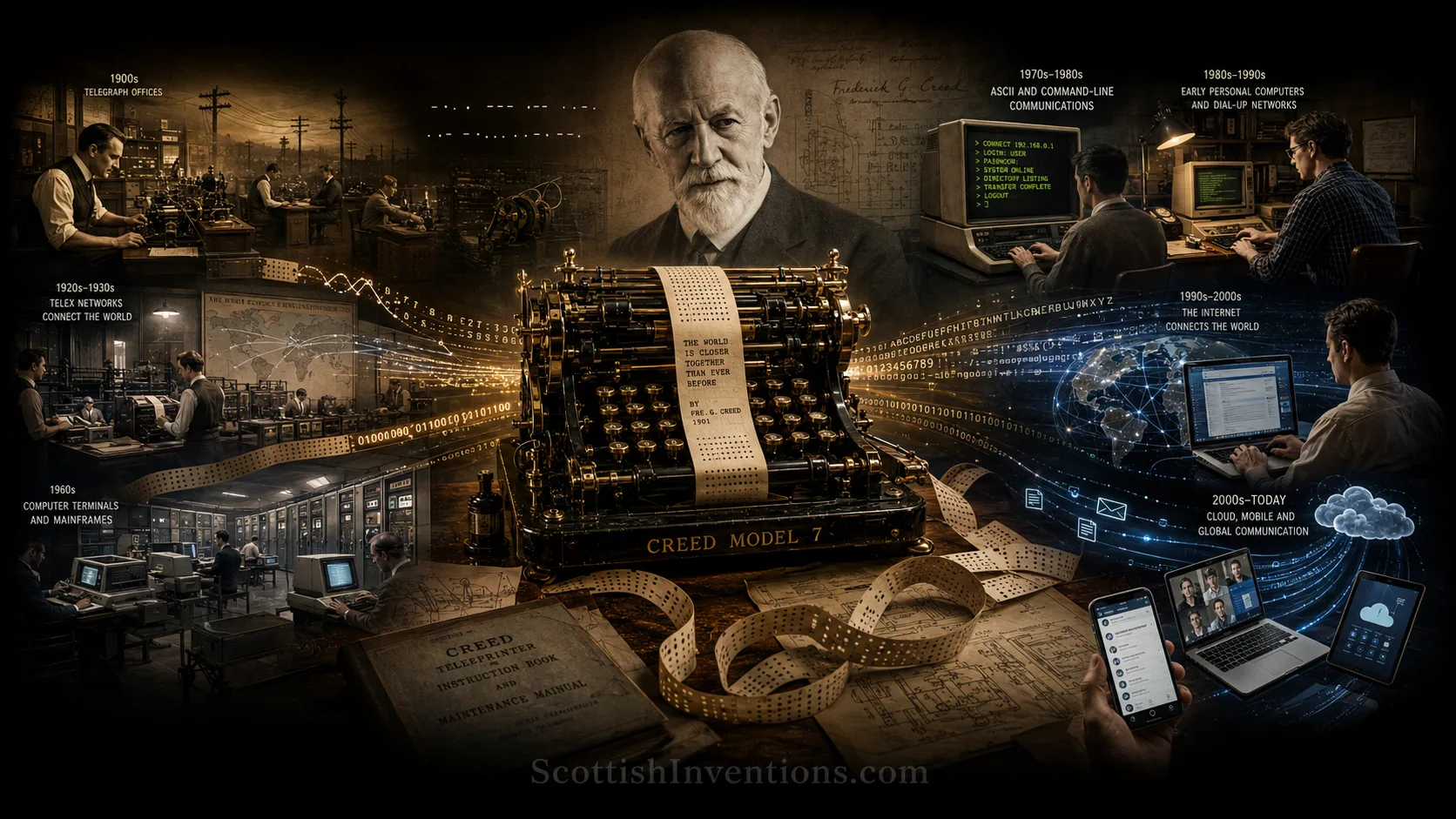
The Model 7 was a start-stop page-printing teleprinter operating at 50 baud (about 66 words per minute) using the ITA2 code. The Model 7B variant became the standard British military teleprinter of WWII; industry and enthusiast sources record that over 150,000 Model 7s were built before production ceased in the late 1960s. It clattered away in Post Office telegraph rooms, on RAF airfields, in Reuters bureaus and in shipping company offices across the world. To a generation of British secretaries, the sound of the Creed Model 7 was the sound of news.
"The world is closer together than ever before." — Frederick G. Creed, 1901
How the Teleprinter Changed Journalism
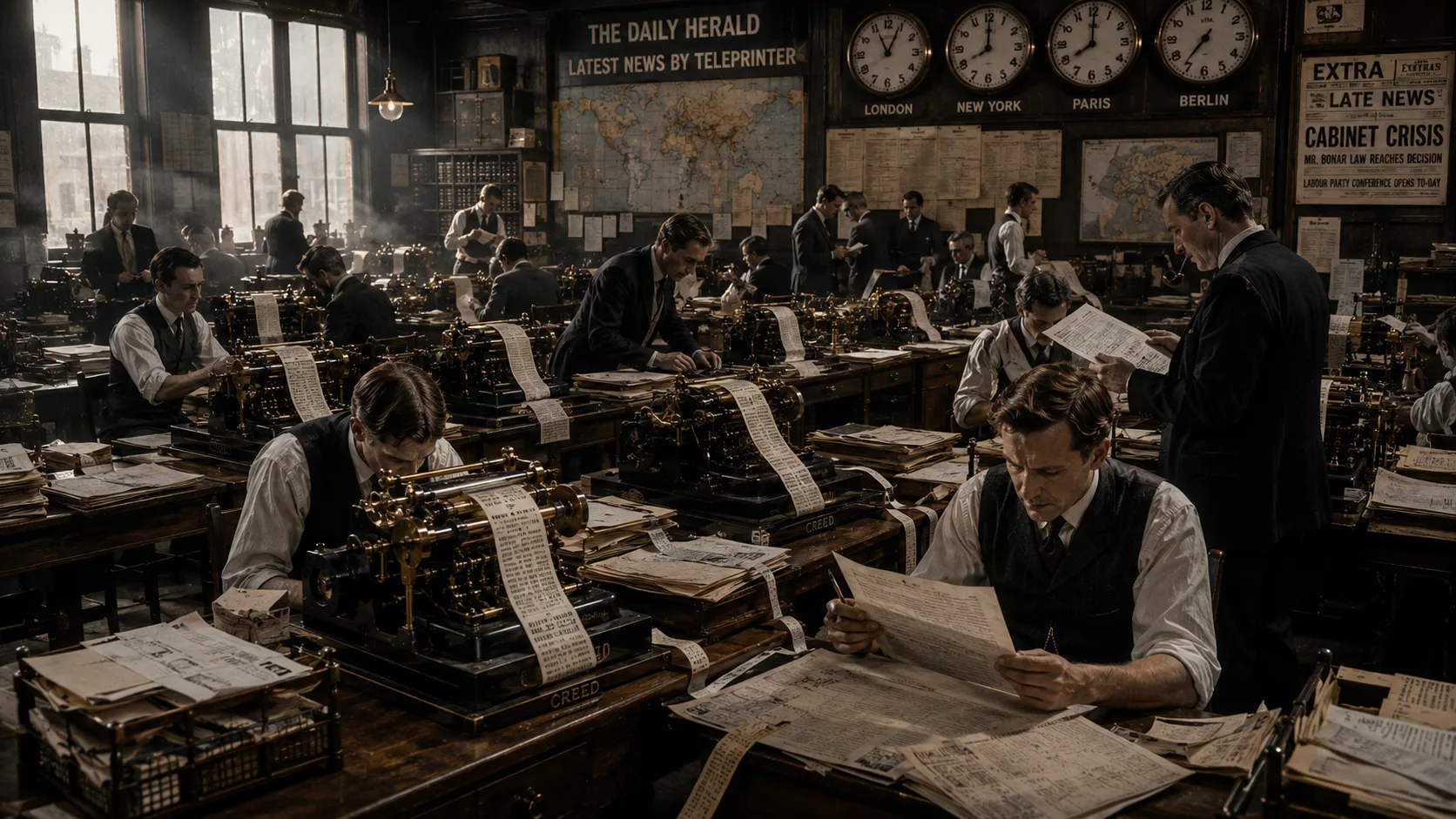
In 1920 the Press Association built a private national news network using several hundred Creed teleprinters serving practically every daily morning newspaper in the United Kingdom — for many years the world's largest private teleprinter network. Similar networks were rolled out in Australia, Denmark, India, South Africa and Sweden. In newsrooms from Fleet Street to Bombay, receive-only Creed machines spat out continuous feeds from Reuters, the Press Association, Exchange Telegraph and Central News.
The cultural consequences were profound. A national newspaper could carry a story from Sydney within minutes of it happening; a regional editor in Aberdeen could rewrite his front page on the back of a wire-room bulletin from Berlin. Bells on the machines signalled the urgency of incoming bulletins: on United Press machines, five bells meant a "Bulletin"; ten bells, a "Flash". The chatter of the teleprinter became the heartbeat of twentieth-century news.
The Birth of Telex
From the 1930s, switched teleprinter networks transformed point-to-point machines into a global dial-up text network. Telex in Europe and TWX in the United States (inaugurated by AT&T in 1932) gave subscribers a telex number and an "answerback" code that automatically confirmed the identity of the receiving machine — a feature still recognisable to anyone who has used a fax cover sheet.
In the UK the telex service grew out of a 1930s Telex Printergram service built around the Creed Model 7B. Conversion to fully automatic switching was completed by 1961, with 21 exchanges across the country and one international exchange in London. For half a century, telex was the workhorse of international business — banks, shipping lines, news agencies, embassies and freight forwarders all depended on its reliability and its legally admissible printed record. The service was finally retired in stages: BT stopped offering telex to new UK customers in 2004 and discontinued the service in 2008.
Teleprinters During the Second World War
Creed teleprinters served on every front of the Second World War. The Model 7B was the most commonly used British teleprinter of the conflict, deployed across the armed forces, the BBC's broadcast newsroom and the Air Ministry — and, most famously, at Bletchley Park. The codebreaking centre's 1944 teleprinter building housed more than 60 Creed machines linking Bletchley to its wireless intercept stations (the Y-stations) and to Whitehall.
The connection ran deeper still. The German high-command cipher Bletchley attacked — the Lorenz "Tunny" system, whose breaking required Colossus, the world's first programmable electronic digital computer — was itself an online teleprinter cipher, built around the same five-bit code that Creed and Murray had perfected for civilian traffic. The first programmable computer in history was, in effect, designed to break a teleprinter. That single fact tells you almost everything about how central this technology became to the twentieth century.
From Teleprinter to Computer Terminal
When the first electronic computers needed a way to talk to human beings, engineers reached for the machine they already had: the teleprinter. The Manchester Mark I used a five-bit Baudot-derived code (adopted by Alan Turing, because programs could then be read and written on standard telegraph tape). Early DEC, IBM and ICL machines all used teleprinters for input and output, and the famous Teletype Model 33 — using the new seven-bit ASCII code from 1963 — became the most influential interactive computer terminal of the early computing era, with over half a million built. To a generation of programmers, "the computer" was a teletype with a printer wheel and a paper-tape reader.
ASCII, TTY and Modern Computing
ASCII — the American Standard Code for Information Interchange, the character set that still underpins virtually every text file on Earth — descends directly from teleprinter coding tradition. Its control characters are the lineal descendants of Murray's LTRS and FIGS shifts and the Carriage Return and Line Feed codes Murray added in 1901. Unicode, in turn, was designed as a strict superset of ASCII; every emoji you send is, at the lowest level, a coded packet on the same conceptual model that Creed's machines used to print "GENERAL STRIKE CONTINUES IN LANCASHIRE."
And the word TTY — teletypewriter — survives intact. It began as a device-naming convention on Digital's PDP-6 and PDP-10 systems and was inherited wholesale by Unix, where every terminal device, real or virtual, became /dev/tty something. Modern Linux, macOS and BSD all preserve it. Every time you open a terminal window on a Mac or run tty in a shell, you are reaching back through sixty years of computing history to Frederick Creed's printing telegraph.
Legacy: Glasgow to the Global Internet
Creed & Company was absorbed by International Telephone & Telegraph (ITT) in July 1928, and Creed himself retired in 1930. The firm continued as a major teleprinter and data-equipment maker, moving from Croydon to the former Underwood typewriter factory at Hollingbury, Brighton, in the mid-1960s, and was renamed ITT Creed in 1972; employment peaked at around 2,000 in the early 1970s before contraction set in. Creed himself spent his later years on ambitious if largely unsuccessful projects: a mid-Atlantic "Sea Drome" floating airport, and the SWATH (small-waterplane-area twin-hull) ship concept, presented to the British Admiralty before 1938 and patented in Britain in 1946. He died at his Croydon home on 11 December 1957, aged 86.
He is commemorated with an English Heritage blue plaque, erected in 1973, at his former home at 20 Outram Road, Addiscombe, East Croydon, where the front wall also bears the Creed company logo carved in stone. In Canada, the Canadian Coast Guard's SWATH survey vessel CCGS Frederick G. Creed (launched 1988, retired 2020) was named in his honour. There is, as yet, no prominent dedicated monument to Creed in Scotland — despite Glasgow being the birthplace of his invention. That, perhaps, is something this article hopes in a small way to begin to change.
Myth vs Fact
Common claims about Frederick G. Creed — and what the evidence actually says
Myth: Creed invented the teleprinter single-handedly
The teleprinter was the cumulative work of House, Hughes, Baudot, Murray, the Krums and Creed across roughly 80 years. Creed's defensible claim is that he built the first practical, mass-produced high-speed teleprinter system in Britain.
Myth: Creed was of Scottish descent
Not well documented. He was born in Nova Scotia; the best-traced Nova Scotian Creeds have English (Kentish) origins. His Scottish connection rests firmly on his Glasgow workshop and his Scottish-born first wife.
Myth: Creed and Donald Murray were bitter rivals
Untrue. In 1925 Creed simply bought the rights to Murray's code and patents. Murray's documented bitterness was directed at AT&T and Western Union, not Creed.
Fact: Lord Kelvin really did dismiss the idea
Kelvin is reported to have told Creed "there is no future in that idea." The British Post Office disagreed and ordered 12 machines in 1902.
Did You Know?
- Creed built his first teleprinter perforator using a second-hand typewriter bought from a market on Glasgow's Sauchiehall Street.
- Lord Kelvin reportedly told Creed "there is no future in that idea." The Post Office ordered 12 machines anyway.
- The word baud comes from Émile Baudot; the code we loosely call "Baudot" is technically ITA2, derived from Donald Murray.
- Every time you open a terminal on a Mac or Linux machine and it says "tty," you are seeing a roughly century-old abbreviation for teletypewriter.
- The German cipher attacked at Bletchley Park was an online teleprinter cipher, and the British machines in the Bletchley teleprinter building were largely Creed Model 7Bs.
- Creed's other big idea — the SWATH twin-hull ship — was rejected by the Admiralty in 1938 but is now used for stable oceanographic research vessels; one is named after him.
Timeline
- 1871
Born in Nova Scotia
Frederick George Creed is born on 6 October 1871 in Mill Village, Queens County, Nova Scotia, into a small lumbering community.
- 1880s
Western Union, Canso
As a teenage 'check boy' at the transatlantic cable landing station of Canso, Creed teaches himself both cable and landline telegraphy.
- 1890s
Operator in Peru and Chile
Working for the Central and South American Telegraph and Cable Company at Iquique, Chile, Creed conceives a typewriter-style keyboard that could punch coded tape automatically.
- 1896
Marries Jennie Russell
Creed marries Scottish-born Jane 'Jennie' Russell, whom he meets in Chile.
- 1897
Moves to Glasgow
Creed relocates to Glasgow to develop his idea, working in a shed and using a second-hand typewriter from the Sauchiehall Street market to build his first keyboard perforator.
- 1902
First British Post Office order
Despite Lord Kelvin reportedly telling him 'there is no future in that idea,' Creed wins an order for 12 machines from the British General Post Office.
- 1904
Glasgow factory opens
A small Glasgow factory begins manufacturing the Creed High Speed Automatic Printing System.
- 1906
Glasgow Herald adopts the system
The Glasgow Herald becomes one of the first newspapers to adopt the Creed system, reporting it to be three times faster than rival Morse apparatus.
- 1909
Move to Croydon
Creed relocates south with six of his Glasgow mechanics to be closer to the Post Office's London headquarters.
- 1912
Creed, Bille & Company
Creed and Danish engineer Harald Bille form Creed, Bille & Company Ltd, renamed Creed & Company after Bille's death in a 1916 railway accident.
- 1920
Press Association network
The Press Association builds a private national news network using several hundred Creed teleprinters — for many years the world's largest private teleprinter network.
- 1925
Acquires Murray's patents
Creed buys the rights to Donald Murray's code and patents — the documented basis of the supposed Murray–Creed 'rivalry' was in fact a friendly commercial transaction.
- 1927
Creed Model 3
The Model 3 (3X) tape teleprinter enters mass production for the Post Office telegram service, printing onto gummed paper tape at 65 words per minute.
- 1928
Acquired by ITT
Creed & Company is absorbed by International Telephone & Telegraph in July 1928.
- 1931
Creed Model 7
The landmark Model 7 page-printing teleprinter is launched for the new telex service; it will become the backbone of British military communications in WWII.
- 1939–45
Bletchley Park and the war
Model 7B teleprinters are deployed across British forces and in the Bletchley Park teleprinter building, which by 1944 houses more than 60 Creed machines.
- 1957
Death in Croydon
Creed dies at his home in Croydon, Surrey, on 11 December 1957, aged 86.
- 1973
Blue plaque
An English Heritage blue plaque is unveiled at 20 Outram Road, Addiscombe, Creed's former Croydon home.
- 1988
CCGS Frederick G. Creed
The Canadian Coast Guard launches the SWATH survey vessel CCGS Frederick G. Creed, honouring his ship-design work.
- Today
ASCII, TTY and the internet
Teleprinter codes evolved into ASCII; the Unix/Linux 'tty' device convention preserves the teletypewriter name; email and the modern internet inherit the teleprinter's core idea of machine-readable text on a wire.
Further Reading
- Encyclopaedia Britannica — biographical entry on Frederick George Creed.
- Bletchley Park — official site of the wartime codebreaking centre, including its teleprinter building and Lorenz / Colossus exhibits.
- The National Museum of Computing — Bletchley Park-based museum with working teleprinters and the rebuilt Colossus.
- Institution of Engineering and Technology (IET) — archive and biographical material on Creed, Murray and Baudot.
- IEEE Engineering and Technology History Wiki — peer-curated entries on the printing telegraph, Baudot code and start-stop signalling.
- Computer History Museum — collections covering teletype terminals, ASCII and early interactive computing.
- British Library — newspapers, trade journals and patent records relating to the British telegraph industry.
- The National Archives (UK) — General Post Office and Admiralty records covering teleprinter procurement and military signals.
- English Heritage Blue Plaques — record of the 1973 Frederick Creed plaque at 20 Outram Road, Addiscombe, Croydon.
- The Royal Society — biographical archives on contemporaries including Lord Kelvin.
Frequently Asked Questions
›Who invented the teleprinter?
The teleprinter has no single inventor. It was developed cumulatively over roughly 80 years by Royal Earl House (printing telegraph, 1846), David Edward Hughes (improved printing telegraph, 1855), Émile Baudot (five-unit code and multiplex system, 1874), Donald Murray (typewriter keyboard and rationalised Murray code, 1901), Charles and Howard Krum at the American Morkrum / Teletype Corporation (start-stop synchronisation, from c.1906) and Frederick George Creed, who built the first practical, mass-produced high-speed teleprinter system in Britain from a Glasgow workshop beginning in 1897.
›Who was Frederick G. Creed?
Frederick George Creed (6 October 1871 – 11 December 1957) was a Nova Scotian-born engineer who developed the first widely adopted practical teleprinter system in Britain. He taught himself telegraphy as a teenage 'check boy' for Western Union in Canso, Nova Scotia, then worked as a cable operator in Peru and Chile before moving to Glasgow around 1897. There he built the keyboard perforator, reperforator and printer that became the Creed High Speed Automatic Printing System, won a British Post Office contract in 1902, founded a Glasgow factory in 1904, and went on to lead Creed & Company, the dominant British teleprinter manufacturer of the 20th century.
›What is a teleprinter?
A teleprinter is an electromechanical device that sends and receives typed text over a telegraph circuit. The sender types on a typewriter-style keyboard; each character is encoded as a short, fixed-length burst of electrical pulses (classically the five-bit Baudot/Murray code) and transmitted down a wire; at the receiving end an identical machine decodes the pulses and prints the message automatically on paper. Unlike Morse telegraphy, a teleprinter does not need a trained operator at either end — anyone who can type can use it.
›How does a teleprinter work?
When a key is pressed, the teleprinter sends a five-bit (Baudot / Murray / ITA2) code wrapped in a start bit and one or more stop bits — the 'start-stop' method. Each bit is either 'mark' (current on) or 'space' (current off). The receiving machine reads the start bit to synchronise, captures the five data bits, looks the combination up on its typewheel or type-bars, and prints the matching character. Because five bits give only 32 combinations, two shift codes — LTRS (letters) and FIGS (figures) — flip the same codes between two character sets, plus control characters such as Carriage Return and Line Feed.
›What is the Creed Model 7?
The Creed Model 7 is the most famous British teleprinter of the 20th century. Launched in 1931 for the new public telex service, it was a start-stop page-printing teleprinter operating at 50 baud (about 66 words per minute) using the ITA2 code. Variants including the Model 7B became the standard British military teleprinter of WWII and the workhorse of the Press Association news wire. Industry and enthusiast sources record that over 150,000 Model 7s were manufactured before production ceased in the late 1960s; Wikipedia's Creed & Company entry gives over 100,000 specifically for the 7B.
›What is the difference between Morse code and a teleprinter?
Morse code uses variable-length combinations of dots and dashes that a skilled human operator transmits on a Morse key and decodes by ear. A teleprinter uses a fixed-length code (typically the five-bit Baudot/Murray code) sent automatically by a typewriter keyboard, and the message is printed automatically as text at the receiving end. Morse needs a trained operator at each end; a teleprinter can be used by any typist. Teleprinters were also significantly faster, and they produced a permanent printed record without manual transcription.
›What is Baudot code?
Baudot code is the five-unit (5-bit) telegraph code patented by French engineer Émile Baudot in 1874. Each character is a fixed combination of five 'mark' or 'space' signals — far more efficient for machine transmission than Morse's variable-length symbols. Baudot's original alphabet became International Telegraph Alphabet No. 1 (ITA1). The unit of signalling speed, the baud, is named after him.
›What is Murray code?
Murray code is the typewriter-friendly five-bit code developed by New Zealand engineer Donald Murray in 1901. Because the operator no longer formed the code by hand, Murray reassigned Baudot's combinations so that the most frequent letters used the fewest punched holes, reducing wear on the perforator. He also added control characters such as Carriage Return and Line Feed. Murray code evolved into International Telegraph Alphabet No. 2 (ITA2), the dominant teleprinter code of the 20th century. Creed teleprinters used the Murray system, and in 1925 Creed bought the rights to Murray's patents.
›What is telex?
Telex was a worldwide switched network of teleprinters that allowed subscribers to dial each other directly and exchange typed messages, much like the telephone network for text. In Britain it grew out of a 1930s 'Telex Printergram' service using the Creed Model 7B, with fully automatic switching completed by 1961. Each subscriber had a telex number and an 'answerback' code that automatically confirmed the receiving machine's identity. Telex was the workhorse of international business communication for fifty years; BT stopped accepting new UK telex customers in 2004 and ended the service in 2008.
›How did teleprinters influence computers?
Teleprinters were the first input/output devices for early computers. The Manchester Mark I used a five-bit Baudot-derived code (chosen by Alan Turing so programs could be read and written on standard telegraph tape). The Teletype Model 33, using the new seven-bit ASCII code from 1963, was one of the most influential early computer terminals — more than half a million were built. ASCII itself descends directly from teleprinter coding tradition, and control characters such as Carriage Return and Line Feed survive in software today. The very idea of a 'character', a 'terminal' and a 'console' in computing comes from the teleprinter.
›Why is 'TTY' still used in Linux?
TTY is an abbreviation of teletypewriter — the teleprinter that served as the first interactive terminal for time-sharing computers. The naming convention 'tty' began on Digital's PDP-6 and PDP-10 systems and was inherited by Unix, where every terminal device — physical or virtual — became /dev/tty something. Modern Linux, macOS and BSD systems all preserve the convention: every shell session and every terminal window is, etymologically, a teletype. The word is a roughly century-old fossil of Frederick Creed's machine.
›How did teleprinters contribute to Bletchley Park?
Creed teleprinters — chiefly the Model 7B — were the primary text-handling machines at Bletchley Park during the Second World War. The 1944 Bletchley teleprinter building housed more than 60 Creed machines linking the codebreaking centre to wireless intercept stations (Y-stations) and to Whitehall. Equally important, the high-end German cipher Bletchley attacked — the Lorenz 'Tunny' system whose breaking led to Colossus, the world's first programmable electronic digital computer — was itself an online teleprinter cipher built around the same five-bit code that Creed and Murray had perfected.
›What is the connection between teleprinters and the internet?
The teleprinter is one of the deepest technological ancestors of the internet. It pioneered the idea of sending typed text as standardised digital codes over a wire; switched teleprinter networks (telex, TWX) prefigured packet-style addressed messaging; the five-bit Baudot/Murray code led to ASCII and then Unicode; the Teletype Model 33 became the first widely used interactive computer terminal; the 'tty' abstraction underpins Unix and the modern command line; and the practice of sending machine-readable text from one machine to another is exactly what email, instant messaging and the web do today, with the wire replaced by the internet.
›Was Frederick Creed Scottish?
Frederick George Creed was born in Nova Scotia, Canada. The popular claim that he was personally 'of Scottish descent' is not well documented; the best-traced Creed family in Nova Scotia in fact has English (Kentish) origins. What is firmly documented is that Creed's first wife, Jane 'Jennie' Russell, was Scottish-born, and — decisively — that the pioneering work to build the first practical teleprinter was carried out in Glasgow from around 1897, where Creed lived, set up his shed workshop, opened his first factory in 1904 and supplied his first machines to the British Post Office. ScottishInventions.com frames him as a Nova Scotian who made Glasgow the home of the teleprinter.
›Were Donald Murray and Frederick Creed bitter rivals?
No — this is a popular misconception. The two men were contemporaries working on compatible technologies, and in 1925 Creed bought the rights to Donald Murray's code and patents. Murray's documented bitterness over patent credit was real but directed at the American giants Western Union and AT&T, not at Creed. In a 1914 article in the Telegraph and Telephone Journal Murray appealed 'for the sympathy of all fair-minded men against the unscrupulous tactics of a big American company' — a reference to AT&T. The honest framing is that Creed and Murray were partners in succession, with Murray as seller and Creed as buyer.