Scottish Inventions · Transport · Card No. 41 of 50
Robert Stevenson & the Bell Rock Lighthouse
The Scottish Engineer Who Lit a Deadly Coast
For almost fifty years Robert Stevenson served as engineer to the Northern Lighthouse Board, transforming one of Europe's deadliest coasts into one of its safest. His masterpiece — the Bell Rock Lighthouse, built on a reef submerged for twenty hours a day — still stands, essentially unaltered, more than two centuries later.
TL;DR
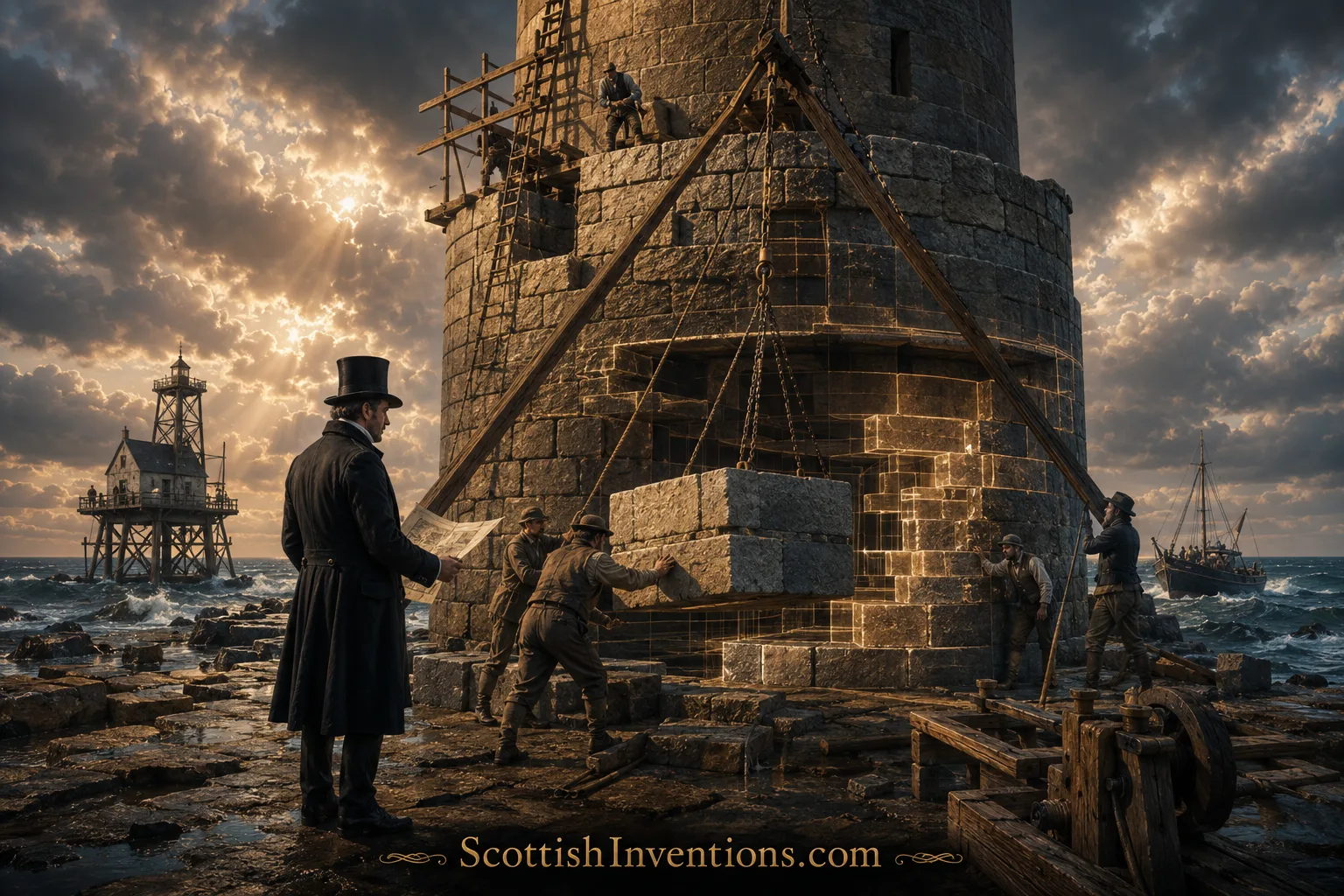
- Robert Stevenson (1772-1850) did not invent the lighthouse, but as engineer to the Northern Lighthouse Board for nearly fifty years he designed and built numerous lighthouses around Scotland's lethal coast — crowned by the Bell Rock Lighthouse (1807-1811), the world's oldest surviving sea-washed tower.
- His genuine claims to fame are construction, not optics: he perfected the catoptric (mirror-and-lamp) system, lit Scotland's first revolving red-and-white light, invented intermittent flashing light "signatures" and the balance crane. But he was sceptical of the Fresnel lens; it was his son Alan Stevenson who introduced that French technology to Scotland.
- Stevenson founded a four-generation engineering dynasty — the "Lighthouse Stevensons" — that built most of Scotland's lights over 150 years. He was the grandfather of Treasure Island author Robert Louis Stevenson, who trained briefly as a lighthouse engineer before turning to writing.
Key Findings
Robert Stevenson stands as one of Scotland's greatest civil engineers, but his reputation needs careful handling. Lighthouses are ancient — the Pharos of Alexandria pre-dates him by two millennia — and the dramatic optical revolution in lighthouse lighting was largely the work of the Frenchman Augustin-Jean Fresnel. What Stevenson genuinely achieved was something arguably harder: he worked out how to build a permanent stone tower on a reef that vanished beneath the sea twice a day, and he industrialised and systematised the lighting of an entire nation's coast. His Bell Rock Lighthouse has stood, essentially unaltered in its masonry, for over 200 years.
The honest picture is this: Stevenson was a brilliant builder, organiser and improver rather than a lone inventor of revolutionary ideas. He adapted John Smeaton's interlocking-masonry technique, he resisted rather than introduced the Fresnel lens, and on his most famous project he shared design responsibility with John Rennie. But his courage, his project management under brutal conditions, his real mechanical inventions, and the dynasty and system he founded fully justify his standing as the "father of Scottish lighthouses."
Robert Stevenson at a glance
- Engineer
- Robert Stevenson FRSE
- Born
- Glasgow — 8 June 1772
- Died
- Edinburgh — 12 July 1850
- Role
- Engineer to the Northern Lighthouse Board (c.1800-1842/43)
- Central work
- Bell Rock Lighthouse (1807-1811)
- Height
- 115 ft (35-36 m); 42 ft base tapering to 15 ft
- Stone
- Rubislaw granite base; Mylnefield / Carmyllie sandstone above
- Genuine inventions
- Balance crane · flashing light signatures · improved parabolic reflectors · hydrophore
- Lighthouses attributed
- At least 15 major lights (NLB) — up to 25+ by other counts
- Dynasty
- Alan, David & Thomas Stevenson; grandfather of Robert Louis Stevenson
Early Life: From Charity School to Lighthouse Engineer
Robert Stevenson was born in Glasgow on 8 June 1772, the only son of Alan Stevenson, a partner in a West India trading house, and Jean (Jean Lillie) Stevenson. His father died of a fever on the island of St Christopher (St Kitts) in the West Indies on 26 May 1774, just before Robert's second birthday, leaving the family in straitened circumstances. Robert was educated at a charity school, and his mother initially intended him for the ministry.
His life changed when his mother remarried. Her new husband was Thomas Smith, a tinsmith, lamp-maker and "ingenious mechanic" who in 1786 had been appointed the first engineer to the newly-formed Northern Lighthouse Board — the Commissioners of Northern Lighthouses, established by Act of Parliament after storm losses in 1782 prompted the Convention of Royal Burghs to act. Smith was therefore both Stevenson's stepfather and — after Robert married Smith's eldest daughter Jean in 1799 — his father-in-law. This double family bond placed Stevenson at the very heart of the new Scottish lighthouse service.
Stevenson became Smith's assistant and proved a natural. At just nineteen he was entrusted with supervising the building of a lighthouse at Little Cumbrae in the River Clyde, and in 1794 he superintended the Pentland Skerries lighthouse in Orkney. He studied surveying, drawing, mathematics and the sciences at the Andersonian Institute in Glasgow and the University of Edinburgh (he never graduated, reportedly for "total want of Greek"). He became Smith's business partner around 1800 and succeeded him as sole engineer to the Board, a post he held for nearly fifty years until 1842/43.
A Deadly Coastline
Scotland's coast is one of the most dangerous in Europe. Before the Northern Lighthouse Board, the country's shore was almost entirely unlit; the only significant light was a coal brazier on the Isle of May, first established under a patent granted by Charles I in 1635, plus a few minor harbour lights. Yet sea travel was the fastest and often only practical way to move people and heavy cargo, so ships ran appalling risks. By one estimate, in the late eighteenth century up to a fifth of the cargo on ships sailing round the Scottish coast was lost to shipwreck. Some coastal communities even grew rich on the spoils of wrecks.
The single worst hazard on the east coast was the Bell Rock (or Inchcape Rock), a sandstone reef around eleven miles off Arbroath in Angus that lay submerged under up to twelve to sixteen feet of water at high tide and was exposed for only a couple of hours at low water. It sat squarely in the fairway for ships making for the Firths of Forth and Tay. According to the Northern Lighthouse Board's account, "it was calculated that on average the Bell Rock wrecked six ships every winter, with thousands of lives lost in all." Historic accounts also record catastrophic mass losses — a single storm in 1779 (some accounts place it closer to 1799) reputedly wrecked as many as seventy vessels on the reef.
The decisive event was the loss of the 64-gun warship HMS York, which struck the rock in a gale in 1804 and sank with all aboard — around 491 crew — causing a furore in Parliament and finally turning public opinion toward action.
The Bell Rock Lighthouse — The Central Achievement
Stevenson had first visited the rock in 1800 and was convinced a stone tower could be built there, even though many considered it impossible. He proposed a lighthouse in 1799/1800, but cost, the radical nature of the scheme, and his relative youth saw it shelved. After the York disaster, Stevenson sent his design to the eminent engineer John Rennie, whose backing helped secure the necessary Act of Parliament in 1806. The Board appointed Rennie as chief engineer and Stevenson as resident engineer to execute the work — an arrangement that later caused a long credit dispute between the two men's descendants.
Modern scholarship and the Northern Lighthouse Board itself give Stevenson the chief credit for the design and execution, while acknowledging Rennie's contribution was real. The Board's own memorial minute on Stevenson's death honoured him "to whom is due the honour of conceiving and executing the great work of the Bell Rock Lighthouse." Historic Environment Scotland's listing puts it judiciously: "The extent to which John Rennie contributed to the design is not clear, but Robert Stevenson was the engineer in charge of construction and deserves most of the credit for this remarkable structure."
Building the Bell Rock Lighthouse
Construction ran from 1807 to 1810, with the light first exhibited on 1 February 1811. The engineering challenges were extraordinary.
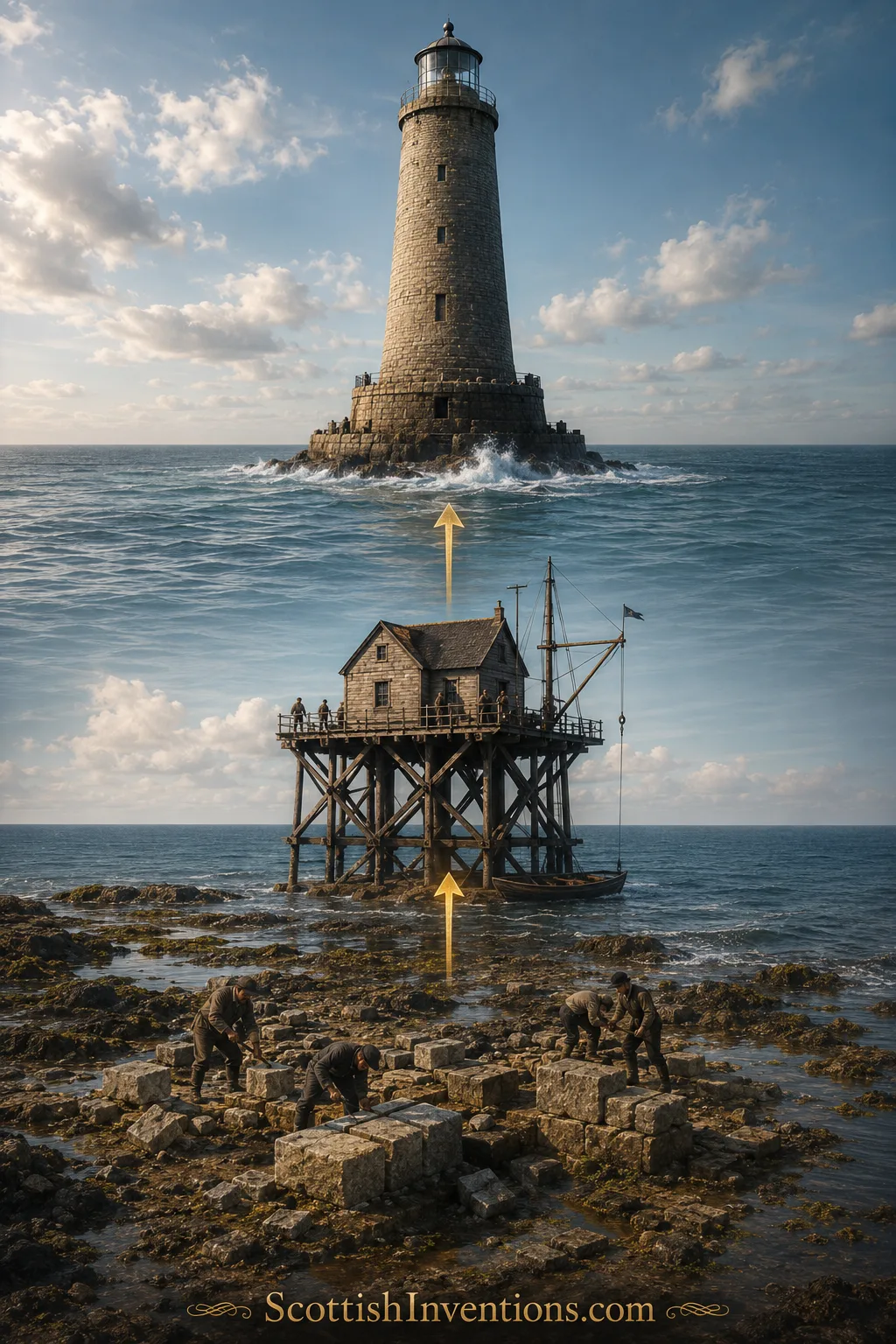
- Working against the tide. Because the rock was underwater roughly twenty hours a day, in the first season men could work only about two hours at each low tide, and only in the calmer summer months. At first they rowed out from a ship moored a mile away; after a near-disaster when their vessel drifted off, Stevenson had a timber beacon house built on stilts on the reef so workers could live alongside the site, dramatically speeding progress from 1809.
- A shore-based system. A work-yard was set up at Arbroath where each course of stone was cut, shaped and trial-assembled before being shipped out. A horse-drawn railway carried stones across the rock — Stevenson noted that one horse alone hauled the lighthouse's roughly 2,076 tons of stone several times over.
- Interlocking masonry. The lower tower — the bottom roughly 30 feet — is solid dovetailed masonry, each block locked to its neighbours like a jigsaw and pinned with stone joggles and trenails, so the structure's own weight and interlock resist the waves. The tower stands about 115 feet (35-36 m) tall, 42 feet in diameter at the base tapering to about 15 feet at the top, built of Rubislaw granite in the lowest courses and Mylnefield/Carmyllie sandstone above.
- Invented machinery. Stevenson devised new construction plant for the job, including the balance crane and the movable jib crane, used for the first time at the Bell Rock.
Tragedy and drama accompanied the work: in January 1810 Stevenson lost his twins and then his youngest daughter to whooping cough; storms repeatedly battered the half-built tower; and the rising structure became a tourist attraction. Sir Walter Scott visited in 1814 and immortalised its "ruddy gem of changeful light." JMW Turner painted it.
The result has been astonishingly durable. The masonry has never had to be replaced or adapted in more than two centuries; the lighthouse was automated on 26 October 1988 and is now monitored remotely from the Northern Lighthouse Board's Edinburgh headquarters. Because of the engineering challenges overcome, it has been described as one of the "Seven Wonders of the Industrial World" — a characterisation popularised by Deborah Cadbury's 2003 BBC docudrama series and companion book, not a formal or ancient designation. It is the world's oldest surviving sea-washed lighthouse.
"To whom is due the honour of conceiving and executing the great work of the Bell Rock Lighthouse."
Scotland's Lighthouse Network
Across his long career Stevenson designed and built a substantial number of lighthouses, and the exact tally depends on what one counts. The Northern Lighthouse Board states he "was responsible for engineering at least 15 major lighthouses" during his tenure; the Victorian-era Dictionary of National Biography records that "no fewer than twenty lighthouses were designed and constructed"; his son David's 1878 biography gives twenty-three; and Historic Environment Scotland says "over 25." The variation reflects how one counts major rock towers versus lesser lights, joint works with Thomas Smith, and rebuilds.
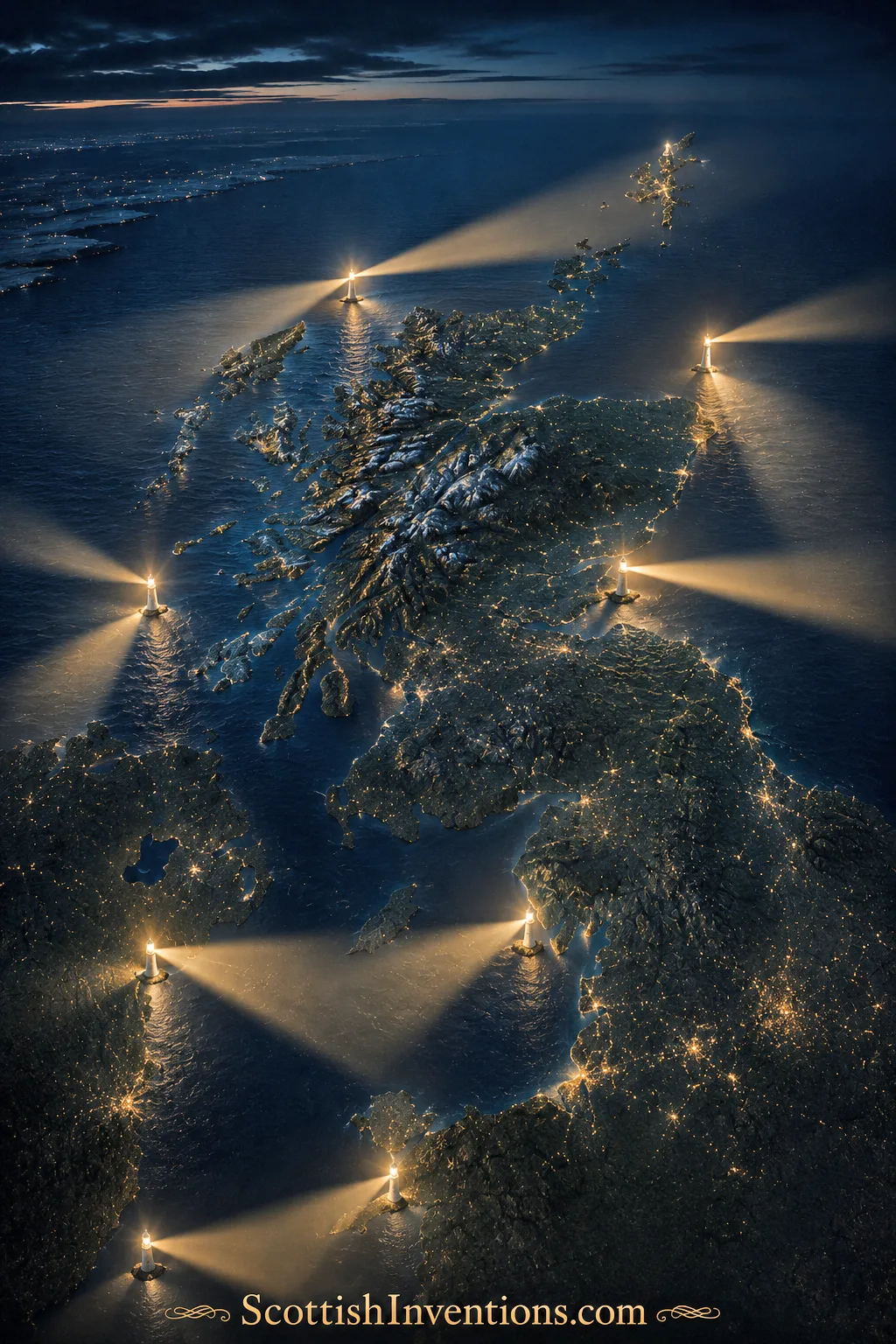
Major lights attributed to Robert Stevenson include:
- Inchkeith (1804, Firth of Forth — with Thomas Smith)
- Start Point, Sanday, Orkney (1806) — an early revolving light
- Bell Rock (1811, Angus)
- Toward Point (1812, Argyll)
- Isle of May (1816, Firth of Forth) — Gothic-style tower replacing the old coal beacon
- Corsewall (1817, Dumfries & Galloway — now a hotel)
- Point of Ayre and Calf of Man (1818, Isle of Man)
- Sumburgh Head (1821, Shetland)
- Rinns of Islay (1825)
- Buchan Ness (1827, Aberdeenshire)
- Cape Wrath (1828, Sutherland)
- Tarbat Ness and Mull of Galloway (1830)
- Dunnet Head (1831, Caithness)
- Girdle Ness, Barra Head, Lismore/Eilean Musdile (1833)
He also worked far beyond lighthouses — designing the Regent Bridge and Hutcheson Bridge, Stirling New Bridge, the Trinity sea wall, roads, canals, harbours and railway schemes, and he is credited with advocating malleable-iron rather than cast-iron rails.
Technical Innovations — Honestly Attributed
This is where care is essential.
What Stevenson genuinely did
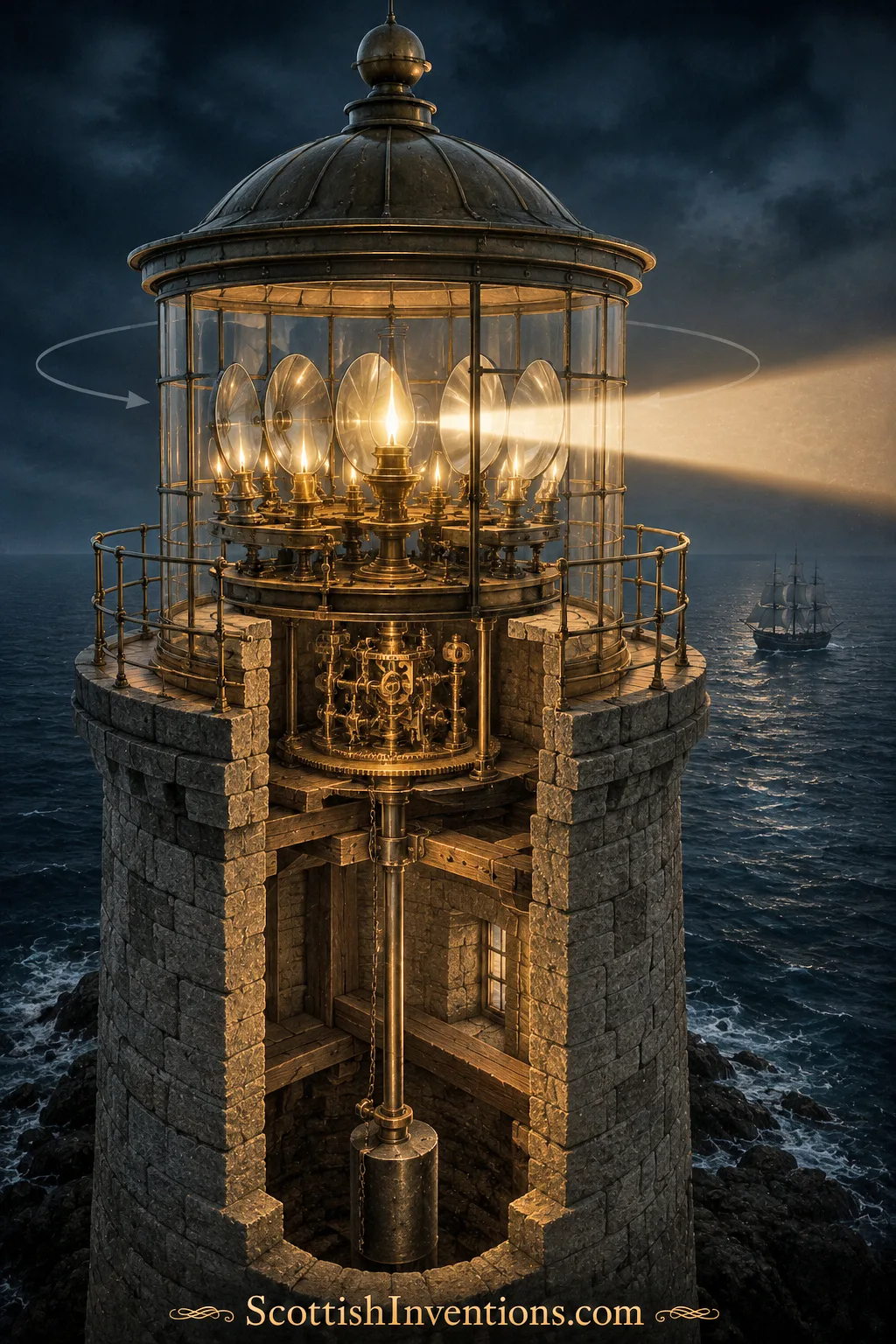
From 1803 to 1810 he significantly improved Scotland's reflector lighting — the catoptric system of silvered-copper parabolic reflectors paired with Argand oil lamps. He developed a true parabolic reflector with heavy silver cladding and an ingenious retractable lamp mounting (first installed at Bell Rock in 1811). At Bell Rock he installed the first revolving light in Scotland: an array of 24 Argand oil lamps backed by parabolic silvered reflectors, rotated by a clockwork-and-weight mechanism, with red glass over the reflectors on the shorter sides so that, in the Northern Lighthouse Board's words, "when turned, [it] gave the Bell Rock an alternately red and white beam."
Crucially, he developed the idea of giving each lighthouse a distinct "signature" — intermittent and flashing characteristics produced by rotation and shuttering — so seafarers could tell one light from another. For this, in 1829 he was awarded a gold medal by King William I of the Netherlands. He also invented the balance crane and the hydrophore, an instrument for sampling water at depth.
What he did NOT do
He did not invent the Fresnel lens. That was the work of the French physicist Augustin-Jean Fresnel, whose revolutionary dioptric (refracting) lens system dates from the early 1820s. In fact, Robert Stevenson was sceptical of the merits of the Fresnel lens over his beloved reflectors. It was his eldest son, Alan Stevenson, who embraced and introduced Fresnel/dioptric technology to Scotland — first at Inchkeith in 1835 (the UK's first dioptric light) and most famously at Skerryvore (1844), working under the guidance of Léonor Fresnel. Several secondary sources blur this by listing "his use of Fresnel lenses" among Robert's innovations; the more careful record shows he advocated the dioptric system in principle but resisted replacing reflectors in practice.
The Smeaton lineage
The interlocking dovetailed masonry that makes Bell Rock so strong was not Stevenson's invention. John Smeaton pioneered it on the third Eddystone Lighthouse (1756-59) off Cornwall, using interlocking granite blocks dovetailed together, secured with marble joggles and oak trenails, in a tapering oak-tree profile. Stevenson visited and studied Eddystone in detail in 1801 and openly modelled Bell Rock on Smeaton's work — both Stevenson and Rennie described the lighthouse as essentially a copy of Smeaton's Eddystone tower "with sundry improvements." Stevenson's genuine refinements were real but incremental: a more gradual taper, thicker walls, and — as his son David documented — converting the internal floor courses into "effective bonds" so that "instead of exerting an outward thrust, they actually tie or bind the walls together." The honest verdict: Stevenson brilliantly adapted and extended an existing technique rather than originating it.
The Stevenson Dynasty
Robert Stevenson founded a remarkable engineering dynasty. Three of his sons became lighthouse engineers: Alan (1807-1865), who built Skerryvore and introduced Fresnel optics; David (1815-1886), who also designed lighthouses for Japan; and Thomas (1818-1887), a designer and meteorologist (inventor of the "Stevenson screen" weather instrument shelter) who built Dhu Heartach and many others. The line continued with David's sons David Alan Stevenson (1854-1938) and Charles Alexander Stevenson (1855-1950), who designed numerous lights into the late 1930s.
Across roughly four generations and some 150 years — from Thomas Smith and Robert Stevenson through to D. Alan Stevenson, who died in 1971 — the family was responsible for designing or building the great majority of Scotland's lighthouses. Scotland's coast carries over 200, and the Northern Lighthouse Board today maintains 208. It is one of the most sustained family engineering achievements in history.
The Robert Louis Stevenson Connection
Robert Stevenson was the grandfather of Robert Louis Stevenson (1850-1894), author of Treasure Island, Kidnapped and Strange Case of Dr Jekyll and Mr Hyde. RLS was the son of Thomas Stevenson, and the family fully expected him to join the profession. He duly studied engineering at the University of Edinburgh from 1868 and spent summers learning in the field — at Anstruther and Wick harbours in 1868, touring the Orkney and Shetland lights with his father aboard the yacht Pharos in 1869, and three weeks on the island of Erraid in 1870.
In 1871 he was even awarded a silver medal by the Royal Scottish Society of Arts for a paper on "A New Form of Intermittent Light." But he had no real passion for it; later that year he switched to law, and ultimately to literature. He nonetheless remained fascinated by his forebears, writing the unfinished Records of a Family of Engineers (1896), and called his grandfather "above all a projector of works in the face of nature, and a modifier of nature itself."
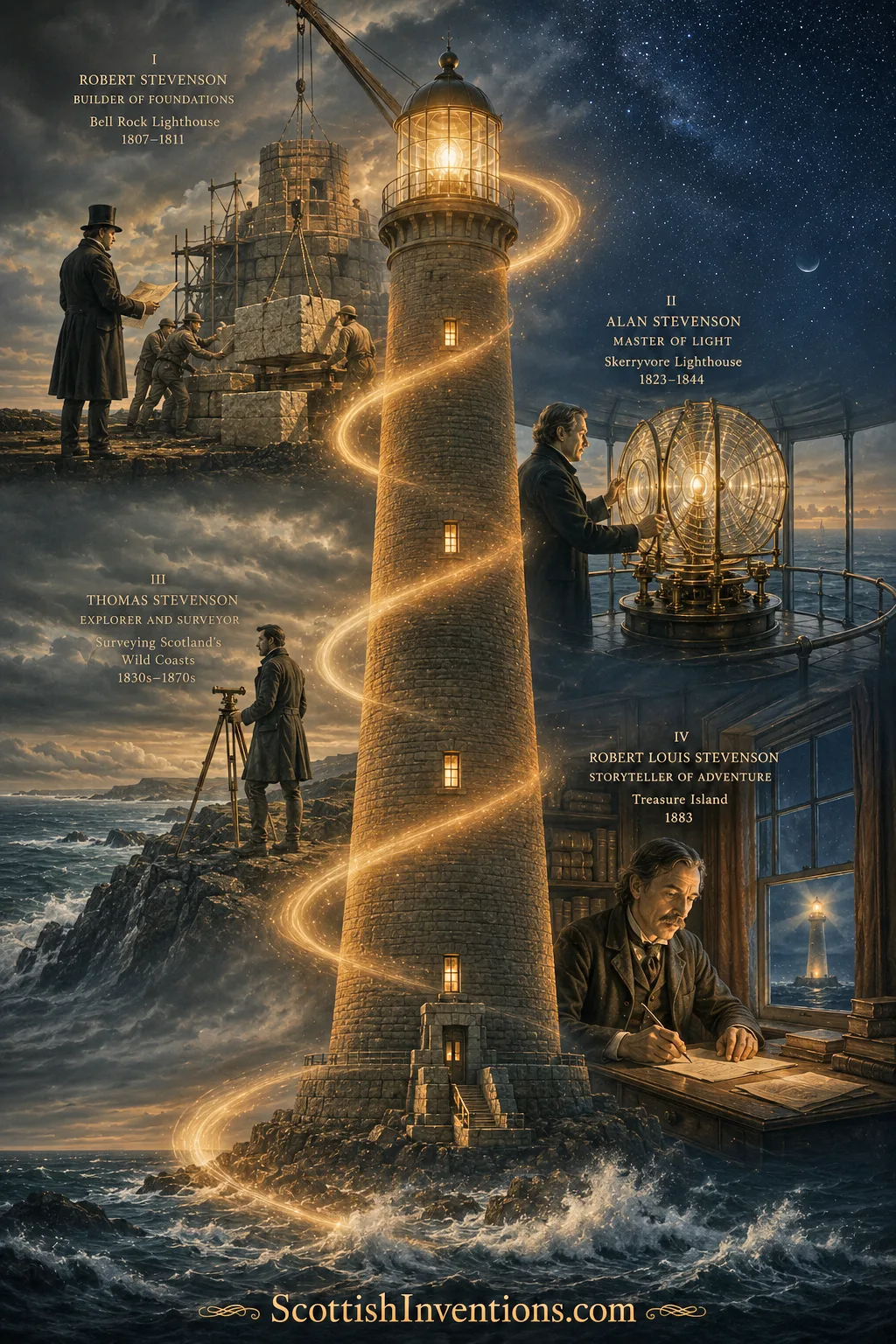
Timeline
8 June 1772
Born in Glasgow
Robert Stevenson is born in Glasgow, the only son of West India merchant Alan Stevenson and Jean Lillie. His father dies in the West Indies before his second birthday.
1786
Northern Lighthouse Board founded
The Commissioners of Northern Lighthouses are established by Act of Parliament following heavy shipping losses. Thomas Smith, later Stevenson's stepfather, is appointed the Board's first engineer.
1791
First lighthouse at 19
At just nineteen, Stevenson supervises construction of a lighthouse at Little Cumbrae on the River Clyde.
1799
Marries Jean Smith
Marries Thomas Smith's eldest daughter Jean, becoming both Smith's stepson and son-in-law — a double bond that places him at the heart of the Scottish lighthouse service.
1800
First visit to Bell Rock
Stevenson visits the deadly Bell Rock (Inchcape) reef off Arbroath and becomes convinced a permanent stone tower can be built there.
1804
HMS York disaster
The 64-gun warship HMS York strikes the Bell Rock in a gale, sinking with around 491 crew. Public outrage finally forces political action.
1806
Act of Parliament approves Bell Rock
Parliament authorises the Bell Rock Lighthouse. Stevenson's design is adopted; John Rennie is appointed chief engineer, Stevenson resident engineer.
1807-1810
Bell Rock built
Construction proceeds during summer working seasons. From 1809 a timber beacon house lets men live on the reef itself, dramatically speeding progress.
1 February 1811
Bell Rock first illuminated
The Bell Rock Lighthouse first shows its light — Scotland's first revolving light, an array of 24 Argand oil lamps and parabolic silvered reflectors giving a distinctive red-and-white signature.
1815
Fellow of the Royal Society of Edinburgh
Elected FRSE in recognition of his engineering achievements.
1816-1833
Scotland's coast systematised
Stevenson designs and builds a long series of major lights — Isle of May, Corsewall, Sumburgh Head, Cape Wrath, Girdle Ness and many more.
1829
Dutch gold medal
Awarded a gold medal by King William I of the Netherlands for inventing intermittent and flashing lighthouse signatures.
1842/43
Steps down as engineer
Retires from the post of engineer to the Northern Lighthouse Board after nearly fifty years; his sons Alan, David and Thomas continue the family practice.
12 July 1850
Died in Edinburgh
Robert Stevenson dies at 1 Baxter's Place, Edinburgh, and is buried in the New Calton Burial Ground.
1988
Bell Rock automated
Bell Rock Lighthouse is automated on 26 October 1988 and is now monitored remotely from the Northern Lighthouse Board in Edinburgh.
Today
Category A listed
Bell Rock is a Category A listed building (HES LB45197) and remains operational — the world's oldest surviving sea-washed lighthouse.
Key Takeaways
Robert Stevenson's Enduring Contributions
- A permanent tower on Bell Rock — a lighthouse where all others had said none could stand, built in 1807-1810 and still lit today.
- The lighthouse "signature" — flashing and intermittent lights that let a mariner name any lighthouse on sight, earning a gold medal from the King of the Netherlands.
- A national system — Scotland's lighthouse network industrialised, systematised and staffed under the Northern Lighthouse Board.
- An engineering dynasty — four generations of Stevensons who between them built the majority of Scotland's 200-plus lights.
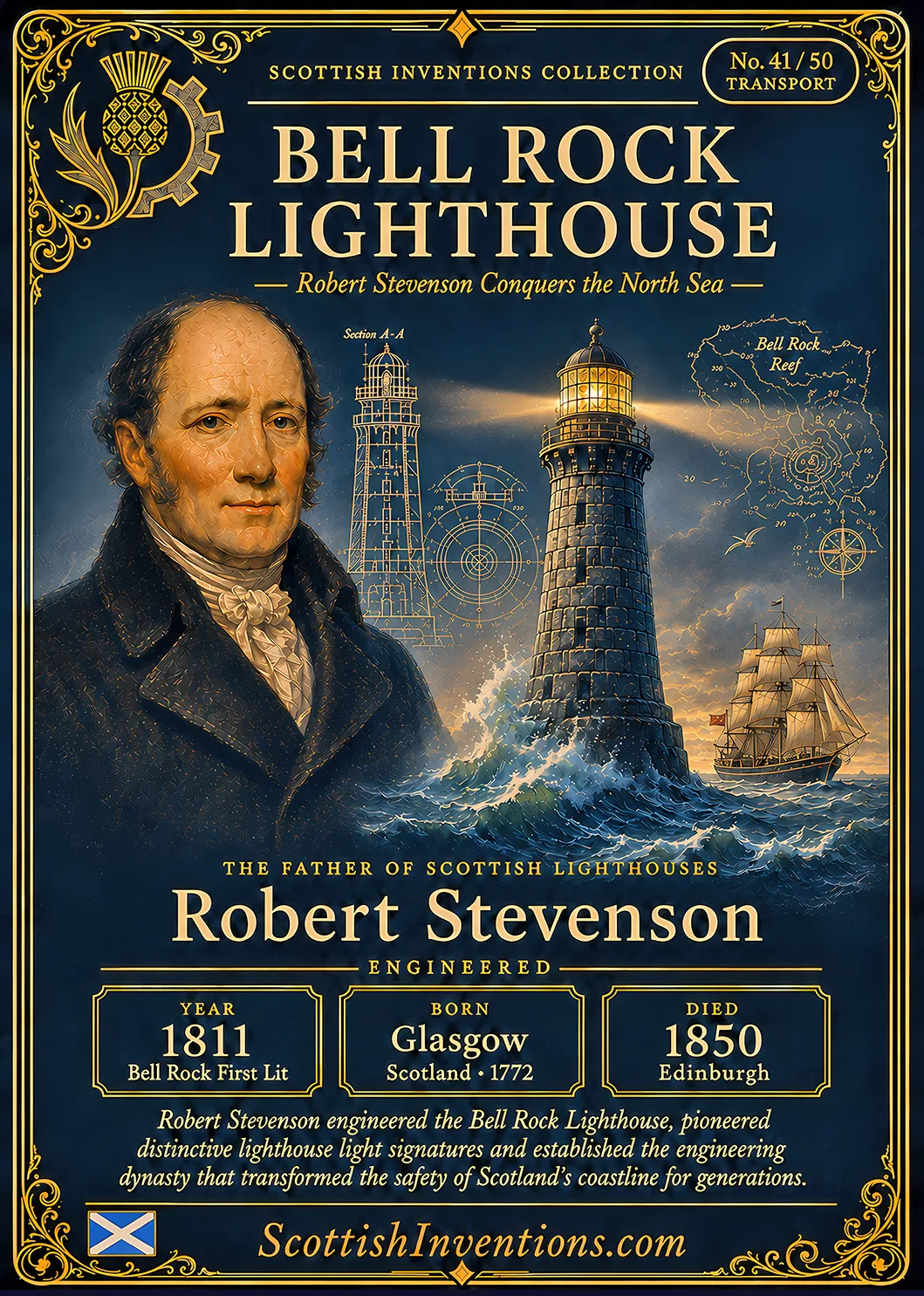
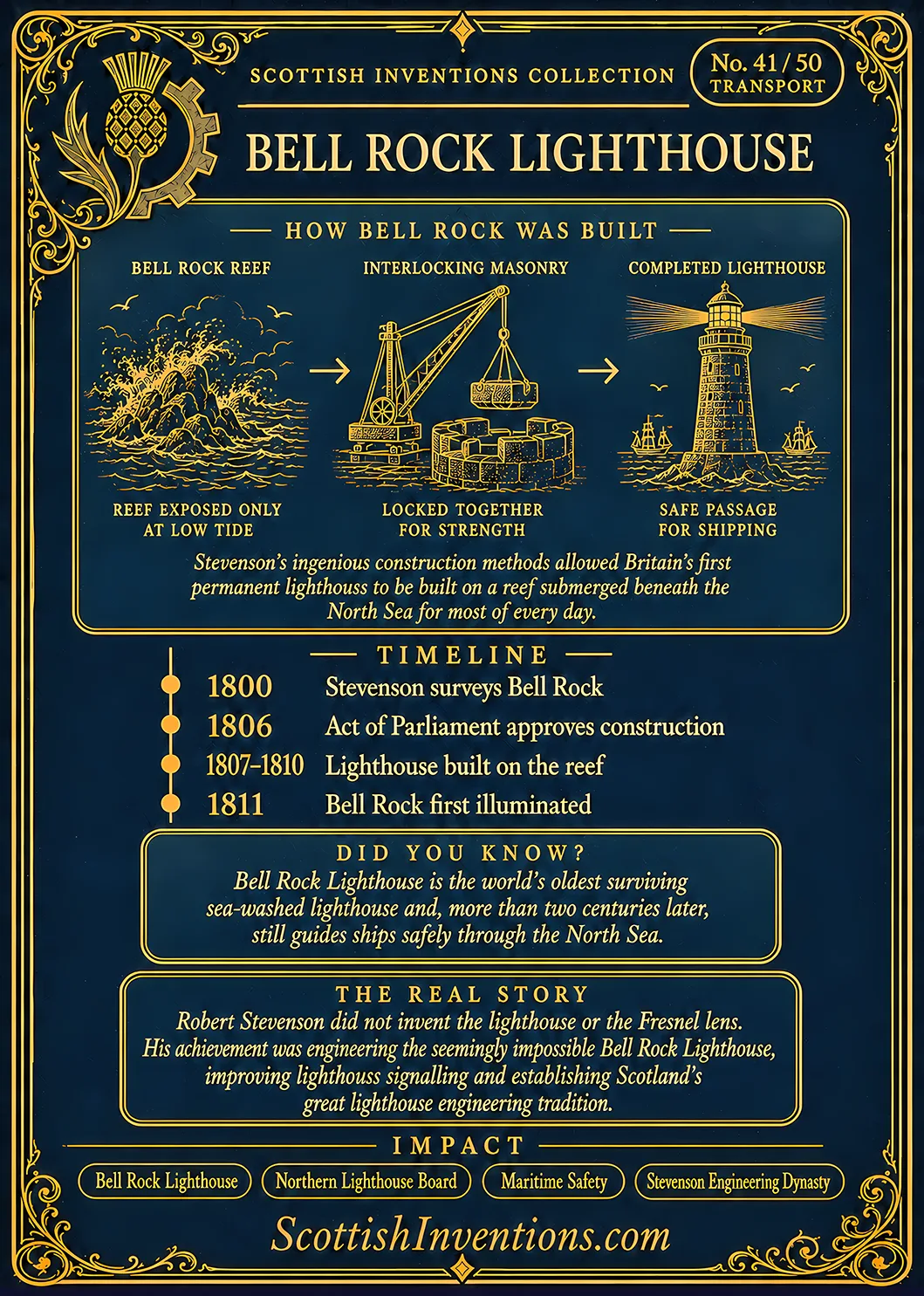
The Bell Rock Lighthouse trading card
Card No. 41 of 50 in the Scottish Inventions Collection.
Frequently Asked Questions
- Who was Robert Stevenson?
- Robert Stevenson (1772-1850) was a Scottish civil engineer who served as engineer to the Northern Lighthouse Board for nearly fifty years. He designed and built numerous lighthouses around Scotland's coast, most famously the Bell Rock Lighthouse (1807-1811), and founded the Stevenson lighthouse engineering dynasty.
- Did Robert Stevenson invent the lighthouse?
- No. Lighthouses are ancient — the Pharos of Alexandria predates Stevenson by more than two thousand years. Stevenson's genuine achievement was engineering a permanent masonry tower on the tide-swept Bell Rock reef, refining reflector optics and revolving light mechanisms, and systematising the lighting of Scotland's coast. He did not invent the lighthouse itself and did not invent the Fresnel lens.
- What is Bell Rock Lighthouse?
- Bell Rock Lighthouse is a stone tower standing 115 feet (about 35 metres) on the Bell Rock (Inchcape) reef, roughly 11 miles off Arbroath in Angus, Scotland. Built from 1807 to 1810 and first illuminated on 1 February 1811, it is the world's oldest surviving sea-washed lighthouse. Its interlocking masonry has never had to be replaced.
- Why is Bell Rock Lighthouse famous?
- Bell Rock is famous because Robert Stevenson built a permanent stone tower on a reef submerged for around twenty hours a day. It has protected shipping in the Firths of Forth and Tay continuously since 1811, has survived fire, wartime attack and a 1955 helicopter crash, and has been popularly described as one of the Seven Wonders of the Industrial World.
- How was Bell Rock Lighthouse built?
- Workers were rowed out from a moored ship and could initially work only about two hours at each low tide. Stevenson built a timber beacon house on stilts on the reef so men could live alongside the site, set up a work-yard at Arbroath where each block was pre-fitted, and used dovetailed interlocking granite and sandstone masonry adapted from John Smeaton's Eddystone technique. He also invented the balance crane for hoisting stones into place.
- What is the oldest surviving sea-washed lighthouse?
- The Bell Rock Lighthouse, engineered by Robert Stevenson between 1807 and 1810 and first lit on 1 February 1811, is the world's oldest surviving sea-washed lighthouse. Its masonry has stood essentially unaltered for more than two centuries.
- What did Robert Stevenson invent?
- Stevenson's verified inventions include the balance crane and movable jib crane developed for the Bell Rock project, distinctive flashing and intermittent light signatures allowing sailors to identify individual lighthouses, Scotland's first revolving red-and-white lighthouse beam, refined parabolic silvered reflectors for the catoptric system, and the hydrophore for sampling water at depth.
- Who introduced the Fresnel lens to Scotland?
- The Fresnel lens was invented by the French physicist Augustin-Jean Fresnel in the early 1820s. Robert Stevenson was actually sceptical of it. It was his eldest son Alan Stevenson who introduced Fresnel dioptric optics to Scotland — experimentally at Inchkeith in 1835 and most famously at Skerryvore in 1844, working with guidance from Léonor Fresnel.
- Was Robert Louis Stevenson related to Robert Stevenson?
- Yes. Robert Louis Stevenson (1850-1894), author of Treasure Island, Kidnapped and Dr Jekyll and Mr Hyde, was Robert Stevenson's grandson. His father Thomas Stevenson was a lighthouse engineer, and Robert Louis trained briefly in the family profession before switching to law and then to literature.
- Can Bell Rock Lighthouse still be visited?
- Bell Rock Lighthouse remains operational and is automated, monitored remotely from the Northern Lighthouse Board's Edinburgh headquarters. The reef itself is not accessible to visitors on a routine basis, but the shore station at Arbroath — the 1813 Signal Tower — is now the Signal Tower Museum, which tells the lighthouse's story.
Legacy
Robert Stevenson died on 12 July 1850 at 1 Baxter's Place, Edinburgh, and is buried in the New Calton Burial Ground. He effectively inaugurated the modern Scottish lighthouse service, whose systematic approach he established. He was a Fellow of the Royal Society of Edinburgh (1815) and a member of the Institution of Civil Engineers, and was inducted into the Scottish Engineering Hall of Fame in 2016.
His lighthouses endure. Bell Rock remains operational, automated since 1988 and managed by the Northern Lighthouse Board. It is protected as a Category A listed building — the highest category in Scotland — under Historic Environment Scotland reference LB45197, listed on 23 March 1998. The shore station at Arbroath, the 1813 Signal Tower, is separately listed and today houses the Signal Tower Museum, which tells the lighthouse's story.
His story sits alongside the great civil engineers of the age — James Watt, James Nasmyth, John Rennie and Thomas Telford — as one of the makers of the modern British landscape. And through his grandson Robert Louis Stevenson, the family's engineering imagination found its way into the fabric of world literature.
Continue Exploring
Explore More Scottish Engineering Legends
From Bell Rock Lighthouse to steam engines, bridges, railways and electrical engineering, Scottish innovators helped make the modern world possible. Discover the remarkable inventions and engineering achievements that changed history.
Explore More Scottish Engineering InnovationsSources
- Northern Lighthouse Board — official history of the Bell Rock Lighthouse and biographical notes on Robert Stevenson.
- Historic Environment Scotland — Category A listing LB45197 (Bell Rock Lighthouse), listed 23 March 1998.
- David Stevenson, Life of Robert Stevenson, Civil Engineer (1878).
- Robert Louis Stevenson, Records of a Family of Engineers (unfinished, 1896).
- Bella Bathurst, The Lighthouse Stevensons (1999).
- Deborah Cadbury, Seven Wonders of the Industrial World (2003).
- Scottish Engineering Hall of Fame — Robert Stevenson (inducted 2016).
- Encyclopædia Britannica — entries on Robert Stevenson, Bell Rock and the Northern Lighthouse Board.