Scottish Inventions · Engineering · Card No. 34 of 50
Sir William Fairbairn and the Box Girder
The Scottish Engineer Behind the Britannia Bridge
Born in Kelso in 1789, Sir William Fairbairn proved the wrought-iron box girder by experiment at Millwall — the structural principle that carried trains across the Menai Strait and now lives on inside modern bridges and every large aircraft wing.
TL;DR
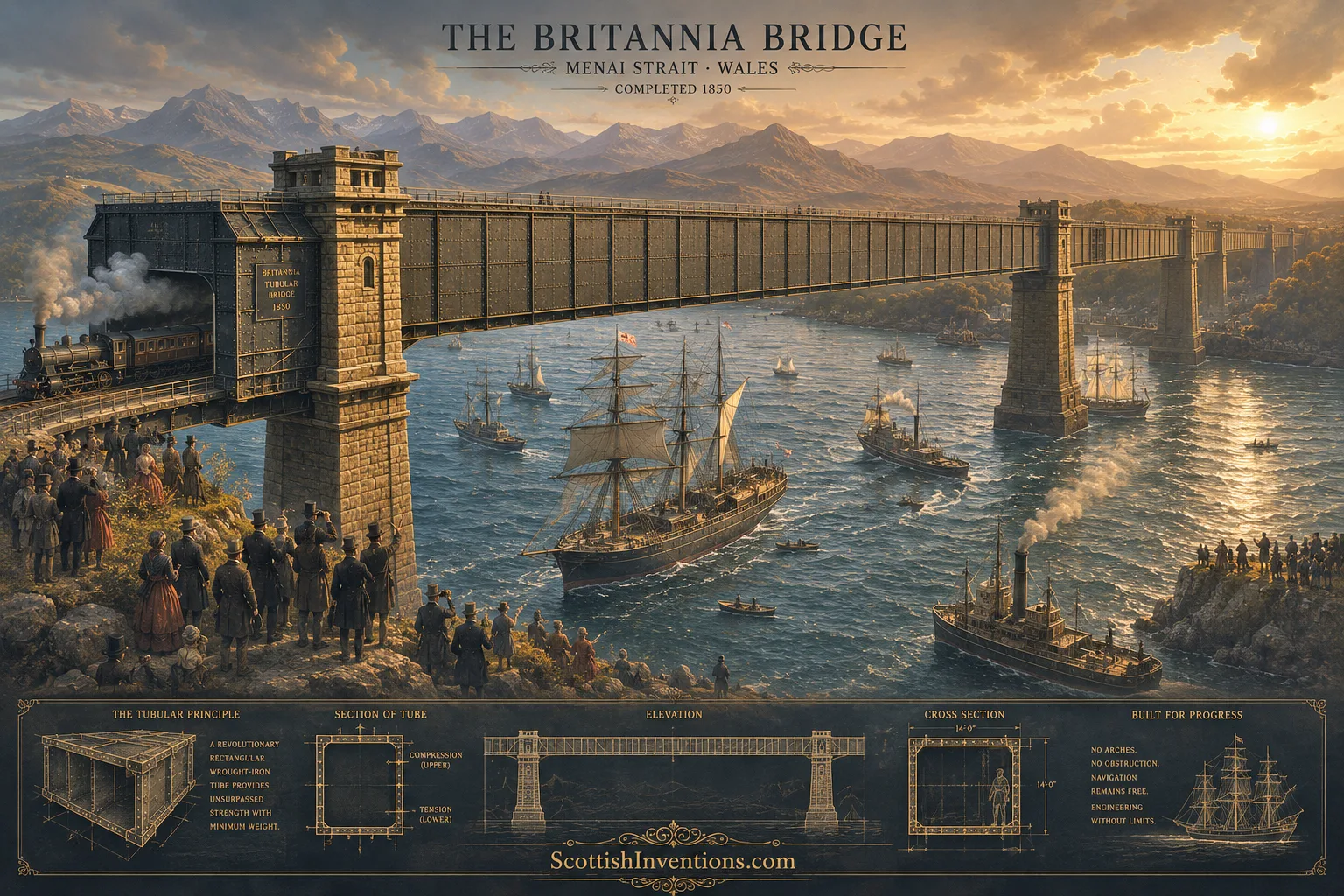
- Sir William Fairbairn (1789–1874), born in Kelso in the Scottish Borders, led the experimental work that produced the world's first great wrought-iron box-girder (tubular) bridges — the Conway Tubular Bridge (1848) and the mighty Britannia Bridge over the Menai Strait (1850) — proving through model-testing at his Millwall shipyard that a hollow rectangular tube with cellular flanges could carry trains across spans no iron beam had ever approached.
- This was a genuine three-way collaboration, not a solo triumph: Robert Stephenson was engineer-in-chief and conceived the tubular idea; Fairbairn ran the decisive experiments and settled the rectangular, cellular form; Eaton Hodgkinson supplied the mathematical theory. Stephenson kept most of the public credit, and Fairbairn fought back in print with an 1849 book published before the bridge was even finished.
- The box-girder principle Fairbairn helped prove is now foundational to bridge engineering worldwide and to the "torsion box" at the heart of every large aircraft wing — while his pioneering experiments on metal fatigue underpin modern materials safety. Poignantly, the original Britannia tubes were destroyed by fire in 1970, so the world's first box-girder bridge no longer has its box girders.
Key Findings
- Fairbairn was born on 19 February 1789 in Kelso, Roxburghshire — today in the Scottish Borders — the son of Andrew Fairbairn, a farm steward, and Margaret Henderson; he was baptised on 8 March 1789. He built his entire career in England — a "Scottish by birth, English by career" figure.
- The engineering problem was extreme: the Admiralty forbade any arch or suspension cables obstructing navigation of the Menai Strait, and the required 460-foot main span dwarfed the previous wrought-iron span record of just 31 feet 6 inches — a roughly fifteen-fold leap.
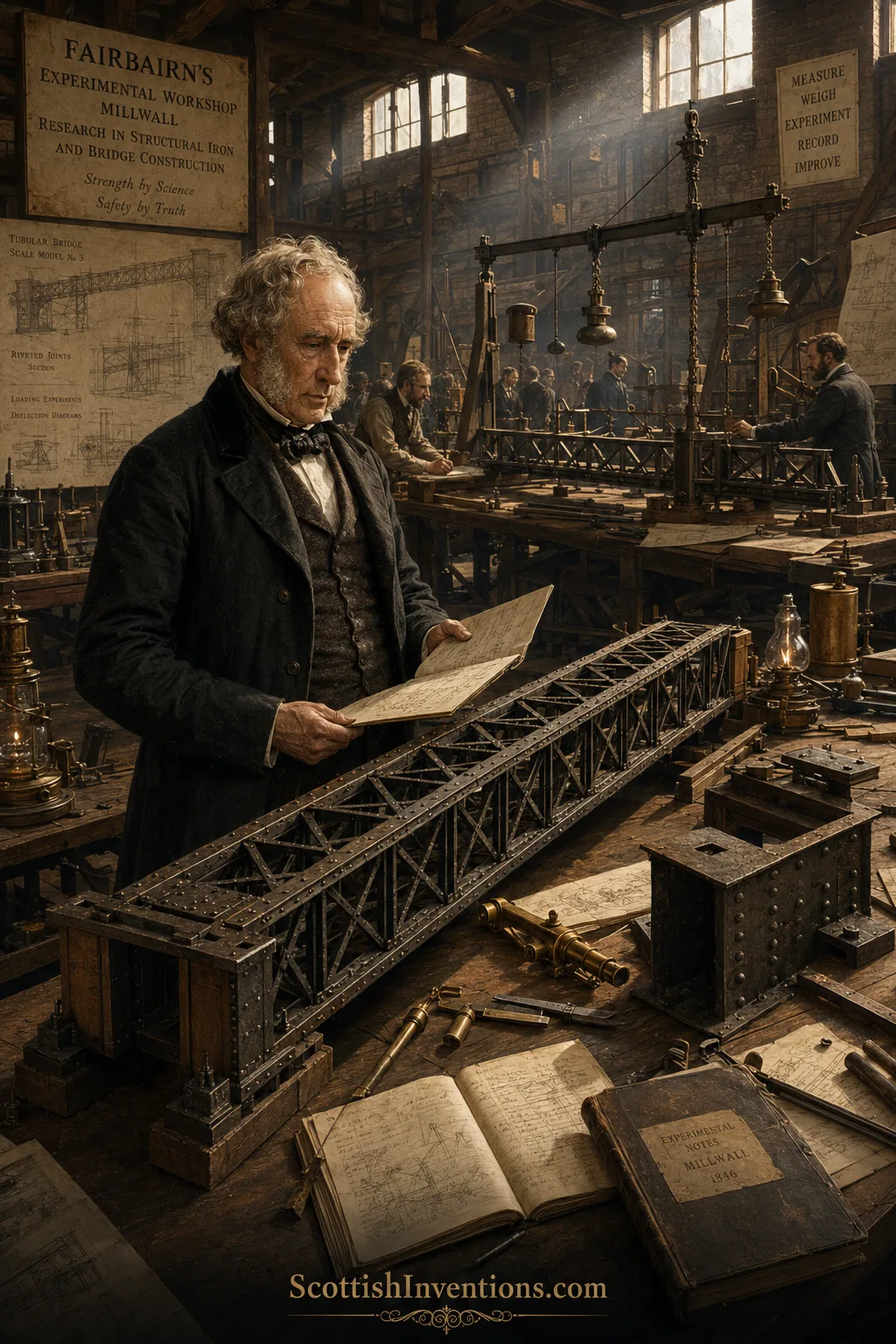
- At his Millwall shipyard from 1845, Fairbairn built and tested scale-model tubes, discovering that a rectangular section outperformed the circular or elliptical form Stephenson favoured, and that cellular (honeycomb) construction of the top flange resisted the buckling that was the true enemy.
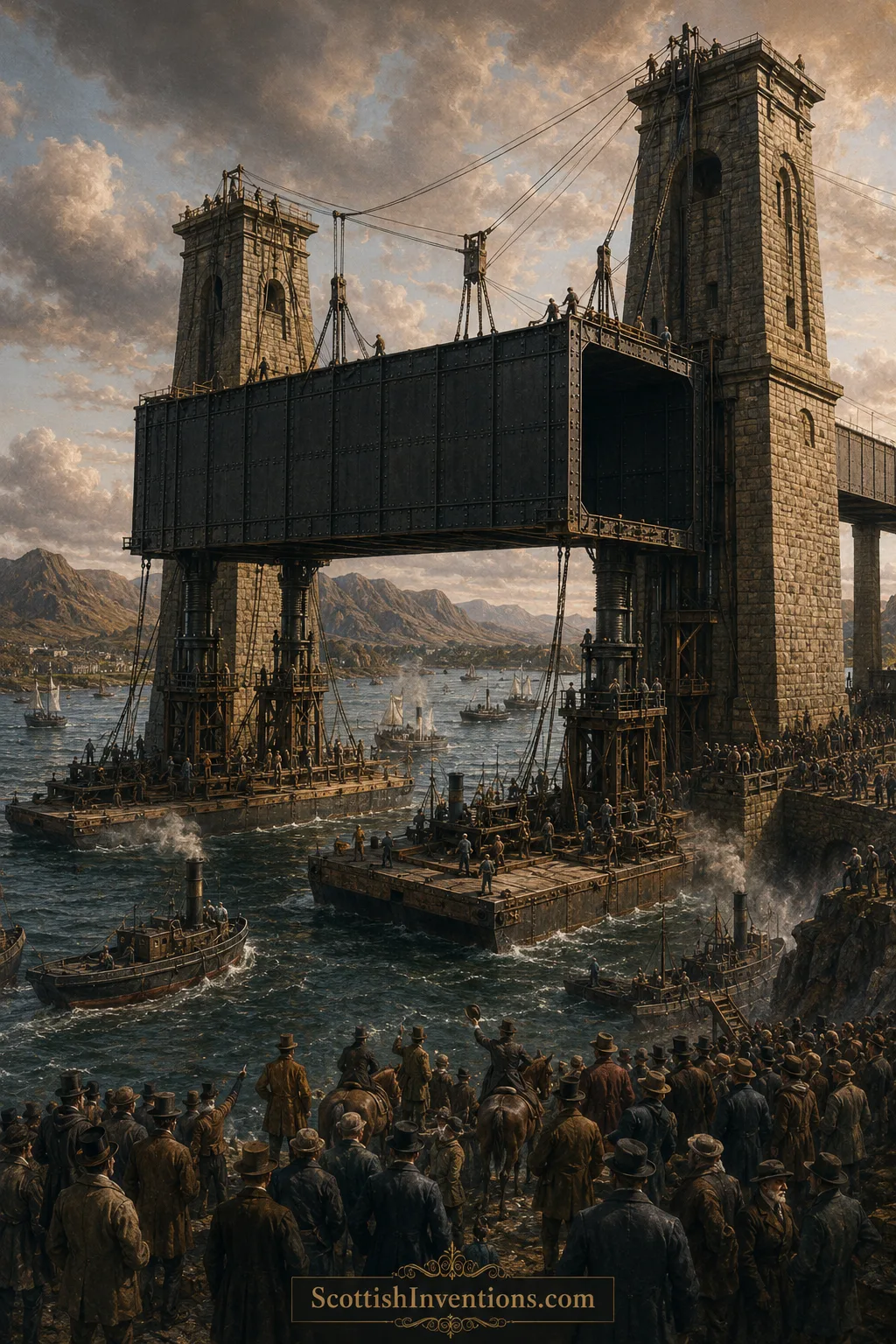
- The Conway Bridge (single 400-foot span, opened 1848) was the rehearsal; the Britannia Bridge (two 460-foot and two 230-foot spans, opened 1850) was the masterpiece. Both used tubes fabricated on shore, floated into place on pontoons, and raised by hydraulic press.
- Fairbairn's later, government-funded experiments on metal fatigue — repeatedly loading wrought iron millions of times — showed that metals fail far below their single-load breaking strength, a discovery central to modern bridge and aircraft safety.
- He was elected a Fellow of the Royal Society in 1850, served as President of the British Association for the Advancement of Science in 1861, declined a knighthood in 1861, and was created a baronet in 1869.
Sir William Fairbairn at a glance
- Engineer
- Sir William Fairbairn, 1st Baronet
- Born
- Kelso, Roxburghshire — 19 February 1789
- Died
- Moor Park, Surrey — 18 August 1874
- Signature invention
- Wrought-iron box girder with cellular top flange
- Proved at
- Millwall shipyard, London (1845–47)
- Britannia main spans
- 2 × 460 ft (previous record: 31 ft 6 in)
- Britannia total girder
- 1,511 ft continuous wrought-iron beam
- Britannia tubes
- 4 × 1,500 long tons · ~800,000 rivets each
- Honours
- FRS 1850 · IMechE President 1854 · Baronet 1869
- Legacy
- Modern bridges · aircraft wing boxes · metal-fatigue safety
1. Early Life and Scottish Background
William Fairbairn was born on 19 February 1789 in the handsome Border town of Kelso, Roxburghshire (today in the Scottish Borders), and baptised there on 8 March. His father, Andrew Fairbairn, was a farm steward (a farm-bailiff); his mother was Margaret Henderson, the daughter of a Jedburgh tradesman. The family was not wealthy, and it moved frequently in search of work — to farms in the north of Scotland, in North Yorkshire, and on Tyneside. Young William's formal schooling was slight, including a spell at Munlochy parish school in Ross-shire.
In 1803, while the family was living in the Borders, the teenage Fairbairn briefly worked as a labourer on a bridge being built at Kelso by the great engineer John Rennie — and was injured in an accident within days. Later that year his father became steward on a farm attached to Percy Main Colliery near North Shields, and around 1804 William was apprenticed there as a millwright. It was at Percy Main that he struck up a lifelong friendship with a young engine-man named George Stephenson — a friendship that would, decades later, bring him the commission of his life through George's son Robert.
Fairbairn finished his apprenticeship in 1811, worked as a journeyman, spent time in London, and finally settled in Manchester in 1813, working for the millwrights Adam Parkinson and Thomas Hewes. In 1817, aged 28, he founded the mill-machinery firm of Fairbairn and Lillie with James Lillie. His reputation soon reached back into Scotland: in the 1820s his firm supplied the celebrated giant water-wheels at Catrine in Ayrshire and at Deanston — the Catrine wheels, 50 feet in diameter, were among the largest in Britain and remained working tourist attractions into the 1940s. In 1834–35 he established a dedicated shipbuilding yard at Millwall on the Thames, which became the earliest iron-shipbuilding establishment of any size in England, and where he built over eighty vessels. It was this yard — and Fairbairn's habit of thinking of an iron ship as "a floating tubular beam" — that would prove decisive for the bridges.
2. The Engineering Problem — Bridges in the 1840s
The iron bridge was still young and dangerous. Cast iron, used since the first iron bridge at Coalbrookdale (Ironbridge) in 1781, was strong in compression but brittle and treacherous in tension. Fairbairn himself had become one of Britain's first forensic engineers, investigating collapsed mills and exploded boilers; he warned Robert Stephenson against a trussed cast-iron design for a bridge over the River Dee at Chester, and when that bridge collapsed in May 1847, killing five, the disaster cast a long shadow over every railway bridge in the country.
Into this climate came Stephenson's problem: carry the Chester and Holyhead Railway across the River Conwy and across the Menai Strait, completing the vital London–Holyhead–Dublin link. Thomas Telford had already bridged both waters in the 1820s, but with suspension bridges for road traffic — and the consensus was that a suspension bridge could never be stiff enough to carry a locomotive. Worse, the Admiralty insisted the strait remain open to shipping, demanding at least 100 feet of clearance for a fully rigged man-of-war and refusing to permit any arch or supporting structure in the navigable channel. That single constraint ruled out every conventional solution at once.
The scale was without precedent. Stephenson needed a clear main span of 460 feet. The longest wrought-iron span ever built to that date was 31 feet 6 inches — barely one-fifteenth of what was required. This was not an incremental improvement; it demanded an entirely new way of thinking about how iron carries load.
3. Fairbairn's Experimental Programme at Millwall (1845–1847)
Stephenson's initial idea, evolved from a trough-shaped iron girder road bridge he had built in 1841, was radical: run the trains inside a great hollow iron tube acting as a beam. He suspected he would still need suspension chains to help hold it up. In 1845 he engaged Fairbairn — "well known for his thorough practical knowledge in such matters" — to test whether the idea could work, and Fairbairn in turn brought in the mathematician Eaton Hodgkinson, "the first scientific authority on the strength of iron beams," to analyse the results.
Fairbairn's Millwall shipyard became the laboratory. There he built and destroyed a series of riveted wrought-iron model tubes, culminating in a large one-sixth-scale model about 78 feet long, tested with ever-increasing loads. The experiments yielded two findings of first-rate importance:
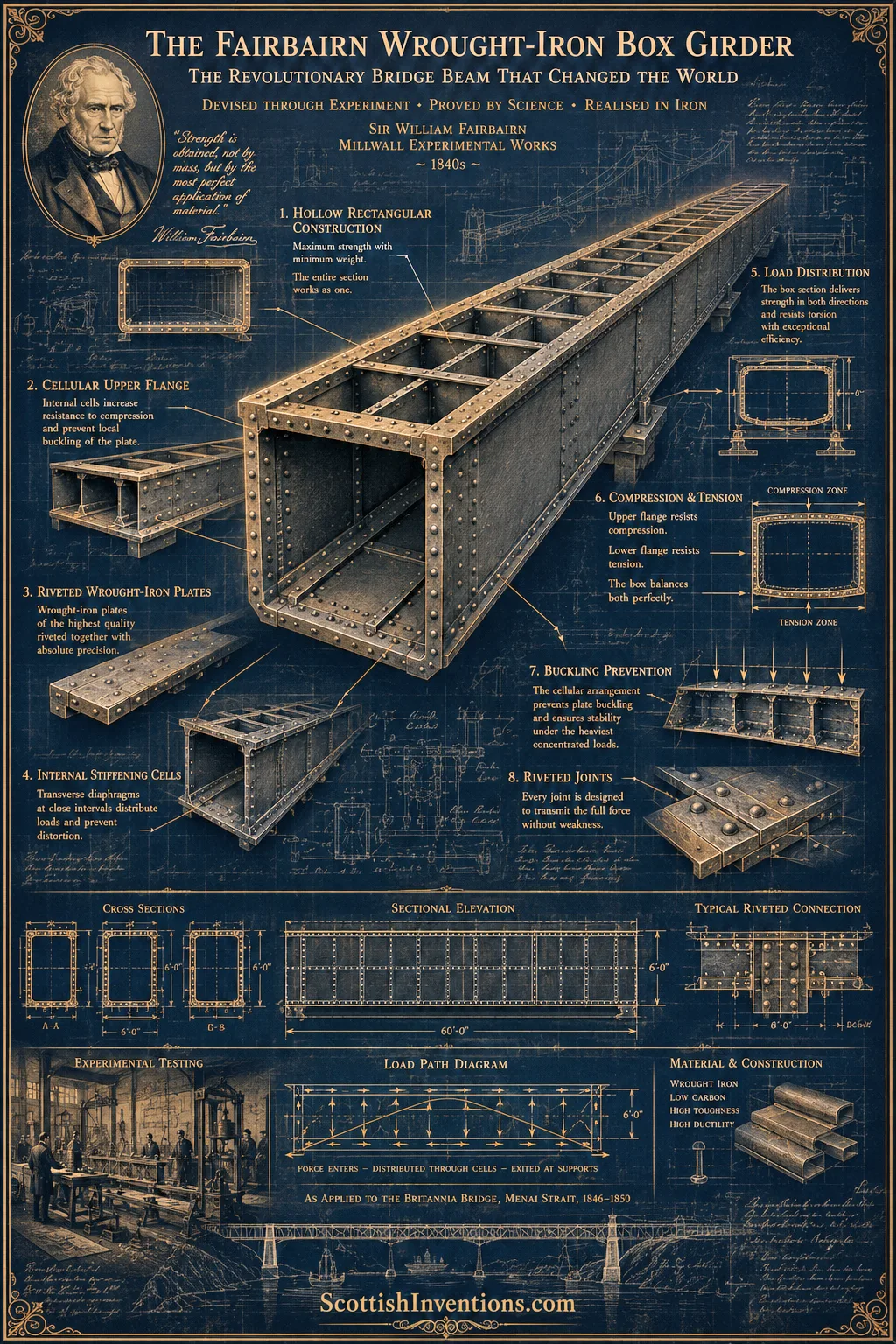
- A rectangular hollow tube was superior. Stephenson had pressed for a circular or elliptical section; Fairbairn's tests showed the rectangular box was both stronger for its weight and far easier to build. The rectangular section was adopted.
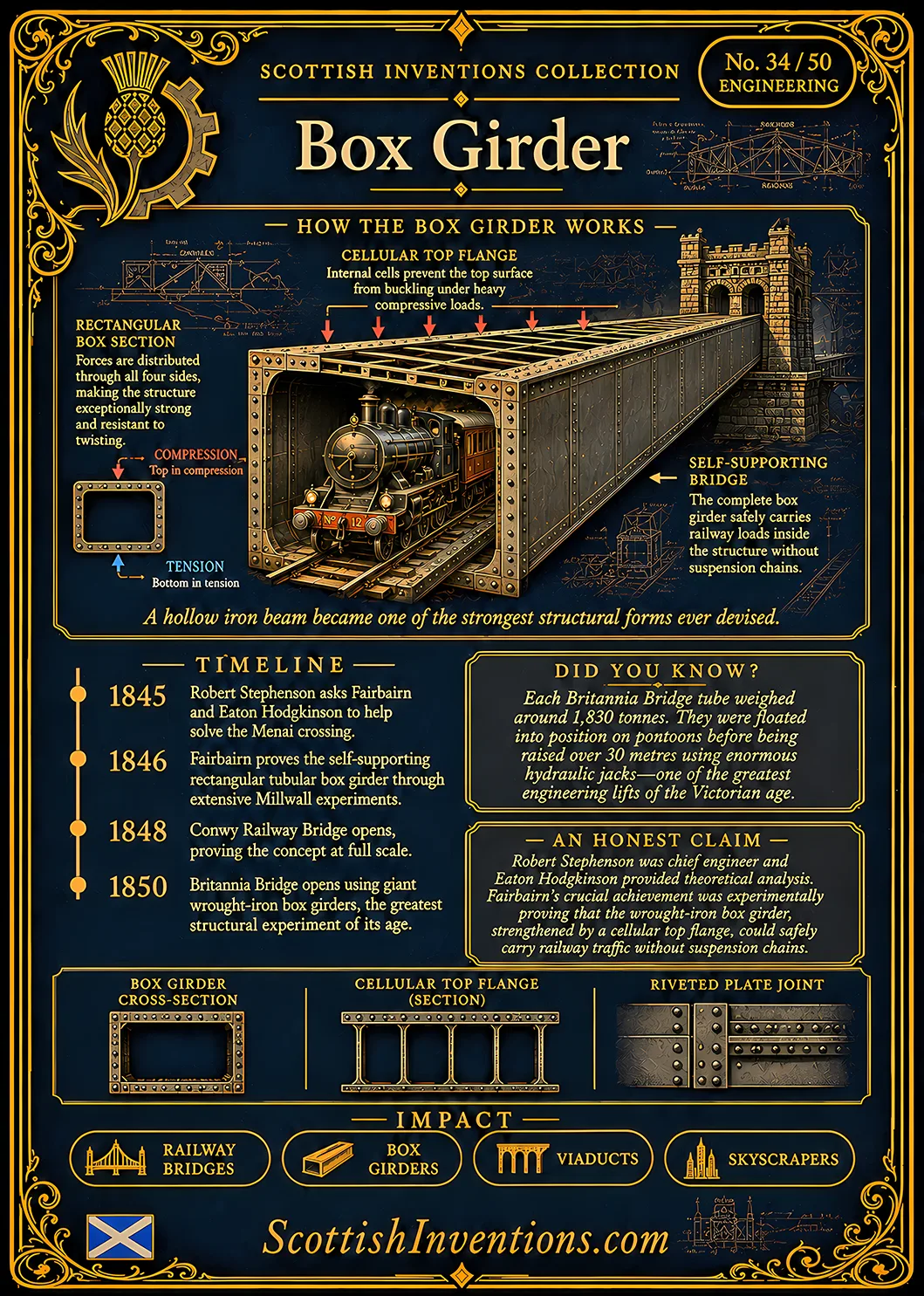
- The real enemy was buckling — and cellular flanges defeated it. Fairbairn found that a thin iron top plate under compression did not simply crush; it buckled and wrinkled, failing well below its theoretical strength. His solution was to build the top (and bottom) of the tube not as a single plate but as a cellular structure — a honeycomb of smaller rectangular cells — which dramatically increased resistance to buckling. Through this refinement the design of the cellular girder was pushed until the model could carry 2.4 times its original capacity.
Crucially, Fairbairn concluded the suspension chains were unnecessary. In a memorable phrase he told Stephenson that, if the plates were properly proportioned and riveted, "you may strip off the chains and have it as a useful Monument of the enterprise and energy of the age in which it was constructed." Hodgkinson, more cautious, still advised auxiliary chains; the weight of received opinion was with him. But Stephenson, after finally attending one of Fairbairn's model tests, was persuaded, and the chains were abandoned. (The masonry towers were built tall enough to carry chains that were never fitted — which is why, above deck level, they serve no structural purpose to this day.)
The division of labour was real and it matters. Stephenson conceived the tubular concept, held the post of engineer-in-chief, and made the final decisions and took ultimate responsibility. Fairbairn ran the decisive physical experiments and settled the rectangular, cellular form. Hodgkinson supplied the mathematical theory of the results. Historians today treat it as the work of a team. Richard Byrom, Fairbairn's most recent biographer, argues in his 2015 University of Huddersfield study that Fairbairn was "more an 'innovator' and optimiser than an inventor" — a fair verdict that credits his genius for experiment without erasing Stephenson's originating idea or Hodgkinson's mathematics.
The Fairbairn Box Girder
Three Principles Proved at Millwall
01
Rectangular Hollow Section
Stronger for its weight than the circular or elliptical tube, and far easier to build in wrought iron.
02
Cellular Top Flange
A honeycomb of smaller cells that resists local buckling of the compression face.
03
Self-Supporting Beam
Strong enough to carry trains without any suspension chains — proved by scale-model destruction tests.
4. The Conway Tubular Bridge (1848)
The smaller crossing at Conwy came first, deliberately, as a full-scale rehearsal for the Britannia. It consisted of a single span of 400 feet formed by two parallel rectangular wrought-iron tubes, each weighing 1,300 tons, with masonry towers dressed with battlements and turrets to harmonise with the adjacent medieval Conwy Castle. The construction method was itself a marvel: each tube was riveted together on the shore, floated out into position on pontoons, and then jacked up to its final height by hydraulic press. The first tube was floated on 6 March 1848; Stephenson himself rode the first locomotive across on 18 April 1848, and the first tube opened to traffic on 1 May 1848. The bridge was officially opened in 1849 after Stephenson insisted on exhaustive testing.
The Conway bridge still stands and still carries the North Wales coast railway line. Since the destruction of the original Britannia tubes, it is the only surviving tubular bridge of Stephenson's in the world — a Grade I listed structure, strengthened in 1899 with additional supporting columns but otherwise remarkably unchanged.
5. The Britannia Bridge (1850) — The Masterpiece
The Britannia Bridge across the Menai Strait was six times larger than any girder bridge previously built — described as the greatest single increment in span in the entire history of bridge-building. It comprised four spans: two central main spans of 460 feet and two side spans of 230 feet, all carried on masonry towers, the central Britannia Tower rising to 221 feet and founded on the Britannia Rock that gave the bridge its name. The tubes were joined over the towers to form a continuous wrought-iron girder 1,511 feet long — at the time, the longest wrought-iron span in the world.
Two parallel rectangular tubes carried the two railway tracks, the trains running inside the box girders. Each of the four great tubes weighed 1,500 long tons and was fabricated from wrought-iron plate hand-riveted together with some 800,000 rivets per tube. As at Conwy, the tubes were assembled on the Caernarfon shore, floated into position on pontoons, and raised into the towers by hydraulic press — a nerve-shredding operation. Masonry was built up beneath each tube as it rose, so that when one hydraulic press failed during a lift the tube dropped only a few inches instead of plunging into the strait; the base of that fractured jack survives near the bridge to this day.
The foundation stone was laid on 10 April 1846; the first rivet was driven on 10 August 1847; and Stephenson fitted the last rivet on 5 March 1850. A single line opened to rail traffic on 18 March 1850, with both tubes in use by 21 October that year. Guarding the portals stand four monumental limestone lions, sculpted in a bold Egyptian style by John Thomas, each about 25 feet long, 12 feet tall and weighing around 30 tons — later immortalised in a gloriously artless piece of Welsh doggerel by the local bard John Evans ("Pedwar llew tew / Heb ddim blew" — "Four fat lions / Without any hair").
460 ft
Main span (previously 31 ft 6 in)
1,511 ft
Continuous wrought-iron girder
1,500 t
Weight of each tube
800k
Rivets per tube
6. The Priority Dispute — Fairbairn vs Stephenson
The collaboration ended in bitterness. As engineer-in-chief, Stephenson enjoyed the lion's share of public acclaim, and Fairbairn came to feel that his own central role — and that of his associates — was being written out of the story. He resigned from the project in May 1848. Then, in 1849, before the Britannia Bridge was even finished, he published his own account: An Account of the Construction of the Britannia and Conway Tubular Bridges (London: John Weale, 1849), a volume largely built from the correspondence that had passed between him and Stephenson, showing how the rectangular-tube ideas had emerged from his own tests and calculations. It was an extraordinarily proactive piece of self-assertion — a man publishing his claim to credit before the monument was complete.
Stephenson's camp responded in kind: the official, lavishly illustrated account was written by Stephenson's resident engineer Edwin Clark (The Britannia and Conway Tubular Bridges, 1850, published under Stephenson's supervision), in which Fairbairn was scarcely mentioned. Hodgkinson, for his part, had also fallen out with Fairbairn — essentially over Fairbairn's willingness to extrapolate boldly from experiment where Hodgkinson wanted a justifying mathematical theory first.
Modern historians apportion the credit with care. Stephenson conceived the tubular idea and carried ultimate responsibility; Fairbairn proved and optimised the crucial rectangular, cellular form by experiment; Hodgkinson provided the theory. One further irony deserves note: a late redesign, interconnecting the four Britannia girders into a single continuous beam to control excessive bending stresses, was made after Fairbairn's departure — historian John Rapley suggests this elegant solution came from Edwin Clark, probably assisted by Charles Heard Wild. It is a reminder that even the "subordinate" engineers deserve their share. Whatever the personal wounds, Fairbairn's standing did not suffer: he was elected a Fellow of the Royal Society in 1850, and in 1854 he succeeded George and Robert Stephenson as the third President of the Institution of Mechanical Engineers.
7. The Britannia Bridge Fire of 1970
For 120 years the Britannia Bridge carried the railway faithfully, reputed to be one of the most easily maintained bridges in Britain. Then, on the evening of 23 May 1970, disaster struck. Two boys had gone up into the tubes — by the enduring account, searching for bats — and lit a paper torch to see in the dark. They dropped it, and it set alight the tar-coated timber roof that had been built over the tubes to protect the iron from the weather. The fire raced the whole length of the structure. The bridge's height and the lack of an adequate water supply defeated the fire brigades, and although the bridge was still standing when the flames died, the intense heat had critically weakened the wrought iron; the tubes split open over the towers and the great spans began to sag.
The damage was beyond repair. Engineers reused Stephenson's surviving masonry towers but replaced the tubes entirely with steel arches. The bridge reopened to a single rail line on 30 January 1972, and in 1980 — after a decade's work — a second, upper deck opened to carry the A55 road. The result is the two-tier road-and-rail bridge that stands today, and a genuine historical irony: the world's first great box-girder bridge no longer contains any of its original box girders. (A short section of the original tube, and the four lions, survive beside the crossing.)
8. Fairbairn's Other Contributions
Fairbairn was one of the most prolific engineers of the age, and the tubular bridges were only part of his legacy:
- The Lancashire boiler (1844). With John Hetherington, Fairbairn developed the twin-flue Lancashire boiler, patented in 1844 (the patent was strictly for the method of firing the two furnaces alternately to reduce smoke). Rugged and reliable, it became a workhorse of the cotton mills and remained in use for well over a century.
- Iron shipbuilding. At Millwall he ran the earliest large iron-shipbuilding yard in England, pioneering the use of wrought iron for hulls and challenging the conservative standards of Lloyd's.
- Metal fatigue — his deepest scientific contribution. In 1861, at the request of Parliament and with Board of Trade support, Fairbairn conducted some of the first systematic experiments on what we now call metal fatigue. In one famous test he raised and lowered a three-tonne load onto a wrought-iron cylinder three million times before it fractured — proving that a static load of twelve tonnes would have been needed to break the same specimen in a single application. In other words, metal repeatedly stressed fails far below its single-load breaking strength, through cracks that grow from tiny defects. He published the results in a paper titled "Experiments to Determine the Effect of Impact, Vibratory Action, and Long-Continued Changes of Load on Wrought-Iron Girders" in the Philosophical Transactions of the Royal Society of London in 1864. This insight is foundational to the safe design of everything that flexes repeatedly — bridges, railway axles, and, above all, aircraft. (The German engineer August Wöhler is generally credited with the first fully systematic characterisation of fatigue in the same era; Fairbairn should be credited as a pioneer rather than the sole originator.)
- Author and statesman of engineering. His books became standard texts, including Iron: Its History, Properties and Processes of Manufacture (1861) and the two-part Treatise on Mills and Millwork (1861–63). He served as President of the British Association for the Advancement of Science in 1861, declined a knighthood the same year, and was created a baronet — Sir William Fairbairn, 1st Baronet of Ardwick — in 1869. When he died in 1874, the crowd at his funeral was estimated in the tens of thousands.
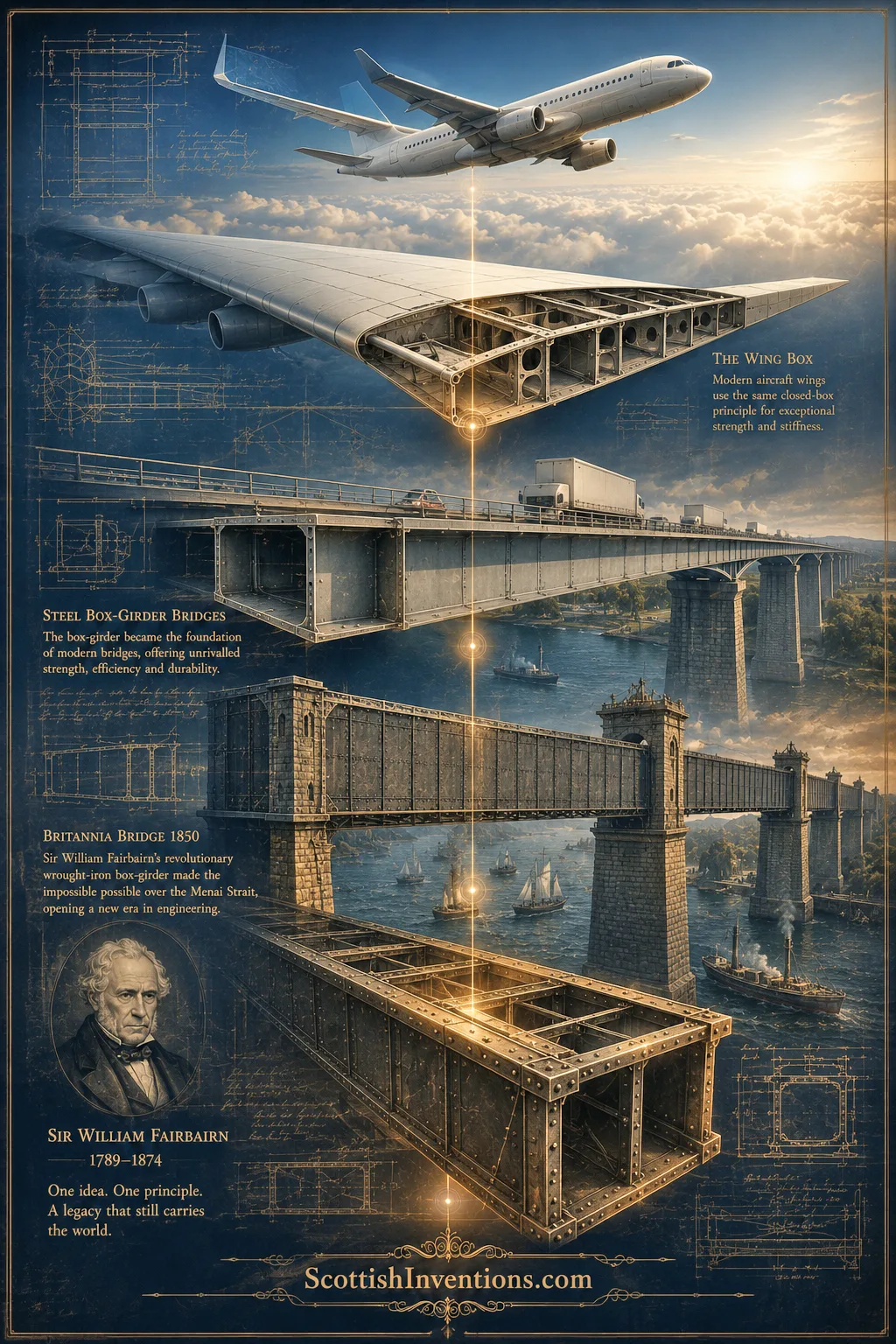
9. The Modern Legacy of the Box Girder
The specific tubular bridge — trains running inside the girder — proved a technological dead-end, because the sheer mass and cost of wrought iron made it uneconomic; lattice and truss girders soon overtook it. But the underlying principle Fairbairn proved by experiment became one of the most universal ideas in engineering.
A closed, hollow rectangular section resists both bending and twisting (torsion) far more efficiently, for its weight, than an open section — and cellular or stiffened walls resist the buckling that would otherwise cause a thin panel to fail early. That is the box girder, and it is everywhere. Look under almost any modern motorway overpass or flyover and you will find a hollow box section carrying the deck; London's Hammersmith Flyover (1961), one of Britain's earliest major segmental box-girder road structures, is a classic example, built as a hollow prestressed-concrete box.
The same principle leapt into the air. The structural heart of a modern aircraft wing is the "torsion box" or wing box — front and rear spars closed off by the upper and lower skins to form a hollow closed section that resists exactly the bending and twisting loads Fairbairn first studied in iron. From the Menai Strait to the wing of an airliner, the lineage of the closed box under load runs straight back to a Millwall shipyard in the 1840s.
Did You Know?
- Fairbairn was born in Kelso in the Scottish Borders but built his career in Manchester and at Millwall on the Thames — Scotland gave the engineer; England provided the workshop.
- The Britannia Bridge was destroyed by a fire accidentally started by boys looking for bats in 1970 — meaning the world's first great box-girder bridge no longer has its original girders.
- Before Fairbairn's work, the longest wrought-iron bridge span was 31 feet 6 inches; his Britannia Bridge had main spans of 460 feet — an almost fifteen-fold leap in a single generation.
- His metal-fatigue experiments — loading a wrought-iron specimen three million times — were among the first systematic studies of why metals fail under repeated loading, knowledge critical to aircraft and bridge safety today.
- The box-girder principle appears in the wings of almost every large aircraft (the "wing box") and in road bridges across the world.
- Fairbairn published his book claiming credit for the tubular bridge in 1849, before the Britannia Bridge was even finished — making him one of engineering history's most proactive self-publicists.
Timeline
19 February 1789
Born in Kelso
William Fairbairn born in Kelso, Roxburghshire, son of the farm steward Andrew Fairbairn and Margaret Henderson.
1803
Rennie's Kelso bridge
As a teenager, Fairbairn briefly labours on a bridge being built at Kelso by John Rennie — and is injured within days.
c.1804
Apprenticed as a millwright
Apprenticed at Percy Main Colliery near North Shields, where he befriends a young engine-man named George Stephenson.
1813
Settles in Manchester
Works for the millwrights Adam Parkinson and Thomas Hewes.
1817
Founds Fairbairn and Lillie
Aged 28, sets up his own mill-machinery firm with James Lillie.
1820s
Great water wheels for Catrine and Deanston
Supplies the 50-foot Catrine water wheels in Ayrshire — among the largest in Britain.
1834–35
Millwall shipyard
Establishes at Millwall on the Thames the earliest large iron-shipbuilding yard in England, building over eighty vessels.
1844
Lancashire boiler
With John Hetherington, patents the twin-flue Lancashire boiler — a workhorse of the cotton mills for over a century.
1845
Engaged for the Menai crossing
Robert Stephenson engages Fairbairn to test whether trains can safely run inside a great hollow iron tube.
1845–47
Millwall experiments
Fairbairn builds and destroys scale-model wrought-iron tubes, proving the rectangular section and inventing the cellular top flange to defeat buckling.
May 1848
Resigns from the project
Fairbairn resigns from the Britannia works, feeling his contribution is being written out of the story.
1848
Conway Tubular Bridge opens
The rehearsal — a single 400-foot span carrying the North Wales coast railway across the River Conwy.
1849
Publishes his account
Fairbairn publishes An Account of the Construction of the Britannia and Conway Tubular Bridges — before the Britannia is even finished.
18 March 1850
Britannia Bridge opens
The masterpiece: four spans, 1,511 feet of continuous wrought-iron girder across the Menai Strait.
1850
Fellow of the Royal Society
Elected FRS in recognition of his engineering and experimental work.
1854
President of the IMechE
Succeeds George and Robert Stephenson as third President of the Institution of Mechanical Engineers.
1861
Metal fatigue experiments
Government-funded experiments load a wrought-iron specimen three million times, proving that metals fail far below their single-load breaking strength. Also declines a knighthood and serves as President of the British Association.
1864
Fatigue paper published
Publishes 'Experiments to Determine the Effect of Impact, Vibratory Action, and Long-Continued Changes of Load on Wrought-Iron Girders' in the Philosophical Transactions of the Royal Society.
1869
Baronet of Ardwick
Created Sir William Fairbairn, 1st Baronet of Ardwick.
18 August 1874
Dies at Moor Park, Surrey
The funeral crowd is estimated in the tens of thousands.
23 May 1970
Britannia Bridge fire
The original wrought-iron tubes are destroyed by fire. The masonry towers are retained; the tubes are replaced with steel arches.
Key Takeaways
Fairbairn's Three Enduring Contributions
- The self-supporting rectangular box girder — a hollow wrought-iron beam proved at Millwall and realised on the Menai Strait, still the foundation of modern bridge design.
- The cellular top flange — a honeycomb of smaller cells that defeats buckling and lets the full section develop its strength. The same idea sits inside every wing box in the sky.
- Experimental engineering — Fairbairn's insistence on destroying scale models to test structural theory shaped the modern practice of experimental validation in structural and materials engineering.
"You may strip off the chains and have it as a useful Monument of the enterprise and energy of the age in which it was constructed." — William Fairbairn to Robert Stephenson, on the tubular bridge
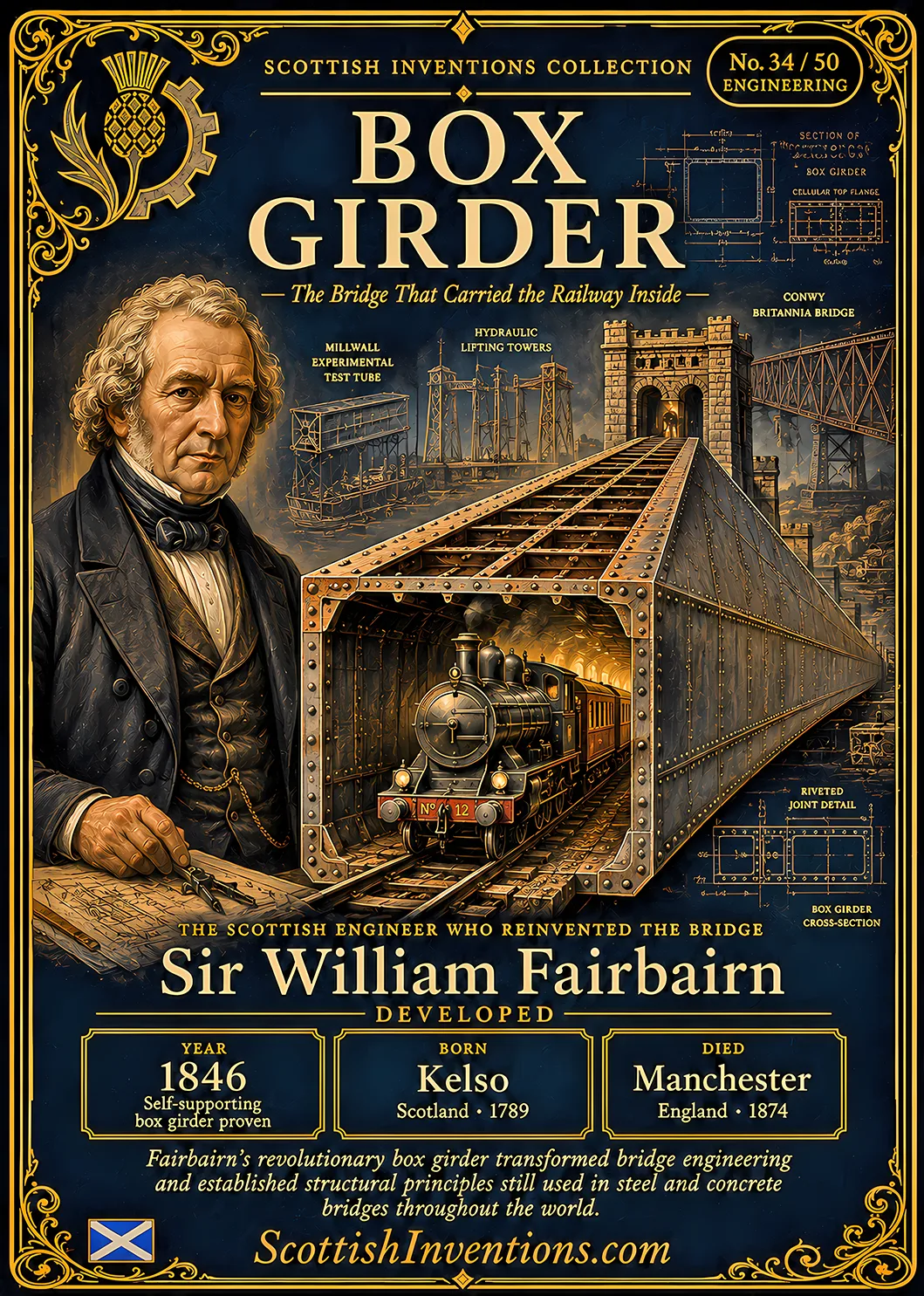
The Box Girder trading card
Card No. 34 of 50 in the Scottish Inventions Collection.
Frequently Asked Questions
- Who invented the box girder?
- The wrought-iron box girder as a great structural form was proved in the mid-1840s by a three-way collaboration: Robert Stephenson conceived the tubular idea and served as engineer-in-chief; Scottish engineer Sir William Fairbairn ran the decisive scale-model experiments at his Millwall shipyard and settled the rectangular, cellular form; and the mathematician Eaton Hodgkinson supplied the theoretical analysis. Fairbairn's practical work is what turned the concept into a workable box girder.
- Who built the Britannia Bridge?
- Robert Stephenson was engineer-in-chief of the Britannia Bridge across the Menai Strait, opened in 1850. William Fairbairn led the experimental programme that proved the wrought-iron box-girder tubes, and Eaton Hodgkinson provided the mathematical theory. The tubes were fabricated by hand from riveted wrought-iron plate — some 800,000 rivets per tube — assembled on shore, floated into position on pontoons, and lifted into the masonry towers by hydraulic press.
- What did Sir William Fairbairn invent?
- Fairbairn is best remembered for proving, by experiment at Millwall, the self-supporting rectangular wrought-iron box girder with a cellular top flange — the structural form used for the Conway (1848) and Britannia (1850) tubular bridges. He also co-developed the Lancashire boiler (1844), pioneered iron shipbuilding in England, and conducted some of the first systematic experiments on metal fatigue (published 1864), a field foundational to modern bridge and aircraft safety.
- What is a tubular bridge?
- A tubular bridge carries its traffic inside a large hollow iron or steel tube that acts as a beam. The Conway Tubular Bridge (1848) and Britannia Bridge (1850) were the great Victorian examples: trains ran inside rectangular wrought-iron box tubes with cellular flanges, spanning gaps far greater than any solid iron beam of the day could reach. The specific 'trains inside the tube' idea proved a technological dead end, but the underlying box-girder principle became universal.
- How does a box girder work?
- A box girder is a hollow closed section — typically rectangular — that resists both bending and twisting (torsion) far more efficiently, for its weight, than an open beam. In Fairbairn's Millwall tests, the top plate under compression tended to buckle and wrinkle long before it crushed. His solution was a cellular top flange — a honeycomb of smaller cells — that resisted local buckling and allowed the whole tube to develop its full strength. The same principle underpins modern steel and concrete box-girder bridges.
- Why was the Britannia Bridge revolutionary?
- The Admiralty forbade any arch or suspension cables blocking navigation of the Menai Strait, demanding at least 100 feet of clearance. Stephenson needed a clear main span of 460 feet — roughly fifteen times the previous wrought-iron span record of just 31 ft 6 in. Fairbairn's rectangular cellular box girder, proved by scale-model testing, made the impossible possible: a self-supporting wrought-iron tube nearly a third of a mile long, carrying trains without any suspension chains.
- Why did the original Britannia Bridge burn down?
- On the evening of 23 May 1970 the original tubes were destroyed by fire. By the enduring account, two boys had gone up into the tubes searching for bats and dropped a lit paper torch, which set alight the tar-coated timber roof built over the tubes to protect the iron from the weather. The fire raced the length of the bridge; the intense heat critically weakened the wrought iron, the tubes split and the spans sagged beyond repair. The masonry towers were retained and the tubes replaced with steel arches.
- Where is Sir William Fairbairn from?
- William Fairbairn was born on 19 February 1789 in Kelso, Roxburghshire, in the Scottish Borders, the son of Andrew Fairbairn, a farm steward, and Margaret Henderson. He built his entire career in England — apprenticed as a millwright near North Shields, settled in Manchester from 1813, and established a pioneering iron shipbuilding yard at Millwall on the Thames in 1834–35. In the collection's phrase: Scotland gave the engineer; England provided the workshop.
- How does the box girder relate to aircraft wings?
- The structural heart of a modern aircraft wing is a 'torsion box' or wing box — front and rear spars closed off by the upper and lower skins to form a hollow closed section that resists exactly the bending and twisting loads Fairbairn first studied in iron. The lineage of the closed box under load runs straight from the Menai Strait to the wings of every large airliner flying today.
- What is Sir William Fairbairn remembered for?
- Fairbairn is remembered as one of the great Victorian engineers: the experimental proof of the box girder for the Britannia and Conway tubular bridges; the Lancashire boiler; pioneering iron shipbuilding; foundational experiments on metal fatigue; standard reference works such as Iron: Its History, Properties and Processes of Manufacture (1861); Fellow of the Royal Society (1850); third President of the Institution of Mechanical Engineers (from 1854); President of the British Association for the Advancement of Science (1861); and Baronet of Ardwick (1869).
Continue Exploring Scottish Engineering
Discover the Scottish Inventions Collection
Discover the remarkable inventions, discoveries and engineering achievements that helped shape the modern world in the Scottish Inventions Collection, where every innovation tells another chapter in Scotland's extraordinary contribution to global progress.
Explore More Scottish InventionsSources & Further Reading
- William Fairbairn, An Account of the Construction of the Britannia and Conway Tubular Bridges (London: John Weale, 1849).
- Edwin Clark, The Britannia and Conway Tubular Bridges (London, 1850), published under Robert Stephenson's supervision.
- William Fairbairn, "Experiments to Determine the Effect of Impact, Vibratory Action, and Long-Continued Changes of Load on Wrought-Iron Girders," Philosophical Transactions of the Royal Society of London, 1864.
- Richard Byrom, Sir William Fairbairn: The Experimental Engineer (University of Huddersfield doctoral study, 2015; published 2017).
- John Rapley, The Britannia and other Tubular Bridges: and the Men Who Built Them (2003).
- John Barr, "The Conway and Britannia tubular bridges: Stephenson's team," Institution of Civil Engineers, 2010.
- Colin Ryall, British Wrought Iron and Steel Bridges Since 1800 (1999).
- Oxford Dictionary of National Biography — entry for Sir William Fairbairn.
- Science Museum Group and National Railway Museum object records.