Scottish Inventions · Science & Astronomy
Scotland and the Reflecting Telescope: From a Page of Mathematics to the Edge of the Universe
How a 24-year-old Scot named James Gregory conceived, in 1663, the optical principle behind Hubble, the James Webb Space Telescope and nearly every great observatory on Earth.
On this page
- TL;DR
- Key Facts
- The Problem with Early Telescopes
- James Gregory — the Breakthrough
- Newton Built First — Why Gregory Still Gets Credit
- James Short — the Craftsman
- James Nasmyth and the Nasmyth Focus
- The James Gregory Telescope at St Andrews
- Legacy — from Gregory to Hubble and Webb
- Timeline
- Did You Know?
- Related Scottish Inventions
- FAQ
- Sources
TL;DR
- The reflecting telescope — the design behind virtually every great observatory on Earth and in space — was first set down on paper by a Scot, James Gregory of Aberdeenshire, in his 1663 treatise Optica Promota.
- Gregory never built one. Isaac Newton beat him to the first working reflector in 1668, and the first working Gregorian was constructed by Robert Hooke around 1673.
- Three Scots shaped the instrument across three centuries: Gregory conceived it (1663), Edinburgh's James Short turned it into the finest telescopes in the world, and James Nasmyth added the elegant Nasmyth focus in 1845 — still used today.
- The living legacy stands at St Andrews: the James Gregory Telescope, the largest working optical telescope in the UK.
Key Facts
Optica Promota 1663
Gregory published the reflecting telescope design in London at the age of 24.
Mirrors, not lenses
Eliminated chromatic aberration — the defining flaw of refractors.
Newton built first
Newton's reflector worked in late 1668; Hooke built the first Gregorian c. 1673.
James Short ~1,360
Edinburgh's Short perfected the parabolic mirror and made the design a commercial reality.
Nasmyth focus 1845
Still standard on the Keck, VLT, Subaru and the Extremely Large Telescope.
JGT at St Andrews
Largest working optical telescope in the UK, named for Gregory.
The Problem with Early Telescopes
The telescope was born in the Netherlands. In autumn 1608 a Middelburg spectacle-maker, Hans Lippershey, filed the first known patent for a device "for seeing things far away as if they were nearby." Within months Galileo built his own and turned it on the heavens — discovering lunar mountains, sunspots, the phases of Venus and the four large moons of Jupiter.
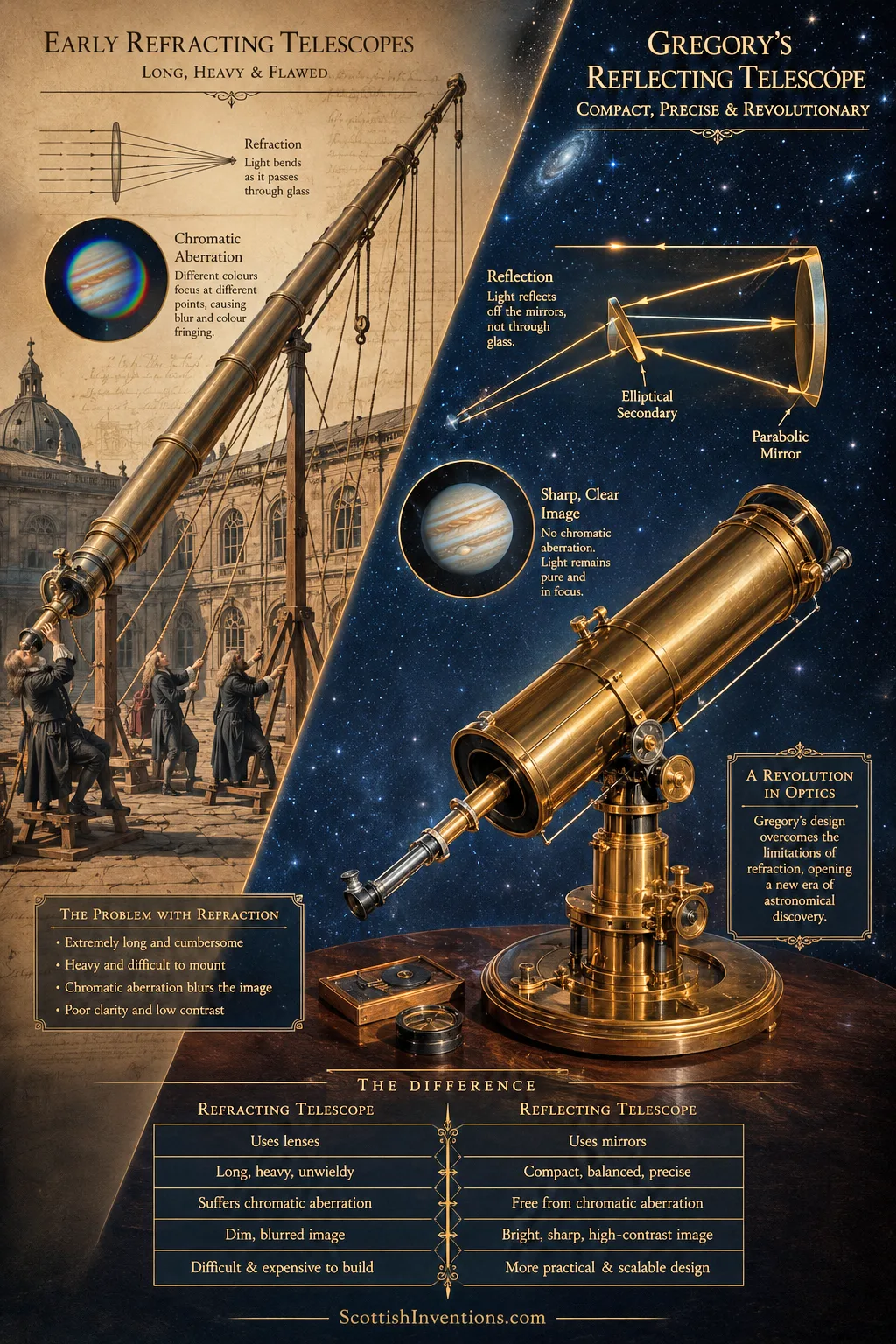
But these early refractors — telescopes that use lenses to bend light — suffered from a maddening flaw: chromatic aberration. A glass lens bends different colours of light by slightly different amounts, so every star and planet was fringed with false colour. The workaround was absurd: make the tube longer. Johannes Hevelius built a refractor with a focal length of 150 feet, slung from a mast and worked by ropes — a nightmare to point.
A mirror reflects all colours of light by exactly the same amount. Replace the lens with a curved mirror and the colour problem simply vanishes. This was the prize that James Gregory and Isaac Newton were chasing in the 1660s.
James Gregory — the Theoretical Breakthrough
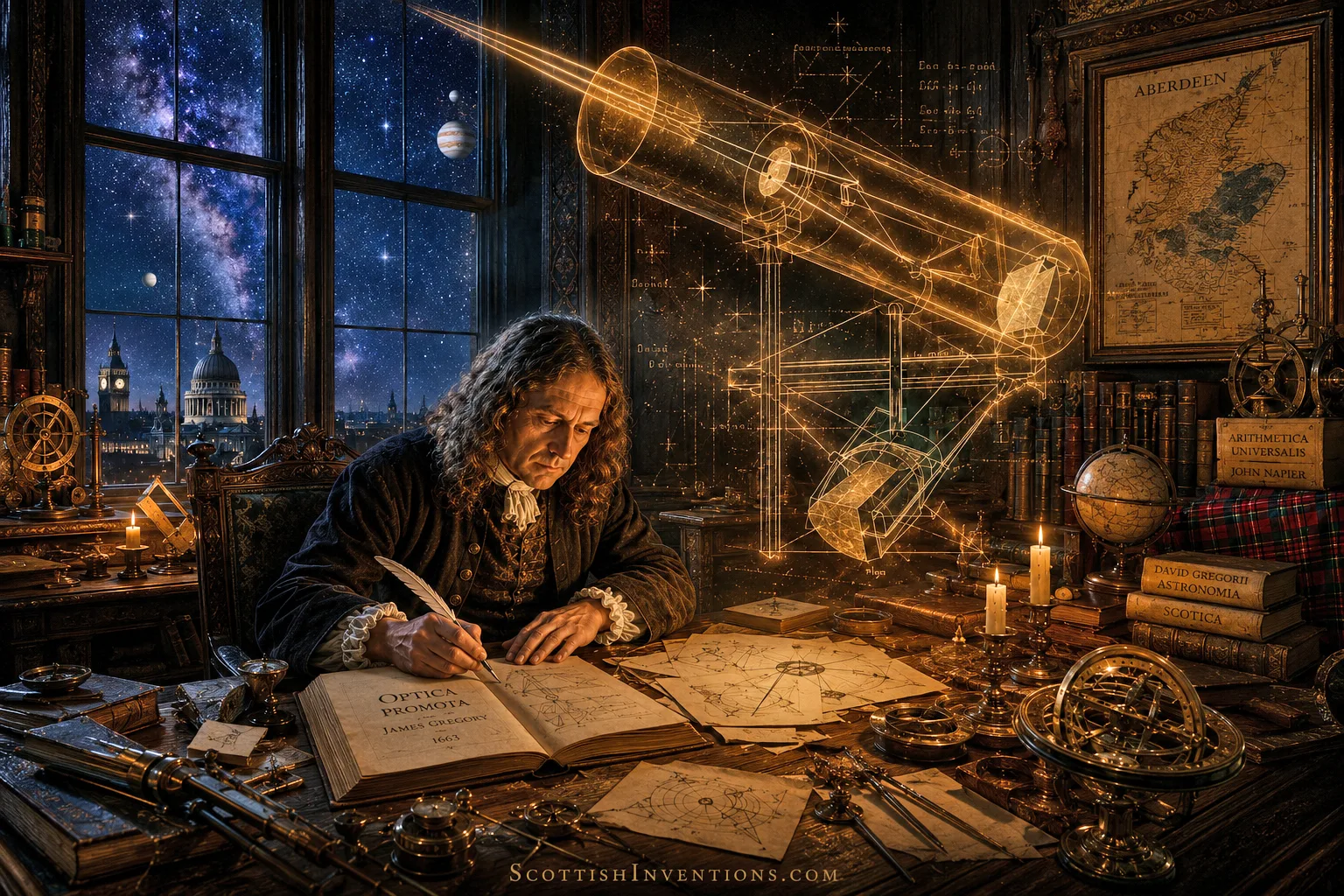
James Gregory was born in November 1638 in the manse of Drumoak, a small parish on the River Dee about fifteen kilometres west of Aberdeen. His father, the Rev. John Gregory, was an Episcopalian minister; his mother, Janet Anderson, first taught him geometry. The mathematical gift ran on her side of the family — her uncle Alexander Anderson had been a pupil and editor of François Viète. Gregory attended Aberdeen Grammar School and Marischal College, Aberdeen, graduating in 1657.
In 1663, aged just 24, Gregory travelled to London and published Optica Promota ("The Advance of Optics"). In it he described the reflecting telescope that now bears his name. The Gregorian telescope works like this:
- A large concave parabolic primary mirror gathers starlight and reflects it forward to a focus.
- Just beyond the focus a small concave elliptical secondary mirror catches the light and reflects it back down the tube.
- The light passes through a small hole in the primary to an eyepiece at the back.
- The observer sees an erect (right-way-up) image, unlike the inverted image of Newton's design — especially valuable for solar observation.
Gregory understood why this was superior: a parabolic mirror corrects spherical aberration as well as eliminating chromatic aberration entirely. But there was a fatal practical snag. The primary had to be a true parabola — and parabolic mirrors are far harder to grind than spheres. Gregory, by his own admission, had no practical skill, and could find no optician in Britain capable of the work. So the most advanced telescope design of its age stayed exactly where it began: on the page.
He became the first Regius Professor of Mathematics at St Andrews in 1668 and moved to the first Chair of Mathematics at Edinburgh in 1674. His death was as poignant as it was sudden: in October 1675, about a year into the Edinburgh post and aged just 36, Gregory was showing the moons of Jupiter to his students through a telescope when he was struck blind by a stroke. He died a few days later.
Newton Built First — Why Gregory Still Gets the Credit
Honesty matters here, because the popular story often gets it wrong. Isaac Newton built the first working reflecting telescope in late 1668, five years after Gregory's design was published but well before any Gregorian was actually made. Newton's design — the Newtonian reflector — is optically simpler: a concave primary throws the light onto a small flat secondary mirror set at 45°, which deflects it out through the side of the tube to an eyepiece. Newton's first instrument was tiny — about 6 inches long, with a roughly 1-inch mirror — but it worked; he could see Jupiter's moons and the phases of Venus with it.
Newton's telescope was shown to the Royal Society, and on 11 January 1672 he was elected a Fellow. So why does Gregory retain pride of place in the concept of the reflector? Because he published the optical theory first, in 1663; because the Gregorian design is in some respects optically superior (its erect image and its later value for solar work); and because the first large, high-quality reflecting telescopes manufactured and sold in quantity were Gregorians — thanks to a second Scot.
As for the first working Gregorian: that was built around 1673 by the English experimentalist Robert Hooke, with Gregory's encouragement — a full decade after the design appeared, and emphatically not by Gregory himself. (A French priest, Laurent Cassegrain, published a third reflector design in 1672, sparking a three-way priority debate at the Royal Society between Newton, Gregory and Cassegrain.)
James Short — the Craftsman Who Made It Real
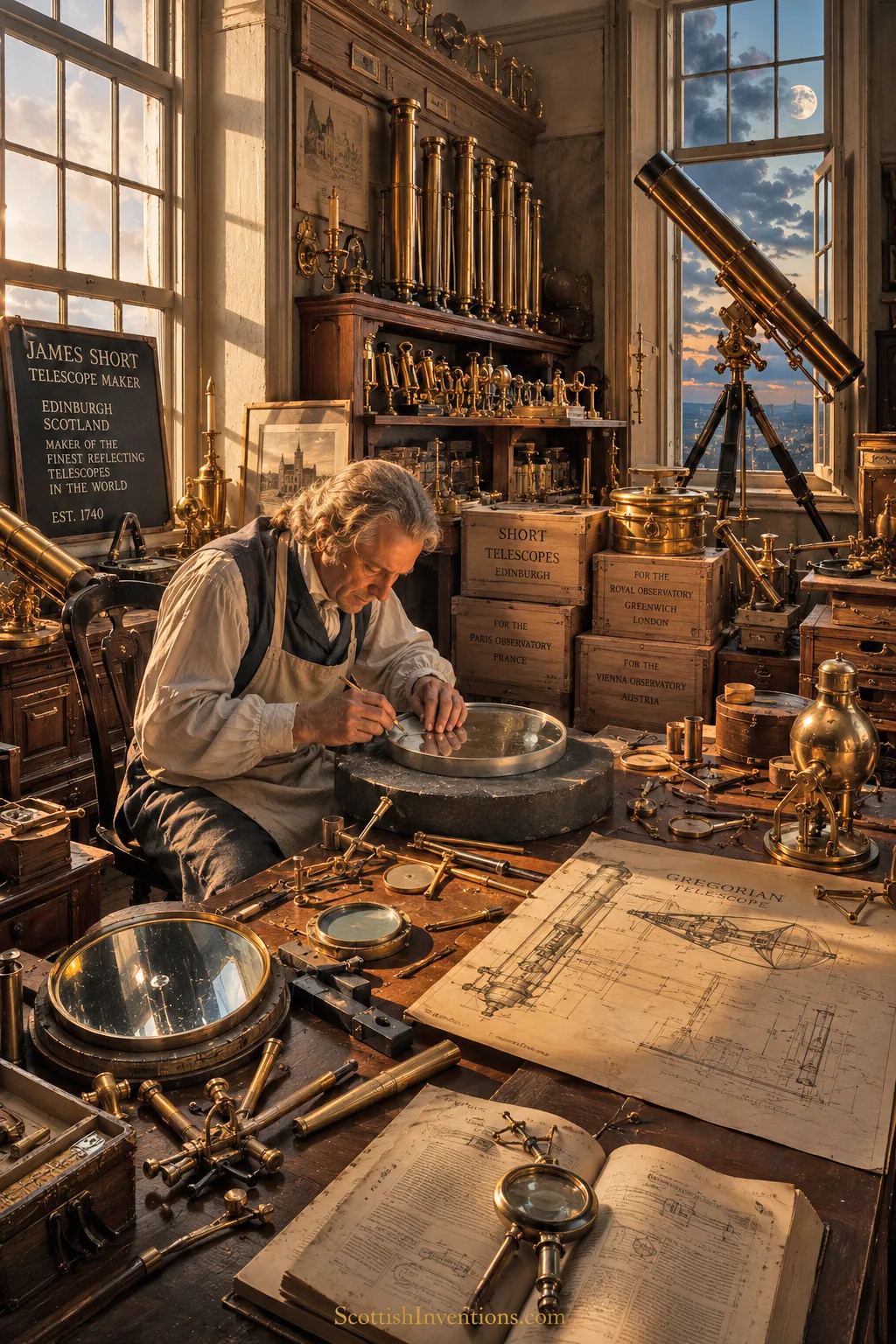
If Gregory gave the world the idea, it was James Short who gave it sharp, reliable images. Short was born in Edinburgh on 10 June 1710, the son of a joiner. Orphaned young, he was educated at George Heriot's Hospital and the Royal High School, and entered the University of Edinburgh in 1726 intending to enter the ministry. There he fell under the influence of Colin Maclaurin, professor of mathematics and a devoted follower of Newton, who recognised Short's talent and lent him rooms in the college for telescope-making experiments around 1732.
Short's decisive technical achievement was this: he was the first to give telescope mirrors a true parabolic figure. His earliest mirrors were of glass, but he soon turned exclusively to speculum metal — a hard, brilliant alloy of roughly two-thirds copper and one-third tin — which he learned to cast, grind, and polish into precise parabolic primaries and elliptic secondaries. His secret recipes and figuring techniques were so closely guarded that he had his tools destroyed before his death.
Short made telescope-making his profession, working first in Edinburgh and, from 1738, permanently in London. His trade card read "Optician, solely for reflecting telescopes." Over a roughly 35-year career he produced about 1,360 instruments; the Dictionary of Scientific Biography records "1,370 reflecting telescopes, of which 110 still exist." He was elected a Fellow of the Royal Society in 1737 and died a wealthy man in London on 14 June 1768, leaving a fortune of around £20,000. His instruments played a starring role in the Transits of Venus of 1761 and 1769, observed worldwide to measure the distance from the Earth to the Sun.
James Nasmyth and the Nasmyth Focus
The third Scot in our chain is already in the Scottish Inventions Collection as Card 9: James Nasmyth (1808–1890), the Edinburgh-born engineer famous for the steam hammer and the Bridgewater Foundry at Patricroft. Nasmyth was the son of the painter Alexander Nasmyth, and he had a lifelong passion for astronomy. He built his first reflecting telescope — a 6-inch speculum reflector — with his own hands in 1827, at the age of 19.
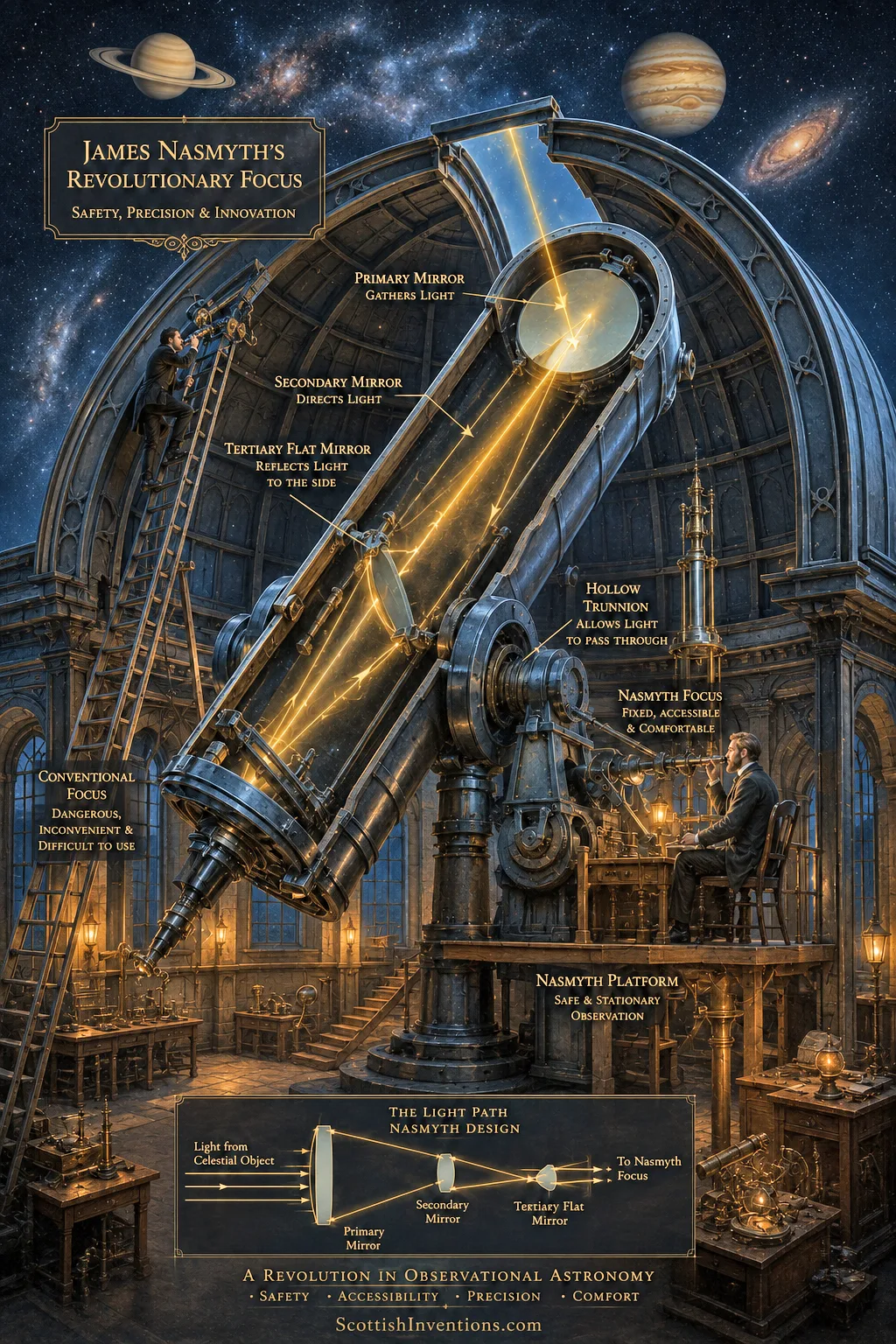
It was on his big telescope that Nasmyth introduced, in 1845, the modification that bears his name: the Nasmyth focus. He added a third, flat mirror inside the tube, set at 45° on the telescope's altitude axis. This tertiary mirror deflects the converging beam 90 degrees, sending it sideways out through a hollow trunnion — "like a cannon," as Nasmyth put it. The eyepiece is mounted on the side of the instrument, and the observer sits on a platform beside the telescope.
Why is this so clever? On a large telescope, the eyepiece at the ordinary focus swings through a huge arc as the tube tilts — forcing the astronomer to clamber up ladders or into a cage high on the tube. With the Nasmyth focus, the eyepiece stays in a fixed, comfortable position no matter where the telescope points. Nasmyth designed it precisely "to avoid the personal risk and inconvenience of having to mount to the eye-piece by a ladder." With James Carpenter of the Royal Observatory, Greenwich, he co-authored The Moon: Considered as a Planet, a World, and a Satellite (1874), one of the true classics of astronomy.
The James Gregory Telescope at St Andrews — the Living Legacy
Fittingly, Scotland's tribute to Gregory stands at the university where he was the first Regius Professor of Mathematics. The James Gregory Telescope (JGT) at the University of St Andrews' University Observatory was inaugurated in 1962 after two decades of planning, almost all of it built in Scotland by the observatory's director Erwin Finlay-Freundlich and a self-taught Dumfries technician, Robert Waland. It is the largest working optical telescope in the UK.
A point of honest detail: the JGT is not itself a Gregorian, nor a plain Cassegrain, but a Schmidt-Cassegrain — a catadioptric design using both mirrors and a thin glass corrector plate to deliver crisp, distortion-free wide-field images. It has a 0.94 m (37-inch) primary and remains a working research instrument — contributing to exoplanet hunts such as SuperWASP and the HOYS young-star survey.
Legacy — from Gregory to Hubble and Webb
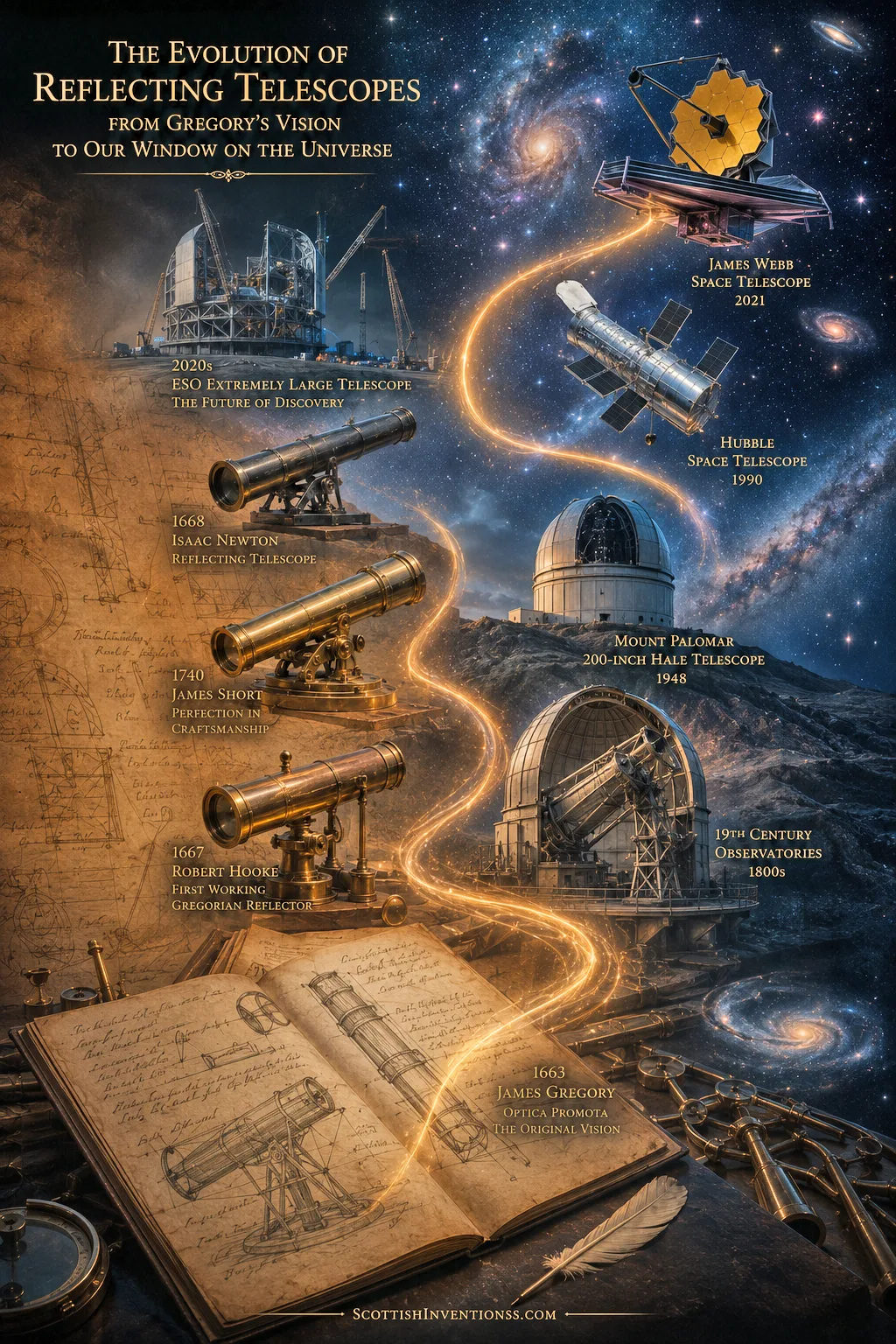
Gregory was right: mirrors, not lenses, were the future. Nearly every great telescope built since is a reflector, and several of the key designs are direct descendants of the family of two-mirror telescopes Gregory helped found.
- The Cassegrain design (1672) is the close cousin of the Gregorian — convex hyperbolic secondary, shorter tube — and is the more common layout in big modern telescopes.
- The Hubble Space Telescope uses a Ritchey-Chrétien design — a refined Cassegrain with two hyperbolic mirrors. So do the Keck telescopes and the Very Large Telescope.
- The James Webb Space Telescope uses a three-mirror anastigmat — again, a many-mirror reflector built on Gregory's founding principle.
- The Nasmyth focus lives on at the cutting edge: the twin 10 m Kecks, the 8.2 m Subaru, ESO's four 8.2 m VLT Unit Telescopes, and the planned Extremely Large Telescope all carry instruments on Nasmyth platforms.
Gregory's mathematics endures too: the Gregory–Leibniz series for π and his early grasp of calculus and infinite series secure his place among the foremost mathematicians of the seventeenth century — a tradition continued in Scotland by figures such as James Clerk Maxwell, who decades later would take the world's first colour photograph, and by C. T. R. Wilson, whose cloud chamber let particle physicists see the unseen.
Timeline
- ●
1663
Optica Promota
James Gregory publishes the reflecting telescope design in London at age 24.
- ●
1667
Vera Circuli
Gregory's work in Padua introduces convergent infinite series; later, the Gregory–Leibniz series for π.
- ●
1668
Newton's reflector
Isaac Newton builds the first working reflecting telescope — a Newtonian with a flat secondary mirror.
- ●
c. 1673
Hooke's Gregorian
Robert Hooke builds the first working Gregorian telescope from Gregory's design.
- ●
1740s
James Short
Edinburgh's James Short perfects parabolic mirror-grinding and produces around 1,360 Gregorians.
- ●
1761 & 1769
Transits of Venus
Short's telescopes are central to the global campaigns measuring the Earth–Sun distance.
- ●
1845
Nasmyth focus
James Nasmyth introduces the tertiary flat mirror sending light through a hollow trunnion to a fixed eyepiece.
- ●
1948
Hale Telescope
Mount Palomar's 200-inch reflector — the largest in the world for decades.
- ●
1962
James Gregory Telescope
St Andrews inaugurates the 0.94 m Schmidt-Cassegrain named for its first Regius Professor of Mathematics.
- ●
1990
Hubble Space Telescope
A Ritchey-Chrétien reflector — a refined Cassegrain — opens deep space to humanity.
- ●
2021
James Webb Space Telescope
A three-mirror anastigmat reflector launches, the direct heir to Gregory's 1663 principle.
- ●
2020s
Extremely Large Telescope
ESO's 39 m mirror under construction in Chile — carrying instruments on Nasmyth platforms.
Did You Know?
- James Gregory designed a telescope he could never build — the craftsmen of his day simply could not grind mirrors to the precision his parabolic primary demanded.
- He died aged just 36, struck down by a stroke while showing the moons of Jupiter to his students.
- James Short ground around 1,360 telescopes — the Dictionary of Scientific Biography puts the figure at 1,370, of which 110 still survive.
- The Nasmyth focus, still used on the world's largest telescopes, was invented by the very same Scot who gave the world the steam hammer.
- Gregory was wrestling with the reflecting telescope before Newton built his — Gregory published first, but Newton built first.
Frequently Asked Questions
- Who invented the reflecting telescope?
- The reflecting telescope was conceived in 1663 by Scottish mathematician James Gregory of Drumoak, Aberdeenshire, who published the design in Optica Promota. Isaac Newton built the first working reflector in 1668, and the first working Gregorian was built by Robert Hooke around 1673. The honest history is: Gregory published first, Newton built first.
- Did James Gregory build a reflecting telescope?
- No. Gregory had no practical skill himself and could find no optician in Britain capable of grinding the precise parabolic mirror his design required. He admitted this openly. His design stayed on the page until Robert Hooke built the first working Gregorian around 1673.
- Why is the Gregorian telescope important?
- It set out the optical principle — mirrors instead of lenses — that defines virtually every great astronomical telescope built since, from 19th-century observatories to the Hubble Space Telescope and the James Webb Space Telescope. It also produces an erect (right-way-up) image, making it especially valuable for solar observation.
- What is the difference between a reflecting and refracting telescope?
- A refracting telescope uses lenses to bend light to a focus, but glass bends different colours by different amounts (chromatic aberration), producing colour fringing and blur. A reflecting telescope uses curved mirrors; because reflection treats all colours identically, the chromatic problem vanishes and the instrument can be made far shorter, lighter and more powerful.
- Who was James Short?
- James Short (1710–1768) was an Edinburgh-born optician who made the Gregorian telescope a practical reality. He was the first to give telescope mirrors a true parabolic figure, produced around 1,360 instruments — the Dictionary of Scientific Biography records 1,370 reflecting telescopes, of which 110 still exist — and supplied observatories worldwide, including those used to observe the Transits of Venus in 1761 and 1769.
- What is the Nasmyth focus?
- Invented by Scottish engineer James Nasmyth in 1845, the Nasmyth focus adds a tertiary flat mirror inside the telescope tube that deflects light sideways through a hollow trunnion to an eyepiece fixed on a platform beside the telescope. The observer stays in one comfortable position no matter where the telescope points. It is still used on the Keck, VLT, Subaru and the Extremely Large Telescope.
- Why is the James Webb Space Telescope a reflecting telescope?
- JWST is a three-mirror anastigmat — a multi-mirror reflector — because only mirrors can be made huge, lightweight, and free from chromatic aberration. Its 6.5-metre segmented primary gathers infrared light and reflects it onto a secondary and tertiary mirror in a direct lineage from Gregory's 1663 principle that mirrors, not lenses, are the future of astronomy.
- What is chromatic aberration?
- Chromatic aberration is the colour fringing produced when a lens bends different wavelengths of light by different amounts, so red and blue focus at slightly different points. It plagued early refracting telescopes. Because mirrors reflect all colours by exactly the same amount, reflecting telescopes are inherently free of it — the reason Gregory pursued the design in 1663.
- Why are modern observatories based on Gregory's original idea?
- Because his core insight — replace lenses with mirrors — solved chromatic aberration permanently and allows much larger apertures. The Cassegrain (1672), Ritchey-Chrétien (Hubble, Keck, VLT) and three-mirror anastigmat (James Webb) designs are all members of the family of multi-mirror reflectors Gregory helped found.
- What is the James Gregory Telescope?
- The James Gregory Telescope (JGT) at the University of St Andrews is a 0.94 m (37-inch) Schmidt-Cassegrain reflector inaugurated in 1962 and named for Gregory, the university's first Regius Professor of Mathematics (1668–1674). It is the largest working optical telescope in the UK and contributes to research including SuperWASP exoplanet searches and the HOYS young-star survey.
Sources
- James Gregory, Optica Promota (London, 1663).
- Dictionary of Scientific Biography — entries on James Gregory and James Short (G. L'E. Turner).
- Royal Society of London, election records and Philosophical Transactions (1672–1771).
- University of St Andrews — University Observatory, James Gregory Telescope (JGT) pages.
- Encyclopædia Britannica — entries on the reflecting telescope, Isaac Newton and Robert Hooke.
- Nasmyth & Carpenter, The Moon: Considered as a Planet, a World, and a Satellite (London, 1874).
Newsletter
Discover Scotland's hidden inventors
One short, beautifully illustrated story a fortnight. No spam, ever.
Sign up free