Scottish Inventions · Engineering · Card No. 24 of 50
Thomas Bell and the Invention of Roller Printing — The Scottish Innovation That Dressed the World
The Fife engraver who turned textile printing into a continuous industrial process
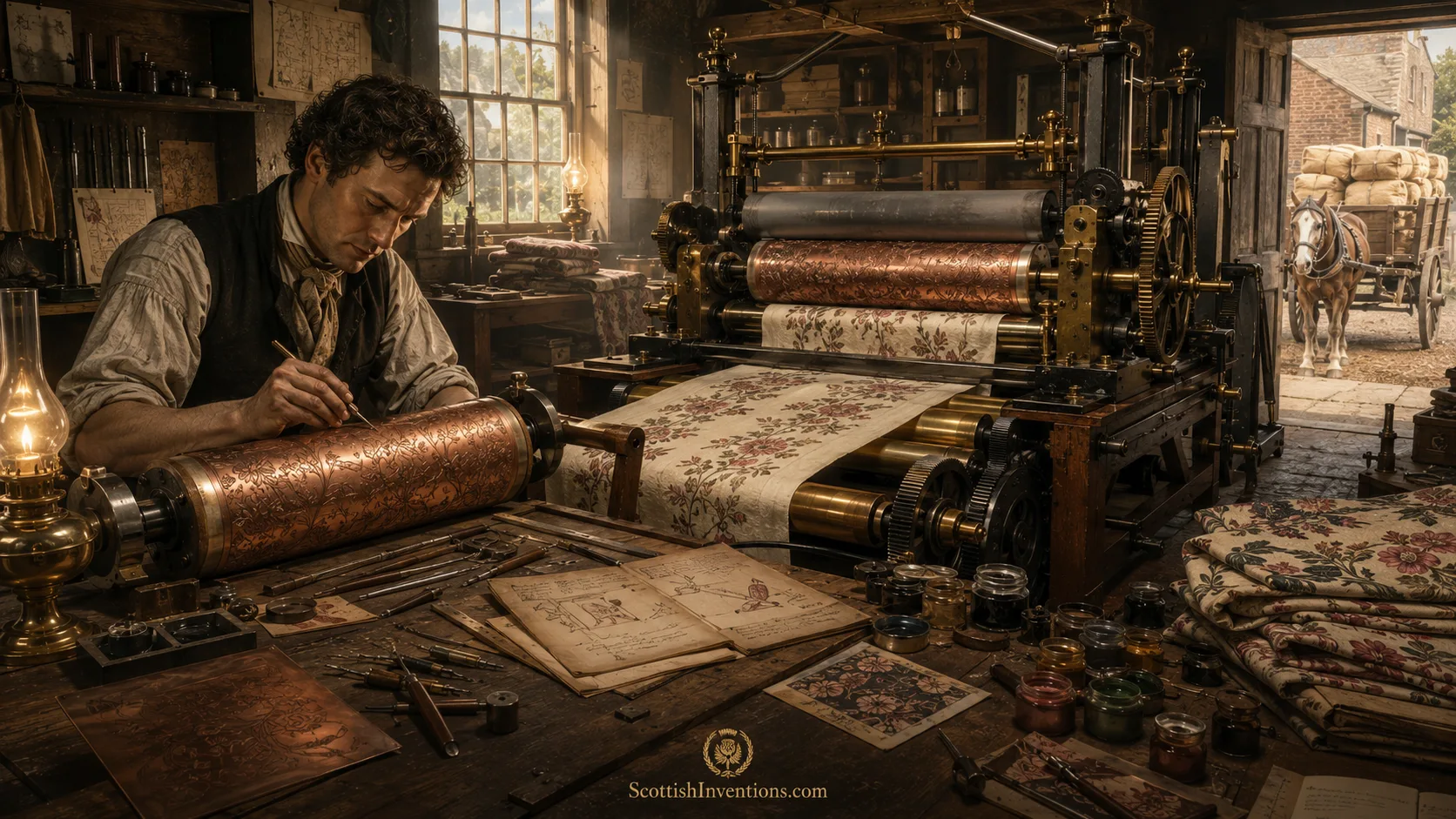
In November 1783 a Scottish copperplate engraver working in Lancashire patented a machine that wrapped an engraved copper design around a rotating cylinder — and, in doing so, converted textile printing from a slow hand craft into one of the first truly continuous manufacturing processes. Thomas Bell's roller printing machine made colourful patterned cotton affordable to ordinary families for the first time in history and laid the mechanical foundation for every newspaper rotary press ever run.
TL;DR
- Thomas Bell, probably born and baptised in Dysart, Fife, around September 1750, was a Scottish copperplate engraver who in 1783 patented the world's first practical roller printing machine — using engraved copper cylinders to print continuous patterns onto cloth.
- His machine could produce thousands of yards of patterned calico a day where a hand block-printer managed a handful of pieces; first put to commercial use near Preston in 1785, it made colourful printed fabric affordable to ordinary people for the first time in history.
- Bell died young, probably around 1804, largely forgotten — but the rotating-cylinder principle he demonstrated in a Lancashire print works underpins every newspaper rotary press ever run, and lives on in every patterned fabric printed today.
Bell at a glance
- Inventor
- Thomas Bell
- Born
- Probably Dysart, Fife — c. 23 Sept 1750
- Died
- Probably England — c. 1804
- Trade
- Copperplate engraver & printer
- Patent
- November 1783 (roller printing)
- Second patent
- 1784 (multi-roller register)
- First commercial use
- Livesey, Hargreaves & Co, Walton-le-Dale, 1785
- Key collaborator
- Adam Parkinson of Manchester
- Output leap
- 6 pieces/day → 10,000–12,000 yards/day
- Legacy
- Foundation of modern rotary printing
Introduction
Almost nobody today knows his name. There is no verified portrait, no known grave, no family archive, no biography on any shelf. Yet the man behind roller printing helped launch the world we now take for granted — mass-produced, endlessly patterned, affordable printed cloth. If you own a floral shirt, a paisley scarf, printed curtains or wallpaper, the technology that made them cheap is a descendant of Thomas Bell's 1783 patent.
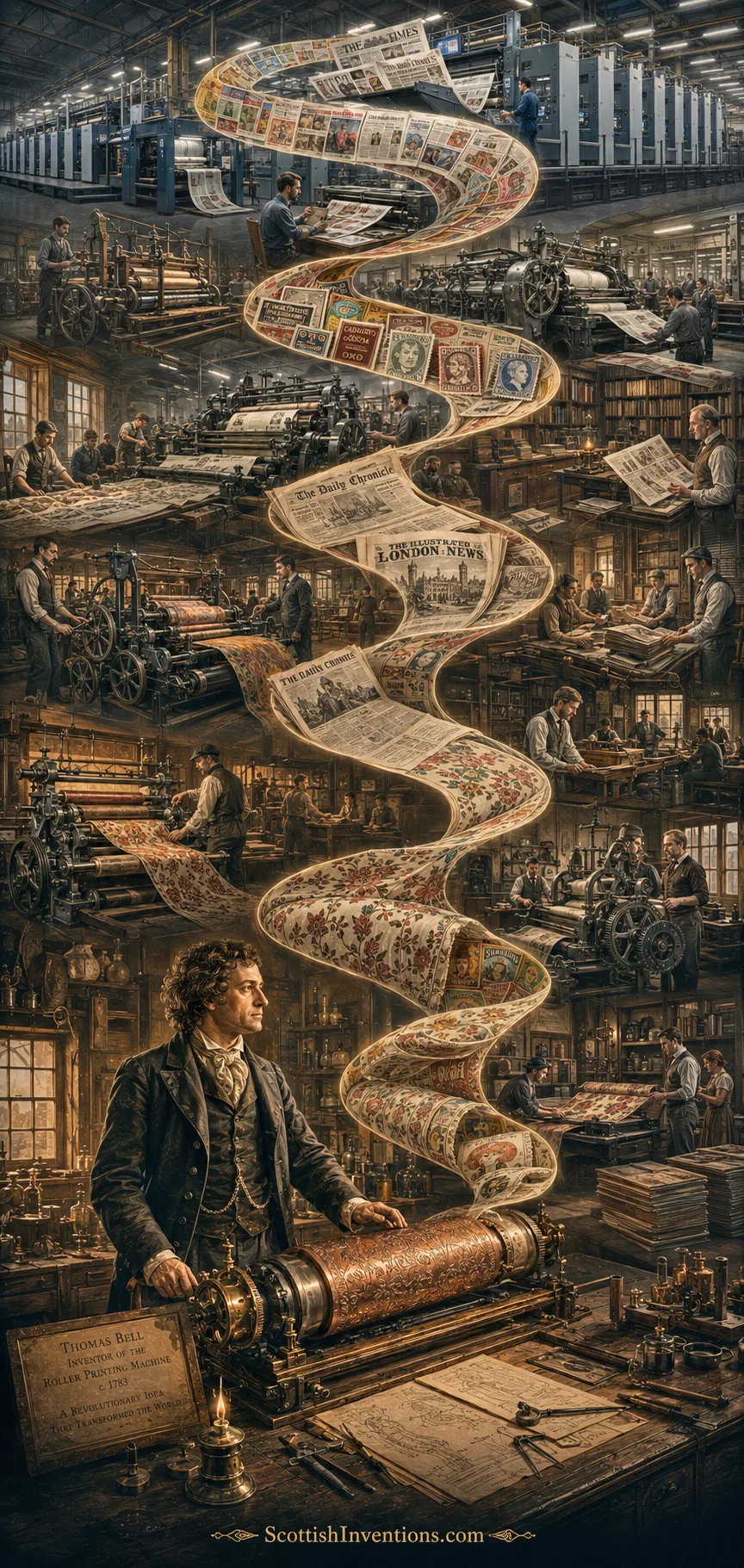
Bell's insight was elegant and industrial: wrap an engraved copper plate around a cylinder, spin it against the cloth, and pattern will emerge in one continuous, unbroken length. That single geometric switch — from flat block to rotating cylinder — turned textile printing from a slow craft into one of the world's first genuinely continuous manufacturing processes, and quietly laid the mechanical foundation of every rotary printing press that would follow.
The Man from Dysart
Dysart is not a famous name — a small royal burgh perched on a cliff above the Firth of Forth, seven miles from Edinburgh along the Fife coast. In the mid-eighteenth century it was a working town: salt panning, linen weaving, coal shipping. Skilled trades thrived there, including the fine craft of copperplate engraving — the skill needed to cut maps, currency plates and book illustrations. It is a credible birthplace for a boy who would grow up to engrave copper rollers for textile printing.
Thomas Bell was probably baptised in Dysart on 23 September 1750. The baptismal record has been identified in genealogical research, though confirmation against the original Kirk Session register held at the National Records of Scotland would be the final proof. Everything else known about Bell is consistent with this origin: a Scot, trained in copperplate engraving, working in England by the 1780s.
By 1779, aged around 28 or 29, Bell was already active as a copperplate printer — there is a passing London newspaper reference to him in that year. By the early 1780s he had moved to Mosney, near Preston in Lancashire. This was not an unusual journey for a skilled Scottish craftsman in those years. The Lancashire cotton trade was the fastest-growing industry in Britain, and the bottleneck — the expensive, labour-intensive process of printing patterns onto cloth — was crying out for anyone with the skill and imagination to solve it. Bell had both.
He died around 1804, probably still in his mid-fifties. His exact burial place is not recorded. He left no known family archive, no portrait, no memoir. The only documents that survive to tell his story are two patents and a handful of industry records. Yet those patents changed the world.
Why Textile Printing Mattered in 1783
To understand why a machine for printing cloth mattered so much, picture Britain in 1783. The transformation of spinning was already extraordinary: James Hargreaves's spinning jenny (about 1764), Richard Arkwright's water frame (1769) and Samuel Crompton's spinning mule (1779) had between them mechanised the production of yarn beyond all recognition. Two years after Bell's patent, Edmund Cartwright would patent the power loom (1785). Plain cloth was suddenly abundant and cheap.
But decorating that cloth — printing patterns onto it — was still done by hand, either with carved wooden blocks or flat engraved copper plates. Both were slow, skilled and expensive. As mechanised spinning and weaving flooded the market with cheap cotton, the bottleneck shifted to the finishing end. There was enormous commercial demand for a faster way to print.
The prize was printed calico — lightweight, washable, colourful cotton cloth that was among the most fashionable fabrics of the Georgian age but, because printing was so laborious, largely the preserve of those with money. The same wave of Scottish industrial ingenuity that gave the world coal gas lighting, James Watt's improved steam engine and, later, the hot blast process in ironmaking would soon meet that demand.
Block Printing Before Bell — What He Replaced
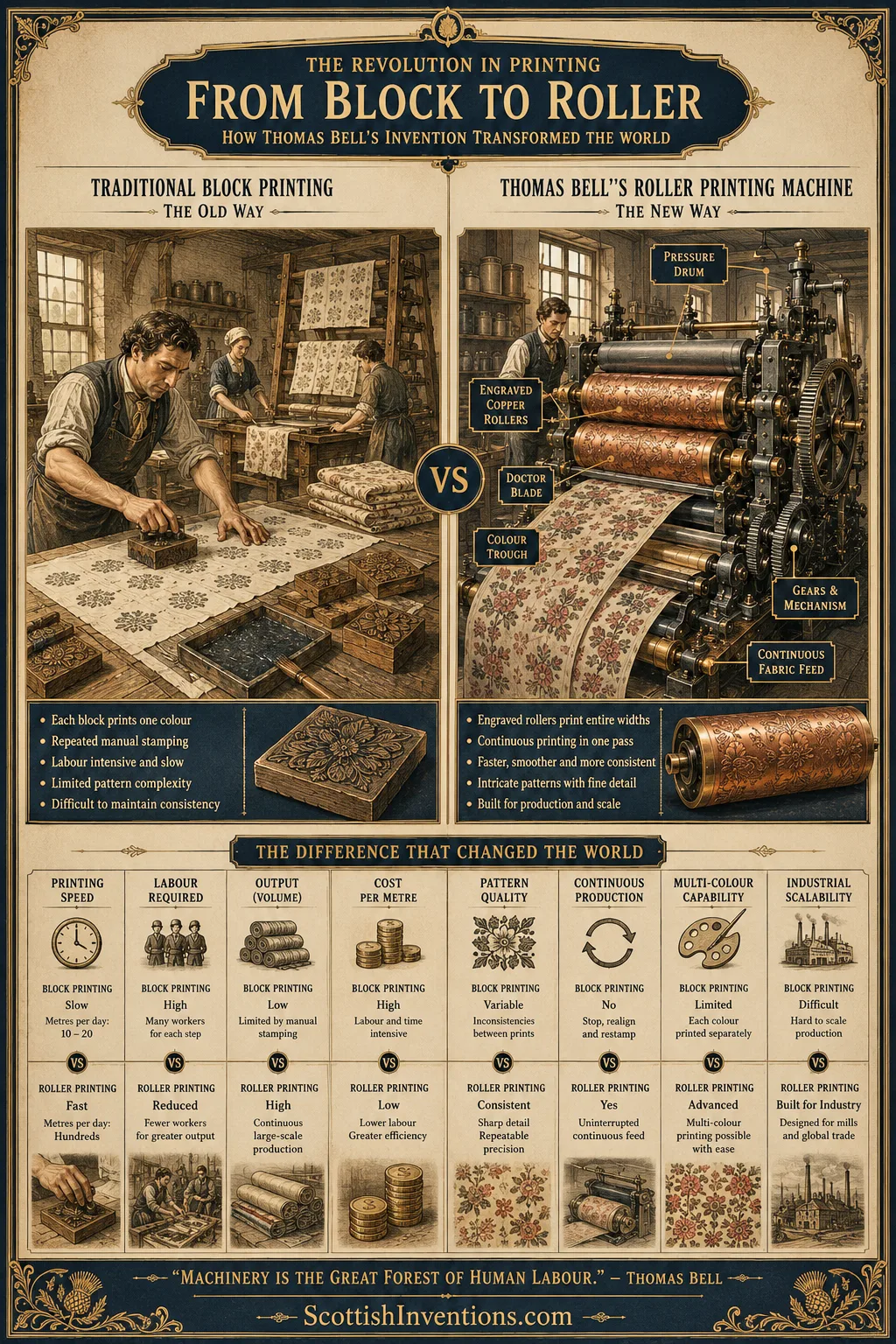
Block printing was the ancient method. A carved wooden block was charged with colour by a child assistant called a "tierer", pressed onto the cloth by the printer and struck with a mallet. Each colour needed its own block, and the cloth could only move on when the previous section had dried. It was skilled and beautiful — and on a plain pattern, it could take all day to produce six pieces of cloth.
Flat copperplate printing was the newer, finer method. A large copper plate engraved with the design was pressed against the cloth, allowing far more naturalistic detail than wooden blocks. Pioneered by Francis Nixon at the Drumcondra printworks near Dublin around 1752, it was a significant advance — but still one impression at a time, one colour only, and with enormous difficulty in making successive impressions align precisely. It was best suited to isolated motifs rather than continuous repeating patterns.
The fundamental limitation of both methods was identical: neither could print patterns continuously onto long lengths of cloth at speed. Every impression had to be manually positioned, pressed and lifted. The insight that would break the bottleneck came from a Fife engraver who had spent his working life cutting designs into copper.
Thomas Bell's Revolutionary Idea — The 1783 Patent
Bell's insight was elegant, and it grew directly from his trade. A copperplate engraver spends his professional life cutting designs into flat copper. Bell's thought was simple and transformative: what if you wrapped the copper around a cylinder?
A copper roller engraved from end to end with the design could rotate continuously. Cloth fed beneath it would receive the pattern with every revolution, in an unbroken process limited only by the length of the cloth. No lifting, no positioning, no waiting. Just rotation, and pattern, and cloth running forward indefinitely.
The November 1783 patent describes Bell as "of Mosney, in the County of Lancaster, copper plate printer", claiming "a new and peculiar art or method of printing with one colour or with various colours at the same time, on linens, cottons, woollen cloths, silks, and any other species or kind of linen cloth, or manufactured goods." The ambition was extraordinary from the outset — Bell's first patent proposed printing six colours at once, each on its own engraved roller. His second patent (1784) addressed the multi-roller alignment challenge directly, proposing mechanical refinements to keep multiple cylinders in register.
"A new and peculiar art or method of printing with one colour or with various colours at the same time, on linens, cottons, woollen cloths, silks, and any other species or kind of linen cloth, or manufactured goods."
The Roller Printing Machine Explained
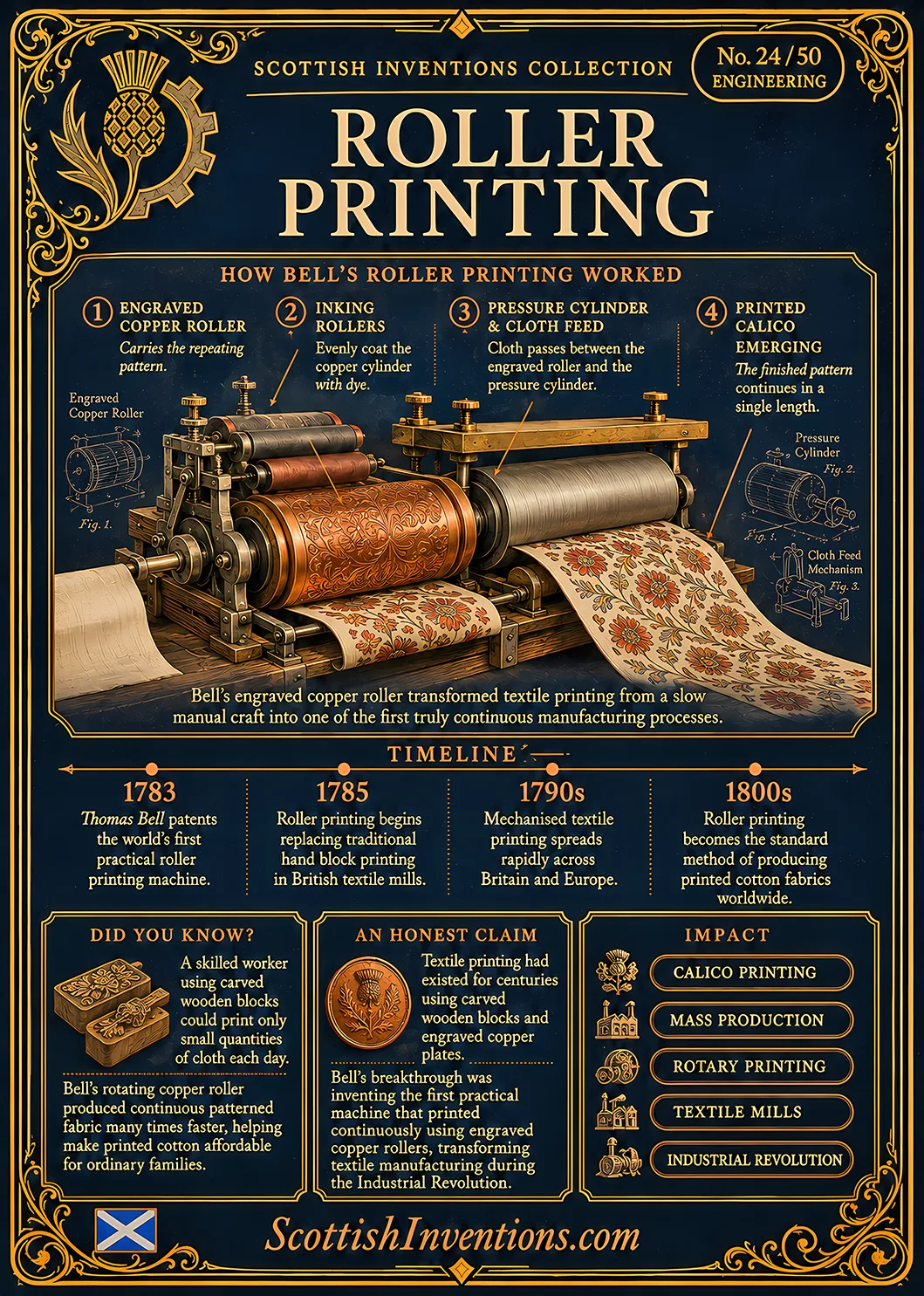
The machine had an elegant mechanical logic. Every component solved a specific problem in continuous, high-speed printing:
- Engraved copper roller. The heart of the machine — a cylinder of solid copper, engraved from end to end with the repeating pattern to be printed.
- Pressure cylinder (drum). A large iron drum wrapped in layers of wool and cotton for elasticity, mounted above the copper roller. It pressed the cloth firmly against the pattern.
- Colour trough & furnishing roller. A shallow trough of coloured paste, with a smaller roller dipping into it and rotating against the copper cylinder to charge it evenly with colour.
- Doctor blade. A thin, precisely-set steel blade that scraped every trace of surplus colour from the smooth face of the copper roller, leaving colour only in the engraved lines. The doctor blade is still used in printing today.
- Continuous fabric feed. The cloth passed between pressure drum and engraved roller in one uninterrupted length — as the roller turned, the pattern transferred to the cloth, repeating precisely with every revolution.
Where a hand block-printer stamped one impression at a time, Bell's machine simply rotated. Pattern followed pattern down an unbroken length of cloth. It was the first time in history that printing had been made truly continuous — a mechanical principle that would later underpin newspaper rotary presses, industrial packaging, banknote printing, and countless other high-speed manufacturing processes.
The First Commercial Print Works — Walton-le-Dale, 1785
Bell needed partners who could build and operate at scale. The critical figure was Adam Parkinson of Manchester, who solved the registration problem — the precise alignment of multiple rollers — possibly through a fine mechanical adjustment called the "box wheel." With Parkinson's improvement, Bell's six-colour concept became practical.
In 1785, the machine went to work at Livesey, Hargreaves and Company at their Mosney print works at Walton-le-Dale, near Preston. The firm was already formidable — Lancashire County Council Museum records describe it as "one of the largest cotton manufacturing enterprises in the early stages of the Industrial Revolution", providing bread, directly or indirectly, to 20,000 people. Rolls of cloth said to be twelve miles long bleached in the surrounding fields. Now, with Bell's roller machines running, they could print calico in two to six colours in a single continuous operation.
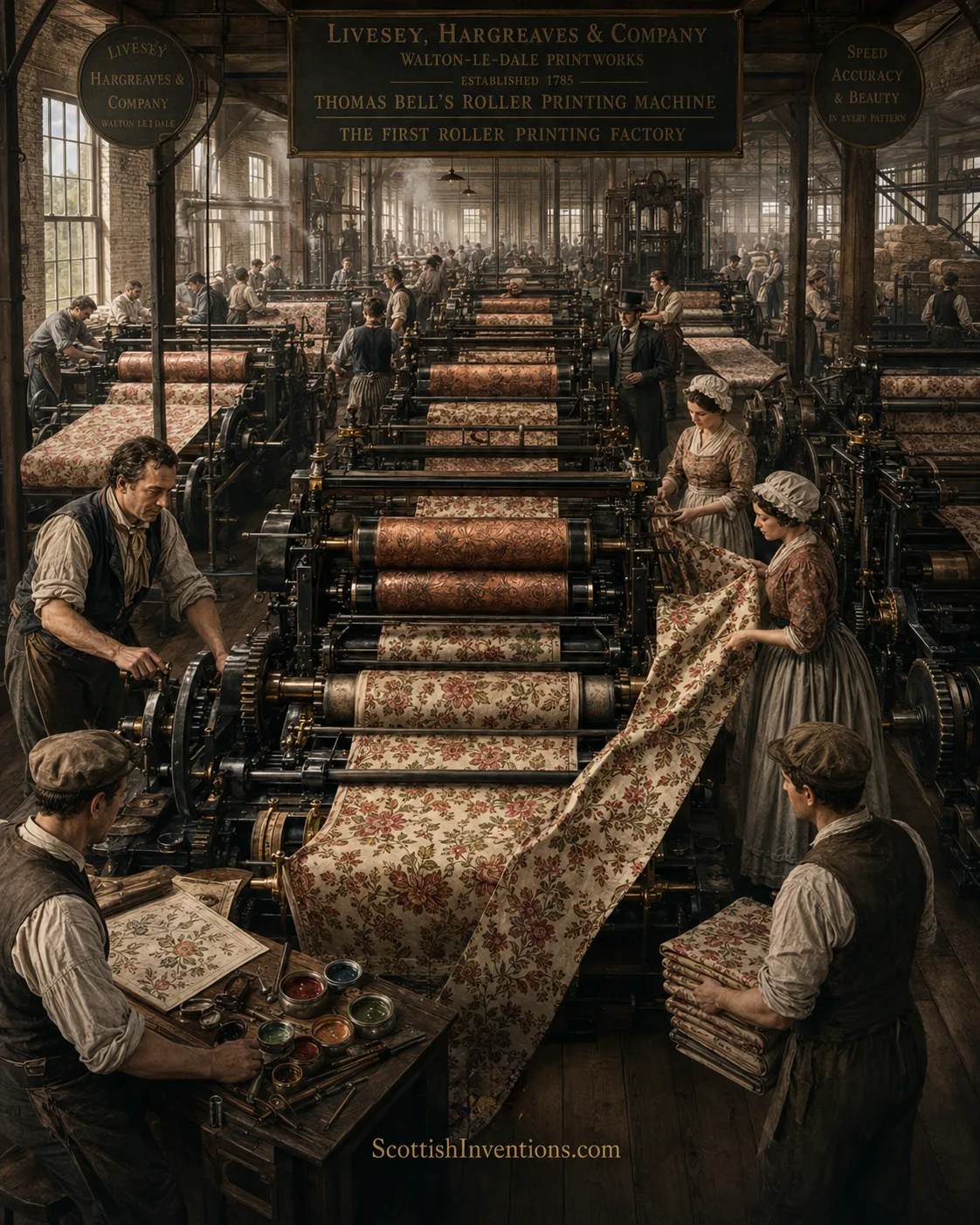
The partnership between Scottish invention and Lancashire commerce was brief. The Mosney works collapsed into bankruptcy in 1788 — debts of £1.5 million, nearly £200 million in today's money. Bell's venture ended. But the machine did not.
How Roller Printing Changed Fashion
The productivity difference was stark. By the mature period of the technology, a single-colour roller machine could print 10,000 to 12,000 yards of cloth in a ten-hour day. A skilled hand block-printer might produce around six pieces — perhaps 180 yards — in the same time. Lancashire printed-cloth production rose from an estimated 50,000 pieces of 30 yards in 1750 to 20,000,000 pieces by 1850.
Cheaper printing meant cheaper printed cloth. Where patterned cotton had been a luxury, roller-printed calicos in a widening variety of patterns came within reach of working families. The democratisation of fashion — the idea that a cotton worker's wife might wear a printed dress — begins here, in the early 1790s, in the mills that ran on Bell's principle.
Early roller prints had a recognisable look: small monochrome patterns and tiny dotted grounds known as "machine grounds". As engraving technology improved through the 1810s and 1820s, the designs grew richer. Turkey red and chrome yellow became the dominant palette of the 1820s roller print. By mid-century, machines with twelve or sixteen colour rollers were producing prints of genuine intricacy and beauty.
Block printing retreated, surviving in short runs and specialist work. William Morris revived it deliberately as an artistic statement — a rejection of the mechanical — but the mainstream trade belonged entirely to the roller. The Georgian fashion for chintz curtains, floral gowns and printed waistcoats that filled the drawing rooms of the 1790s was, in effect, Bell's fashion.
The Scottish Textile Industry — The Turkey Red Thread
While Bell developed his machine in Lancashire, the west of Scotland became one of the great centres of the roller-printing trade. Turkey red dyeing arrived in Scotland in 1785 — the very year Bell's machine first went to work — when George Macintosh (father of Charles Macintosh of raincoat fame) and David Dale established the first British Turkey Red dyeworks at Bridgeton, Glasgow.
The Vale of Leven in Dunbartonshire became world-famous for printed Turkey red cloth, exported to India, Africa and Asia — a trade that ran until the United Turkey Red Company finally closed in 1961. Alongside Neilson's hot blast process in ironmaking and, later, work such as James Clerk Maxwell's first colour photograph, Scotland's contribution to the industrialisation of colour ran from Bell's copper roller straight through to twentieth-century imaging.
Influence on Modern Printing
Bell's rotating cylinder cast a longer shadow than textile printing. The same principle — a design on a revolving cylinder transferred continuously to material passing beneath — is the foundation of the rotary printing press developed for newspapers by Richard March Hoe in America in 1847. Every newspaper run off a rotary press is a mechanical descendant of the engraved copper cylinder a Fife-born engraver patented in Lancashire in 1783.
The lineage widened as the nineteenth century turned into the twentieth: banknote printing, industrial packaging, gravure magazines, flexographic labels, cash-register receipts and beverage-can decoration all inherit some part of the same idea. So does the doctor blade Bell wrote into his 1783 patent — still used, in modernised form, on gravure and flexographic presses running today.
Scottish printing has its own separate story alongside this — including William Ged's stereotype printing, the birth of the Encyclopædia Britannica in Edinburgh in 1768, and, in a different register, Alexander Bain's chemical telegraph and precursor of the fax machine. But it is Bell's rotating cylinder that provided the physical mechanism by which mass-produced imagery could actually leave the workshop and reach the world.
Learn More: Interactive Panels
Tap any panel to expand.
+Learn more: Close: What the doctor blade actually does
The doctor blade — a thin, precisely-set steel blade — is one of the most important small components in printing history. As the engraved copper roller turns after passing through the colour trough, the blade wipes the smooth surface of the roller absolutely clean while leaving colour intact in the engraved lines. Only that ink transfers to the cloth. Without the doctor blade, colour would smear across the entire fabric. Bell specified it in 1783; modern gravure and flexo presses still use its direct descendant today.
+Learn more: Close: Why register was so hard — and Adam Parkinson's fix
Printing six colours means running the cloth past six engraved rollers, one after another, each contributing a different part of the design. If any roller is out of phase by even a fraction of a millimetre, the whole print misregisters and the pattern is ruined. Bell's 1784 patent recognised the problem; the Manchester mechanic Adam Parkinson is credited with solving it in practice, possibly using a fine mechanical adjustment called the "box wheel" that let each roller be finely re-timed to the machine. With Parkinson's fix, Bell's six-colour concept moved from patent drawing to production floor.
+Learn more: Close: Six pieces a day vs 10,000 yards a day
The economic transformation is easier to grasp in the raw numbers. A skilled hand block-printer working a full day produced around six pieces of cloth — perhaps 180 yards. A single-colour roller printing machine, once mature, could produce 10,000 to 12,000 yards in a ten-hour shift. That is roughly a sixty-fold uplift in output per worker. Combined with the massive cost reduction of mechanised spinning and weaving happening in parallel, the price of a metre of patterned cotton fell by orders of magnitude between 1780 and 1830 — one of the sharpest price collapses in any consumer good of the Industrial Revolution.
+Learn more: Close: How roller printing built the Scottish Turkey Red trade
Turkey Red is a brilliant colour-fast red dye that took months to apply to cotton using traditional methods. When George Macintosh and David Dale opened the first British Turkey Red dyeworks in Glasgow in 1785, they gave Scottish printers a raw material no one else could match. Combined with Bell's roller printing machine, it made the Vale of Leven in Dunbartonshire one of the world's leading producers of printed cotton for export, especially to South Asia and Africa. The industry lasted until the United Turkey Red Company closed in 1961.
+Learn more: Close: From copper roller to rotary press
Richard March Hoe patented his rotary printing press in the United States in 1847 — the machine that made mass-market daily newspapers physically possible. It works on Bell's principle: the type (or a curved stereotype plate) is fixed to a revolving cylinder, and paper passes continuously beneath it. Every subsequent rotary innovation — offset lithography, gravure, flexography, rotary screen printing — is a variation on the same theme. Bell demonstrated the mechanical vocabulary; later inventors built the sentences.
+Learn more: Close: Why Bell is so poorly remembered
Bell died around 1804, before the technology fully proved itself commercially at national scale. His major partner firm went bankrupt in 1788. He left no known portrait, no memoir, no descendants who campaigned for his memory. The Oxford Dictionary of National Biography lists him as active only "fl. 1783–1784" — two years in the written record. History tends to remember charismatic founders and successful investors; Bell was neither. But the machine he patented ran, quite literally, for 200 years.
Timeline of Roller Printing
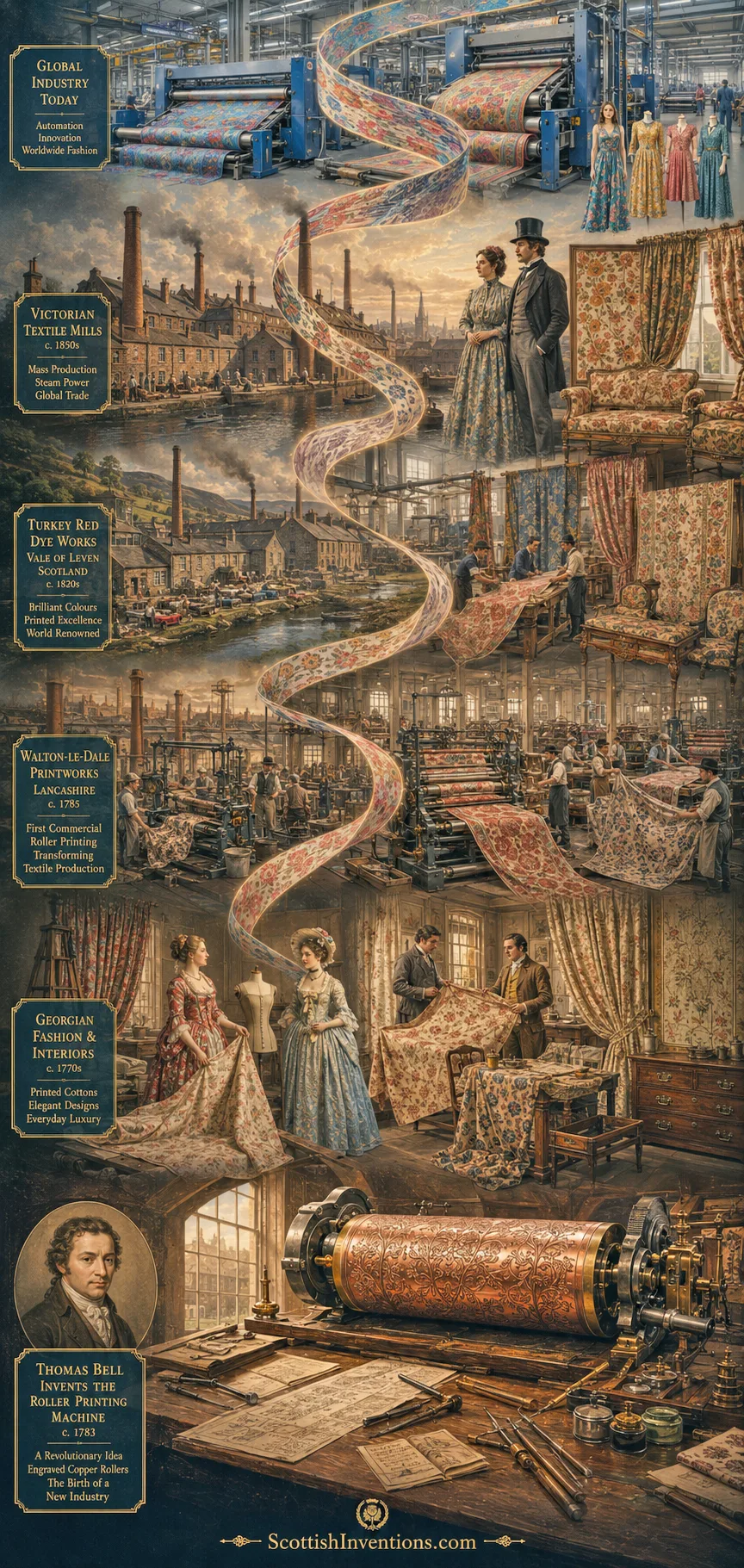
c. 23 September 1750
Probably baptised in Dysart, Fife
Thomas Bell is probably baptised in the small royal burgh of Dysart on the Fife coast, where linen weaving and copperplate engraving were established trades.
1779
Active as a copperplate printer
A passing London newspaper reference places Bell in the copperplate trade at around 28 or 29 — four years before his patent.
Early 1780s
Moves to Mosney, near Preston
Drawn by the booming Lancashire cotton industry, Bell settles at Mosney in Walton-le-Dale, where finishing — printing patterns onto plain cotton — has become the great commercial bottleneck.
November 1783
First roller printing patent
Bell patents 'a new and peculiar art or method of printing with one colour or with various colours at the same time' on linens, cottons, woollens and silks, using an engraved copper cylinder.
1784
Multi-roller refinement
A second patent addresses the challenge of keeping multiple engraved cylinders in register for multi-colour prints.
1785
First commercial operation
Improved by the Manchester mechanic Adam Parkinson, Bell's machine goes to work at Livesey, Hargreaves and Company's Mosney print works at Walton-le-Dale — the world's first roller printing factory.
1785
Turkey Red arrives in Scotland
In the same year, George Macintosh and David Dale establish the first British Turkey Red dyeworks at Bridgeton, Glasgow — the foundation of the Vale of Leven printing industry.
1788
Livesey, Hargreaves collapses
The Mosney works falls into bankruptcy with debts of about £1.5 million. Bell's commercial venture ends, but the machine survives.
1790s
Roller printing spreads
Mechanised textile printing spreads rapidly across Britain and Europe as calico printers adopt Bell's cylinder principle.
c. 1804
Death of Thomas Bell
Bell disappears from the record around 1804, probably aged about 53 or 54. No known portrait, memoir or estate survives.
1847
Rotary press for newspapers
Richard March Hoe patents the rotary printing press in the United States, applying Bell's rotating-cylinder principle to newspapers.
c. 1850
20 million pieces a year
Lancashire printed-cloth production rises from an estimated 50,000 pieces of 30 yards in 1750 to 20,000,000 pieces by 1850.
Mid-1980s
Still running in India
Copper roller printing machines remain in everyday commercial use in Indian textile mills — around 200 years after Bell's 1783 patent.
Today
The cylinder principle endures
Digital and rotary screen printing have superseded engraved copper rollers in textiles, but Bell's cylinder principle underlies every high-speed rotary printing process in the world.
An Honest Claim
What Bell did — and did not — invent
- Bell did not invent textile printing. Wooden-block printing on cloth is thousands of years old, and flat copperplate printing on cloth was pioneered by Francis Nixon at Drumcondra, near Dublin, around 1752.
- Bell did invent the first commercially practical roller printing machine, patented in November 1783, using an engraved copper cylinder to print continuous patterns onto cloth — the first genuinely continuous printing process at industrial scale.
- Bell did not build the industry alone. The Manchester mechanic Adam Parkinson solved the critical registration problem, and the Livesey, Hargreaves partnership put the machine into commercial production at Walton-le-Dale in 1785.
- Bell did not personally invent the newspaper rotary press. Richard March Hoe patented that in 1847. But the rotating-cylinder principle Hoe used — and every rotary press since — traces back to Bell's 1783 patent.
- Some biographical details remain "probably." The Dysart baptismal record is the best available evidence for Bell's birthplace, but has not yet been confirmed against the original Kirk Session register at the National Records of Scotland.
Frequently Asked Questions
- Who invented roller printing?
- Roller printing was invented by Thomas Bell, a Scottish copperplate engraver, who patented the first practical roller printing machine in November 1783. His invention used an engraved copper cylinder to print continuous repeating patterns onto cloth.
- Was Thomas Bell Scottish?
- Yes. Thomas Bell was probably baptised on 23 September 1750 in Dysart, a small royal burgh on the Fife coast known for linen weaving and copperplate crafts. He trained as a copperplate engraver in Scotland before moving to Lancashire, where he was working by the early 1780s.
- What is roller printing?
- Roller printing is a method of printing patterns onto cloth using an engraved copper cylinder rather than a flat block or plate. As the cylinder rotates, cloth passes beneath it and receives the pattern continuously, allowing thousands of yards to be printed in a single working shift.
- How did Bell's roller printing machine work?
- A large iron pressure drum, wrapped in wool and cotton, pressed the cloth against an engraved copper roller below. A furnishing roller applied colour paste from a trough; a thin steel 'doctor blade' scraped surplus colour from the smooth face of the roller, leaving colour only in the engraved lines. As the roller turned, the pattern transferred continuously to the cloth passing through.
- Why was Bell's invention important?
- It converted textile printing from a slow hand craft into one of the first truly continuous manufacturing processes. A hand block-printer produced around six pieces of cloth a day; a roller machine produced 10,000–12,000 yards. It made colourful patterned cotton affordable for ordinary families and helped launch modern mass fashion.
- What did roller printing replace?
- Roller printing replaced two older methods: hand block printing using carved wooden blocks stamped one impression at a time, and flat copperplate printing developed by Francis Nixon at Drumcondra near Dublin around 1752. Both were slow, one-impression-at-a-time processes; Bell's cylinder made printing continuous.
- Where was the first roller printing factory?
- The first commercial roller printing operation was Livesey, Hargreaves and Company's Mosney print works at Walton-le-Dale, near Preston in Lancashire, which put Bell's machine to work in 1785 — improved by the Manchester mechanic Adam Parkinson to solve multi-roller registration.
- Did Bell influence newspaper printing?
- Indirectly, yes. Bell's rotating-cylinder principle — a design engraved on a revolving cylinder transferred continuously to material passing beneath — is the foundation of the rotary printing press developed for newspapers by Richard March Hoe in the United States in 1847. Every newspaper ever run off a rotary press is a mechanical descendant of Bell's 1783 idea.
- What happened to Thomas Bell?
- Bell's partner firm Livesey, Hargreaves and Company collapsed into bankruptcy in 1788 with debts of about £1.5 million. Bell himself largely disappears from the record and is believed to have died around 1804, aged about 54, with no known estate, portrait or memorial. His machine, however, outlived him by two centuries.
- Is roller printing still used today?
- In textiles, engraved copper roller printing has largely been superseded by rotary screen and digital printing. But Bell's cylinder principle — including the doctor blade he specified in 1783 — remains at the heart of every high-speed rotary printing process on earth, from newspaper presses to industrial packaging.
Legacy
Bell is among the least-known of the Industrial Revolution's transforming figures. The Oxford Dictionary of National Biography notes him as active only "fl. 1783–1784" — two years in the written record, then silence. He died around 1804, probably in his mid-fifties, with no known estate, no portrait and no memorial. The Mosney works that first proved his machine went bankrupt four years after opening. History, as it often does, remembered the investors rather than the inventor.
The roller printing machines kept running for 200 years. In India they were still in everyday commercial use in the mid-1980s. Today, digital printing and rotary screen technology have superseded the copper roller in textiles — but the cylinder principle Bell demonstrated endures in every high-speed printing process on earth.
Bell's contribution belongs squarely alongside the other great Scottish additions to the Industrial Revolution — Watt's steam engine, Neilson's hot blast process, Nasmyth's steam hammer, Murdoch's coal gas lighting and Macintosh's waterproof raincoat. Where Watt gave the age its power and Neilson its cheap iron, Bell gave it its patterns — the visible surface of everyday industrial life.
Did You Know?
- Thomas Bell was probably baptised in Dysart, Fife, on 23 September 1750 — a small coastal town on the Firth of Forth where linen weaving and copperplate crafts were local trades.
- Bell was already active as a copperplate printer by 1779 — four years before his patent — suggesting years of professional preparation before his breakthrough.
- A skilled hand block-printer could produce around six pieces of cloth in a day; Bell's roller machine could print 10,000–12,000 yards in a ten-hour shift.
- The company that first used Bell's machine went bankrupt in 1788 with debts of £1.5 million — nearly £200 million today. The technology outlasted the firm.
- Bell's rotating-cylinder principle influenced all modern rotary printing — every newspaper ever run on a rotary press owes something to this Fife engraver.
- Roller printing remained in everyday commercial use in India until the mid-1980s — around 200 years after Bell's 1783 patent.
- The steel "doctor blade" Bell specified in his 1783 patent is still used, in modernised form, on gravure and flexographic presses today.
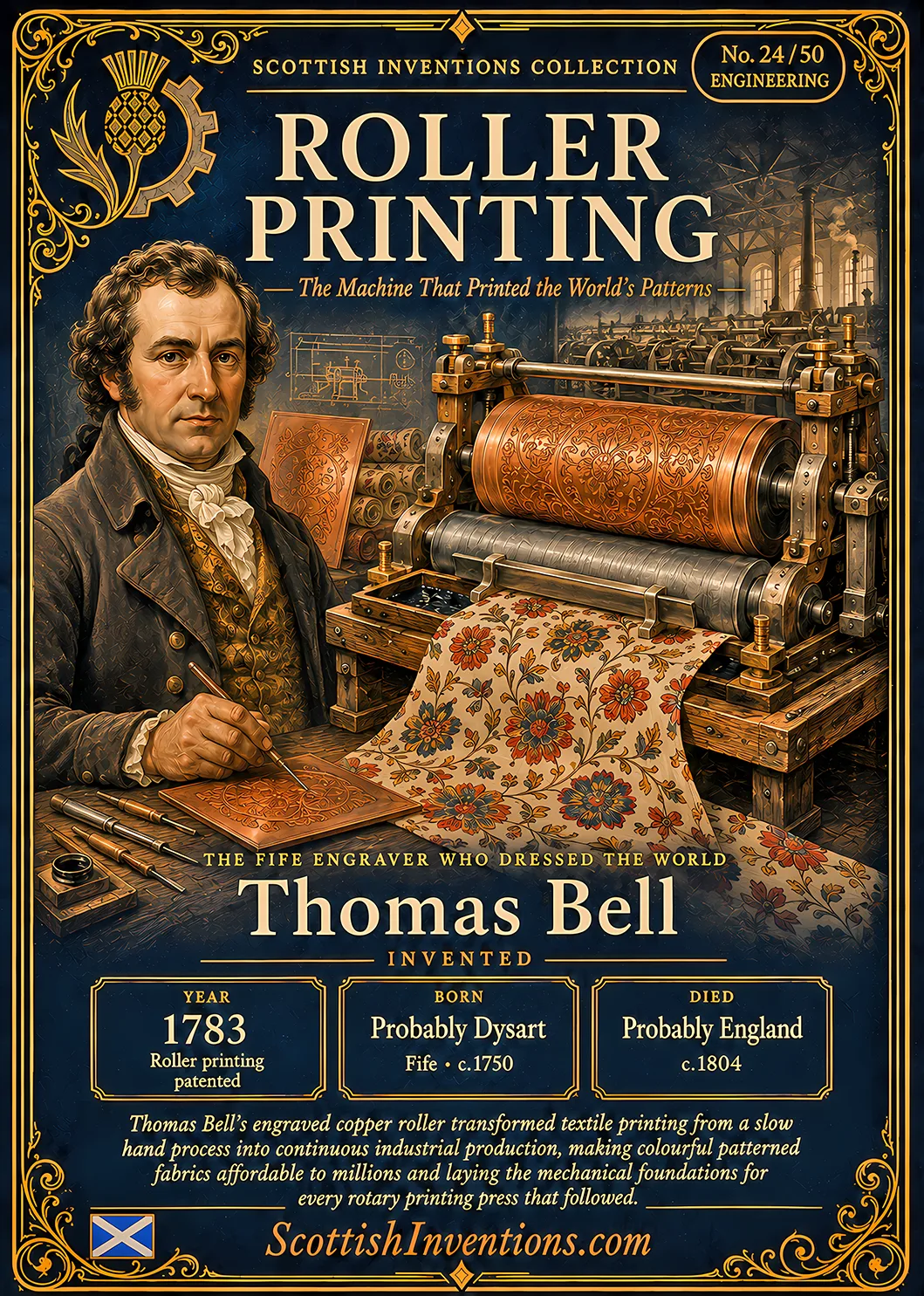
The Roller Printing trading card
Card No. 24 of 50 in the Scottish Inventions Collection.
Discover More Scottish Inventions
Thomas Bell's Machine Dressed the World
Thomas Bell's revolutionary roller printing machine transformed the textile industry and laid the foundations for modern rotary printing. Explore more remarkable Scottish inventions that changed the world.
Explore the Scottish Inventions CollectionSources
- Oxford Dictionary of National Biography — entry on Thomas Bell, calico printer (fl. 1783–1784).
- Thomas Bell, patent specifications (1783 and 1784) — engraved cylinder printing on linens, cottons, woollens and silks.
- Lancashire County Council Museum records — Livesey, Hargreaves and Company, Walton-le-Dale.
- S. D. Chapman & S. Chassagne, European Textile Printers in the Eighteenth Century (Heinemann, 1981).
- A. Robertson, The Turkey Red Dyeworks of the Vale of Leven — Scottish Textile Heritage Online.
- Richard Leslie Hills, Power in the Industrial Revolution (Manchester University Press).
- Richard March Hoe, US patent for the rotary printing press, 1847.
- National Records of Scotland — Old Parish Registers, Dysart parish (baptism records).
- Wikipedia entries on roller printing, calico printing, Livesey Hargreaves & Company, Turkey Red and the rotary press.