Scottish Inventions · Everyday Life
Charles Macintosh: The Glasgow Chemist Who Taught the World to Stay Dry
How a 19th-century Scottish industrial chemist dissolved rubber in coal-tar naphtha, sandwiched it between two layers of cloth, and invented the world's first practical waterproof fabric — the foundation of every modern raincoat.
Introduction
On 17 June 1823, a Glasgow chemist named Charles Macintosh was granted British Patent No. 4804 for a method of rendering cloth "impervious to water and air." It was the founding document of the modern waterproof clothing industry — and the moment a long, miserable history of waxed capes, oiled cloaks and leaking cloth coats began to come to an end.
Macintosh had discovered that coal-tar naphtha, a waste product of the Glasgow Gas Works, would dissolve natural India rubber into a workable, glue-like solution. His genius was not the chemistry alone but what he did with it: rather than paint rubber onto a single piece of cloth — which produced a stiff, smelly, cracking surface, as earlier experimenters had found — he sandwiched the rubber layer between two pieces of fabric, hiding it inside and protecting it from wear. The result was the first lightweight, flexible, mass-producible waterproof cloth in human history, and the Mackintosh raincoat that followed gave its name to every raincoat that came after it.

On this page
- Key Takeaways
- Quick Facts
- Early Life
- Glasgow's Chemical Industry
- Waterproof Clothing Before 1823
- The Invention of Waterproof Fabric
- How the Mackintosh Process Worked
- Why the Coat Was Revolutionary
- Early Problems and Improvements
- Thomas Hancock and Vulcanisation
- The Birth of Modern Waterproof Clothing
- Legacy
- Did You Know?
- Myth vs Fact
- Timeline of Waterproof Clothing
- Related Scottish Inventions
- Further Reading
- Frequently Asked Questions
Key Takeaways
- Charles Macintosh (1766–1843), a Glasgow chemist, patented the world's first practical waterproof fabric on 17 June 1823 (British Patent No. 4804).
- The process bonded a layer of India rubber dissolved in coal-tar naphtha between two pieces of cloth — not simply rubber-coated cloth, but a three-layer sandwich.
- Macintosh was a Fellow of the Royal Society and one of the founders of the Scottish chemical industry, with work on bleaching powder, alum, sal ammoniac, dyes and hot-blast iron.
- Surgeon James Syme had published in 1818 that naphtha dissolves rubber; Macintosh's distinct contribution was the patented sandwich construction and the commercial fabric industry built on it.
- The early garments stank, stiffened and cracked; Thomas Hancock's masticator and vulcanisation (Goodyear 1839; Hancock UK patent 21 November 1843) cured these flaws.
- Every modern waterproof jacket — including Gore-Tex shells — descends from Macintosh's principle of bonding a waterproof barrier within fabric.
- The persistent claim that Macintosh helped found the Clydesdale Bank is a myth and should not be repeated; he is also not related to the architect Charles Rennie Mackintosh.
Quick Facts
Glasgow 1766
Born 29 December 1766 in Glasgow, the son of dye manufacturer George Macintosh.
British Patent No. 4804
Granted 17 June 1823 for making textiles 'impervious to water and air' using rubber and coal-tar naphtha.
First coat sold 1823
The first Mackintosh garment is reported to have been sold in Glasgow on 12 October 1823.
Hancock partnership 1825–26
Thomas Hancock, inventor of the rubber masticator, licensed the patent and became a partner in Charles Macintosh & Co.
Vulcanisation 1839 / 1843
Goodyear (US, 1839) and Hancock (UK patent, 21 November 1843) cured rubber's stink, stickiness and cracking.
FRS 1823
Elected a Fellow of the Royal Society for his chemistry — bleaching powder, alum, dyes, sal ammoniac, hot-blast iron.
Early Life: Born Into Glasgow's Chemistry of Colour
Charles Macintosh was born in Glasgow on 29 December 1766, the son of George Macintosh, a merchant and dye manufacturer, and Mary Moore. The family was steeped in the chemistry of colour: George Macintosh had moved to Glasgow from Ross-shire and, in 1777, established a works in the Dennistoun area to manufacture "cudbear," a violet-red dye extracted from lichens, and was a leading figure in introducing Turkey-red dyeing to Scotland. Young Charles grew up surrounded by industrial chemicals, dye-vats, mordants and pigments — an extraordinary apprenticeship for the man he would become.
He was educated at Glasgow's grammar school and at a school at Catterick Bridge in Yorkshire, then placed as a clerk in a Glasgow merchant's counting-house. But the boy's heart was in the laboratory, not the ledger. He devoted his spare hours to chemistry, attending lectures by Dr William Irvine in Glasgow and later studying under the great Joseph Black in Edinburgh. Before he was twenty, he abandoned the clerk's stool entirely to manufacture chemicals — taking up the production of sal ammoniac (ammonium chloride) from the soot of Glasgow's coal-gas works, introducing the manufacture of "sugar of lead" (lead acetate) from Holland, and producing acetate of alumina, both important mordants for fixing dyes.
Glasgow's Chemical Industry — and Macintosh's Place in It
Early-nineteenth-century Glasgow was already an industrial-chemistry powerhouse, and Macintosh was at the heart of it. By 1797, aged just twenty-three, he had established Scotland's first alum works at Hurlet, Renfrewshire — Macintosh, Knox & Co. — cleverly using waste shale from coal mines as raw material. In partnership with Charles Tennant at the great St Rollox chemical works north of Glasgow, he helped develop dry bleaching powder, patented in 1799, an innovation that slashed the time needed to bleach cloth from months to days. St Rollox went on to become, in its mid-Victorian heyday, what the Max Planck Institute for the History of Science describes as "often … the largest in Europe, if not the world," employing some 1,500 workers at its peak.
He improved dyeing processes, refined the manufacture of Prussian blue, manufactured sal ammoniac and lead acetate, patented in 1825 a method of converting iron to steel by heating it white-hot in coal gas, and from 1828 partnered James Beaumont Neilson in exploiting the hot-blast iron process that transformed Scotland's iron industry. In 1823 he was elected a Fellow of the Royal Society, honoured for his chemistry — not just for his coat.
"Macintosh was no one-invention man. He ranks as one of the founding figures of the Scottish chemical industry — a practical industrial chemist, businessman and inventor in the quintessential Scottish Enlightenment mould."
Waterproof Clothing Before 1823
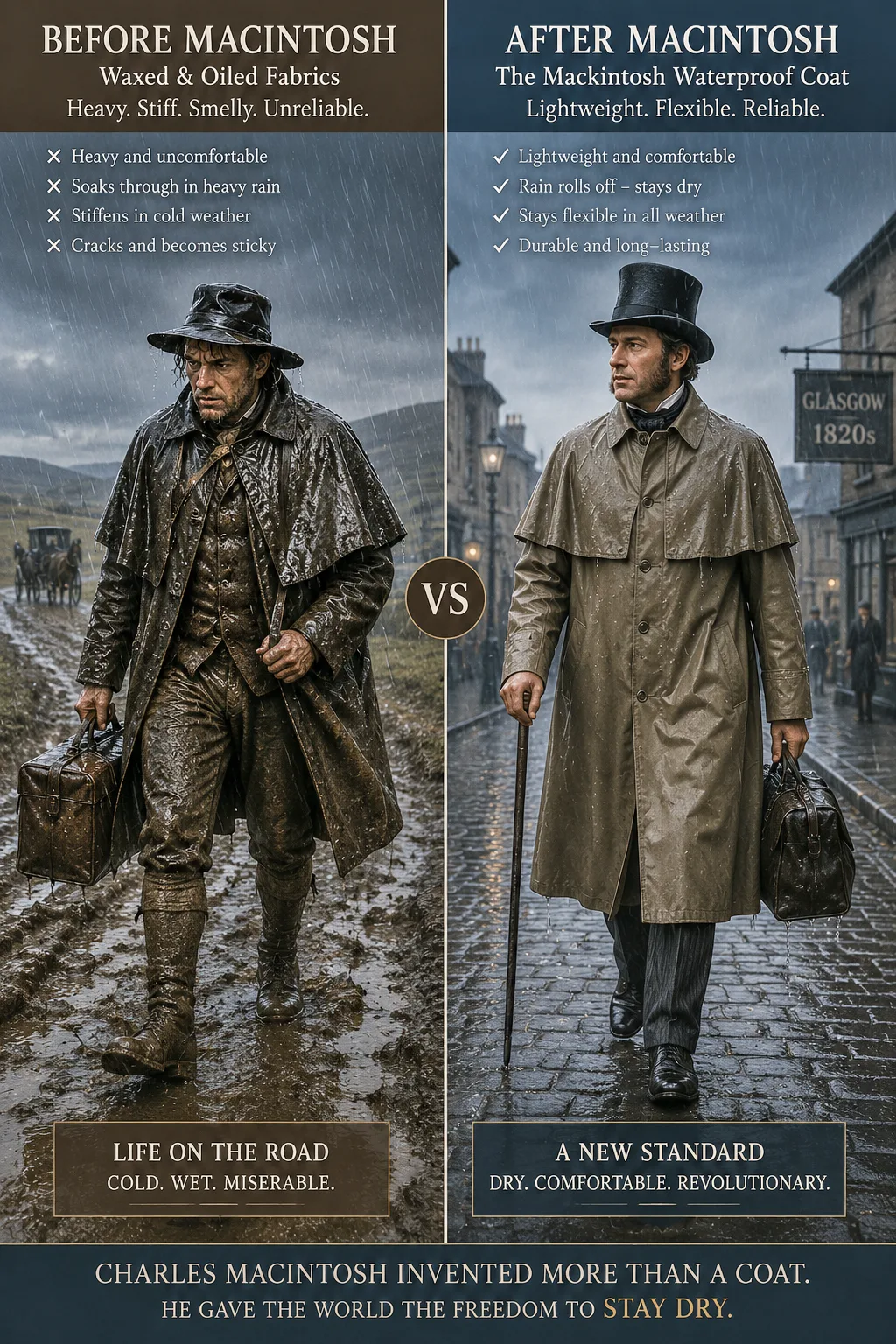
Before Macintosh, staying dry was a miserable business. Waxed and oiled fabrics existed — sailors had used them for centuries, and shepherds and farm workers wore heavy waxed-cotton smocks — but they were weighty, stiff, smelly and unreliable, and they cracked and grew tacky with use. People had long known that rubber (caoutchouc, or "India rubber") repelled water; South American peoples had waterproofed cloth and footwear with latex for centuries. But raw rubber was hopeless as clothing: it rotted, stank, melted in heat and stiffened in cold.
The problem was clear and the prize was enormous: a lightweight, flexible, practical waterproof fabric that ordinary people could actually wear. In a country as famously wet as Scotland, the need was acute — for shepherds, fishermen, farm workers, dockers, mail-coach drivers and city-dwellers alike. There was also a pressing military demand: armies and navies needed waterproof capes, groundsheets and gun covers. Whoever cracked the problem first stood to make a fortune.
The Invention of Waterproof Fabric
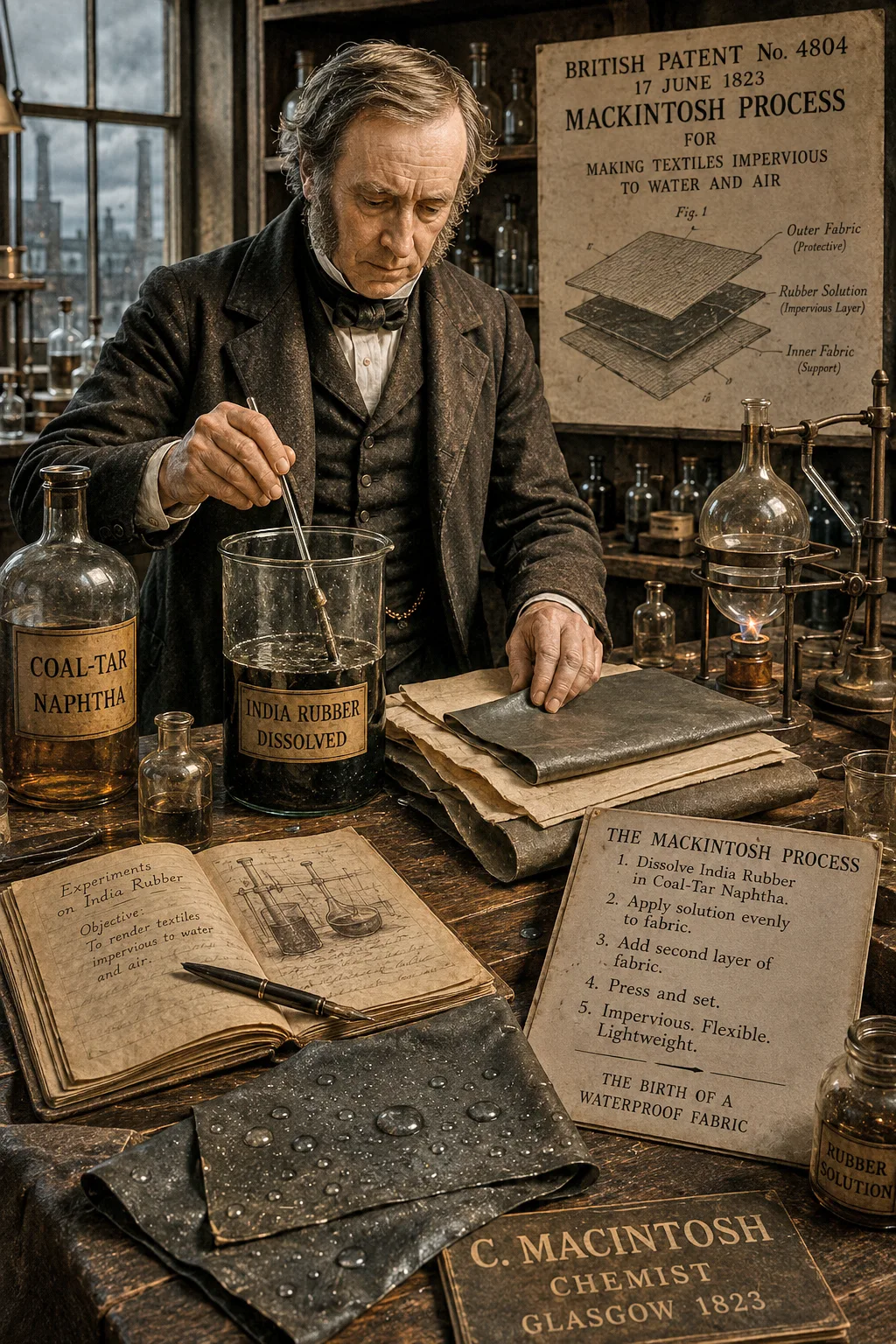
Macintosh's breakthrough grew directly out of his industrial chemistry. From 1819 he contracted with the Glasgow Gas Works to take away their waste products — ammonia (useful for his cudbear) and sticky black coal tar. By distilling the coal tar he obtained naphtha, a volatile, oily liquid. And here came the crucial chemical insight: naphtha dissolved natural rubber into a workable, glue-like solution.
The genius was in what he did next. Rather than simply coating cloth with rubber — which produced a stiff, smelly, cracking surface, as earlier experimenters had found — Macintosh painted the rubber solution onto one piece of fabric and pressed a second piece on top, sandwiching the impermeable rubber layer between two textiles and allowing the naphtha to evaporate. This "double-textured" construction hid the rubber inside, kept the outer surfaces dry to the touch, and remained flexible.
On 17 June 1823 he received British Patent No. 4804 for the process, described in formal patent language as a method "for rendering the texture of hemp, flax, wool, cotton, silk, and also leather, paper and other substances impervious to water and air." The first coat made from his material is reported to have sold in Glasgow on 12 October 1823, less than four months after the patent. To manufacture the cloth at scale, Macintosh partnered with Manchester cotton manufacturers — the Birley brothers (H. H. Birley & Co.) — building a dedicated factory beside their mill, where the engineer Peter Ewart installed machinery powered by a Boulton & Watt steam engine.
A historical footnote worth honest mention: a fellow Scot, the surgeon James Syme, had published in Thomson's Annals of Philosophy in 1818 that naphtha distilled from coal tar would dissolve rubber. Syme never patented it and never proposed the sandwich construction or waterproof garments — so the practical invention, and the commercial leap that built an industry, were genuinely Macintosh's.
How the Mackintosh Process Worked
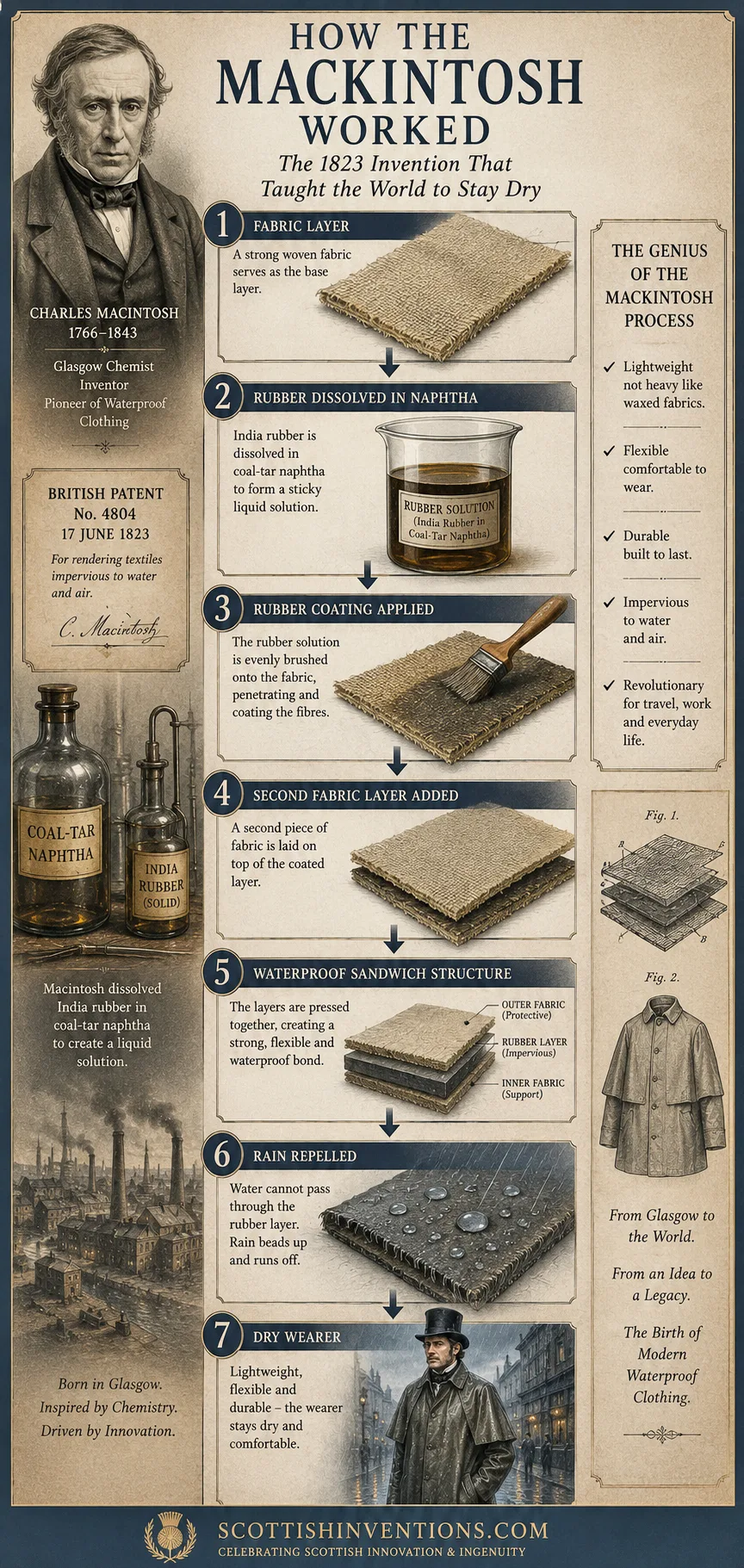
The Mackintosh process is one of those nineteenth-century inventions whose elegance comes from how simply each step builds on the last. Translated into the modern language of materials science, this is what Macintosh's patent describes:
- 1. Distil naphtha from coal tar. Coal tar — a sticky waste from the Glasgow Gas Works — is distilled to yield naphtha, a volatile hydrocarbon solvent.
- 2. Dissolve India rubber in the naphtha. Raw natural rubber, until then almost impossible to spread thinly, dissolves in the naphtha to form a sticky liquid solution.
- 3. Brush the rubber solution onto cloth. The solution is painted or rolled evenly onto a piece of woven fabric, penetrating between the fibres.
- 4. Press a second layer of cloth on top. A second fabric is laid over the wet rubber and pressed home, forming a three-layer "sandwich".
- 5. Let the naphtha evaporate. As the solvent evaporates, what remains between the two cloths is a thin, continuous, impermeable rubber film bonded to both.
- 6. Cut, sew and seal. The finished "double-textured" cloth is tailored into coats, capes, groundsheets and covers; in modern Mackintosh production the seams are still hand-glued and tape-sealed rather than only stitched.
- 7. The wearer stays dry. Rain beads up on the outer cloth and runs off; the rubber core blocks any water that does penetrate; the inner cloth keeps the rubber away from the skin.
Why the Coat Was Revolutionary
To eyes used to modern Gore-Tex shells, the Mackintosh can look quaintly clunky. To eyes used to 1820s outerwear, it was astonishing. Compared with the heavy, stiff, smelly waxed and oiled cloths it replaced, the Mackintosh was lightweight, flexible and genuinely waterproof. Rain did not soak through. The coat could be folded, packed and carried. It could be made in standard sizes by the yard from a mill. And, crucially, the principle scaled: the same "double-textured" cloth could be cut into capes for soldiers, groundsheets for armies, covers for cargo, aprons for industrial workers, hoods for fishermen and overshoes for travellers.
The coat conquered Britain. It clothed the British Army, the police and the railways; it became a staple of the upper and middle classes; and Macintosh secured a large military contract for rainproof cloth. The name entered the English language as a generic term for any raincoat — with one delightful quirk of spelling. The inventor spelled his name "Macintosh," but the garment acquired an extra "k" to become "mackintosh." The exact moment the "k" crept in is unknown, but the misspelling became standard, and a famous 1836 patent-infringement lawsuit only publicised the product further and cemented the altered name.
Early Problems and Improvements
The early garments were far from perfect. They smelled strongly of rubber and naphtha; they became stiff and board-like in cold weather and soft and sticky in the heat; the seams leaked because tailors' needles punctured the waterproof layer; and the natural oils in woollen cloth degraded the rubber cement. They were also expensive, and tailors disliked working with the awkward material. Reception was decidedly mixed — and a small chorus of unhappy customers helped seed the persistent myth that the Mackintosh was a failure rather than a foundation.
Hancock's masticator
Enter Thomas Hancock (1786–1865), the Englishman who founded the British rubber industry. Hancock had invented the "masticator" — a toothed machine, which he coyly called the "pickle," that shredded and re-kneaded rubber scraps into a soft, homogeneous, far more soluble mass. His masticated rubber dissolved into a stronger, more uniform solution than Macintosh's; in February 1826 he took a licence from Macintosh; by 1830 they were collaborating closely, and Hancock eventually became a partner in Charles Macintosh & Co.
Thomas Hancock and Vulcanisation
The decisive cure for rubber's instability was vulcanisation — heating rubber with sulphur to lock its molecules into stable cross-links. Charles Goodyear discovered the process in the USA in 1839 (famously, after dropping a rubber-sulphur mixture on a hot stove); Thomas Hancock, after examining Goodyear samples, independently patented vulcanisation in Britain on 21 November 1843, eight weeks before Goodyear's US patent of 30 January 1844. Hancock's friend William Brockedon coined the word "vulcanisation," after Vulcan, the Roman god of fire.
Vulcanised rubber resisted heat and cold, no longer rotted or stank, and the improved mackintosh that followed was a far better garment. By the 1850s and 1860s, the coat was a fixture of British public and military life — and the technology was being applied to belts, hoses, tyres, insulating sheets and gaskets, supplying the rubber backbone of industrial civilisation. The priority dispute between Goodyear and Hancock is contentious; both are normally credited together, and ScottishInventions.com treats both names with equal respect.
The Birth of Modern Waterproof Clothing
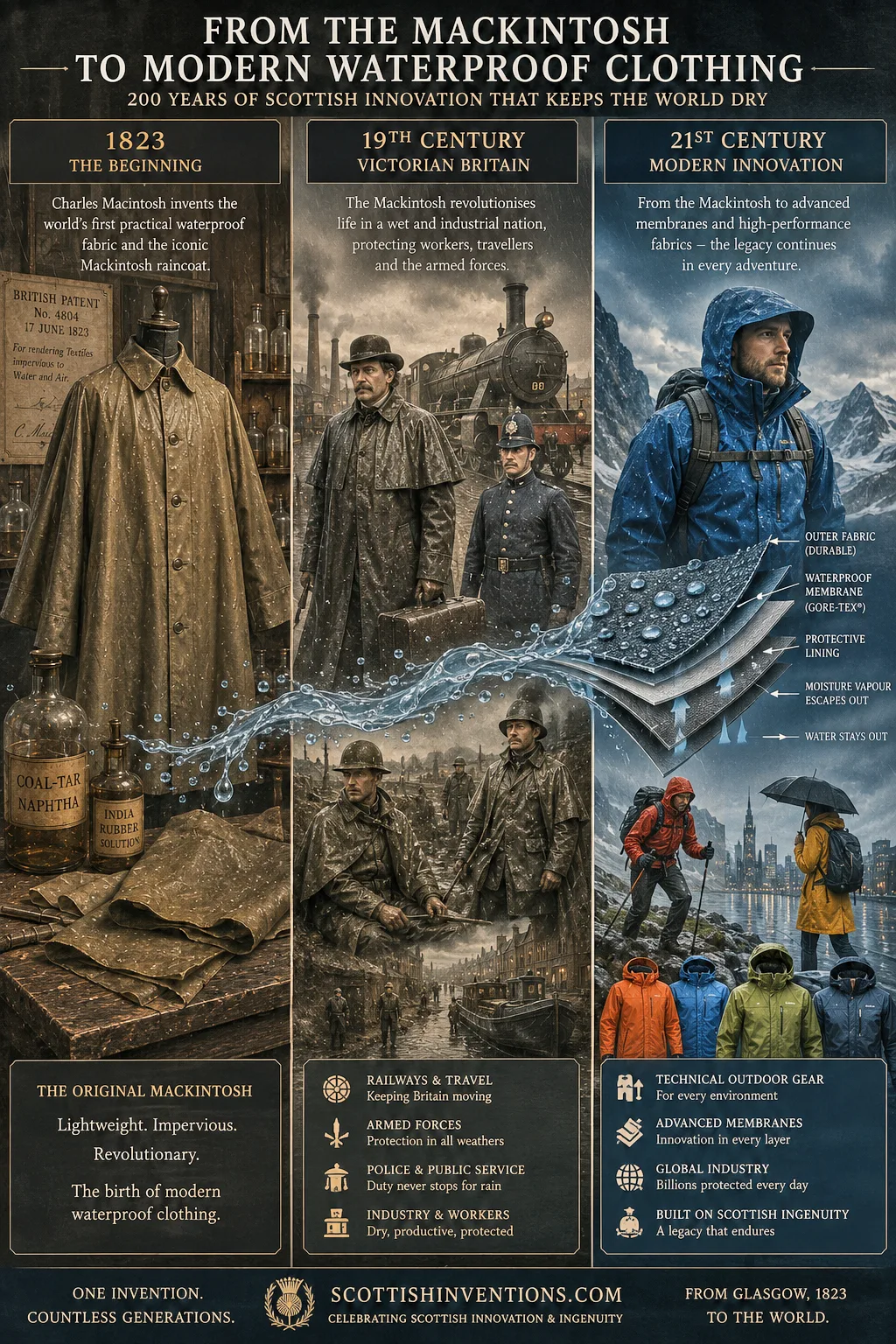
Macintosh's three-layer sandwich is the conceptual ancestor of every modern waterproof jacket. The materials have changed — natural rubber has been largely replaced by synthetic polymers, and breathable microporous membranes such as Gore-Tex have transformed the experience of wearing one — but the architecture is recognisably the same: a waterproof barrier laminated between, or bonded to, layers of textile. Even the way modern technical jackets are assembled — seam-sealed, taped, lap-bonded rather than only stitched — echoes the engineering problem Macintosh first ran into when tailors' needles leaked his rubber cement.
Other British heritage brands developed their own routes to the trench coat using different, breathable fabrics: Aquascutum (founded by John Emary) patented a waterproof wool in the 1850s, and Burberry (Thomas Burberry, 1879) invented breathable gabardine. They are pillars of British weatherproof style, but they are separate stories from Macintosh's rubberised cloth. The Mackintosh remains the only one of the three to have given its name to the entire category.
Legacy: From Glasgow 1823 to a Global Industry
The humble raincoat became a global industry. Modern market research valued the global rainwear sector at over USD 4 billion in 2024, and that figure does not begin to count the technical outdoor jackets, military waterproofs, industrial protective clothing and everyday rain gear whose engineering descends from the Mackintosh idea. The transition from rubberised cloth to modern synthetic waterproof membranes nearly bankrupted the original Mackintosh company in the 1980s and 1990s. But the underlying Macintosh principle — a waterproof layer bonded to, or sandwiched within, fabric — underlies every modern rain shell.
The original brand survives, and it is still a Scottish story. The bonded cotton is now produced in Japan and then delivered to the Mackintosh factory in Cumbernauld, Scotland, where, in the words of the company, "each seam is glued and taped by hand" using the bonded-cotton process descended directly from Macintosh's 1823 patent. Mackintosh has been owned by the Tokyo firm Yagi Tsusho since 2007 and has collaborated with fashion houses including Gucci, Hermès and Louis Vuitton. A genuine portrait of Macintosh — a mezzotint after a painting by John Graham Gilbert — is held by the National Galleries of Scotland. He was buried in the graveyard of Glasgow Cathedral, where his name is added to a seventeenth-century family monument.
Did You Know?
- The inventor spelled his name "Macintosh", but the coat became "mackintosh" — the extra "k" crept in during popular usage, and nobody knows exactly when.
- The mysterious "man in the macintosh" is one of the great unsolved riddles of James Joyce's Ulysses (1922): an unidentified mourner in a brown coat whose name the reporter Hynes mishears as "M'Intosh."
- Macintosh's coat is the conceptual ancestor of every modern waterproof jacket, including Gore-Tex shells used by mountaineers, sailors and emergency services worldwide.
- He was elected a Fellow of the Royal Society in 1823, honoured for his chemistry, not just his coat.
- Glasgow was already an industrial-chemistry powerhouse in the early 19th century — Macintosh was part of (and helped build) that tradition, alongside the great St Rollox works of Charles Tennant.
- Mackintosh coats are still made by hand in Cumbernauld, Scotland, with seams glued and taped using the bonded-cotton process descended from Macintosh's 1823 patent.
Myth vs Fact
Common claims about Charles Macintosh — and what the evidence actually says
Myth: Macintosh co-founded the Clydesdale Bank
Not supported by any reliable source. The Clydesdale Banking Company was founded in Glasgow in 1838 by James Lumsden and a committee of Glasgow businessmen. Charles Macintosh the chemist died only five years later and has no documented connection with the bank.
Myth: Charles Macintosh designed the Glasgow School of Art
A persistent confusion. Charles Macintosh (1766–1843), the chemist, is unrelated to Charles Rennie Mackintosh (1868–1928), the Glasgow architect and designer, born more than a century later and with a different surname.
Myth: Macintosh just glued rubber onto cloth
The patented invention is the sandwich: a rubber layer dissolved in coal-tar naphtha and bonded between two layers of fabric, with the rubber hidden inside. Single-sided rubber-coated cloth had already been tried and was a failure.
Fact: James Syme discovered naphtha dissolves rubber first
Yes — Scottish surgeon James Syme published the observation in 1818. But Syme never patented it and never proposed a waterproof garment. The practical fabric and the industry built on it were Macintosh's distinct contribution.
Timeline of Waterproof Clothing
- 1766
Born in Glasgow
Charles Macintosh is born on 29 December 1766, the son of George Macintosh, a Glasgow merchant and dye manufacturer.
- 1786
Leaves the counting-house
Before he is twenty, Macintosh abandons his clerkship to manufacture chemicals, including sal ammoniac from gas-works soot and lead acetate.
- 1797
Scotland's first alum works
Aged 23, Macintosh establishes Scotland's first alum works at Hurlet, Renfrewshire, ingeniously using waste shale from coal mines as raw material.
- 1799
Bleaching powder
Working with Charles Tennant at St Rollox, Macintosh helps develop dry bleaching powder — a chlorine and slaked-lime compound that slashes textile bleaching times from months to days.
- 1819
Coal-tar contract
Macintosh contracts with the Glasgow Gas Works to take away their waste ammonia and coal tar, leading him to distil the tar into naphtha.
- 1823
British Patent No. 4804
On 17 June 1823 Macintosh is granted his waterproof-fabric patent. He is elected a Fellow of the Royal Society the same year. The first Mackintosh coat is reportedly sold in Glasgow on 12 October.
- 1825–26
Hancock licence
Thomas Hancock takes a licence under the patent in February 1826; his rubber masticator dramatically improves the rubber solution and the resulting cloth.
- 1828
Hot-blast iron
Macintosh partners James Beaumont Neilson in exploiting the hot-blast furnace process that transforms Scotland's iron industry.
- 1839
Goodyear discovers vulcanisation
In the United States, Charles Goodyear discovers that heating rubber with sulphur produces a stable, weather-resistant material — vulcanised rubber.
- 1843
Hancock patents vulcanisation in Britain
Thomas Hancock independently patents vulcanisation in Britain on 21 November 1843, eight weeks before Goodyear's US patent. The improved mackintosh conquers the world. Macintosh dies at Dunchattan on 25 July 1843.
- 1922
'Man in the macintosh'
The mysterious 'man in the macintosh' appears in James Joyce's Ulysses, cementing the coat's place in twentieth-century literature.
- Modern day
Cumbernauld and Gore-Tex
Mackintosh coats are still hand-finished in Cumbernauld, Scotland; the underlying principle of a waterproof layer bonded to fabric powers every modern rain jacket, from Gore-Tex shells to technical outdoor clothing.
Further Reading
- Encyclopaedia Britannica — biographical entry on Charles Macintosh.
- The Royal Society — Fellowship records and biographies of Scottish chemists, including Macintosh (FRS, 1823).
- National Galleries of Scotland — holdings of nineteenth-century Scottish portraits, including the mezzotint after John Graham Gilbert's painting of Charles Macintosh.
- Glasgow Museums — primary collections on Glasgow's industrial and chemical history.
- National Library of Scotland — manuscripts, patents and trade literature on the Scottish chemical industry.
- Science Museum, London — collections on the history of rubber, vulcanisation and waterproof clothing.
- Historic Environment Scotland — records relating to Glasgow Cathedral and the Macintosh family monument.
- Mackintosh — official heritage brand site, with information on the Cumbernauld factory and bonded-cotton production.
- Macintosh, G. (1847), Biographical Memoir of the Late Charles Macintosh, F.R.S., Glasgow.
Frequently Asked Questions
›Who invented the Mackintosh raincoat?
The Mackintosh raincoat was invented by Charles Macintosh (1766–1843), a Glasgow chemist. He patented the waterproof fabric on which it was made on 17 June 1823 as British Patent No. 4804, for 'rendering the texture of hemp, flax, wool, cotton, silk, and also leather, paper and other substances impervious to water and air.' The first coat made from his rubberised cloth was reportedly sold in Glasgow on 12 October 1823, less than four months after the patent was granted.
›Who was Charles Macintosh?
Charles Macintosh was a Scottish chemist and industrialist, born in Glasgow on 29 December 1766 and died at Dunchattan, near Glasgow, on 25 July 1843. The son of dye manufacturer George Macintosh, he became one of the founding figures of the Scottish chemical industry — manufacturing bleaching powder with Charles Tennant, opening Scotland's first alum works at Hurlet in 1797, working with James Beaumont Neilson on the hot-blast iron process, and producing sal ammoniac, lead acetate and dyes. He was elected a Fellow of the Royal Society in 1823, the same year he patented his waterproof fabric.
›How was the first waterproof fabric invented?
Macintosh's breakthrough came from his industrial chemistry. From 1819 he contracted with the Glasgow Gas Works to take away their waste products, including sticky black coal tar. By distilling the tar he obtained naphtha, a volatile oily liquid. He discovered that this coal-tar naphtha would dissolve natural rubber into a workable, glue-like solution. Rather than simply painting the rubber onto cloth — which produced a stiff, smelly, cracking surface — he sandwiched the rubber layer between two pieces of fabric and let the naphtha evaporate, producing a flexible 'double-textured' waterproof cloth.
›What is British Patent No. 4804?
British Patent No. 4804 was granted to Charles Macintosh on 17 June 1823 for 'rendering the texture of hemp, flax, wool, cotton, silk, and also leather, paper and other substances impervious to water and air.' It is the foundational patent for the modern waterproof garment industry. The patent did not protect a particular coat design — it protected the chemical process of bonding a rubber layer between two layers of fabric using a solution of rubber in coal-tar naphtha.
›How does a Mackintosh coat work?
A traditional Mackintosh coat is built from a three-layer 'sandwich' fabric: an outer cloth, a thin impermeable layer of natural rubber, and an inner cloth. The rubber layer blocks the passage of water; the inner and outer cloths protect the rubber from abrasion and hide its tackiness. Because the seams of an early Mackintosh leaked where tailors' needles punctured the waterproof core, modern Mackintosh coats made in Cumbernauld are still hand-glued and tape-sealed using the bonded-cotton process descended directly from Macintosh's 1823 patent.
›Why was coal-tar naphtha important?
Coal-tar naphtha was the solvent that made the Mackintosh process possible. Macintosh was already taking waste tar and ammonia from the Glasgow Gas Works for his cudbear dye business when he discovered that the naphtha he distilled from the tar would dissolve raw India rubber. Without a practical rubber solvent, rubber could not be spread thinly and evenly across cloth; with naphtha, it could be brushed on as a liquid and then dried into a continuous waterproof film.
›Who was Thomas Hancock?
Thomas Hancock (1786–1865) was the English engineer who founded the British rubber industry. He invented the rubber 'masticator' — a toothed machine he coyly called the 'pickle' — that shredded and re-kneaded rubber scraps into a soft, far more soluble mass. In February 1826 he took a licence under Macintosh's patent; by 1830 the two men were close collaborators, and Hancock eventually became a partner in Charles Macintosh & Co. He went on to patent vulcanisation in Britain in November 1843.
›What is vulcanisation?
Vulcanisation is the process of heating natural rubber with sulphur so that the long rubber molecules form stable cross-links. The vulcanised material no longer melts in heat or stiffens in cold, no longer smells of raw rubber, and resists abrasion. Charles Goodyear discovered the process in the United States in 1839; Thomas Hancock independently patented it in Britain on 21 November 1843, eight weeks before Goodyear's US patent of 30 January 1844. Vulcanised rubber cured the early Mackintosh's worst flaws and turned it into a durable mass-market garment.
›Is Gore-Tex based on Macintosh's invention?
Yes, in principle. Gore-Tex and other modern waterproof membranes are not made from rubber and naphtha; they use a thin microporous polymer (expanded PTFE) bonded to a face fabric and a lining. But the underlying idea — laminating a waterproof barrier between layers of textile so the wearer stays dry while the surfaces remain flexible — is exactly the principle Macintosh patented in 1823. Every modern rain shell is, in this sense, a great-great-grandchild of the Mackintosh process.
›Why is the Mackintosh still famous today?
The Mackintosh became a global icon for three reasons: it worked, it was instantly recognisable, and its name passed into the English language as a generic word for a raincoat. It clothed the Victorian British Army, the police and the railways; it crossed into literature most famously as the mysterious 'man in the macintosh' in James Joyce's Ulysses (1922); and the brand still finishes its rubberised coats by hand at its factory in Cumbernauld, Scotland, today, having been owned by the Tokyo firm Yagi Tsusho since 2007.
›Why is it spelled 'mackintosh' when the inventor was Macintosh?
The inventor spelled his name 'Macintosh' — without a 'k'. The garment, by contrast, became known as a 'mackintosh' with an extra 'k', and that misspelling became standard. The precise moment the 'k' crept into the garment name is not recorded; it appears to have crystallised in popular usage during the mid-nineteenth century. ScottishInventions.com follows the historical convention: 'Macintosh' for the man, 'mackintosh' for the coat.
›Was Charles Macintosh related to Charles Rennie Mackintosh?
No. Charles Macintosh (1766–1843), the Glasgow chemist who invented waterproof fabric, is frequently confused with Charles Rennie Mackintosh (1868–1928), the Glasgow architect and designer of the Glasgow School of Art. They are two entirely different people, born more than a century apart, with different surnames (Macintosh versus Mackintosh). Any portrait, plaque or biography that conflates the two is mistaken.
›Did Charles Macintosh help found the Clydesdale Bank?
No — this is a persistent myth that should not be repeated. The Clydesdale Banking Company was founded in Glasgow in 1838 by James Lumsden and a committee of Glasgow businessmen. No credible primary source links Charles Macintosh the chemist to the founding of the bank, and he died only five years later. The claim appears to stem from confusion with other Glasgow Macintoshes of the period.
›Did James Syme really discover that naphtha dissolves rubber?
Yes — and the record deserves to be told honestly. The Scottish surgeon James Syme published in Thomson's Annals of Philosophy in 1818 that naphtha distilled from coal tar would dissolve rubber. Syme never patented the idea, never proposed the sandwich construction, and never built a waterproof garment industry around it. The chemical observation was Syme's; the practical, patented invention of the double-textured waterproof fabric — and the company that made it a global product — was Macintosh's.
›Where is Charles Macintosh buried?
Charles Macintosh died at Dunchattan, near Glasgow, on 25 July 1843 and is buried in the graveyard of Glasgow Cathedral, where his name was added to a seventeenth-century Macintosh family monument. His son George published a Biographical Memoir of his father in 1847.