Scottish Inventions · Communications
Alexander Bain: The Caithness Crofter's Son Who Invented the World's First Fax Machine — in 1843
Thirty-three years before the telephone, a self-taught Scottish clockmaker patented British Patent No. 9745 — the founding document of image transmission and the conceptual ancestor of every fax, scanner and digital photograph since.
Introduction
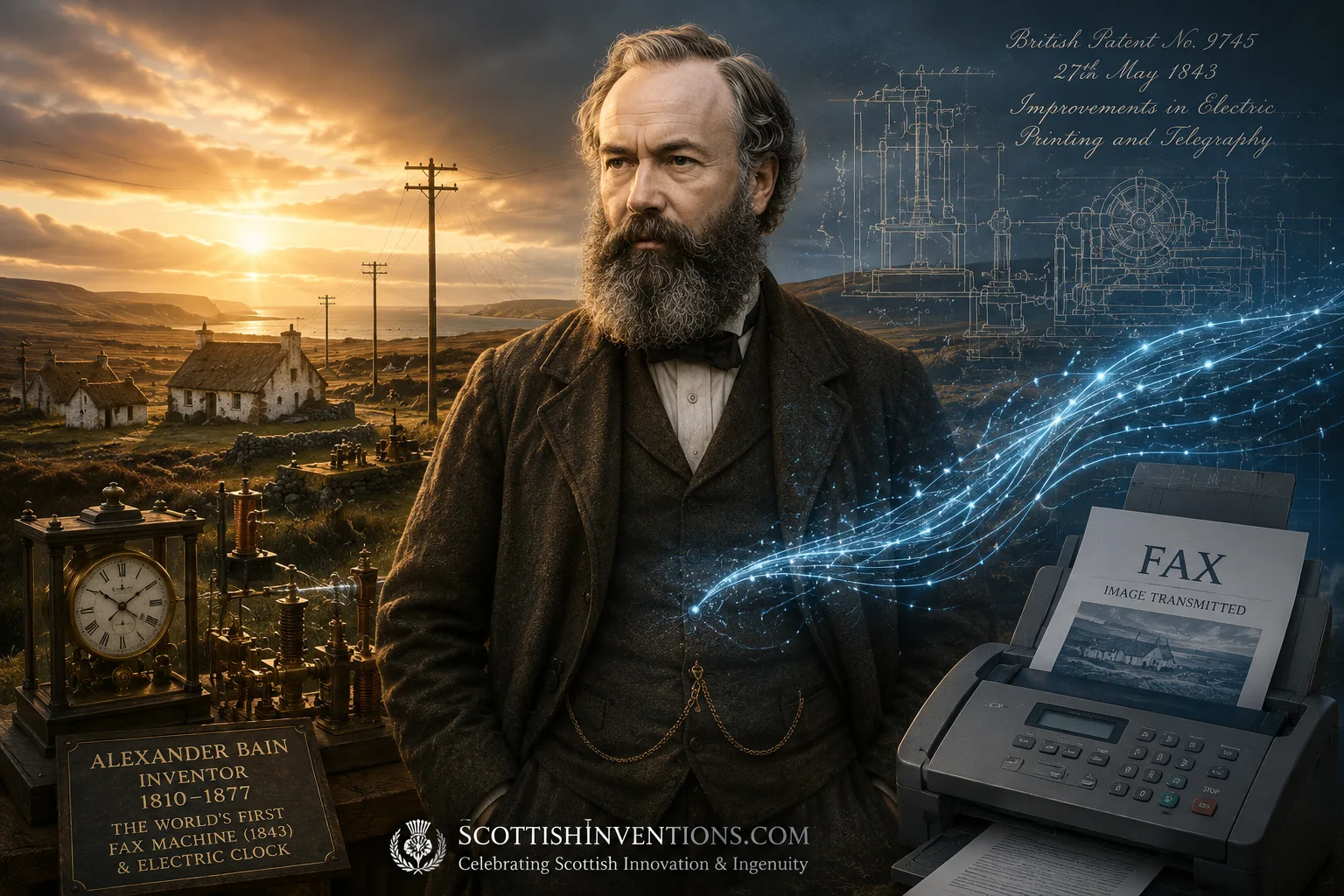
On the morning of 27 May 1843, a thirty-two-year-old Scottish clockmaker named Alexander Bain walked away from the British Patent Office with a single sheet of paper — British Patent No. 9745 — that quietly invented the modern world. It described a machine that could scan a written page, send it down a telegraph wire as electrical pulses, and rebuild it as a copy at the other end. It was, in every essential sense, the world's first fax machine.
Bain was a crofter's son from the parish of Watten in Caithness, near the very top of mainland Britain. He had been bottom of his class at school, indifferent at shepherding, and self-taught in electromagnetism. Yet the principle he set down in 1843 — scanning an image line by line and transmitting it as pulses — is the same principle that underlies television, every digital image sensor, every flatbed scanner, every chest x-ray sent to a specialist and every photograph posted to the internet. In 2016 the National Academy of Television Arts & Sciences agreed, awarding him a posthumous Technology & Engineering Emmy "for inventing the concept of scanning for image transmission". He had been dead 139 years.
On this page
- Key Takeaways
- Quick Facts
- Early Life in Caithness
- The Problem Bain Solved
- How the Copying Telegraph Worked
- The World's First Fax Machine
- Patent Battles
- How the World's First Fax Machine Worked
- From Bain to the Modern Fax
- Legacy in Television and Digital Communications
- Did You Know?
- Myth vs Fact
- Timeline
- Lasting Legacy
- Related Scottish Inventions
- Further Reading
- FAQ
Key Takeaways
- Alexander Bain (1810–1877), a self-taught Scottish clockmaker from the parish of Watten, Caithness, invented the world's first facsimile transmission system — the copying telegraph — in British Patent No. 9745 dated 27 May 1843, 33 years before the telephone.
- The machine scanned a metal-type message line by line, transmitted electrical pulses down a telegraph wire and reconstructed the image on chemically treated paper, kept in step by Bain's own electric clock.
- Bain's career was defined by priority disputes. He defeated Sir Charles Wheatstone at a House of Lords committee (£10,000 in compensation; Wheatstone resigned) but was ruined by Samuel Morse's injunction in the United States, decided in O'Reilly v. Morse (1853).
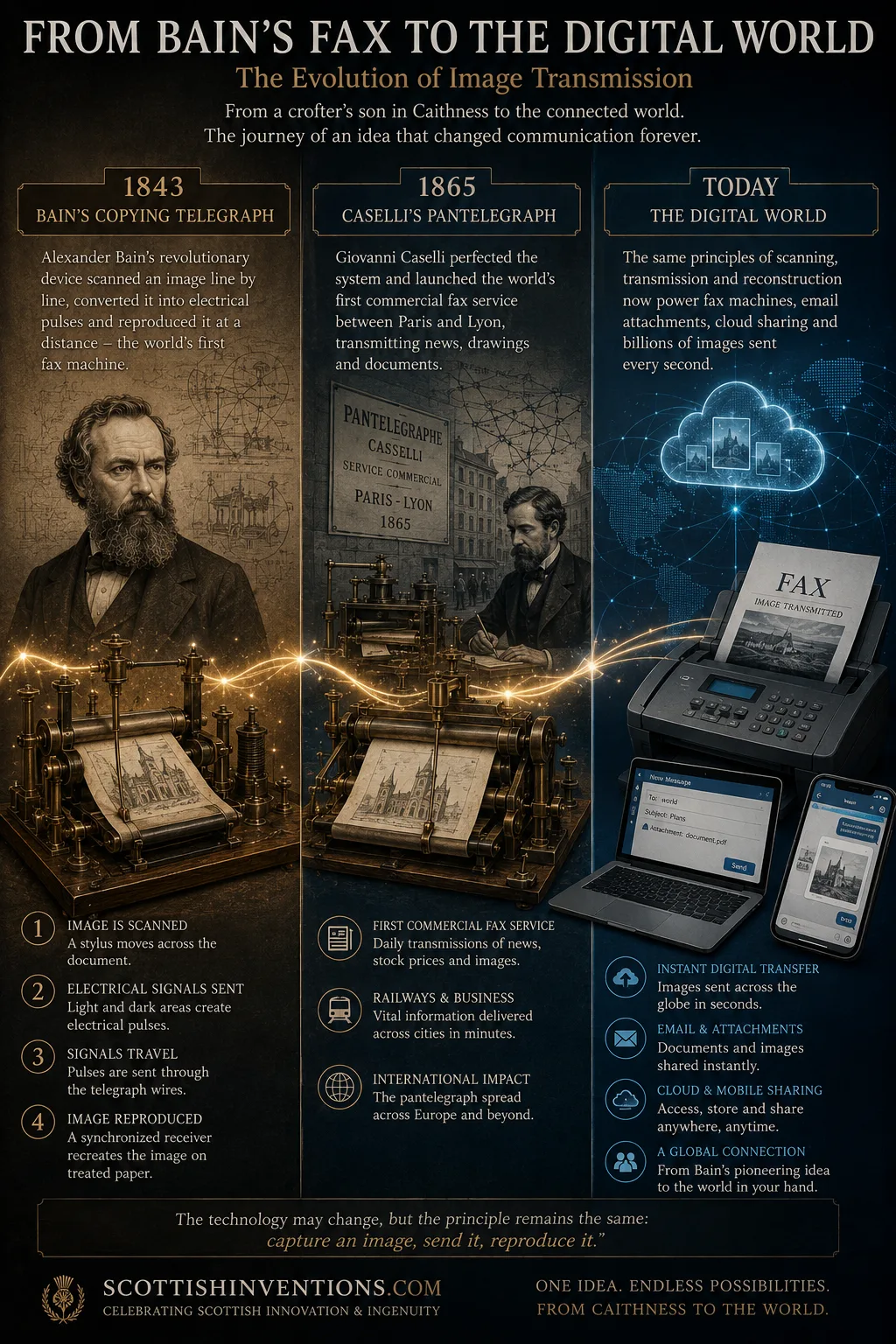
- The line of descent runs directly from Bain (1843) through Bakewell's improved image telegraph (1848) to Giovanni Caselli's pantelegraph, which ran the world's first commercial fax service between Paris and Lyon from 1865.
- Bain died nearly destitute in Kirkintilloch on 2 January 1877, surviving on an £80-a-year Civil List pension arranged by Lord Kelvin. In 2016 he was awarded a posthumous Technology & Engineering Emmy for inventing the concept of scanning for image transmission.
Quick Facts
Born Watten, 1810
Born October 1810 in the parish of Watten, Caithness; baptised 22 November 1810. One of thirteen children of a tenant crofter.
Clockmaker turned electrician
Apprenticed to Wick clockmaker John Sellar, then worked in Edinburgh and London — Clerkenwell, the heart of British horology.
British Patent No. 9745
Granted 27 May 1843: 'electric printing, and signal telegraphs'. The founding patent of image transmission.
Chemical telegraph, 1846
Second patent (12 December 1846, with Robert Smith) for a high-speed chemical text telegraph — far faster than Morse.
Won against Wheatstone
House of Lords committee awarded Bain £10,000 in total; Wheatstone resigned from the Electric Telegraph Company.
Posthumous Emmy, 2016
Awarded a Technology & Engineering Emmy on 8 January 2016 'for inventing the concept of scanning for image transmission.'
- Inventor
- Alexander Bain (1810–1877)
- Birth
- October 1810, parish of Watten, Caithness, Scotland
- Invention
- The copying telegraph — the world's first fax machine
- Patent Number
- British Patent No. 9745
- Patent Date
- 27 May 1843
- Place
- London (workshop, Hanover Street, Clerkenwell)
- Significance
- First electrical image transmission; founding patent of facsimile
- Legacy
- Fax, scanners, television raster scanning, digital image transmission; posthumous Emmy (2016)
Early Life in Caithness
Alexander Bain was born in October 1810 in the parish of Watten, a windswept scatter of crofts in Caithness, in the far north of Scotland. He was one of thirteen children of John Bain, a tenant crofter, and his wife Isabella; Alexander had a twin sister, Margaret. The family worked a croft in peaty country between Thurso and Wick.
It should be said plainly that several of the most-repeated "facts" about Bain's birth are unreliable. Popular websites confidently quote "12 October 1811", but the Oxford Dictionary of National Biography and the Watten memorial both give 1810, and he was baptised on 22 November 1810 — a date incompatible with an 1811 birth. The exact hamlet is also disputed: the ODNB names Houstry, the physicist and Bain scholar Ivan Ruddock says Backlass Hill, and local tradition says Leanmore. All agree only that it was the parish of Watten.
Young Alexander was, by every account, a poor scholar — bottom of his class at the school in Backlass — and an indifferent shepherd, forever daydreaming. But he was fascinated by machinery, and is said to have built himself a working model clock using heather for the springs and cogs. A sympathetic father got him apprenticed, around the age of twenty, to John Sellar, a clockmaker in Wick. As an apprentice he attended a public lecture in Thurso entitled "Light, Heat and the Electric Fluid" — and was captivated. The "humble lad walking behind" the lecturer, straining to hear every word, never forgot it.
After roughly seven years learning his trade, Bain left the north, working briefly in Edinburgh before moving in 1837 to London — to Clerkenwell, then the heart of British clock- and watch-making. He worked as a journeyman, haunted the science lectures at the Polytechnic Institution and the Adelaide Gallery, and was especially drawn to demonstrations of electromagnetism. He set up his own workshop in Hanover Street. It was here, around 1840, that Bain — chronically short of money — was introduced through the editor of the Mechanics' Magazine to the chronometer maker John Barwise, who partnered with him on his first electric-clock patent, and to the eminent natural philosopher Sir Charles Wheatstone, who would become his nemesis.
The Problem Bain Solved: Telegraphy on the Cusp
To understand why Bain's invention mattered, picture the state of electrical communication in the late 1830s. In 1837 two rival systems appeared almost simultaneously. In Britain, William Fothergill Cooke and Charles Wheatstone patented their electric telegraph on 12 June 1837, using electric currents to swing magnetic needles that pointed to letters on a board. In America, Samuel F. B. Morse independently developed a recording telegraph and, with Alfred Vail, the dot-and-dash code that bears his name; on 24 May 1844 Morse sent his famous first message — "What hath God wrought" — from Washington to Baltimore.
These systems were revolutionary, but limited. They could transmit only coded signals — needle deflections or dots and dashes — which required trained operators at both ends to encode and decode every message. They could not send a document, a drawing, a signature, or a picture. The compelling next question was obvious: if electricity could carry a coded pulse, could it carry the pattern of light and dark that makes up a written page? Could a document be reproduced at a distance? It was Bain, the Caithness clockmaker, who answered first.
How Bain's Copying Telegraph Worked
Bain's conceptual leap was the idea of scanning. On 27 May 1843 he was granted British Patent No. 9745 — the document now recognised as the ancestor of the fax machine. Its title is dense — "improvements in producing and regulating electric currents and improvements in timepieces, and in electric printing, and signal telegraphs" — but its mechanism, explained simply, looks like this.
At the transmitting end
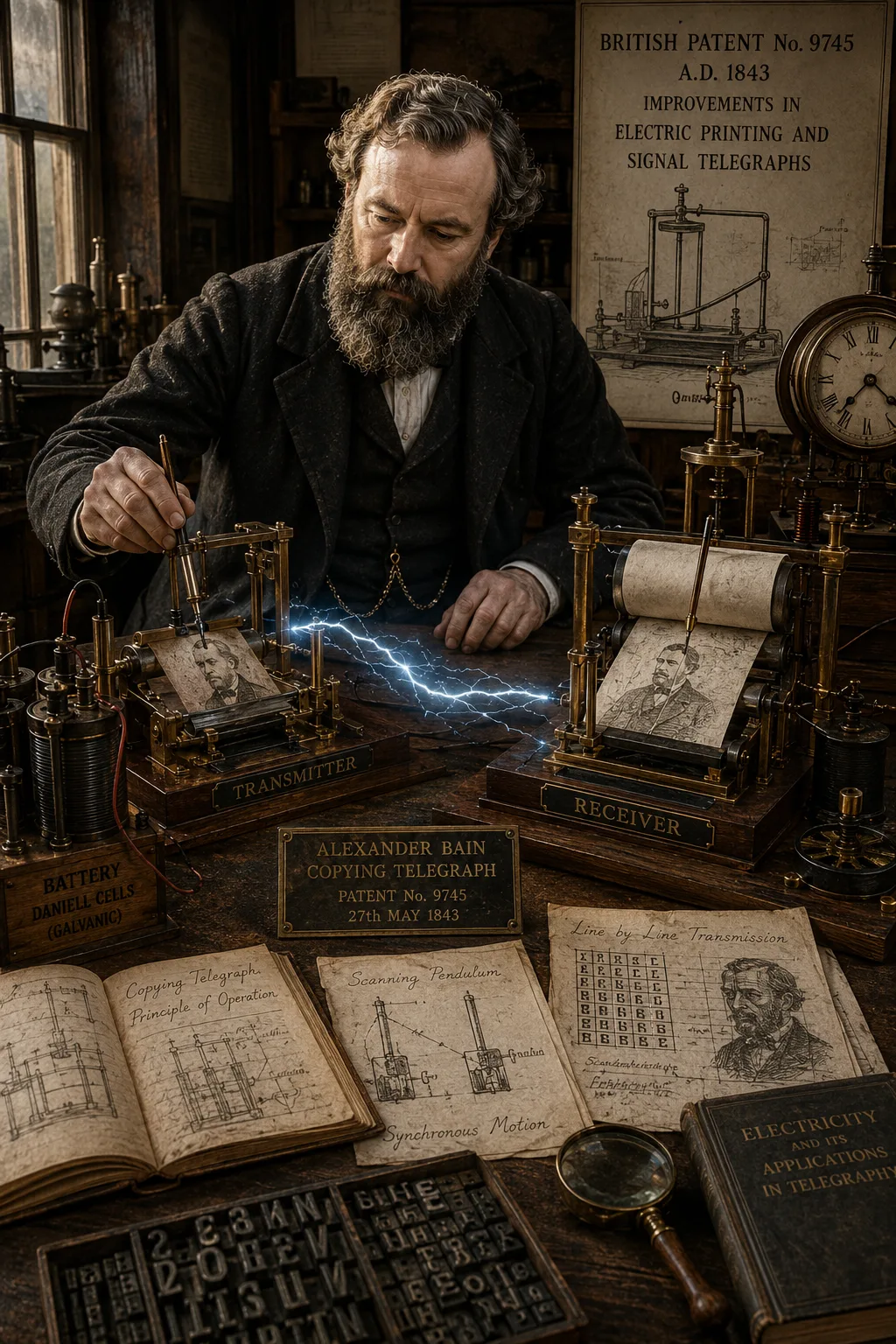
A message composed of raised metal type — identical to printer's type — was mounted on a flat surface. A stylus mounted on a swinging pendulum passed across the surface, line by line. When the stylus touched raised metal, it completed an electrical circuit; when it passed over a gap, the circuit broke. The result was a stream of electrical pulses corresponding exactly to the light and dark of the original.
At the receiving end
A second stylus swung in step across paper soaked in a chemical solution. When a pulse arrived, the current caused a chemical reaction that left a dark mark on the paper; where no pulse arrived, the paper stayed blank. Point by point, line by line, the original was rebuilt as a copy at the far end.
The crucial trick: synchronisation
The two pendulums had to swing in exact unison, or the copy would be gibberish — and here Bain's genius as a clockmaker came into play. He proposed using his own electric clock mechanism to keep the transmitting and receiving pendulums in step. As both original and copy were slowly lowered after each swing, the whole surface was scanned. In Bain's own patent words, "a copy of any other surface composed of conducting and non-conducting materials can be taken by these means." That sentence is the conceptual birth certificate of the fax machine.
"A copy of any other surface composed of conducting and non-conducting materials can be taken by these means."
The World's First Fax Machine
This is, in principle, exactly what a fax machine does: scan, transmit, reconstruct. The image quality of Bain's experimental apparatus was poor, and synchronisation over long distances remained a practical headache. Bain himself probably never performed a true long-distance image transmission. But his patent made facsimile feasible, and contained every essential idea. In April 1844 The Times described him as "a most imaginative and meritorious inventor."
In a separate strand of work, Bain — with the Perthshire chemistry lecturer Robert Smith — patented the chemical telegraph on 12 December 1846. This was a faster text telegraph: instead of moving heavy mechanical parts, the signal current itself made a mark directly on chemically treated paper (a strip soaked in a solution that turned blue when current passed). With no mechanical inertia to overcome, it was dramatically faster than Morse's instrument. A Continental speed trial between Paris and Lille is traditionally said to have clocked 282 words in 52 seconds, against Morse's roughly 40 words per minute — figures that should be treated as nineteenth-century biography rather than primary measurement.
Patent Battles: Wheatstone, Morse and Bain
Bain's career was defined as much by who he fought as by what he built. The pattern was always the same: the inventive genius, lacking money and connections, cheated of his proper reward.
Wheatstone vs Bain
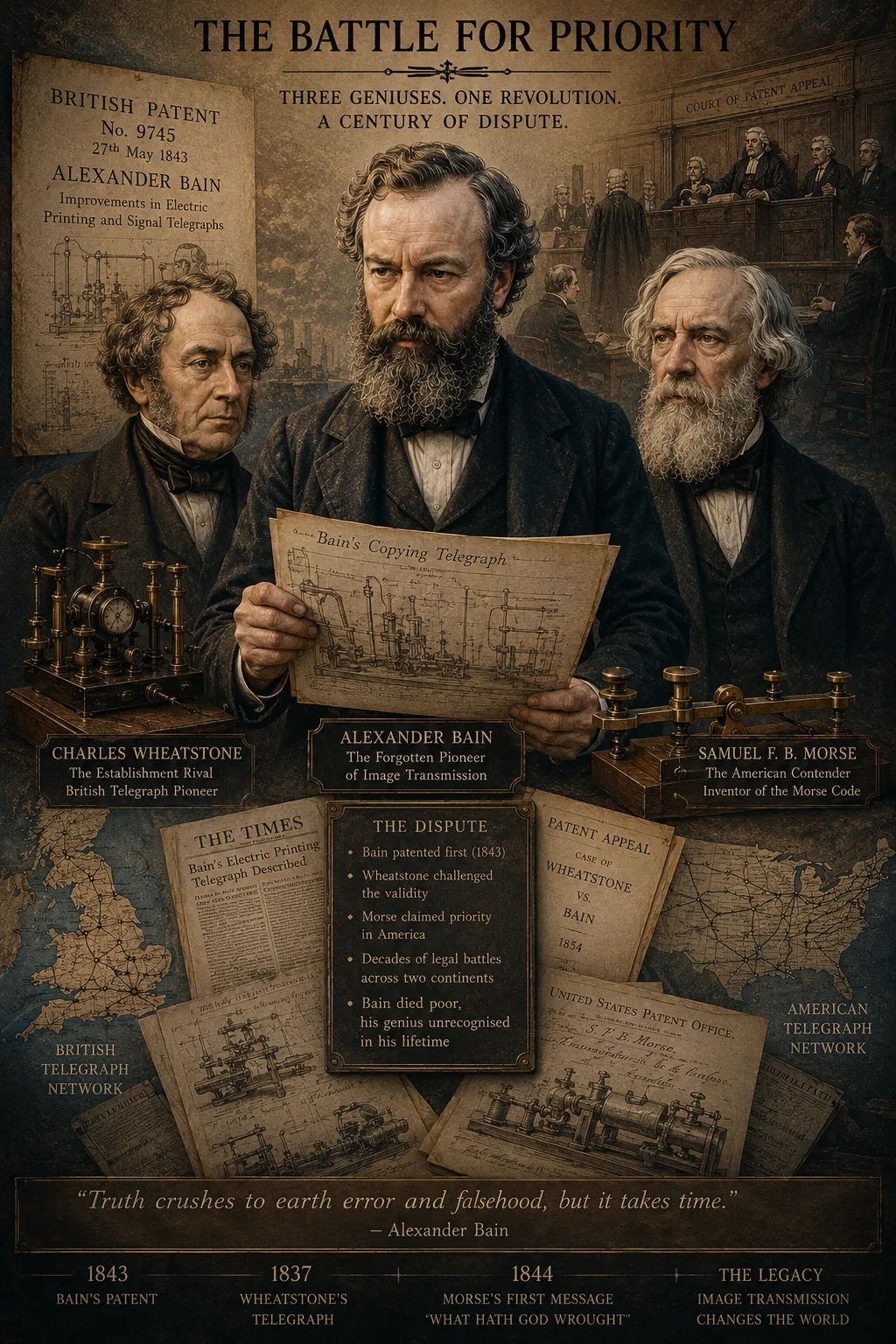
The first and most notorious clash was with Sir Charles Wheatstone. In 1840 Bain demonstrated his electric-clock models to Wheatstone, who — when asked his opinion — reportedly said, "Oh, I shouldn't bother to develop these things any further! There's no future in them." Three months later, Wheatstone demonstrated an electric clock to the Royal Society as his own invention. But Bain had already applied for his patent (granted, with Barwise, in January 1841). Wheatstone tried to block him and failed.
The dispute came to a head when Wheatstone and Cooke's Electric Telegraph Company sought an Act of Parliament. Bain objected, citing his 1843 patent. After both Bain and Cooke gave evidence, a House of Lords committee found in Bain's favour: the company paid him £7,500 in compensation plus £2,500 for the use of his printing-telegraph patents, agreed to manufacture and market his clocks with a profit share, and made him a shareholder. Wheatstone resigned in fury. For once, the Highland clockmaker had won.
Morse vs Bain
The second great battle, against Samuel Morse, ended very differently. When Bain went to the United States in 1848 to exploit the American railway boom, he applied for a US patent on his chemical telegraph. Morse opposed it on grounds of priority. Bain appealed to the federal court, which accepted the priority of his British patent and overruled the Patent Office; he and Smith received their US patent in October 1849. For a time his chemical telegraph was licensed to Henry O'Reilly and ran on more than 2,000 route miles of American lines.
But Morse struck again, obtaining an injunction in 1851 for infringement of his sweepingly broad 1840 patent. The case reached the US Supreme Court — O'Reilly v. Morse (1853) — which ruled for Morse, though, as scant comfort to Bain, it rejected Morse's broadest, unimplemented claims. That distinction between a broad idea and a specific implementation remains a landmark of patent law to this day. Bain returned to Britain financially ruined.
There was a third quarrel, too. While Bain was in America, the London writer-inventor Frederick Bakewell — who had seen Bain's copying-telegraph schematic — publicly announced an "image telegraph" in The Spectator in April 1848 as his own. Bain returned to find his idea claimed by another, and a public squabble in the periodicals followed.
How the World's First Fax Machine Worked — Step by Step
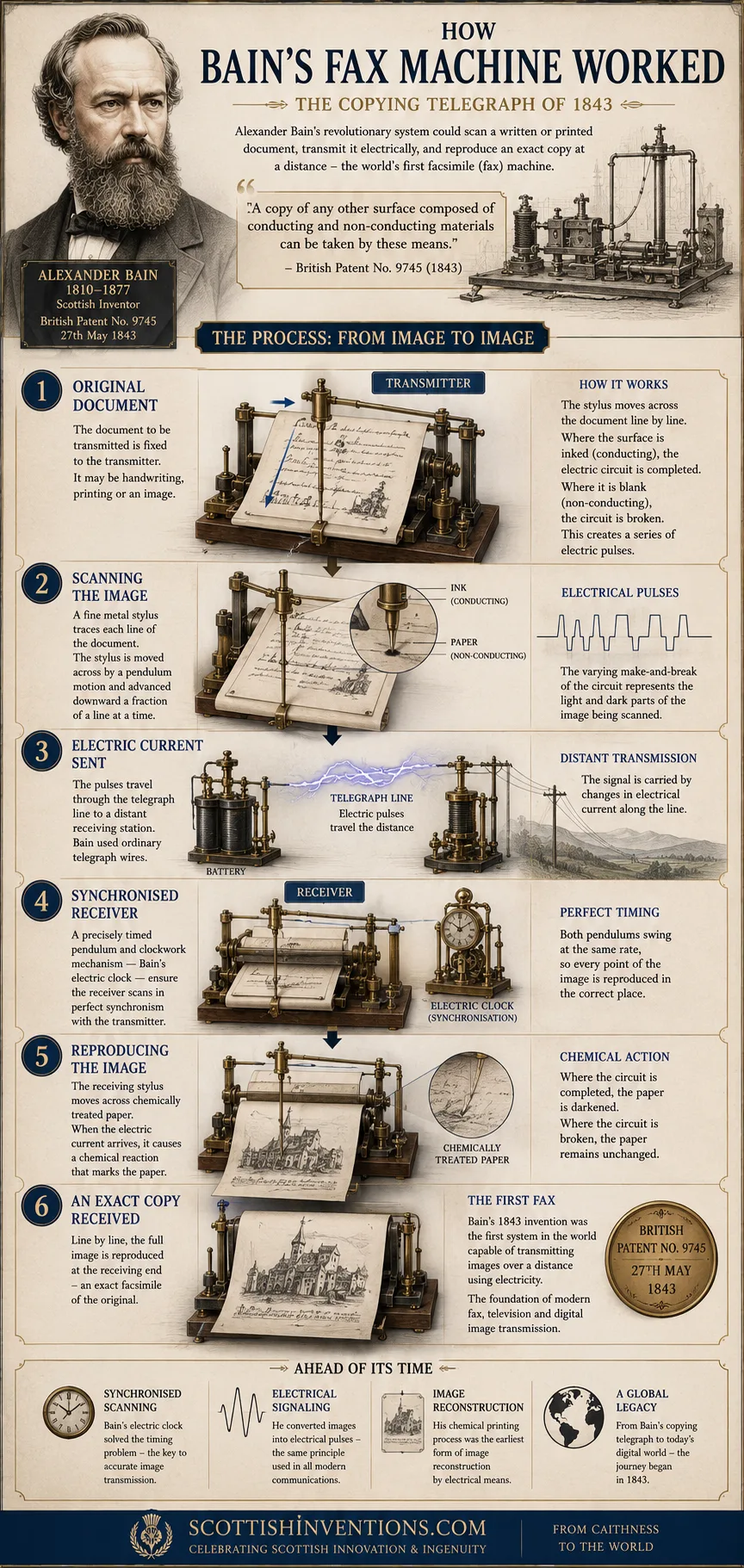
- 1. Original document. The message — handwriting, printing or an image — was fixed to the transmitter as raised metal type or a conducting plate.
- 2. Scanning the image. A fine metal stylus, driven by a swinging pendulum, traced each line of the document, advanced downward a fraction at a time, and converted light and dark into a stream of electrical pulses.
- 3. Electric current sent. The pulses travelled along ordinary telegraph wires — Bain used the same lines being strung across Britain in the 1840s — to a distant receiving station.
- 4. Synchronised receiver. A precisely timed pendulum and clockwork mechanism — Bain's electric clock — kept the receiver scanning in perfect synchronism with the transmitter, so every point of the image was reproduced in the correct place.
- 5. Reproducing the image. The receiving stylus moved across chemically treated paper. When the current arrived, a chemical reaction marked the paper; where no current arrived, the paper stayed blank.
- 6. An exact copy received. Line by line, the full image was reproduced at the receiving end — an exact facsimile of the original, the world's first true transmitted picture.
From Bain to the Modern Fax
Here a popular myth must be corrected. Many websites claim Bain gave a public demonstration of his chemical telegraph between Edinburgh and London in 1848. There is no scholarly support for this; in 1848 Bain was in fact emigrating to America. The confusion appears to blend his genuine Edinburgh–Glasgow railway telegraph line (built 1845–46, 46 miles long, used to send time from a master clock in Edinburgh to a slave clock in Glasgow) with the year 1848 and with the chemical telegraph's real English deployment on the Electric Telegraph Company's lines.
The genuine line of descent from Bain to the modern fax runs clearly. Frederick Bakewell improved Bain's design in 1848, replacing the swinging pendulums with synchronised rotating cylinders, and demonstrated his version at the Great Exhibition of 1851 — where Bain, too, exhibited and won a medal. The decisive step to commercial reality came from the Italian physicist (and abbé) Giovanni Caselli, whose pantelegraph — a giant machine using a regulating pendulum clock to keep transmitter and receiver in step — entered service as the world's first commercial fax service, between Paris and Lyon, in 1865, eleven years before the telephone. This is confirmed by the IEEE (Bonnier, "A Florentine in Paris: The Caselli pantelegraph and its successors, 1859–1871"). Caselli had patented the pantélégraphe in Europe (No. 2,532, 1861) and the United States (No. 37,563, 1863). Every one of these machines descended from the principle Bain set down in 1843.
The modern fax machine evolved through Caselli (1865), Elisha Gray's "telautograph" (US patent, 1888) and Arthur Korn's photoelectric Bildtelegraph — Korn first transmitted a photograph in 1904, sent a photo of Crown Prince William over 1,800 km on 17 October 1906 using selenium photoelectric cells, and in 1923 successfully transmitted an image of Pope Pius XI across the Atlantic from Rome to Bar Harbor, Maine — through AT&T and RCA's wirephoto systems of the 1920s, and finally the standardised digital fax machines that flooded offices in the 1980s. At the head of that lineage stands Bain.
Legacy in Television and Digital Communications
More profoundly, Bain's concept of breaking an image into scanned lines anticipated television — fellow Scot John Logie Baird and other pioneers used exactly the same raster-scanning idea — and, ultimately, every digital image transmitted across the internet. It was precisely this insight that earned Bain a posthumous Technology & Engineering Emmy, awarded by the National Academy of Television Arts & Sciences on Friday 8 January 2016 at a Las Vegas ceremony "for inventing the concept of scanning for image transmission"; the statuette is displayed in Kirkintilloch Town Hall.
The fax he fathered is, remarkably, not dead. The technology persists most stubbornly in healthcare — at least 70% of US health-care providers still exchange medical information by fax, according to Steve Posnack of the US Office of the National Coordinator for Health Information Technology — as well as in legal, government and Japanese business sectors. The global fax-services market was valued at USD 3.30 billion in 2024 and is projected to reach USD 4.47 billion by 2030.
Bain was also a pioneer of the automatic telegraph, devising a system that used punched paper tape to send code at high speed — the chemical telegraph was so fast that a human hand could not keep up. The Science Museum credits Bain as "the originator of perforated paper tape used for telegraph purposes". He also patented insulated telegraph cabling, a fire alarm, a marine depth sounder, a ship's log, a current regulator, and a string of domestic gadgets including a spill-proof inkwell and a propelling pencil. Surviving Bain clocks are held by the National Museum of Scotland, the Science Museum in London, and the Deutsches Uhrenmuseum.
Did You Know?
- He invented the fax machine in 1843 — roughly 150 years before the office fax boom of the 1980s, and 33 years before the telephone was patented.
- He was a crofter's son with twelve siblings in the far north of Scotland, and was bottom of his class at school.
- His first working principle used a swinging pendulum to scan a surface of raised metal type, with a second synchronised pendulum reproducing the marks on chemically treated paper.
- Charles Wheatstone allegedly told him his inventions had "no future" — then demonstrated an electric clock as his own three months later; a House of Lords committee later sided with Bain, winning him £10,000 in total and forcing Wheatstone to resign.
- He died nearly destitute, repairing clocks for a living, surviving on an £80-a-year pension arranged by Lord Kelvin.
- Caselli's 1865 Paris–Lyon pantelegraph — the world's first commercial fax service — descended directly from Bain's 1843 patent, and in 2016 Bain was awarded a posthumous Emmy for inventing the concept of scanning for image transmission.
Myth vs Fact
Myth
Bain was born on 12 October 1811.
Fact
The Oxford DNB and the headstone give October 1810; he was baptised on 22 November 1810. The exact day and hamlet are genuinely disputed.
Myth
Bain demonstrated the chemical telegraph between Edinburgh and London in 1848.
Fact
No scholarly source supports this. In 1848 Bain was emigrating to America. The real Scottish triumph was the 1845–46 Edinburgh–Glasgow railway telegraph.
Myth
Samuel Morse invented the fax machine.
Fact
Morse invented the recording text telegraph. The facsimile principle — scanning, transmitting and reconstructing an image — was Bain's, patented three years before Morse's first public message.
Myth
Bain ran the world's first commercial fax service.
Fact
Bain patented the principle and is rightly called the inventor, but he never operated a working long-distance image transmission. Bakewell built a working model (1848); Caselli's pantelegraph ran the first commercial service (Paris–Lyon, 1865).
Timeline
Oct 1810
Born in the parish of Watten
Alexander Bain is born in Caithness, one of thirteen children of John Bain, a tenant crofter, and his wife Isabella; baptised on 22 November 1810.
c.1830
Apprenticed in Wick
Apprenticed around age twenty to John Sellar, clockmaker of Wick. Attends a public lecture in Thurso — 'Light, Heat and the Electric Fluid' — and is captivated by electromagnetism.
1837
London — Clerkenwell
Moves to London and works as a journeyman clockmaker in Clerkenwell. Haunts the Polytechnic Institution and Adelaide Gallery and sets up his own workshop in Hanover Street.
Jan 1841
First electric clock patent
Bain and John Barwise are granted the first patent for an electromagnetically maintained pendulum clock — the world's first electric clock.
27 May 1843
The copying telegraph
British Patent No. 9745: the world's first facsimile transmission system. Scans metal type with a pendulum stylus and reproduces it on chemically treated paper.
1845–46
Edinburgh–Glasgow telegraph
Builds a 46-mile railway telegraph line for the North British Railway, sending a master-clock time signal from Edinburgh to a slave clock in Glasgow.
12 Dec 1846
Chemical telegraph patent
Patents the chemical telegraph with chemistry lecturer Robert Smith — a current passing through chemically treated tape, with no mechanical inertia to slow it down.
1848
Emigrates to America
Sails for the United States to exploit the American railway boom. Bakewell publicly claims an 'image telegraph' in The Spectator in his absence.
Oct 1849
US patent — overruling Morse
After a federal-court appeal against the Patent Office, Bain and Smith are granted a US patent for the chemical telegraph despite Morse's priority objection.
1851
Great Exhibition medal
Wins a medal at the Great Exhibition, where Bakewell shows his rotating-cylinder 'image telegraph' descended from Bain's design.
1853
O'Reilly v. Morse
The US Supreme Court rules for Morse on injunction, but rejects his broadest unimplemented claims — a landmark distinction in patent law. Bain returns to Britain financially ruined.
1865
Caselli's pantelegraph
Giovanni Caselli's pantelegraph — built on Bain's scanning principle — runs the world's first commercial fax service between Paris and Lyon.
1873
Civil List pension
After lobbying by Lord Kelvin, Sir William Siemens and Latimer Clark, Gladstone's government grants Bain a Civil List pension of £80 a year.
2 Jan 1877
Death in Kirkintilloch
Dies at the Broomhill Home for Incurables, Kirkintilloch, and is buried in the Old Aisle Cemetery. The headstone reads, 'He thought above himself and also helped to secure a great and better world.'
8 Jan 2016
Posthumous Emmy
The National Academy of Television Arts & Sciences awards Bain a Technology & Engineering Emmy in Las Vegas 'for inventing the concept of scanning for image transmission.' The statuette is displayed in Kirkintilloch Town Hall.
Lasting Legacy
Bain himself enjoyed little of the glory his ideas would create. After his American ruin he was reduced to repairing clocks for a living in Glasgow. One of his customers was the University's William Thomson — Lord Kelvin — who recognised both Bain's genius and his plight. Through Thomson, Sir William Siemens, Latimer Clark and others, the Gladstone government granted Bain a Civil List pension of £80 a year from 1873, with a further £150 grant from the Royal Society. After a stroke in 1876, Thomson again helped secure him a place in the Broomhill Home for Incurables in Kirkintilloch, where Bain died on 2 January 1877. He is buried in the Old Aisle (Auld Aisle) Cemetery, Kirkintilloch.
Scotland remembers him. A granite memorial erected by public subscription in 1943 stands outside Watten village hall; Bain Place in Watten, a commemorative plaque at his apprenticeship site in Wick, and a plaque at his former Edinburgh workshop in Hanover Street all bear his name, as do the BT Heritage "Alexander Bain House" buildings in Glasgow and Thurso, and a Wetherspoon pub in Wick.
The crofter's son from Caithness invented, patented and lost more than most engineers of his generation managed to dream. Yet every time a hospital sends a referral by fax, a parliament transmits a signed document, a phone scans a passport, a probe sends an image back from a moon, or a child shares a photograph across the world, the principle in motion is his: scan it, send it, rebuild it. From the parish of Watten, to Las Vegas in 2016, to a billion screens lit by his idea — that is the legacy of Alexander Bain.
Further Reading
- Oxford Dictionary of National Biography — entry on Alexander Bain (1810–1877).
- National Museum of Scotland — surviving Bain electric clocks and Scottish telegraph collections.
- Science Museum, London — Bain telegraph apparatus and the history of perforated paper tape.
- British Library — original copy of British Patent No. 9745 (27 May 1843).
- IEEE Engineering and Technology History Wiki — Bonnier, "A Florentine in Paris: The Caselli pantelegraph and its successors, 1859–1871".
- Royal Society — papers and pension records relating to Alexander Bain.
- National Academy of Television Arts & Sciences — 2016 Technology & Engineering Emmy citation: "for inventing the concept of scanning for image transmission".
- BT Heritage Archives — telegraph history and the legacy of nineteenth-century electrical communication.
Frequently Asked Questions
Who invented the fax machine?
The world's first fax machine — strictly, the first facsimile transmission system — was invented by Alexander Bain, a self-taught Scottish clockmaker from the parish of Watten, Caithness. Bain was granted British Patent No. 9745 on 27 May 1843 for his 'copying telegraph', covering improvements in electric printing and signal telegraphs. His patent set out every essential principle of the modern fax: scanning an image line by line, transmitting the result as electrical pulses, and reconstructing it at a distance on chemically treated paper.
Was Alexander Bain Scottish?
Yes. Alexander Bain was unambiguously Scottish. He was born in October 1810 in the parish of Watten in Caithness, in the far north of Scotland, to a tenant crofter named John Bain. He was baptised on 22 November 1810. After an apprenticeship with the Wick clockmaker John Sellar, he worked in Edinburgh and then London, but he returned often to Scotland — building the 46-mile Edinburgh-to-Glasgow railway telegraph line in 1845–46 and dying at Kirkintilloch in 1877.
When was the first fax machine invented?
The first fax machine was invented in 1843. Alexander Bain's British Patent No. 9745, dated 27 May 1843, describes a system that could scan a metal-type message and reproduce it electrically at a distance — 33 years before Alexander Graham Bell patented the telephone in 1876. A second Bain patent, the 'chemical telegraph', followed on 12 December 1846.
What was Bain's copying telegraph?
Bain's copying telegraph was a facsimile transmission system patented in 1843. At the sending end, a stylus mounted on a swinging pendulum scanned a flat surface of raised metal type. Each time the stylus touched conducting metal it closed an electrical circuit; each time it passed over a non-conducting gap the circuit broke. The resulting stream of pulses travelled down a telegraph wire to a second, synchronised pendulum, whose stylus swept across chemically treated paper. Where current arrived, a chemical reaction marked the paper. Point by point, line by line, the original was rebuilt at the far end.
How did the world's first fax machine work?
Bain's machine worked in five steps. (1) A document was prepared as raised metal type or a conducting plate. (2) A stylus on a pendulum traced the surface line by line, generating electrical pulses according to the light and dark areas. (3) The pulses travelled along ordinary telegraph wires. (4) A second, identical pendulum at the receiving station swung in perfect synchronism with the first, kept in step by Bain's own electric-clock mechanism. (5) The receiving stylus passed over chemically treated paper, which darkened wherever a pulse arrived. The result was a slow but recognisable copy — the world's first true image transmission.
What is British Patent No. 9745?
British Patent No. 9745, granted on 27 May 1843 to Alexander Bain, is the foundational fax-machine patent. Its title is 'improvements in producing and regulating electric currents and improvements in timepieces, and in electric printing, and signal telegraphs.' Critically, the specification claims that 'a copy of any other surface composed of conducting and non-conducting materials can be taken by these means.' That single sentence is the conceptual birth certificate of the facsimile machine.
What was Bain's dispute with Wheatstone?
Alexander Bain demonstrated his electric-clock models to Sir Charles Wheatstone in 1840. Wheatstone reportedly told him there was 'no future' in them — and three months later presented an electric clock to the Royal Society as his own invention. Bain had already filed his patent (granted with John Barwise in January 1841) and Wheatstone's attempt to block him failed. When Wheatstone and Cooke's Electric Telegraph Company later sought an Act of Parliament, Bain objected on the basis of his 1843 patent. A House of Lords committee found in Bain's favour, awarding him £7,500 in compensation plus £2,500 for his printing-telegraph patents, a profit share on his clocks and a shareholding. Wheatstone resigned.
Did Samuel Morse invent the fax machine?
No. Samuel F. B. Morse invented the recording electric telegraph and, with Alfred Vail, the Morse code that bears his name — he did not invent the fax machine. Morse's system could transmit only coded dots and dashes, not images. When Bain took his chemical telegraph to America in 1848, Morse opposed the US patent on priority grounds; the federal court overruled the Patent Office and granted Bain his patent in October 1849. Morse then obtained an injunction in 1851 for infringement of his own broader 1840 patent, and the case reached the US Supreme Court in O'Reilly v. Morse (1853), which ruled for Morse but rejected his broadest, unimplemented claims — a distinction still fundamental in patent law.
How did Bain influence television and modern communications?
Bain's conceptual breakthrough was the idea of breaking an image into a sequence of scanned lines — what engineers now call raster scanning. The same principle underlies television (John Logie Baird's 1925–26 demonstrations used a mechanical scanning disc), every digital image sensor, every flatbed scanner, every fax and every photograph sent over the internet. The National Academy of Television Arts & Sciences explicitly recognised this in 2016, awarding Bain a posthumous Technology & Engineering Emmy 'for inventing the concept of scanning for image transmission.'
Why is Alexander Bain important today?
Bain is the originator of image transmission by electrical scanning — the principle behind every modern digital photograph, scan, fax, x-ray, MRI image and live video stream. He also invented the first electric clock (1841), pioneered punched paper-tape automation and master–slave time distribution, and built the first long-distance time signal in Britain. The fax services market alone is still worth more than US$3 billion a year, and roughly 70–89 percent of US healthcare providers still exchange medical records by fax. The conceptual ancestry of all of it runs straight back to a Caithness crofter's son and his 1843 patent.