Scottish Inventions · Communications · Card No. 6 of 50
The Edinburgh Goldsmith Who Cast the Future of Printing: William Ged and the Invention of Stereotyping
William Ged (c. 1690–1749), an Edinburgh goldsmith and jeweller, invented stereotyping — casting a solid metal plate from a mould of a whole page of set type — around 1725, roughly seventy years before the process transformed publishing worldwide.
On this page
- TL;DR
- Key Findings
- Key Facts
- The Man Behind the Movable Type
- The Problem With Movable Type
- Ged's Insight — The Goldsmith's Solution
- The "1725 Patent" — A Myth Worth Correcting
- The Cambridge Venture (1730–1738)
- The Edinburgh Sallust (1739)
- The Gap — Why It Took 60 More Years
- How Stereotyping Transformed Publishing
- Legacy
- Did You Know?
- Caveats & Sources
- Timeline
- Collector Card
- FAQ
- Related Scottish Inventions
TL;DR
- William Ged (c. 1690–1749), an Edinburgh goldsmith and jeweller, invented stereotyping — casting a solid metal plate from a mould of a whole page of set type — around 1725, roughly seventy years before the process transformed publishing worldwide.
- His single most important surviving proof is the 1739 Edinburgh edition of Sallust, whose title page proudly declares it was printed "not from movable type, as is commonly done, but from cast plates" — the first book in history to announce it was printed from stereotype plates.
- Ged died in poverty and obscurity, his invention beaten down by hostile printers and unreliable partners; but the idea he pioneered went on to underpin the mass-market book and newspaper trade of the 19th century — making him one of Scotland's most quietly consequential inventors.
Key Findings
- Ged was a working goldsmith in Edinburgh, and it was precisely his trade — making moulds and casting metal — that gave him the insight to cast a printing plate from a page of type.
- The often-repeated claim that Ged "patented" his process in 1725 is not supported by scholarly evidence. The best modern research treats 1725 as the date he began experimenting; no patent-roll record has ever been produced.
- The dramatic story of sabotage at Cambridge derives substantially from a family memoir published in 1781, not from independent record. What is documented in Cambridge University archives is the licensing arrangement, the partnership, and the venture's failure.
- Ged was not the absolute first to print from solid plates — Dutch experimenters preceded him — but he appears to have arrived at his method independently and carried it further than anyone before.
- Stereotyping became commercially viable only through Firmin Didot in France (from 1795, patented 1797) and the Earl of Stanhope in England (perfected c. 1802–1804), building indirectly on later Scottish work by Tilloch and Foulis.
Key Facts
Edinburgh Goldsmith
A working goldsmith and jeweller in Edinburgh's Old Town; his trade in casting metal from moulds gave him the key insight for stereotyping.
Experiments from c.1725
Best modern scholarship treats 1725 as the year Ged began experimenting — not the date of any surviving patent.
1728 First Specimen
A Form of Prayer for 11 June 1728 is the earliest known specimen printed from Ged's stereotype plates.
1739 Sallust
The first book in history to declare on its title page that it was printed 'not from movable type… but from cast plates.'
Cambridge 1731
In April 1731 the University of Cambridge leased its right to print Bibles and prayer books to Ged's partnership for £100 a year.
Died 1749, Unmarked Grave
Ged died in Edinburgh on 19 October 1749 and was buried in Greyfriars Kirkyard in an unmarked grave.
1. The Man Behind the Movable Type
William Ged was, first and foremost, an Edinburgh craftsman in precious metals — a goldsmith and jeweller who, according to the earliest accounts, was "considerably noted in the trade for his ingenuity." He worked in the Old Town of Edinburgh in the early decades of the 18th century, a period when Scotland's capital was fast becoming one of Britain's great centres of learning and print.
His birth date is genuinely uncertain, and honest reporting requires acknowledging the range. The Encyclopædia Britannica gives 1690; the Scientific American biography of 1869 says "about the year 1690"; Wikipedia and several modern reference works give 1699; and the book historian Dr William Zachs, in a 2025 lecture at UCLA's Clark Library, used "c. 1683–1749." What is agreed is that he was born in Edinburgh and died on 19 October 1749. The variation of a decade or more in his birth year reflects the thinness of the surviving record for a tradesman of his era.
What is well attested is the human tragedy of his later life and the loyalty of his family. His son James Ged was apprenticed to a printer to assist his father, later joined the Jacobite rising of 1745 as a captain in the Duke of Perth's regiment, was captured at Carlisle and condemned, then released. Ged's daughters kept a school for young ladies in Edinburgh. It was the family that kept his memory — and his claim — alive.
2. The Problem With Movable Type
To understand why Ged's idea mattered, you have to understand the central economic flaw in Gutenberg's revolution. Movable type — thousands of individual metal letters assembled by hand into a page, or "forme" — was miraculous, but it created a bind. Once a book was printed, the publisher faced a dilemma. Either he kept the type "standing" — locked up, page after page, tying up enormous quantities of costly metal type indefinitely against the chance of a reprint — or he broke the type up and reset the entire book from scratch when a new edition was needed, at great expense and with every fresh setting introducing fresh errors.
For any large or recurring print job — Bibles, prayer books, popular classics, later newspapers — this was ruinous. A printer needed vast stocks of expensive type kept idle, or he paid to reset every page for every edition. This limitation was especially acute in Scotland: as The Edinburgh History of the Book in Scotland records, "there were also no type foundries in Scotland at the Union" of 1707, and "not until 1742 and the partnership of Alexander Wilson and John Baine at St Andrews did Scotland begin the domestic manufacture of fine type." Type had to be imported from London or the Continent, making standing type an even greater luxury. This is the problem Ged set out to solve — and the same source calls his "experimentation with stereotyping (1725)… perhaps the most significant Scottish contribution to the evolution of printing."
Why This Matters
A reusable metal plate meant a printer no longer had to lock up thousands of pieces of expensive type for years on the off-chance of a reprint, nor pay to reset a whole book — and its errors — from scratch. That single change ultimately made cheap books, cheap Bibles, cheap classics and, later, mass-circulation newspapers economically possible.
3. Ged's Insight — The Goldsmith's Solution
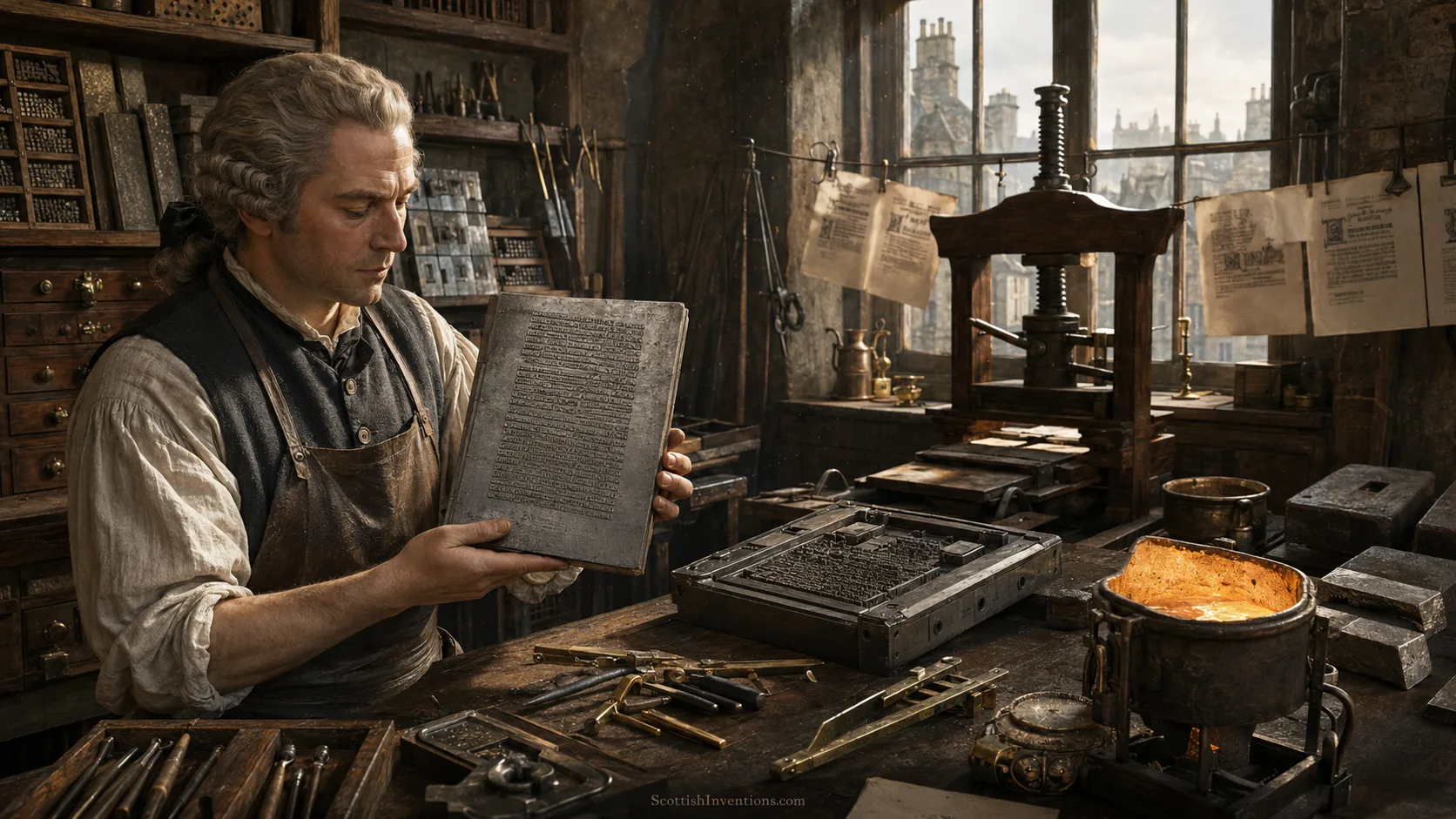
Here is where his trade becomes the key to the whole story. A goldsmith spends his working life making moulds and casting metal into them. So when — by one contemporary account — an Edinburgh printer complained to Ged around 1725 about the cost and difficulty of type, and asked whether he could invent a way of making it, Ged reportedly replied that he judged it "more practicable… to make plates from the composed pages than to make single types."
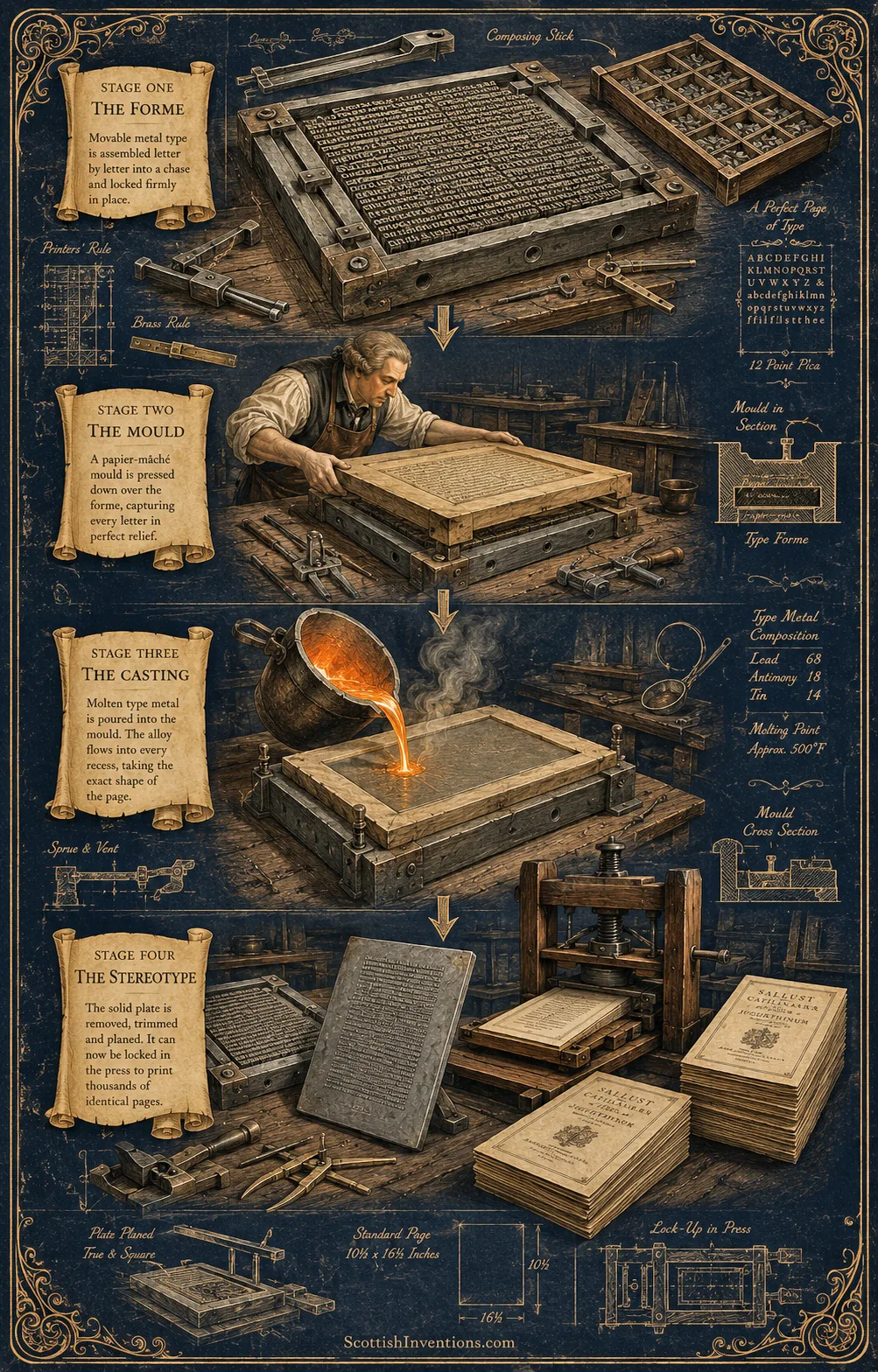
That was the entire idea in one sentence. Instead of casting individual letters, take a mould — a matrix — from a complete page of already-set type, then cast a single solid metal plate carrying the whole page's impression. The original type could immediately be broken up and reused, while the plate was stored away, ready to print again at any time. Multiple plates could be cast from one mould, allowing the same page to be printed on several presses at once. This was stereotyping, and it flowed directly from the mould-and-cast instincts of the goldsmith's bench.
Ged is thought to have begun experimenting around 1725. By about 1727 he was producing plates that reproduced pages of type; the earliest known specimen of his work is a Form of Prayer for 11 June 1728. Contemporaries reported that within two years his cast plates produced impressions barely distinguishable from ordinary type.
Scottish Innovation
Ged was neither a printer nor a scholar — he was a metalworker. It was the daily practice of casting jewellery, plate and precious metal from moulds that primed him to see printing as a casting problem, not a compositor's one. Scotland's greatest print invention came, in other words, from a jeweller's bench in Edinburgh's Old Town.
4. The "1725 Patent" — A Myth Worth Correcting
Popular sources — Britannica, Wikipedia, countless websites — state flatly that Ged "patented" his process in 1725. The accuracy-conscious verdict is that this is almost certainly wrong. Careful bibliographic scholarship — above all John Carter's authoritative study "William Ged and the Invention of Stereotype" in The Library, 5th series, vol. XV (1960), pp. 161–192 — treats 1725 only as the approximate date Ged began experimenting, not as a patent date. No surviving patent-roll record (the English patents of this period were enrolled in Chancery) has ever been cited in the scholarly literature, and the detailed 19th-century Dictionary of National Biography account — which discusses the Cambridge contract in specifics — makes no mention of any patent at all. Notably, Britannica itself says Ged "invented (1725) stereotyping," not that he patented it. The safest and most honest statement is this: 1725 marks the beginning of Ged's experiments; the claim that he took out a formal patent appears only in tertiary encyclopedias and is unsupported by documentary evidence.
(One genuine footnote on prior art: the Alexander Tilloch entry in Wikipedia states that "in 1725 William Ged had obtained a privilege for a development of Van der Mey's process." This wording conflates two disputed claims — a "privilege" and dependence on Dutch prior art — and should be treated with caution rather than repeated as fact.)
Historical Myth
"William Ged patented stereotyping in 1725" is repeated across countless encyclopedias, but no patent-roll record has ever been produced. The best modern scholarship treats 1725 only as the year Ged began experimenting. He almost certainly did — but the patent almost certainly never existed.
5. The Cambridge Venture (1730–1738)
Unable to persuade cautious Edinburgh printers to back him, Ged looked south. In 1729 he entered a 21-year partnership with a London stationer, William Fenner. In 1730 they brought in the London typefounder Thomas James and his brother John James, a successful London architect (not, as some accounts muddle it, a second typefounder). John James's Cambridge connections proved critical in obtaining the university's licence.
The Cambridge side of the story is, refreshingly, documented in the university's own archives, as reconstructed by David McKitterick in his History of Cambridge University Press. A contemporary letter from the Cambridge scholar Conyers Middleton to Lord Harley, dated to around April 1730, records that a proposal had been made to the University to lease its right to print Bibles and Common Prayer books by "persons who pretend to be Masters of a new discovery & rare secret in ye Art of Printing." In 1731 the University leased out its right to print Bibles and prayer books; the Dictionary of National Biography records the contract as dated 23 April 1731 and credits the Earl of Macclesfield with procuring it. The University was to receive £100 a year, and the arrangement pointedly excluded its own University Printer.
Then it went wrong. The documented causes, per the Cambridge records, were mundane and cumulative: disputes with the workmen, disagreements between the partners, the awkward distance between Cambridge and London, and — damningly — the poor quality of what was produced, described at the time as "done in so bad a manner, and so far inferior to those sold by the King's Printer." Only two prayer-books were completed; the lease was surrendered in 1738. Ged returned to Scotland in 1733.
The vivid tale that Ged's own compositors deliberately sabotaged his plates — inserting bad type and "batters" to make the work fail and protect their livelihoods — is the most famous part of his story. It must be presented honestly for what it is: a claim resting substantially on the 1781 family memoir (whose core narrative, the DNB notes, was written by Ged's daughter) and on an 18th-century secondhand account by Edward Rowe Mores. It is plausible, and trade hostility to labour-saving inventions was real, but it is a reported family account rather than an independently documented fact.
6. The Edinburgh Sallust (1739) — The Physical Proof
Back in Edinburgh, working in near-poverty and aided by subscriptions from friends and by his printer-apprenticed son, Ged produced the object that secures his place in history. In 1736 he issued Proposals for a subscription edition of Sallust "done by plates in the manner lately invented by William Ged goldsmith in Edinburgh" — a document surviving in a single copy in the National Library of Scotland.
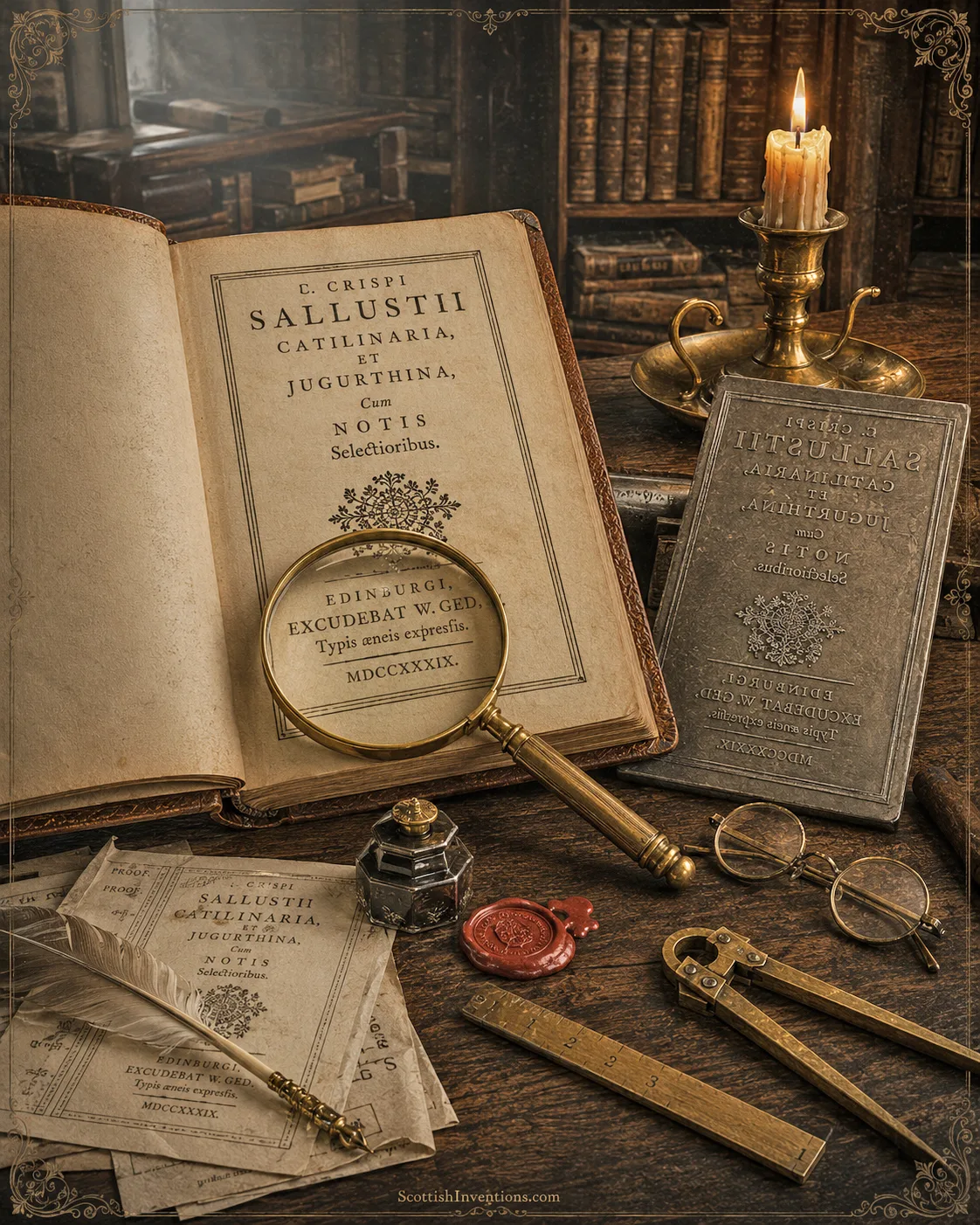
Then in 1739 came the book itself: Belli Catilinarii et Jugurthini Historiae by the Roman historian Sallust, a small duodecimo of a title leaf and 150 pages of tiny type. Its imprint is the moment stereotyping announces itself to the world:
"Edinburghi, Gulielmus Ged, Aurifaber Edinensis, non Typis mobilis, ut vulgo fieri solet, sed Tabellis seu Laminis fusis, excudebat, MDCCXXXIX."
("Edinburgh: Printed by William Ged, Goldsmith of Edinburgh, not from movable type, as is commonly done, but from cast plates, 1739.")
Bibliographers agree this is the first book to declare in print that it was produced from cast plates rather than movable type. Modern scholarship (Carter 1960; Philip Gaskell's 1963 note in The Bibliotheck on a surviving Ged plate in Glasgow's Hunterian Library; and recent work by William Zachs) treats it as authentic physical evidence that Ged had mastered the essentials of the art. He reprinted the edition once, in 1744; a manuscript note in a surviving copy records that the 1739 printing was for presentation and only the 1744 issue was offered for sale. Surviving stereotype plates from the Sallust were preserved — one was presented by Ged to the Faculty of Advocates in 1740 in a vain bid for patronage.
Ged died on 19 October 1749, his workshop goods already shipped from Leith towards London where he had hoped to renew the venture with his son. He was buried in Greyfriars Kirkyard, Edinburgh, in an unmarked grave.
7. The Gap — Why It Took Another 60 Years
Why did so powerful an idea lie dormant? Several reasons converge: the genuine technical difficulty of making perfect plaster moulds (which shrank and cracked, distorting fine type); entrenched opposition from the printing trade, whose compositors and typefounders saw a threat to their work; and Ged's own lack of capital and reliable partners.
Revival came in stages. On 28 April 1784 the Glaswegian printer Andrew Foulis the younger and the printer-inventor Alexander Tilloch — who had developed a stereotype method by 1782, apparently unaware of Ged — took out a joint English patent (No. 1431) for "printing books from plates instead of movable types." They printed several small volumes but made little commercial use of it. From Tilloch, Charles Stanhope, 3rd Earl Stanhope, derived knowledge of the process, and around 1802–1804 he perfected a workable plaster-of-Paris method with the practical help of the printer Andrew Wilson. In 1804 Wilson produced John Anastasius Freylinghausen's An Abstract of the Whole Doctrine of the Christian Religion — "the first book stereotyped by the new process," and also the first book printed on a Stanhope press.
In France, meanwhile, Firmin Didot (1764–1836) developed his own stereotype process, using it for Callet's logarithm tables in 1795 and patenting it in December 1797 — and it was Didot who coined the very word stéréotype, from the Greek stereos ("solid") and typos ("impression"). As the 1911 Encyclopædia Britannica fairly put it, Didot "revived (if he did not invent — a distinction which in order of time belongs to William Ged) the process of stereotyping, and coined its name."
8. How Stereotyping Transformed Publishing
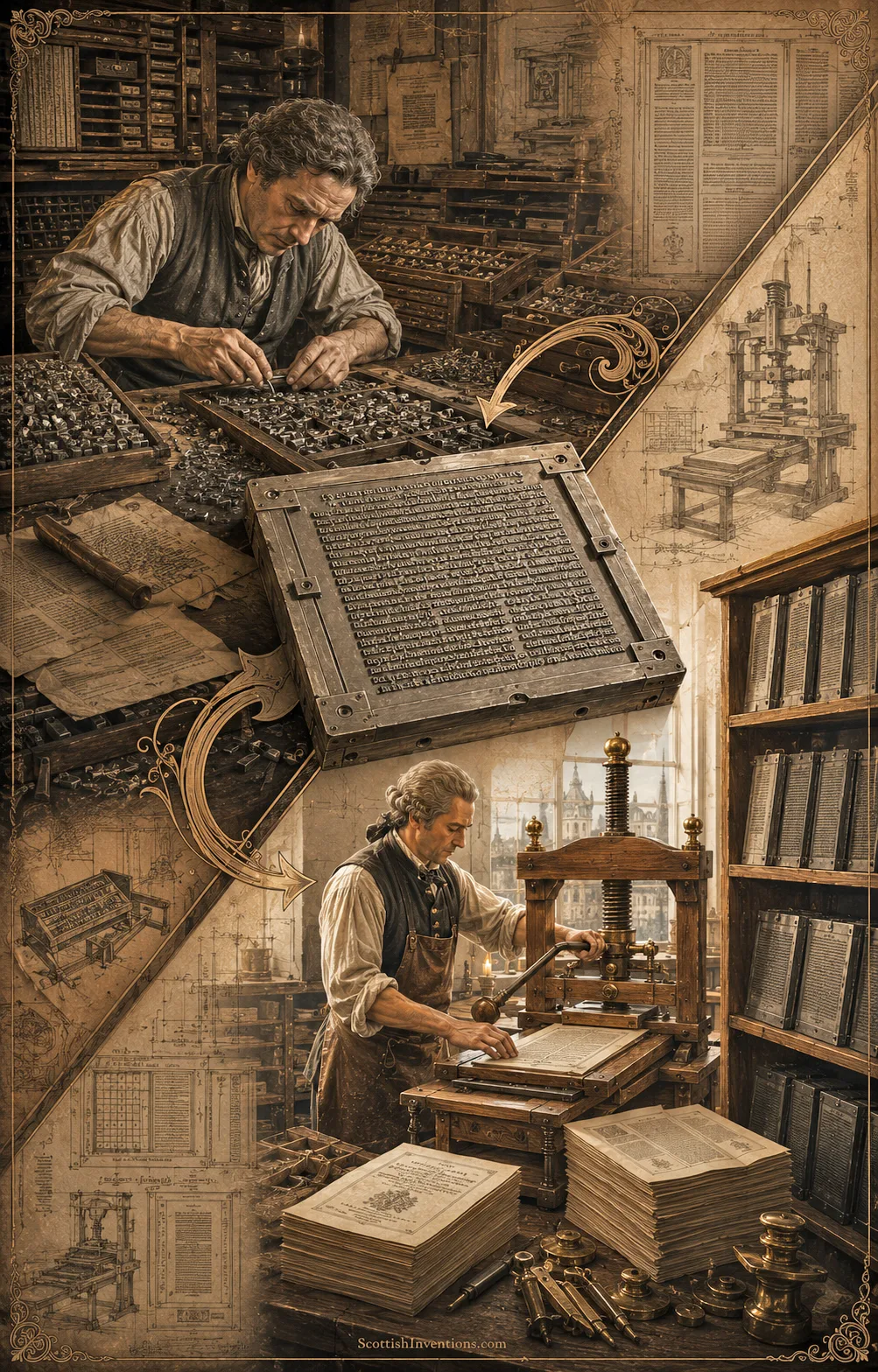
Once perfected, stereotyping did exactly what Ged had foreseen — and more. It allowed cheap reprinting of popular works without resetting type; plates could be stored for years and pulled out on demand.
Its first great practical use was in religious and mass-market printing. Cambridge University Press adopted the improved Stanhope method and produced a Cambridge Stereotype Bible in the first decade of the 19th century. In America, the technology arrived fast: in 1812 the Philadelphia Bible Society issued the first stereotype Bible printed in the U.S., from a set of plates produced by T. Rutt in London — the British and Foreign Bible Society contributing £500 of the roughly $3,500 plate cost, admitted duty-free during the War of 1812, from which the Philadelphia printer William Fry produced 1,050 complete Bibles and 750 New Testaments. The following year, in June 1813, John Watts & Co. of New York produced The Larger Catechism Agreed Upon by the Assembly of Divines at Westminster for the booksellers Whiting & Watson — a book that announced in tiny type above its imprint, "The first book ever stereotyped in America," being the first printed in America from plates made in America. By the 1820s roughly half of all American-made Bibles were stereotyped.
The deepest impact came in newspapers. Because a single mould (later the flexible papier-mâché flong) could yield many identical plates — and because those plates could be cast curved to fit the cylinders of high-speed rotary presses — stereotyping made mass-circulation journalism physically possible. It let the same page print simultaneously on multiple presses, and it freed type for reuse while protecting it from wear. The papier-mâché flong, which displaced brittle plaster from the 1850s, is credited to the French printer Claude Genoux (1829); the term "flong" entered English by the 1860s. Stereotype plates remained integral to newspaper production well into the 20th century.
9. Legacy
William Ged has a curious immortality: the word "stereotype" is now used far more often in its metaphorical sense — a fixed, unchanging mental image — than in its original printing meaning. Yet both senses share the same root idea: a solid, unvarying impression, exactly what Ged's plates were.
He was rediscovered largely through the 1781 memoir published by the printer-antiquary John Nichols, reprinted in 1818 by the Newcastle printer and stereotype historian Thomas Hodgson, and again in George Kubler's 20th-century compilations. Modern printing history places him as a genuine pioneer — "Scotland's Gutenberg," in the phrase used for a 2025 scholarly lecture — a man who solved a fundamental problem decades before the world was ready for the answer. That his invention flowered only after his death, in other hands and other countries, does not diminish the originality of the Edinburgh goldsmith who first thought to cast a page of words in solid metal.
His story also belongs to a larger Scottish one: 18th-century Edinburgh was one of the great engines of the European book trade and the Enlightenment, and Ged's experiment stands as arguably the most significant Scottish contribution to the technical evolution of printing itself. It sits naturally alongside Scotland's other landmark communications inventions: James Chalmers's adhesive postage stamp, Alexander Bain's chemical telegraph, James Clerk Maxwell's first colour photograph, John Logie Baird's television, and Frederick Creed's teleprinter.
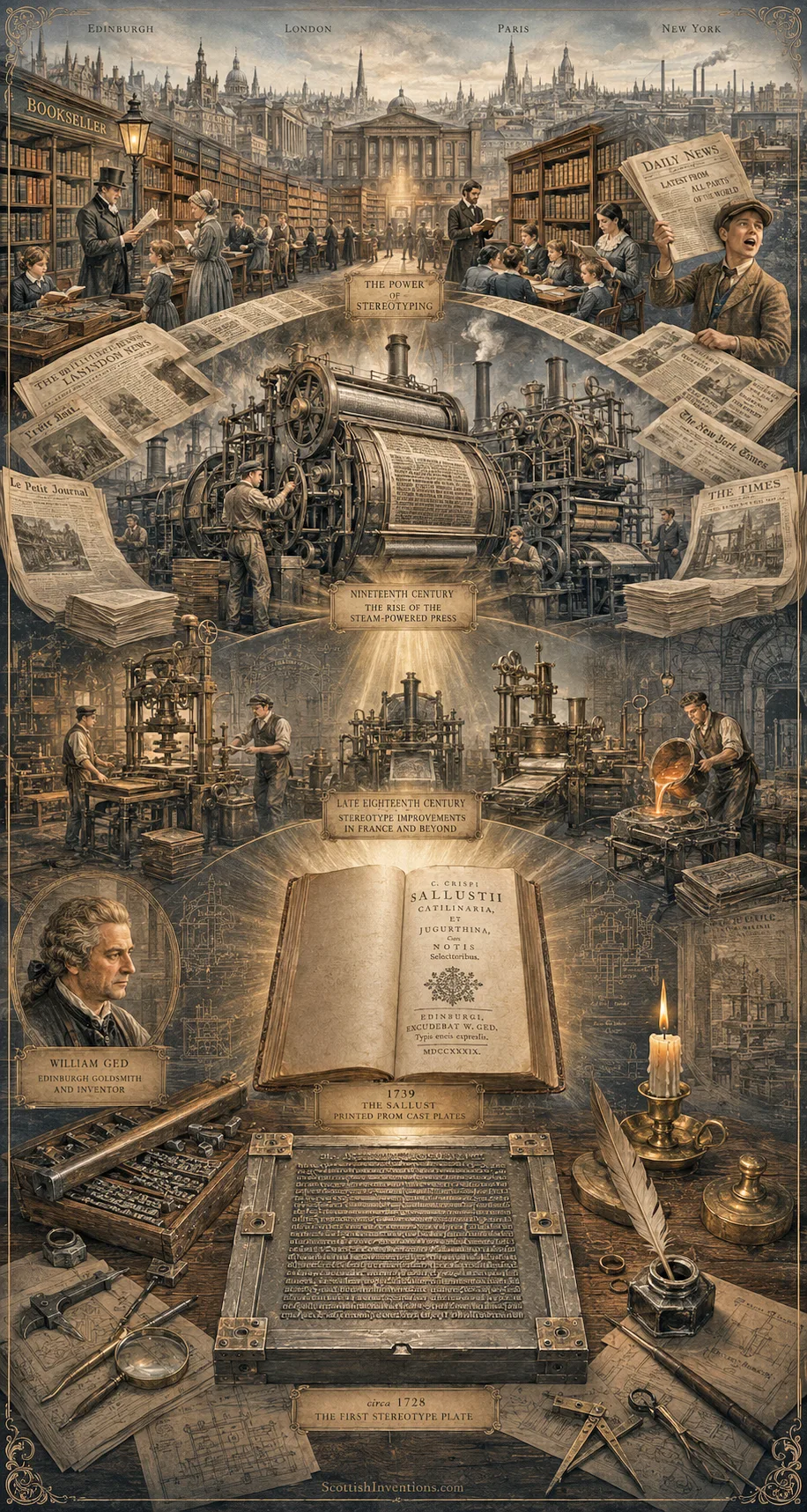
Did You Know?
He was a goldsmith first.
It was Ged's professional knowledge of casting metal from moulds that handed him the key insight for stereotyping — a printing revolution born at a jeweller's bench.
His own workmen may have sabotaged him.
At Cambridge, compositors reportedly inserted bad type into his plates to make the process fail and protect their jobs — though this dramatic detail comes chiefly from a family memoir, not independent record.
He died not knowing he'd changed the world.
Ged died in poverty in 1749, with no idea his idea would one day underpin newspaper and book printing across the globe.
The 1739 Edinburgh Sallust
is the first book in history to declare on its title page that it was printed from cast plates, not movable type.
The word "stereotype"
— in both its printing and its everyday sense — comes from the Greek for "solid" and "impression": precisely what Ged's plates were.
It took nearly 60 years
after Ged for stereotyping to catch on commercially — but when it did, it powered the mass-market publishing explosion of the 19th century.
Caveats & Sources
- Birth date unresolved: sources range across c. 1683, 1690, and 1699. Only the death date (19 Oct 1749) and Edinburgh birth are secure.
- The "patent": treated here as unproven; the popular claim is unsupported by scholarship. Direct verbatim conclusions from Carter's 1960 article could not be accessed (paywalled) and would strengthen the point further.
- The sabotage narrative and other emotive details (patriotic refusal of Dutch offers; treacherous partners) rest substantially on the 1781 family memoir and later secondhand accounts, not contemporary record.
- Prior art: Dutch experimenters (variously named Van der Mey, Müller, and Athias) worked with solid or soldered plates before Ged; he was not literally first, though his method appears independent. The exact nature of this prior art is imperfectly understood.
- Some Cambridge figures come via tradition: "two prayer-books completed" and the lease "surrendered 1738" derive from the DNB tradition; McKitterick's archival account frames the Cambridge output slightly differently (a nonpareil Bible plus a Book of Common Prayer begun).
- A note on authorship of the key source: the landmark 1960 Library article is by John Carter, not Philip Gaskell; Gaskell's contribution is a separate 1963 note in The Bibliotheck on a surviving Ged plate. Several popular pages conflate the two.
Timeline
c.1690
Born in Edinburgh
Birth date is genuinely uncertain — sources give c.1683, 1690 and 1699. Only the death date and Edinburgh birth are secure.
c.1725
Experiments begin
Ged, working as an Edinburgh goldsmith, begins experimenting with casting a solid metal plate from a mould of a whole page of movable type.
1727–1728
First working plates
Producing plates that reproduce pages of type; the earliest surviving specimen is a Form of Prayer for 11 June 1728.
1729
Partnership with Fenner
Enters a 21-year partnership with the London stationer William Fenner to exploit the process commercially.
23 Apr 1731
Cambridge lease
Cambridge University leases its right to print Bibles and Common Prayer books to the partnership for £100 a year; the Earl of Macclesfield is credited with procuring the contract.
1733
Returns to Scotland
The Cambridge venture stumbles amid poor-quality output and disputes; Ged returns to Edinburgh, though the lease is not formally surrendered until 1738.
1736
Proposals for the Sallust
Issues Proposals for a subscription edition of Sallust 'done by plates in the manner lately invented by William Ged goldsmith in Edinburgh' — a document surviving in a single copy in the National Library of Scotland.
1739
The Sallust
Publishes Belli Catilinarii et Jugurthini Historiae — the first book to declare on its title page that it was printed from cast stereotype plates rather than movable type.
1740
Faculty of Advocates gift
Ged presents a surviving stereotype plate from the Sallust to the Faculty of Advocates in a vain bid for patronage.
1744
Sallust reprinted
The Sallust is reprinted; a manuscript note in a surviving copy records that the 1739 printing was for presentation and only the 1744 issue was offered for sale.
19 Oct 1749
Death in Edinburgh
Ged dies in Edinburgh, his workshop goods already shipped from Leith towards London for a renewed venture with his son. Buried in Greyfriars Kirkyard in an unmarked grave.
28 Apr 1784
Tilloch and Foulis patent
Glaswegian printer Andrew Foulis the younger and printer-inventor Alexander Tilloch take out English patent No. 1431 for printing from plates instead of movable type.
1795–1797
Firmin Didot in Paris
Firmin Didot develops his own stereotype process, using it for Callet's logarithm tables in 1795 and patenting it in December 1797; he also coins the word stéréotype from the Greek for 'solid' and 'impression'.
c.1802–1804
Stanhope perfects the process
Charles Stanhope, 3rd Earl Stanhope, working with the printer Andrew Wilson, perfects a workable plaster-of-Paris method. In 1804 Wilson prints the first book stereotyped by the new process on a Stanhope press.
19th century
Newspaper revolution
The papier-mâché flong (Claude Genoux, 1829) and curved stereotype plates for rotary presses make mass-circulation newspapers physically possible. Stereotype plates remain integral to newspaper production well into the 20th century.
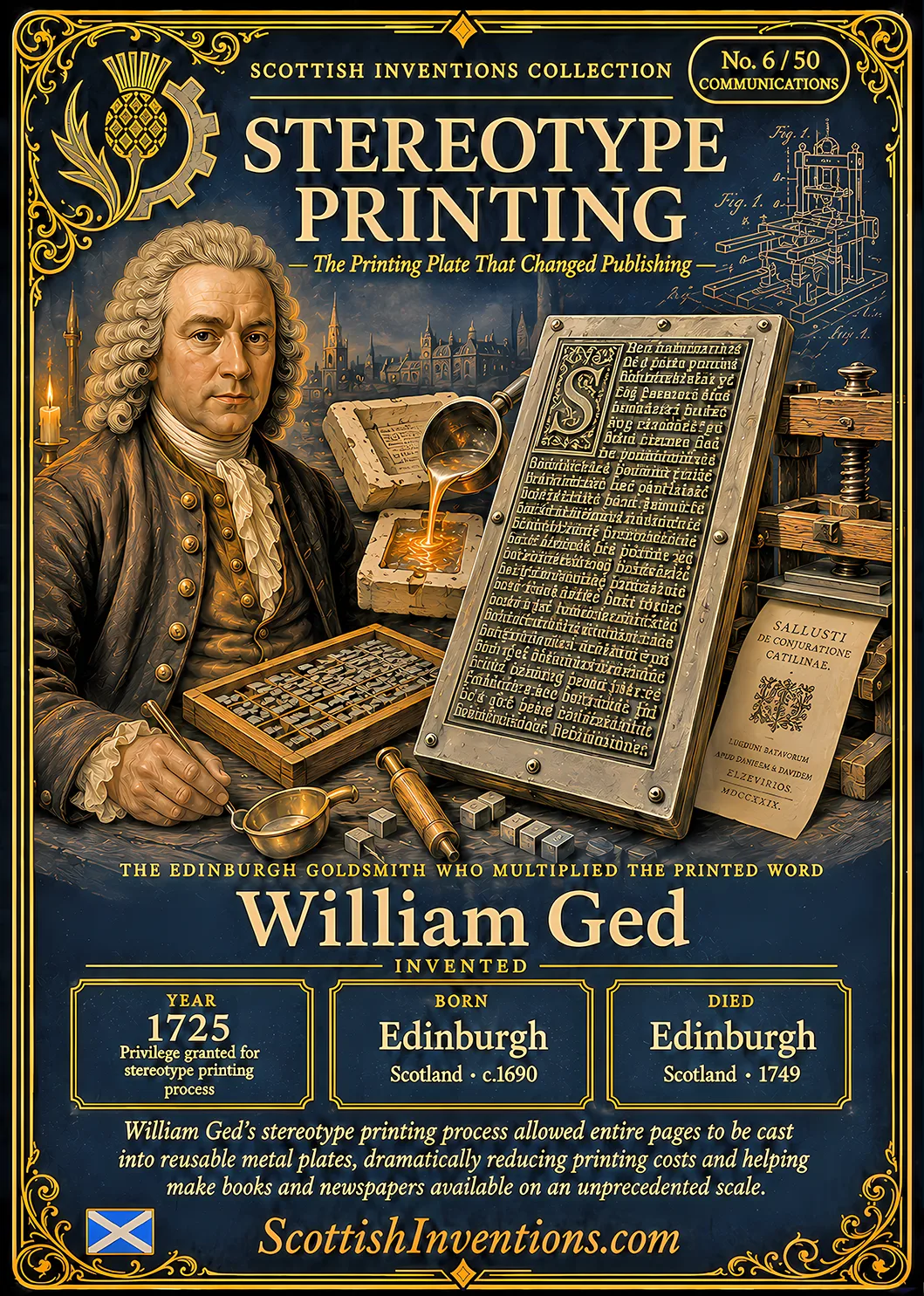
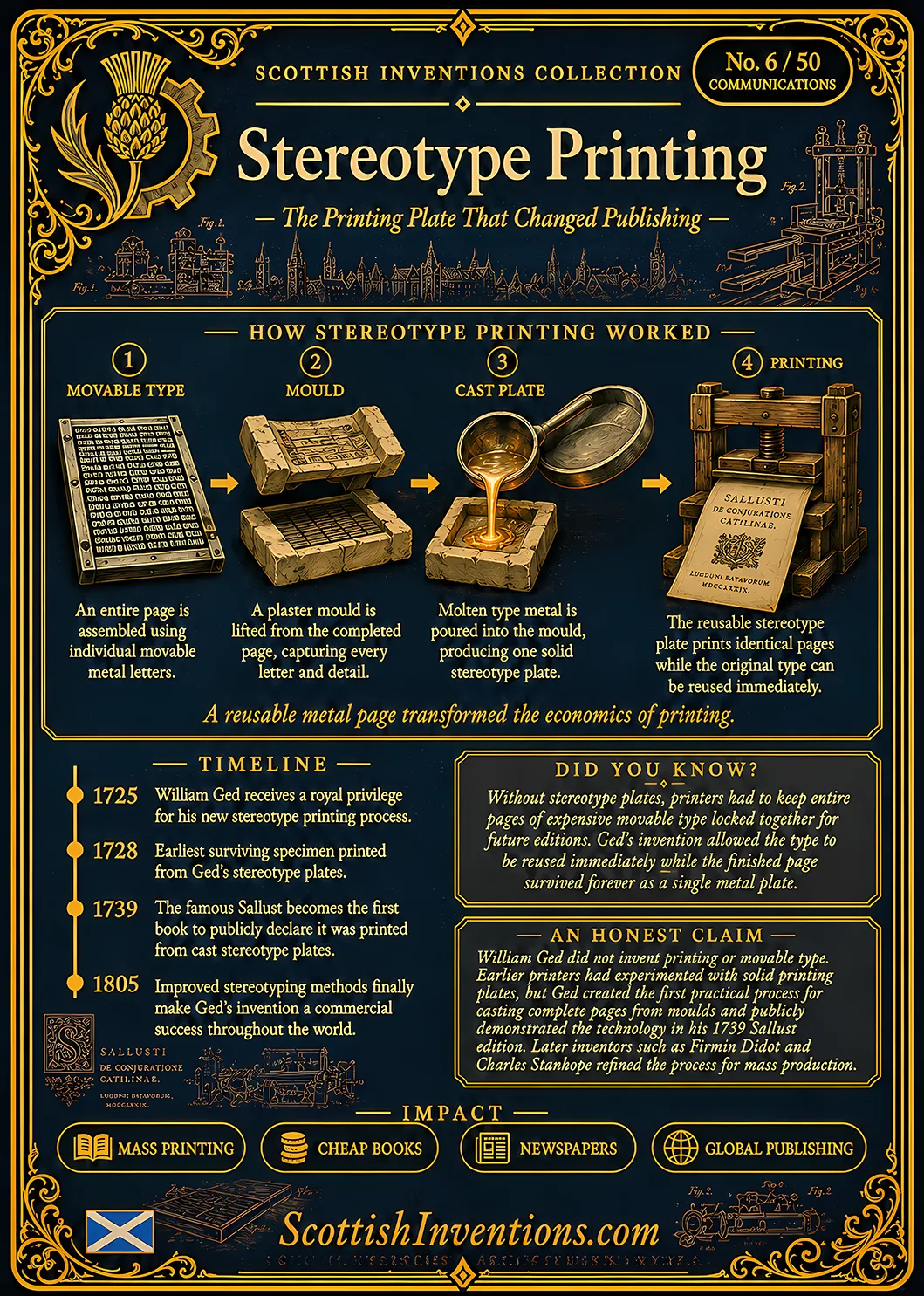
The Collector Card
Card No. 6 of 50 in the Scottish Inventions Collection — celebrating William Ged and the invention of stereotype printing. Flip to read the back.
Frequently Asked Questions
- Who was William Ged?
- William Ged (c. 1690–1749) was an Edinburgh goldsmith and jeweller who, around 1725, invented stereotyping — the process of casting a solid metal printing plate from a mould taken of a whole page of movable type. He died in Edinburgh on 19 October 1749 and was buried in Greyfriars Kirkyard in an unmarked grave.
- What is stereotype printing?
- Stereotype printing is a process in which a mould is taken from a complete page of assembled movable metal type, and a single solid metal plate is then cast from that mould. That plate — a 'stereotype' — can be stored and reprinted from at any time, while the original type is broken up and reused. It removed the need to repeatedly reset thousands of individual pieces of type for reprints.
- Did William Ged invent stereotyping?
- Ged invented the first practical stereotype printing process. Earlier Dutch experimenters — variously associated with Van der Mey, Müller and Athias — had worked with solid or soldered plates, so Ged was not literally the first to think of printing from plates. But he appears to have arrived at his method independently, developed it further than anyone before him, and produced the first book to declare in print that it had been printed from cast plates.
- Was stereotype printing patented in 1725?
- Almost certainly not. The popular claim that Ged 'patented' his process in 1725 is unsupported by scholarly evidence. John Carter's authoritative 1960 study in The Library treats 1725 only as the approximate year Ged began experimenting, and no surviving patent-roll record has ever been cited. The safest statement is that 1725 marks the beginning of Ged's experiments; the patent claim appears only in tertiary encyclopedias and is not backed by documentary evidence.
- What is the 1739 Sallust?
- The 1739 Sallust is the Edinburgh edition of Belli Catilinarii et Jugurthini Historiae by the Roman historian Sallust, a small duodecimo of a title leaf and 150 pages, printed by Ged from his cast stereotype plates. Its Latin imprint declares that it was printed 'not from movable type, as is commonly done, but from cast plates.' Bibliographers agree it is the first book in history to announce on its title page that it was produced from cast plates rather than movable type.
- Why was stereotype printing important?
- It transformed the economics of publishing. Before stereotyping, printers had either to keep expensive movable type locked up indefinitely as 'standing type' or to reset entire books from scratch for every new edition. Stereotype plates could be stored cheaply, printed from on demand, and even cast in multiple copies from a single mould, allowing the same page to run simultaneously on several presses. This made cheap reprints of Bibles, prayer books, classics and, eventually, mass-market newspapers physically possible.
- How did stereotyping change newspapers?
- By the mid-19th century the flexible papier-mâché 'flong' — credited to the French printer Claude Genoux in 1829 — replaced brittle plaster moulds and allowed curved stereotype plates to be cast that fitted the cylinders of high-speed rotary presses. A single mould could yield many identical plates, so the same page could print simultaneously on multiple presses. Stereotype plates remained integral to newspaper production well into the 20th century.
- Why did William Ged die in poverty?
- Ged's invention was ahead of its time and opposed at almost every turn. Cautious Edinburgh printers refused to back him; his Cambridge venture (1731–1738) collapsed amid disputes with workmen, distant partners and poor-quality output; and traditional accounts also credit hostile compositors with deliberately sabotaging his plates. He returned to Scotland, subsisted on subscriptions and family loyalty, and died on 19 October 1749 shortly after shipping his workshop goods from Leith towards London for one final attempt. He was buried in Greyfriars Kirkyard in an unmarked grave.