Scottish Inventions · Engineering & Power
James “Paraffin” Young and the World’s First Commercial Oil Refinery
The Glasgow joiner’s son who lit Victorian homes and invented the modern petroleum industry
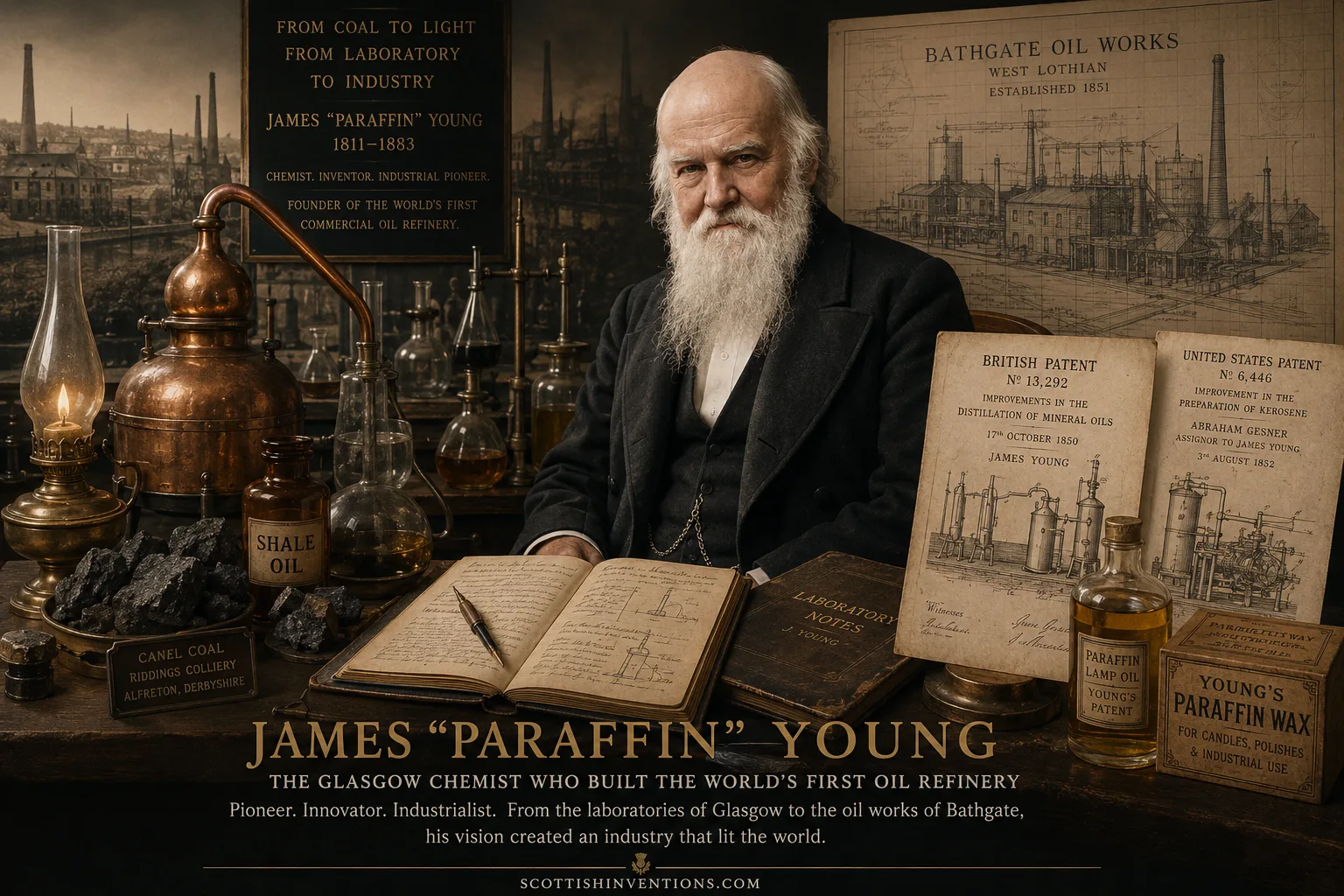
In 1851, a self-taught Scottish chemist named James “Paraffin” Young opened the world’s first truly commercial oil refinery at Bathgate, West Lothian. Working from British Patent No. 13,292 of 17 October 1850, he distilled coal and oil shale into paraffin lamp oil, paraffin wax, naphtha and lubricants — nearly a decade before Edwin Drake’s famous Pennsylvania oil well of 1859.
TL;DR
- James “Paraffin” Young (1811–1883), a self-taught Glasgow chemist, patented his oil-distillation process on 17 October 1850 and opened a commercial mineral-oil works at Bathgate in 1851 — roughly a decade before Edwin Drake’s 1859 Pennsylvania oil well, making Young the founder of the world’s first truly commercial oil-refining industry.
- He turned Scottish “boghead coal” and oil shale into paraffin lamp oil, paraffin wax, naphtha and lubricants, gave ordinary people cheap, clean indoor light, grew immensely wealthy, and used that wealth to fund his lifelong friend David Livingstone’s African expeditions.
- His legacy is written into the Scottish landscape — the red “bings” of West Lothian, the last of the shale-oil works closing only in 1962 — and into every refinery on earth, all of which still rely on the fractional distillation he pioneered.
Young at a glance
- Inventor
- James “Paraffin” Young FRS FRSE
- Born
- Glasgow — 13 July 1811
- Died
- Kelly House, Wemyss Bay — 13 May 1883
- Education
- Anderson's College, Glasgow (night school)
- Refinery
- Bathgate, West Lothian, opened 1851
- British Patent
- No. 13,292 — 17 October 1850
- Sold works for
- £400,000 (1866)
- Company
- Young's Paraffin Light & Mineral Oil Co.
- FRS
- Elected 1873
- Legacy
- World's first commercial oil-refining industry
Introduction
The story of modern energy is usually told through American oil derricks and Texan gushers. Yet the industry itself — the practical business of turning raw hydrocarbons into useful fuels and materials — was born in the west of Scotland, in a small town called Bathgate, at the hands of a Glasgow joiner’s son with no university degree. James Young patented his process for making oil from coal in 1850, opened his first oil works in 1851, and by the 1860s had built an industrial kingdom that made Scotland, briefly, the world’s leading oil-refining region.
He was known throughout the Victorian world as “Paraffin” Young — a nickname earned as his firm sold paraffin lamp oil and paraffin lamps in enormous volumes, from Glasgow to India to America. Every refinery on earth today — from Grangemouth to the Gulf — still performs the essential operation he pioneered: heating hydrocarbons and separating them, by fractional distillation, into a spectrum of useful products.
The Joiner’s Son from Glasgow
James Young was born on 13 July 1811 in Shuttle Street, in the Drygate district of Glasgow — one of the city’s oldest streets, in the shadow of Glasgow Cathedral. He was the eldest son of John Young, a self-employed cabinetmaker and joiner, and his wife Jean Wilson. In the custom of the time the boy was put to his father’s bench early; but from the age of 19 he began attending evening classes in chemistry at Anderson’s College (the future University of Strathclyde).
That decision changed his life. At Anderson’s he came under the wing of Thomas Graham, the newly appointed chemistry lecturer and one of the great chemists of the age. In 1831 Graham appointed Young as his laboratory assistant, and when Graham was appointed to the chair of chemistry at University College London in 1837, Young followed him south. It was also at Anderson’s that Young struck up one of the most touching friendships in the history of Scottish science, with a fellow student named David Livingstone — then a poor mill-worker studying medicine and theology.
Young married his cousin Mary Young on 21 August 1838. He was practical, methodical and industrious, with a particular genius — rare among laboratory chemists — for scaling up bench experiments into full industrial production.
Scotland Before Petroleum
To understand why Young’s work mattered, picture a world that was, after sunset, genuinely dark. In the 1840s the brightest, cleanest lamp fuel was whale oil — costly, and as whale populations were hunted down, dearer every year. Most ordinary households made do with smoky tallow candles, or with volatile “burning fluids” prone to explosions.
Coal gas, pioneered by William Murdoch from the 1790s, lit streets and mills but required expensive pipework and was not available to most homes. There was a desperate need for a clean, cheap, reliable lamp oil, and a parallel demand for lubricating oils to keep the machinery of the Industrial Revolution running.
The Discovery of Oil from Coal
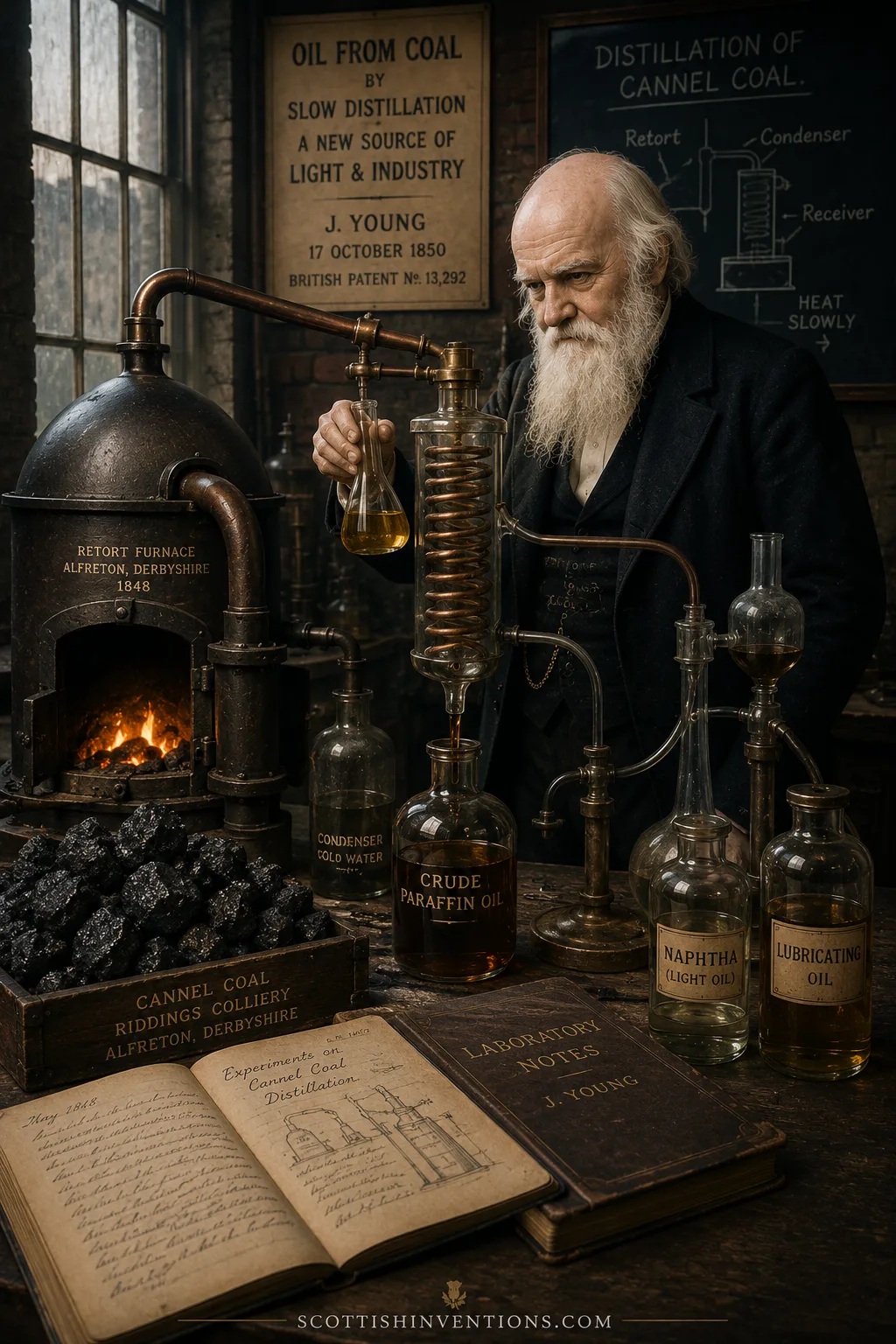
Young’s path to oil began with a chance tip from a friend. By the mid-1840s he was working as a chemist for Charles Tennant’s firm in Manchester. His old Anderson’s acquaintance Lyon Playfair told him of a natural petroleum seep flowing from the Riddings colliery at Alfreton, Derbyshire. Tennant’s dismissed it as “too small a matter”, so in 1848 Young, in partnership with his assistant Edward Meldrum, took on the seep themselves, distilling from it a thin oil suitable for lamps and a thicker oil for lubricating machinery.
The Derbyshire seep was soon exhausted. But Young had made a crucial deduction. Noticing that the oil dripped from the coal-bearing strata, he reasoned that the petroleum had somehow been formed by the action of heat on the coal — and that it might therefore be produced artificially. After long experiments, he succeeded: by distilling cannel coal at a low, slow heat he produced a liquid resembling petroleum, from which he could separate several useful products. One of these he named “paraffine oil” because at low temperatures it congealed into a wax resembling paraffin.
He protected the process with a patent dated 17 October 1850 — British Patent No. 13,292, “Treating Bituminous Coals to Obtain Paraffine and Oil Containing Paraffine Therefrom”. Contemporaries regarded it as a shrewdly drafted document: specific enough to defend, broad enough to apply widely.
Building the World’s First Commercial Oil Refinery
In 1850 Young, Meldrum and the Manchester man Edward William Binney formed E.W. Binney & Co. at Bathgate. The Bathgate works, completed in 1851, began producing naphtha and lubricating oils; paraffin for burning was sold from 1856 and solid paraffin (for candles) in quantity from 1859. The plant was so closely guarded against industrial espionage — high fences, a workforce sworn to secrecy — that it became known locally as the “secret works”.
When the rich local boghead coal began to run short, Young had his answer to hand: the surrounding district of West Lothian was enormously rich in oil shale. In 1865 Young bought out his partners and built a second, far larger works at Addiewell, near West Calder; in 1866 he floated the business as Young’s Paraffin Light and Mineral Oil Company. At its peak in 1913 the wider Scottish shale-oil industry employed an estimated 10,000 workers.
How the Refinery Worked
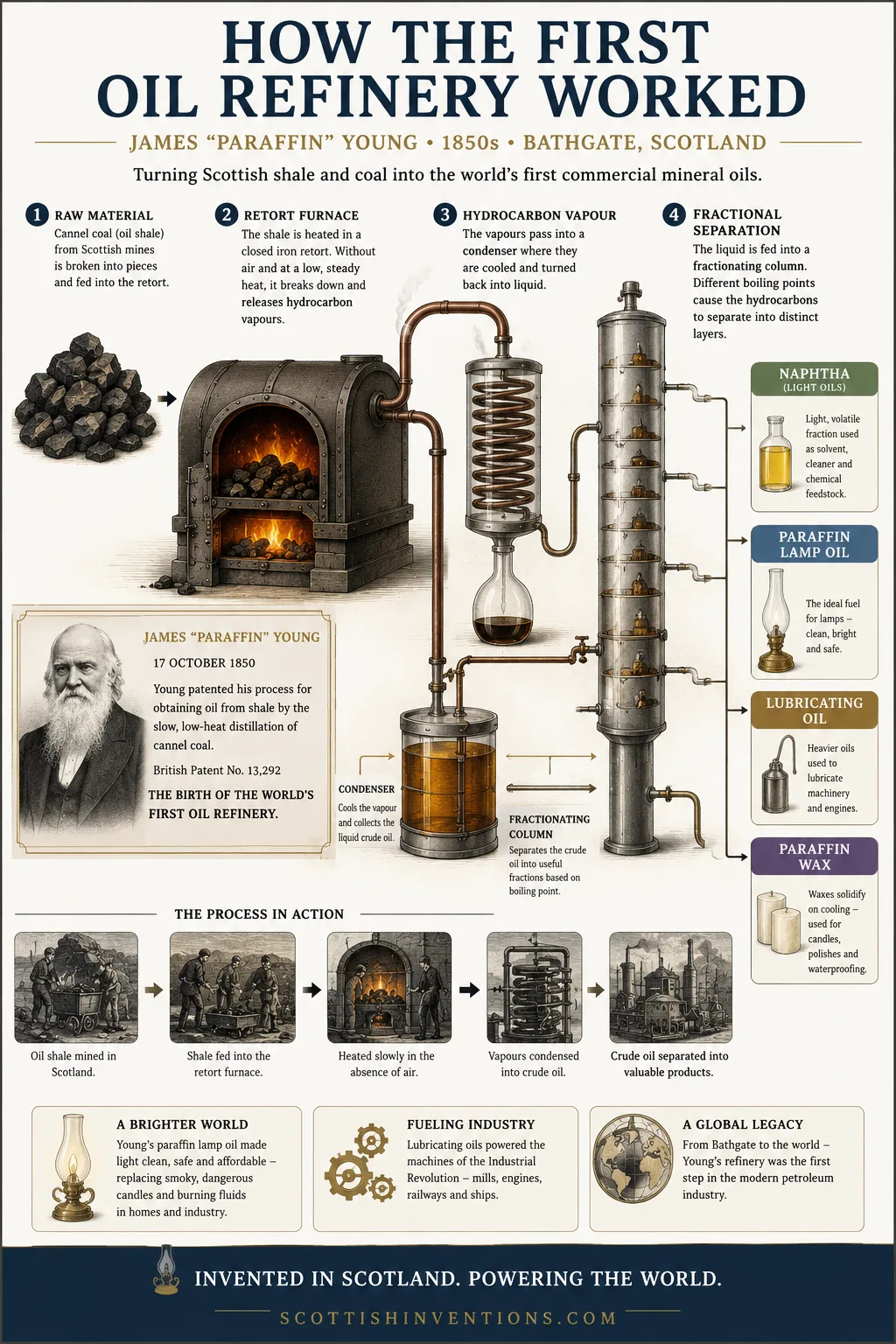
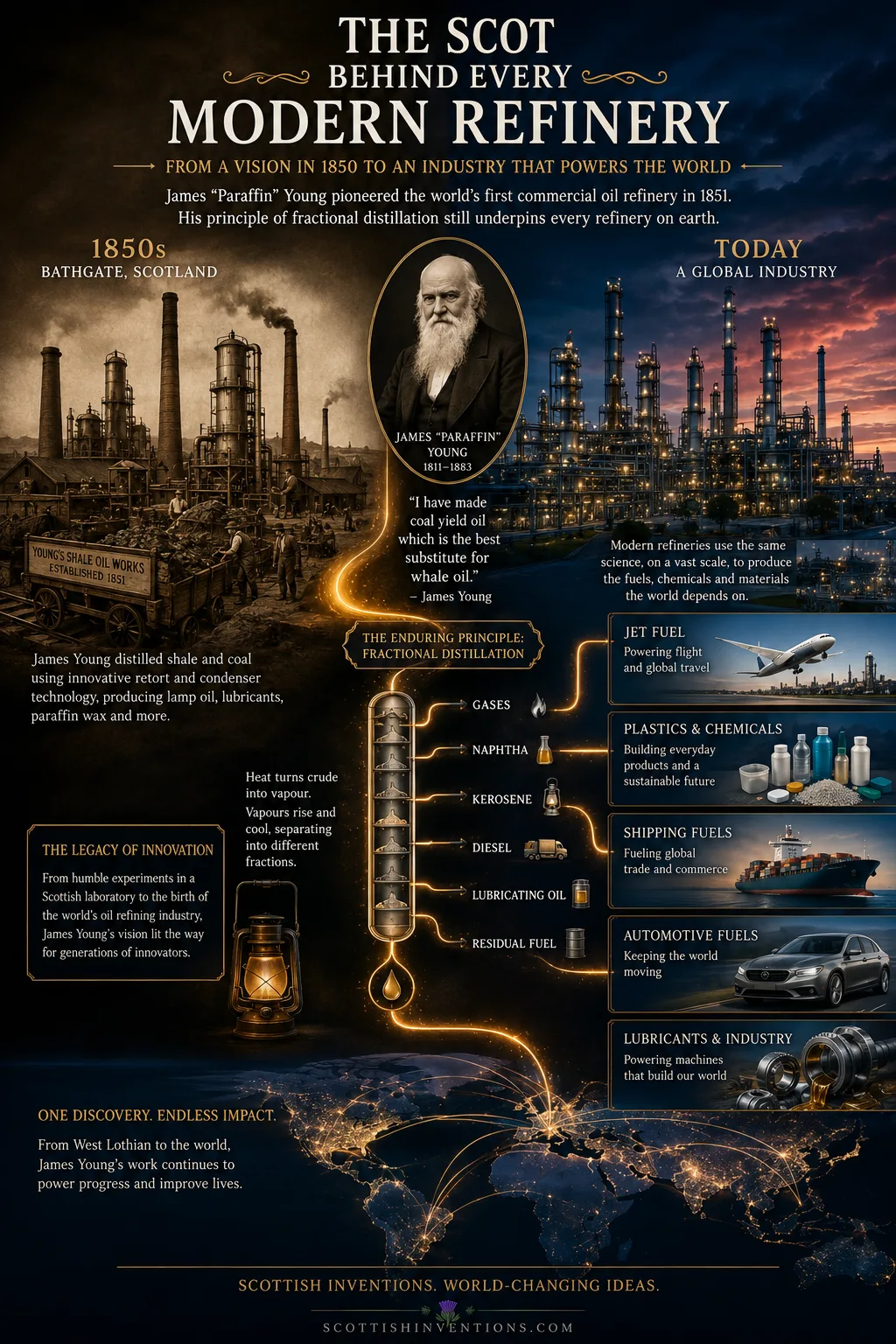
The technical heart of the breakthrough was elegantly simple. Coal-gas makers heated cannel coal fiercely in cast-iron retorts to drive off gas. Young found that under gentler heat he could drive off an oil vapour instead of an incondensable gas — and then condense, wash and fractionate it into burning oil, lubricating oil, naphtha and solid paraffin wax.
- Raw material — cannel coal (oil shale) from Scottish mines was broken up and fed into a closed iron retort.
- Retort furnace — the shale was heated slowly, without air, releasing hydrocarbon vapours.
- Condenser — the vapours were cooled back into liquid crude oil.
- Fractionating column — the crude was separated by boiling point into naphtha, paraffin lamp oil, lubricating oil and paraffin wax.
The Birth of the Shale-Oil Industry
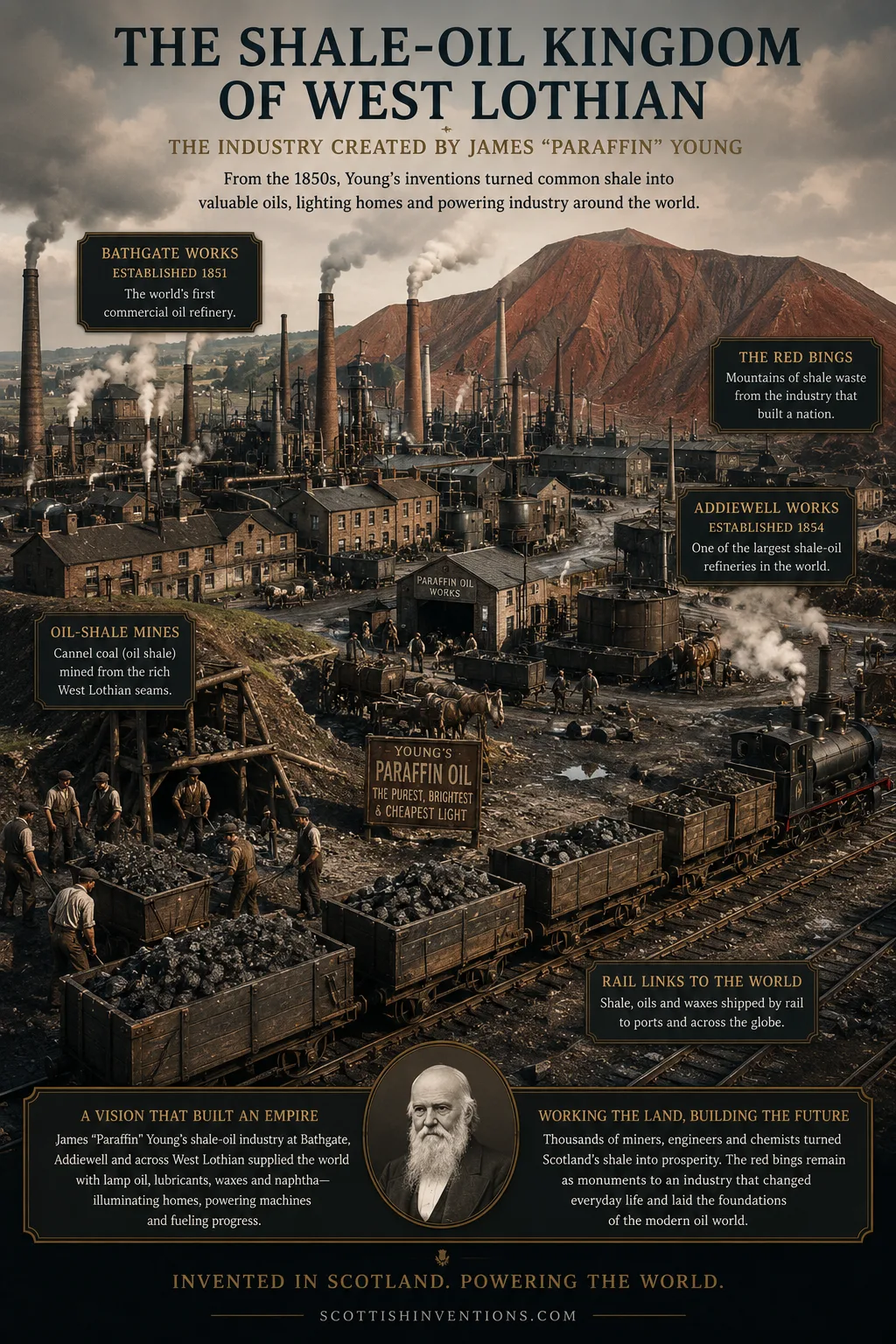
The industry Young founded turned West Lothian into, for a brief period, the world’s leading oil-producing region. From his works flowed paraffin lamp oil, paraffin wax for candles, lubricating oils, naphtha, and by-products such as ammonium sulphate fertiliser. Torbanite was astonishingly rich, yielding hundreds of litres of oil per tonne; leaner shales yielded less but were cheap and abundant.
After Young’s patent expired in 1864 the industry exploded: by 1870 dozens of competing firms had sprung up, and at its peak around 1892 some 120 shale-oil works were in operation. Miners, engineers and chemists turned West Lothian’s shale into prosperity, and the red “bings” of Bathgate, Addiewell and West Calder remain as scheduled monuments to the industry Young made possible.
Why James Young Beat Edwin Drake
The comparison everyone reaches for is Edwin Drake’s oil well at Titusville, Pennsylvania, which struck oil on 27 August 1859. The key point is that Drake’s achievement and Young’s are different things. Drake drilled the first commercial oil well — a breakthrough in extraction. Young, eight to nine years earlier, had built an industry around the refining of oil into saleable products.
Crucially, Young’s patents reached across the Atlantic. He took out a US patent in 1852 — two years before Abraham Gesner patented his rival “kerosene” process in 1854. Young’s patents were upheld in a series of lawsuits, and he successfully sued American producers — including Gesner’s North American Kerosene Gas Light Company — for infringement, forcing them to pay him royalties.
“James Young was the first person to refine mineral oil commercially on an industrial scale — nearly a decade before Drake’s famous well — and his patents materially shaped the oil industry on both sides of the Atlantic.”
Lighting the Victorian World
The social impact was profound. Young’s paraffin oil was cleaner, safer and more consistent than the animal- and vegetable-based oils it replaced, and from 1858 he built a national network of sales offices selling both the oil and lamps designed to burn it. Cheap, clean light reached ordinary homes for the first time — extending the working and reading day, transforming domestic life, and helping to relieve the slaughter of whales for lamp oil.
His wealth flowed back into science, education and friendship. His most famous beneficiary was David Livingstone: Young helped finance the explorer’s African expeditions, honouring “any monetary promise” Livingstone made — even debts scrawled on bark or leather. He built a miniature replica of the Victoria Falls on the burn at his Limefield estate, endowed the Young Chair of Technical Chemistry at Anderson’s College, and paid for the public statues of both Thomas Graham and David Livingstone in Glasgow.
The Legacy of Fractional Distillation
The industry Young founded proved astonishingly durable. The West Lothian shale-oil industry ran at full capacity until around 1910, then slowly declined under competition from cheap imported crude — but the last works did not close until 1962, nearly 80 years after Young’s death. Its most visible monuments are the “bings” — great flat-topped heaps of spent shale that glow a distinctive pinkish-red. The most famous, the Five Sisters bing near West Calder, was designated a Scheduled Monument in 1992.
He was elected a Fellow of the Royal Society of Edinburgh in 1861 and a Fellow of the Royal Society in 1873. According to the Dictionary of National Biography, in 1866 Young sold his whole works at Addiewell and Bathgate to a limited liability company for about £400,000. He died on 13 May 1883 at Kelly House near Wemyss Bay and was buried at Inverkip churchyard.
But Young’s greatest memorial is conceptual. Every oil refinery on earth still performs the essential operation he pioneered: heating crude hydrocarbons and separating them, by fractional distillation, into a spectrum of useful products — jet fuel, petrol, diesel, lubricants, paraffin wax and the feedstocks of the entire petrochemical industry.
Did You Know?
- He beat Drake by nearly a decade. Young was refining oil commercially at Bathgate from 1851 — about nine years before Edwin Drake drilled his famous Pennsylvania oil well in 1859.
- He bankrolled an explorer. Young helped fund David Livingstone’s African expeditions, honouring even debts scrawled on scraps of bark and leather.
- Those red hills are his. The pinkish-red “bings” of West Lothian are heaps of spent shale left by the oil industry Young founded.
- He lit up ordinary homes. “Paraffin” Young’s cheap, clean lamp oil brought affordable indoor light within reach of working families for the first time.
- From the workbench to a fortune. A joiner’s son who learned chemistry at night school, Young became one of the wealthiest self-made industrialists in Scotland, selling his works for about £400,000 in 1866.
- Every refinery is his heir. The fractional distillation Young pioneered is still the basic process at the heart of every oil refinery on the planet.
Frequently Asked Questions
- Who was James “Paraffin” Young?
- James Young (1811–1883) was a self-taught Glasgow chemist who founded the world's first commercial oil-refining industry. Born a joiner's son in the Drygate, he trained at Anderson's College under Thomas Graham, patented his oil-distillation process in 1850 and opened the Bathgate oil works in 1851.
- Did James Young build the world's first oil refinery?
- Young built the first truly commercial mineral-oil refinery, at Bathgate in West Lothian in 1851 — nearly a decade before Edwin Drake's Pennsylvania oil well of 1859. Isolated earlier distillations existed (e.g. the Dubinin brothers in Russia, 1823), but Young was first to refine oil on a sustained commercial scale.
- Why is James Young called ‘Paraffin’ Young?
- The nickname came from the product that made his fortune: paraffin lamp oil and paraffin wax. His company sold Young's Paraffin Oil and paraffin lamps around the world, and the name stuck to him for life.
- What did James Young invent?
- Young invented and patented (British Patent No. 13,292, 17 October 1850) a slow, low-heat distillation of cannel coal and oil shale that produced paraffin lamp oil, paraffin wax, naphtha and lubricating oils — the founding process of the modern petroleum-refining industry.
- How did the first oil refinery work?
- Cannel coal or oil shale was heated in closed iron retorts at a low, steady temperature. Hydrocarbon vapours passed through a condenser to form crude oil, which was then fed into a fractionating column that separated it by boiling point into naphtha, paraffin lamp oil, lubricating oil and paraffin wax.
- What is fractional distillation?
- Fractional distillation heats a mixture and separates it into fractions by their different boiling points as the vapours cool at different heights in a column. It is the core operation of every modern refinery — the process Young pioneered commercially at Bathgate in 1851.
- Did James Young invent paraffin?
- Paraffin wax was first identified in 1830 by the German chemist Carl von Reichenbach, but Young was the first to manufacture paraffin oil and paraffin wax commercially, at industrial scale, from coal and shale — turning a laboratory curiosity into an everyday product.
- Why was Bathgate important?
- The Bathgate works in West Lothian, completed in 1851, is widely described as the world's first commercial oil refinery. It launched the Scottish shale-oil industry that made West Lothian, for a period, the world's leading oil-producing region.
- What are the West Lothian bings?
- The pinkish-red ‘bings’ are great flat-topped heaps of spent oil shale left by the industry Young founded. The most famous, the Five Sisters bing near West Calder, is a Scheduled Monument and features in the logo of West Lothian Council.
- How did James Young influence the modern petroleum industry?
- Every oil refinery on earth still performs the operation Young pioneered — fractional distillation of hydrocarbons. His UK and US patents shaped the early American industry; he successfully sued Gesner's North American Kerosene Gas Light Company for infringement, and his refining process underpins every fuel from petrol to jet kerosene today.
Discover More Scottish Industrial Innovations
James “Paraffin” Young transformed chemistry into an industry that changed the modern world. Explore more remarkable Scottish inventions that powered the Industrial Revolution and beyond.
Sources
- Royal Society of Chemistry — James “Paraffin” Young Chemical Landmark, Bathgate (2011).
- Museum of the Scottish Shale Oil Industry, Almond Valley Heritage Centre, Livingston.
- University of Strathclyde — Archives & Special Collections: Young papers.
- Dictionary of National Biography — entry for James Young.
- British Patent No. 13,292 (17 October 1850); US Patent No. 6,446 (1852).
- Historic Environment Scotland — Five Sisters Bing, Scheduled Monument (1992).