Scottish Inventions · Engineering & Power
George Forbes and the Carbon Brush – The Scottish Invention That Made the Electric Age Possible
The Edinburgh physicist whose humble sliding contact quietly wired the modern world
In 1885, an Edinburgh-born physicist named George Forbes was granted British Patent No. 1288 for using carbon rather than metal as the current-collecting brush on a dynamo. It was the first patent for the carbon brush — the small, self-sacrificing block of graphite that made reliable electric generators, motors and traction possible, and that still hums away in billions of machines today.
TL;DR
- George Forbes (1849–1936), an Edinburgh-born physicist and engineer, invented the carbon brush — the humble sliding carbon contact that carries current between the rotating and stationary parts of electric generators and motors. He was granted British Patent No. 1288 for it in 1885 (not 1881–82, as sometimes stated).
- The carbon brush solved one of the most stubborn bottlenecks in early electrical engineering: metal brushes sparked, overheated, wore out fast and chewed up commutators. Carbon is self-lubricating, wears slowly and evenly, and reduces sparking — making large-scale, reliable power generation and electric traction practical. Carbon brushes remain in billions of motors and generators today.
- Forbes was one of the most versatile Scottish scientists of the Victorian age — he measured the speed of light, observed the 1874 transit of Venus from Hawaii, predicted a trans-Neptunian planet, and served as consulting engineer on the Niagara Falls hydroelectric scheme. But two popular claims need care: he did not help "standardise the volt and ohm" (that was a different Forbes), and credit for the first practical use of the carbon brush belongs to Van Depoele and Sprague.
Forbes at a glance
- Inventor
- George Forbes FRS
- Born
- Edinburgh — 5 April 1849
- Died
- Worthing, England — 22 October 1936
- Education
- Edinburgh Academy · St Andrews · Cambridge
- Trade
- Physicist & consulting electrical engineer
- Company
- British Electric Light Company, London
- British Patent
- No. 1288, 1885
- Sold US rights for
- £2,000 (to Westinghouse)
- Fellow of the Royal Society
- Elected 1887
- Niagara consulting engineer
- c. 1891–1895
Introduction
The story of electrification is usually told through household names — Edison, Swan, Tesla, Westinghouse — but the practical engineering that actually made electric power reliable often came from quieter figures. One of the quietest was George Forbes, an Edinburgh-born physicist and engineer whose invention of the carbon brush in 1885 removed the single greatest obstacle to the large-scale use of electric machinery.
Before Forbes, every dynamo and every DC motor depended on metal brushes that sparked, overheated and destroyed the copper commutators they were meant to serve. Forbes' idea — a small block of carbon, sprung against the rotating segments — was so unassuming that even he did not fully grasp what he had done. Yet without it, the vast electrical infrastructure that followed, from Niagara Falls to the London Underground to today's wind farms, would not have been possible.
Scotland's Forgotten Electrical Pioneer
George Forbes was born on 5 April 1849 at 3 Park Place, Edinburgh, the second son of James David Forbes and Alicia Wauchope. He belonged to one of Scotland's most distinguished scientific families. His father was Professor of Natural Philosophy at the University of Edinburgh from 1833 and later Principal of the United College of St Andrews — one of the great physicists of his generation, who pioneered the study of radiant heat, showed that glaciers flow like viscous fluids, and taught the young James Clerk Maxwell.
Young George was educated at Edinburgh Academy, then at the University of St Andrews and at Cambridge — where, contrary to some accounts that place him at St John's, he was actually associated with Christ's College and St Catharine's College — graduating BA in 1871. In 1872, aged only about 23, he was appointed Professor of Natural Philosophy at Anderson's University in Glasgow (later the core of the University of Strathclyde), a post he held until 1880.
The Electrical Revolution
By the late 1870s and early 1880s, the electrical industry was on the cusp of transformation but hamstrung by practical engineering problems. Zénobe Gramme's ring dynamo of 1871 had produced the first generator suitable for commercial power; Werner Siemens, Charles Brush and others were building dynamos for arc lighting. On 4 September 1882, Thomas Edison's Pearl Street Station in New York — with six coal-fired "Jumbo" dynamos — became the world's first commercial central power station, while Joseph Swan and Edison were racing to perfect incandescent lighting.
Every one of these systems depended on the dynamo — and every dynamo depended on brushes. A DC generator (or DC motor) needs a commutator, a segmented rotary switch on the machine's shaft that reverses the current in the windings at exactly the right moment to produce usable direct current. To get the current on and off that spinning commutator, you need brushes: stationary conductors pressed against the rotating surface. And here was the bottleneck.
Why Early Dynamos Failed
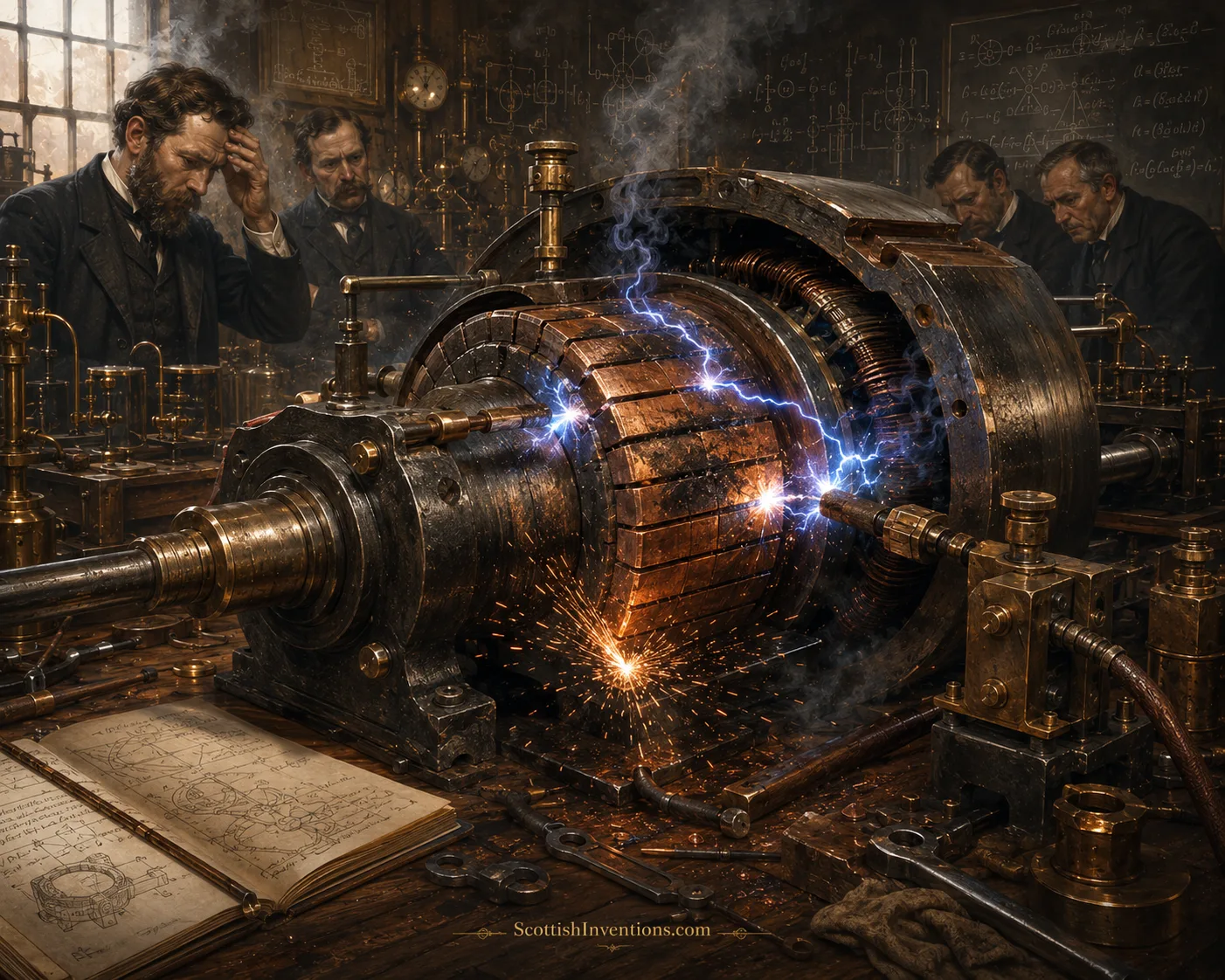
Early brushes were made of copper or brass — laminated foil, bundles of wire (Gramme's looked like a shaving brush when worn, which is where the word "brush" comes from), or metal gauze (patented by O. Schulze in 1884). Michael Faraday had even used copper rods wetted with mercury as far back as 1832.
All of these metal current-collectors suffered the same fatal flaw: excessive wear. They sparked violently, ground themselves and the commutator into dust, produced what a contemporary writer called a "ghastly greenish illumination," overheated, and required constant maintenance. Elihu Thomson recalled that on the first electric railways "all forms of metal brush had been tried and become acknowledged failures." Without a reliable way to collect current, large-scale power and electric traction were simply not viable.
"The most wonderful and valuable advance that was ever made in the art with relation to commutating machines."
Inventing the Carbon Brush
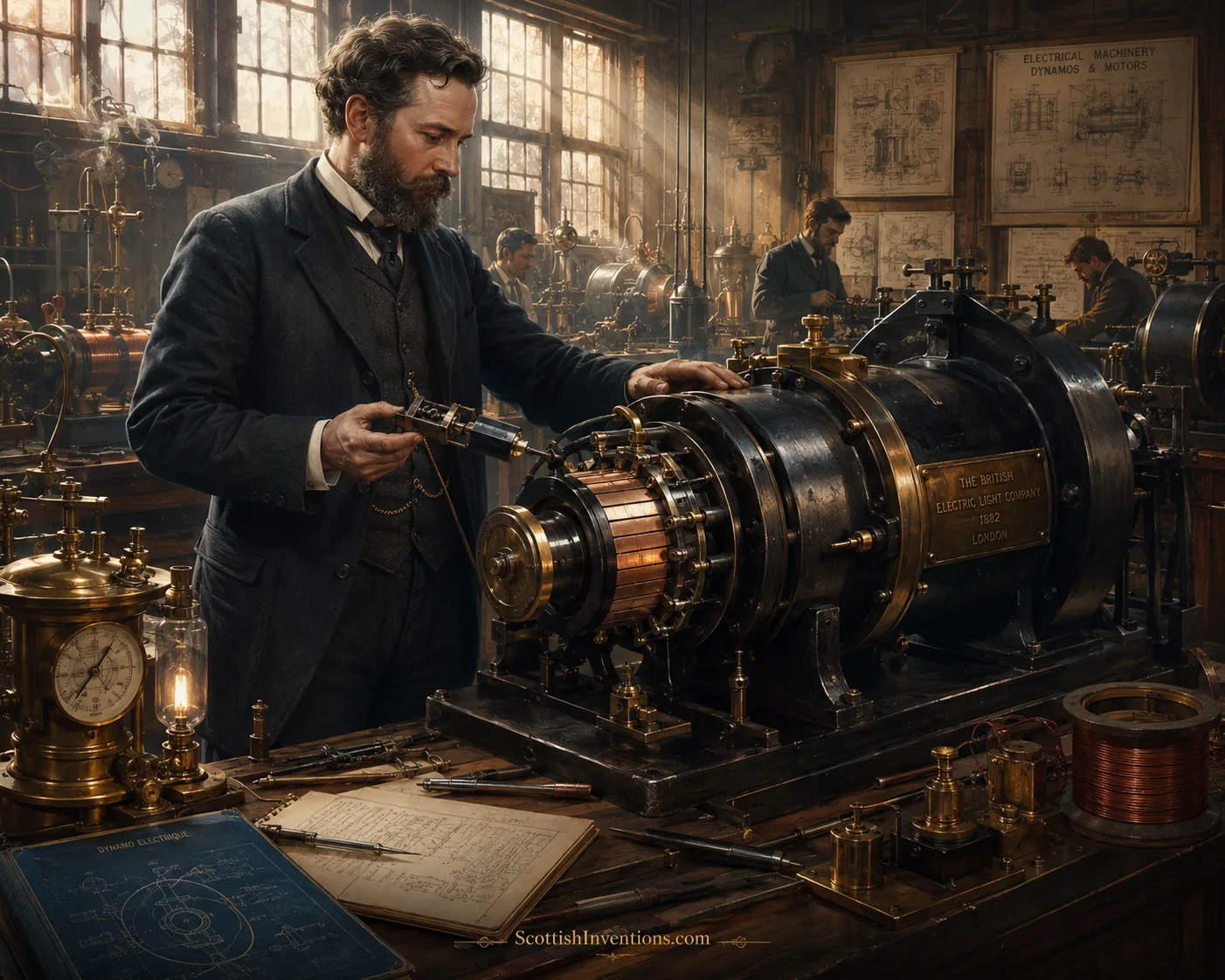
In 1882, Forbes left academia, moved to London, and became manager of the British Electric Light Company, a maker of carbon filaments and arc lamps. Surrounded by carbon products and dynamo work, he began experimenting with carbon — rather than wire or gauze — as the brush material for the sliding contact on commutators.
In 1885 this led to British Patent No. 1288, titled "Improved Means for Establishing Electric Connection between Surfaces in Relative Motion Applicable to the Collectors of Dynamo Machines." Historians of the Institution of Electrical Engineers recognise it as the first patent for the carbon brush. Forbes' surviving original brushes — some are held by the Science Museum Group, catalogued as used on his "non-polar dynamo," 1884 — do not look like a modern brush at all. Examined later by researchers at Morganite, the carbon collector was made of thin retort carbon, copper-plated and soldered to a copper backing: the aim was to keep the carbon thin (to reduce contact resistance) while strengthening it. The carbon itself was initially cut from battery plates or arc-lighting electrodes.
Forbes seems not to have grasped what he had. In the words of his obituarist G. L. Addenbrooke, "He always referred to this work with much modesty, but there can be no doubt that almost without acknowledgement he presented to the world an idea of great engineering and commercial value, the importance of which he does not seem to have fully grasped at the time." A British firm he approached experimented for three months, acknowledged the brushes' "great merit," but never adopted them. Forbes eventually sold the American rights to Westinghouse for a mere £2,000 (about $8,000 then) and appears to have received no UK royalties. He died in relative poverty.
How the Carbon Brush Works
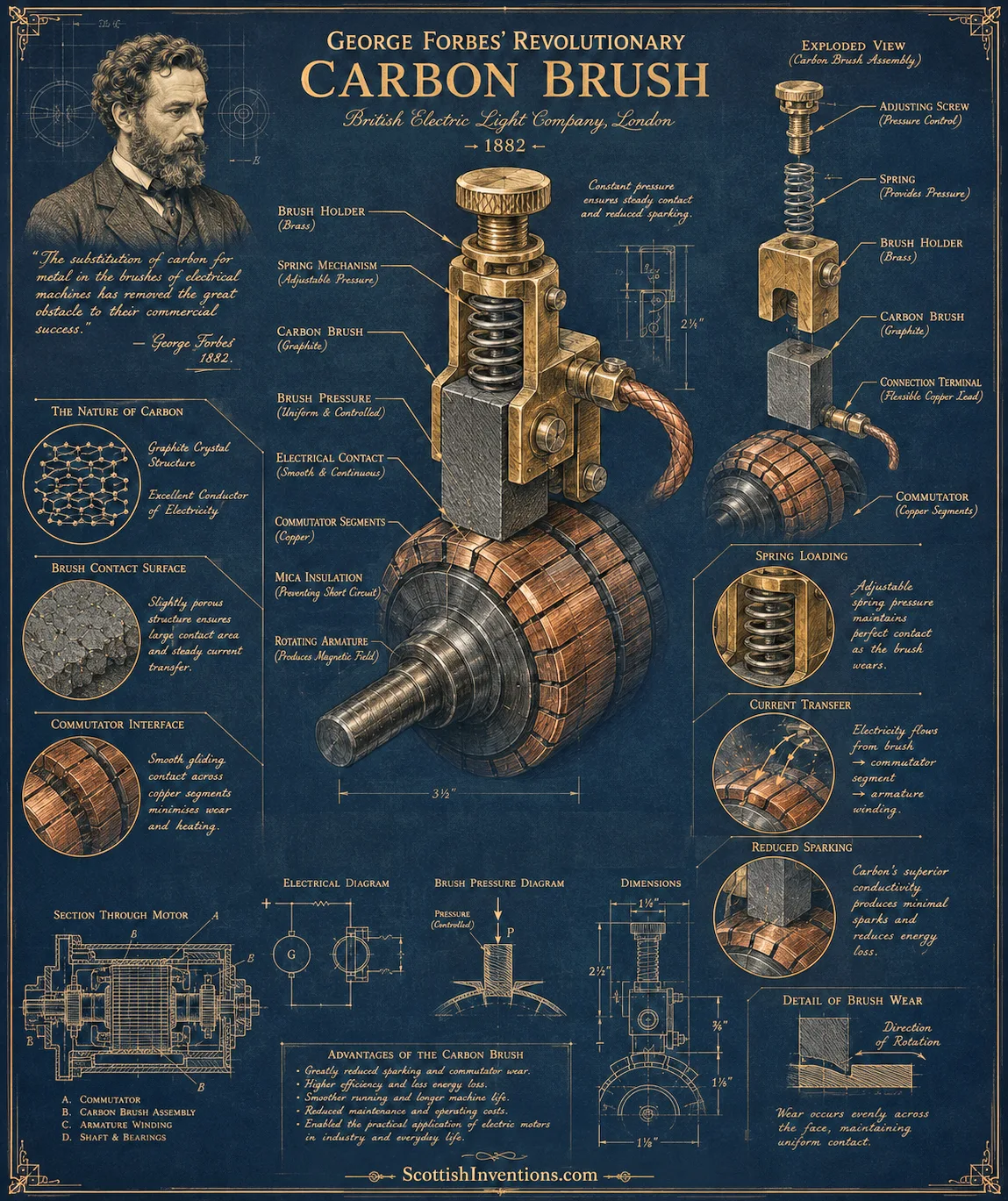
- The commutator is a cylinder of copper segments (bars) on the machine's shaft, insulated from one another by mica, each connected to the rotor windings.
- The brush is a small block of carbon held in a metal brush-holder and pressed against the spinning commutator by a spring — typically at a few hundred grams of pressure per square centimetre. It provides the sliding electrical bridge between the stationary circuit and the rotating armature.
- Why carbon is ideal: graphite is naturally self-lubricating; it is electrically conductive but has a higher resistance than metal, which limits the short-circuit currents that cause sparking; and, crucially, it is soft enough to wear away in preference to the far more expensive copper commutator. The brush sacrifices itself to protect the machine.
- The patina: a well-behaved carbon brush lays down a thin, polished film of graphite oxide on the commutator that cuts friction and electrical noise, actually improving contact over time.
- Modern formulations: today's brushes range from pure electrographite (graphitised at over 2,500 °C) to metal-graphite composites loaded with copper or silver for high-current, low-voltage work. They have wear indicators and pigtail leads — but the principle is exactly Forbes'.
Why Carbon Changed Everything
Metal brushes failed because they combined the wrong properties: high conductivity (which meant no damping of commutation sparks), hardness (which chewed up the copper commutator), and no self-lubrication (which meant continual friction and heat). Carbon flipped every one of those trade-offs the right way round.
The result was a machine that could run for months at a time with only routine brush changes, instead of hours before servicing. Central power stations could grow to city scale. Electric trams and locomotives could stay in service. Factory motors could drive continuous production. In a very real sense, the carbon brush turned electricity from a laboratory curiosity into an industry.
The Spread of Electrification
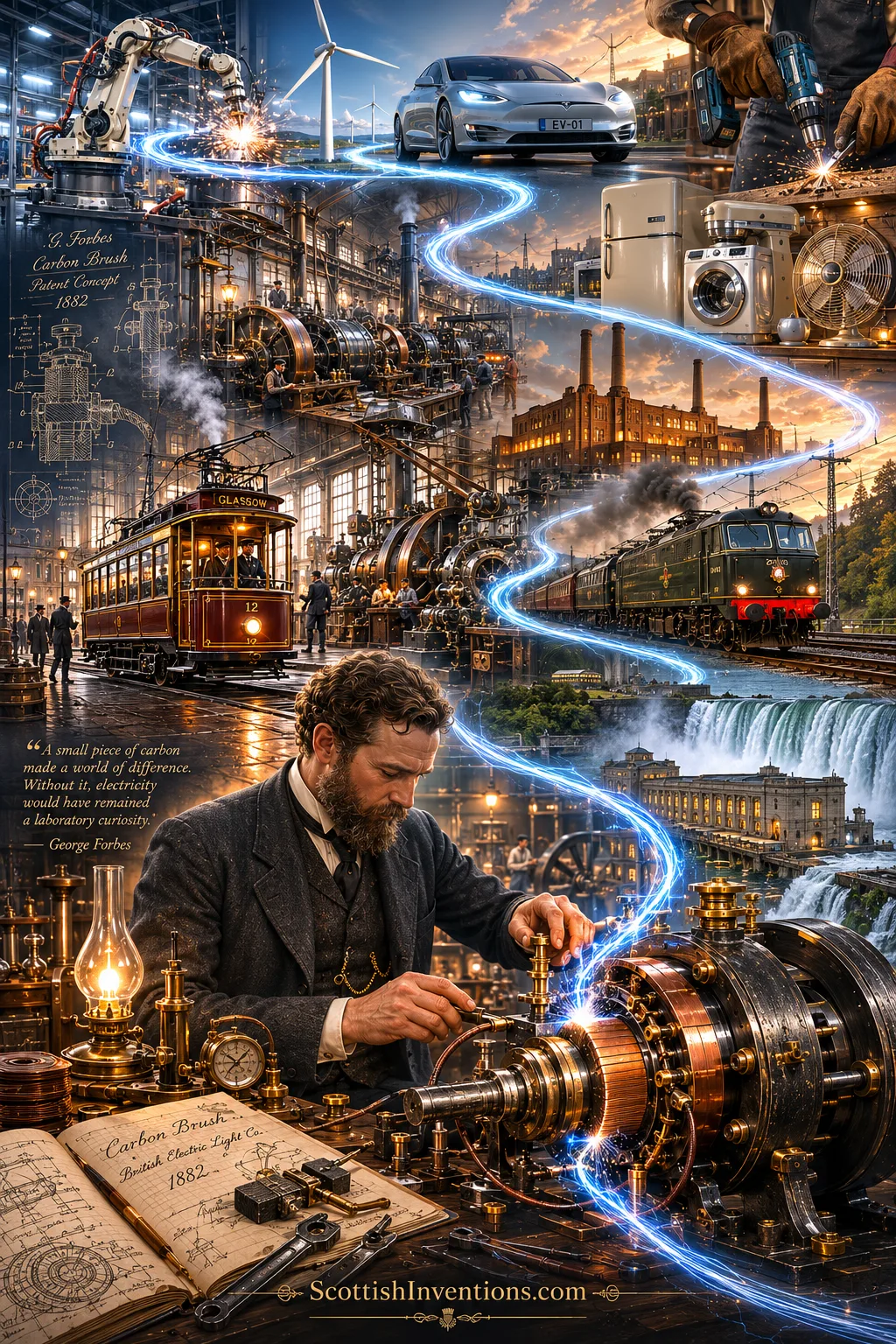
Once carbon brushes were adopted commercially from 1888 onward, the pace of electrification accelerated sharply. Electric trams multiplied in every major city. In Britain, the City & South London Railway — the world's first deep-level electric tube — opened in 1890, and Forbes himself had recommended electric propulsion for it. Central power stations grew from a handful of blocks to entire cities. Factory shafting gave way to individual electric motors on each machine. Domestic appliances followed — washing machines, vacuum cleaners, refrigerators — all of them, at first, brushed motors.
Forbes' name featured only rarely in the resulting boom. He advised on hydro schemes in India (1893), South Africa (1895), New Zealand (1896) and Egypt (1897–98), and after 1900 turned to gunnery — developing a naval rangefinder used by the Royal Navy into the Second World War, and light-based signalling for submarines in the First World War.
Niagara Falls and the Age of Electricity
Forbes' second great engineering legacy is Niagara Falls. The Cataract Construction Company, led by Edward Dean Adams, formed the International Niagara Commission in 1890, chaired by Lord Kelvin, to find a way to harness the falls. It rejected all seventeen submitted proposals. Forbes was engaged as a technical consultant in 1892 (he served as consulting electrical engineer roughly 1891–1895), and the Cataract Construction Company's decision to adopt Nikola Tesla's polyphase alternating current system was officially made on 6 May 1893 — "five years and five days after the issuing of Tesla's patents" — a choice Forbes pushed for against much contemporary opinion favouring DC.
Westinghouse was subcontracted to build ten AC generators, each rated (per the Smithsonian's record for Adams Station generator no. 1) at "25 cycles, 2-phase alternating current, 2200 volts, 5000 horse-power," and "designed and built by Westinghouse Electric and Manufacturing Co. after a preliminary design by Forbes." The ten units together gave Powerhouse No. 1 a design capacity of 50,000 hp. Generator no. 1 began operation on 26 August 1895, and the first transmission of Niagara power to Buffalo occurred at midnight on 15 November 1896. Forbes contributed specific design ideas — eliminating the flywheel, and using an external revolving field.
His role is fairly contested: the final generator design was a compromise with Westinghouse, and C. E. L. Brown criticised aspects of it. Forbes felt he deserved a knighthood for Niagara and was disappointed not to receive one. The plant is rightly remembered as a Tesla/Westinghouse triumph, but Forbes was the consulting engineer who helped steer it decisively toward AC.
Legacy of the Carbon Brush
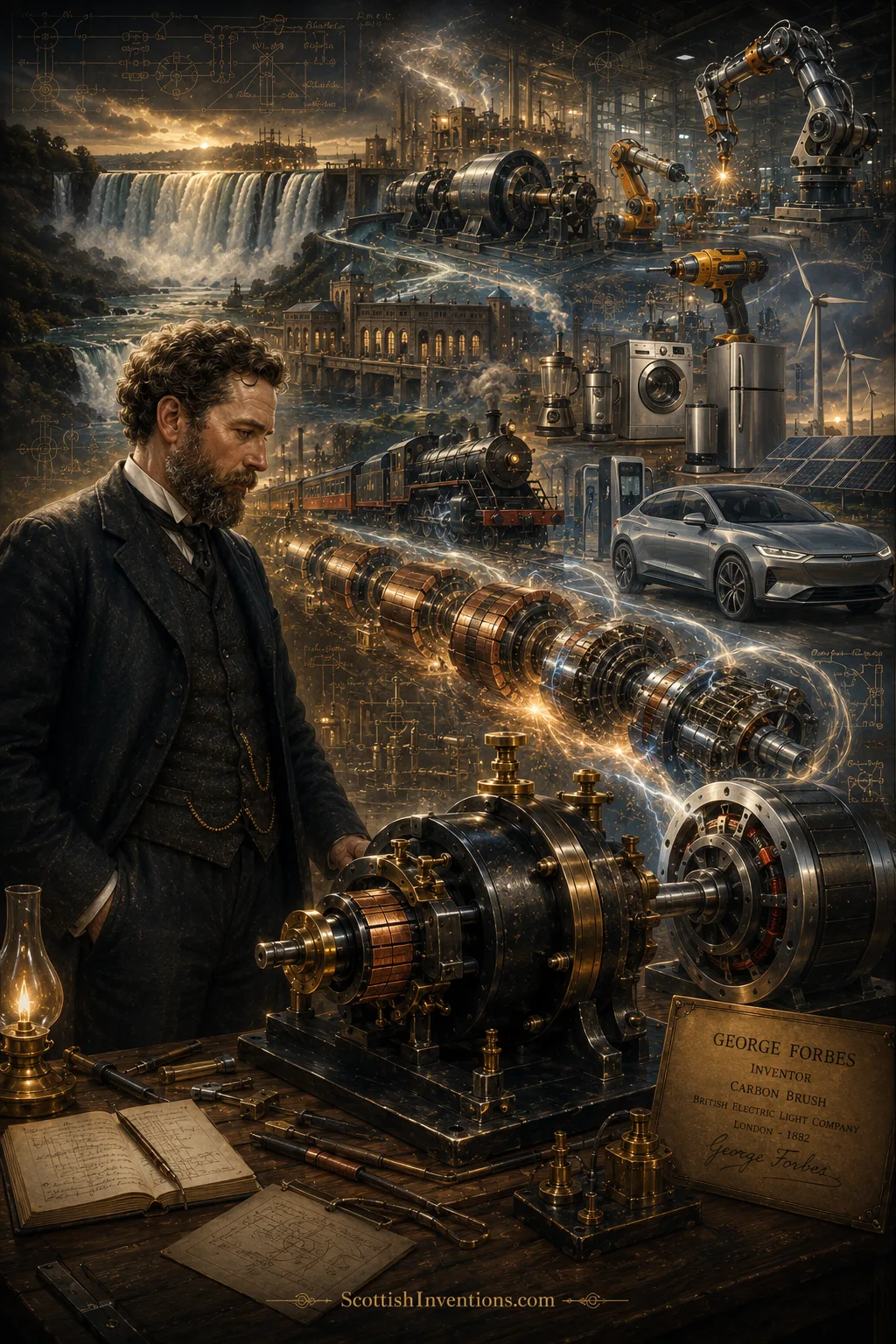
The carbon brush was a genuine enabling technology for the electrification of the modern world. Every DC generator and DC motor of the classic type relies on brushes; AC machines with wound rotors and alternators use carbon brushes on slip rings. Without reliable current collection, neither central power stations nor electric railways could have scaled up.
And the technology has proved astonishingly durable. Carbon brushes are still found in power tools (drills, angle grinders), vacuum cleaners, washing machines, automotive starter motors and alternators, power-window and seat motors, railway traction motors, cranes, elevators, wind-turbine generators and countless industrial machines — quite literally billions of devices. It remains a healthy, growing business: the global carbon brush market was valued at about USD 3.35 billion in 2023 and is projected to reach roughly USD 4.98 billion by 2032 (a compound annual growth rate of about 4.5%), with leading players including Morgan Advanced Materials, Mersen SA and Schunk GmbH.
The one major successor technology is the brushless DC motor, which emerged as semiconductor electronics matured from the 1960s onward. It replaces the mechanical commutator and brushes with electronic commutation, eliminating brush wear and sparking and offering longer life and higher efficiency — which is why modern electric vehicles, drones and premium appliances increasingly use them. But brushed machines remain widespread wherever simplicity and low cost matter, so Forbes' invention is very far from obsolete.
Did You Know?
- George Forbes was the son of one of Scotland's most famous physicists — James David Forbes, who showed that glaciers flow like viscous fluids and pioneered the study of radiant heat.
- The carbon brush Forbes patented in 1885 is still found in billions of electric motors and generators worldwide — from cordless drills to wind turbines.
- Forbes was the consulting engineer who helped push the Niagara Falls power scheme toward alternating current — one of the most important engineering projects of the 19th century.
- He measured the speed of light to within about 0.5% of the modern value using an improved Fizeau toothed-wheel method — around 1880–81.
- In 1880 he predicted the existence of a trans-Neptunian planet from the clustering of comet aphelia — half a century before Pluto, and an idea that prefigures modern "Planet Nine" speculation.
- Every time you drill a hole, start a car, or switch on a vacuum cleaner, there is a good chance a carbon brush is doing its quiet work.
Timeline
5 April 1849
Born in Edinburgh
George Forbes is born at 3 Park Place, Edinburgh, second son of James David Forbes, Professor of Natural Philosophy at Edinburgh and one of Britain's leading physicists — the man who showed that glaciers flow like viscous fluids.
1871
Cambridge graduation
Educated at Edinburgh Academy, St Andrews and Cambridge (Christ's College and St Catharine's College), Forbes graduates BA.
1872
Professor at Anderson's, Glasgow
Aged only about 23, Forbes is appointed Professor of Natural Philosophy at Anderson's University in Glasgow — the future core of the University of Strathclyde.
1874
Transit of Venus, Hawaii
Forbes leads the British expedition to Hawaii to observe the transit of Venus, aiming to refine the Earth–Sun distance.
1877
Russo-Turkish War correspondent
The only British war correspondent with the Russian army, reporting for The Times and awarded the Russian Order of St George.
c. 1880–81
Measures the speed of light
With James Young at Anderson's, Forbes measures the velocity of light using an improved Fizeau toothed-wheel method, obtaining about 301,382 km/s — remarkably close to the modern value.
1880
Predicts a trans-Neptunian planet
From the clustering of comet aphelia, Forbes predicts an unknown planet beyond Neptune — half a century before Pluto's discovery.
1882
Manager, British Electric Light Co.
Forbes leaves academia and moves to London to manage the British Electric Light Company, a maker of carbon filaments and arc lamps. Surrounded by carbon and dynamos, he begins experimenting with carbon as the brush material.
1885
British Patent No. 1288
The first patent for the carbon brush: 'Improved Means for Establishing Electric Connection between Surfaces in Relative Motion Applicable to the Collectors of Dynamo Machines'.
1887
Fellow of the Royal Society
Forbes is elected FRS, joining the great Scottish scientific tradition of Maxwell, Kelvin and Rankine.
1888
First commercial carbon-brush use
Charles Van Depoele (US Patent 390,921) and Frank Sprague demonstrate carbon brushes on railway motors — the first triumphant commercial application of Forbes's principle.
1891–1895
Niagara Falls consulting engineer
Forbes advises the Cataract Construction Company and pushes decisively for Tesla's polyphase AC — officially adopted on 6 May 1893. Westinghouse builds ten 5,000 hp AC generators; generator no. 1 begins running on 26 August 1895.
15 November 1896
Power reaches Buffalo
The first long-distance transmission of Niagara power to Buffalo at midnight — the beginning of the AC age.
1906
'The Shed' at Pitlochry
Forbes builds a wooden house with an observatory near Pitlochry, overlooking the valley later flooded as Loch Faskally for a hydro scheme he himself proposed.
22 October 1936
Death at Worthing
Forbes dies at Worthing, aged 87, after an accident with a gas fire. Having sold the American rights to his carbon brush to Westinghouse for just £2,000, he dies in relative poverty.
2021
Scottish Engineering Hall of Fame
George Forbes is inducted into the Scottish Engineering Hall of Fame.
Frequently Asked Questions
Who invented the Carbon Brush?
The carbon brush was invented by George Forbes (1849–1936), an Edinburgh-born Scottish physicist and engineer. He was granted British Patent No. 1288 in 1885 for using carbon rather than metal as the current-collecting brush on the commutators of dynamo machines — the first patent for the carbon brush.
What is a Carbon Brush?
A carbon brush is a small block of graphite or electrographite, held in a spring-loaded metal brush-holder and pressed against the rotating commutator or slip rings of an electric motor or generator. It provides the sliding electrical bridge between the stationary circuit and the spinning armature, carrying current on and off the machine.
Why was the Carbon Brush important?
Carbon brushes solved the single biggest practical bottleneck in early electrical engineering. Metal brushes sparked violently, overheated, wore out quickly and destroyed the copper commutator. Carbon is self-lubricating, wears slowly and evenly, dramatically reduces sparking and lays down a protective graphite film — making large-scale, reliable power generation and electric traction commercially viable.
Why did metal brushes fail?
Copper and brass brushes — whether laminated foil, wire bundles or gauze — had low electrical resistance, so at the split-second of commutation they short-circuited coils and threw destructive sparks. They also ground themselves and the commutator into dust, overheated, and produced what one contemporary called a 'ghastly greenish illumination'. Elihu Thomson wrote that on early electric railways 'all forms of metal brush had been tried and become acknowledged failures'.
How does a commutator work?
A commutator is a segmented rotary switch mounted on the shaft of a DC machine. It is a cylinder of copper bars, insulated from each other by mica, each bar connected to one coil of the rotor windings. As the shaft turns, the commutator reverses the current in each coil at exactly the right moment, so the torque always pushes in the same direction — turning alternating currents in the windings into usable direct current at the brushes.
What does a Carbon Brush do?
It carries current between the stationary wiring of a motor or generator and the rotating armature. Because carbon has a higher resistance than metal, it limits the short-circuit currents at commutation and suppresses sparking; because it is soft and self-lubricating, it wears in preference to the far more expensive copper commutator, sacrificing itself to protect the machine.
Is the Carbon Brush still used today?
Yes — in billions of machines. Carbon brushes are found in cordless drills, angle grinders, vacuum cleaners, washing machines, car starter motors and alternators, power-window and seat motors, railway traction motors, cranes, lifts, wind-turbine generators and countless industrial motors. The global carbon brush market was valued at roughly USD 3.35 billion in 2023 and is projected to reach about USD 4.98 billion by 2032.
Did George Forbes work on Niagara Falls?
Yes. Forbes served as consulting electrical engineer to the Cataract Construction Company at Niagara Falls in the early 1890s. He was among those who pushed decisively for Nikola Tesla's polyphase alternating current system over direct current — a choice officially adopted on 6 May 1893. Westinghouse built ten AC generators for Powerhouse No. 1, giving 50,000 hp of design capacity; generator no. 1 began operation on 26 August 1895.
What machines still use Carbon Brushes?
Every DC motor and DC generator of the classic type; AC machines with wound rotors and alternators use them on slip rings. In everyday life that means power tools, vacuum cleaners, kitchen mixers, washing machines, hair dryers, car starter motors and alternators, seat and window motors, railway traction motors, cranes, lifts, escalators, wind-turbine generators and vast numbers of industrial motors.
Why is George Forbes important?
Because his carbon brush was a genuine enabling technology for the electrification of the world — without reliable current collection, neither central power stations nor electric railways could have scaled up. He was also one of the most versatile Scottish scientists of the Victorian age: he measured the speed of light, observed the 1874 transit of Venus from Hawaii, predicted a trans-Neptunian planet 50 years before Pluto, crossed Siberia overland, and served as consulting engineer on the Niagara Falls hydroelectric scheme.
Sources
- Frederick W. Duthie, "George Forbes: Carbon Brush Inventor," Journal of the IEE, April 1996.
- Royal Society, Biographical Memoirs of Fellows of the Royal Society, obituary of George Forbes (1938).
- G. L. Addenbrooke, obituary of George Forbes, Journal of the Institution of Electrical Engineers.
- Science Museum Group Collection — Forbes carbon brushes and non-polar dynamo (1884).
- Smithsonian National Museum of American History — Adams Station Generator No. 1 records.
- Institution of Electrical Engineers (now IET) archival records.
- Encyclopædia Britannica, entries for Charles J. Van Depoele and Frank J. Sprague.
- SkyQuest Technology, Carbon Brush Market Report (November 2025).
Discover more
Discover More Scottish Electrical Innovations
George Forbes solved one of the greatest practical challenges of early electrical engineering. Explore more remarkable Scottish inventions that powered the modern world.
Explore the Scottish Inventions Collection