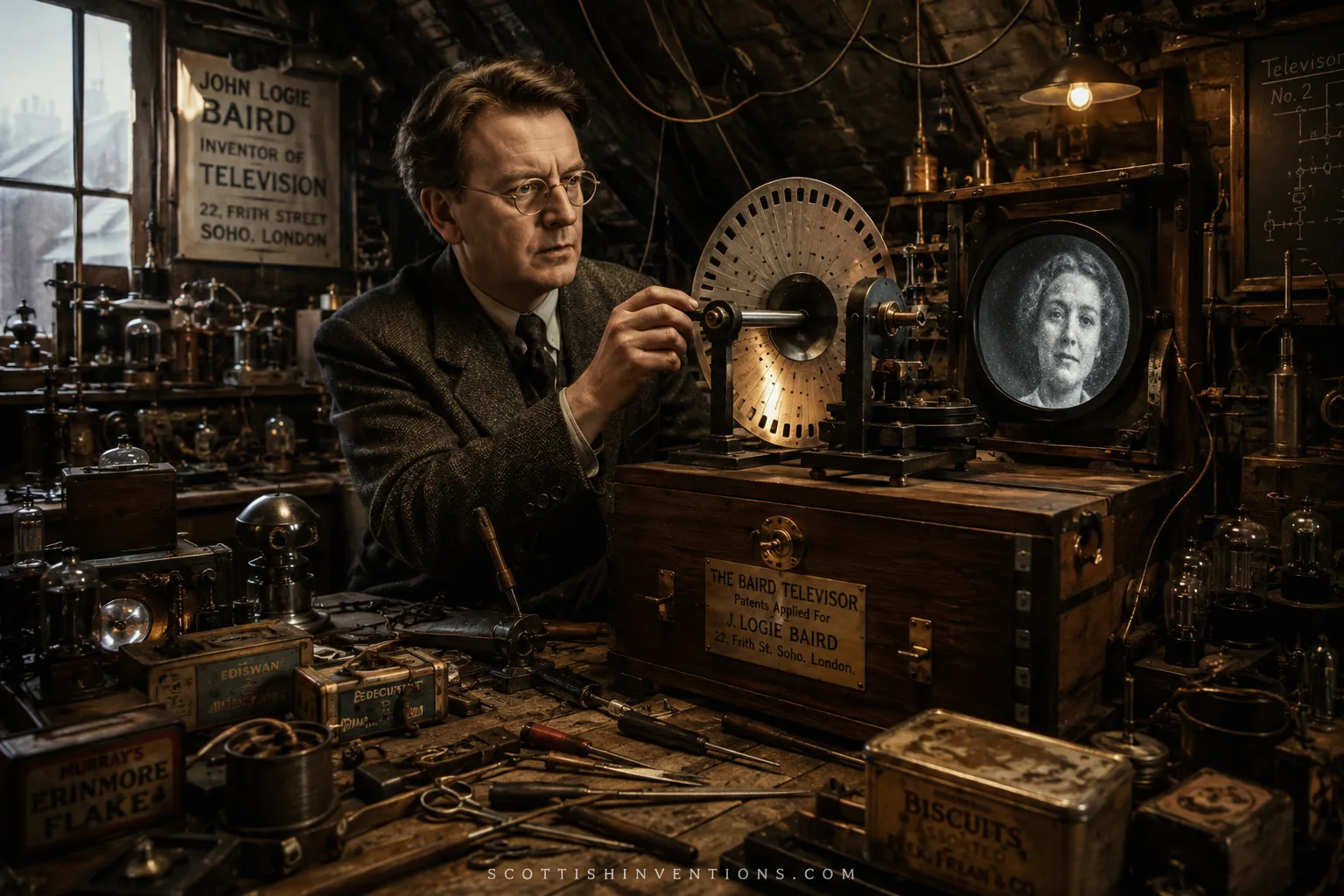
Scottish Inventions · Communications
John Logie BairdThe Scot Who Gave the World Television — in Black, White and Colour
"From a tea chest and a hat box to every screen on Earth."
TL;DR
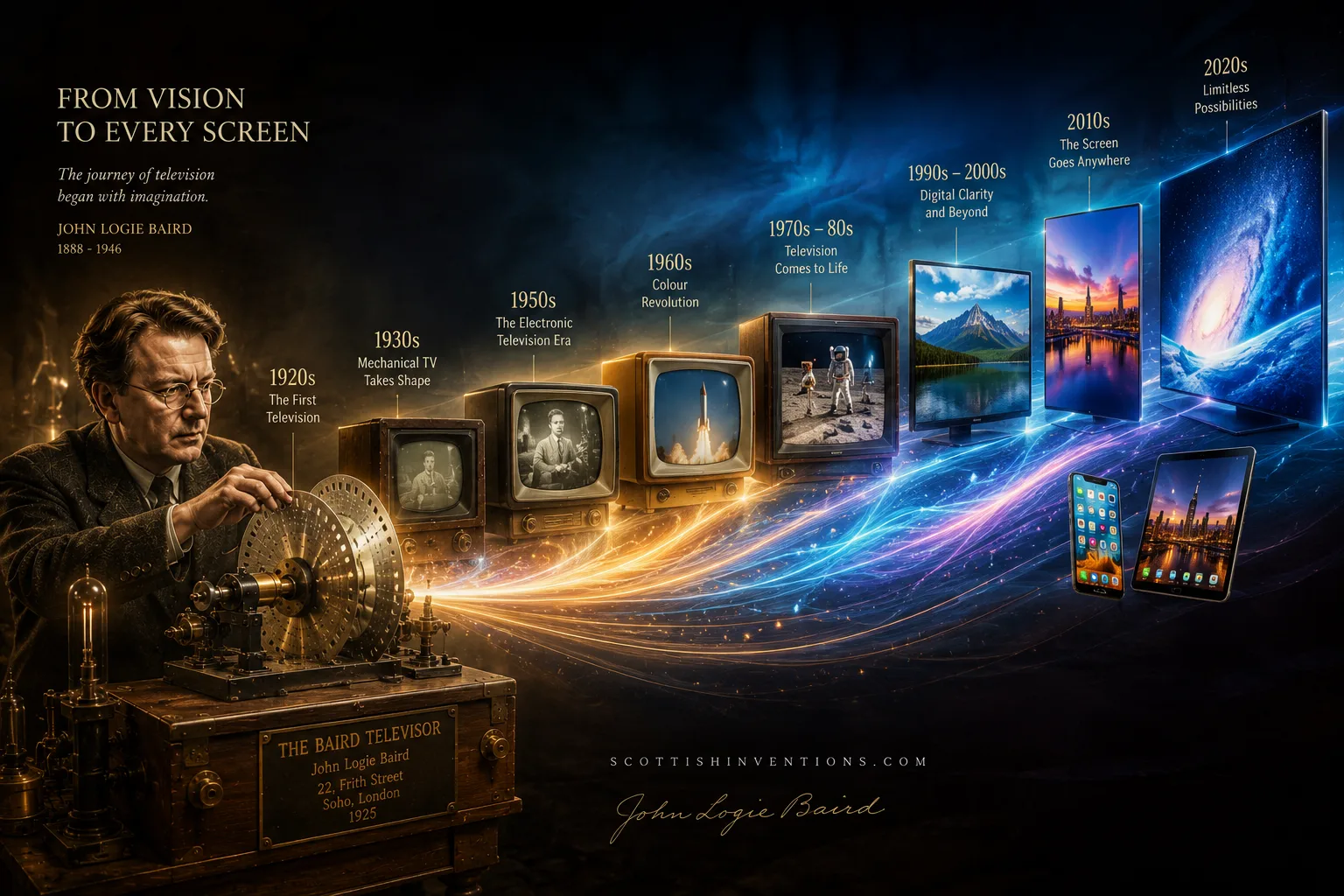
- John Logie Baird, born in Helensburgh in 1888, gave the world's first public demonstration of working television on 26 January 1926 — built from a tea chest, a hat-box disc and bicycle-lamp lenses in a Soho attic.
- He then went further than anyone expected: on 3 July 1928, just two years after proving television was possible at all, he gave the world's first demonstration of colour television — decades before colour broadcasting became standard.
- His mechanical system was eventually superseded by the electronic technology of Philo Farnsworth and Vladimir Zworykin, but it was Baird who proved — first, and in public — that television worked, and Baird who first made it work in colour. Every screen you watch today is his inheritance.
Key Facts
First TV: 26 Jan 1926
Public demonstration at 22 Frith Street, Soho — generally accepted as television's birth date.
First Colour TV: 3 Jul 1928
Baird demonstrated colour television at his Long Acre laboratory — decades before colour broadcasting.
Built from junk
A tea chest, a disc cut from a hat box, bicycle-lamp lenses, a biscuit tin, glue, string and sealing wax.
Transatlantic in 1928
Transmitted television images from London to Hartsdale, New York on 8 February 1928.
First outside broadcast
Televised the Epsom Derby live on 3 June 1931 — the world's first televised sporting event.
Born in Helensburgh
Son of a Church of Scotland minister, educated in Glasgow, working in a London attic.
Early life: the minister's son from the Clyde
John Logie Baird was born on 13 August 1888 in Helensburgh on the Firth of Clyde, the youngest of four children of the Reverend John Baird and Jessie Morrison Inglis, niece of a family of Glasgow shipbuilders. From boyhood the spark was there: as a teenager he wired up the family home for electric light — the first house in the district to have it — and rigged up a private telephone exchange between his bedroom and his friends' houses across the street.
He enrolled at the Glasgow and West of Scotland Technical College (now the University of Strathclyde) for electrical engineering but the First World War interrupted his degree and he never graduated. His health was chronically fragile throughout his life; he was rejected for military service and worked instead on munitions for the Clyde Valley Electrical Power Company.
Baird was also an irrepressible entrepreneur. He invented a water-absorbent "undersock," launched a jam factory in Trinidad (the local insects helped themselves to the sugar), tried Australian honey imports, boot polish and fertiliser. The ventures flopped, but the engineering instincts they exercised would prove the making of him.
The invention of television: a hat box and some darning needles
In early 1923, ill and short of money, Baird moved to Hastings and began assembling the world's first working television apparatus from improvised materials — an old tea chest as a base, a disc cut from a hat box, lenses from bicycle headlamps, a biscuit tin to house the lamp, plus glue, string and sealing wax. He electrocuted himself twice and was evicted by his landlord. He moved to two attic rooms at 22 Frith Street in Soho, London (today the Bar Italia café, marked with commemorative plaques).
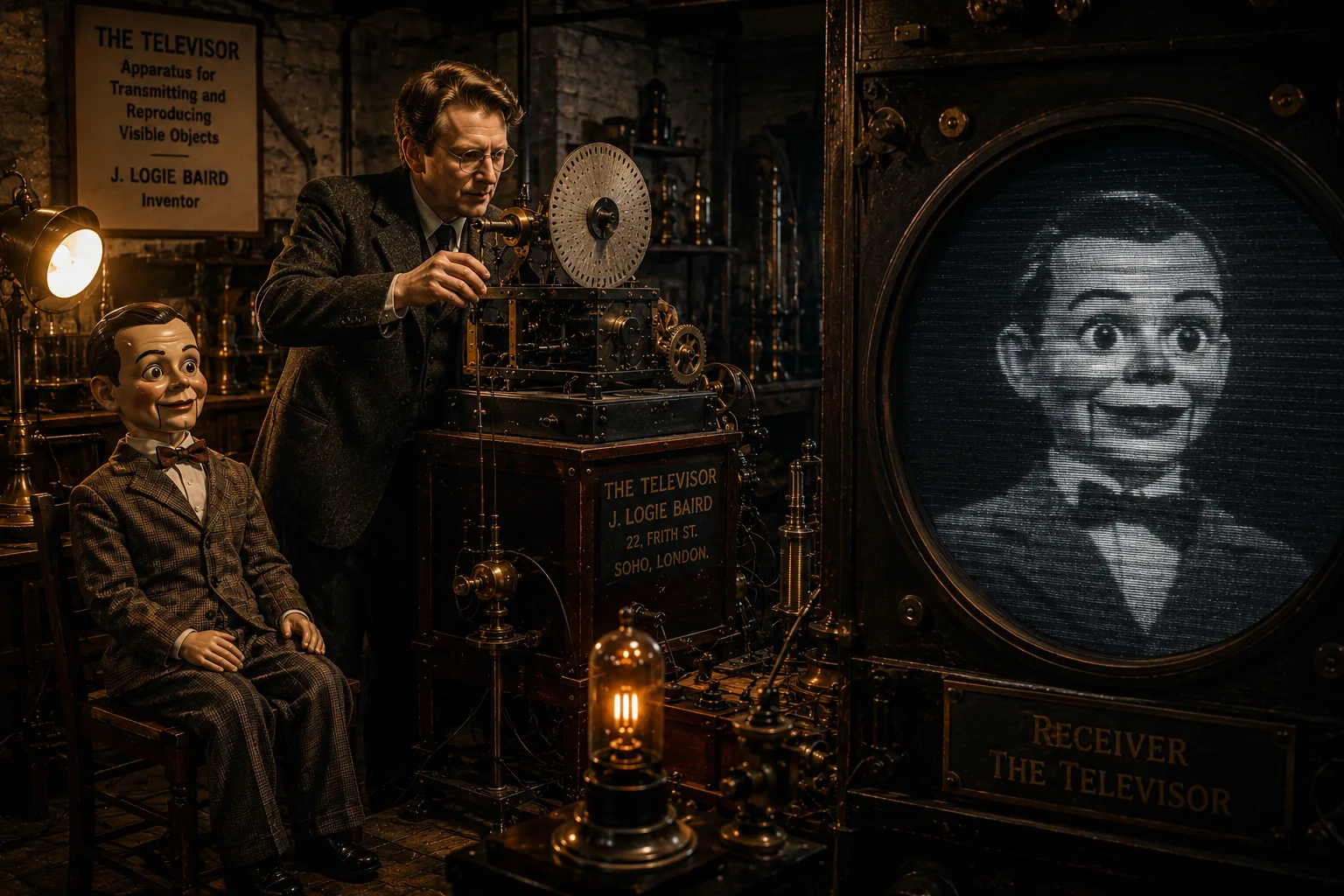
From late March 1925 he demonstrated moving silhouette images at Selfridges department store. But silhouettes were not television. The breakthrough came on Friday 2 October 1925. The image of the dummy's head "suddenly showed up on the screen not as a mere smudge of black and white but as a real image with details and graduations of light and shade." Baird dashed downstairs and grabbed 20-year-old office worker William Edward Taynton — the first living human being to be televised in a full range of light and shade. By some accounts Taynton received the first-ever television appearance fee: half a crown.
The decisive public moment came on 26 January 1926, when Baird invited 40 members of the Royal Institution and a Times reporter to his cramped Frith Street laboratory. The Times, reporting two days later, noted the image was "faint and often blurred, but substantiated a claim that through the 'Televisor'… it is possible to transmit and reproduce instantly the details of movement, and such things as the play of expression on the face." This is generally accepted as the world's first public demonstration of a working television system.
How it worked
Baird's system was mechanical, based on the Nipkow disc — a spinning disc perforated with a spiral of holes, patented by the German Paul Nipkow in 1884. As it rotated, each hole swept across the subject line by line; a light-sensitive cell converted the image into a varying electrical signal. At the receiving end, an identical synchronised disc reassembled the picture. Baird's early image was just 30 lines at 5 frames per second — a tiny, flickering picture roughly 3.5 by 2 inches — later improved to 12.5 frames per second.
Anatomy of the World's First Television
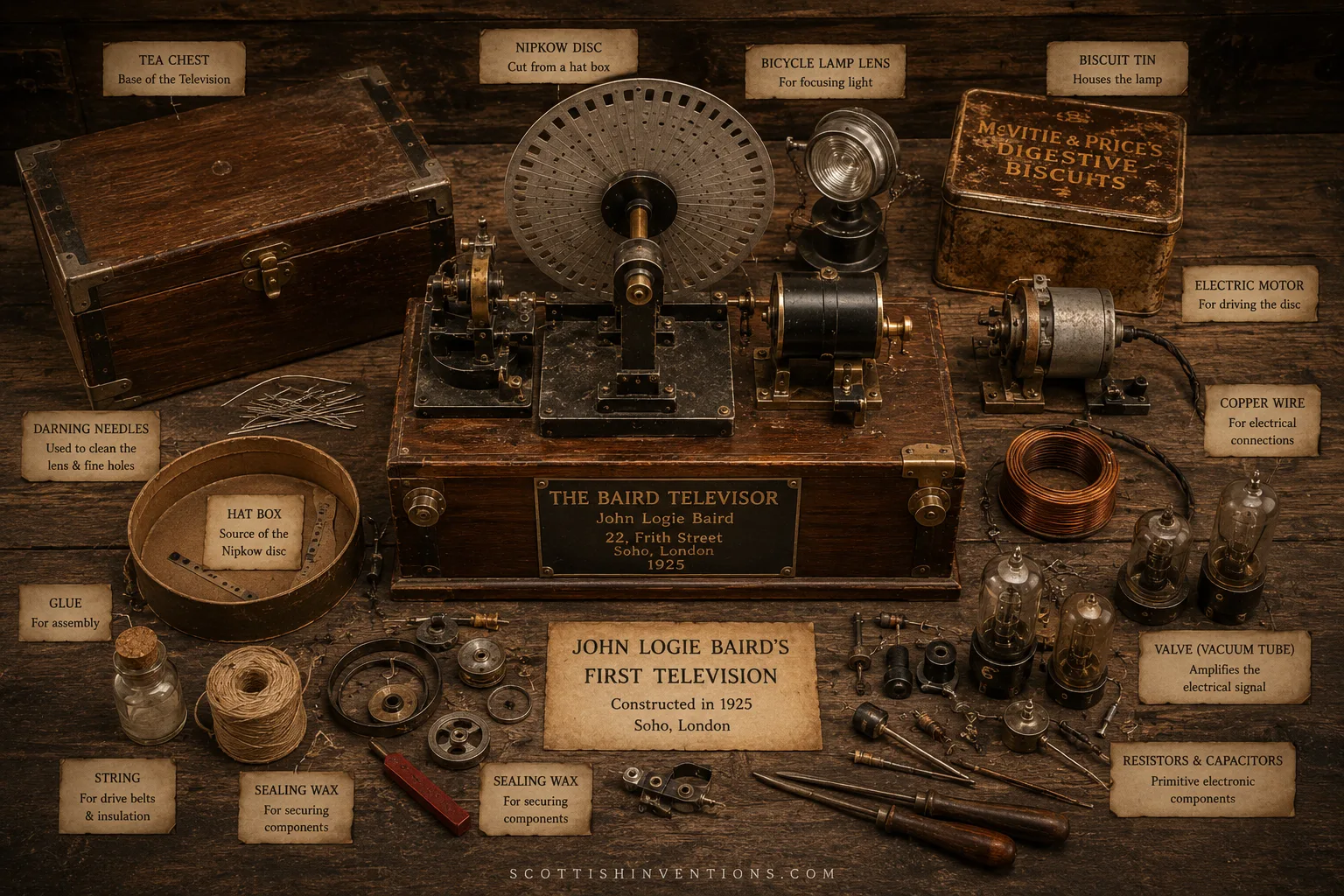
- Tea chestBase of the televisor
- Hat boxSource of the Nipkow disc
- Nipkow discSpinning scanning element
- Bicycle lamp lensesFocusing the light
- Biscuit tinHousing for the lamp
- Darning needlesCleaning the lens and fine holes
- GlueAssembly
- StringDrive belts and insulation
- Sealing waxSecuring components
- Electric motorDriving the disc
- Copper wireElectrical connections
- Vacuum tubesAmplifying the signal
Colour television: the even greater achievement
What is less well known — and perhaps even more remarkable — is what Baird did next. Just over two years after proving black-and-white television was possible, he demonstrated colour.
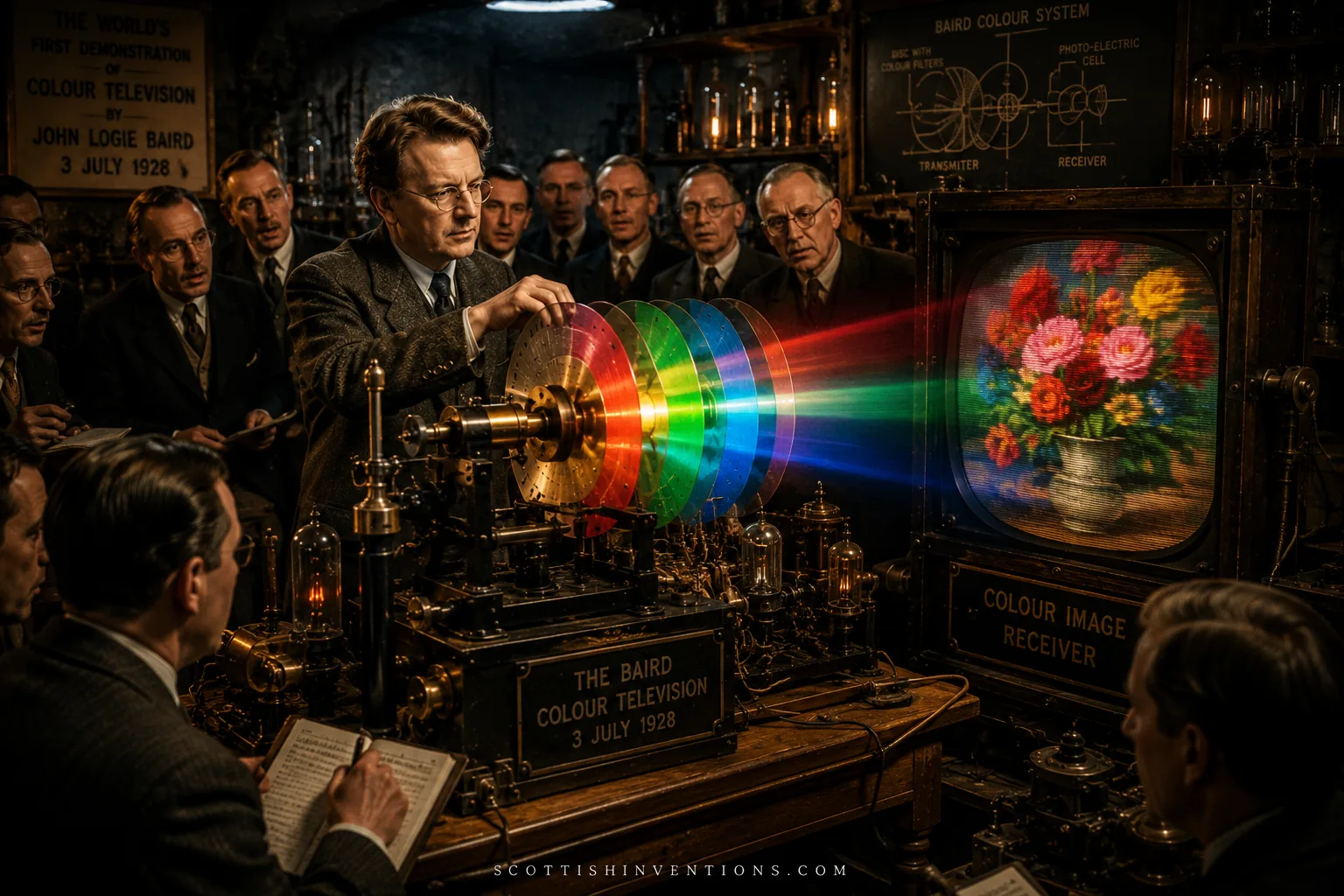
On 3 July 1928, Baird gave the world's first demonstration of colour television at his Long Acre laboratory in London. His method used the same spinning-disc scanning principle, but with colour filters — red, green and blue — fitted over alternate apertures of the disc. Three sets of filters scanned the scene in three colour channels simultaneously; at the receiving end, a matching set of filters and a neon lamp reconstituted the image in colour. The system was primitive by modern standards — the colours were vivid but the picture small and flickering — but the principle was proven: you could transmit colour images over a wire or through the air.
This was not the last word in Baird's colour work. In 1944, in what is often called his most impressive achievement, he demonstrated a fully electronic colour television system at the Dorchester Hotel in London — a 600-line colour picture in a darkened room before an invited audience that included government representatives and scientists. This high-definition colour demonstration was years ahead of any rival system. He died in 1946 before seeing colour broadcasting become a commercial reality, but the principle he had first demonstrated in 1928 underpinned all that followed.
A dazzling run of firsts
From the world's first televised face to the first electronic colour broadcast.
- 1925
First televised face
On 2 October Baird transmits the first recognisable televised human face — Stooky Bill, then office worker William Taynton.
- 1926
Television born
26 January: 40 members of the Royal Institution witness the first public demonstration of working television.
- 1927
London to Glasgow
Long-distance transmission over 438 miles of telephone line from London to Glasgow Central station.
- 1928
Transatlantic, colour & 3D
8 Feb: transatlantic transmission to New York. 3 Jul: world's first colour television. Same year: stereoscopic (3D) television.
- 1930
Big-screen television
London Coliseum demonstration projects television onto a 9 × 4 foot screen for a paying audience.
- 1931
First outside broadcast
3 June: live transmission of the Epsom Derby — the world's first televised sporting event.
- 1932
BBC adopts Baird's system
The first regular television service in the world begins as experimental BBC broadcasts.
- 1936
Alexandra Palace contest
Baird's 240-line mechanical system tested against the all-electronic Marconi-EMI 405-line system.
- 1944
Electronic colour TV
Baird demonstrates a 600-line fully electronic colour system at the Dorchester Hotel — years ahead of any rival.
- 1946
Death
Baird dies in Bexhill-on-Sea on 14 June, one week after the BBC television service resumes post-war broadcasts.
The BBC contest and the honest verdict
Baird's BBC broadcasts began in September 1929 from a modest studio in Long Acre. In November 1936, the BBC began a formal comparison of two rival systems at Alexandra Palace: Baird's 240-line mechanical system against the all-electronic 405-line Marconi-EMI system developed by Isaac Shoenberg. The electronic system was sharper, more reliable and vastly more practical. In February 1937 the BBC dropped Baird's system and adopted Marconi-EMI's entirely.
Here honesty is essential. Modern television does not descend technically from Baird's spinning discs. While Baird perfected mechanical television, the American Philo T. Farnsworth had been pursuing a fully electronic approach; on 7 September 1927, aged 21, his "image dissector" camera tube transmitted its first electronic image — a single straight line. Combined with Vladimir Zworykin's iconoscope camera tube at RCA, electronic television is what the entire modern industry is built on. Baird's mechanical system was a technological dead end. His colour demonstration of 1944, however, was electronic — he had recognised the future and moved to it.
So who invented television? The fairest answer is that television had several parents. Baird was the pioneer who proved, first and in public, that television was possible at all — dragging the idea from theory into reality. He was also the first to demonstrate colour, stereoscopic and big-screen television, and to achieve transatlantic transmission. Farnsworth and Zworykin built the technology we actually use. Baird's genius was as an inventor-demonstrator and evangelist: without his demonstrations and his relentless optimism, it is doubtful the medium would have advanced as fast as it did.
Mechanical vs Electronic Television
Baird proved television publicly first. Farnsworth and Zworykin built the technology we still use.
Baird (Mechanical)
- · Nipkow spinning disc, 30 lines at 5 fps (later 240 lines)
- · First public demonstration: 26 January 1926
- · First colour television: 3 July 1928
- · First transatlantic, big-screen, 3D and outside broadcast
- · Adopted by the BBC for the world's first regular TV service
Farnsworth / Zworykin (Electronic)
- · Image dissector / iconoscope camera tubes
- · First electronic image: 7 September 1927
- · 405-line all-electronic Marconi-EMI system wins the 1936–37 Alexandra Palace contest
- · The technical lineage of every modern TV, monitor and phone display
Personal life and legacy
Baird married South African concert pianist Margaret Albu in New York on 13 November 1931; she was 19 years his junior. (He was famously tone-deaf — an irony for a man married to a concert pianist.) The couple had two children, Diana and Malcolm. His health, fragile all his life, finally failed; he suffered a stroke in February 1946 and died at his home in Bexhill-on-Sea on 14 June 1946, aged 57 — just one week after the BBC television service resumed its post-war broadcasts on 7 June 1946.
His legacy is worldwide. In Helensburgh a bronze bust on the West Clyde Street seafront, sculpted by Donald Gilbert, honours the "native of this town, inventor of television." Australia's prestigious television "Logie Awards" are named after him. He was ranked No. 44 in the BBC's 2002 "100 Greatest Britons" poll, inducted into the Scottish Engineering Hall of Fame in 2015, and in 2021 the Royal Mint issued a commemorative 50p coin marking the 75th anniversary of his death. The global television and video market his medium spawned is projected at US$731.24 billion in 2025 (Statista) — not bad for a sickly minister's son from the Clyde coast, working in a Soho attic with a hat box and some darning needles.
Legacy today
Logie Awards
Australia's premier television awards — named in Baird's honour since 1959.
Royal Mint coin
2021 commemorative 50p marking the 75th anniversary of his death.
Helensburgh memorial
Bronze bust by Donald Gilbert on West Clyde Street, honouring 'a native of this town'.
Scottish Engineering Hall of Fame
Inducted in 2015, alongside Watt, Bell and Telford.
100 Greatest Britons
Ranked No. 44 in the BBC's 2002 national poll.
A US$731 billion industry
The global television and video market his medium spawned (Statista, 2025).
Did you know?
Built from junk
A tea chest, a hat-box disc, a darning-needle spindle, a biscuit tin, bicycle-lamp lenses, glue, string and sealing wax.
Stooky Bill, TV's first star
The first recognisable face on television belonged to a ventriloquist's dummy with painted features for high contrast.
Colour in 1928
Baird demonstrated colour television almost four decades before colour broadcasting became standard in Britain (1967).
Half a crown for fame
Office worker William Edward Taynton, the first living person on TV, reportedly received the first-ever TV appearance fee.
The birthplace of TV
22 Frith Street in Soho, London — today the site of the famous Bar Italia café — marked with commemorative plaques.
First televised sport
On 3 June 1931 Baird broadcast the Epsom Derby live — the world's first televised sporting event.
Frequently asked questions
Who invented television?
Scottish engineer John Logie Baird gave the world's first public demonstration of working television on 26 January 1926 at 22 Frith Street, Soho. American Philo T. Farnsworth followed in 1927 with a different, all-electronic system. Television had several parents, but Baird was the pioneer who first proved publicly that it worked.
Did John Logie Baird invent colour television?
Yes. On 3 July 1928, at his Long Acre laboratory in London, Baird gave the world's first demonstration of colour television, using spinning discs fitted with red, green and blue filters. He went further in 1944 with a 600-line fully electronic colour demonstration at the Dorchester Hotel.
Was John Logie Baird Scottish?
Yes. Baird was born on 13 August 1888 in Helensburgh on the Firth of Clyde, the youngest son of the Reverend John Baird, and studied electrical engineering at the Glasgow and West of Scotland Technical College (now the University of Strathclyde).
How did Baird's television work?
Baird's system was mechanical, based on the Nipkow disc — a spinning disc perforated with a spiral of holes that scanned the subject line by line. A light-sensitive cell converted the image into an electrical signal; at the receiver, an identical synchronised disc reassembled the picture. Early images were 30 lines at 5 frames per second.
Who was Stooky Bill?
Stooky Bill was a ventriloquist's dummy whose painted face gave the strong contrast Baird's early television needed. On 2 October 1925, his image became the first recognisable face transmitted by television, before Baird grabbed office worker William Taynton from downstairs to become the first living person televised.
When was the first television demonstrated?
The first private breakthrough came on 2 October 1925 in Soho. The first public demonstration, generally accepted as television's birth date, was on 26 January 1926, when Baird showed his Televisor to 40 members of the Royal Institution and a Times reporter.
Who invented electronic television?
American inventor Philo T. Farnsworth transmitted the first electronic television image on 7 September 1927, aged 21, using his 'image dissector' camera tube. Vladimir Zworykin's iconoscope tube at RCA built on the same principles. Modern television descends from this electronic line, not from Baird's mechanical discs.
Why did Baird lose to Marconi-EMI?
In the 1936–37 Alexandra Palace contest the BBC compared Baird's 240-line mechanical system with the all-electronic 405-line Marconi-EMI system. The electronic system was sharper, more reliable and more practical, so in February 1937 the BBC adopted Marconi-EMI's system. Baird had already recognised the shift and was working on electronic colour television himself by 1944.
Explore more Scottish inventions
The Telephone →
Alexander Graham Bell, 1876 — voice on the wire.
Radar →
Sir Robert Watson-Watt — the eyes that won the Battle of Britain.
The Electric Light (1835) →
James Bowman Lindsay's pioneering Dundee demonstration.
The BBC →
John Reith and the invention of public-service broadcasting.
First Colour Photograph →
James Clerk Maxwell's three-colour separation, 1861.
Inventions Collection →
All 50 Scottish inventions in one place.
Keep exploring Scotland's story of invention
From Watt's steam engine to Baird's colour television — discover the Scots who built the modern world.