Scottish Inventions · Engineering · Card No. 28 of 50
Thomas Morton and the Patent Slip – The Scottish Invention That Revolutionised Ship Repair
The Leith shipwright who devised a wheeled cradle on rails — and brought the world's ships ashore
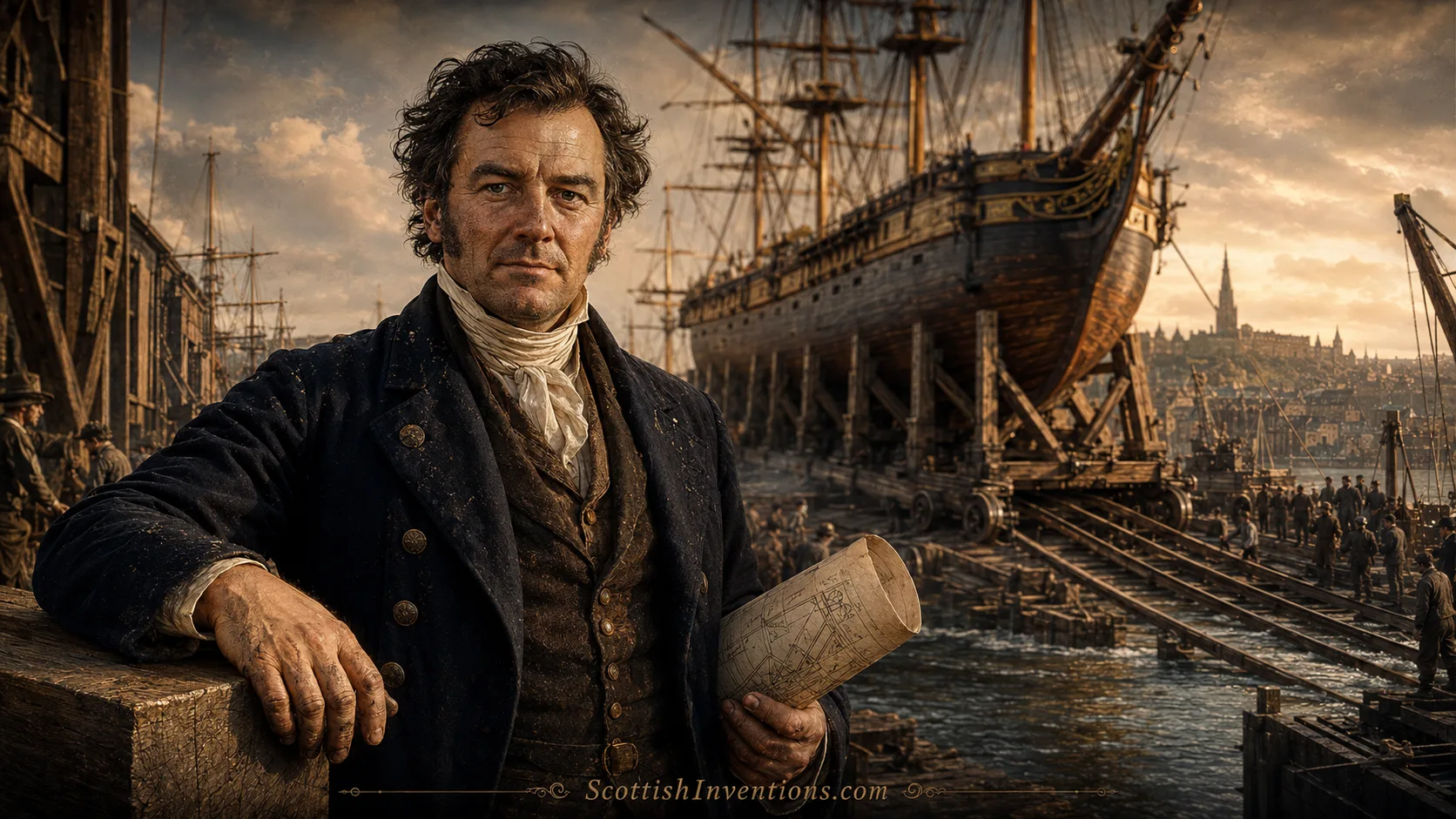
In 1818 a Leith-born shipbuilder named Thomas Morton laid iron rails from dry land down beneath the low-water mark, built a strong wheeled cradle to run on them, and fitted it with self-adjusting timber chocks that drew in beneath a hull as it rose from the sea. His Patent Slip — protected by British Patent No. 4352 on 23 February 1819 — hauled entire ships out of the water for repair at roughly one-tenth the cost of a masonry dry dock, and quietly changed how the world maintained its fleets.
TL;DR
- Thomas Morton (1781–1832), a Leith-born shipwright, invented the Patent Slip — a marine railway — in 1818 and patented it in 1819 (British Patent No. 4352, 23 February 1819). It hauled ships out of the water for repair at roughly one-tenth the cost of a dry dock.
- Contrary to a common assumption, Morton was not a ship-chandler but a working shipbuilder; and simple inclined "ways" already existed. His genuine innovation was the wheeled cradle running on submerged rails, with self-adjusting bilge chocks to hold the hull upright.
- The invention spread across Britain, the Empire and beyond — to Ireland, Russia, the United States, Australia, New Zealand and the Caribbean — democratising ship maintenance, though Morton himself profited only modestly and died before Parliament's £2,500 consolation award could reward him.
Morton at a glance
- Inventor
- Thomas Morton
- Born
- Leith, Scotland — 8 October 1781
- Died
- Leith, Scotland — 24 December 1832
- Trade
- Shipwright & shipbuilder
- Yard
- Water of Leith, Cooper Street
- Scottish patent
- 18 August 1818
- British patent
- No. 4352, 23 February 1819
- Cost vs dry dock
- About one-tenth to build
- Slipping vs dry-docking
- £3 vs £170 (1832)
- Slips in Morton's lifetime
- 45 across five countries
Introduction
Two persistent misconceptions cling to the story of the Patent Slip, and both deserve correcting up front. Thomas Morton was not a ship-chandler supplying stores to passing vessels — every authoritative source, from the Oxford Dictionary of National Biography to Grace's Guide, describes him as a working shipwright and shipbuilder. Nor did he invent the idea of dragging a ship up a slope: simple inclined "ways" had been used for centuries, including at the French royal dockyard at Brest early in the eighteenth century. His genuine, patentable contribution was something more precise and more consequential — the wheeled cradle running on submerged rails, together with the self-adjusting bilge chocks that held the hull safely upright as the vessel rose out of the sea.
That single mechanical idea, protected by British Patent No. 4352 in 1819, put safe and affordable ship repair within reach of every modest harbour on earth. Its descendants — travel-lifts, boat-hoists and marine railways — still haul boats ashore from Arbroath to Wellington today.
The Shipbuilder from Leith
Thomas Morton was, through and through, a son of Scotland's greatest port. He was born in Leith on 8 October 1781, the son of Hugh Morton, described in the Dictionary of National Biography as a "wright and builder" — a craftsman in timber. Leith at this time was the maritime gateway to Edinburgh and, for centuries, one of Scotland's busiest ports, trading with the Baltic, the Low Countries, France, the Mediterranean and the Americas in coal, grain, fish, hides, wine, whale oil and spices. The town's first enclosed wet dock had opened in 1806, with a second following in 1817, and shipbuilding had been carried on in and around Leith since the fourteenth century.
Young Thomas learned his trade in his father's business. Later accounts hold that he broadened his experience in London studying naval architecture before returning to Leith around 1804 to build ships on his own account, on the Water of Leith in front of his premises on Cooper Street. It was precisely as a builder and repairer of hulls that he encountered the problem his invention would solve. He died on 24 December 1832 at his home, 1 Pilrig Place, aged 51, and was buried in the Morton family plot at South Leith Parish Churchyard.
The Problem of Repairing Wooden Ships
Wooden ships in the age of sail were high-maintenance machines. Below the waterline, hulls fouled quickly with weed and barnacles, which dramatically increased drag. Timbers had to be caulked, damaged planking repaired, and — increasingly — copper sheathing fastened over the hull to discourage marine growth and the wood-boring worm. All of this demanded getting at the ship's bottom.
Leith, for all its importance, lacked adequate dry-docking capacity, and the wider maritime economy was expanding fast after the Napoleonic Wars. Unable to afford a dry dock at his own yard, Morton "resorted to the process of hauling up [ships] on greased ways" — dragging them up simple inclined ramps — a method he found both dangerous and time-consuming. The need for a cheaper, safer, quicker way to lift a ship was acute.
Dry Docks vs Careening
There were two traditional solutions, and both had serious drawbacks. The first was the dry dock (or graving dock): a masonry basin dug into the shore, sealed with watertight gates, into which a ship was floated before the water was pumped out, setting the hull high and dry. Dry docks were superb but ruinously expensive to build, slow to flood and empty, and simply beyond the means of most ports.
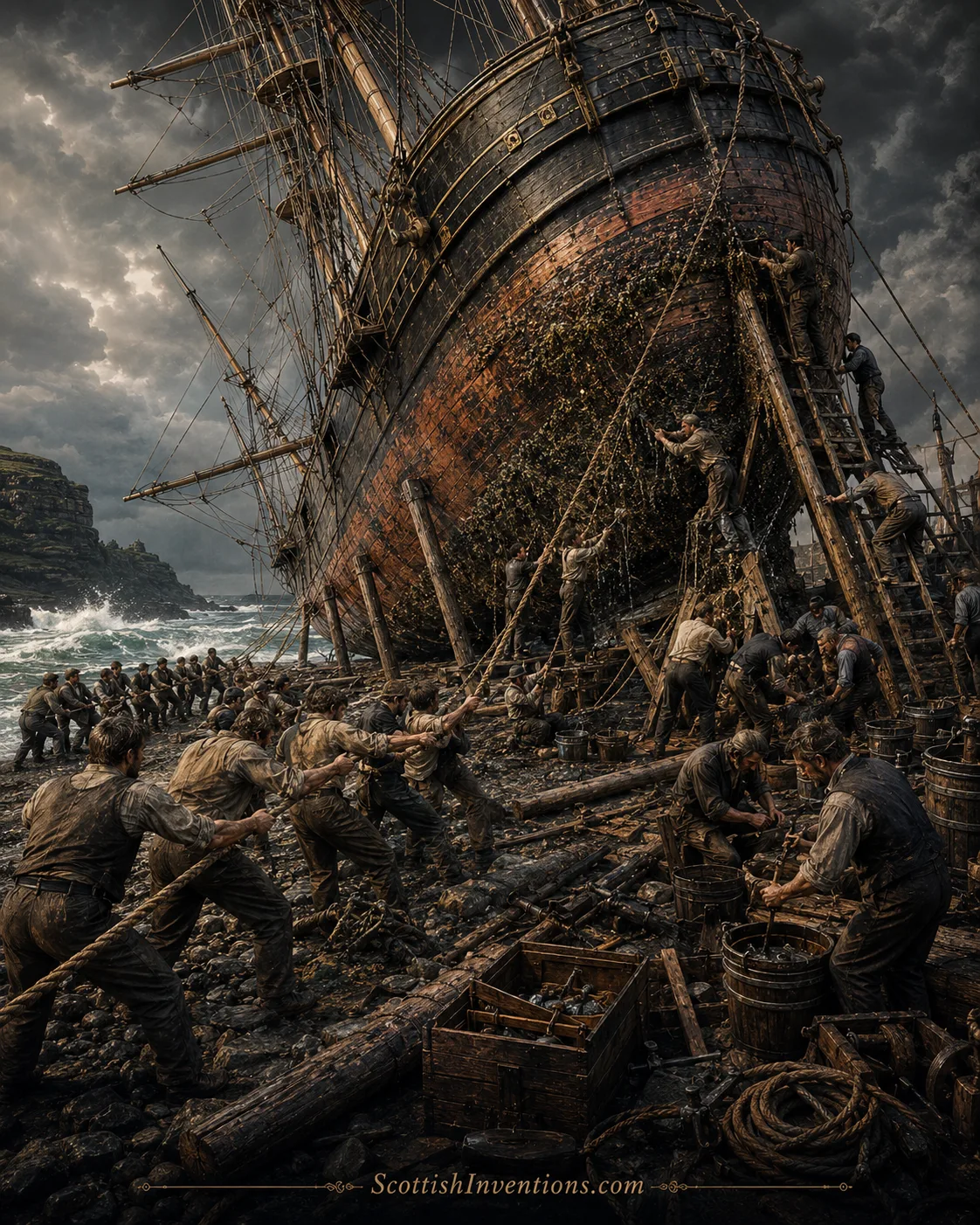
The second was careening — deliberately grounding a vessel on a beach and hauling it over on its side using tackles from the masts to expose one half of the hull, then repeating the process on the other side. Careening was laborious and genuinely dangerous: it strained the hull, and a badly managed heave could wreck a ship. HMS Royal George famously sank at Spithead in 1782 during a related operation.
"One of the most ingenious and valuable descriptions – of the highest advantage to the shipping interests of this maritime country."
Morton's Revolutionary Patent Slip (1818/1819)
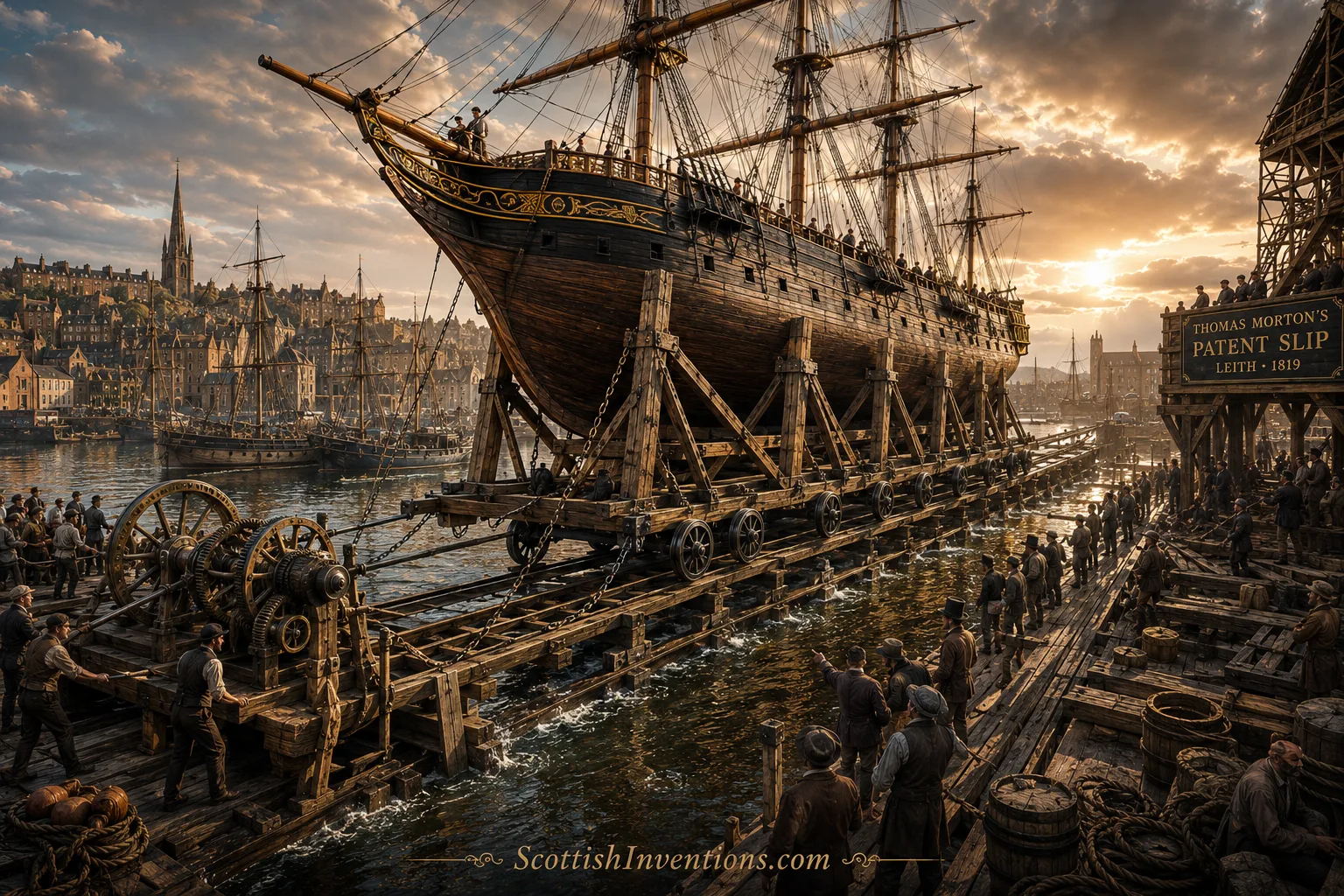
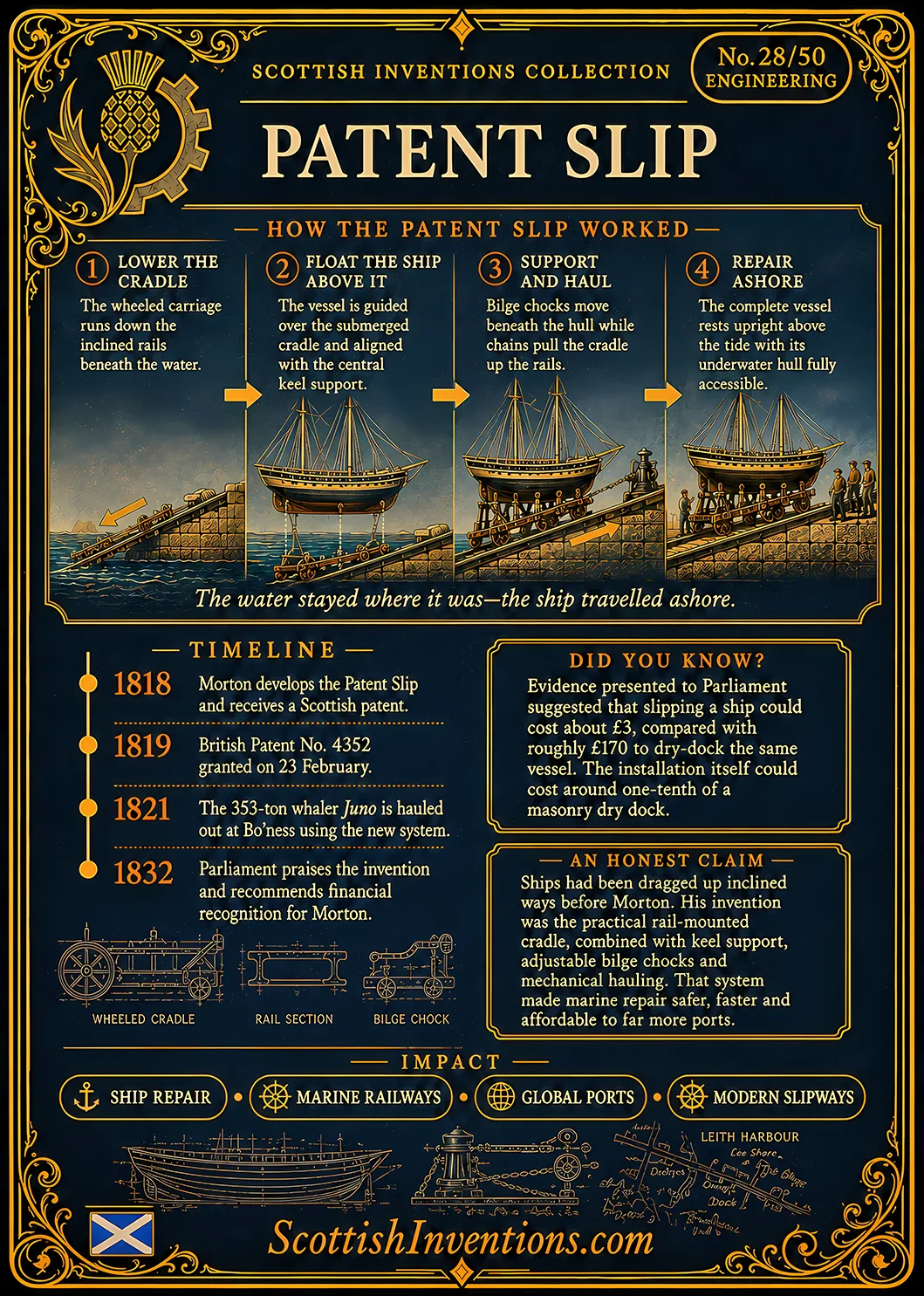
Morton's answer was elegant. He laid a set of rails — typically three parallel lines — on an inclined plane running from dry land down below the low-water mark. On these rails ran a strongly built wheeled cradle, or carriage, supported on many small wheels. The cradle could be let down into the water on a chain worked by a capstan or winding engine. A ship was then floated over the submerged cradle, positioned so its keel sat exactly over the centre — rods projecting above the surface showed where the cradle lay. As the hauling gear was set to work and the cradle drawn up the incline, the vessel gradually settled onto it and was carried bodily out of the water.
What exactly did Morton patent? Not the inclined plane itself — as the DNB frankly acknowledges, "the idea of drawing ships out of the water up an inclined plane was not new," having been used at the royal dockyard at Brest early in the eighteenth century. Morton's genuine innovation, and the heart of his patent, was the wheeled cradle running on rails into the water, together with the ingenious hull-support system: a set of chocks mounted on transverse slides that were drawn in under the ship's bilges as it rose, holding the hull safely upright. A purchase tackle at the head of the cradle took the strain, so there was no damaging pull on the ship itself, and a safety mechanism arrested the cradle if the chain broke.
He invented the device in 1818 and took out a Scottish patent on 18 August 1818, to last fourteen years. The British patent — No. 4352 — followed, dated 23 February 1819, later extended to England, Ireland and the colonies. The Science Museum Group catalogues the 1830 advertisement for "Morton's patent slip, for hauling ships out of the water to be repaired" under exactly this reference. The term "patent slip" stuck so firmly that it is still used two centuries after the patent lapsed.
How the Patent Slip Worked
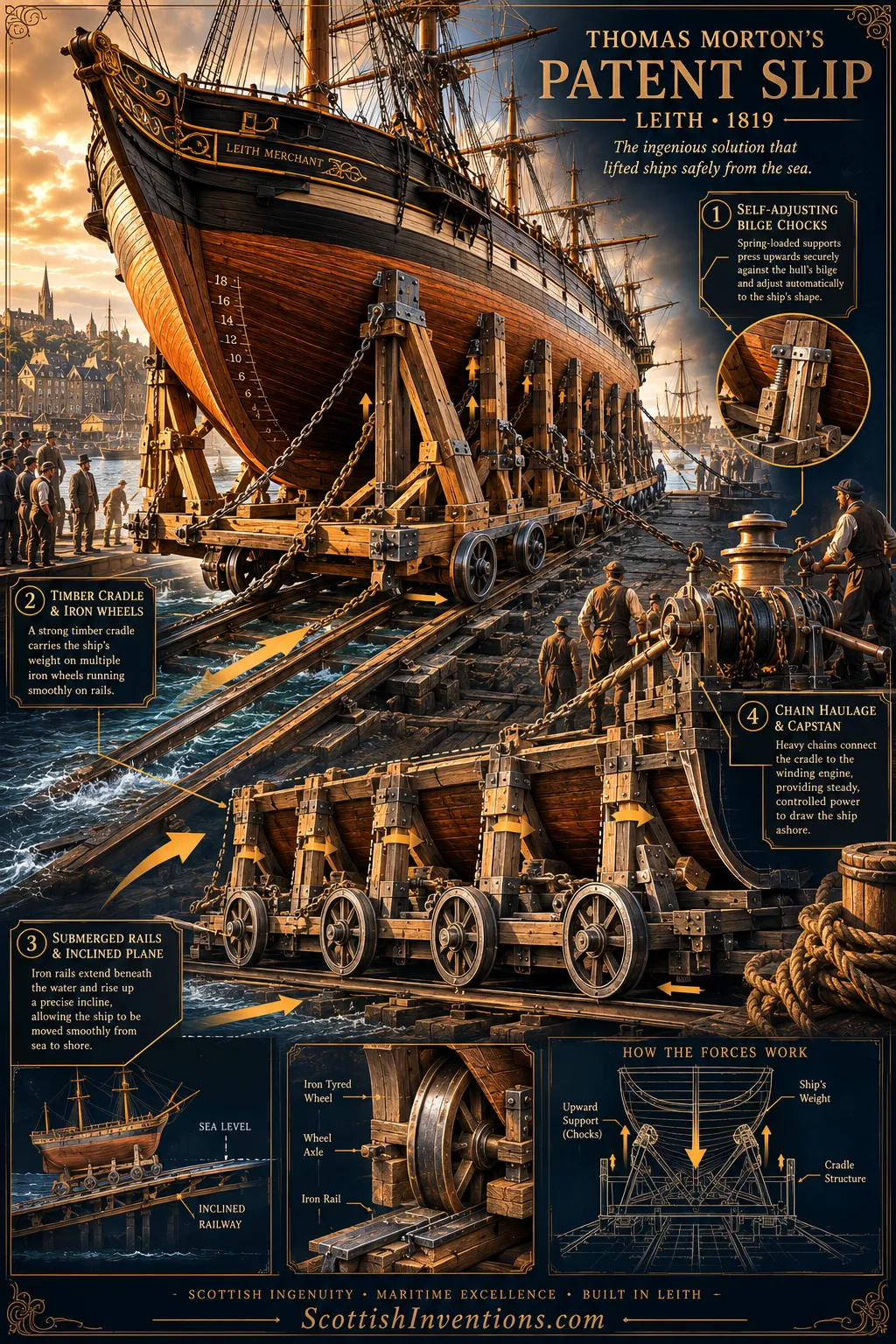
The machine had an elegant mechanical logic. Every component solved a specific problem in hauling a heavy wooden hull safely from the sea to dry land:
- Submerged iron rails. Typically three parallel lines of iron rail were laid on a carefully surveyed inclined plane running from dry ground down below the low-water mark.
- Wheeled timber cradle. A strongly built carriage — a heavy timber frame carried on many small iron wheels — ran on the rails. Rods projecting above the surface showed the crew exactly where the submerged cradle sat.
- Central keel support. A row of keel blocks along the centre of the cradle took the ship's weight along her strongest structural line as she settled onto the carriage.
- Self-adjusting bilge chocks. Angled timber supports mounted on transverse slides drew in beneath the hull's bilges as the cradle rose, automatically adjusting to the vessel's shape and holding her firmly upright.
- Chain haulage and capstan. A heavy chain connected the cradle to a hand-cranked capstan, and later to a horse-gin or steam winch. A safety catch arrested the cradle if the chain parted.
A vessel could often be lifted on one tide and returned on the next. Initially the cradle was hauled by hand or by horses; steam winches came later.
First Successes in Scotland
Where was the Patent Slip first used? The evidence is slightly tangled. The first major commercial slip built to the Morton design is often said to be at Bo'ness on the Firth of Forth around 1821–1822, where in November 1821 the 353-ton Greenland whaler Juno was hauled out — the winches turned by hand by 28 men. But contemporary newspaper evidence points to Leith first: in December 1819 the Caledonian Mercury reported that the brigantine Hope had been repaired, and her bottom re-coppered, on the "New Patent Slip at Leith." The most likely reading is that Morton proved his invention at his own Leith yard from 1818–1819 and built his first major commercial slip at Bo'ness soon after.
The economics were transformative. Because the slip could simply be laid on sloping ground — no deep excavation, masonry basin, lock gates or pumps — it cost roughly one-tenth as much as a dry dock to build. And it was far cheaper to use: an 1832 Parliamentary hearing was told that hauling a ship out on the slip cost about £3, against roughly £170 to dry-dock the same vessel.
Success was rapid — and imitators soon appeared. As early as 1824, Morton was in court defending his patent against one John Barclay, who had erected a copycat slip at Stobcross near Glasgow. At the Edinburgh trial of 15 March 1824, expert witnesses including John Farey, the Rev. William Scoresby and Captain Basil Hall testified for Morton, and the court found in his favour.
Global Adoption
From Leith and Bo'ness the technology fanned outward. The DNB records early adoptions at Irvine, Whitehaven and Dumbarton; Montrose followed in 1828, and the Clyde soon bristled with slips. Across Morton's lifetime, 45 slips were built in Scotland, England, Ireland, Russia and the United States.
The concept then travelled the world with British trade and emigration. In the United States the "marine railway" took root, with an early example built in 1822 and the term firmly established by the 1840s. In Ireland, the shipyards at Cork and Passage West had patent slips. In the Caribbean, the St Thomas Marine Railway (later the Creque Marine Railway) was built on Hassel Island in the 1840s, entering commercial service in 1844 — probably the world's oldest surviving marine railway. In Australia, the South Australian Company shipped a patent slip out with its very first settlers, and by 1855 the Australasian Steam Navigation Company operated a celebrated slip at Sydney. In New Zealand, the Evans Bay Patent Slip opened at Wellington in May 1873; its 180-foot (55 m) cradle could handle ships of up to 2,000 tons, the 316-ton barque Cyprus being the first vessel hauled up on 2 May 1873.
The point about the colonies is important: the patent slip was exactly the technology a young or remote port needed. It let places that could never justify the enormous capital of a dry dock nonetheless maintain their own shipping — extending trade routes and giving distant harbours a measure of maritime self-sufficiency. It is telling that when Morton's own Leith slip was cleared away in 1846, it was reportedly shipped out to St Thomas rather than scrapped. Its logic sits comfortably alongside Scotland's other maritime breakthroughs — from Symington's first practical steamboat to Coleman's refrigerated cargo transport and Stevenson's Bell Rock Lighthouse.
The Evolution of Marine Railways
Morton's basic principle proved remarkably adaptable. The first slips were muscle- or horse-powered; with the spread of the steam engine, most were converted to steam-driven winches — the Leith engineering trade was advertising Morton's slips complete with 10-horsepower steam winches by the mid-nineteenth century.
Cradles grew larger to take heavier ships, and the grander installations, like Morton's own later yard at Granton, were powered from a dedicated engine house rather than a hand-cranked winch. In the twentieth century, hydraulic and then electric winches took over — the surviving slip at the Underfall Yard in Bristol, originally driven by a hydraulic engine, was fitted with an electric motor in 1924 that still operates. Modern marine railways can lift vessels of several thousand tons. The mechanical vocabulary is Morton's; the power source has simply changed.
Comparison with Dry Docks and Other Methods
The Patent Slip occupies a clear niche. Against the dry dock, it was dramatically cheaper to build and faster to use, and offered practical advantages the 1832 witnesses stressed: free circulation of air under the hull, better daylight for working (a ship on a slip sits in the open, not at the bottom of a deep pit), and no materials to be lugged down into a dock. Its limitation was size — pulling the very largest ships up an incline required enormous force, so the biggest vessels still needed dry docks.
Against careening, the slip was safer, quicker and gentler on the hull. A later competitor, the floating dry dock, emerged from the 1840s (John S. Gilbert patented a design in 1840; New York's Great Balance Dock followed in 1854) and could handle very large ships without a fixed basin. Today the Patent Slip's descendants — travel-lifts, boat-hoists and dry-stack marinas — dominate the small-craft market, but the slip itself remains in working use at boatyards and harbours worldwide, from Arbroath to Bristol.
Learn More: Interactive Panels
Tap any panel to expand.
+Learn more: Close: What the self-adjusting bilge chocks actually do
The bilge chocks are angled timber supports mounted on transverse slides in the cradle. As the ship rises out of the water on the ascending cradle, the chocks draw in from either side beneath the hull's bilges, automatically adjusting to the vessel's shape so it stays safely upright. Without them the ship would be balanced only on her keel — dangerously unstable. This self-adjusting hull support is arguably the single most ingenious piece of Morton's design.
+Learn more: Close: Why 1818 and 1819 are both correct
Morton invented the Patent Slip in 1818 and secured a Scottish patent on 18 August 1818. The British patent — No. 4352 — was dated 23 February 1819 and later extended to England, Ireland and the colonies. The apparent contradiction in secondary sources ("invented in 1818" vs "patented in 1819") simply reflects two jurisdictions, not two different events.
+Learn more: Close: Why the inclined plane was not the invention
Hauling ships up inclined planes was old — the Dictionary of National Biography notes it was done at the French royal dockyard at Brest early in the eighteenth century, and rough "greased ways" were used at small yards long before Morton. What Morton patented was something more specific: the wheeled carriage on iron rails that ran down into the water, together with the self-adjusting chocks that held the hull upright. Take away the cradle and the chocks and you are left with a Georgian slipway. Add them and you have a marine railway.
+Learn more: Close: One-tenth the cost — how the economics broke open
Because the slip could be laid on sloping ground with no deep excavation, no masonry basin, no lock gates and no pumps, installing one cost about one-tenth as much as building a masonry dry dock. That capital gap is what put ship maintenance within reach of colonial ports, small harbours and private yards for the first time. It also explains why 45 slips were built in Morton's lifetime — and why the design carried on spreading around the world after his death.
+Learn more: Close: From capstan to steam to electric winch
The earliest slips were worked by hand or horse — twenty-eight men turned the winches to haul out the whaler Juno at Bo'ness in 1821. By the mid-nineteenth century Leith engineers were selling Morton's slips complete with 10-horsepower steam winches; by the 1920s the classic slip at Bristol's Underfall Yard had been fitted with an electric motor that still operates. The cradle and rails have hardly changed; only what pulls them.
+Learn more: Close: Why the world's oldest surviving marine railway is in the Caribbean
When Morton's own Leith slip was dismantled in 1846, it was reportedly shipped out to St Thomas in the Danish West Indies (today the U.S. Virgin Islands) rather than scrapped. The Creque Marine Railway on Hassel Island grew out of that Caribbean transplant, entering commercial service in 1844 and is now regarded as probably the oldest surviving marine railway in the world — a direct Morton descendant, half an ocean away from Leith.
Timeline of the Patent Slip
8 October 1781
Born in Leith
Thomas Morton is born in Leith, son of Hugh Morton, a wright and builder — a craftsman in timber.
c. 1804
Sets up as a shipbuilder
After training in his father's business and, according to later accounts, studying naval architecture in London, Morton establishes a shipbuilding yard on the Water of Leith in front of Cooper Street.
1818
Invents the Patent Slip
Frustrated by the cost of dry docks and the danger of hauling ships up 'greased ways', Morton devises the wheeled rail-mounted cradle with self-adjusting bilge chocks. A Scottish patent is granted on 18 August 1818.
23 February 1819
British Patent No. 4352
The British patent for 'Morton's patent slip, for hauling ships out of the water to be repaired' is dated 23 February 1819 and later extended to England, Ireland and the colonies.
December 1819
First slip at Leith
The Caledonian Mercury reports that the brigantine Hope has been repaired and re-coppered on the 'New Patent Slip at Leith'.
November 1821
Juno hauled out at Bo'ness
The 353-ton Greenland whaler Juno is drawn ashore at Bo'ness on the Firth of Forth — twenty-eight men turn the winches by hand.
15 March 1824
Patent upheld in Edinburgh court
Morton successfully defends his patent against John Barclay's copycat slip at Stobcross, with John Farey, the Rev. William Scoresby and Captain Basil Hall testifying on his behalf.
1828
Slip installed at Montrose
Patent slips continue to spread along the Scottish coast; the Clyde soon bristles with them.
1832
Parliament praises the invention
A House of Commons select committee, chaired by Sir George Cockburn, describes the Patent Slip as 'one of the most ingenious and valuable' inventions and awards Morton £2,500 in lieu of extending the patent.
24 December 1832
Death of Thomas Morton
Morton dies at 1 Pilrig Place, Leith, aged 51, before he can receive the Parliamentary award. He is buried in the Morton family plot at South Leith Parish Churchyard.
1840s
St Thomas Marine Railway
A Morton-style slip is built on Hassel Island in the Caribbean, entering commercial service in 1844 — probably the world's oldest surviving marine railway.
1846
Leith slip shipped to St Thomas
Morton's own Leith slip is cleared away and reportedly shipped out to St Thomas rather than scrapped.
May 1873
Evans Bay opens in Wellington
The 180-foot Evans Bay Patent Slip opens at Wellington, New Zealand, capable of handling ships of up to 2,000 tons; the 316-ton barque Cyprus is the first vessel hauled up.
1925
Thomas Morton Hall opens
A performance hall in the Leith Town Hall complex is named the Thomas Morton Hall in his memory.
Today
Descendants still in service
Patent slips and their descendants — travel-lifts, boat-hoists and marine railways — remain in everyday use at harbours and boatyards worldwide.
An Honest Claim
What Morton did — and did not — invent
- Morton did not invent the inclined slipway. Ships had been dragged up simple inclined "ways" for centuries, including at the French royal dockyard at Brest early in the eighteenth century.
- Morton did not invent the dry dock, nor hauling ships onto shore in general. Both long pre-date him.
- Morton did invent the practical Patent Slip system — submerged iron rails, a wheeled timber cradle, central keel support, self-adjusting bilge chocks and mechanical chain haulage — a combination protected by British Patent No. 4352 in 1819.
- Morton was not a ship-chandler. Every authoritative source, including the Dictionary of National Biography and Grace's Guide, describes him as a working shipwright and shipbuilder.
- The first-installation question is not fully settled. Contemporary newspaper evidence points to Leith 1818–1819 (the brigantine Hope); Bo'ness around 1821–1822 is the earliest firmly recorded major commercial slip.
- "Over 1,000 slips" is not supported. The firmly sourced figure is 45 slips in Morton's lifetime. Wider global adoption is real but not reliably quantified — best described qualitatively as "hundreds worldwide over the following century."
Frequently Asked Questions
- Who invented the Patent Slip?
- The Patent Slip was invented by Thomas Morton (1781–1832), a Leith-born Scottish shipbuilder. He devised the rail-mounted marine railway in 1818, secured a Scottish patent on 18 August 1818, and was granted British Patent No. 4352 on 23 February 1819.
- What is a Patent Slip?
- A Patent Slip — also called a marine railway — is a system of inclined rails running from dry land down beneath the water, along which a strongly built wheeled cradle can be hauled by chain and capstan. A ship is floated over the submerged cradle, then drawn up the incline until it rests upright ashore, ready for cleaning, caulking or repair.
- Was Thomas Morton Scottish?
- Yes. Thomas Morton was born in Leith, the port of Edinburgh, on 8 October 1781, the son of Hugh Morton, a wright and builder. He trained in his father's business and set up as a shipbuilder on the Water of Leith. He died at his home at 1 Pilrig Place, Leith, on 24 December 1832 and was buried in South Leith Parish Churchyard.
- How does a marine railway work?
- Iron rails are laid on an inclined plane running from dry land down below the low-water mark. A wheeled timber cradle sits on the rails. It is lowered into the water on a chain worked by a capstan or winding engine, a ship is floated over it and aligned with its keel above the central support, and the cradle is then wound up the incline, carrying the whole vessel bodily out of the water.
- What problem did the Patent Slip solve?
- Before Morton, the only ways to expose a ship's hull for repair were a dry dock — enormously expensive to build and slow to use — or careening, which meant deliberately grounding the ship and hauling it over on its side. The Patent Slip offered a third option: cheap to install, quick to operate, safer for the hull, and within reach of small and colonial ports that could never justify a masonry dry dock.
- What is the difference between a dry dock and a Patent Slip?
- A dry dock is a masonry basin dug into the shore, sealed with gates and pumped dry once a ship is inside. A Patent Slip is an inclined railway laid on sloping ground with a wheeled cradle that hauls the ship out onto dry land. In 1832 a Parliamentary hearing was told that a slip cost roughly one-tenth as much as a dry dock to build, and that hauling out a ship cost about £3 compared to around £170 to dry-dock the same vessel.
- Where was the first Patent Slip built?
- The evidence is slightly tangled. In December 1819 the Caledonian Mercury reported that the brigantine Hope had been re-coppered on the 'New Patent Slip at Leith', suggesting Morton first proved his invention at his own Leith yard in 1818–1819. The first major commercial slip is usually said to be at Bo'ness on the Firth of Forth around 1821–1822, where in November 1821 the 353-ton Greenland whaler Juno was hauled out by twenty-eight men turning the winches by hand.
- Is the Patent Slip still used today?
- Yes. Marine railways descended from Morton's design are still in working use at boatyards and small harbours around the world, from Arbroath to Bristol. Modern versions with hydraulic or electric winches can lift vessels of several thousand tons, and the survivors include the Creque Marine Railway on Hassel Island in the U.S. Virgin Islands and the Evans Bay Patent Slip in Wellington, New Zealand.
- What are self-adjusting bilge chocks?
- The bilge chocks are angled timber supports mounted on transverse slides in the cradle. As the ship rises out of the water on the ascending cradle, the chocks draw in from either side beneath the hull's bilges, automatically adjusting to the vessel's shape so it stays safely upright. This self-adjusting hull support, together with the wheeled rail-mounted cradle, was the genuine novelty at the heart of Morton's patent.
- How did Morton's invention spread around the world?
- In Morton's lifetime alone, 45 slips were built in Scotland, England, Ireland, Russia and the United States. From there the design travelled with British trade and emigration to Ireland, the Caribbean, Australia and New Zealand. Famous survivals include the Creque Marine Railway on Hassel Island, St Thomas, and the Evans Bay Patent Slip at Wellington, which opened in May 1873 and could handle ships of up to 2,000 tons.
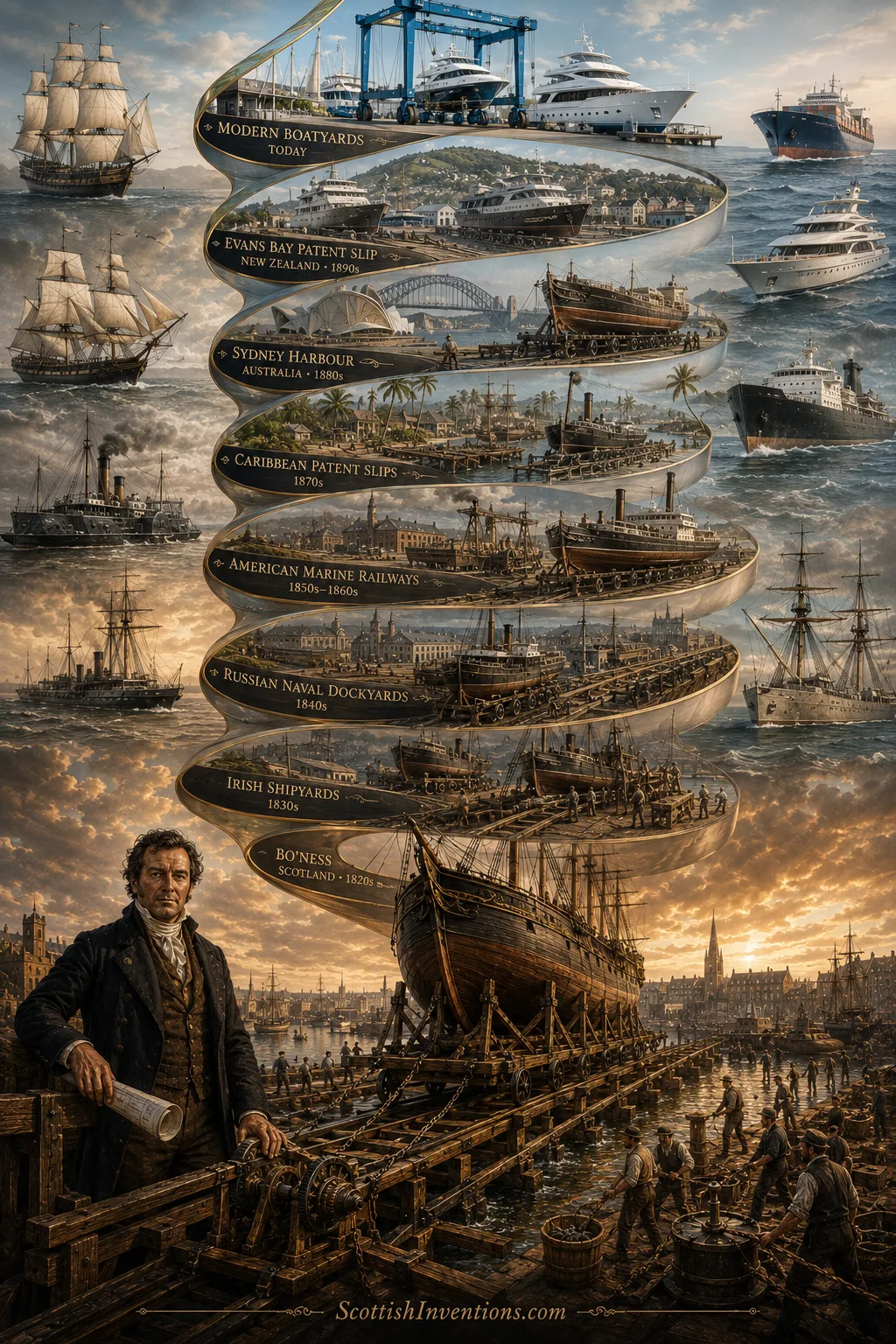
Legacy
Did Morton grow rich? Not really. Despite the invention's runaway popularity, he did not profit for the first six years of the patent, and his total earnings came to just £5,737. When he petitioned Parliament in 1832 to extend the patent, the House of Commons select committee — chaired by Sir George Cockburn — ultimately did not support the extension, though it recommended that some other means be found to reward him. The Commons awarded him £2,500, but Morton died on 24 December 1832 before he could enjoy any such gratuity.
His family carried on. The firm S. & H. Morton & Co. — run by his brother Samuel and Samuel's son Hugh — continued building ships and patent slips at Leith and Bo'ness, later relocating to Granton and then to reclaimed ground by the Leith dry docks (a site eventually occupied by Henry Robb, Leith's last shipyard). Morton is commemorated in his home town by the Thomas Morton Hall, a performance hall built in 1925 as part of the Leith Town Hall complex, and a vertical steam engine reported to have powered one of his patent slips is preserved at the McLean Museum in Greenock.
The Patent Slip democratised ship maintenance. Before Morton, keeping a large vessel's hull sound meant access to a hugely expensive dry dock or the dangerous drudgery of careening — both effectively rationing good maintenance to wealthy, established ports. After Morton, any harbour with a modest sloping waterfront and a winch could haul ships ashore. That single shift rippled through the maritime world, giving colonial and developing ports the ability to maintain their own fleets and helping to knit together the trading routes of the nineteenth century. The Patent Slip belongs firmly alongside Scotland's other great contributions to maritime and mechanical engineering — from the Carronade and Neilson's hot blast process to Nasmyth's steam hammer, the Fairlie locomotive and Fairbairn's box girder.
Did You Know?
- Morton was a working shipbuilder who solved the biggest headache in his own trade — getting a hull out of the water — from painful first-hand experience of hauling ships up "greased ways."
- His Patent Slip cost roughly one-tenth of a dry dock to build, yet did the same job for most commercial vessels.
- Slipping a ship cost about £3 in 1832; dry-docking the same vessel cost around £170.
- Before Morton, exposing a ship's bottom meant an expensive dry dock or the perilous business of "careening" — tipping the vessel on its side on a beach.
- The world's oldest surviving marine railway — the Creque Marine Railway on Hassel Island in the U.S. Virgin Islands — and New Zealand's Evans Bay Patent Slip both trace their lineage to Morton's Leith invention.
- Patent slips are still called "patent slips" today — nearly two centuries after the patent expired — and are still hauling boats ashore around the world.
- Morton is commemorated in his home town by the Thomas Morton Hall, built in 1925 as part of the Leith Town Hall complex.
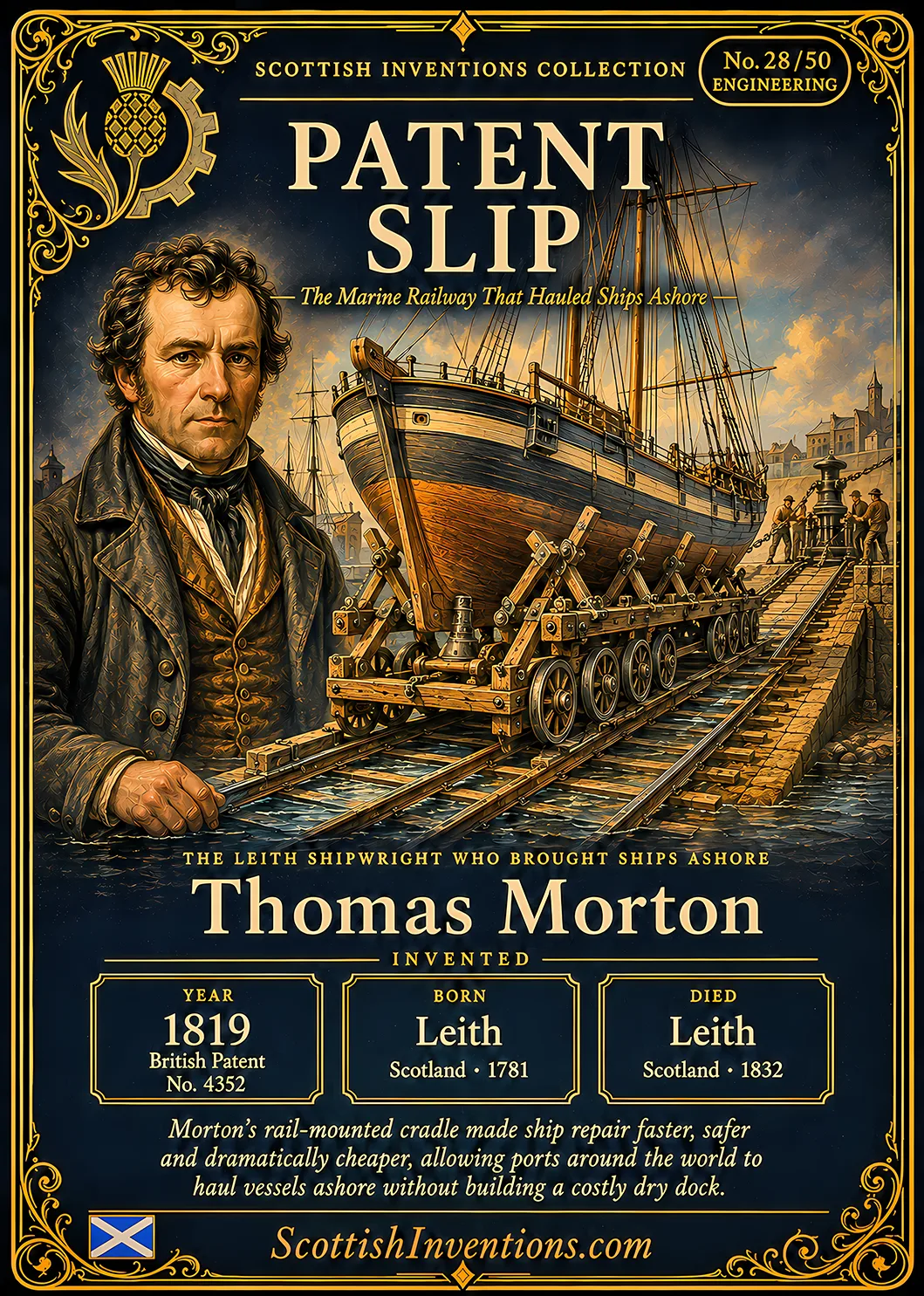
The Patent Slip trading card
Card No. 28 of 50 in the Scottish Inventions Collection.
Discover More Scottish Maritime Innovations
Morton's Patent Slip Brought the World's Ships Ashore
Thomas Morton's ingenious Patent Slip transformed ship repair across the world. Discover more remarkable Scottish engineering achievements that changed global industry and transport.
Explore the Scottish Inventions CollectionSources
- Dictionary of National Biography (1885–1900) — entry on Thomas Morton, shipbuilder of Leith.
- Oxford Dictionary of National Biography — Morton, Thomas (1781–1832).
- British Patent No. 4352, "Morton's patent slip, for hauling ships out of the water to be repaired," 23 February 1819 — Science Museum Group catalogue.
- Caledonian Mercury, December 1819 — repair of the brigantine Hope on the "New Patent Slip at Leith."
- Report of the House of Commons select committee on Thomas Morton's patent, 1832 (chair: Sir George Cockburn).
- Grace's Guide to British Industrial History — Thomas Morton and S. & H. Morton & Co.
- Institution of Engineers in Scotland — biographical notice of Thomas Morton.
- Historic Environment Scotland records — Leith and Bo'ness shipbuilding heritage.
- McLean Museum, Greenock — vertical steam engine reported to have powered a Morton patent slip.
- National Records of Scotland — Old Parish Registers, South Leith parish.
- Wikipedia entries on Thomas Morton (shipbuilder), Patent Slip, Marine Railway, Evans Bay Patent Slip and the Creque Marine Railway.