Scottish Inventions · Engineering · Card No. 50 of 50
Robert Stirling Newall: The Dundee Engineer Who Spun the World's First Lifeline of Steel
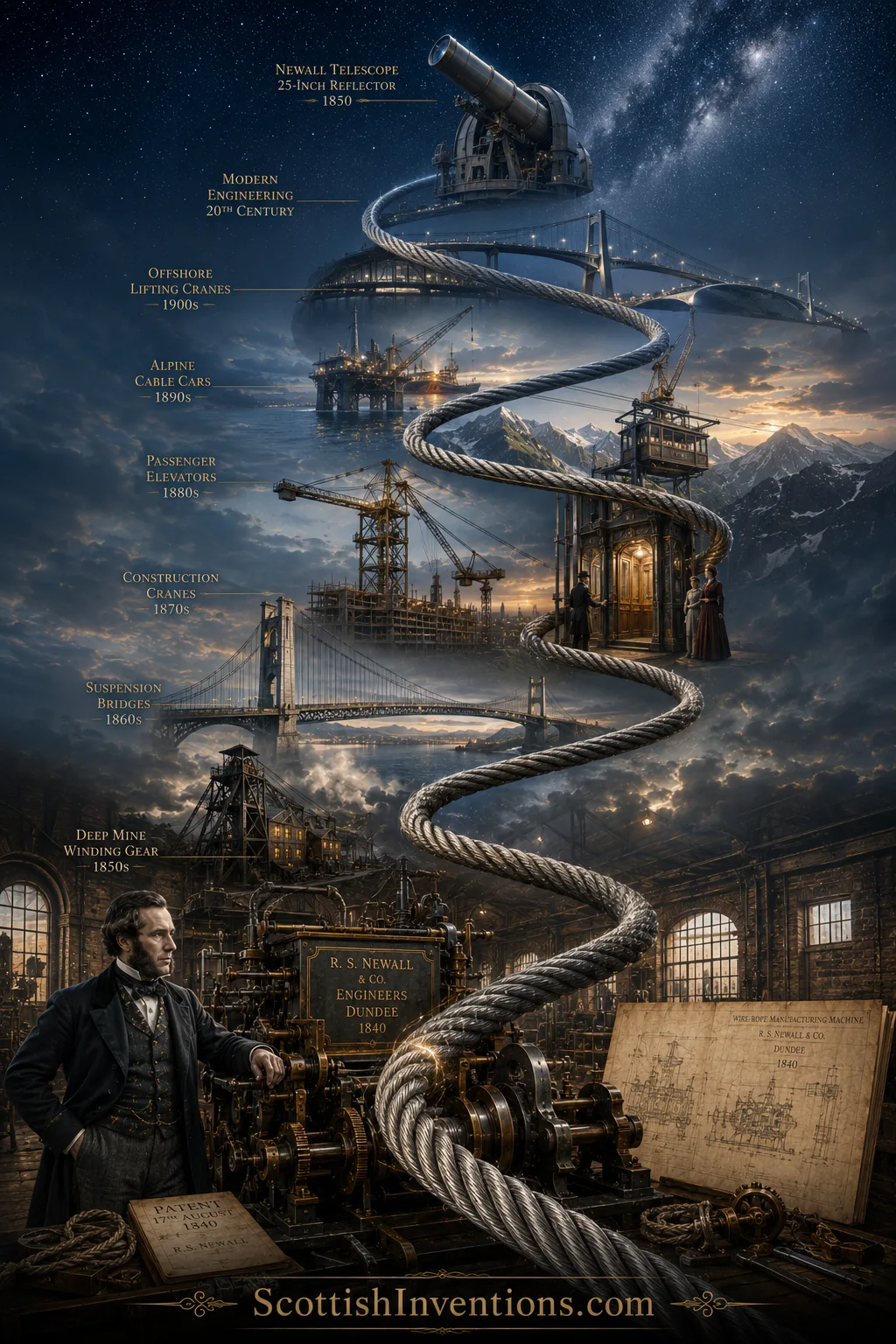
Robert Stirling Newall (1812–1889), a Dundee-born engineer, patented machinery for the mechanical manufacture of wire rope on 17 August 1840 — industrialising a material that would armour the first submarine telegraph cables, hoist deep-mine cages, rig ocean-going ships and, ultimately, hold up the modern world.
On this page
- TL;DR
- The Honest Verdict
- Key Facts
- Early Life & the Road to Wire Rope
- The Problem: Rope Before Wire Rope
- The 1840 Patent — The Invention
- Submarine Telegraph Cables
- The First Atlantic Cable
- Legacy & Impact
- The Forth Bridge Myth
- Astronomy & the Newall Telescope
- Timeline
- Collector Card
- FAQ
- Related Scottish Engineering
TL;DR
- Robert Stirling Newall (1812–1889), born in Dundee, patented a machine for manufacturing wire rope on 17 August 1840 and founded R.S. Newall & Co. He did not invent wire rope itself — that was German engineer Wilhelm Albert, c. 1831–34 — but he industrialised its production and turned it into a reliable, mass-produced product.
- His true genius was to see that a fragile telegraph wire could be protected by sheathing it inside a wire rope. His firm armoured the first commercially successful Channel cable (Dover–Calais, 1851) and manufactured half of the first transatlantic cable (1857–58).
- The technology Newall helped industrialise — twisted wire rope — underpins the modern world's lifts, cranes, cable cars, suspension bridges and aerial ropeways. He died a wealthy and honoured man in 1889, leaving a second legacy in astronomy through the giant Newall Telescope, which still survives in Greece.
The Honest Verdict
Robert Stirling Newall industrialised rather than invented wire rope. Wilhelm Albert of the Harz Mountains got there first, in 1831–34. But Newall's Dundee patent of 17 August 1840 mechanised the process — and, more importantly, he was the first engineer to realise that wire rope could armour a submarine telegraph cable. That single insight let humanity begin speaking across oceans.
Key Facts
Dundee 1812
Born in Dundee on 27 May 1812, son of merchant Walter Newall and Janet Hair.
Patent 17 Aug 1840
Patented machinery for the mechanical manufacture of wire rope around a hemp core.
R.S. Newall & Co
Founded first in Dundee, with a major works at Gateshead on the Tyne.
Dover–Calais 1851
Armoured the world's first commercially successful submarine telegraph cable.
Atlantic Cable 1857
Manufactured half of the first transatlantic telegraph cable.
Newall Telescope
Commissioned the 25-inch refractor — the world's largest in 1869 — now in Athens.
Early Life and the Road to Wire Rope
Robert Stirling Newall was born in Dundee on 27 May 1812, the son of Walter Newall, a merchant, and his wife Janet Hair. He began his working life in a Dundee mercantile office before moving to London, where he worked under Robert McCalmont on experiments in the rapid generation of steam, and spent around two years promoting McCalmont's business interests in America. By 1838 he was back in Scotland, the proprietor of an engineering works in Dundee with a reputation for innovation.
The turning point came through his friend Lewis Dunbar Brodie Gordon, who had studied at the Freiberg School of Mines and visited the mines at Clausthal in the Harz Mountains, where he met Wilhelm Albert and saw his wire ropes at work. On 20 June 1838 Gordon wrote to Newall urging him to "invent a machine for making wire ropes." Newall rose to the challenge, and by the end of July he had sent Gordon a drawing of a machine that would produce a rope of four strands with four wires to each strand. When Gordon returned from Germany in 1839, the two formed a partnership with Charles Liddell, a former pupil of the great railway engineer George Stephenson.
The Problem: Rope Before Wire Rope
For centuries, hemp rope and wrought-iron chain were the only options for mine hoists, ship rigging, and heavy lifting — and both had grave limitations. Hemp rope rotted, stretched, and had a poor strength-to-weight ratio, a particular danger in deep mine shafts where the rope had to support not only its load but its own enormous weight. Iron chains were prone to sudden catastrophic failure: a single flawed link could break and send a cage of miners plunging to the bottom of a shaft.
This was the problem Wilhelm Albert solved. As a senior mining official at Clausthal, working with the colliery blacksmith Heinrich August Mummenthey, Albert produced a rope of iron made of three strands of four wires each. It is reported to have had roughly six times the lifting capacity of a hemp rope and four times that of a chain rope, while being far lighter than chain. Albert first put his invention to work in the Caroline mine at Clausthal in the summer of 1834, where his first rope measured some 600 metres. The new "Albert ropes" spread rapidly through European mining. It is important to be honest about this lineage: wire rope was a German invention, and Newall himself never claimed otherwise.
Newall's 1840 Patent — The Invention
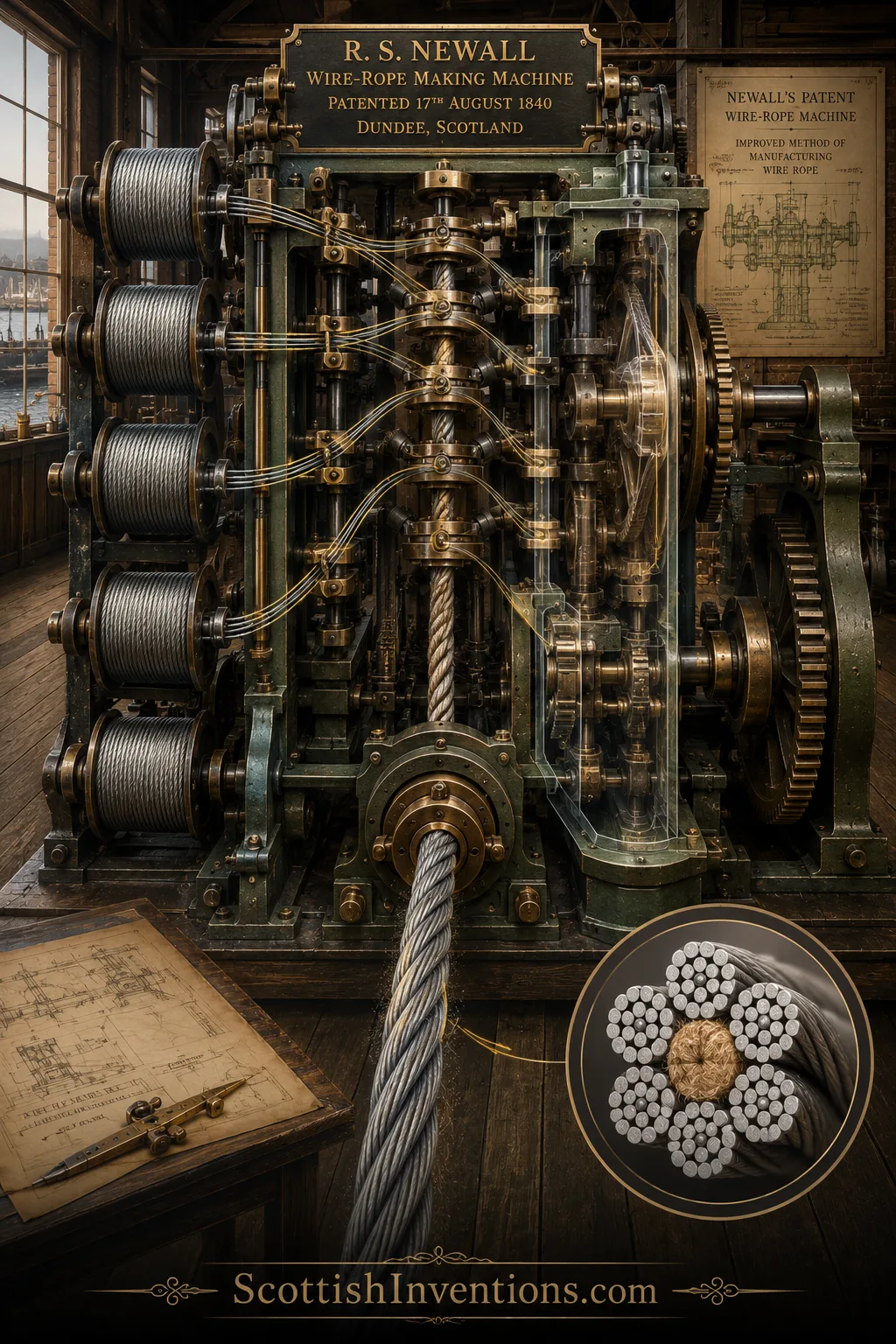
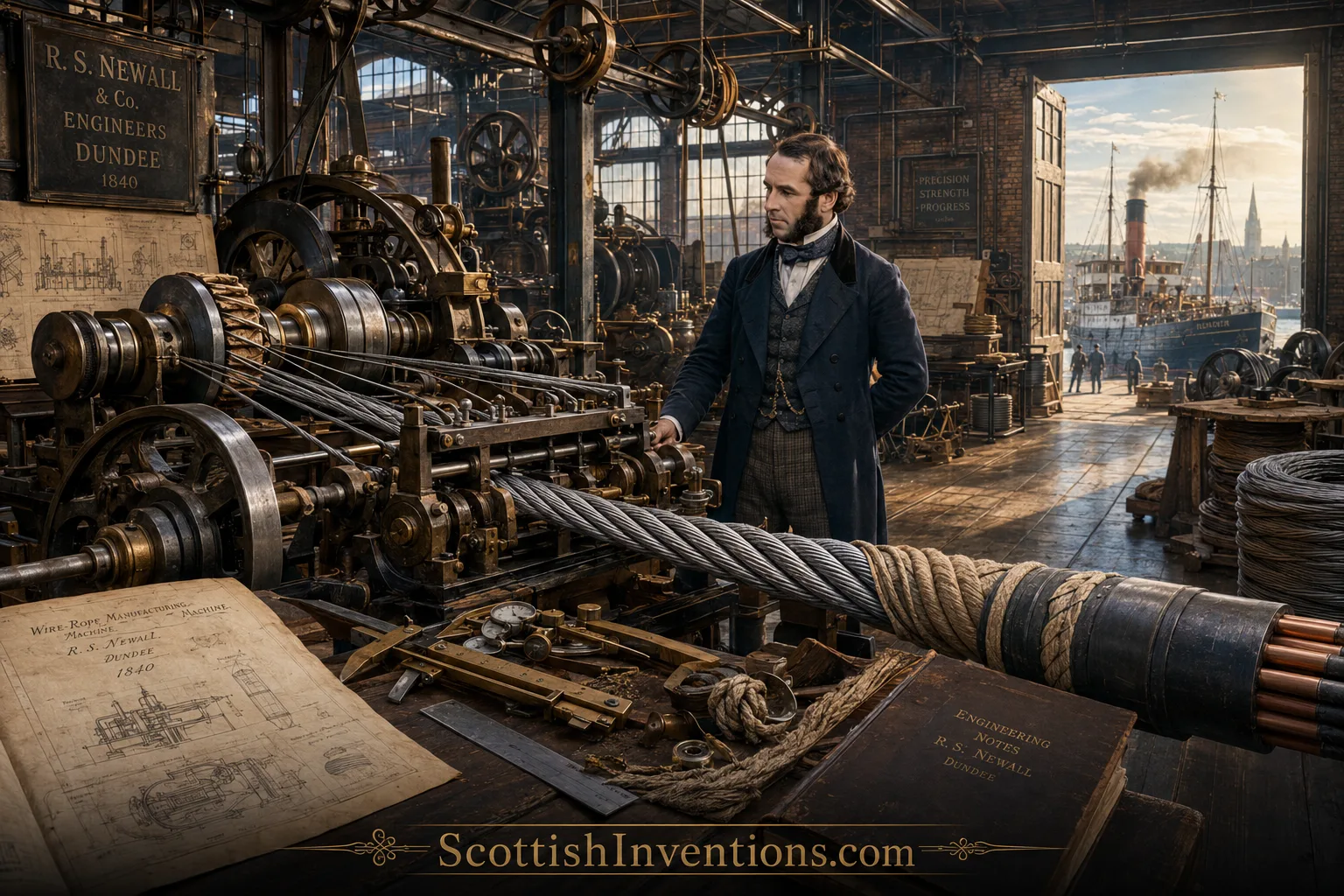
What Newall brought was industrialisation. Albert's ropes were twisted by hand; Newall devised machinery to make them mechanically — faster, longer, and more uniform. On 17 August 1840, he took out a patent for "certain improvements in wire rope and the machinery for making such rope." A defining feature of his rope was a central core of hemp or other flexible material, which held the individual wires and strands equidistant from the centre so that the stress was shared equally across every wire — a crucial advance for reliability under load.
The partners established R.S. Newall and Company, first registered in Dundee, and soon built a major factory at Gateshead, on the Tyne, where they made wire ropes for "Mining, Railway, Ships' Rigging, and other purposes." Early applications were spectacular: in 1850 the Newcastle Courant reported that Messrs R.S. Newall & Co had completed "the largest wire rope ever yet made" — 14,100 feet long and weighing upwards of 22 tons, made in a single piece for the Edinburgh and Glasgow Railway, to replace one the firm had supplied two and a half years earlier. Such ropes powered the rope-worked inclined planes and colliery winding gear of the industrialising north.
Newall's wire rope was also adopted for the standing rigging of Isambard Kingdom Brunel's pioneering iron steamship SS Great Britain (launched 1843), an early and influential demonstration of wire replacing hemp aloft. He was not without rivals: the London inventor Andrew Smith had patented wire rope for ships' rigging in 1836. When Smith and Newall clashed in a patent dispute in the mid-1840s, Newall prevailed, and the two firms later merged. Newall's six-strand, fibre-cored construction came to dominate the British market. (In a delightful footnote, Andrew Smith's son emigrated to California, changed his name to A.S. Hallidie, and used wire-rope technology to invent the San Francisco cable car.)
Did You Know?
The San Francisco cable car system was invented by Andrew Smith Hallidie — the son of Newall's chief British rival — who took his father's wire-rope patents across the Atlantic and used them to haul carriages up the hills of California.
The Submarine Telegraph Cable Connection
Newall's most historically significant insight was to see that wire rope could solve the central problem of submarine telegraphy. The first cross-Channel cable — an unarmoured, gutta-percha-insulated line laid by the Brett brothers in 1850 — famously failed almost immediately, broken either by a fishing boat or by abrasion on the rocks. Newall proposed that the delicate gutta-percha-insulated conductor be surrounded with a sheath of strong iron wires: in effect, making the telegraph cable the core of a wire rope. It was an idea that grew directly out of his trade.
When the rope maker E. Weatherly began producing such an armoured cable for the 1851 cross-Channel attempt on behalf of the Submarine Telegraph Company, Newall sued for infringement of his patent and took over the job, carrying out the bulk of the work at Weatherly's factory with men brought from Gateshead, and sub-contracting the remainder to Kuper and Co. The resulting Dover–Calais cable — core supplied by the Gutta Percha Company, overall design by Thomas Crampton — was laid on 25 September 1851 and opened to public traffic that November. It was the first commercially successful submarine telegraph cable anywhere in the world, and it came from Newall's works. The orders flooded in, and by the mid-1850s Newall held what one biographer called a near-monopoly on the business.
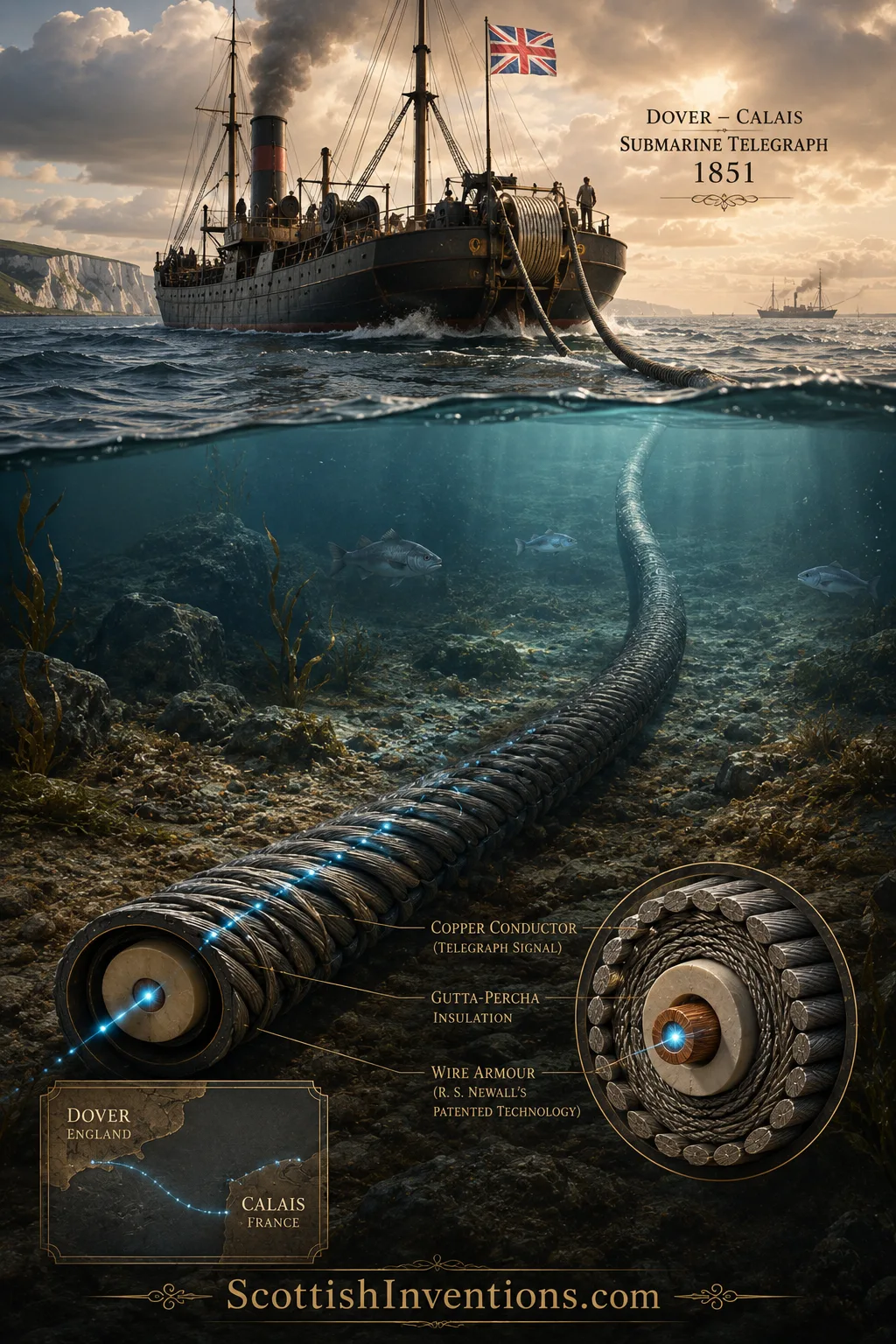
Over the following years, R.S. Newall & Co manufactured and often personally laid an extraordinary run of cables: England–Ireland (1852), England–Belgium (1853), and a string of lines including Holyhead–Howth, Dover–Ostend, and Malta–Corfu, besides several others in the Mediterranean. During the Crimean War the firm laid the Varna–Balaclava Black Sea cable in 1855 — a 300-mile line that was, in the words of an IEEE study of the project, "longer than any ever previously attempted," enabling "virtually instant communication between the British and French field commanders and their respective sovereigns." For this service the firm received the thanks of the government.
In 1853 Newall also invented a "brake-drum" and cone for paying out cable in deep seas, drawing directly on his expertise with colliery winding gear; he frequently directed the submergence of his own cables because so few engineers were competent to handle the work.
The First Atlantic Cable
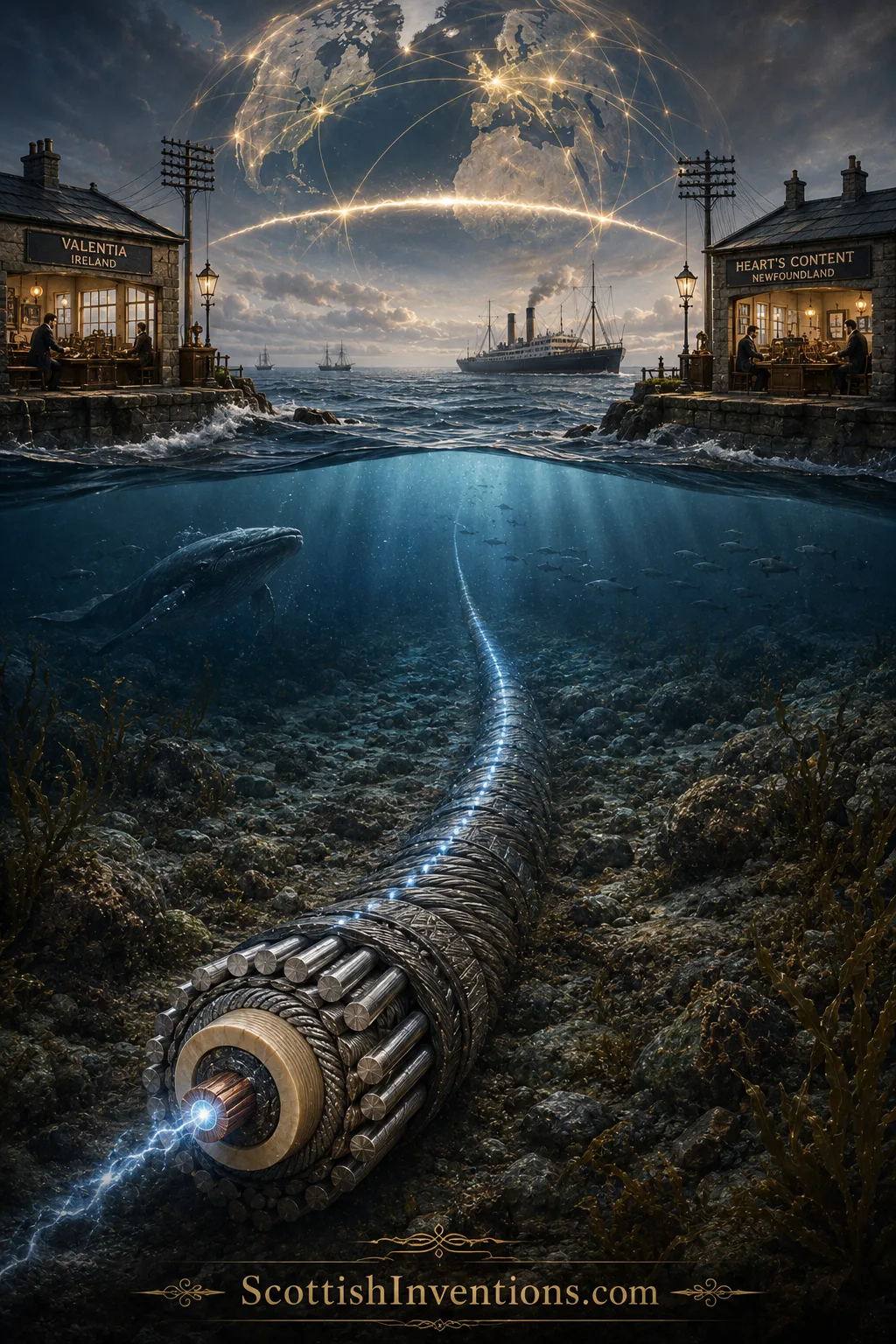
The crowning involvement was the first transatlantic cable. The Atlantic Telegraph Company split the armouring contract between two firms — Glass, Elliot & Co of Greenwich and R.S. Newall & Co at Birkenhead — each armouring half of the roughly 2,500-nautical-mile core supplied by the Gutta Percha Company, because no single works could make it all in the time allowed.
A now-famous error resulted: Newall's half was given a right-handed "lay" (the usual rope-making convention), while Glass, Elliot's was left-handed, so the two halves could not be directly spliced and a special frame had to be improvised. The 1857 attempt failed when the cable snapped; the line finally carried messages briefly in August 1858 before its insulation died after a few weeks.
Newall's firm also made the ill-fated Red Sea and India cable (Suez–Aden–Karachi) of 1859–60, which failed because it was too lightly armoured and laid with too little slack over rough underwater terrain. Following these commercial setbacks — and a damaging scandal in which his London agent was found to have employed a saboteur against a rival's cable — Newall withdrew from the cable business around 1861, selling the goodwill of that part of the firm to Siemens. The company returned briefly in 1869–70, making a final England–Ireland cable for the General Post Office, before leaving the field for good.
Legacy and Impact
Wire rope transformed the industrial world, and Newall stands among the small handful of pioneers — alongside Albert in Germany and John A. Roebling in America — who made it ubiquitous. In mining, wire rope allowed shafts to be sunk far deeper, with safety margins that hemp could never offer. The same fundamental technology made possible the great suspension bridges (Roebling's Brooklyn Bridge being the supreme example), the safety elevator that in turn enabled the skyscraper, construction cranes, aerial ropeways and cable cars, ships' rigging, and the control cables of countless machines and aircraft. Every time a lift rises in a tower or a gondola climbs a mountainside, it runs on the descendant of the product Newall industrialised in Gateshead.
Correcting a Common Myth
The Forth Bridge and the Firth of Forth
Although wire rope was used extensively during the construction of the Forth Bridge (1883–1890) — for hoists, men's cages, cranes and temporary ties used to build out the great steel cantilevers — there is no credible evidence that R.S. Newall & Co supplied any of it. The official contemporary account of the bridge's erection names no rope maker at all, and the Forth Bridge, being a cantilever rather than a suspension structure, contains no structural wire-rope cables.
Newall's genuine Forth connection is a different and earlier one: in 1853 his firm armoured a submarine telegraph cable laid across the Firth of Forth (part of the Electric Telegraph Company's Edinburgh–Aberdeen route), one of the world's first estuary cable crossings. The two should not be confused — they are separated by some 37 years and an entirely different technology.
Astronomy and the Newall Telescope
Newall prospered greatly from his inventions. He served as mayor of Gateshead in 1867 and 1868, was an alderman and justice of the peace, and was one of the most active members of the River Tyne Commission. He was elected a Fellow of the Royal Astronomical Society (1864) and of the Royal Society (1875), became a member of the Institution of Mechanical Engineers (1879), was decorated with the Order of the Rose of Brazil (1872), and received an honorary doctorate (D.C.L.) from the University of Durham in 1887.
A passionate amateur astronomer — encouraged by his friend and father-in-law-to-be, the chemist Hugh Lee Pattinson, who had himself bought a small Cooke refractor in 1851 — Newall commissioned the York optician Thomas Cooke to build a giant 25-inch (62.5 cm) refracting telescope, using two large glass discs he had bought from Chance Brothers of Birmingham. Cooke promised completion in under a year; in the event it took six, and was finished in 1869, two years after Cooke's own death. When complete, the roughly 9-metre-long, 9-ton instrument was the largest refracting telescope in the world.
Newall installed it at his Gateshead home, Ferndene, though the smoky local skies rendered it nearly useless; he gave it to the University of Cambridge shortly before his death, where his son Hugh Frank Newall used it to show that the star Capella is a multiple system. The telescope was donated to the National Observatory of Athens and moved to the Penteli Observatory in 1959, where it survives and is still used for educational purposes today.
Robert Stirling Newall died at Ferndene on 21 April 1889, survived by his wife Mary (youngest daughter of Hugh Lee Pattinson FRS), four sons, and a daughter. His son Hugh Frank Newall became a distinguished astronomer and FRS in his own right — a fitting continuation of a remarkable Scottish family of engineers and scientists.
Timeline
1812
Born in Dundee
Robert Stirling Newall is born in Dundee on 27 May, son of Walter Newall and Janet Hair.
1830s
London and America
Works under Robert McCalmont in London on rapid steam generation and spends two years promoting his business in America.
1838
Dundee engineering works
Back in Scotland by 1838, Newall is proprietor of an engineering works in Dundee with a reputation for innovation.
20 Jun 1838
Gordon's letter
His friend Lewis Dunbar Brodie Gordon, fresh from the Harz mines, writes urging him to 'invent a machine for making wire ropes.'
Jul 1838
First drawings
Newall sends Gordon a drawing of a machine that would produce a four-strand rope of four wires per strand.
1839
Partnership formed
Gordon returns from Germany; Newall, Gordon and Charles Liddell form a partnership.
17 Aug 1840
The wire-rope patent
Newall patents 'certain improvements in wire rope and the machinery for making such rope', built around a central hemp core.
1843
SS Great Britain
Newall wire rope adopted for the standing rigging of Brunel's pioneering iron steamship — wire replacing hemp aloft.
1850
Largest rope ever made
R.S. Newall & Co completes 'the largest wire rope ever yet made': 14,100 feet, over 22 tons, in one piece for the Edinburgh and Glasgow Railway.
25 Sep 1851
Dover–Calais cable
Newall armours and lays the Dover–Calais cable — the first commercially successful submarine telegraph cable in the world.
1853
Firth of Forth cable
The firm armours a submarine telegraph cable across the Firth of Forth for the Electric Telegraph Company's Edinburgh–Aberdeen route.
1855
Black Sea cable
Lays the 300-mile Varna–Balaclava cable during the Crimean War — 'longer than any ever previously attempted.'
1857–58
Atlantic cable
Manufactures half of the first transatlantic telegraph cable at Birkenhead, alongside Glass, Elliot & Co at Greenwich.
1861
Withdraws from cables
After commercial setbacks and a saboteur scandal, Newall sells the cable-manufacturing goodwill to Siemens.
1869
25-inch telescope
The giant Newall Refractor is completed by Thomas Cooke — the largest refracting telescope in the world.
1875
Fellow of the Royal Society
Elected FRS, having already been elected FRAS (1864). Later serves twice as Mayor of Gateshead (1867, 1868) and receives an honorary D.C.L. from Durham (1887).
21 Apr 1889
Death at Ferndene
Newall dies at his Gateshead home, Ferndene, survived by his wife Mary, four sons and a daughter.
The Collector Card
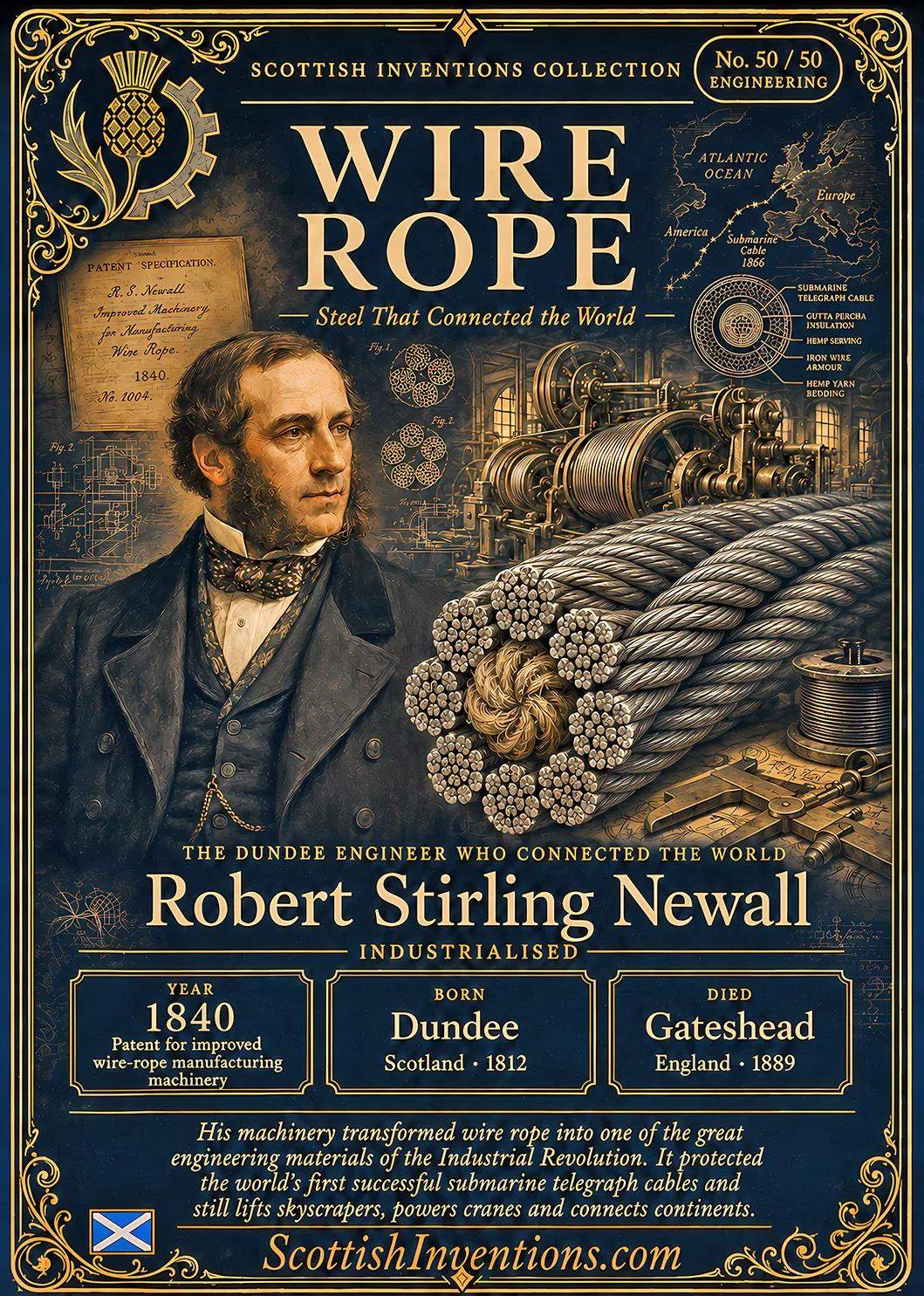
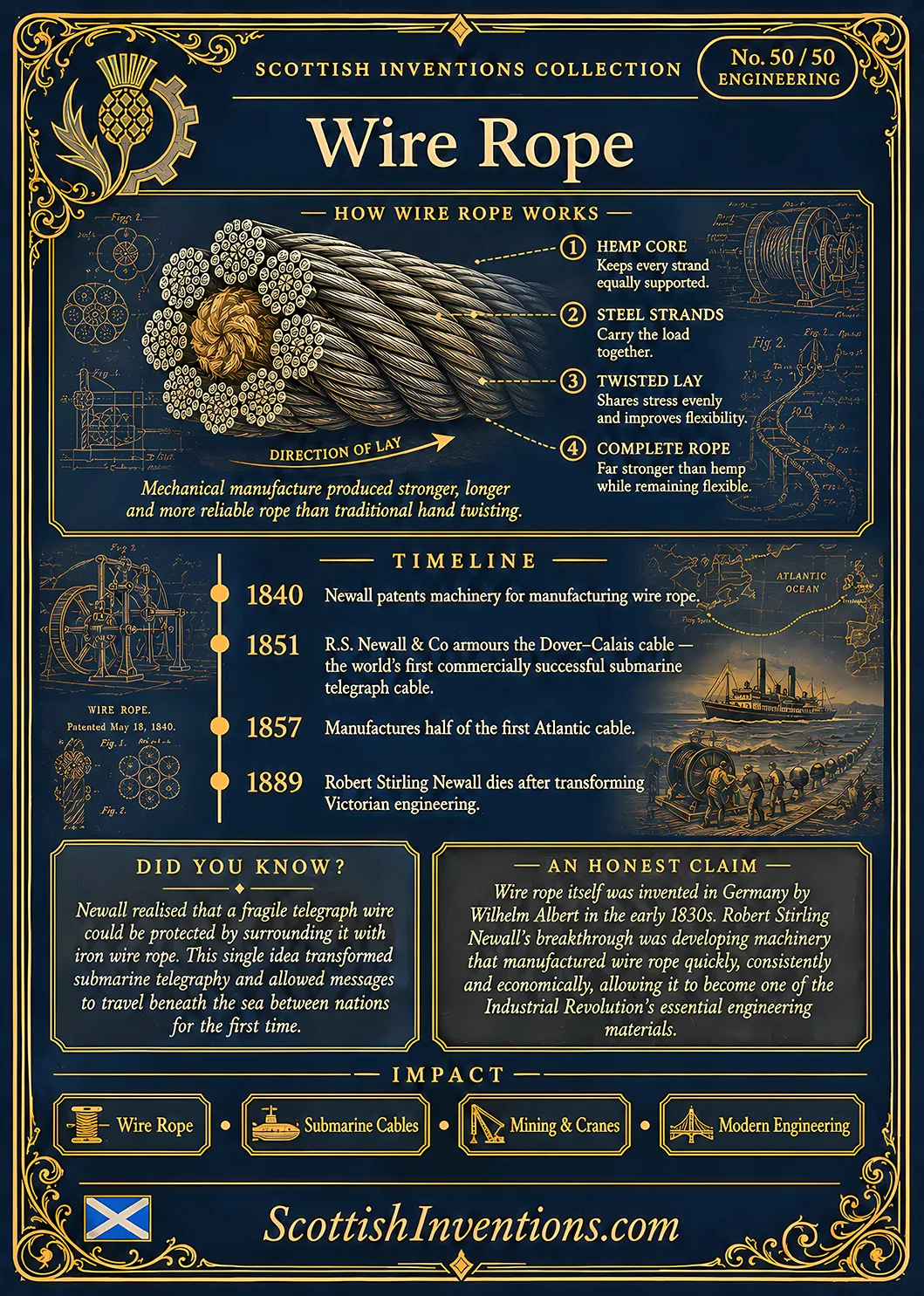
Card No. 50 of 50 in the Scottish Inventions Collection — the final card celebrates Robert Stirling Newall's industrialisation of wire rope. Flip to read the back.
Frequently Asked Questions
- Who invented wire rope?
- Modern wire rope was invented by the German engineer Wilhelm Albert in the Harz Mountains around 1831–1834, working with the colliery blacksmith Heinrich August Mummenthey. His first rope of three strands of four wires each was put to work in the Caroline mine at Clausthal in the summer of 1834. Robert Stirling Newall himself never claimed the invention; his contribution came later, in industrialising Albert's idea.
- Did Robert Stirling Newall invent wire rope?
- No — and he never claimed to. Newall industrialised wire rope. On 17 August 1840 he patented machinery to manufacture wire rope mechanically, around a flexible hemp core, replacing Albert's slow hand-twisting. His firm R.S. Newall & Co turned wire rope into a mass-produced industrial product that reshaped mining, shipping, telegraphy and civil engineering.
- What did Robert Stirling Newall invent?
- Newall patented, on 17 August 1840, machinery for the mechanical manufacture of wire rope — 'certain improvements in wire rope and the machinery for making such rope.' His defining innovation was a central hemp core that held every wire equidistant from the centre so that stress was shared equally across the rope. He later invented a brake-drum and cone (1853) for paying out submarine cable in deep water.
- Why was wire rope important?
- Wire rope replaced hemp rope and iron chain in every field that depended on strong, reliable lifting or hauling. It made deep mine shafts safe, allowed ships to replace hemp rigging with lighter and stronger steel, enabled the safety elevator and therefore the skyscraper, and made possible cable cars, aerial ropeways, construction cranes and the great suspension bridges. It is the invisible backbone of the modern built world.
- How did Newall help submarine telegraph cables?
- Newall saw that a fragile gutta-percha-insulated telegraph conductor could be protected by sheathing it inside a wire rope — turning the cable into the core of a rope. His firm armoured the 1851 Dover–Calais cable, the first commercially successful submarine cable in the world, and manufactured half of the first transatlantic cable of 1857–1858. By the mid-1850s R.S. Newall & Co held what one biographer called a near-monopoly on the business.
- What was the Dover–Calais cable?
- The Dover–Calais cable, laid on 25 September 1851 and opened to public traffic that November, was the world's first commercially successful submarine telegraph cable. Its gutta-percha core was supplied by the Gutta Percha Company; its overall design was Thomas Crampton's; and it was armoured with Newall's patented wire rope. The 1850 unarmoured cable had failed almost immediately — Newall's insight was that only wire rope could keep a submarine cable alive.
- What was the first Atlantic cable?
- The first transatlantic telegraph cable of 1857–1858, laid by the Atlantic Telegraph Company. The armouring contract was split between R.S. Newall & Co at Birkenhead and Glass, Elliot & Co at Greenwich, each armouring half of the roughly 2,500-nautical-mile core, because no single works could make it all in time. A famous error left Newall's half with a right-handed lay and Glass, Elliot's with a left-handed lay, and the two had to be joined with a special frame. The line finally carried messages briefly in August 1858 before its insulation failed.
- Where was Robert Stirling Newall born?
- Robert Stirling Newall was born in Dundee, Scotland, on 27 May 1812, the son of Walter Newall, a merchant, and Janet Hair. He began his working life in a Dundee mercantile office, worked in London on rapid steam generation and spent around two years promoting his employer's business in America before returning to Scotland by 1838 as proprietor of an engineering works in Dundee.
- What happened to the Newall Telescope?
- Newall commissioned the York optician Thomas Cooke to build a 25-inch (62.5 cm) refracting telescope, completed in 1869 — then the largest refracting telescope in the world. He installed it at his Gateshead home, Ferndene, but the smoky local skies made it nearly useless. He gave it to the University of Cambridge shortly before his death; his son Hugh Frank Newall used it there to show that the star Capella is a multiple system. In 1959 it was donated to the National Observatory of Athens and moved to the Penteli Observatory, where it survives and is still used for educational purposes today.
- Why is Robert Stirling Newall important?
- Because he turned wire rope from a craft product into an industrial one, and then used that same technology to connect the world by submarine telegraph. Wire rope, industrialised at his Gateshead works, made possible modern mining, shipping, lifts, bridges and cranes. The armoured cables his firm made — Dover–Calais 1851, the Black Sea cable of the Crimean War, half of the 1857 Atlantic cable — began the age of instantaneous intercontinental communication. He belongs alongside Wilhelm Albert and John A. Roebling as one of the three founders of the wire-rope world.