Scottish Inventions · Banking & Security
James Goodfellow: The Scottish Inventor Who Gave the World the PIN
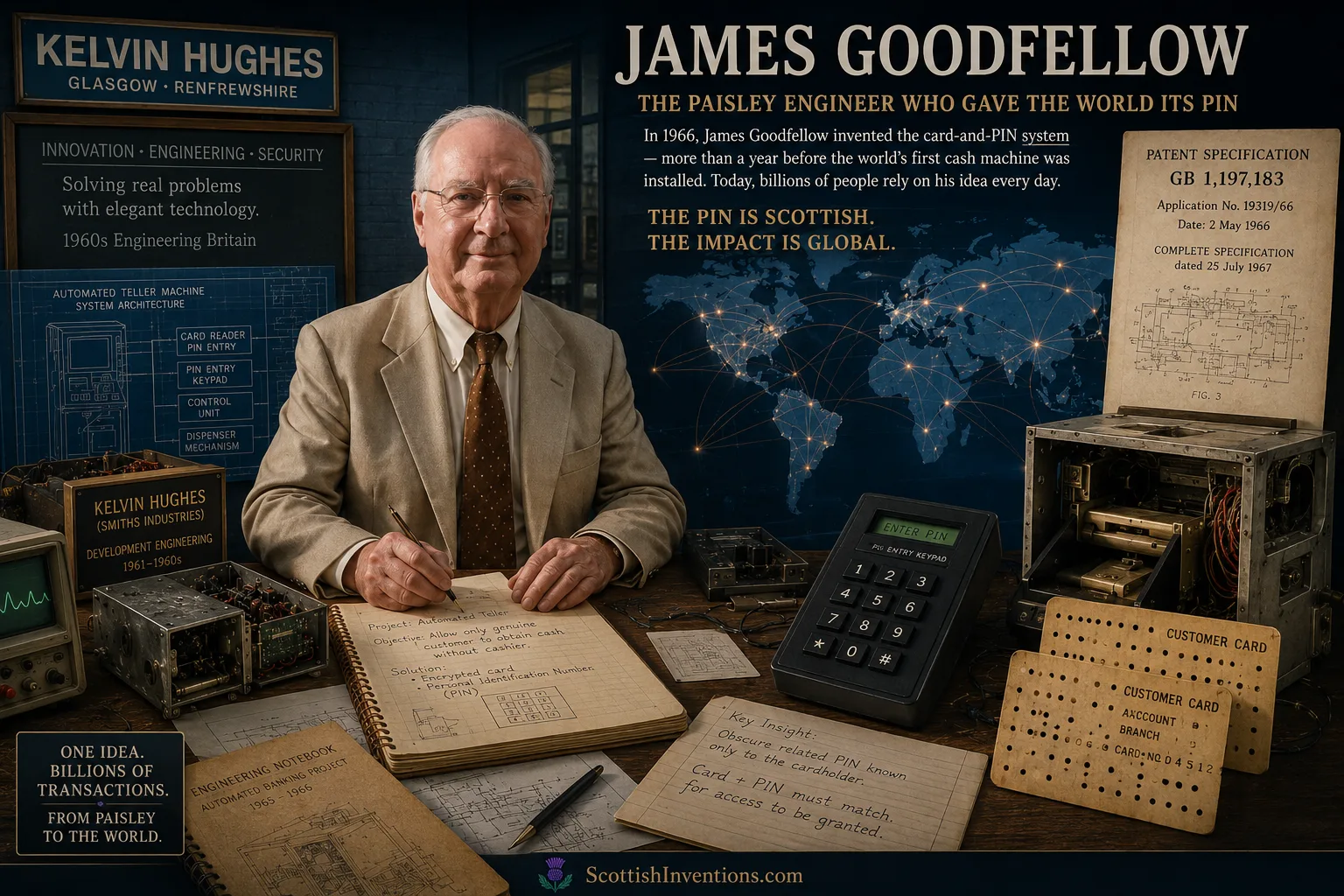
The Paisley engineer who patented the card-and-PIN system in 1966 — over a year before the first cash machine was switched on — and earned a £10 bonus for one of the most-used inventions in history.
Published 2026-06-25 · Updated 2026-06-25 · ScottishInventions.com Editorial
Quick Answer
James Goodfellow PIN inventor: Scottish engineer James Goodfellow of Paisley patented the card-and-PIN system on 2 May 1966 (UK Patent GB1,197,183) — over a year before the first cash machine was installed. He invented the system every ATM still uses; John Shepherd-Barron's 1967 Barclays Enfield machine was first to be deployed but used a radioactive paper voucher, not a card and PIN.
Key Facts
Contents
1. Introduction
The James Goodfellow PIN inventor story is one of Scotland's most consequential and most overlooked. In 1966 — over a year before anyone had ever stood in front of a working cash machine — a 28-year-old engineer in Paisley filed a UK patent for an idea that today secures more than a billion transactions every day.
James Goodfellow was born in Paisley, Renfrewshire, on 18 May 1937. He attended St Mirin's Academy, apprenticed at Renfrew Electrical & Radio Engineers, served in REME (where he designed a mobile electronics workshop for the “Thunderbird” missile) and in 1961 joined Kelvin Hughes, then a division of Smiths Industries Ltd. The mechanical cash-dispensing housing was built by Chubb Lock & Safe Co.; the initiating customer was Westminster Bank.
2. The Problem Banks Faced
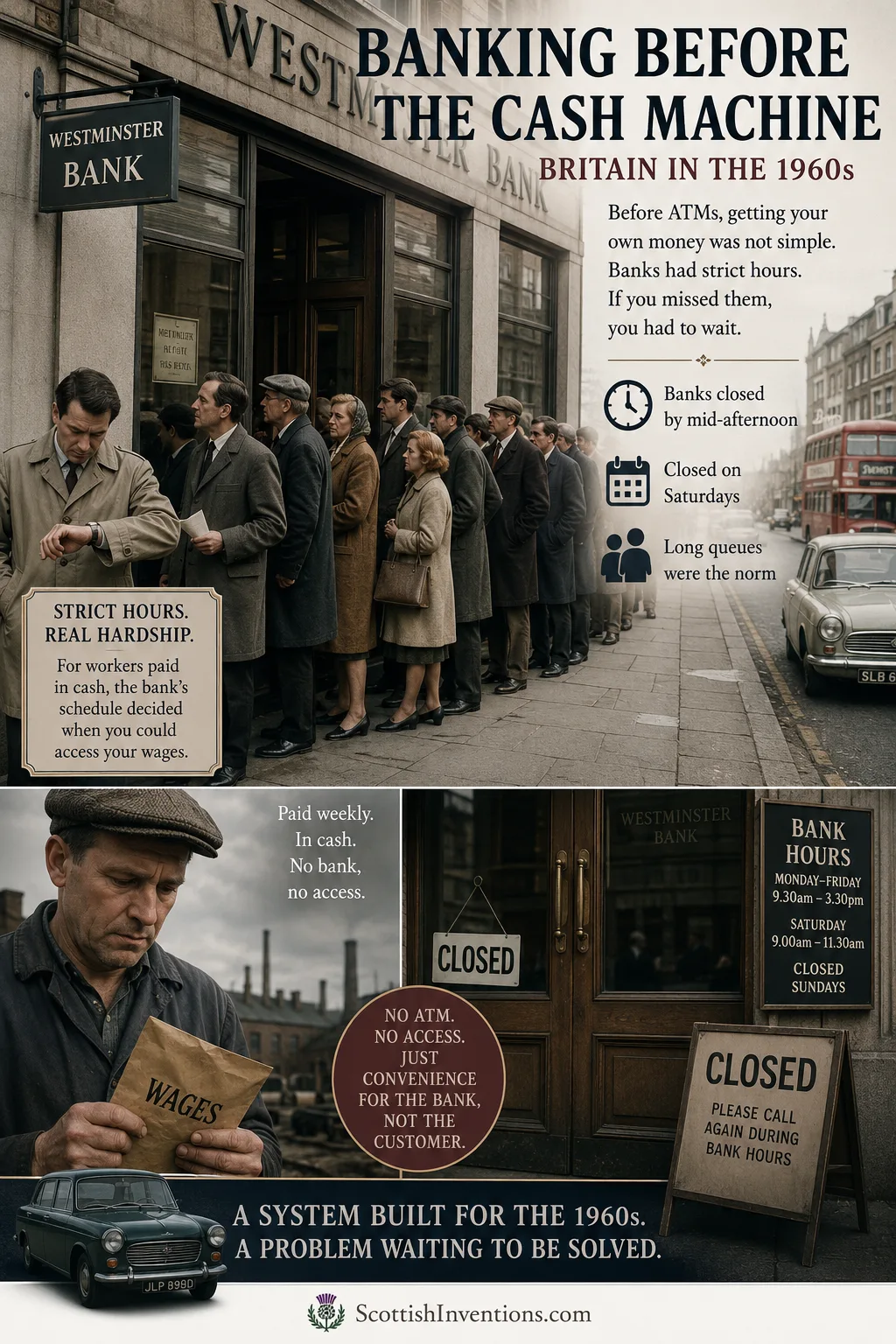
Britain in the mid-1960s ran on cash and on strict banking hours. Branches closed by mid-afternoon and were shut on Saturdays — a genuine hardship for working people paid weekly, in cash, with no way to access their money outside the bank's tight window. The banks wanted to stop loss-making Saturday-morning opening without abandoning their customers, and the answer they reached for was a machine that could hand out cash with no human teller present.
3. The Invention — The ATM and PIN
In 1965, the 28-year-old Goodfellow was handed the project. The brief was deceptively simple: build something that lets a genuine customer — and only a genuine customer — take cash from a machine with no clerk watching.
“My task was to design the means of allowing a customer, and only a genuine customer, to actuate the dispenser mechanism.” — James Goodfellow
He worked through the alternatives — fingerprints, voice recognition, retinal patterns, magnetic stripes, online operation — and found them all unworkable on grounds of cost, bulk, or technical feasibility in 1965. His breakthrough was elegant:
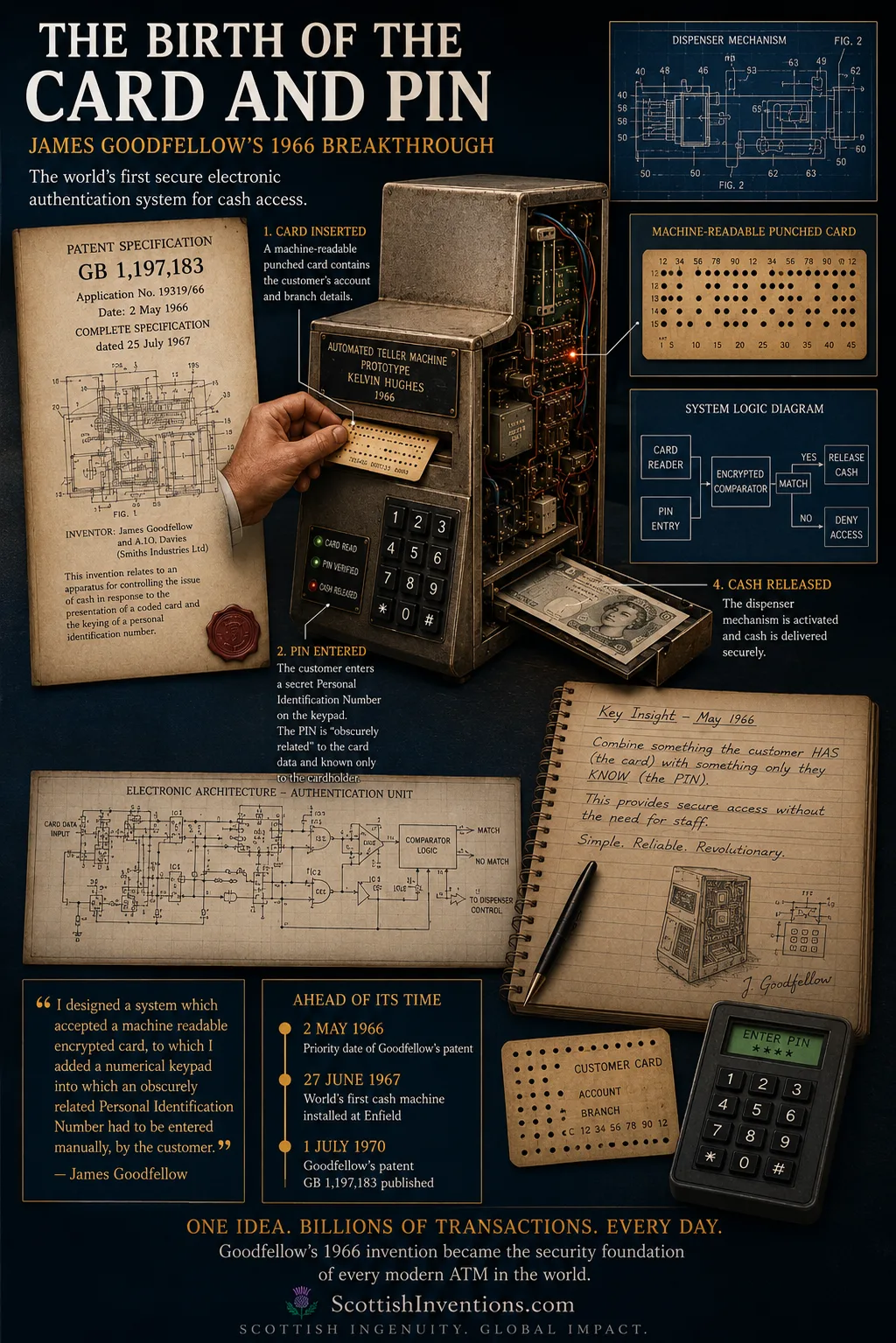
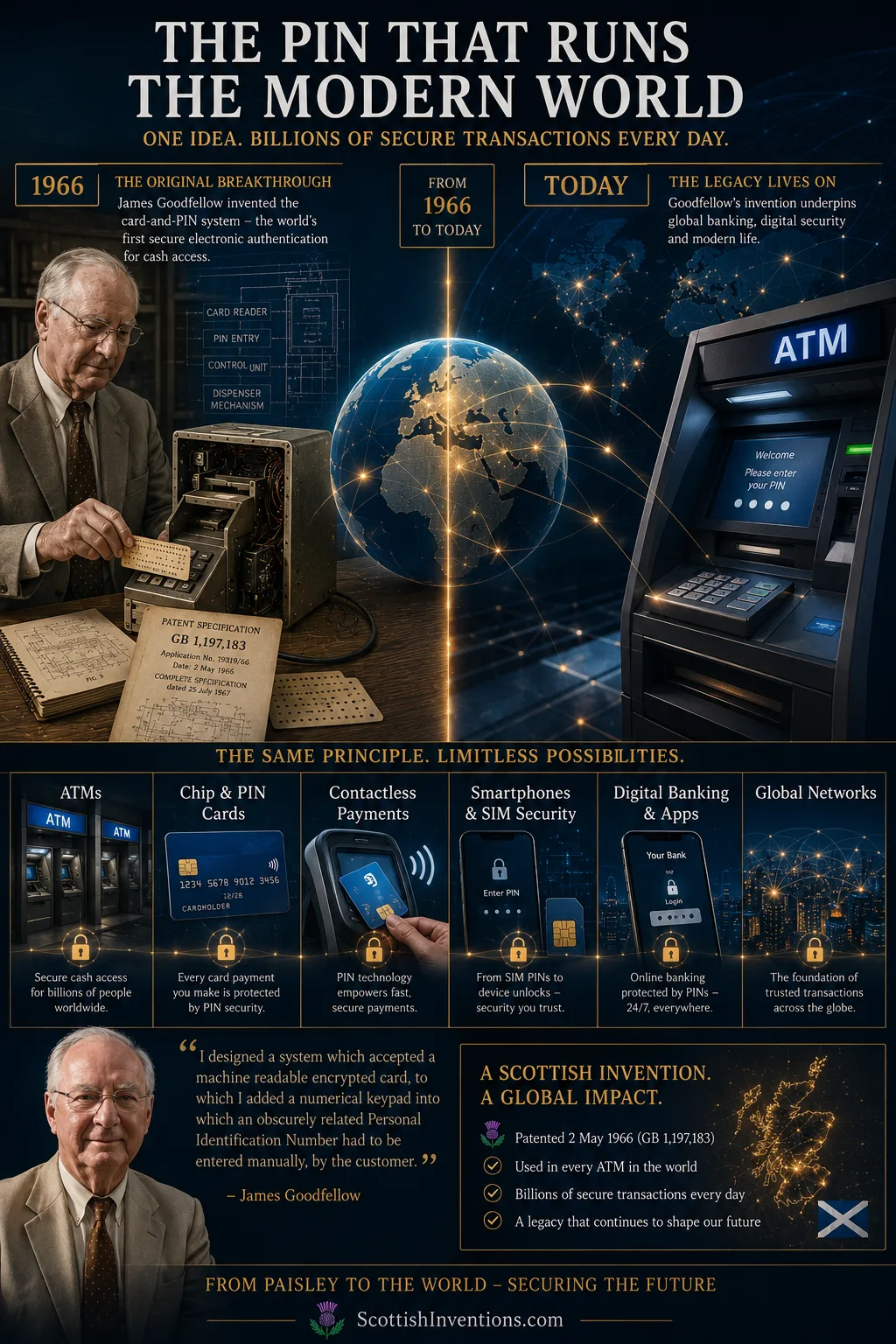
“I designed a system which accepted a machine readable encrypted card, to which I added a numerical keypad into which an obscurely related Personal Identification Number had to be entered manually, by the customer. This PIN was known only to the person to whom the card was issued.”
That combination — a machine-readable card plus a secret numeric code — is the heart of his claim, because it is exactly how every modern ATM works.
The Patent
UK Patent No. 1,197,183 · application 19319/66 · priority date 2 May 1966 · complete specification dated 25 July 1967 · published 1 July 1970. Assigned to Smiths Industries Ltd, naming James Goodfellow as inventor alongside the company's general manager Anthony (A.I.O.) Davies. The same invention is covered by US Patent 3,905,461, which subsequent patents cite as “prior art”.
4. How the PIN Works
The patent describes circuitry inside the dispenser that read a plastic card punched with holes encoding the customer's number, account number and branch — needing only around 30 bytes of data. Crucially, the PIN was scrambled — “obscurely related” to the card data — so it could not simply be read off the card. The customer keyed a PIN (described in the patent as a “plural-character” code rather than a fixed length) into a keypad; the machine compared the two inputs, and if they matched, out came the cash. Chubb-built machines were installed across the UK in the late 1960s and early 1970s.
The principle — something you have (the card) combined with something you know (the PIN) — is now the textbook definition of two-factor authentication and underlies almost every secure consumer transaction made today.
5. The Rival Claim
On 27 June 1967, more than a year after Goodfellow's filing, the world's first cash machine was ceremonially unveiled at a Barclays branch in Enfield, north London — comedy actor Reg Varney of On the Buses making the first withdrawal. It was the work of John Shepherd-Barron, managing director of De La Rue Instruments. But his machine, the De La Rue Automatic Cash System (“Barclaycash”), worked completely differently: customers fed in a single-use paper voucher impregnated with carbon-14 — a mildly radioactive isotope the machine detected — then keyed a PIN. There were no plastic cards, and De La Rue deliberately never patented the design.
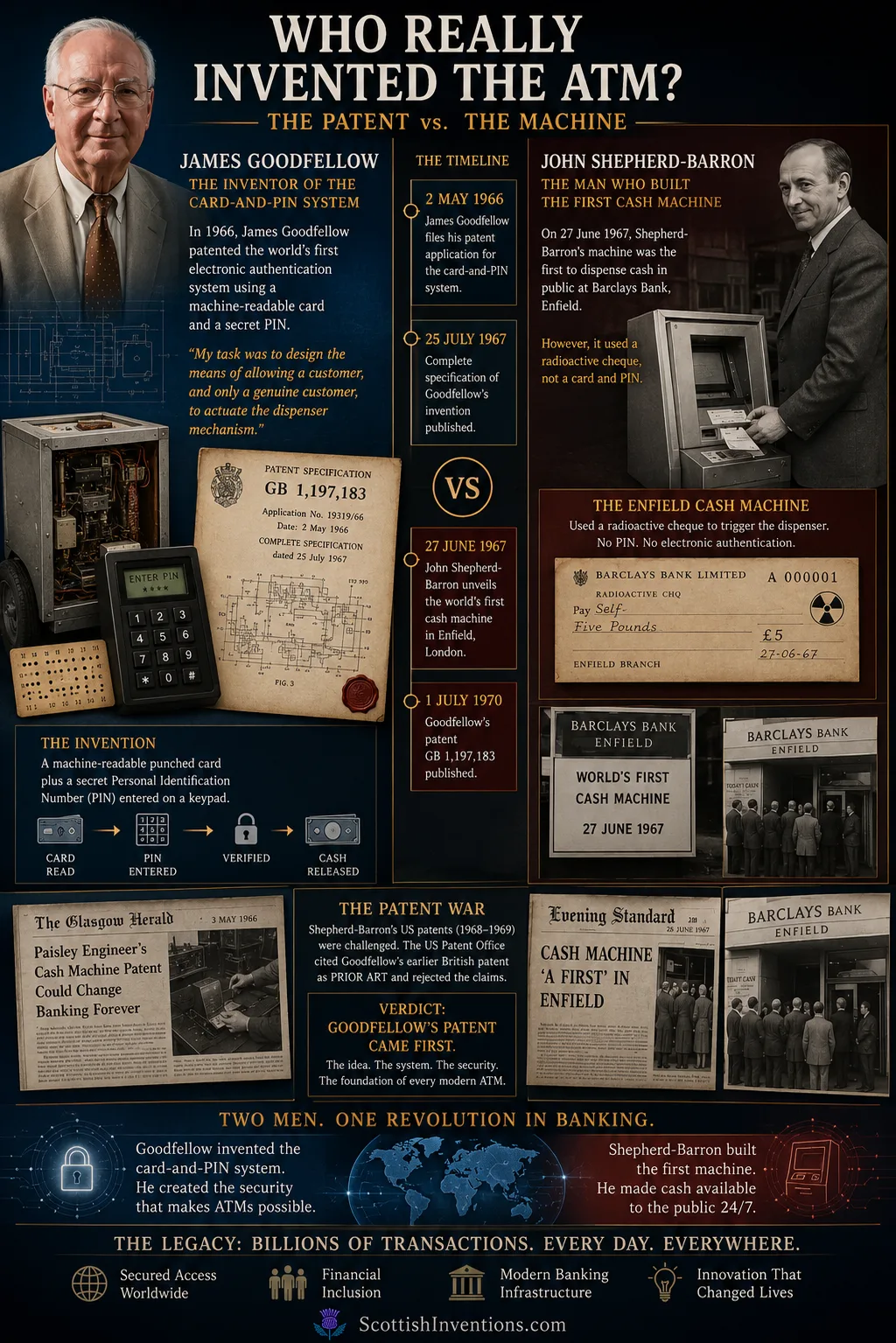
The honest verdict, which the best sources support: Shepherd-Barron was first to install a working cash machine; Goodfellow invented and patented the card-and-PIN system that the entire world adopted. As Goodfellow himself put it: “He invented a radioactive device to withdraw money. I invented an automated system with an encrypted card and a PIN number, and that's the one that is used around the world today.”
Other contenders should be framed precisely. American inventor Luther George Simjian built the “Bankograph”, installed by a New York bank around 1960 — but it was a deposit machine and did not dispense cash. Don Wetzel's Docutel “Docuteller”, installed at Chemical Bank's Rockville Centre branch on 2 September 1969, is generally counted as the first American ATM and used magnetic-stripe plastic cards. Goodfellow's distinct contribution is the verification system at the core of all of them.
Myth-Buster: the “four-digit” story
The charming anecdote that the PIN was cut from six digits to four because the inventor's wife could only remember four is true of John Shepherd-Barron, not James Goodfellow. Shepherd-Barron, an army veteran, proposed a six-figure code based on his army number; his wife Caroline vetoed it — “over the kitchen table, she said she could only remember four figures, so because of her, four figures became the world standard.” Any retelling that pins this on Goodfellow is an error.
6. Patent Timeline
- 18 May 1937Born in Paisley, Renfrewshire — attended St Mirin's Academy.
- 1958Completes apprenticeship at Renfrew Electrical & Radio Engineers.
- 1958–1961National Service with REME; designs a mobile electronics workshop for the Thunderbird missile.
- 1961Joins Kelvin Hughes, a Smiths Industries division, as a development engineer.
- 1965Aged 28, is handed the automated-teller project for Westminster Bank and Chubb.
- 2 May 1966Files UK Patent GB1,197,183 — the card-and-PIN system (application 19319/66).
- 27 Jun 1967John Shepherd-Barron's De La Rue cash machine unveiled at Barclays Enfield — uses a radioactive voucher, not a card and PIN.
- 25 Jul 1967Complete specification of Goodfellow's patent published.
- 1 Jul 1970UK Patent 1,197,183 published. US Patent 3,905,461 follows.
- 1970s–1992Long career at IBM Greenock; twice wins IBM's Outstanding Technical Achievement Award. Retires 1992.
- 14 Feb 2006UK 'Chip and PIN changeover day' — Goodfellow's idea becomes the national payment standard.
- Jun 2006Appointed OBE in the Queen's Birthday Honours for services to banking.
- 2013First inductee into the Paymts.com Hall of Fame at Harvard.
- 2014Honorary doctorate from the University of the West of Scotland.
- 7 Oct 2016Inducted into the Scottish Engineering Hall of Fame.
7. Recognition — and why it took so long
Here is the sting. Because Goodfellow was a salaried employee and the patent belonged to his employer, he received a £10 bonus for the invention. According to patent attorneys Marks & Clerk, “as an employee of Kelvin Hughes, James Goodfellow's compensation for assigning the world-changing invention to his employer amounted to a £10 bonus, around £160 in today's money.” He never earned a penny in royalties. He went on to a long and distinguished engineering career at IBM in Greenock, twice winning IBM's Outstanding Technical Achievement Award, and retired in 1992 — for decades almost entirely unknown to the public.
Recognition came late and largely by accident. When Shepherd-Barron received an OBE in the 2005 New Year Honours, widely reported as “inventor of the automatic cash dispenser”, it stung Goodfellow into action. He dug out his patents, contacted the UK Intellectual Property Office and made his prior claim public. The following year, Goodfellow was appointed OBE in the 2006 Queen's Birthday Honours — reported by The Scotsman as being “for services to banking as 'patentor of the personal identification number'.”
Further honours followed: a John Logie Baird award for “outstanding innovation” (2009), third place in the IPO British Visionary Inventor award (2012), the first induction into the Paymts.com Hall of Fame at Harvard (2013), an honorary doctorate from the University of the West of Scotland (2014), and induction into the Scottish Engineering Hall of Fame on 7 October 2016, placing him alongside Alexander Graham Bell, James Clerk Maxwell and John Logie Baird.
8. Legacy
Every ATM on the planet — some 3 million of them — uses the card-and-PIN verification system that James Goodfellow invented. But the PIN's reach goes far beyond the cash machine.
Chip-and-PIN cards arrived in the UK through trials from 2003, culminating in the famous “Chip and PIN changeover day” on 14 February 2006 — Valentine's Day, branded “I ♥ PIN”, and described at the time as the biggest change in UK consumer behaviour since decimalisation. Contactless payments, introduced in the UK in 2007, still lean on the PIN: you are prompted for it above the contactless limit (raised to £100 in 2021, with the FCA removing the mandatory cap in March 2025) and periodically as a security reset. Per UK Finance, 19.2 billion contactless debit and credit card payments were made in 2025 in the UK, with a total value of £311 billion. Add SIM-card PINs and phone passcodes, and Goodfellow's six-decade-old idea is woven through daily life.
Did You Know?
- The PIN was patented before the first ATM was even installed — Goodfellow filed on 2 May 1966; Enfield opened on 27 June 1967.
- He earned a £10 bonus — about £160 today — for a system now used in over a billion chip-and-PIN sales a day.
- The “wife's-memory” four-digit story belongs to Shepherd-Barron, not Goodfellow.
- Every ATM on Earth uses his card-and-PIN system — around 3 million machines from Antarctica to the Forbidden City.
- Both Scots received OBEs a year apart: Shepherd-Barron 2005, Goodfellow 2006.
- The famous Enfield machine used no card at all — just a radioactive carbon-14 paper voucher and a keypad.
For the Scottish context, Goodfellow stands alongside James Watt and the pioneers of Scottish engineering as a quietly brilliant inheritor of the same tradition — “Scottish ingenuity, global impact”, as the inscription on his collectible card puts it.
9. Frequently Asked Questions
›Who invented the PIN?
The Personal Identification Number, paired with a machine-readable card, was invented by Scottish engineer James Goodfellow of Paisley. He patented the card-and-PIN system on 2 May 1966 (UK Patent GB1,197,183) while working at Kelvin Hughes, a division of Smiths Industries.
›Who invented the ATM?
The honest answer is that two Scots share the credit. James Goodfellow invented and patented the card-and-PIN authentication system in 1966 — the technology every ATM still uses. John Shepherd-Barron's De La Rue machine, installed at Barclays in Enfield on 27 June 1967, was the first cash machine deployed in public — but it used a radioactive paper voucher, not a card and PIN.
›Did James Goodfellow invent the cash machine?
He invented the card-and-PIN system that became the security foundation of every modern ATM. He did not build the first physical cash dispenser installed in public — that was John Shepherd-Barron's Barclays Enfield machine on 27 June 1967, which used a radioactive cheque rather than Goodfellow's card and PIN.
›What did John Shepherd-Barron invent?
Shepherd-Barron led the De La Rue Instruments team that built the world's first deployed cash machine, unveiled at Barclays Bank, Enfield on 27 June 1967. It accepted single-use paper vouchers impregnated with carbon-14 (a mildly radioactive isotope) plus a PIN. De La Rue deliberately never patented the design.
›What is GB Patent 1,197,183?
UK Patent No. 1,197,183 (application 19319/66) is James Goodfellow's patent for the card-and-PIN authentication system. Priority date 2 May 1966; complete specification 25 July 1967; published 1 July 1970. It is assigned to Smiths Industries Ltd and names James Goodfellow with Anthony Davies.
›What is the history of chip and PIN?
Chip-and-PIN cards combine an EMV chip with Goodfellow's 1966 PIN concept. UK trials began in 2003 and the national rollout culminated on 'Chip and PIN changeover day', 14 February 2006 — branded 'I ♥ PIN' and described as the biggest change in UK consumer behaviour since decimalisation.
›How does a PIN work?
A PIN works by combining 'something you have' (a machine-readable card) with 'something you know' (a secret numeric code). The card data and PIN are 'obscurely related' so the code cannot be read off the card. The machine compares the two inputs and only releases cash, opens a door or authorises a payment if they match.
›Why is James Goodfellow important?
Every ATM on Earth — around 3 million machines — uses his card-and-PIN system. The same idea underpins chip-and-PIN cards, contactless payment limits, SIM-card security and smartphone lock screens, facilitating more than a billion 'chip and PIN' transactions a day worldwide.
›How much did James Goodfellow earn for inventing the PIN?
He received a £10 bonus — roughly £160 in today's money — because as a salaried employee of Kelvin Hughes the patent belonged to his employer, Smiths Industries. He never earned royalties on one of the most-used inventions in history.
›When was James Goodfellow recognised?
Recognition came late: an OBE in the 2006 Queen's Birthday Honours, a John Logie Baird award (2009), third place in the IPO British Visionary Inventor award (2012), an honorary doctorate from the University of the West of Scotland (2014) and induction into the Scottish Engineering Hall of Fame on 7 October 2016.
›Did Goodfellow choose four digits because his wife couldn't remember six?
No. That story belongs to John Shepherd-Barron and his wife Caroline, who vetoed his six-figure army-number PIN over the kitchen table. There is no credible evidence Goodfellow ever told such a tale about himself — his patent simply specified a 'plural-character' PIN.
›Where was James Goodfellow born?
James Goodfellow was born on 18 May 1937 in Paisley, Renfrewshire, Scotland. He attended St Mirin's Academy before training as an electronics apprentice and serving in the Royal Electrical and Mechanical Engineers (REME).
›Who built the first cash machine?
The first cash machine installed in public was built by John Shepherd-Barron's team at De La Rue Instruments and unveiled at a Barclays branch in Enfield, north London, on 27 June 1967. Comedy actor Reg Varney made the ceremonial first withdrawal.
›Has Goodfellow appeared on a Scottish banknote?
No. Despite Clydesdale Bank's long tradition of featuring famous Scots, James Goodfellow has not appeared on a banknote. A local street mural in his native Paisley stands as a more modest tribute.
›What is the difference between James Goodfellow and John Shepherd-Barron?
Goodfellow invented and patented the card-and-PIN system in 1966 — the security system every modern ATM uses. Shepherd-Barron built and deployed the first public cash machine in 1967, using a radioactive paper voucher instead of a card and PIN. Goodfellow invented the system; Shepherd-Barron installed the first machine.
10. Sources & Further Reading
- UK Patent GB 1,197,183 — Goodfellow & Davies, application 19319/66, priority 2 May 1966.
- US Patent 3,905,461 — the corresponding US specification.
- Queen Elizabeth Prize for Engineering — citation of Goodfellow's contribution to global ATM security.
- Marks & Clerk patent attorneys — commentary on the £10 employee-inventor bonus.
- The Scotsman, BBC News, Daily Mail and The Herald coverage around the 50th anniversary of the patent (2016).
- RBR Data Services (Datos Insights), Global ATM Intelligence Service — global ATM totals.
- UK Finance — 2025 contactless payments statistics.
- National Museums Scotland & the Scottish Engineering Hall of Fame — biographical records.
Continue Exploring Scottish Inventions
- Ian Donald & the Invention of Diagnostic Ultrasound
- James Beaumont Neilson & the Hot Blast Process
- James Bowman Lindsay & the 1835 Electric Light
- The Pneumatic Tyre — Invented Twice by Two Scots
- The Telephone — Alexander Graham Bell
- Television — John Logie Baird
- Radar — Sir Robert Watson-Watt
- All Scottish Inventions A–Z