Scottish Inventions · Transport & Engineering
Alexander Henry: The Scottish Gunmaker Who Armed an Empire
From a workshop on Edinburgh's South St Andrew Street, a millwright's apprentice invented the seven-groove polygonal rifling that armed the British Army for a generation — and lives on in the pistols of the twenty-first century.
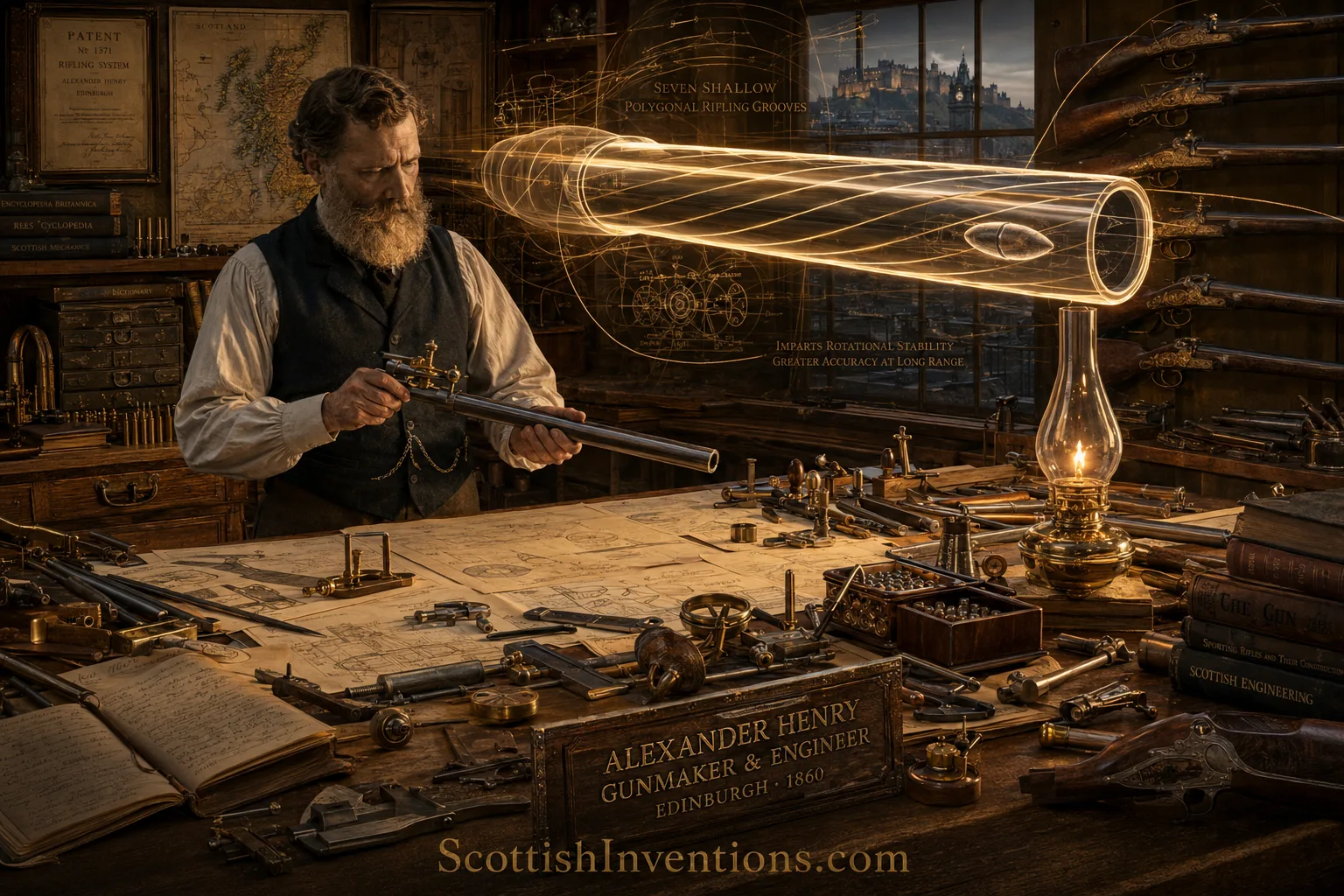
In the middle decades of the nineteenth century, the world's great military powers were locked in a race for the perfect rifle — a weapon accurate enough to hit a man at half a mile, reliable enough to fire in the mud of a colonial battlefield, and simple enough to mass-produce for an imperial army. The Scottish contribution to that race came from a gunmaker's shop at 12 South St Andrew Street, Edinburgh.
Alexander Henry (1818–1894) invented a shallow seven-groove polygonal rifling — patented as British Patent No. 2802 on 15 November 1860 — that gave Whitworth-class accuracy with an ordinary soft-lead bullet. The War Office chose it. Married to a Swiss engineer's falling-block action, it became the Martini-Henry rifle: the standard weapon of the British Army from 1871, the rifle of Rorke's Drift and Tel el-Kebir, and the ancestor of the Lee-Metford, the Lee-Enfield and — in principle — the polygonal rifling of the modern Glock.
Key Facts
Born Leith/Edinburgh, 1818
Alexander Henry was born in 1818 — Wikipedia records 4 June 1818 at Leith, the port district of Edinburgh; his successor firm and biographer Donald Dallas describe him as an Edinburgh man.
Patented 1860
British Patent No. 2802, dated 15 November 1860, at Westminster: a polygonal bore 'provided with curved, square, or angular spiral projections or grooves.'
1,100-yard hits
In early trials Henry's rifles reportedly scored hits at 1,100 yards — a performance so startling contemporaries refused to believe any but a Whitworth could achieve it.
Royal gunmaker
Appointed gun and rifle manufacturer to His Royal Highness the Prince of Wales in 1872. Queen Victoria commissioned him to make John Brown's Christmas 1873 rifle.
11 VCs at Rorke's Drift
The Martini-Henry — Henry's rifling married to Martini's action — armed the 139 defenders of Rorke's Drift. Eleven Victoria Crosses were won there in a single night.
Still influencing rifling
The smooth, low-fouling polygonal principle Henry championed lives on in the modern polygonal rifling of Glock, Heckler & Koch and other precision firearms.
Early Life & Background
Alexander Henry was born in 1818 — Wikipedia records his birth as 4 June 1818 at Leith, the port district of Edinburgh, while his successor firm and biographer Donald Dallas describe him simply as an Edinburgh man. At about twelve he was apprenticed to Thomas Mortimer, a respected Edinburgh gunmaker. The seven-year apprenticeship ended around 1837, and Henry was so highly regarded that he became manager of Mortimer's business at the age of twenty-two. The 1841 census lists him as a "journeyman gunmaker."
In 1852 he acquired the business of Samuel Gourlay and set up under his own name at 12 South St Andrew Street. As his biographer wryly noted, "only a short period, forty-two years — but in that time [he] rose to become the pre-eminent rifle maker in the world." The firm later occupied premises on Frederick Street and Beaverbank, and opened a London shop in King William Street in 1869. From the outset Henry concentrated almost exclusively on rifles, conducting detailed experiments into rifling, bullets and trajectory, and — a first-rate marksman himself — used competition success as advertising.
He was a man of standing in his city: a Justice of the Peace, an Edinburgh town councillor, Moderator of the High Constables of Edinburgh, an elder of his church, a Freemason of Lodge St Clair No. 349, and the "First Volunteer" — the first signatory to the founding of the Queen's Edinburgh Rifle Volunteers around 1859. In 1872 he was appointed gun and rifle manufacturer to His Royal Highness the Prince of Wales. His life also held real tragedy: in 1860 — the very year of his rifling patent — his twelve-year-old son James was accidentally shot and killed by his father.
Rifling & Military Firearms in the 1860s
The mid-Victorian decades were a revolution in firearms. Britain's mainstay had been the muzzle-loading .577 Pattern 1853 Enfield rifle-musket. In 1866 the Army adopted the Snider-Enfield — a conversion of the old muzzle-loader to fire a self-contained metallic cartridge through a side-hinged breech. It was a stopgap. The race was on for a purpose-built breech-loading service rifle.
Conventional rifling of the day used sharp-edged grooves and raised "lands" cut into the bore to grip the bullet and spin it. It worked — but sharp corners produced friction, fouled quickly with black-powder residue, wore the barrel, and degraded long-range accuracy. Makers competed fiercely to produce the most accurate long-range rifle possible. The most famous attempt was Sir Joseph Whitworth's. Patented in 1854, his bore was a twisted hexagon. In 1857 trials it proved far more accurate than the Enfield — but the War Office rejected it as expensive, prone to fouling, and at its best requiring a mechanically-fitted hexagonal bullet.
Henry's great advance over Whitworth was that his system worked with an ordinary soft-lead cylindro-conical bullet that expanded into the rifling on firing — no special projectile required. That is why the War Office chose him.
Henry's Rifling Patent — The Invention
Henry's breakthrough is recorded in British Patent No. 2802, dated 15 November 1860. The patent abridgement reads: "The rifled bore is of polygonal cross-section, and is provided, in addition, with curved, square, or angular spiral projections or grooves, so as to increase the bearing points of the projectile." Its most successful application was a shallow seven-groove pattern — the barrel is sometimes described as heptagonal.
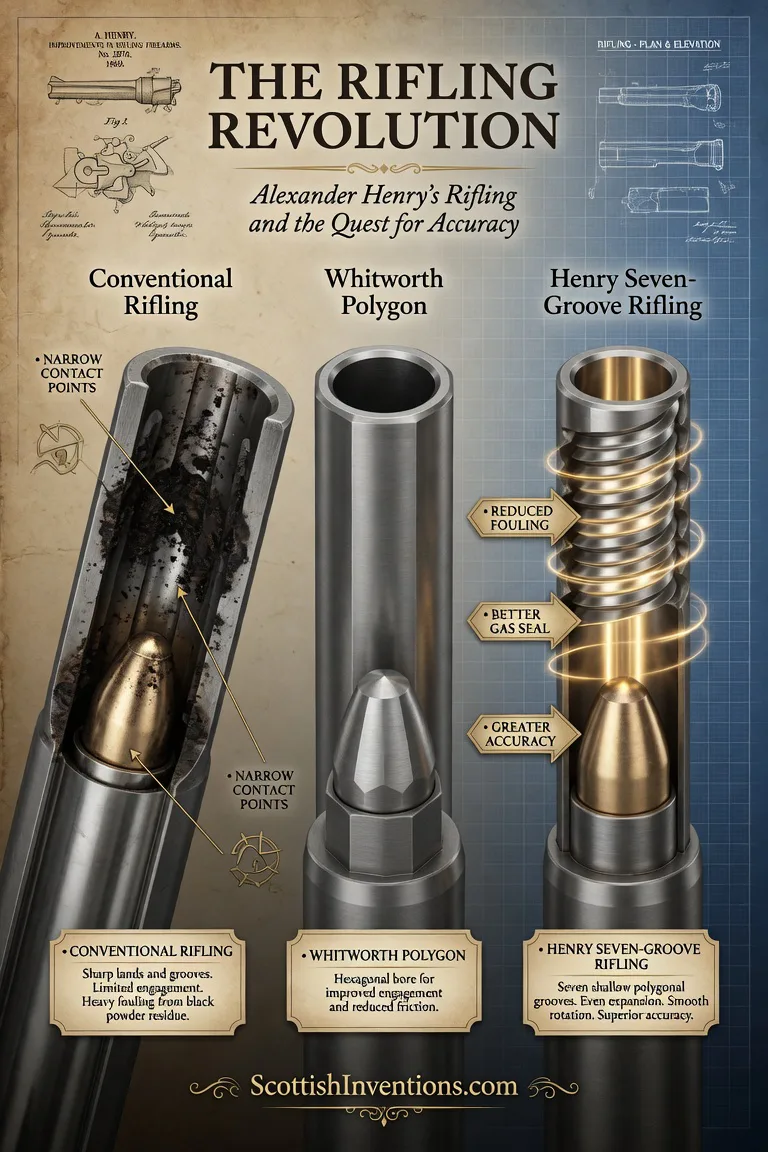
In early trials Henry's rifles reportedly scored hits at 1,100 yards, a performance so startling that contemporaries refused to believe any but a Whitworth could achieve it. In Martini-Henry service form the rifle was sighted to 1,800 yards; it "came into its own" against massed targets at 200–400 yards and could deliver harassing volley fire at far greater range.
- Smoother profile — no sharp corners to dig into the bullet, less friction.
- Uniform grip — spin imparted evenly around the whole circumference.
- Lower fouling — shallow grooves collected less black-powder residue and were easier to clean.
- Better gas seal — deeper rifling at the breech, shallower at the muzzle.
- Standard ammunition — decisive advantage over Whitworth's mechanically-fitted hexagonal bullet.
Comparison Table
Conventional rifling vs Whitworth polygonal vs Henry rifling — the three great mid-Victorian systems compared.
| Property | Conventional Rifling | Whitworth (1854) | Henry Rifling (1860) |
|---|---|---|---|
| Groove shape | Sharp-edged grooves & lands | Twisted hexagon (polygon) | Seven shallow rounded grooves |
| Fouling | High | Moderate | Low |
| Accuracy | Good | Excellent | Superior at service range |
| Bullet required | Standard lead | Special hexagonal bullet | Standard soft-lead cylindro-conical |
| Cost to manufacture | Low | High | Moderate |
| Military adoption | Universal (Enfield & others) | Limited / rejected | Adopted — Martini-Henry (1871) |
The Martini-Henry Rifle — The Combination
The War Office ran a prize competition for a new breech-loader. The trials ran from 1866–1869, with a public competition opening in 1867. Of the many entries, nine were short-listed — including a Henry, a Peabody and a Martini — but no complete rifle met all requirements. The committee then took the radical step of evaluating the two main components (barrel and breech action) separately.
Henry's barrel won. After exhaustive testing it was found "superior to all the other competitors," including the Snider used as a control. Henry was awarded a £600 prize. For the action, the committee chose the falling-block design refined by Friedrich von Martini, a Swiss engineer of Hungarian origin. Martini had improved the earlier falling-block patent of the American Henry O. Peabody (patented 1862) by replacing the external hammer with a self-cocking internal striker — hence the action is sometimes called Peabody-Martini.
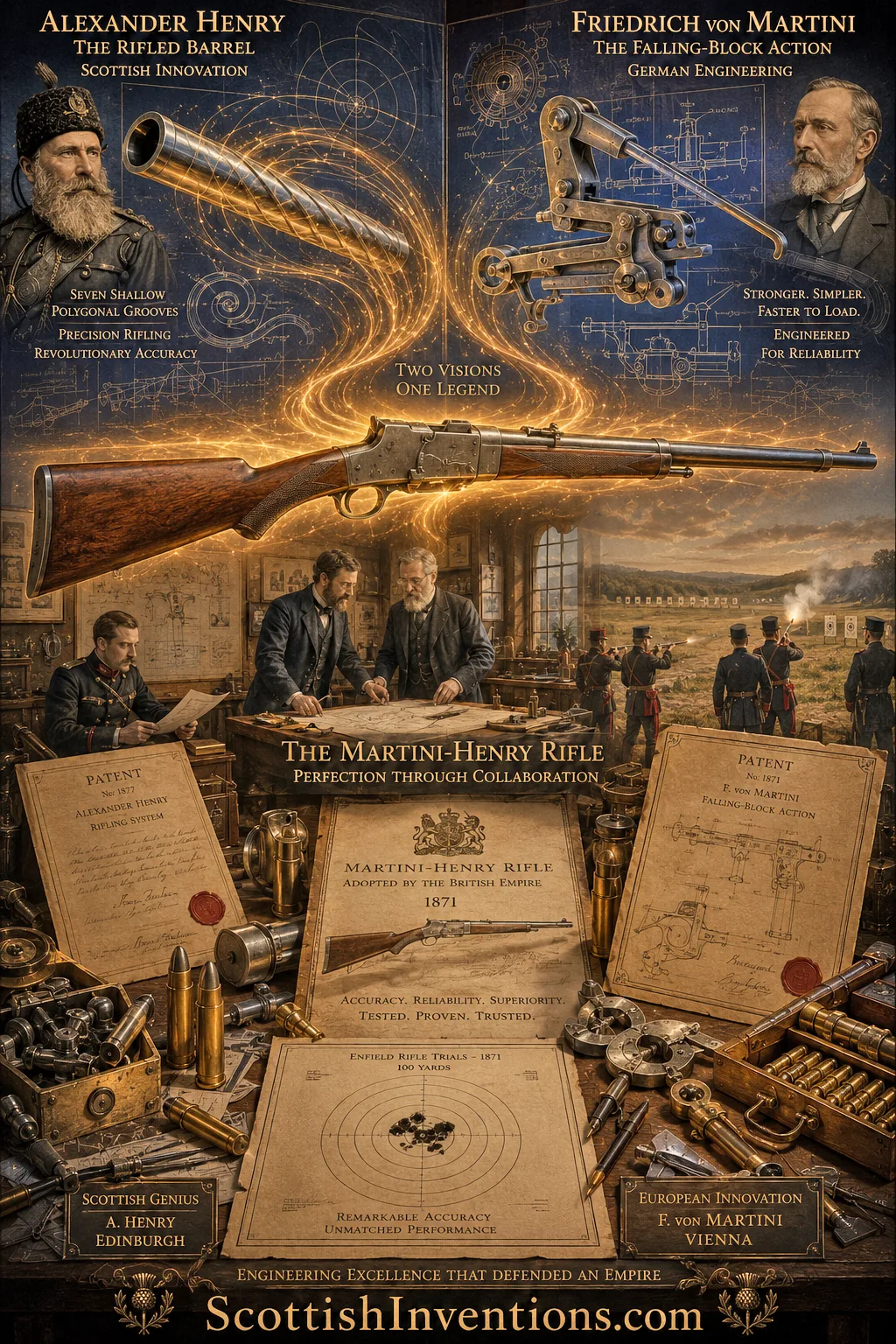
Ironically, Henry's own falling-block action — an excellent and much-copied 1865 design — was rejected for military use because Martini's was hammerless, faster to operate and cheaper to mass-produce. Full-scale production orders were placed on 13 April 1871, the Mark I was released in June 1871, and after empire-wide troop trials the rifle was authorised for full issue on 28 September 1874. The Martini-Henry chambered the powerful .577/450 Boxer-Henry cartridge — a .577 Snider case necked down to .45 calibre — firing a 480-grain lead bullet at roughly 1,350 fps through a 33.22-inch seven-groove Henry-rifled barrel with one turn in 22 inches.
The Martini-Henry in Combat
The Martini-Henry was the British Army's standard service rifle from 1871 (first issued from 1874) until the bolt-action Lee-Metford began replacing it in 1888. Production of the final Mark IV ended in 1889, but the rifle "remained in service throughout the British Empire until the end of the First World War," and was not phased out of front-line British use until 1904.
Anglo-Zulu War, 1879
On 22 January 1879 a British camp at Isandlwana was overwhelmed by a Zulu army of some 20,000 warriors; around 1,300 British, colonial and native troops were killed. British apologists later blamed the defeat partly on jammed cartridges and the famous story that ammunition boxes were screwed shut and could not be opened fast enough. Modern historians — including Ian Knight and Adrian Greaves — regard the "ammunition-box myth" as largely a face-saving invention: the boxes had a sliding lid secured by a single brass screw that could be knocked open with a rifle butt.
That same afternoon, at Rorke's Drift, a garrison reduced to 139 effective defenders — B Company of the 2nd/24th, including the Reverend George Smith and Surgeon James Reynolds with his 35 patients — held a fortified mission station against the Undi reserve corps of approximately 3,000–4,000 Zulu warriors under Prince Dabulamanzi kaMpande. The defenders fired roughly 20,000 Martini-Henry rounds. Eleven Victoria Crosses were awarded — seven to the 2nd/24th, the most ever received by one regiment for a single action.
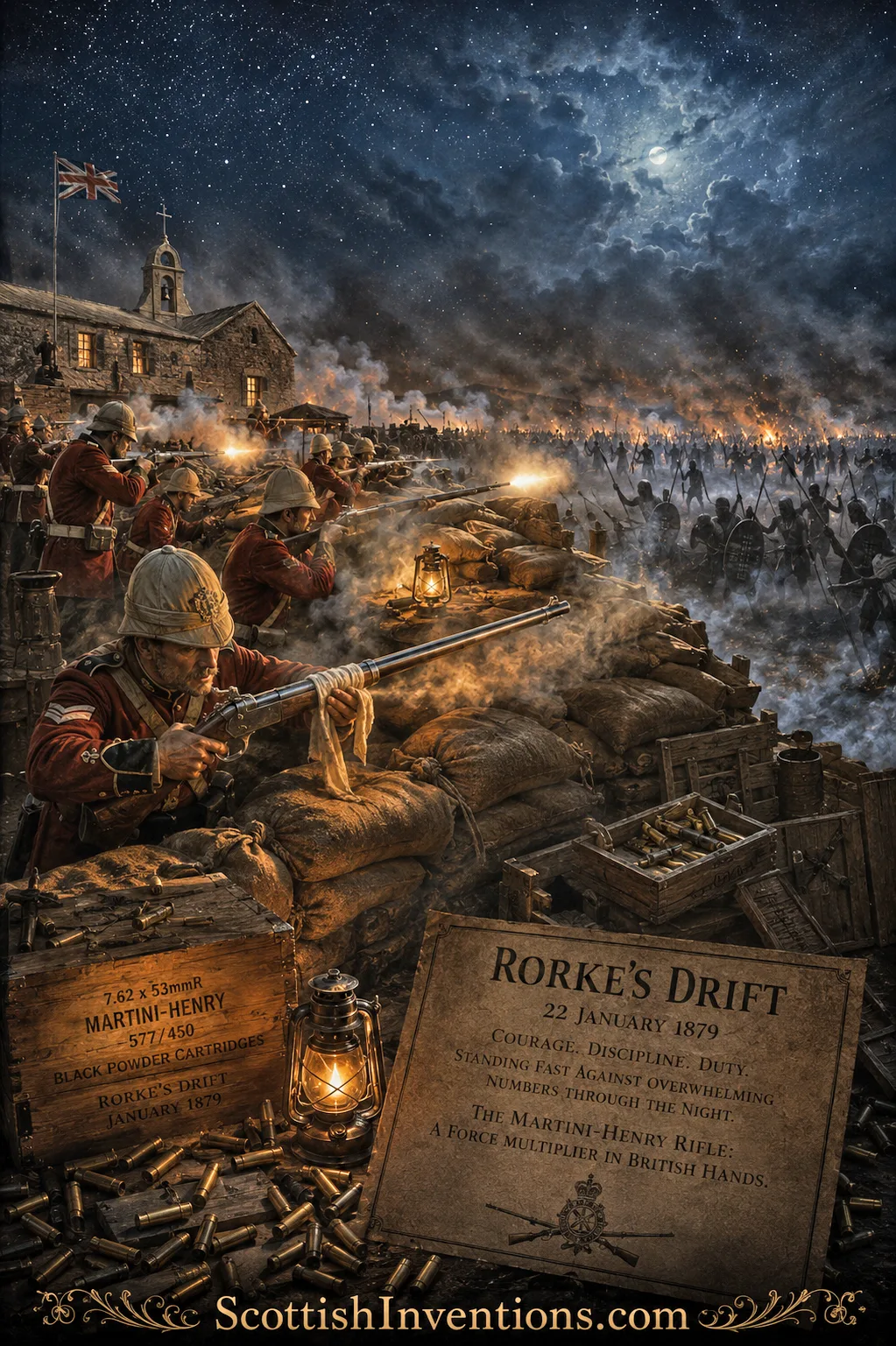
"We all had the utmost confidence in our rifles, which were at that time the most perfect weapons in the world."
— Captain Edward Hutton, 3rd/60th Rifles (King's Royal Rifle Corps), 1879
Afghanistan, Egypt and the Sudan
British infantry carried the Martini-Henry through the Second Anglo-Afghan War (1878–1880), including the disaster at Maiwand and the victory at Kandahar. In 1882 it won the Battle of Tel el-Kebir in Egypt. In the Sudan it served through the Gordon Relief / Nile Expedition (1884–1885) and the Camel Corps action at Abu Klea (1885). Complaints from the Sudan about jammed cases led to the longer operating lever of the Mark IV — a problem largely solved by later solid-drawn brass cases from 1885.
Sporting Rifles & Royal Patrons
Henry was, first and foremost, a maker of fine sporting rifles, and it is for these that connoisseurs revere him. His Edinburgh-made double rifles and express rifles — high-velocity, flat-shooting big-game rifles in calibres from .360 up to .577 — were among the finest of their era. His 1865 falling-block sporting rifle was much copied. The best rifles were made in Edinburgh; lower grades in Birmingham by firms such as Samuel Allport, with locks by Brazier of Wolverhampton.
His preserved "Dimensions Books" read like a Who's Who of the age. Most famously, Queen Victoria commissioned Henry to make a double-barrelled .450 hammer rifle as a Christmas 1873 gift for her servant John Brown — the stock engraved "From V. R. To J. Brown Esq. Christmas 1873." That "extremely rare and fine Royal .450 Black Powder Express" rifle (Alexr. Henry no. 3210) sold at Bonhams in London on 12 May 2011 for £35,000 and was later displayed at the National Museum of Scotland's Wild and Majestic exhibition in 2019.
Legacy — From Henry's Rifling to Modern Firearms
Henry's rifling sat at a pivotal moment. Its direct successor, the Lee-Metford (1888), used William Ellis Metford's shallow seven-groove rounded rifling — itself in the same smooth-groove, anti-fouling tradition Henry helped pioneer — and the later Lee-Enfield adopted deeper Enfield rifling better suited to smokeless cordite. The broad mid-Victorian shift toward smooth, rounded rifling profiles that Henry and Whitworth championed in the 1860s is the conceptual ancestor of modern polygonal rifling, used today in Glock, Heckler & Koch, CZ and other firearms.
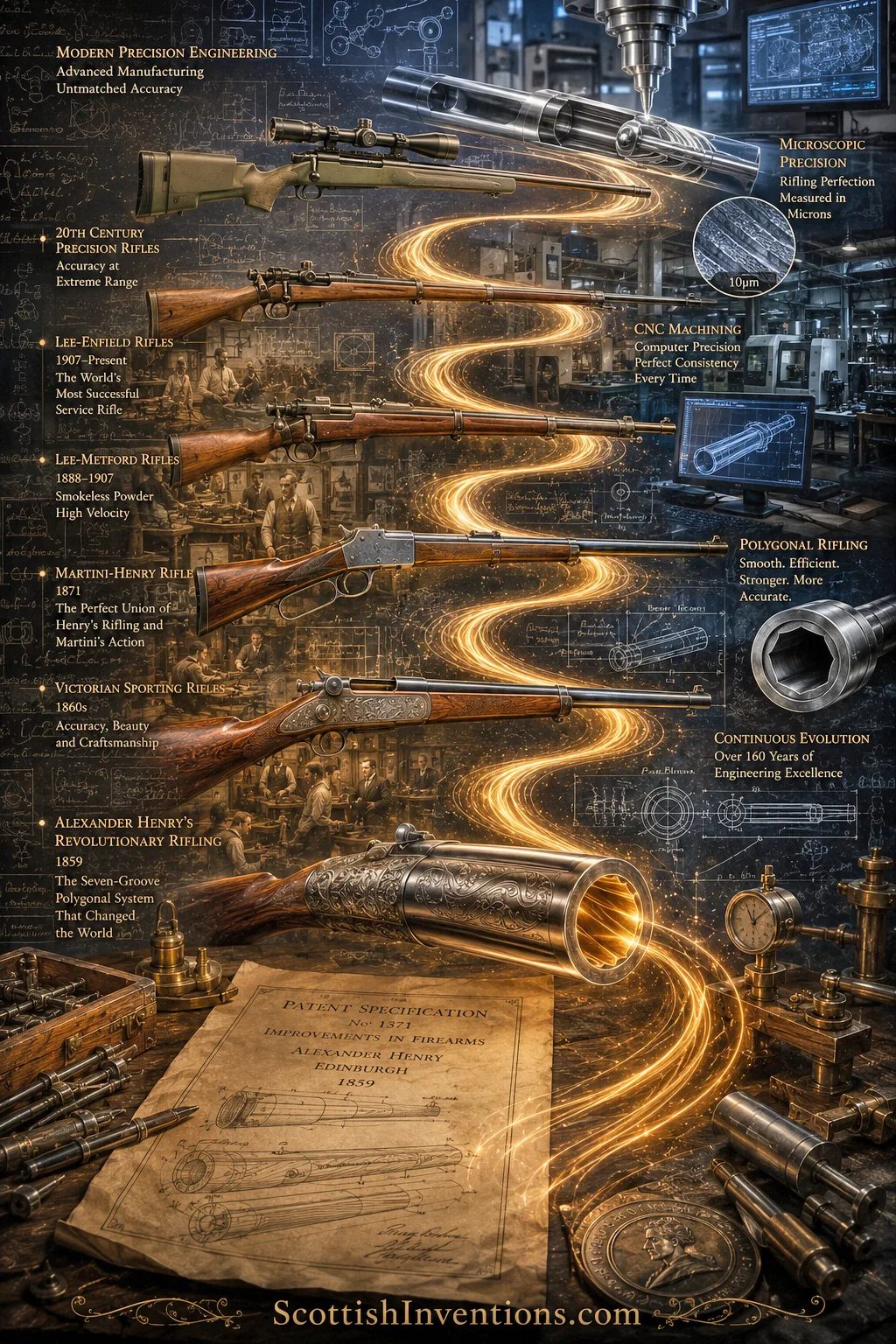
Evolution of Henry's Invention
- 1860 — Henry Rifling (British Patent No. 2802)
- ↓
- 1871 — Martini-Henry Rifle
- ↓
- 1888 — Lee-Metford
- ↓
- 1895 — Lee-Enfield
- ↓
- 1960s–1980s — Modern Polygonal Rifling (H&K, Glock)
- ↓
- Today — Modern Precision Rifles
The honest history is that modern polygonal rifling was independently revived by H&K in the 1960s and popularised by Glock in the 1980s using cold-hammer-forging. There is no direct patent line from Henry's 1860 patent to a modern Glock — but they share the same underlying principle of smooth-profile rifling that reduces fouling and friction. As recently as 2010–2011, U.S. Marines recovered at least three Martini-Henrys from Taliban weapons caches in Marjah, and the U.S. Army's 101st Airborne Division found another near Orgun in Paktika Province — over 130 years after the rifle entered service.
Timeline
1818
Alexander Henry born
Born in 1818 (Wikipedia: 4 June 1818, Leith) — the port district of Edinburgh.
1830
Apprenticed at twelve
Apprenticed to the respected Edinburgh gunmaker Thomas Mortimer for a seven-year term.
1852
Own business at 12 South St Andrew Street
Henry acquires the business of Samuel Gourlay and sets up under his own name in Edinburgh, trading until his death.
1860
Henry rifling — British Patent No. 2802
On 15 November 1860 Henry patents his seven-groove polygonal rifling — the invention that would arm the British Empire.
1865
Falling-block action patent
Henry patents his own falling-block sporting-rifle action — widely copied and admired, though ultimately not adopted for the service rifle.
1866–1869
War Office trials
The Government trials to replace the Snider-Enfield. Henry's barrel is judged 'superior to all the other competitors.' He is awarded a £600 prize.
1871
Martini-Henry Mark I released
Full-scale production orders placed on 13 April 1871; the Mark I is released in June 1871 — Henry's rifling married to Friedrich von Martini's falling-block action.
1872
Gunmaker to the Prince of Wales
Henry is appointed 'gun and rifle manufacturer to His Royal Highness the Prince of Wales.'
1873
The John Brown rifle
Queen Victoria commissions Henry to make a double-barrelled .450 hammer rifle as a Christmas gift for John Brown — later sold at Bonhams (2011) for £35,000.
1874
Full issue to British Army
After empire-wide troop trials the Martini-Henry is authorised for full issue on 28 September 1874.
1879
Isandlwana and Rorke's Drift
22–23 January 1879: the Martini-Henry sees its most famous action. Eleven VCs are awarded at Rorke's Drift — the most for one regiment in a single engagement.
1882
Tel el-Kebir
British infantry armed with the Martini-Henry win the Battle of Tel el-Kebir in the Anglo-Egyptian War.
1888
Superseded by the Lee-Metford
The bolt-action Lee-Metford — with its own shallow seven-groove Metford rifling — begins to replace the Martini-Henry in front-line service.
1894
Death in Edinburgh
Alexander Henry dies at 10 Bellevue Crescent, Edinburgh on 27 January 1894. Buried in Warriston Cemetery.
Today
Living legacy
The smooth polygonal-bore principle Henry championed survives in modern Glock and Heckler & Koch pistols — and Martini-Henrys still turn up in 21st-century Afghan weapons caches.
Conclusion
From an Edinburgh workshop on South St Andrew Street, Alexander Henry solved one of the great engineering problems of the nineteenth century — how to fire an ordinary lead bullet with extraordinary accuracy, at unprecedented range, from a rifle simple enough to arm a whole empire. His seven-groove rifling armed the British Army for a generation, defended Rorke's Drift, and seeded the smooth-profile polygonal principle that shapes precision firearms to this day.
Discover hundreds more world-changing Scottish inventions at ScottishInventions.com.
Frequently Asked Questions
Who was Alexander Henry?
Alexander Henry (1818–1894) was one of Victorian Scotland's greatest gunmakers. Apprenticed at twelve to the Edinburgh gunmaker Thomas Mortimer, he opened his own business at 12 South St Andrew Street, Edinburgh in 1852 and rose to become gun and rifle manufacturer to His Royal Highness the Prince of Wales in 1872. He is best known for inventing the seven-groove 'Henry rifling' adopted for the Martini-Henry, the British Army's standard service rifle from 1871.
What is Henry rifling?
Henry rifling is a shallow seven-groove polygonal barrel system patented by Alexander Henry in British Patent No. 2802 on 15 November 1860. The barrel bore is heptagonal in cross-section with smooth, shallow rounded grooves that grip a standard soft-lead bullet without the sharp corners of conventional rifling — reducing friction, fouling and barrel wear while dramatically improving accuracy and gas seal.
Why was Henry rifling revolutionary?
Conventional Victorian rifling used sharp-edged grooves that dug into the bullet, fouled quickly with black-powder residue and wore rapidly. Whitworth's rival polygonal bore (1854) was more accurate but demanded a specially-shaped hexagonal bullet. Henry's genius was to combine the smooth, low-fouling polygonal profile with an ordinary cylindro-conical soft-lead bullet — giving Whitworth-class accuracy with standard ammunition, at ranges of up to 1,100 yards in trials.
Why is the rifle called the Martini-Henry?
The Martini-Henry is a marriage of two inventions: Alexander Henry's rifled barrel and the falling-block breech action refined by the Swiss engineer Friedrich von Martini (itself an improvement of Henry O. Peabody's 1862 American patent). In the War Office competition of 1866–1869 Henry's barrel and his own falling-block action were both judged superior — but the committee chose Martini's cheaper, hammerless self-cocking action to mate with Henry's rifling.
Did Alexander Henry invent the Martini action?
No. The falling-block action of the Martini-Henry was refined by Friedrich von Martini from Henry O. Peabody's earlier American design. Alexander Henry did design his own excellent falling-block action (patented 1865) — widely copied by sporting-rifle makers — but the War Office selected Martini's hammerless, self-cocking mechanism as easier to mass-produce. Only Henry's rifling was retained in the service rifle.
Who invented polygonal rifling?
Polygonal rifling was pioneered by Sir Joseph Whitworth (British Patent, 1854), whose twisted hexagonal bore fired a mechanically-fitted hexagonal bullet. Alexander Henry's 1860 patent applied the same smooth-profile principle to a seven-groove design that worked with ordinary bullets. Modern polygonal rifling — used in Glock, Heckler & Koch and other firearms — was independently revived by H&K in the 1960s and popularised by Glock in the 1980s. There is no direct patent line from Henry to Glock, but they share the same underlying principle.
Was the Martini-Henry used at Rorke's Drift?
Yes. On the night of 22–23 January 1879 a garrison of roughly 139 effective defenders from B Company, 2nd Battalion, 24th Regiment of Foot held Rorke's Drift against approximately 3,000–4,000 Zulu warriors, firing an estimated 20,000 Martini-Henry rounds. Eleven Victoria Crosses were awarded for the defence — seven to the 2nd/24th, still the most VCs ever received by one regiment for a single action.
Did soldiers really urinate on Martini-Henry barrels to cool them?
The overheating problem is real and well-documented — a War Office conference of September 1873 recorded that 'a barrel cannot be touched after 5 or 6 rounds on some occasions,' and at Rorke's Drift barrels grew hot enough to blister hands. But the popular story that defenders urinated on the barrels is a modern myth with no contemporary source. The documented field remedy was to bind damp rawhide or wet rags around the fore-end; a leather hand-guard was officially issued on 24 October 1885.
How accurate was the Martini-Henry?
In service form the Martini-Henry was sighted to 1,800 yards and delivered devastating volley fire at 200–400 yards against massed targets. Firing the .577/450 Boxer-Henry cartridge — a 480-grain lead bullet at roughly 1,350 feet per second — through a 33.22-inch seven-groove Henry-rifled barrel with one turn in 22 inches, it was, in Captain Edward Hutton's words after the Zulu War, 'the most perfect weapon in the world.'
Did Henry rifling influence modern firearms?
Directly and indirectly, yes. Its immediate successor, the Lee-Metford (1888), used William Ellis Metford's shallow seven-groove rounded rifling in the same low-fouling tradition Henry helped pioneer. The Lee-Enfield followed. And the broader mid-Victorian shift toward smooth, rounded rifling profiles that Henry and Whitworth championed is the conceptual ancestor of the polygonal rifling used today in Glock, HK, CZ and other modern precision firearms.