Scottish Inventions · Military & Engineering
Major Patrick Ferguson: The Aberdeenshire Genius Who Built the Rifle That Could Have Changed History
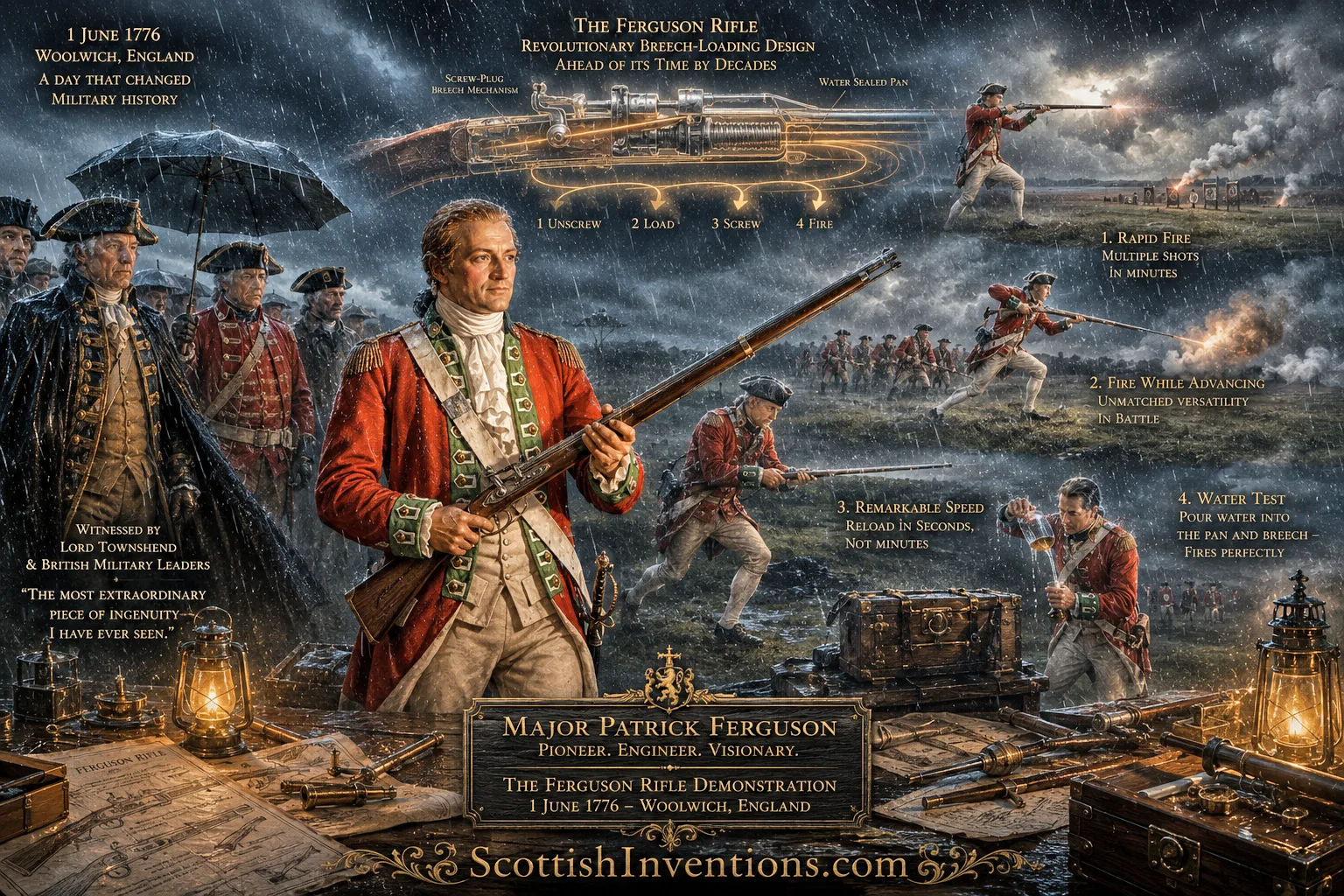
In the wet summer of 1776, a Scottish officer stood on a rain-lashed firing range at Woolwich and did four things with a gun that no soldier had ever done before — and quietly proved a principle that would underpin every modern military rifle.
On this page
- Introduction
- Key Facts
- From Pitfour to the Parade Ground
- The Problem He Set Out to Solve
- The Invention
- The Woolwich Demonstration, June 1776
- Combat in America & the Washington Legend
- Kings Mountain, 7 October 1780
- The Lost Opportunity
- Interactive Timeline
- Brown Bess vs Ferguson Rifle
- Engineering Explainer
- Legacy
- Modern Descendants
- Related Scottish Inventions
- FAQ
- Sources
In the wet summer of 1776, a Scottish officer stood on a rain-lashed firing range at Woolwich and did four things with a gun that no soldier had ever done before. He fired at a target 200 yards away, four times a minute. He fired six shots in a single minute. He fired four shots a minute while walking forward at four miles an hour. And then — to the astonishment of the assembled generals — he poured a bottle of water down the barrel and into the firing pan, soaking every grain of powder, and fired again within half a minute.
The man was Major Patrick Ferguson of Pitfour, Aberdeenshire, and the weapon was his own invention: the first practical, reliable, military breech-loading rifle in the history of warfare. It is one of the great "what-ifs" of military history. Had the British Army embraced Ferguson's rifle, the American Revolutionary War — and the shape of the modern world — might have turned out very differently. Instead, the rifle died with its inventor on a Carolina hilltop, and the principle he proved would not be taken up again by the British Army for nearly ninety years.
Ferguson's story sits alongside other Scottish "lost geniuses" of engineering — from William Symington's Charlotte Dundas to James Watt's Steam Engine, Nasmyth's Steam Hammer and the Carronade.
Key Facts
Born Pitfour, 1744
Patrick Ferguson was born on 4 June 1744 in Aberdeenshire, son of Lord Pitfour, a Senator of the College of Justice.
Patent No. 1139
Filed December 1776, granted March 1777 — 'Improvements in Breech-loading Fire-arms.'
Fired in heavy rain
The water-sealed screw-plug breech kept his powder dry when every other military firearm in the world failed.
200–300 yard accuracy
Three to six times the effective range of the Brown Bess musket, with six or seven aimed shots a minute.
Multi-start thread
One turn of the trigger-guard handle dropped the screw plug and scraped away powder fouling — the engineering masterstroke.
Killed at Kings Mountain
Shot from his horse on 7 October 1780, aged 36. The rifle programme died with him.
From Pitfour to the Parade Ground
Patrick Ferguson was born on 4 June 1744 at Pitfour, the family estate in Aberdeenshire. He was the second son and fourth child of James Ferguson of Pitfour, an advocate raised to the bench as a Senator of the College of Justice — Lord Pitfour from 1764 — and his wife Anne Murray, a daughter of the 4th Lord Elibank and sister of the literary patron Patrick Murray, 5th Lord Elibank. The Fergusons moved in distinguished company; the family knew leading figures of the Scottish Enlightenment, including David Hume.
Destined from boyhood for a military career, Patrick was sent to a military academy in London and trained at the Royal Military Academy, Woolwich. On 12 July 1759, aged just fifteen, he was commissioned as a cornet in the Royal North British Dragoons — the Scots Greys — and saw active service during the Seven Years' War in Germany and Flanders. Ill health (probably tuberculosis of the knee) repeatedly dogged him. In 1768 he purchased a captaincy in the 70th Regiment of Foot and served in the West Indies. Returning home in 1772, he threw himself into the new discipline of light-infantry training, coming to the notice of General William Howe — and it was during this period that he began work on the rifle that would bear his name.
By every account Ferguson was brave, charismatic, intellectually curious and an extraordinary marksman — reputed to be the finest shot in the British Army.
The Problem He Set Out to Solve
To understand why Ferguson's rifle mattered, you have to understand what every British infantryman carried: the "Brown Bess", the Land Pattern musket — a .75-calibre, muzzle-loading, smooth-bore flintlock standard since the 1720s. It was rugged and reliable, but crippled by limitations. A trained soldier could manage perhaps two or three shots a minute, and that rate fell as the barrel fouled. It was wildly inaccurate — effective only to around 50–100 yards against a man-sized target — which is why armies fired in massed volleys rather than aiming. Loading required the soldier to stand upright and exposed, going through a long sequence of motions with a ramrod. And the exposed priming pan was hopeless in the rain.
Muzzle-loading rifles existed and were far more accurate, but they were even slower — the ball had to be hammered down the rifled barrel. The dream was a rifle that combined accuracy with speed. Earlier inventors had tried breech-loading designs, loading from the back rather than ramming down the muzzle, but these had failed in field conditions: they leaked gas, fouled with burnt powder and jammed.
Ferguson never claimed to have invented the breech-loader. His genius was to make one that actually worked as a weapon of war.
The Invention
Ferguson based his design on the screw-plug breech of the French Protestant engineer Isaac de la Chaumette, whose system dated to the early 1700s and had been patented in England in 1721. He commissioned the renowned Anglo-Swiss gunmaker Durs Egg to build improved versions. The result was elegant.
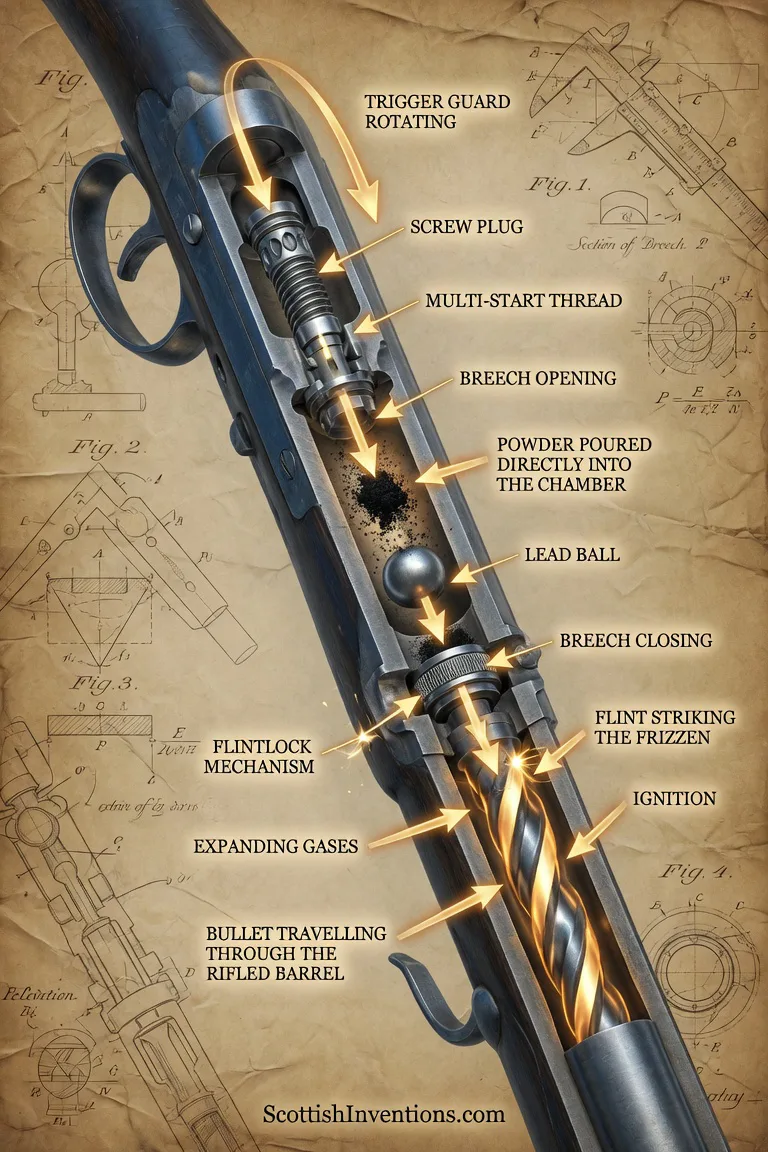
A vertical screw-plug passed up through the breech of the barrel, attached to the trigger guard, which doubled as a handle. One full turn of the trigger guard dropped the plug, opening a hole in the top of the breech. The rifleman dropped a ball into the chamber, poured in the powder, and turned the guard back — the rising plug sealed the breech and sheared off any excess powder, leaving the weapon primed for its conventional flintlock to fire it.
Ferguson's improvements were the difference between a curiosity and a weapon. Where Chaumette's plug needed several turns, Ferguson used a multi-start thread — typically 10 or 11 threads — so a single rotation opened or closed the breech. He cut channels and grooves into the plug so that the screwing motion itself scraped away and dispersed the powder fouling that had defeated earlier designs. Because the breech was sealed by the plug, the powder stayed dry — hence the famous rain demonstration. And because the rifleman loaded from the breech, he could do so lying down, kneeling, or on the move, without ever exposing himself or fumbling with a ramrod.
Patent Highlight
British Patent No. 1139 — "Improvements in Breech-loading Fire-arms." Filed December 1776; granted March 1777. Held today in the records of the Royal Armouries.
The Board of Ordnance rifles were chambered for the standard British carbine ball of approximately .615 calibre, with a rifled barrel. The Ferguson weighed about 7.5 lbs against the musket's 10.5 lbs, and its 34-inch barrel was some five inches shorter than the Brown Bess's. In Ferguson's hands the rifle was accurate to perhaps 200–300 yards — against the Brown Bess's effective 50–100 — and capable of six or seven aimed shots a minute. Ferguson summed it up to Lord Townshend: his rifle "fires with twice the expedition, & five times the certainty, is five pounds lighter and only a fourth part of the powder of a common firelock."
The Woolwich Demonstration, June 1776
On the morning of Saturday 1 June 1776, Ferguson demonstrated his rifle at Woolwich before a glittering audience: Lord Townshend (Master General of the Ordnance), Lord Amherst (Lieutenant-General of the Ordnance), Adjutant-General Edward Harvey, and General Desaguliers of the Royal Artillery, among others. The weather was atrocious — heavy rain and high wind. The official account, published in the Annual Register, records that "under the disadvantages of a heavy rain and a high wind," Ferguson "performed the following four things, none of which had ever before been accomplished with any kind of small arms":
- He fired at a target 200 yards away at four shots a minute for four or five minutes;
- He fired six shots in a single minute;
- He fired four shots a minute while advancing at four miles an hour;
- He poured a bottle of water into the pan and barrel so as to wet every grain of powder, and within half a minute fired again "as well as ever" without extracting the ball.
He also hit the target lying on his back, and across the whole demonstration missed only three times. He patented the design later that year and, on 1 October 1776, gave a further demonstration before King George III and Queen Charlotte at Windsor. As a result, Lord Townshend directed that 100 rifles be manufactured — by four British gun firms, Durs Egg the most notable — and Ferguson was authorised to raise an experimental rifle corps of around 100 men.
Combat in America & the Washington Legend
Ferguson and his corps sailed for America, joining Howe's campaign to take Philadelphia. Their major action came at the Battle of Brandywine on 11 September 1777. It was here that the most famous story attached to Ferguson took place — and it deserves careful handling, because the legend and the documented facts diverge.
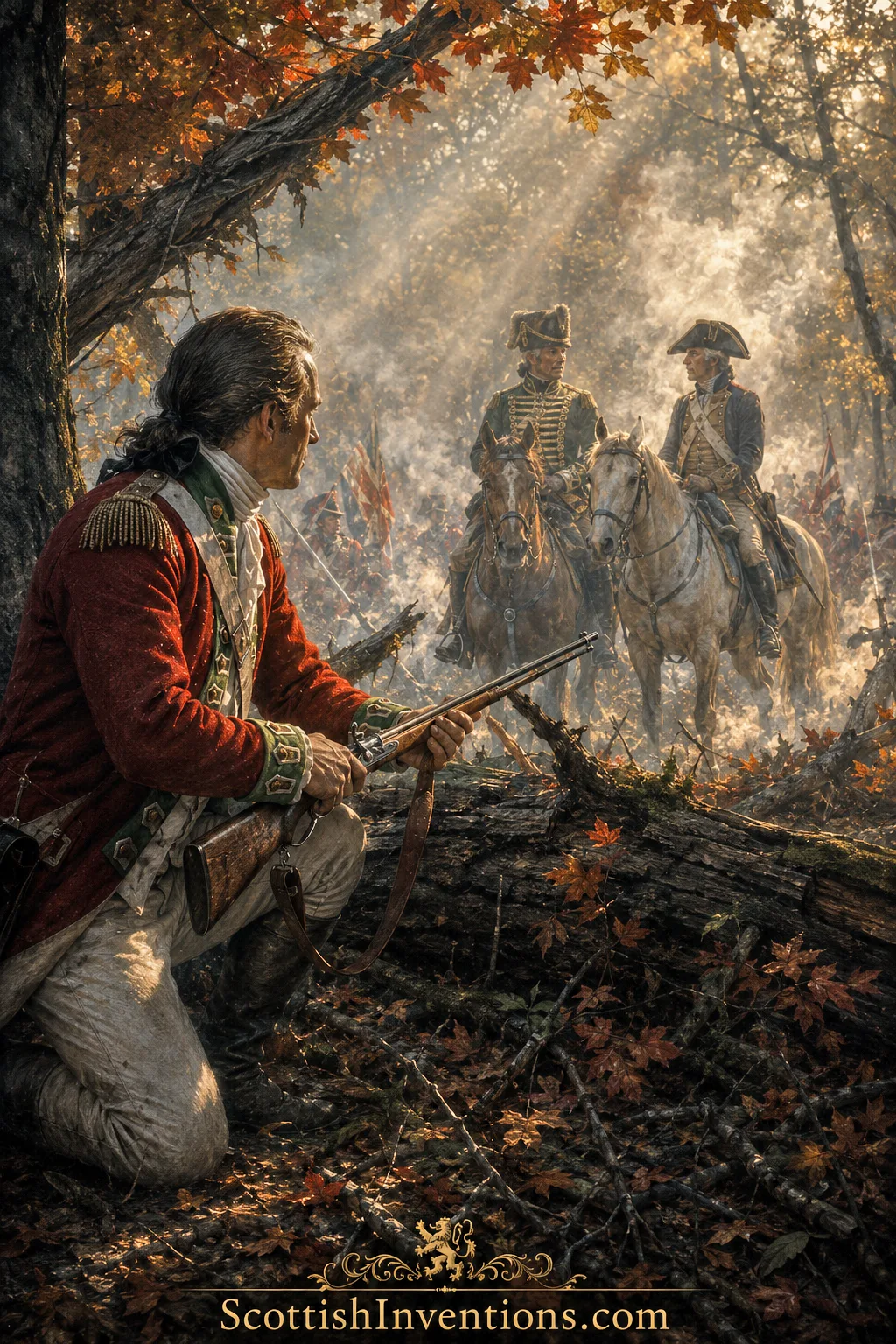
By Ferguson's own account, a few days before the battle he was concealed near the American lines when two mounted rebel officers came within about 100 yards — one in a distinctive hussar dress, the other a tall, well-mounted man in a large cocked hat. Ferguson, the finest shot in the army, could easily have killed them. He ordered three of his riflemen forward to fire, then thought better of so ungentlemanly an act, called out to the officer instead, and let the men ride away rather than shoot a man in the back. In a letter written during his convalescence to his kinsman, the philosopher Adam Ferguson, he recorded:
The next day, a surgeon dressing wounded American officers reported that General Washington had been with the light troops that morning, attended only by a French officer in hussar dress. Was it really Washington? The honest answer is that we cannot be certain. Washington was indeed out reconnoitring that day (confirmed by a 7 September 1777 letter from his aide Robert Harrison to John Hancock), but the identification is traditional and probable rather than proven — some historians suggest the hussar may have been Count Casimir Pulaski. The story should be told for what it is: a documented act of chivalry by Ferguson, with a famous but unprovable identification of his target.
Moments after sparing the horsemen — or during the battle proper — Ferguson was shot through the right elbow, an injury that shattered the joint and permanently crippled his right arm. He endured months of surgery, narrowly avoided amputation, and with characteristic determination taught himself to write, fence and shoot with his left hand. While he was recovering, his patron Howe — reportedly irritated that the corps had been formed without his being consulted — took advantage of Ferguson's absence to break up the experimental rifle corps. The men were returned to their parent units and the rifles put into store. The single most promising weapons programme of the war was quietly shelved.
Kings Mountain, 7 October 1780
Ferguson recovered and was promoted to major in the 71st Regiment of Foot in 1779. When the war shifted to the southern colonies, he was made Inspector of Militia and tasked with raising and organising Loyalist militia in the Carolina backcountry to guard the flank of Lord Cornwallis's army.
It was a brutal civil war of neighbour against neighbour. After Ferguson threatened to "lay waste their country with fire and sword," the frontier "Overmountain Men" — hardy Patriot riflemen from beyond the Appalachians — mustered against him. Ferguson took up a defensive position on a rocky, wooded ridge called Kings Mountain, just inside South Carolina; his command numbered around 1,075 troops drawn from several Loyalist militia regiments and a core of red-coated Provincials. He was the only regular British soldier in his entire command. Confident his position was impregnable, he barely fortified it.
On the afternoon of 7 October 1780, the Patriots struck. As Encyclopædia Britannica records, William Campbell "selected 900 of the best of the militia contingents then assembling at Cowpens, 35 miles distant... There he divided his force into eight smaller groups, each under the command of its own colonel, to surround and attack the ridge." They swarmed up the slopes, using the trees for cover and their accurate long rifles to deadly effect. The fight lasted about sixty-five minutes. Ferguson, directing his men with a silver whistle and refusing to surrender, finally tried to cut his way out on horseback and was "shot dead off his horse by at least eight musket balls as he tried to break out." He was 36 years old. His men surrendered moments later; the Loyalists lost around 290 killed, 163 wounded and 668 captured, against American losses of roughly 28 killed and 60 wounded. Cornwallis, learning of the disaster, abandoned his invasion of North Carolina — a turning point historians count among the first links in the chain leading to the British surrender at Yorktown.
With Ferguson dead, there was no one left to champion the rifle. The breech-loading experiment was over.
The Lost Opportunity
Could the Ferguson Rifle have changed the war? Many writers think so — one popular history flatly calls it "the rifle that could have won the American Revolution for the British." That is almost certainly an overstatement: only about 100 military rifles were ever made, the corps was tiny, and a single experimental unit could never have decided a continental war. But the deeper point stands. Ferguson had proved that a breech-loading rifle could be a practical battlefield weapon — faster, deadlier, longer-ranged and all-weather — at a time when everyone else was still ramming balls down smooth-bore muskets.
So why was it abandoned? The reasons were prosaic. Each Ferguson rifle cost about £4 — roughly double a Brown Bess — and the decentralised network of British gunsmiths could not produce the precision screw-breeches quickly or cheaply; four firms struggled to make 100 in months. The rifles were also fragile: the stocks tended to crack around the breech and lock, and every surviving military example shows an iron repair where the wood failed. There was institutional conservatism, too — adopting the rifle wholesale would have meant rethinking tactics in the middle of a war. And there was the human factor: the wounding of Ferguson at Brandywine and his death at Kings Mountain removed the one passionate, well-connected advocate the project had.
Interactive Timeline
- ●
4 June 1744
Patrick Ferguson born
Born at Pitfour, Aberdeenshire, second son of advocate James Ferguson (later Lord Pitfour) and Anne Murray.
- ●
12 July 1759
Commissioned in the Scots Greys
Aged just fifteen, gazetted cornet in the Royal North British Dragoons; serves in Germany and Flanders during the Seven Years' War.
- ●
1768
Captain, 70th Regiment of Foot
Purchases a captaincy and serves in the West Indies before returning home in 1772.
- ●
1776
Patents the breech-loading rifle
British Patent No. 1139 — based on Chaumette's screw plug but transformed by Ferguson's multi-start thread and self-clearing breech.
- ●
1 June 1776
Woolwich demonstration
In heavy rain and high wind, Ferguson achieves four feats 'never before accomplished with any kind of small arms' before Lord Townshend and senior British officers.
- ●
1 October 1776
Demonstration before George III
Ferguson fires the rifle before the King and Queen at Windsor; Lord Townshend authorises 100 rifles and an experimental rifle corps.
- ●
11 September 1777
Brandywine — and chivalry
Days before the battle, Ferguson refuses to shoot a senior mounted American officer in the back. Hours later he is shot through the right elbow.
- ●
Late 1777
Rifle corps disbanded
While Ferguson convalesces, General Howe quietly breaks up his experimental corps. The rifles are put into store.
- ●
7 October 1780
Killed at Kings Mountain
Surrounded by Patriot riflemen on a Carolina ridge, Ferguson is shot dead off his horse, aged 36. The breech-loading programme dies with him.
- ●
1866
Snider-Enfield adopted
Britain finally adopts a breech-loading service rifle — 86 years after Ferguson's death.
- ●
1871
Martini-Henry
Britain's first purpose-built single-shot breech-loader enters service.
- ●
1888
Lee-Metford
The first bolt-action repeating rifle in British service.
- ●
1895
Lee-Enfield
The rifle that would arm British and Commonwealth forces through two World Wars.
- ●
Today
Universal breech-loading
Every military rifle on earth — assault rifle, sniper rifle, service weapon — loads from the breech, exactly as Ferguson's did in 1776.
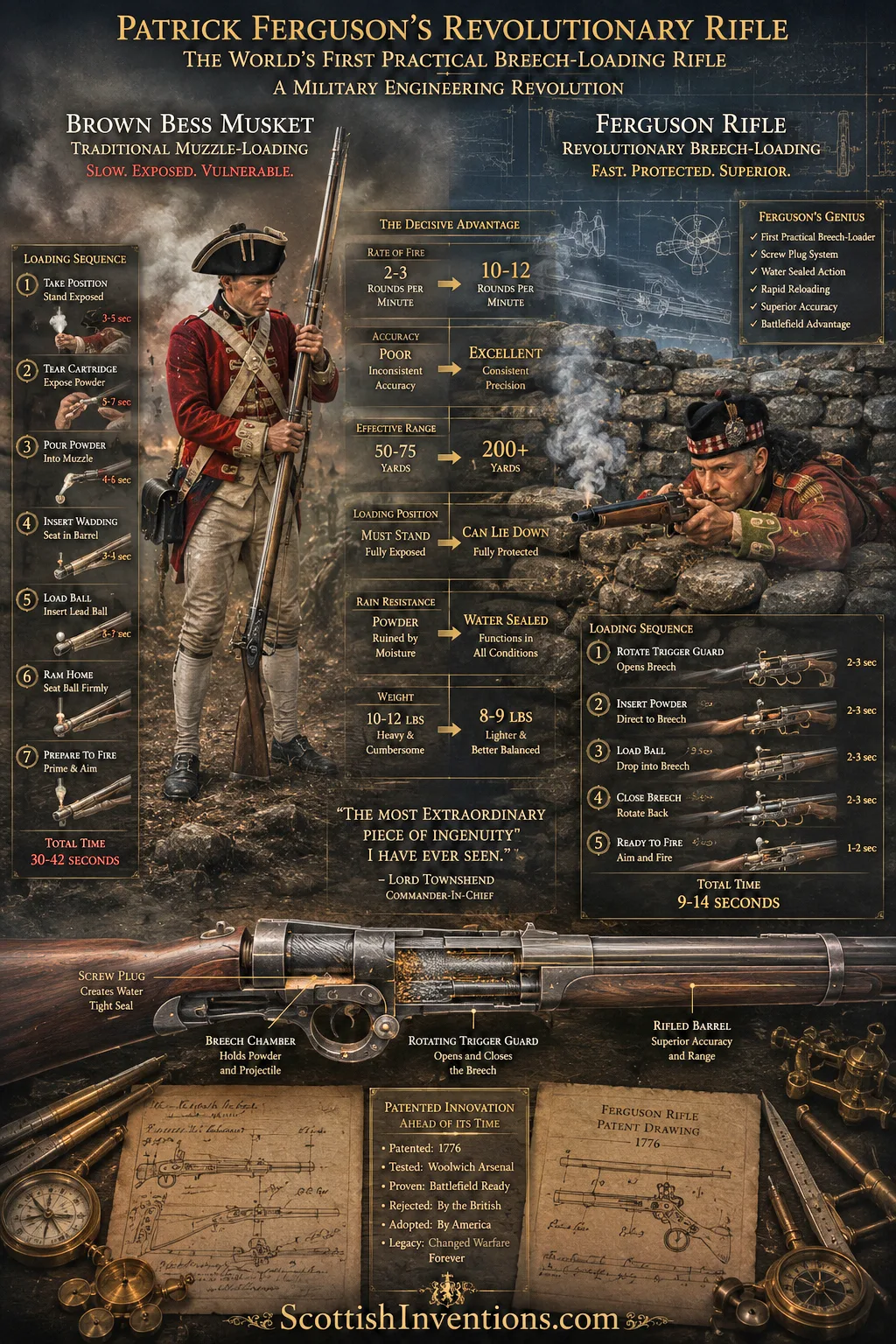
Brown Bess vs Ferguson Rifle
"The most extraordinary piece of ingenuity I have ever seen." — Lord Townshend, Master General of the Ordnance
🪖 Brown Bess Musket
Slow. Exposed. Vulnerable.
- Muzzle-loading, smoothbore .75-calibre flintlock.
- 2–3 rounds per minute.
- 50–100 yard effective range.
- Vulnerable to rain — wet powder = no shot.
- Must stand fully exposed to reload.
- 10–12 lbs, heavy and cumbersome.
🎯 Ferguson Rifle
Fast. Protected. Superior.
- Breech-loading, rifled barrel, ~.615 calibre.
- 6–7 aimed rounds per minute (10–12 in trials).
- 200–300 yard effective range.
- Water-sealed action — fires in heavy rain.
- Can reload lying down or on the move.
- ~7.5 lbs, lighter and better balanced.
Engineering Explainer: How the Ferguson Rifle Worked
The Ferguson Rifle's genius lay in nine interlocking pieces of precision engineering — a remarkable achievement for 1770s manufacturing and a testament to the precision engineering tradition emerging from the early Industrial Revolution.
1 · Rotating Trigger Guard
Doubled as the breech handle. A single full rotation opened the action — no detached parts to drop or lose.
2 · Screw Plug
A vertical plug passed through the breech, lowering when rotated to expose the chamber from above.
3 · Multi-Start Thread
Ferguson's masterstroke: 10 or 11 simultaneous threads meant one turn did the work of several, dramatically faster than Chaumette's original.
4 · Breech Chamber
Loading happened from above the rear of the barrel — no ramrod, no muzzle, no exposure required.
5 · Powder Loading
Powder poured directly into the chamber after the ball, eliminating the patch-and-ramrod fumble of muzzle-loaders.
6 · Lead Ball Insertion
A standard .615-calibre carbine ball dropped straight into the breech — no hammering it down the rifling.
7 · Breech Sealing
Rotating the trigger guard back drove the plug upward, sealing the chamber and shearing off any excess powder.
8 · Flintlock Ignition
A conventional flint and frizzen ignited the priming charge — but here the pan was protected by the sealed breech behind it.
9 · Rifled Barrel
Spiral grooves spun the ball for stable, accurate flight to 200–300 yards — three to six times the Brown Bess.
Why it stayed weatherproof
The closed screw plug formed a water-tight seal behind the powder, isolating the charge from rain striking the barrel. The self-clearing grooves on the plug also dispersed the burnt residue that had defeated every previous breech-loader. Ferguson's system — not any single part — was the invention.
Legacy: Ferguson Was Right
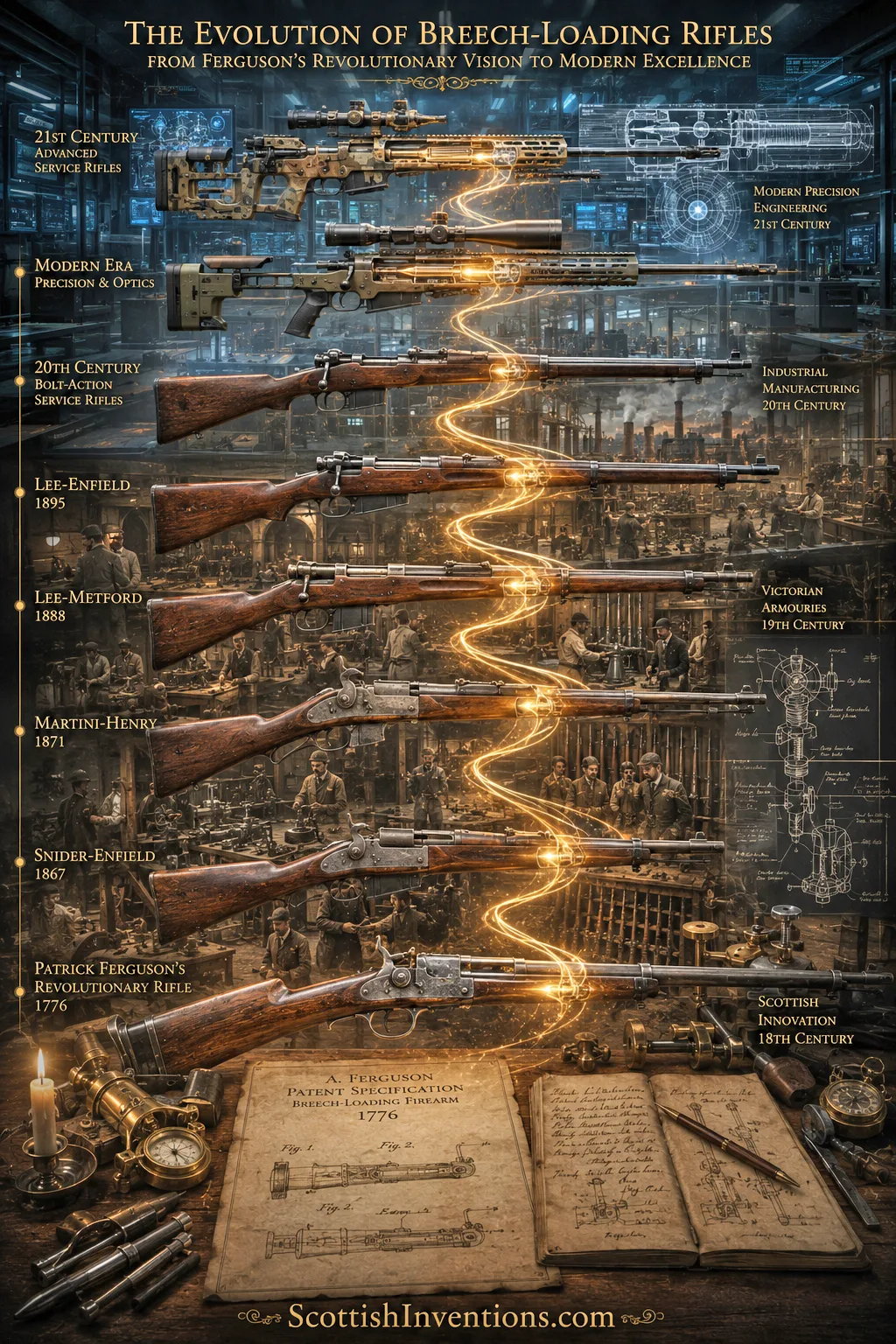
History vindicated Patrick Ferguson completely. The principle he proved — that breech-loading is practical, reliable and superior in military conditions — eventually became the foundation of all modern firearms. But the world was painfully slow to catch up. It was the Prussian inventor Johann Nikolaus von Dreyse, with his bolt-action "needle gun" of 1836 (adopted by Prussia in 1841), who next made a breech-loader a standard infantry weapon. Britain — the very nation that had owned Ferguson's patent — did not return to a breech-loader until it adopted the Snider–Enfield conversion in 1866, followed by the Martini–Henry in 1871, the Lee–Metford in 1888 and the legendary Lee–Enfield from 1895.
Today every military rifle on earth — every assault rifle, every sniper rifle, every service weapon — loads at the breech, exactly as Ferguson's did in 1776. He was, quite literally, a century ahead of his time.
Genuine Ferguson rifles are now among the rarest and most coveted of all firearms; only around a dozen military-pattern examples are thought to survive worldwide, divided between collections such as the Smithsonian, Morristown National Historical Park, the Milwaukee Public Museum, the National Army Museum and the Royal Armouries. The Royal Armouries in Leeds holds a particularly fine Durs Egg-made example, inscribed "Fergus" and "D Egg 15 London" and bearing the crescent-moon crest of the Fergusons of Pitfour — bequeathed to his brother James in the will Ferguson made at Portsmouth on 15 March 1777.
Modern Descendants
While mechanisms evolved dramatically over two centuries, the core principle of loading from the breech became universal — every weapon below is, in engineering terms, a descendant of the Ferguson.
Snider-Enfield (1866)
Britain's first breech-loader, an Enfield muzzle-loader converted by Jacob Snider — 86 years after Ferguson died.
Martini-Henry (1871)
The first purpose-built British single-shot breech-loader; falling-block action of devastating power.
Lee-Metford (1888)
Britain's first bolt-action repeating rifle — magazine-fed and smokeless-powder ready.
Lee-Enfield (1895)
The legendary rifle of two World Wars; .303-inch service rifle from 1895 until the 1950s.
Bolt-Action Rifles
Mauser, Mosin–Nagant, Springfield — the worldwide standard from the 1890s to mid-20th-century.
Modern Sniper Rifles
Precision-engineered breech actions remain the heart of every long-range military rifle today.
Service Rifles
The SA80, M16, AK-platform and L85A3 — all breech-loaders, all gas-operated, all built on Ferguson's principle.
Civilian Rifles
From hunting rifles to target rifles, the breech-loading principle Ferguson proved underpins almost every modern firearm.
Frequently Asked Questions
- Who invented the Ferguson Rifle?
- Major Patrick Ferguson of Pitfour, Aberdeenshire (1744–1780), a Scottish soldier and inventor. He secured British Patent No. 1139 in 1776 for 'improvements in breech-loading fire-arms' and built the first breech-loading rifle that was genuinely practical and reliable as a military weapon.
- Was Patrick Ferguson Scottish?
- Yes. He was born on 4 June 1744 at Pitfour in Aberdeenshire, the son of James Ferguson — a Senator of the College of Justice known as Lord Pitfour — and Anne Murray, daughter of the 4th Lord Elibank. The family moved in the circle of the Scottish Enlightenment and was known to David Hume.
- Why was the Ferguson Rifle revolutionary?
- It could fire six or seven aimed shots a minute (against the Brown Bess's two or three), was accurate to 200–300 yards (against 50–100 for the musket), could be loaded lying down or on the move, and — uniquely — kept firing in heavy rain because its sealed screw-plug breech kept the powder dry.
- Was the Ferguson Rifle the first breech-loading firearm?
- No, and Ferguson never claimed it was. Earlier breech-loaders existed, including Isaac de la Chaumette's screw-plug design of the early 1700s. Ferguson's achievement was to turn the principle into a genuinely practical military weapon — robust, reliable and fast — by adding a multi-start thread that opened the breech in one turn and self-cleared its own powder fouling.
- Could the Ferguson Rifle really fire in the rain?
- Yes. At the famous Woolwich trial on 1 June 1776, in front of senior British officers, Ferguson deliberately poured a bottle of water into the pan and barrel, soaking every grain of powder, then fired the rifle 'as well as ever' within half a minute. The water-sealed screw-plug breech made this possible.
- Did Patrick Ferguson spare George Washington?
- Ferguson certainly spared a senior mounted American officer at Brandywine on or just before 11 September 1777, refusing to shoot a man in the back. He described the incident in a letter to his kinsman Adam Ferguson. The identification of that officer as George Washington is traditional and probable — Washington was out reconnoitring that day — but it has never been definitively proven, and some historians suggest the hussar may have been Count Casimir Pulaski.
- Why wasn't the Ferguson Rifle widely adopted?
- A combination of factors: cost (about £4 per rifle, roughly double the Brown Bess), the difficulty of producing precision screw-breeches in 1770s Britain, fragile stocks that tended to crack around the lock, institutional conservatism, and — decisively — the wounding of Ferguson at Brandywine in 1777 and his death at Kings Mountain in 1780, which removed the project's one passionate advocate.
- What happened at the Battle of Kings Mountain?
- On 7 October 1780, Patriot 'Overmountain Men' surrounded Major Ferguson's Loyalist force on a wooded ridge in South Carolina and attacked uphill using their long rifles. The hour-long battle ended with Ferguson shot dead off his horse — reportedly hit by at least eight balls — and his command destroyed: roughly 290 killed, 163 wounded and 668 captured. Historians count Kings Mountain among the first turning points leading to British defeat at Yorktown.
- How did the Ferguson Rifle influence modern firearms?
- Every military rifle in service today loads at the breech, exactly as Ferguson's did in 1776. Britain itself did not return to a breech-loader until the Snider-Enfield conversion of 1866, followed by the Martini-Henry (1871), Lee-Metford (1888) and Lee-Enfield (1895). Ferguson proved the principle — the world simply took almost a century to follow him.
- Where can surviving Ferguson rifles be seen today?
- Only around a dozen military-pattern Ferguson rifles are thought to survive. Examples are held by the Royal Armouries in Leeds (a Durs Egg-made rifle from the Ferguson family), the National Army Museum in London, the Smithsonian, Morristown National Historical Park and the Milwaukee Public Museum.
Sources
- Marianne McLeod Gilchrist, Patrick Ferguson: 'A Man of Some Genius' (National Museums of Scotland Publishing).
- British Patent No. 1139 (1776) — "Improvements in Breech-loading Fire-arms."
- Annual Register (1776) — official account of the Woolwich demonstration of 1 June 1776.
- Patrick Ferguson, letter to Adam Ferguson (1777) — primary source for the Brandywine incident.
- Royal Armouries, Leeds — collection notes on the Durs Egg Ferguson rifle (Keith Neal Collection, 2000).
- National Army Museum, London — Ferguson rifle holdings and associated material.
- Encyclopædia Britannica — entries on Patrick Ferguson and the Battle of Kings Mountain.
- Lyman C. Draper, King's Mountain and Its Heroes (1881) — standard Patriot account of the battle.
- De Witt Bailey, British Military Flintlock Rifles 1740–1840 (Andrew Mowbray, 2002).
Newsletter
Discover Scotland's hidden inventors
One short, beautifully illustrated story a fortnight. No spam, ever.
Sign up free