Scottish Inventions · Engineering & Power
The Percussion Cap: How a Scottish Minister Ended the Age of the Flintlock
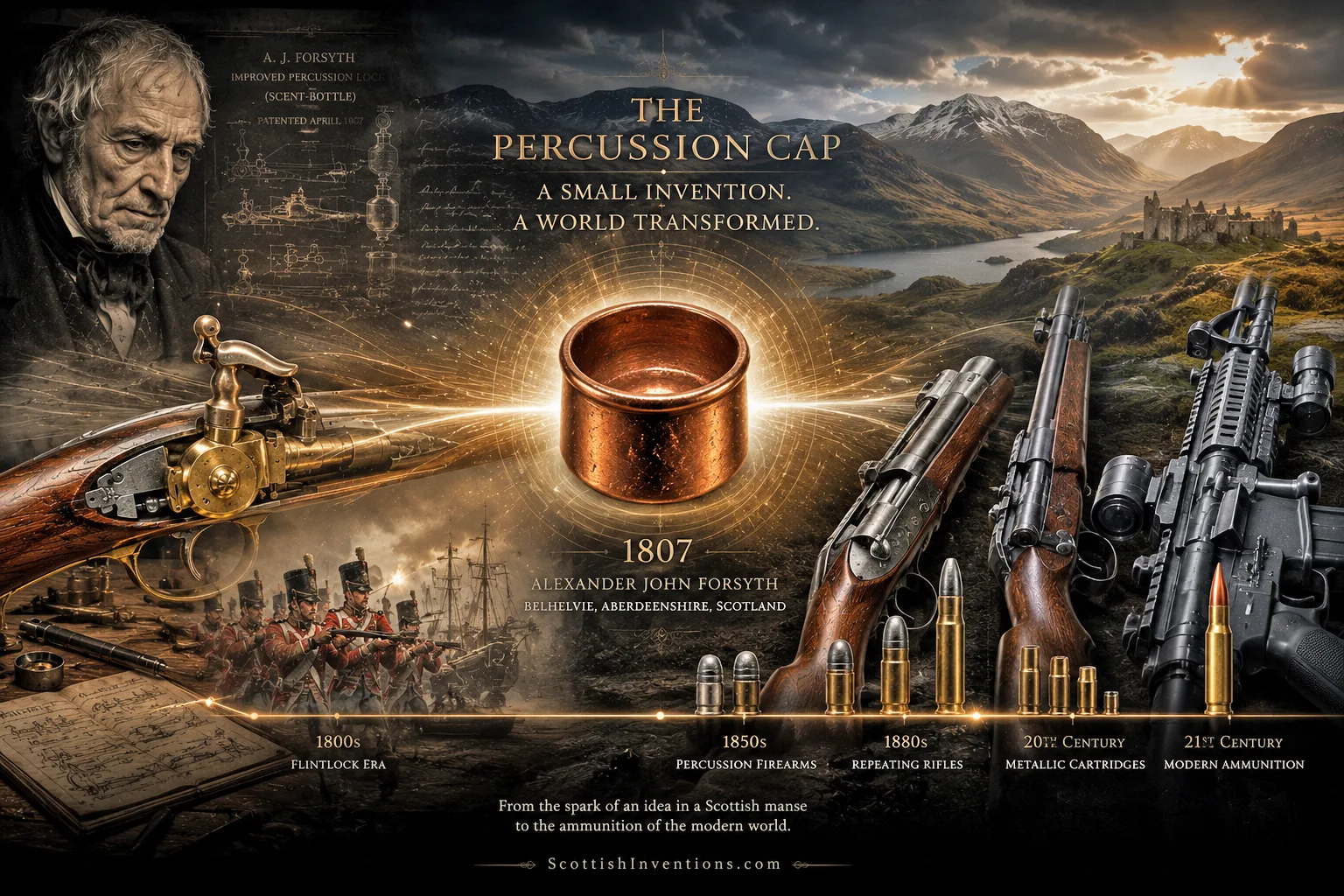
In 1807, a quiet Aberdeenshire parish minister patented a small chemical primer that would obsolete two centuries of flintlock firearms, transform Victorian warfare and lay the foundation for every modern cartridge primer used today.
Introduction
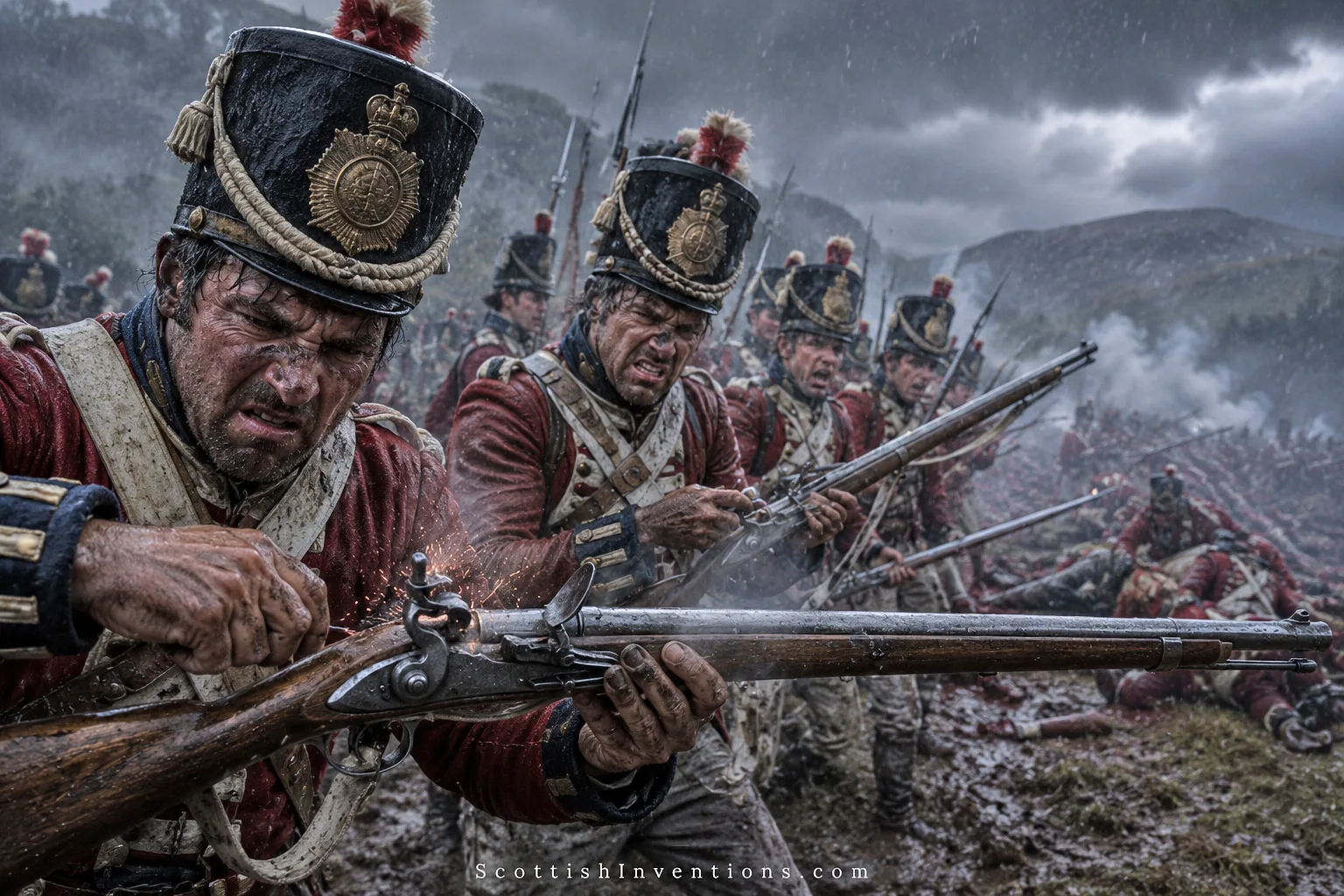
In the early 19th century, the flintlock had ruled warfare and hunting for more than two hundred years. It was also fundamentally flawed — a sudden shower could turn a regiment's muskets into clubs.
Then, in 1807, a quiet Presbyterian minister from Aberdeenshire changed everything. The Reverend Alexander John Forsyth invented the percussion ignition system, replacing the unreliable spark of flint and steel with a small charge of fulminating compound that exploded instantly when struck. It was the single most important advance in firearm ignition since the flintlock itself — and it laid the groundwork for every modern cartridge primer that followed, alongside other transformative Scottish breakthroughs like the hot blast process and Watt's improved steam engine.
Key Takeaways
- Rev. Alexander John Forsyth patented percussion ignition in April 1807.
- His "scent-bottle" lock used a fulminating compound detonated by a hammer blow — chemical ignition rather than flint sparks.
- It made firearms weatherproof, faster to fire and far more reliable, especially in rain.
- Forsyth did not design the final copper cap; that was refined by Joseph Egg in Britain and Joshua Shaw (US patent 1822) — but every percussion system descends from Forsyth's 1807 patent.
- By the 1840s the British Army had adopted percussion muskets; by the American Civil War percussion firearms dominated the battlefield.
- Forsyth's patent is the direct ancestor of every modern cartridge primer in use today.
Key Facts
Patented 1807
British patent granted to a parish minister in April 1807.
Belhelvie, Aberdeenshire
Invented in a Scottish manse, not an arsenal.
Fulminate ignition
Replaced 200 years of flint and steel with chemical detonation.
Weatherproof
Fired reliably in rain, damp and humidity.
Tower of London
Briefly given workshop space by the Master General of the Ordnance.
Foundation of modern primers
Every metallic cartridge primer descends from Forsyth's patent.
The Problem with Flintlocks
By the early 1800s, the flintlock musket and pistol had reached a high level of refinement. The mechanism was relatively simple and could be mass-produced. But it had serious limitations that soldiers and sportsmen had learned to live with for generations.
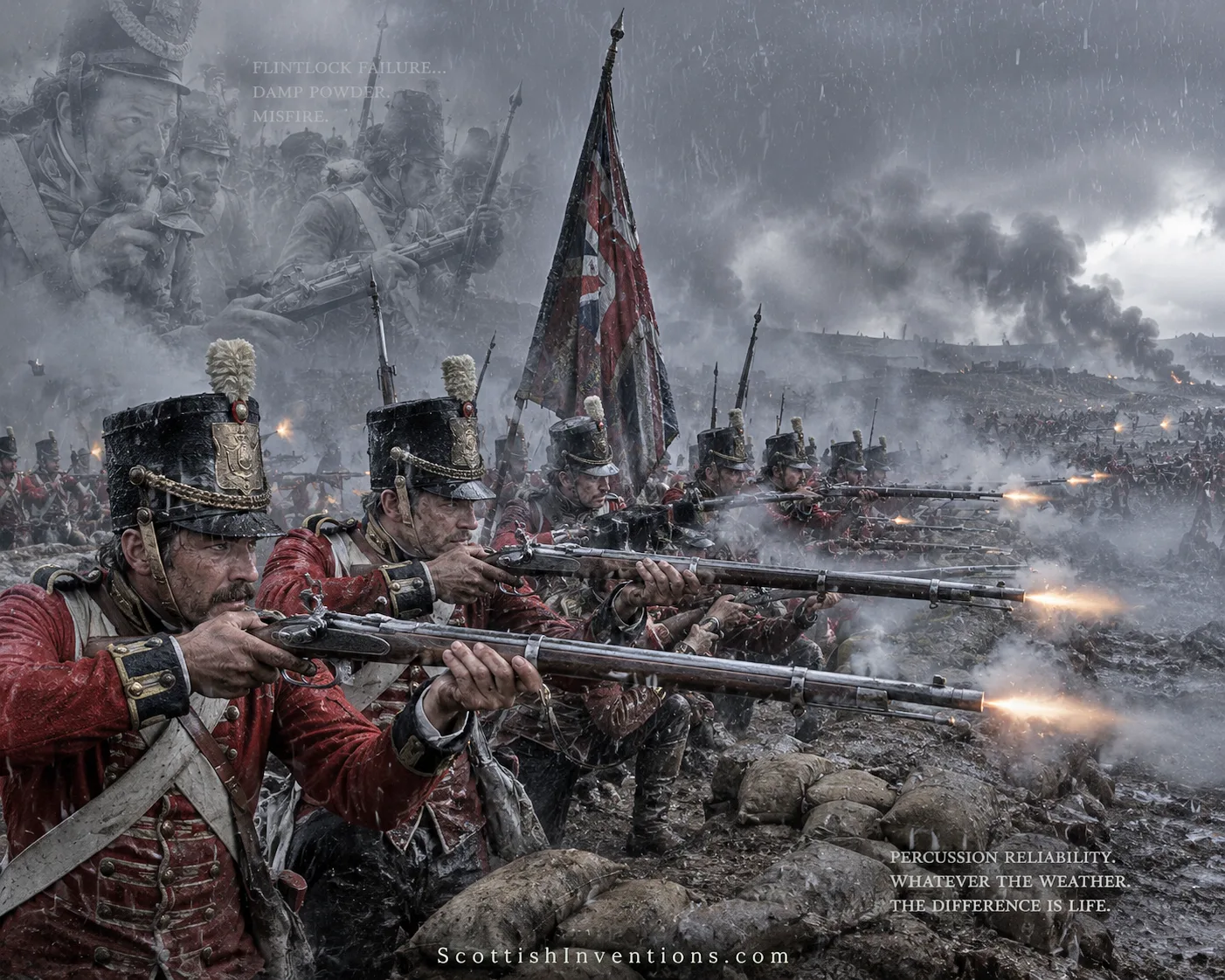
The flintlock relied on a piece of flint striking a steel frizzen to create sparks. These sparks had to ignite a small pan of priming powder, which then flashed through a touch-hole to set off the main charge. In dry conditions it worked reasonably well. In rain, mist or high humidity, the priming powder could become damp and fail to ignite. Even in good weather the system was slow and inconsistent.
For hunters, the bright flash and loud report from the priming pan often startled game before the bullet arrived. For soldiers on campaign, a wet day could turn an entire regiment's muskets into clubs. Military leaders had long dreamed of a more reliable ignition system, and chemists had identified fulminating compounds that exploded when struck — but turning those compounds into a safe, practical firearm mechanism proved extremely difficult.
The Minister Who Took Up the Challenge
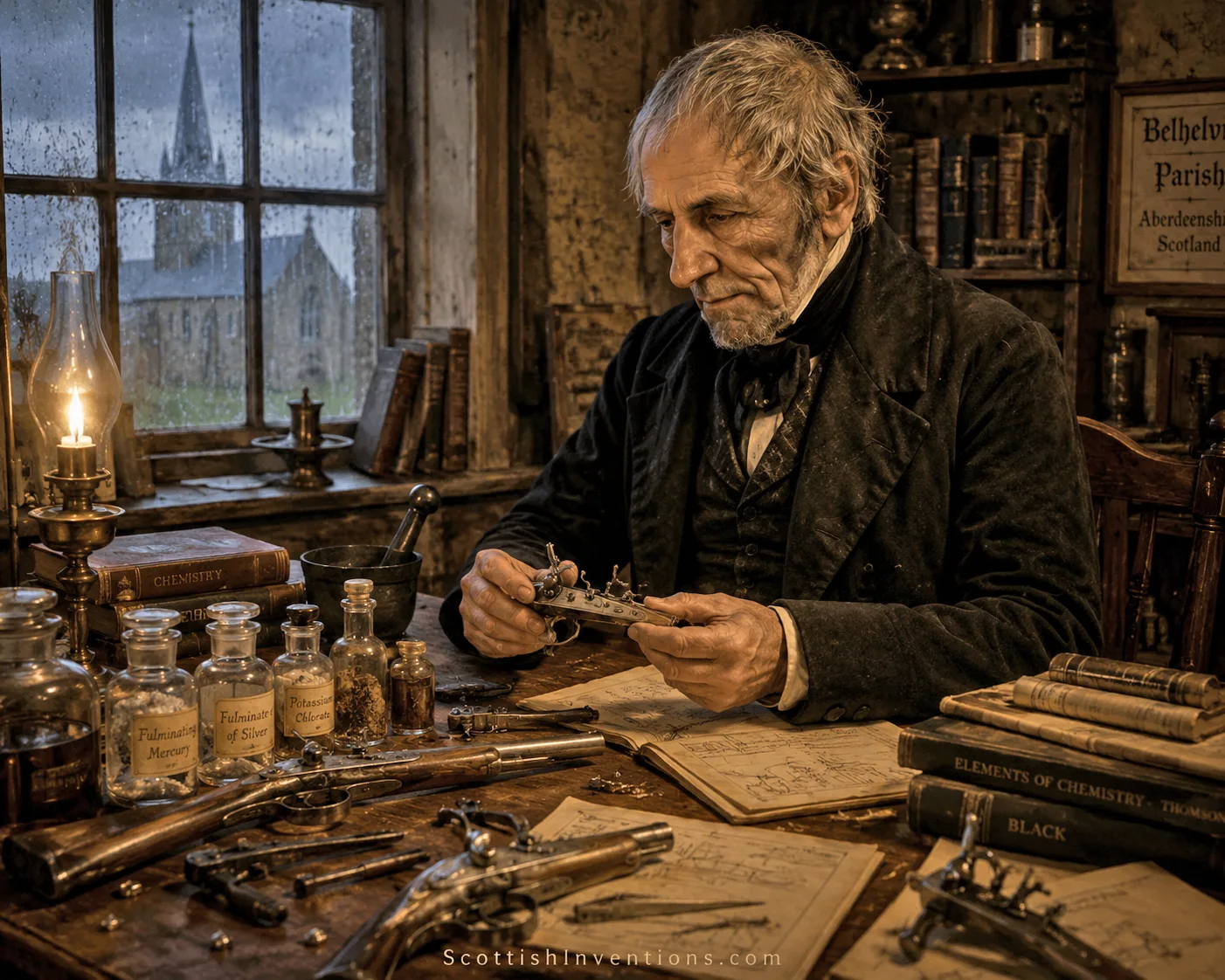
Alexander John Forsyth was born in 1768 (some sources say 1769) in Belhelvie, a coastal parish in Aberdeenshire, Scotland. He followed his father into the ministry and was ordained as minister of Belhelvie in 1791. By all accounts he was a conscientious and well-respected clergyman.
Like many educated men of his time, Forsyth had wide interests. He read scientific reports and became fascinated by the new fulminating powders being developed by chemists. He began experimenting in his spare time, not to create a weapon of war, but because he was intrigued by the scientific challenge — a Scottish tradition of curiosity-driven invention that also gave the world the Maxwell equations and the surgical chainsaw.
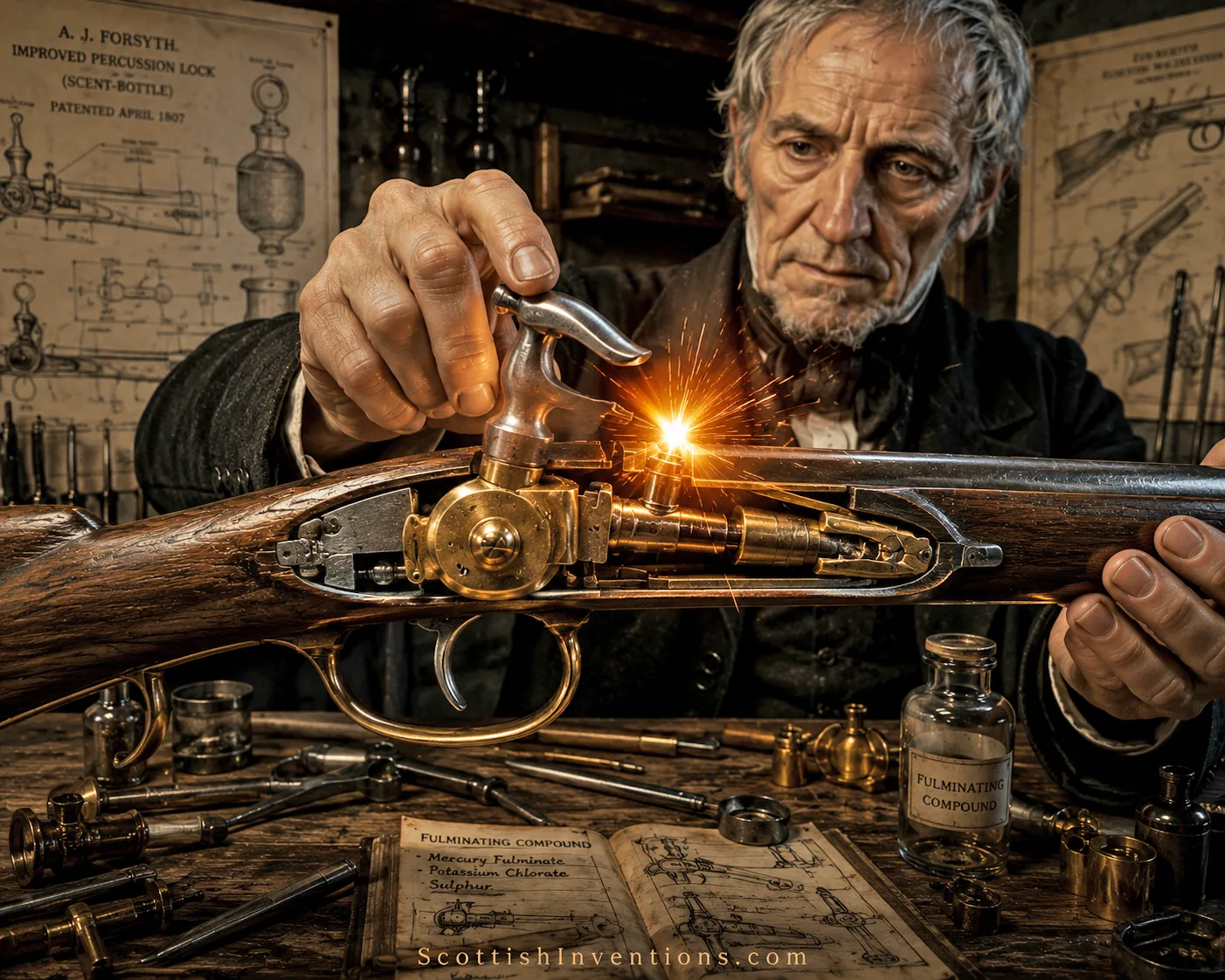
Around 1800, Forsyth began serious work on using fulminates as a priming agent for firearms. He realised that if a small amount of fulminating compound could be detonated by a hammer blow, it would provide a far more reliable and weatherproof source of ignition than flint and steel. By 1805 he had a working prototype: a small rotating steel container — nicknamed the "scent-bottle" lock — that held a supply of fulminating powder. When the hammer fell, it struck a pin that detonated a tiny charge of the compound, sending flame into the main charge.
The 1807 Patent
In April 1807, Forsyth was granted a patent for his percussion lock. The patent was carefully worded to protect the broad principle of using fulminates for ignition. He had effectively claimed the foundational idea that would underpin all future percussion systems.
The British government showed interest. The Master General of the Ordnance, Lord Moira, was impressed enough to give Forsyth workshop space in the Tower of London to develop the system further for military use. For a time it looked as though the percussion lock might quickly replace the flintlock in British service.
When a new Master General took over, however, support was withdrawn. The military establishment was conservative, and there was strong resistance to adopting an entirely new ignition system while Britain was still at war with France. Forsyth returned to Scotland and began manufacturing sporting guns using his system through a company he established in London.
"Before Forsyth, firearms ignition had relied on sparks for over 200 years. After Forsyth, ignition was achieved by a controlled chemical explosion on demand."
How the Percussion Lock Worked
A small chemical detonation, exactly on demand
- Fulminating compound — typically fulminate of mercury, sometimes mixed with potassium chlorate and sulphur — was held in the rotating scent-bottle container or, in later refinements, packed into a small copper cap.
- The hammer was cocked, then released by the trigger.
- As the hammer fell, it struck a pin (in the scent-bottle lock) or the cap itself (in later systems), crushing the fulminate against an anvil.
- The shock detonated the fulminate, sending a jet of flame down a hollow nipple screwed into the breech.
- The flame ignited the main powder charge inside the barrel — instantly, regardless of the weather.
The whole sequence happened in milliseconds, and unlike the flintlock there was no separate priming pan to ignite first. The result was faster lock time, dramatically fewer misfires and reliable ignition in rain, snow and humidity.
Did You Know?
- Forsyth's original 1807 device is preserved by the Royal Armouries, which holds one of the world's finest collections of percussion firearms.
- Napoleon's France reportedly offered Forsyth a substantial sum for his invention; as a Presbyterian minister loyal to Britain, he refused.
- The familiar copper percussion cap as we know it today was patented in the United States by Joshua Shaw in 1822 — but it was Forsyth's 1807 principle that made it possible.
- Forsyth's pension from the British government was only awarded in his final years; he died before receiving the full amount.
The Evolution of the Percussion Cap
Forsyth's original scent-bottle design was ingenious but relatively complex. Other gunmakers quickly saw the potential of his idea and began developing simpler, more practical versions of it.
The most successful development was the percussion cap proper — a small copper cup containing a tiny amount of fulminate. The cap was placed over a hollow nipple screwed into the breech; when the hammer struck the cap, the fulminate exploded and sent flame down the nipple into the main charge.
While Forsyth is rightly credited with inventing percussion ignition, the familiar copper cap as we know it today was refined by others — including Joseph Egg in Britain and Joshua Shaw in America, who patented a version in the United States in 1822. All these later developments built directly upon the fundamental breakthrough Forsyth had made in 1807.
By the 1820s and 1830s, percussion firearms were rapidly gaining popularity among sportsmen. The system was far more reliable than flintlocks, especially in wet weather, and it eliminated the tell-tale flash that had long betrayed the shooter's position to game.
Military Adoption and Impact
The British military was slow to adopt the percussion system officially. It was not until the 1840s that percussion muskets — beginning with the Brown Bess percussion conversion and culminating in the Pattern 1853 Enfield — became standard issue. Other nations moved faster. By the time of the Crimean War and the American Civil War, percussion firearms were dominant on the battlefield.
The advantages were decisive. Soldiers could fire reliably in rain. The rate of fire increased because there was no need to prime the pan separately. Misfires became far less common. The percussion cap helped make the rifled musket a truly effective weapon and contributed to the bloody nature of mid-19th-century warfare — a tactical shift comparable in significance to Patrick Ferguson's breech-loading rifle.
Forsyth himself received only limited recognition during his lifetime. He spent years defending his patent against competitors and continued to manufacture high-quality sporting guns. The British government eventually awarded him a small pension in recognition of his invention, but he died in 1843 before receiving the full amount. He is buried in the churchyard at Belhelvie.
Why Forsyth Matters
Alexander John Forsyth's achievement is easy to underestimate today. In an age of electronic ignition and smart weapons, the percussion cap seems like ancient history. Yet in its time it represented a fundamental leap forward in reliability and effectiveness.
Before Forsyth, firearms ignition had relied on sparks for over 200 years. After Forsyth, ignition was achieved by a controlled chemical explosion on demand. Every subsequent development in firearms — from the metallic cartridge to the modern primer — stands on the foundation he laid.
He also demonstrated something important about Scottish invention. Forsyth was not a professional gunmaker or a government scientist. He was a rural minister who pursued an idea because it interested him — much like James Gregory, who invented the reflecting telescope a century earlier, or James Goodfellow, the Paisley engineer who quietly invented the PIN and ATM. Some of the most important technological advances have come from individuals working outside formal institutions, driven by curiosity and persistence.
Timeline
1768
Born at Belhelvie
Alexander John Forsyth is born in Belhelvie, Aberdeenshire, son of the parish minister.
1791
Ordained minister of Belhelvie
Forsyth succeeds his father as minister of the coastal Aberdeenshire parish.
c.1800
Begins fulminate experiments
Inspired by reports of new fulminating compounds, Forsyth starts experimenting with chemical ignition as a sporting shooter.
1805
Scent-bottle prototype
Develops a working rotating-container percussion lock — the 'scent-bottle' design.
April 1807
Percussion lock patented
British patent granted for the use of fulminating compounds in firearm ignition.
1807–1812
Tower of London workshop
Master General of the Ordnance Lord Moira gives Forsyth space in the Tower of London to develop the system for military use; support is later withdrawn.
1820s
Copper percussion cap emerges
Joseph Egg in Britain and Joshua Shaw in the United States (US patent 1822) refine the simple copper cap that becomes the worldwide standard.
1840s
British Army adopts percussion
The 'Brown Bess' is converted to percussion and the Pattern 1842 musket is issued; the Pattern 1853 Enfield follows.
1843
Death at Belhelvie
Forsyth dies in his Aberdeenshire parish. He is buried in the churchyard at Belhelvie.
1850s–60s
Crimean & American Civil War
Percussion firearms dominate mid-19th-century battlefields, transforming infantry tactics.
Related Scottish Inventions
- The Ferguson Rifle — Patrick Ferguson
- The Carbon Brush — George Forbes
- ATM & PIN — James Goodfellow
- Maxwell's Equations — James Clerk Maxwell
- The Steam Hammer — James Nasmyth
- The Reflecting Telescope — James Gregory
- The Chainsaw (Surgical) — Aitken & Jeffray
- The Hot Blast Process — James Beaumont Neilson
- Coal Gas Lighting — William Murdoch
- Universal Standard Time — Sir Sandford Fleming
Further Reading
- The Royal Armouries Collection — original Forsyth percussion locks and early percussion firearms.
- National Museums Scotland — Scottish firearms and the Forsyth story.
- Historic Environment Scotland — Belhelvie parish and 19th-century Aberdeenshire.
- The British Library — patents and contemporary firearms literature.
Frequently Asked Questions
Who invented the percussion cap?
Percussion ignition was invented by the Reverend Alexander John Forsyth, a Church of Scotland minister at Belhelvie in Aberdeenshire, who patented the principle in April 1807. The familiar copper percussion cap was a later refinement built directly on Forsyth's foundational patent.
When was percussion ignition patented?
Forsyth's percussion lock patent was granted in April 1807 in Britain. It protected the broad principle of using fulminating compounds for firearm ignition.
What problem did the percussion cap solve?
It solved the flintlock's biggest weakness: unreliable ignition. Flintlocks misfired in rain, damp or humid weather and produced a tell-tale flash that warned game and gave away soldiers' positions. Forsyth's chemical ignition was weatherproof, faster and dramatically more reliable.
How did the original flintlock work?
A flintlock used a piece of flint clamped in the hammer to strike a steel frizzen, producing sparks that ignited a pan of priming powder; the flash then travelled through a touch-hole to fire the main charge. The system had been standard for over 200 years before Forsyth replaced it.
What is a 'scent-bottle' lock?
Forsyth's first practical design used a small rotating steel container shaped like a perfume bottle to hold fulminating powder. When the hammer fell, it struck a pin that detonated a tiny charge of the compound, sending flame into the main powder. Gunmakers nicknamed it the scent-bottle lock.
Why was Alexander John Forsyth important?
Forsyth produced the first practical chemical ignition system for firearms — the single most important advance in firearm ignition between the flintlock and the self-contained metallic cartridge. Every modern primer descends from his 1807 patent.
Where was Alexander John Forsyth born?
Forsyth was born in 1768 (some sources say 1769) at Belhelvie, a coastal parish in Aberdeenshire, Scotland. He was ordained minister of Belhelvie in 1791 and lived most of his life there.
How did percussion ignition change warfare?
Percussion firearms could be fired reliably in rain, fired faster (no separate pan to prime), and misfired far less often. By the 1840s the British Army had adopted percussion muskets; by the Crimean and American Civil Wars percussion arms were standard, and the increase in reliability and rate of fire contributed to the bloody character of mid-19th-century warfare.
What came after the percussion cap?
The percussion cap led directly to the self-contained metallic cartridge, the rimfire and centrefire primer, and ultimately to every modern small-arms primer system used today. The principle — a small charge of impact-sensitive compound detonating the main propellant — has never been improved upon, only refined.
Did Forsyth become wealthy from his invention?
No. Forsyth received only limited recognition in his lifetime. He spent years defending his patent and continued making sporting guns. The British government awarded him a small pension late in life but he died in 1843 at Belhelvie before receiving the full amount.