Scottish Inventions · Communications
The Postage Stamp: Did Dundee's James Chalmers Really Invent It?
The honest, evidence-led story of James Chalmers, Sir Rowland Hill, the Penny Black, and the Dundee printer who helped shape the world's first adhesive postage stamp.
Introduction
On a winter morning in February 1838, a Dundee printer and bookseller named James Chalmers sealed a small package and sent it south to the General Post Office in London. Inside were neat sheets of gummed paper, printed in his own shop on Castle Street, bearing the word "POSTAGE" and a value in old pence — and, in a detail that would prove the most enduring of all, one of them carried a hand-stamped cancellation reading "DUNDEE 10th February, 1838".
That package belongs to one of the most romantic and most argued-over chapters in Scottish industrial history: the claim that Chalmers, not the English postal reformer Sir Rowland Hill, invented the world's first adhesive postage stamp. The romance is real. The full story is more interesting than the legend — and at ScottishInventions.com we tell it straight. Chalmers was a genuine pioneer of the adhesive postage stamp, but the documentary evidence does not support the strongest Scottish claim that he invented it alone, or before Hill. The honest verdict — and the one most modern scholarship endorses — is that the modern postage stamp was the product of many minds, and that Chalmers's place in that story is proud, prominent and well-earned.

On this page
- Key Takeaways
- Key Facts
- Who Was James Chalmers?
- Before the Penny Black
- Why Postal Reform Was Needed
- What Exactly Did Chalmers Propose?
- How Adhesive Stamps Worked
- The Penny Black
- Chalmers vs Rowland Hill
- Other Claimants & Precursors
- Myth vs Fact
- Timeline
- Did You Know?
- Lasting Legacy
- Related Scottish Inventions
- Further Reading
- FAQ
Key Takeaways
- James Chalmers (1782–1853), Dundee printer and bookseller, was a genuine pioneer of the adhesive postage stamp — but not its sole inventor.
- Sir Rowland Hill published the gummed adhesive stamp concept in February 1837; Chalmers's earliest hard-dated stamp proposal is February 1838 and explicitly refers to "Mr Hill's plan".
- Chalmers's strongest, best-evidenced contribution is the dated town postmark cancellation, an idea still used on every stamp in the world.
- The Penny Black, the world's first official adhesive stamp, went on sale on 1 May 1840 as part of Hill's Uniform Penny Post.
- The claimed 1834 Chalmers specimen rests on family recollections gathered after 1879; no contemporary document survives.
- The fairest verdict: the postage stamp was the product of many minds, and Chalmers earns a proud and prominent place in that story.
Key Facts
Arbroath 1782
Born 2 February 1782 in Arbroath; trained as a weaver before moving to Dundee in 1809.
10 Castle Street
Took over his brother's bookselling, stationery and printing business in the heart of Dundee.
Faster mails, 1822–25
Successfully campaigned to speed the London–Edinburgh/Dundee mail by roughly a day.
8 February 1838
Submitted his adhesive 'slip' proposal to the General Post Office — his earliest hard-dated stamp.
Dated cancellation
First to propose cancelling an adhesive stamp with a dated town postmark, still standard worldwide.
Penny Black, 1 May 1840
The world's first official adhesive stamp entered service as part of Hill's Uniform Penny Post.
Who Was James Chalmers?
James Chalmers was born in Arbroath on 2 February 1782 and trained as a weaver. In 1809, at the age of twenty-seven, he moved to Dundee to join his elder brother William's business — bookseller, bookbinder and stationer at 10 Castle Street — and took over and rebuilt it after William's death later that same year. Under his management it grew steadily; in 1830 he began publishing the Dundee Chronicle, and by 1840 the firm had expanded into a printing and ink manufactory.
Chalmers was a pillar of Dundee's civic life — a Town Councillor and treasurer, and Convener of the Nine Incorporated Trades. A committed reformer, he campaigned for burgh reform and for the repeal of the "taxes on knowledge" — duties on newspapers and advertisements that priced reading out of working-class reach. His most enduring civic achievement before the stamp was a successful campaign, from around 1822–25, to accelerate the mail-coach service between London and the north, saving roughly a day in each direction. It is the missing context for the stamp story: Chalmers was not a stamp hobbyist who stumbled into postal reform. He was already a serious, documented postal reformer for the better part of two decades before he ever printed a "slip".
Before the Penny Black
The Britain into which Chalmers's first "slip" arrived was a country in which sending a letter was a luxury, not a convenience. Postage was charged by distance and by the number of sheets, and was normally paid by the recipient — who could simply refuse delivery. A single letter from Dublin to London could cost over a shilling, more than a day's wage for many working people. To save money, correspondents would "cross-write" — turning the paper ninety degrees and writing across the previous lines — while Members of Parliament enjoyed a free "franking" privilege that produced its own thriving black market. The system was riddled with anomalies, expensive to run, and chronically abused.
Why Postal Reform Was Needed
Rowland Hill's insight, set out in his February 1837 pamphlet Post Office Reform: Its Importance and Practicability, was that the real cost of the post lay not in transport but in laborious handling and accounting. His solution was disarmingly simple: a low, uniform, prepaid rate based on weight, not distance. This became the Uniform Penny Post — 4d anywhere outside London from 5 December 1839, then a flat penny from 10 January 1840 — abolishing free franking and shifting payment to the sender. It was the kind of reform that quietly changes a civilisation: for the first time, ordinary people could afford to write to one another.

What Exactly Did Chalmers Propose?
This is the crux of the dispute, and precision matters. There are three documented stages to Chalmers's contribution — and one that is not documented at all.
The claimed 1834 specimen
The Chalmers family tradition holds that in August 1834 he set up type, printed and gummed sample adhesive stamps and showed them to Dundee merchants. This account rests entirely on later recollections gathered after 1879 by his son Patrick, plus statements from former employees. No contemporary 1834 document survives, and every book advancing the 1834 date does so without producing primary evidence. ScottishInventions.com flags this date wherever it appears: it is a family claim, not an established fact.
December 1837 — letter to Robert Wallace MP
Chalmers sent proposals on adhesive postage to Robert Wallace, MP for Greenock and chairman of the Commons committee on postage. This is the first reasonably well-evidenced moment in his stamp story.
8 February 1838 — the GPO proposal
On 8 February 1838 (received by the General Post Office on 17 February 1838), Chalmers submitted his essay and accompanying specimens for adhesive "slips" — the earliest independently dated Chalmers evidence. In it he wrote that the most simple and economical way to implement "Mr Hill's plan of a uniform rate of postage" would be:
"…by Slips… in the hope that Mr Hill's plan may soon be carried into operation I would suggest that sheets of Stamped Slips should be prepared… then be rubbed over on the back with a strong solution of gum."
The submission included 1d and 2d values. One bore the line cancellation "DUNDEE 10th February, 1838" — the first essay for an adhesive stamp showing a cancellation, and the seed of an idea now used on every stamp in the world. Crucially, Chalmers preferred the gummed slip precisely because — unlike a stamped envelope or cover — it could seal a letter without adding a separate sheet, and so avoid extra charges. History vindicated that preference: Hill's preferred Mulready stamped stationery flopped, while the adhesive label triumphed.
1839 Treasury competition
Chalmers also entered the 1839 Treasury competition for prepayment designs. The Postal Museum records "some 2,600 entries" in total, of which only around 49 included actual adhesive-stamp designs. Chalmers's essays were not among the four selected.

How Adhesive Stamps Worked
The brilliance of the adhesive stamp lies in the workflow it created, not in any single physical breakthrough — gummed paper was already common. What was new was using it as proof of prepayment for a postal service.
- 1. Buy the stamp. The sender bought a small, printed paper label of fixed value from a Post Office or licensed retailer.
- 2. Gum and affix. The reverse was coated in a "glutinous wash" — gum arabic or potato starch — which the sender moistened with a brush or tongue and stuck to the letter.
- 3. Hand in to the Post Office. The letter went into the system already paid for. There was no need for a clerk to weigh, calculate distance, and bill the recipient.
- 4. Cancel with a dated postmark. The receiving office struck the stamp with a dated town postmark — Chalmers's most enduring single contribution — so the label could not be re-used.
- 5. Deliver to the recipient. The letter arrived without further payment. Recipients no longer had to find shillings at the door to receive news from family abroad.
The Penny Black
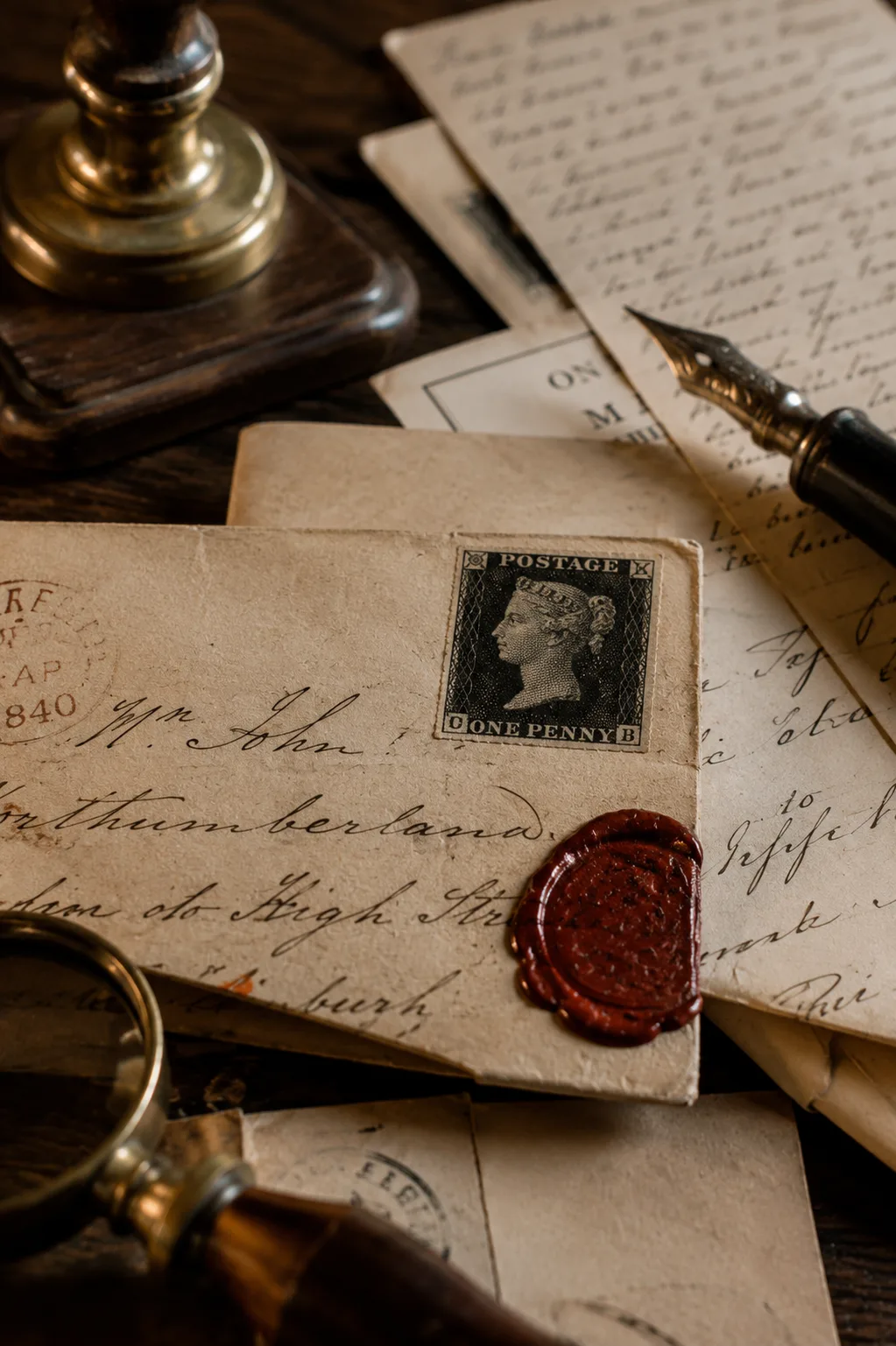
The Penny Black went on sale on 1 May 1840 and became valid for postage on 6 May 1840. It bore the profile of Queen Victoria, engraved from William Wyon's 1837 City medal, against a black background, with the word "POSTAGE" above and "ONE PENNY" below. According to British postal records, "the total print run was 286,700 sheets, containing a total of 68,808,000 stamps." The Smithsonian National Postal Museum records that "an additional two-penny blue stamp went on sale May 8, 1840, for letters over an ounce."
The Penny Black lasted only about a year. As Wikipedia notes, "a red cancellation was difficult to see on the black design… In February 1841 the Treasury switched to the Penny Red and began using black ink for cancellations instead." The reform itself, however, was already an immediate, runaway success: The Postal Museum records chargeable letters in Britain rising from about 76 million in 1839 to 168 million in 1840 alone, and to almost 350 million by 1850.
Chalmers vs Rowland Hill
The priority dispute is the part of the story that mattered most to the people who lived through it, and it deserves to be told fairly. Rowland Hill (1795–1879), a Kidderminster-born teacher and social reformer, took up postal reform around 1835. After being given a "half hundredweight" of documents by MP Robert Wallace, he wrote Post Office Reform, privately circulated to the Chancellor on 4 January 1837, and on 13 February 1837 gave evidence to the Commission of Post Office Enquiry. In that evidence he described the adhesive stamp as "a bit of paper just large enough to bear the stamp, and covered at the back with a glutinous wash". He was appointed to the Treasury to deliver the reform, oversaw the Penny Black's design and production, was dismissed in 1842 on a change of government, returned in 1846, and served as Secretary to the Post Office until 1864. He was knighted in 1860, received a £20,000 parliamentary grant, and is buried in Westminster Abbey.
The dispute ignited after Hill's death in August 1879, when letters in the Dundee press recalled Chalmers. His son Patrick Chalmers (1819–1891), newly retired from the China tea trade, devoted the rest of his life to the cause, producing some 25 books, pamphlets and letters arguing his father had been "fraudulently deprived" of credit. Pearson Hill, Rowland Hill's son, replied. The Dictionary of National Biography concluded that Chalmers laid claim to the adhesive label but "finally admitted that his claim to priority of publication was not tenable", while also stating, more ambiguously, that "Chalmers was the first inventor, but it does not appear how the plan was suggested to Rowland Hill." Granddaughter Leah Chalmers continued the campaign with her 1939 book How the Adhesive Postage Stamp Was Born. In 1979 the James Chalmers Society of Arbroath formed to lobby for a commemorative stamp; it never got one, but in 1982 Royal Mail issued a postal-history booklet for his bicentenary, acknowledging him as producing the first essays of the adhesive stamp.
The clearest modern weighing comes from philatelic writer Michael Peach in Gibbons Stamp Monthly (June 2013), who concluded Chalmers "may well have been the first to suggest the use of adhesive stamps (labels)… and was definitely the first to suggest their cancellation with a date stamp." The fairest summary, quoting Samuel Graveson's Penny Postage Centenary (1940): "in a democratic state no invention is the product of one mind only, but the fruit of many minds and years of trial and experience." Hill published the concept first; Chalmers produced early specimens and originated the dated cancellation; neither truly "invented" the stamp from nothing.

Other Claimants & Precursors
Chalmers and Hill are the loudest names in the dispute, but they are far from the only ones. The deeper history shows just how much groundwork lay behind the Penny Black.
- William Dockwra established the London Penny Post in 1680 — prepaid, flat-rate, and hand-stamped to show payment. Some historians describe its triangular handstamp as the first "postage stamp"; technically it is a prepaid postmark, not a gummed adhesive label.
- Lovrenc Košir (Austria-Hungary, 1835) proposed adhesive "pressed paper wafers" (gepresste Papieroblate). His claim was promoted in Austria and Yugoslavia but is now regarded as unproven; the Philatelic Association of Slovenia took the official position in 1979 that he was neither inventor nor pioneer, and some supporting documents were judged forgeries or misreadings.
- Adhesive labels had long been used for tax and revenue purposes — Samuel Graveson noted that "the collection of postage by means of a stamp was practised in Paris as early as 1653", and the British Stamp Office produced adhesive revenue labels from 1711.
- Further claimants noted in Wikipedia include Dr John Gray, Samuel Forrester, Charles Whiting, Samuel Roberts of Llanbrynmair, Francis Worrell Stevens, Ferdinand Egarter and Curry Gabriel Treffenberg of Sweden.
Myth vs Fact
Common claims about James Chalmers — and what the evidence actually says
Myth: Chalmers invented the postage stamp before Hill
Not supported by the documentary record. Hill published the gummed adhesive stamp concept in February 1837; the earliest hard-dated Chalmers evidence is February 1838, and its wording defers to "Mr Hill's plan".
Myth: He printed adhesive stamps in 1834
Possible, but unproven. The 1834 specimen story rests on family recollections collected after 1879, with no surviving contemporary document. Treat it as a family claim, not an established fact.
Fact: He proposed the dated cancellation
Best-evidenced of Chalmers's contributions. His 1838 essay includes a line cancellation reading "DUNDEE 10th February, 1838" — the first essay for an adhesive stamp showing a dated cancellation, and the seed of an idea still used worldwide.
Timeline
- 1782
Born in Arbroath
James Chalmers is born on 2 February 1782 in Arbroath, Angus, and trained as a weaver.
- 1809
Moves to Dundee
Joins his elder brother William's bookselling and stationery business at 10 Castle Street, Dundee, and rebuilds it after William's death the same year.
- 1822–25
Campaigns for faster mails
Leads a successful Dundee campaign to accelerate the London–Edinburgh/Dundee mail coach service, saving roughly a day in each direction.
- 1830
Publishes the Dundee Chronicle
Adds newspaper publishing to his press and stationery business; later expands into a printing and ink manufactory.
- 1834
Claimed specimen (disputed)
Family tradition holds that Chalmers printed and gummed sample adhesive stamps in August 1834 and showed them to Dundee merchants. No contemporary document survives; the claim rests on later recollections collected after 1879.
- Feb 1837
Hill publishes Post Office Reform
Rowland Hill privately circulates his pamphlet on 4 January 1837 and gives evidence to the Commission of Post Office Enquiry on 13 February 1837, proposing a uniform penny rate and a gummed adhesive stamp.
- Dec 1837
Chalmers writes to Robert Wallace MP
Sends proposals on adhesive stamps to Wallace, chairman of the Commons committee on postage.
- 8 Feb 1838
The 'Slip' proposal
Submits his essay/proposal for adhesive 'slips' to the General Post Office (received 17 February 1838) — the earliest independently dated Chalmers stamp. It refers to 'Mr Hill's plan' and includes 1d and 2d essays, one bearing a 'DUNDEE 10th February, 1838' line cancellation.
- 1839
Treasury competition
Chalmers enters the Treasury competition for prepayment designs. The Postal Museum records about 2,600 total entries, of which only ~49 included adhesive stamps. His essays are not among the four selected.
- 10 Jan 1840
Uniform Penny Post
A flat one-penny rate replaces the older charge-by-distance system across the United Kingdom.
- 1 May 1840
The Penny Black on sale
The world's first official adhesive postage stamp goes on sale, valid for postage from 6 May 1840.
- Jan 1846
Civic honour in Dundee
Dundee citizens present Chalmers with a silver claret jug, salver and 50 sovereigns in recognition of his postal reform work.
- 1853
Death in Dundee
Dies in Dundee on 26 August 1853 and is buried in the historic Howff cemetery.
- 1888
Howff gravestone
His son Patrick erects a gravestone proclaiming him 'Originator of the adhesive postage stamp'.
Did You Know?
- Chalmers's grave in Dundee's Howff cemetery — granted to the town by Mary, Queen of Scots in the sixteenth century — bears the bold epitaph: "Originator of the adhesive postal stamp, which saved the penny postage scheme of 1840 from collapse… and which has been adopted throughout the postal systems of the world."
- One of his Castle Street business neighbours was the Keiller family, of Dundee marmalade fame.
- The University of Dundee named a hall of residence Chalmers Hall in his honour in 1965, in a building beside his old shop.
- Because Britain issued the world's first stamp, British stamps still don't carry the country's name — just the monarch's head.
- The 1874 Treaty of Berne created the General (later Universal) Postal Union, standardising international mail and turning Hill's penny post into a global system.
- Other countries followed fast: the Swiss canton of Zurich (1843), Brazil's "Bull's Eyes" (1843), and the United States (1847).
Lasting Legacy: A Pioneer, Not a Lone Inventor
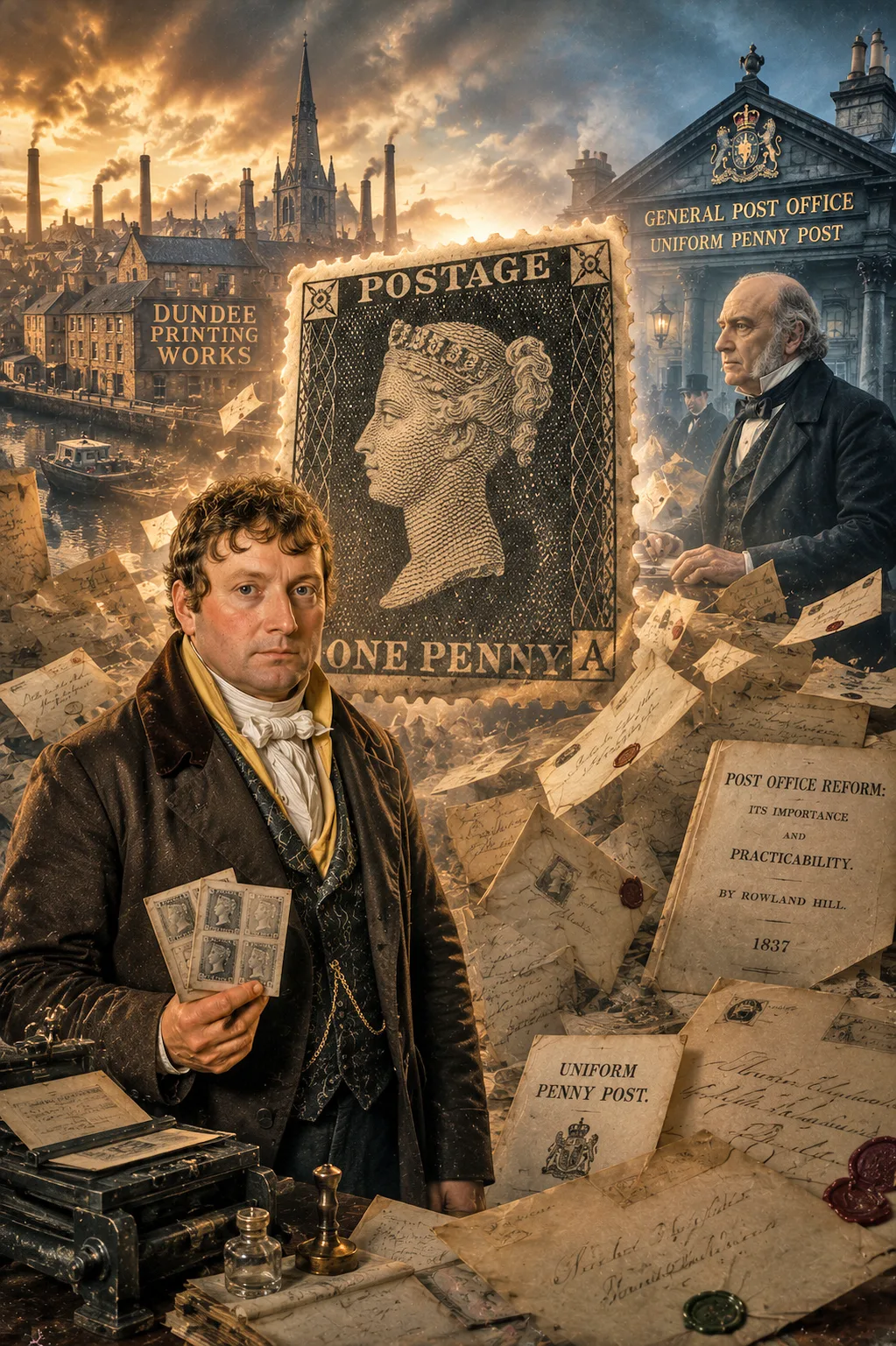
The adhesive postage stamp is one of the quiet revolutions of the nineteenth century. It made distance cheap. It made literacy worth more. It connected emigrants to families they would never see again, soldiers to sweethearts, businesses to markets and movements to members. By 1850 Britain alone was sending almost five times the mail it had sent a decade earlier, and the model had been copied across the world. Chalmers was a real pioneer of that revolution — not the lone genius of the family legend, but a Dundee printer whose practical "slip", whose preference for gummed labels over Hill's preferred envelopes, and whose insight that every stamp should be killed with a dated town postmark, helped shape the adhesive postage stamp as we still know it.
Hill gets Westminster Abbey, the statues, the knighthood. Chalmers gets Dundee's Howff, a hall of residence, a Royal Mail bicentenary booklet — and the quieter, truer credit of having seen, more clearly than Hill in one important respect, what a postage stamp needed to be. That is more than enough for a proud place in the story of Scottish invention, alongside contemporaries such as the work of James Clerk Maxwell and other Victorian Scots who quietly built the modern world.
Further Reading
- The Postal Museum — primary collection on Rowland Hill, the Uniform Penny Post and the Penny Black, including the 1839 Treasury competition records.
- Royal Mail Group Heritage — official postal-history resources, including the 1982 Chalmers bicentenary booklet.
- Smithsonian National Postal Museum — global postal history including the Penny Black and the Two Penny Blue of May 1840.
- Royal Philatelic Society London — holds and has exhibited the primary documents on the Chalmers/Hill priority debate.
- National Records of Scotland — Dundee civic and family records relating to James Chalmers.
- University of Dundee — local historical resources and Chalmers Hall of residence.
- Chalmers, L. (1939), How the Adhesive Postage Stamp Was Born, London.
- Graveson, S. (1940), Penny Postage Centenary, London.
- Peach, M. (2013), "James Chalmers and the Adhesive Postage Stamp", Gibbons Stamp Monthly, June 2013.
Frequently Asked Questions
›Who was James Chalmers?
James Chalmers (1782–1853) was a Dundee bookseller, printer, civic reformer and one of the leading pioneers of the adhesive postage stamp. Born in Arbroath on 2 February 1782, he trained as a weaver before moving to Dundee in 1809 to take over his brother's bookselling and stationery business at 10 Castle Street. He served as a Town Councillor and as Convener of the Nine Incorporated Trades, campaigned for postal reform from the early 1820s, and submitted his famous adhesive 'slip' proposal to the Post Office in February 1838.
›Did James Chalmers invent the postage stamp?
Not on his own, and not before Sir Rowland Hill. The documentary record shows that Hill published the concept of a gummed adhesive stamp in his February 1837 pamphlet Post Office Reform, while the earliest hard-dated evidence of Chalmers's adhesive 'slip' is his proposal dated 8 February 1838. Chalmers can fairly be credited with producing some of the first physical specimens of an adhesive stamp, championing the gummed label over Hill's preferred stamped envelopes, and — most solidly — originating the idea of cancelling a stamp with a dated town postmark, still used worldwide.
›What was the Penny Black?
The Penny Black was the world's first official adhesive postage stamp. It went on sale on 1 May 1840 and became valid for postage on 6 May 1840, as part of Sir Rowland Hill's Uniform Penny Post reform. It bore Queen Victoria's profile, based on William Wyon's 1837 City medal, against a black background. According to British postal records, 286,700 sheets were printed, containing about 68,808,000 stamps. It was replaced by the Penny Red in February 1841 because red cancellation marks were difficult to see on the black design.
›Who invented the Penny Black?
The Penny Black was the product of a Treasury process, not a single inventor. Sir Rowland Hill's 1837 pamphlet proposed the concept of a gummed adhesive stamp; the design selected for production followed an 1839 Treasury competition that received some 2,600 entries, of which only about 49 included adhesive stamps. Chalmers's essays were submitted but were not among the four selected. The final Penny Black engraving was based on William Wyon's 1837 medal portrait of Queen Victoria and produced under Hill's supervision.
›What was the Uniform Penny Post?
The Uniform Penny Post was Sir Rowland Hill's postal reform of 1839–40 introducing a single low rate based on weight rather than distance, prepaid by the sender rather than charged to the recipient. A 4d uniform rate began on 5 December 1839 and was reduced to a uniform penny on 10 January 1840. Free 'franking' for MPs was abolished. The Penny Black, issued on 1 May 1840, was the visible badge of the new system.
›What was Rowland Hill's contribution?
Sir Rowland Hill (1795–1879) was the English postal reformer who proposed and implemented the Uniform Penny Post. His 1837 pamphlet Post Office Reform: Its Importance and Practicability set out a low, flat, prepaid rate and described an adhesive stamp as 'a bit of paper just large enough to bear the stamp, and covered at the back with a glutinous wash.' He gave evidence to the Commission of Post Office Enquiry on 13 February 1837, was appointed to the Treasury to deliver the reform, oversaw the design of the Penny Black, and served as Secretary to the Post Office until 1864.
›What did James Chalmers contribute?
Chalmers contributed three things of lasting importance. First, he produced some of the earliest physical specimens of a gummed adhesive postage stamp, including 1d and 2d essays printed on his Dundee press. Second, he championed the gummed 'slip' over Hill's preferred stamped covers and envelopes — a preference history vindicated, as Hill's Mulready stationery flopped while the adhesive label triumphed. Third, and most strongly evidenced, his 1838 proposal was the first to include a dated town postmark cancellation — an idea now used on every stamp in the world.
›Why was the postage stamp important?
The adhesive postage stamp made the Uniform Penny Post workable and reduced the cost of communication for ordinary people. Before 1840, a single letter could cost more than a day's wages and was usually paid by the recipient, who could refuse delivery. The Postal Museum records that British chargeable letters rose from about 76 million in 1839 to 168 million in 1840 alone, and to almost 350 million by 1850. The stamp was, in effect, the Victorian internet — the enabling technology of cheap mass correspondence.
›When was the Penny Black introduced?
The Penny Black went on sale on 1 May 1840 and became valid for postage from 6 May 1840. It was joined on 8 May 1840 by the Two Penny Blue for letters over an ounce. The Penny Black was in use for only about a year before being replaced in February 1841 by the Penny Red, which allowed black cancellation ink to show clearly against a coloured stamp.
›Why is there debate over the invention of the postage stamp?
Because there are several real claimants and a genuinely complicated documentary record. Sir Rowland Hill published the gummed adhesive stamp concept in February 1837. James Chalmers submitted his earliest dated proposal in February 1838 and explicitly referred to 'Mr Hill's plan'. Lovrenc Košir of Austria-Hungary proposed adhesive 'pressed paper wafers' in 1835, though that claim is now regarded as unproven. William Dockwra's 1680 London Penny Post used a hand-stamped prepaid postmark. Adhesive labels had also long been used for tax and revenue purposes. The modern scholarly consensus is that the postage stamp was the product of many minds, with Hill first to publish the concept and Chalmers a major pioneer of practical adhesive specimens and the dated cancellation.