Scottish Inventions · Everyday Life & Public Health
The Watchmaker Who Saved the World: Alexander Cumming and the Genius of the S-Bend
How an Edinburgh-trained watchmaker's single bend of pipe — British Patent No. 1105, 1775 — made indoor toilets safe and quietly became one of the most important public-health inventions in history.
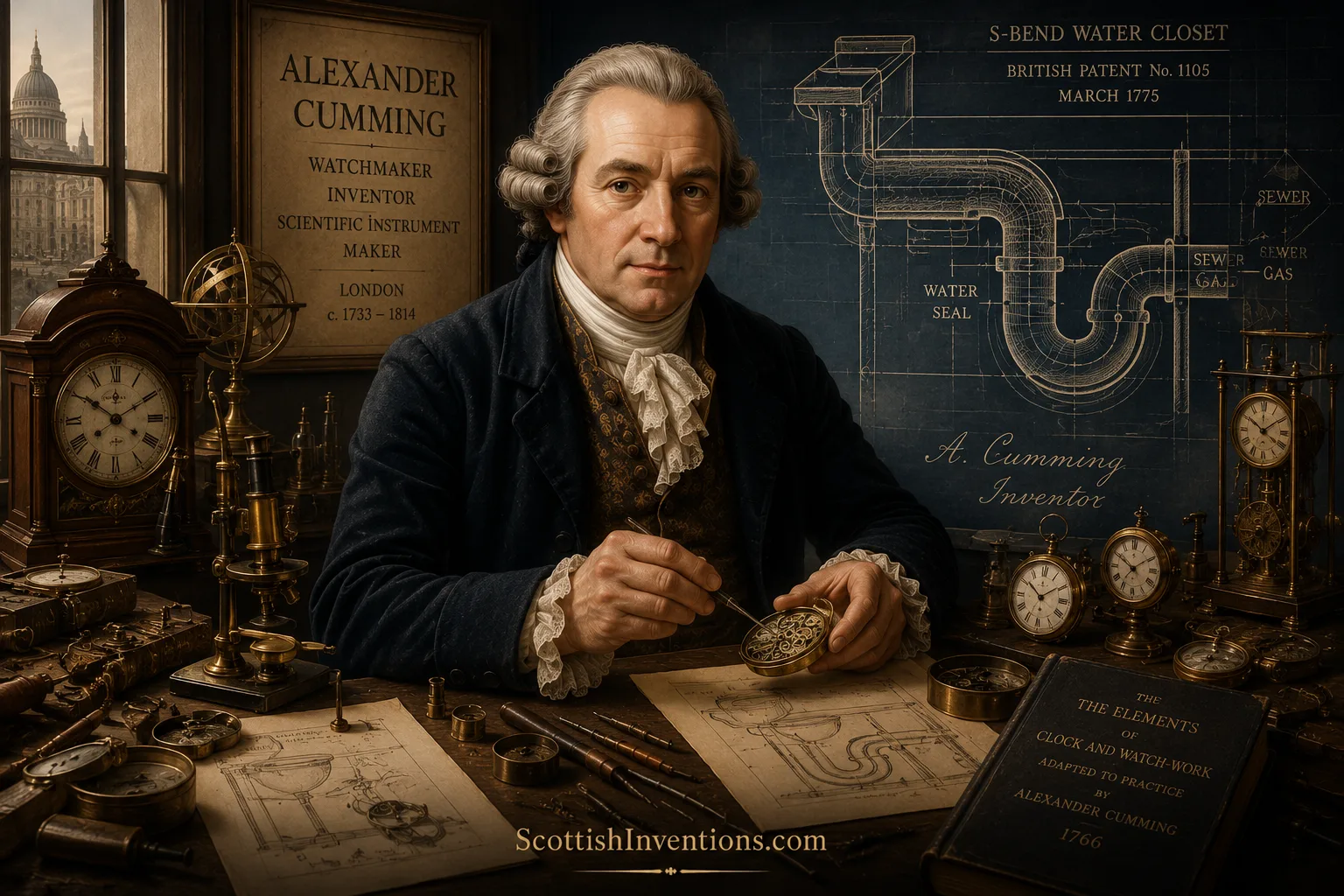
TL;DR
- Alexander Cumming (Edinburgh, c. 1733 – London, 1814) was a Scottish watchmaker who won the first British patent for a flushing water closet — British Patent No. 1105, 2 March 1775.
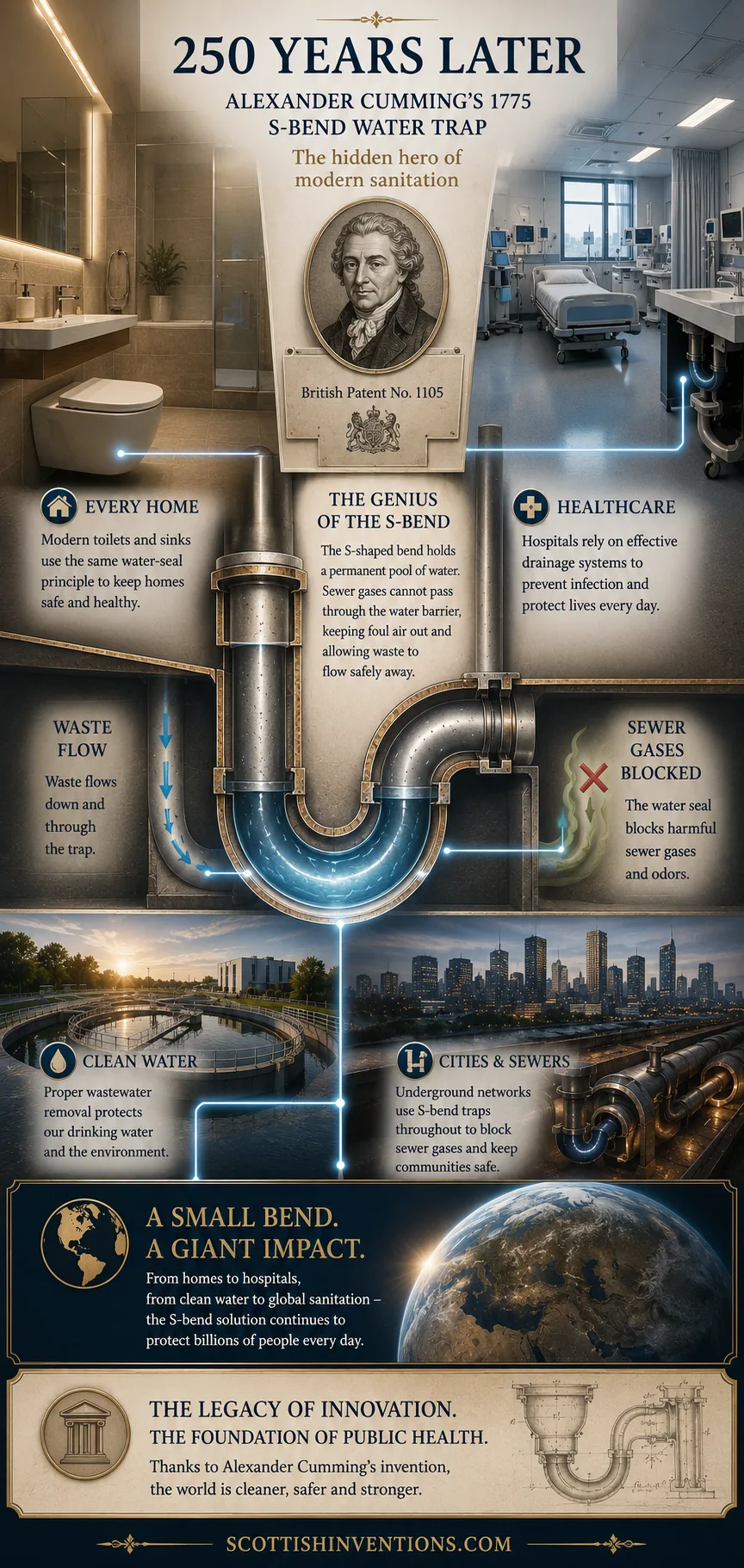
- His decisive innovation was the S-shaped water trap — a permanent pool of water that seals out toxic sewer gases and makes the indoor toilet safe.
- That single bend of pipe is now inside virtually every toilet, sink and drain on Earth and has been in continuous use for 250 years.
- Cumming is largely forgotten — his fame stolen by the popular myth that Victorian plumber Thomas Crapper "invented the toilet". He did not, and was not even born until 61 years after Cumming's patent.
Key Facts
Born Edinburgh c. 1733
Trained as a watchmaker in Edinburgh before rising to international eminence in London.
Patent No. 1105 (1775)
The first British patent for a flushing water closet — the founding document of modern plumbing.
The water seal
An S-shaped bend traps a permanent plug of water that blocks toxic sewer gases.
Instrument-maker to the King
Built precision clocks, organs and scientific instruments for George III.
In every building on Earth
P-traps and U-bends under every sink, bath and drain use Cumming's principle.
Not Thomas Crapper
Crapper wasn't born until 1836 — 61 years after Cumming's S-bend patent.
The State of Sanitation Before Cumming
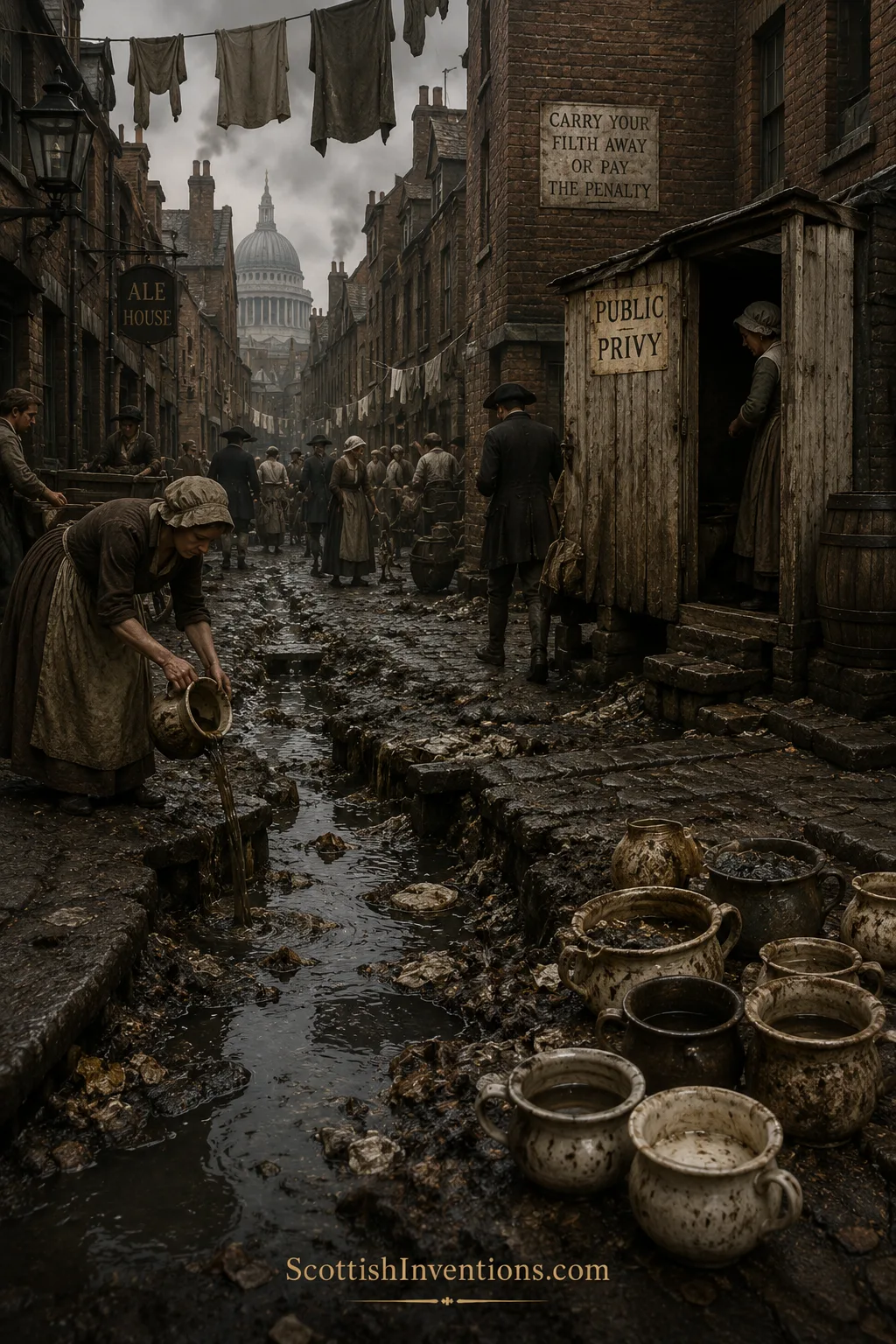
In the eighteenth century the great cities of Britain were drowning in their own waste. London and Edinburgh's streets were cut by open kennels and runnels; chamber pots were emptied into the gutter (in Edinburgh tenements with the legendary warning cry of gardyloo); public privies discharged into cesspits beneath the floorboards. The air of poorer districts was a constant fug of human filth and what eighteenth-century writers called "mephitic vapours" — what we would now call hydrogen sulphide, methane and ammonia.
The idea of an indoor flushing toilet was almost two centuries old by then. In 1596 Sir John Harington had built one for his godmother Queen Elizabeth I at her palace in Richmond. But Harington's "Ajax" — and every flushing toilet built for the next 180 years — shared one fatal flaw: there was nothing between the bowl and the cesspit below. Open a flap, flush, and the house was instantly connected by a column of foul air to the sewer. Toilets in upper-floor rooms were notorious for filling bedrooms with stench, and were widely (and not always wrongly) blamed for outbreaks of disease. It was an Enlightenment problem waiting for an Enlightenment mind.
British Patent No. 1105 — The Quiet Revolution of 1775
Alexander Cumming had the temperament for the job. Born in Edinburgh around 1733, he was trained as a watchmaker in the most exacting craft tradition of the Scottish Enlightenment. By the 1770s he was working from a Bond Street workshop in London, supplying scientific instruments to the Royal Society and clocks and organs of remarkable refinement to King George III. He authored The Elements of Clock and Watch-Work, Adapted to Practice (1766), invented a recording barograph for the King and was elected one of the founding Fellows of the Royal Society of Edinburgh.
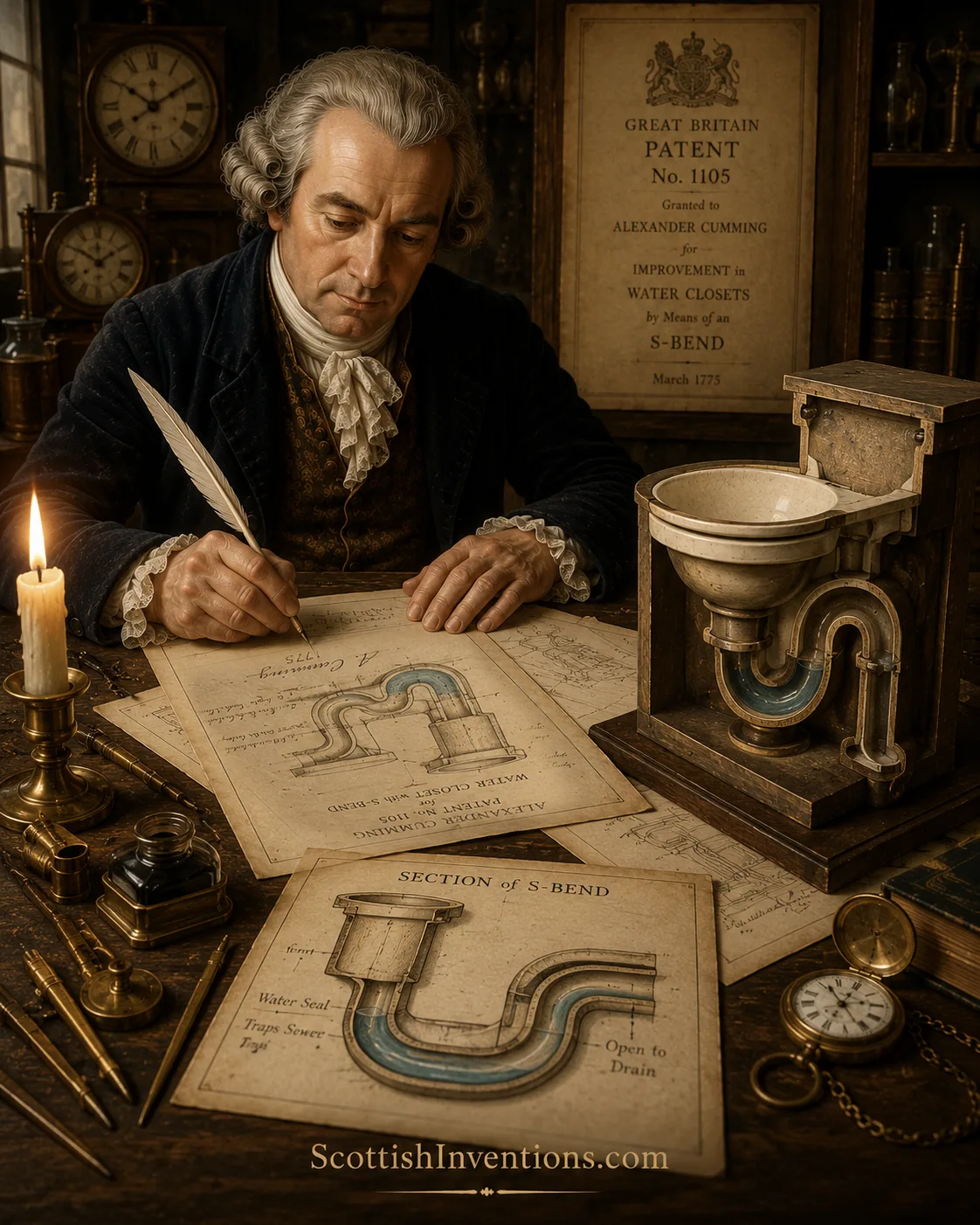
On 2 March 1775 he was granted British Patent No. 1105, titled "An Improvement in Water Closets". The patent specified two innovations: a sliding valve below the bowl that opened to discharge waste, and — far more importantly — a length of soil pipe formed into the shape of the letter S. The bend trapped a small permanent reservoir of water in its low point. Waste fell through it readily; gases from the sewer could not pass back up.
It was the missing piece. With a permanent water seal at every soil pipe, an indoor toilet was no longer a hole into the cesspit — it became a hygienic, self-resealing instrument. Joseph Bramah refined the valve in 1778 (Patent No. 1177) and sold thousands; Lemuel Prosser added further mechanical improvements in 1777. But every single one of these later closets — and every closet, sink and floor drain manufactured since — depends on Cumming's water seal.
How the S-Bend Works
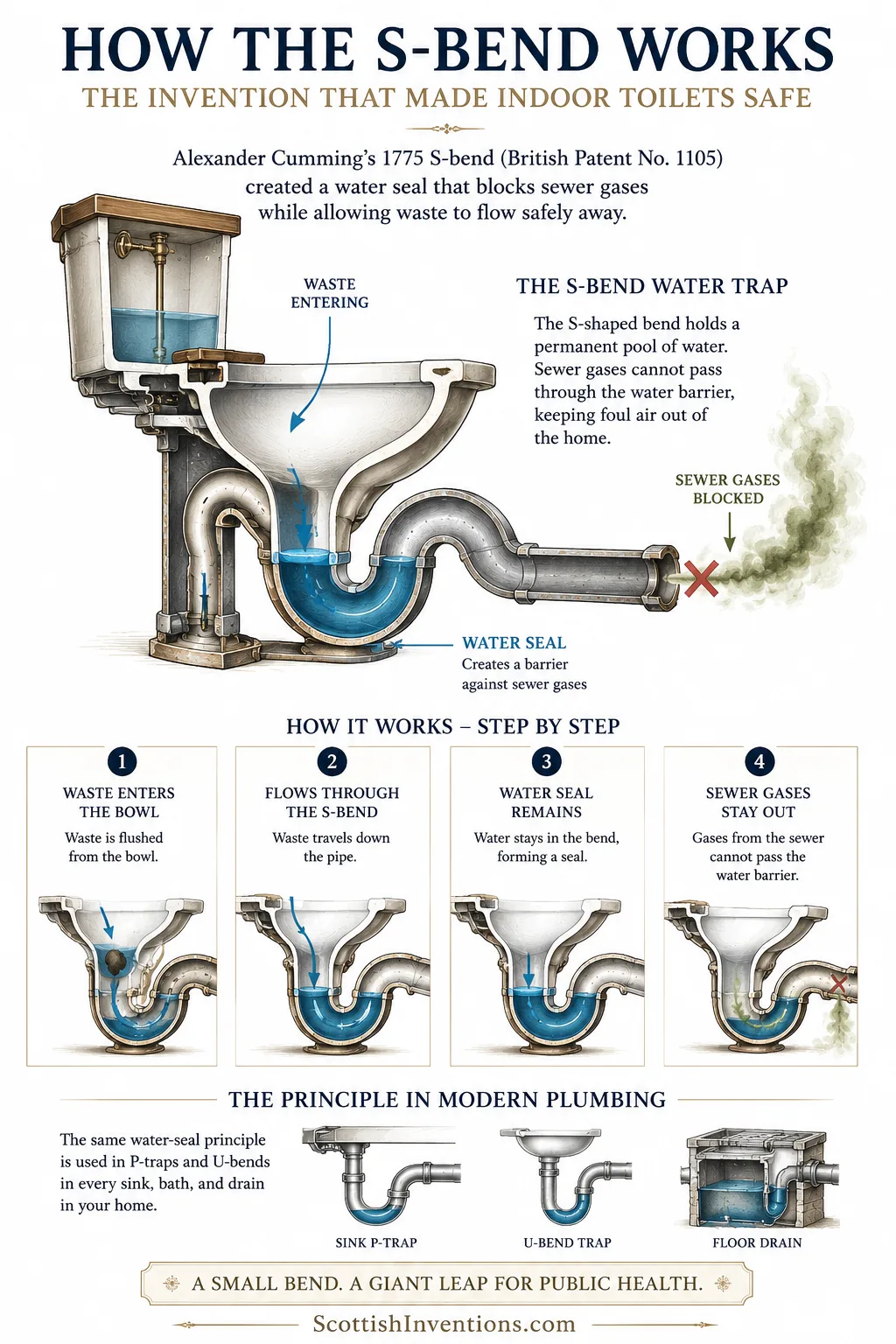
The principle is so elegant that engineers two and a half centuries later have not bettered it. Below the bowl, the soil pipe doubles back on itself in the shape of an S (or, in the slightly later P-trap, a sideways P). Gravity does the rest.
- What sewer gases are. The decomposition of organic waste in sewers produces a cocktail of hydrogen sulphide, methane, ammonia, carbon dioxide and traces of more exotic gases. They smell foul and several are seriously hazardous.
- Why they are dangerous. Hydrogen sulphide is toxic in low concentrations and lethal at high ones; methane is explosively flammable; long-term exposure to "mephitic" sewer air was linked, even before modern germ theory, to outbreaks of disease.
- How the S-bend traps water. The bottom of the S sits below the pipe's inlet and outlet. After every flush, water settles in that low point and stays there indefinitely — a liquid plug filling the full cross-section of the pipe.
- Why gases cannot pass through water. Sewer gases at atmospheric pressure cannot displace a continuous column of water. They are bottled up on the sewer side of the seal, where they belong.
- Why waste still flows freely. A flush adds enough water to push the contents of the bowl over the top of the bend and down the outlet; new water immediately refills the seal behind it.
- Why every sink and drain still uses the principle. Look under any kitchen sink and you will see a P-trap or U-bend. Floor drains, shower wastes, washbasins, urinals and bath wastes all rely on a small water seal — Cumming's idea, reproduced billions of times.
Myth vs Fact: Did Thomas Crapper Invent the Toilet?
❌ Myth
Thomas Crapper invented the toilet.
The much-repeated story that a Victorian plumber called Thomas Crapper invented the flushing toilet — and gave us the word "crap" in the process.
✅ Fact
Alexander Cumming invented the S-bend.
The flushing toilet existed in 1596 (Sir John Harington); the breakthrough that made it safe indoors was Alexander Cumming's 1775 S-bend water trap. Crapper (1836–1910) was a real, successful plumber who improved and popularised toilets — but he was not even born until 61 years after Cumming's patent, and the word "crap" is older still.
Timeline
- ●
1596
Harington's flushing toilet
Sir John Harington builds the first known flushing water closet at Kelston for his godmother Queen Elizabeth I — but with no water seal, it fills houses with sewer gas.
- ●
c. 1733
Alexander Cumming born
Born in Edinburgh, Cumming trains as a watchmaker before relocating to London's Bond Street.
- ●
2 March 1775
British Patent No. 1105
Cumming is granted the first British patent for a flushing water closet, built around the S-bend water trap.
- ●
1777
Prosser's improvements
Lemuel Prosser patents further water-closet refinements building on Cumming's design.
- ●
1778
Bramah's ball-and-hinge
Joseph Bramah patents an improved valve closet (Patent No. 1177); his firm sells thousands across the British Empire.
- ●
1854
Snow links cholera to water
John Snow's Broad Street pump investigation establishes that cholera spreads through contaminated water, making safe sanitation a public-health imperative.
- ●
1858
The Great Stink
A summer of unbearable sewer stench paralyses Parliament in London, accelerating Bazalgette's London sewer system — every connection of which depends on the S-bend principle.
- ●
Late 1800s
Crapper popularises toilets
London plumber Thomas Crapper does not invent the toilet but successfully markets improved versions through his Chelsea showroom.
- ●
1814
Cumming dies in London
Cumming dies in March 1814, a founding Fellow of the Royal Society of Edinburgh and one of the most under-celebrated Scottish inventors of his era.
- ●
Today
3.4bn still without safe sanitation
Cumming's bend protects billions of people daily, yet (UN, 2024) some 3.4 billion still lack safely managed sanitation — the work he began is not done.
Did You Know?
- Alexander Cumming was instrument-maker to King George III and built one of Europe's first recording barographs.
- His 1766 book The Elements of Clock and Watch-Work, Adapted to Practice remained an important horological reference well into the nineteenth century.
- The word "crap" predates Thomas Crapper by several centuries — it derives from the Middle English crappe, meaning chaff or refuse.
- The global sanitary ware market was worth USD 34.3 billion in 2024 (Global Market Insights), with the toilet/water-closet segment alone generating USD 15.8 billion — all of it built on Cumming's water seal.
- The UN reports that, even in 2024, 3.4 billion people still lack safely managed sanitation — a reminder that what Cumming began is far from finished.
Legacy — A Small Bend, A Giant Leap for Public Health
The Victorian sanitation revolution — Bazalgette's London sewers (built after the 1858 Great Stink), John Snow's 1854 demonstration that cholera spread through contaminated water, the rapid expansion of municipal water and waste networks across the British Empire and beyond — could not have happened without a reliable indoor water seal. Every household connection to a public sewer depends on it. Hospitals, schools, prisons, ships, aircraft, the International Space Station: all use traps that descend directly from Patent No. 1105.
Cumming sits alongside other Scottish public-health and engineering greats whose work is so embedded in modern life that we barely notice it: James Watt, who powered the Industrial Revolution; Sir James Young Simpson, whose chloroform anaesthesia ended the agony of surgery; Alexander Wood, inventor of the hypodermic syringe; Sir James Dewar, whose vacuum flask made modern cryogenics and the daily flask of tea possible; James Nasmyth and the steam hammer; and Charles Macintosh, whose waterproof Mackintosh raincoat kept the Empire dry.
Their legacies are still being told. Coming soon to Scottish Inventions: the Scottish Discoveries Collection and the Scottish Institutions Collection, alongside future features such as the Great Stink of 1858 and the rise of municipal sanitation in Victorian Britain.
Frequently Asked Questions
- Who invented the S-bend?
- The S-bend was invented by Scottish watchmaker Alexander Cumming, who was granted British Patent No. 1105 on 2 March 1775 for an 'improvement in water closets' built around an S-shaped trap that holds a permanent pool of water.
- Did Alexander Cumming invent the toilet?
- No. The first flushing water closet was built by Sir John Harington in 1596. What Cumming invented in 1775 was the S-bend water trap — the missing piece that finally made indoor flushing toilets safe by sealing out poisonous sewer gases.
- What did Thomas Crapper actually invent?
- Thomas Crapper (1836–1910) was a Victorian plumber, not the inventor of the toilet. He did not patent the flush toilet, was not even born until 61 years after Cumming's 1775 S-bend patent, and his real contribution was popularising plumbing fittings — including improvements to the ballcock and floating valve — through his successful London showroom.
- What is an S-bend?
- An S-bend is a length of pipe shaped like the letter S that sits beneath a toilet, sink or drain. The bend permanently traps a plug of water that seals the pipe — waste can pass through, but gases from the sewer cannot pass back up into the building.
- Why is there water inside toilet pipes?
- The water you see in the bottom of a toilet bowl is the visible top of the S-bend's water seal. Without it, sewer gases would rise straight into your bathroom. The seal is automatically refilled at the end of every flush.
- How does an S-bend stop sewer gases?
- Sewer gases — including hydrogen sulphide, methane and ammonia — are lighter than water and cannot push through a continuous water plug. The S-bend keeps a permanent slug of water in the low point of the pipe, forming a hermetic barrier between the sewer and the room.
- What is the difference between an S-trap and a P-trap?
- Both work on Cumming's water-seal principle. An S-trap (the original 1775 design) exits downward through the floor; a P-trap (developed slightly later and now standard under most sinks) exits horizontally through the wall. Modern building codes generally prefer P-traps because they are less likely to siphon dry.
- Why is the S-bend important?
- Before 1775, indoor flushing toilets were unsafe — they filled buildings with toxic, flammable sewer gas and were widely blamed for outbreaks of disease. The S-bend made indoor sanitation practical, paving the way for the Victorian sewer revolution and the modern global plumbing system that protects billions of people today.
- What is British Patent No. 1105?
- British Patent No. 1105, granted to Alexander Cumming on 2 March 1775, is titled 'An Improvement in Water Closets'. It is the first British patent for a flushing water closet and the founding document of modern indoor plumbing — it introduced both the S-shaped water trap and a sliding valve under the bowl.
- Why is Alexander Cumming important?
- Cumming was an Enlightenment polymath: instrument-maker to King George III, author of an important 1766 horology treatise, inventor of a recording barograph, and a founding Fellow of the Royal Society of Edinburgh. But his single most consequential invention — the S-bend — is in continuous use 250 years later in every bathroom in the world.
Sources
- British Patent No. 1105, "An Improvement in Water Closets", granted to Alexander Cumming, 2 March 1775.
- Alexander Cumming, The Elements of Clock and Watch-Work, Adapted to Practice (London, 1766).
- British Patent No. 1177, granted to Joseph Bramah, 1778.
- Royal Society of Edinburgh — founding Fellows records (1783).
- S. Halliday, The Great Stink of London: Sir Joseph Bazalgette and the Cleansing of the Victorian Metropolis (Sutton, 1999).
- UN-Water / WHO & UNICEF Joint Monitoring Programme, Progress on Household Drinking Water, Sanitation and Hygiene (2024).
- Global Market Insights, Sanitary Ware Market Report (2024).
- Encyclopædia Britannica — entries on water closet, Alexander Cumming and Thomas Crapper.
Newsletter
Discover Scotland's hidden inventors
One short, beautifully illustrated story a fortnight. No spam, ever.
Sign up free