Scottish Inventions · Engineering
Alexander Shanks: The Scottish Engineer Who Perfected the Lawnmower
He did not invent the lawnmower. He did something arguably more important — he turned it into a serious piece of engineering, and by doing so reshaped every great garden, golf course and cricket pitch in Britain.
On this page
- Introduction
- Key Facts
- Who Was Alexander Shanks?
- Edwin Budding's Original Lawnmower
- The Engineering Breakthrough of 1842
- How the Horse-Drawn Mowing Machine Worked
- Transforming Britain's Great Estates
- From Royal Gardens to Championship Sport
- Timeline
- The Legacy of the Cylinder Lawnmower
- FAQ
- Related Scottish Engineering
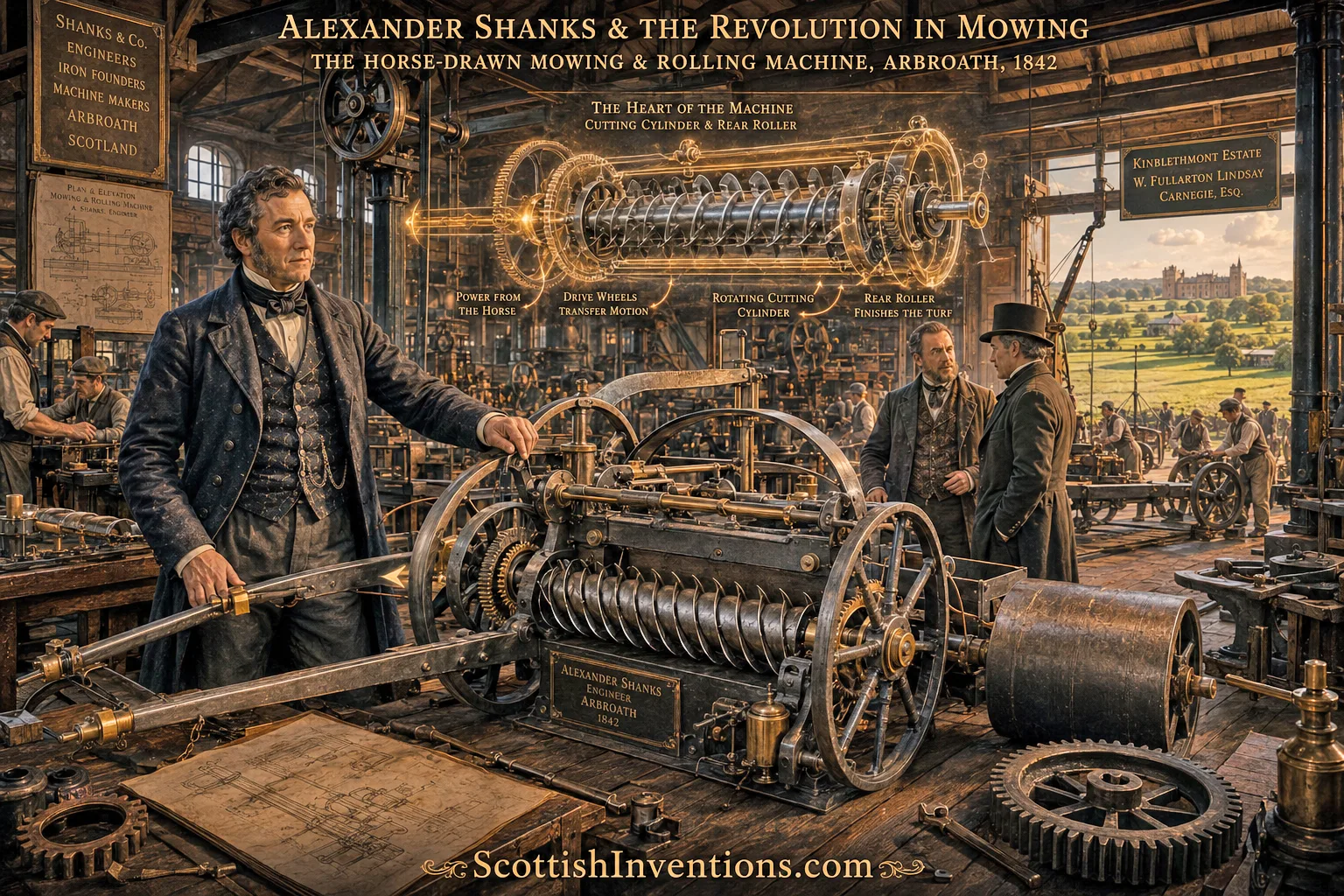
Alexander Shanks did not invent the lawnmower. That distinction belongs to Edwin Beard Budding of Stroud, who in 1830 patented the first hand-pushed cylinder mower. What Shanks did, in his Arbroath workshop in 1842, was arguably even more consequential: he engineered the first practical horse-drawn mowing and rolling machine — a piece of Scottish engineering that scaled the lawnmower up from a domestic novelty into a serious industrial tool capable of maintaining the great estates, royal gardens and championship sporting turf of Britain.
From Balmoral to Wimbledon, from Buckingham Palace to the Old Course at St Andrews, the perfectly striped lawns the modern eye now takes for granted exist because, in a single 1842 design, an Angus engineer combined a wide helical-blade cutting cylinder, an integrated cast-iron roller and steady horse power — and patented the result. This is the story of how he did it, why it mattered, and how the cylinder-and-roller principle he established still defines precision turf care almost two centuries later.
Key Facts
Born Forfarshire, 1801
Alexander Shanks was born on 3 September 1801 at Milnetown of Bridgetown, Forfarshire (Angus), into a Scottish wright's family.
Arbroath engineer
From around 1825 Shanks ran a spinning and machine-making business in Arbroath; in 1840 he founded Alexander Shanks & Son.
Patented 1842
Shanks registered (patented) his improved horse-drawn mowing-and-rolling machine in Scotland in 1842.
Up to 42 inches wide
The famous “five-drummer” production model — exhibited at the Great Exhibition of 1851 — had a 42-inch cutting cylinder.
Royal customers
Trialled at Balmoral; Queen Victoria was an early customer. Used at Windsor, Buckingham Palace, Osborne and Kew.
Championship turf
Later supplied to Wimbledon, Lord's Cricket Ground and the Old Course at St Andrews.
Who Was Alexander Shanks?
Alexander Shanks was born on 3 September 1801 at Milnetown of Bridgetown, in what was then Forfarshire (modern Angus), the son of a wright. By the mid 1820s he had established a spinning and machine-making business in Arbroath, the east-coast Scottish town where his name would become synonymous with quality engineering for the next 140 years. In 1834 he patented a fibre-dressing process; in 1840 he formally founded Alexander Shanks & Son.
The firm was a typical Scottish industrial polymath — building steam engines, iron bridges, cranes, oil engines and eventually the lawnmowers that would make it famous. After Shanks's death in July 1845, his son James Shanks (1831–1909) inherited and grew the business, later patenting a series of further mower improvements in his own name (UK Patent No. 1147 of 1855; No. 1700 of 1859). A common error in popular histories — including the widely copied Hall & Duck Trust account — credits the 1842 invention to James. He was eleven years old at the time. The original engineering, and the 1842 Scottish patent, belong to his father.
Edwin Budding's Original Lawnmower
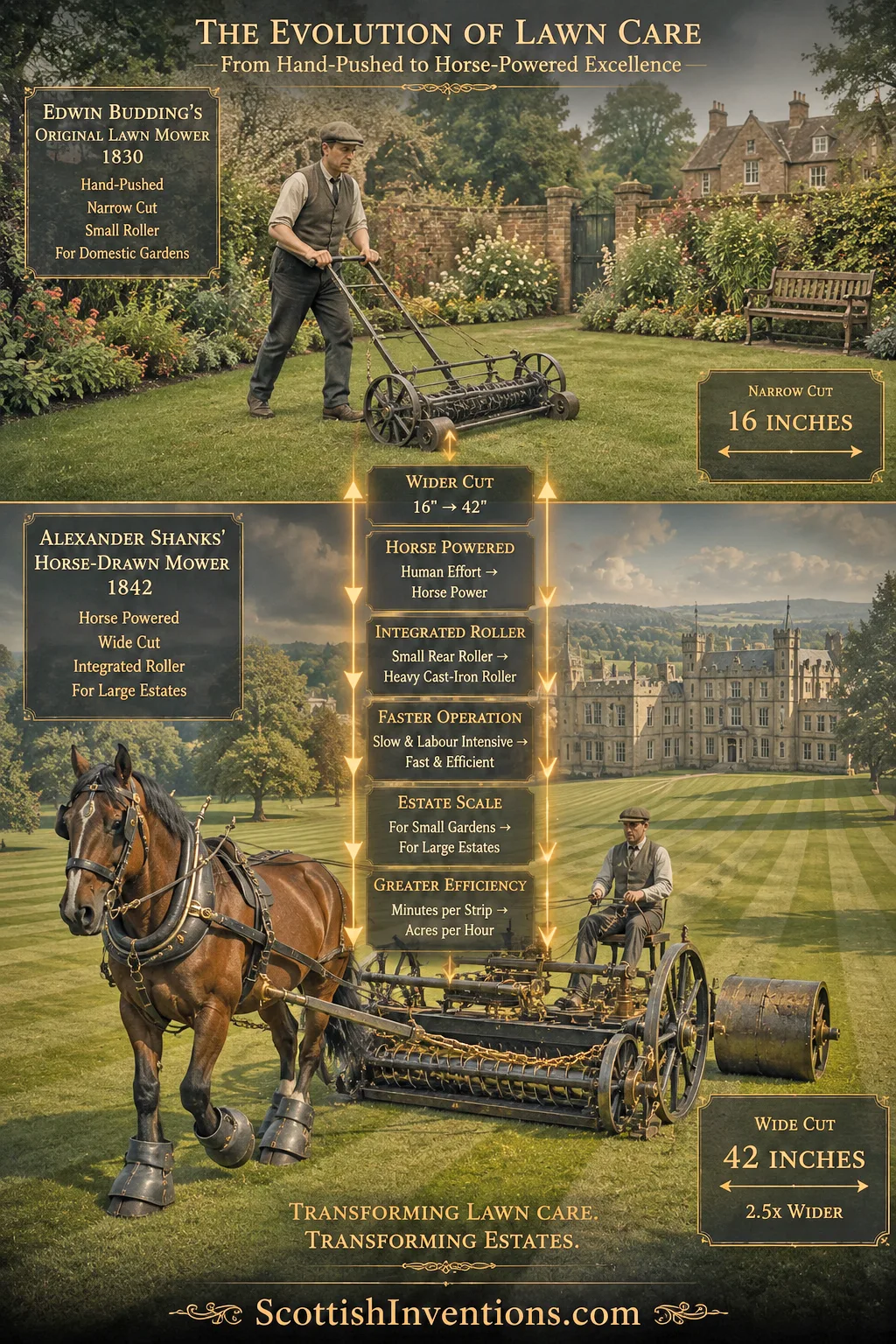
To understand what Shanks achieved, you have to understand what he started from. In 1830, the Gloucestershire engineer Edwin Beard Budding — working with John Ferrabee at the Phoenix Iron Works near Stroud — patented the first mechanical lawnmower (British Patent No. 5990, 31 August 1830). The patent described "a new combination and application of machinery for the purpose of cropping or shearing the vegetable surface of lawns, grass-plats and pleasure grounds."
Budding's machine was small: 19 inches (480 mm) wide, pushed by hand from behind, with a rear land roller driving a helical cutting cylinder through cast-iron gears at a 16:1 ratio. It threw the clippings forward into a tray. For a villa lawn or town garden it was a marvel. For a country estate — where lawns ran to acres and the alternative was a team of men with scythes followed by a separate hand roller — it was simply too small and too slow.
The Engineering Breakthrough of 1842
The decisive commission came from William Fullarton Lindsay Carnegie of the Kinblethmont Estate, a few miles from Arbroath. Carnegie owned a Budding mower, but his 2½-acre lawn defeated it. He asked Shanks "to construct a similar machine with a 27-inch blade" — and Shanks delivered. The result, according to Parks & Gardens UK and the records held at RHS Harlow Carr, allowed Carnegie's gardener to cut the entire lawn once a week in eight hours.
Two engineering decisions made it work. First, the wider blade made the machine too heavy to push, so Shanks adapted it to be drawn by a pony or horse, with a driver walking behind. To stop the animal marking the lawn it was fitted with leather overshoes. Second — and this is the move historians still single out as Shanks's distinctive contribution — he placed a heavy roller behind the cutting cylinder so the machine mowed and rolled the turf in a single operation. That one design choice is the direct origin of the modern roller mower.
Shanks registered the design as a Scottish patent in 1842. (Until the Patent Law Amendment Act of 1852, England & Wales, Scotland and Ireland each had separate patent systems — which is why Shanks could lawfully build on Budding's principle north of the Border. Ferrabee even travelled to Scotland in 1841 to check the Shanks machine for infringement.) The original Scottish patent number has not survived: pre-1852 Scottish patent records were largely destroyed by fire in 1922. But the 1842 date itself is firm — confirmed independently by the Oxford Dictionary of National Biography, Grace's Guide and the Gazetteer for Scotland — and the design was praised, after a successful trial in July 1842, in the Mechanic's Magazine.
| Budding, 1830 | Shanks, 1842 | |
|---|---|---|
| Power | Hand-pushed | Pony / horse drawn |
| Cutting width | 19 in | 27 in → 42 in |
| Roller | Small rear land roller (drive only) | Heavy cast-iron finishing roller |
| Designed for | Villa & town gardens | Estates, royal gardens, sporting turf |
| Patent | British Patent No. 5990, 1830 | Scottish patent, 1842 (number lost in 1922) |
How the Horse-Drawn Mowing Machine Worked
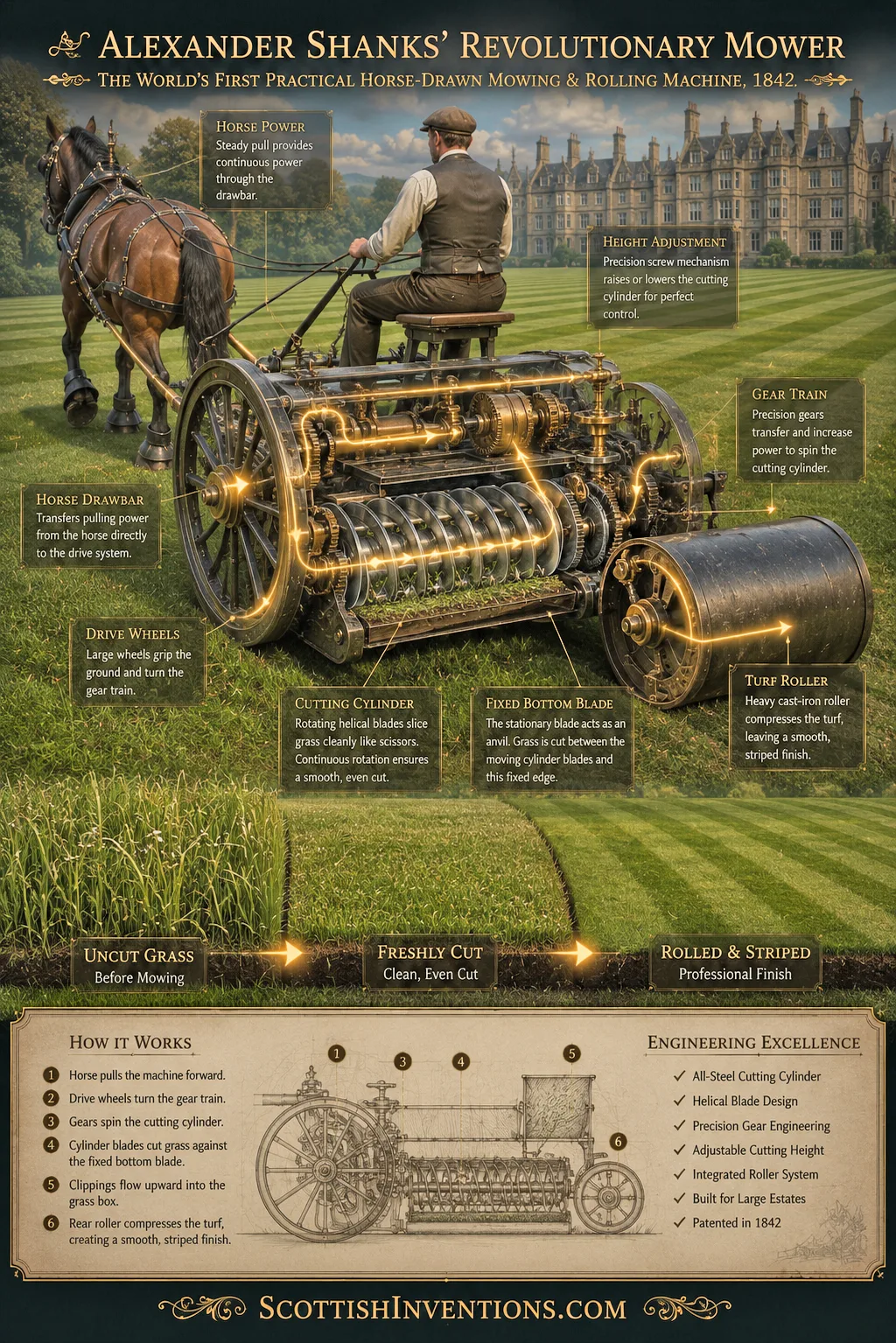
The Shanks mower was, in mechanical terms, a beautifully simple machine. A horse, harnessed to a drawbar at the front, supplied the steady pulling power. As the machine moved forward, large iron-rimmed drive wheels on either side rotated, turning a precision gear train that spun the central cutting cylinder at high speed.
That cylinder carried five helical steel blades. As they rotated they sliced grass cleanly against a stationary fixed bottom blade — exactly the scissor-action principle Watt-era mechanical engineers favoured for clean, even cuts. A screw mechanism allowed the operator to adjust cutting height precisely. Behind the cylinder, a heavy cast-iron roller compressed the freshly cut turf, leaving the smooth, striped finish that every great Victorian lawn was suddenly expected to display.
Transforming Britain's Great Estates
The economics were transformative. A 42-inch Shanks mower sold to Clumber Park in 1846, drawn by a single horse with a boy at its head and a man at the machine, reportedly delivered a 70% labour saving over hand mowing. A contemporary account preserved by the Hall & Duck Trust records: "The machine has been in constant use in the gardens at Clumber for upwards of three months… the saving in labour has amounted to seventy per cent."
Word travelled fast among Britain's gardeners and head gamekeepers. By the 1850s Shanks's "Patent Mowing and Rolling Machine" had become the standard for any estate that took its turf seriously. An advertisement in the Gardeners' Chronicle of 19 May 1855, styling the firm "Alexander Shanks and Son, Arbroath, Forfarshire, Inventors and Sole Manufacturers," reported the machine "is in operation in the Royal Gardens at Windsor Palace, Buckingham Palace, and at Osborne, in the Botanical Gardens at Kew, Regent's Park," in cutting widths of 42, 30, 20 and 15 inches. Later advertisements added Hampton Court — and a single machine purchased by the Emperor of the French, Napoleon III.
From Royal Gardens to Championship Sport
Shanks's "Patent Mowing and Rolling Machine" was trialled at Balmoral, and Queen Victoria was among the firm's earliest customers — perhaps the strongest possible endorsement in mid-Victorian Britain. The firm exhibited a 42-inch "five-drummer" mower at the Great Exhibition of 1851, and in 1859 won a commended award from the Royal Highland and Agricultural Society of Scotland.
Over the following century, as cricket, tennis and championship golf rose to global popularity, Shanks mowers cut the world's most famous sporting lawns: Wimbledon, Lord's Cricket Ground, and the Old Course at St Andrews. The connection is more than romantic. Modern championship turf depends on exactly the qualities Shanks's machine first delivered at scale — a wide, even cylinder cut combined with the levelling effect of a heavy roller, in a single pass.

Timeline
1801
Alexander Shanks born
Born 3 September 1801 at Milnetown of Bridgetown, Forfarshire, son of Alexander Shanks (a wright) and Elizabeth Ferguson.
c.1825
Sets up in Arbroath
Establishes a spinning and machine-making firm in Arbroath, Angus — laying the foundations of one of Scotland's most enduring engineering names.
1830
Budding patents the lawnmower
In Stroud, Edwin Beard Budding patents the first cylinder mower — a 19-inch hand-pushed machine (British Patent No. 5990, 31 August 1830).
1840
Founds Alexander Shanks & Son
Shanks formally founds the engineering firm that will carry his name into the twentieth century, building steam engines, cranes, iron bridges and mowers.
1841
The Kinblethmont commission
W. Fullarton Lindsay Carnegie of Kinblethmont, near Arbroath, finds his Budding mower cannot cope with 2½ acres of lawn — and asks Shanks to build something larger.
1842
Patented in Scotland
Shanks completes a 27-inch horse- or pony-drawn cylinder mower with an integrated rear roller, patents the design in Scotland, and is praised by the Mechanic's Magazine following a successful July trial.
1846
Clumber Park machine
A 42-inch Shanks mower sold to Clumber Park reportedly saves 70% of the labour of hand mowing — convincing every great British estate.
1851
The Great Exhibition
Shanks's 42-inch “five-drummer” is shown at the Crystal Palace — alongside other Scottish marvels of Victorian engineering.
1855
Royal gardens
Adverts in the Gardeners' Chronicle list the Royal Gardens at Windsor, Buckingham Palace, Osborne, Kew and Regent's Park among Shanks customers.
1859
Royal Highland & Agricultural Society
Alexander Shanks & Son is commended at the RHASS show for its mowing-and-rolling machines.
1853→
Dens Iron Works, Arbroath
The firm moves to the Dens Iron Works in Arbroath, which would remain a major employer in the town for more than a century.
1968
End of the Shanks name
The firm is absorbed by Giddings & Lewis-Fraser — but the cylinder-and-roller principle Shanks pioneered remains the gold standard for championship turf.
The Legacy of the Cylinder Lawnmower
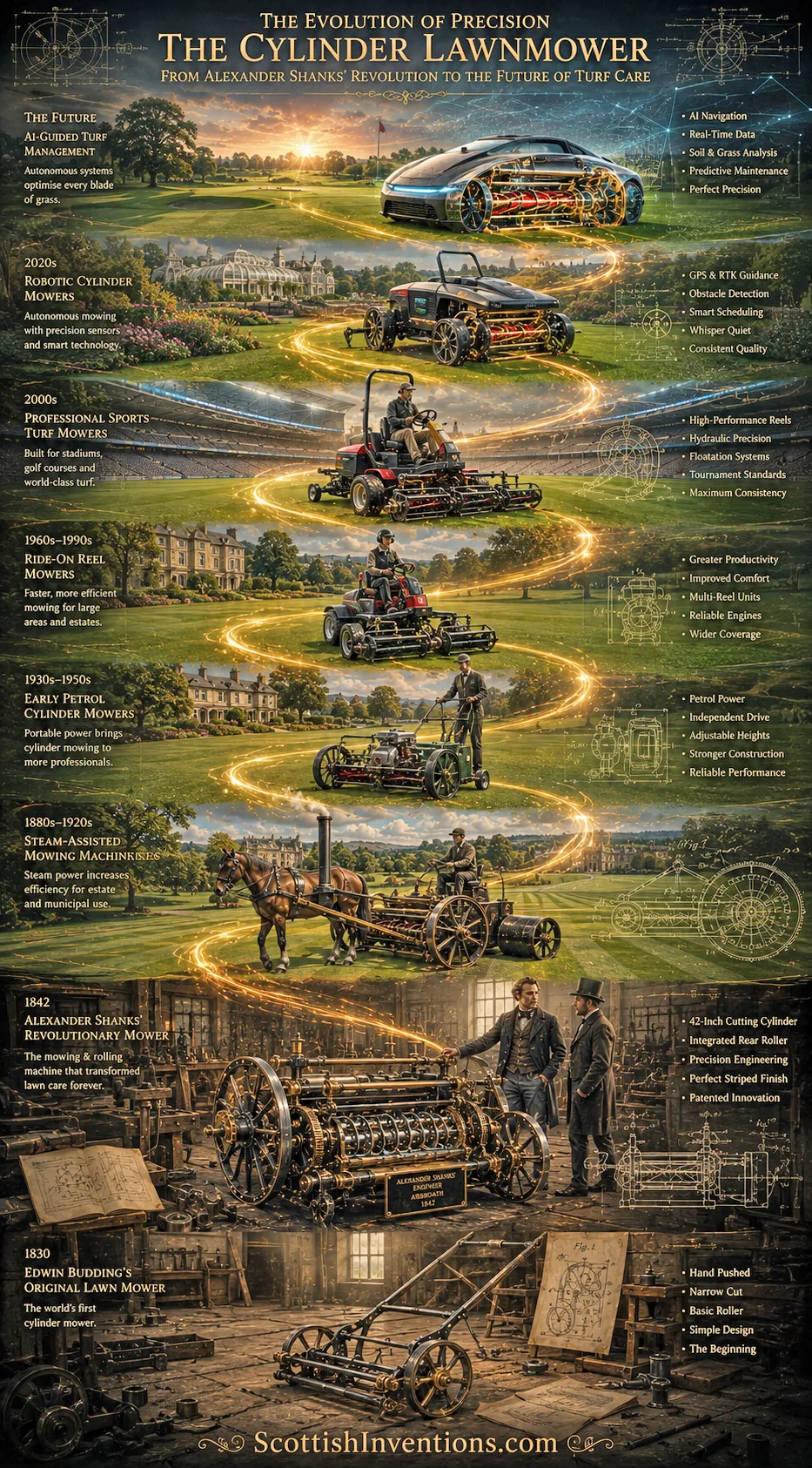
The Shanks lineage runs straight from 1842 to the present. Steam-assisted mowing machines appeared in the 1880s. Early petrol cylinder mowers arrived in the 1930s. Ride-on reel mowers swept estate and sports-turf maintenance from the 1960s. High-performance professional sports turf mowers — the machines that cut the modern Wimbledon Centre Court and the fairways of every Open Championship venue — appeared in the 2000s. The latest generation are GPS-guided, sensor-equipped robotic cylinder mowers, joining a coming generation of AI-managed autonomous turf systems.
Every one of them uses the same cylinder-and-roller architecture Shanks established in 1842. The materials, the power source and the navigation systems have all changed; the mechanical principle has not. Like James Watt's centrifugal governor, James Nasmyth's steam hammer, the Charlotte Dundas and the vacuum flask, Shanks's mower is one of those Scottish designs whose engineering bones have outlasted everything built around them.
Frequently Asked Questions
Who invented the lawnmower?
The lawnmower was invented by Edwin Beard Budding of Stroud, Gloucestershire, who patented his hand-pushed cylinder (reel) mower as British Patent No. 5990 on 31 August 1830.
Did Alexander Shanks invent the lawnmower?
No. Alexander Shanks (1801–1845) did not invent the lawnmower — Budding did, in 1830. Shanks's contribution was to engineer the first practical horse- or pony-drawn mowing-and-rolling machine, patented in Scotland in 1842, which scaled the technology up for large estate lawns.
How did Alexander Shanks improve the lawnmower?
Shanks took Budding's compact hand-pushed mower and re-engineered it for large lawns. He widened the cutting cylinder (eventually to 42 inches), made it horse- or pony-drawn rather than man-pushed, and crucially added a heavy roller behind the cutting cylinder so the machine mowed and rolled the turf in a single pass — the direct ancestor of the modern roller mower.
Why was the Shanks mower important?
Before Shanks, maintaining acres of estate lawn meant teams of labourers with scythes followed by separate rolling. Shanks's 1842 machine made it possible to cut and finish a large lawn in a fraction of the time, with a perfect striped finish — and it set the engineering pattern for cylinder mowers used worldwide for the next 180 years.
Where were Shanks lawnmowers used?
Period advertisements and surviving records list the Royal Gardens at Windsor, Buckingham Palace, Osborne House, Balmoral Castle, Kew Gardens, Regent's Park, Hampton Court, Clumber Park and gardens of Napoleon III. Over the following century Shanks mowers were supplied to Wimbledon, Lord's Cricket Ground and the Old Course at St Andrews.
Why did Shanks add a rear roller?
The roller behind the cutting cylinder served two purposes: it compressed the freshly cut turf to leave a smooth, striped finish, and it added enough weight to anchor the machine for an even cut. Combining mowing and rolling in one operation halved labour and produced a quality of finish that defined estate, sporting and championship lawns ever after.
What is a cylinder lawnmower?
A cylinder (or reel) mower cuts grass with helical blades mounted around a rotating cylinder, which shears grass against a fixed bottom blade — the same scissor-like action used in the highest-precision golf, cricket and tennis mowers today. The cylinder principle dates from Budding's 1830 patent; Shanks's 1842 machine was the first to combine it with horse power and a roller at estate scale.
What is the difference between Budding's mower and Shanks' mower?
Budding's 1830 mower was a 19-inch hand-pushed machine with a small rear roller, designed for the lawns of villas and town gardens. Shanks's 1842 mower was a horse- or pony-drawn 27- to 42-inch wide machine with a heavy cast-iron roller, designed for the great estates, royal gardens and (later) championship sporting turf of Britain. Same scissor-cut principle, an entirely different scale and finish.
Conclusion
The lawnmower was not a Scottish invention. The practical lawnmower — wide, horse-drawn, roller-finished, fit for the great estates and championship sporting grounds of a nation — was. In 1842, in a workshop in Arbroath, Alexander Shanks turned a Gloucestershire curiosity into a piece of serious Scottish engineering, and in doing so set the pattern for nearly two centuries of precision turf care.
Scottish engineering didn't simply improve lawn care — it helped shape the landscapes of Britain. Explore hundreds more world-changing Scottish inventions on ScottishInventions.com.